Introduction
African yam bean, AYB (Sphenostylis stenocarpa Hochst ex A. Rich. Harms), is a less utilized and dual-purpose (leguminous and tuberous) crop. AYB is potentially a food and nutrition security crop due to its productive and nutritional value. Its seeds and tubers contain 25.6 and 15.9% protein, respectively (Ojuederie and Balogun, Reference Ojuederie and Balogun2017; Ojuederie and Balogun, Reference Ojuederie and Balogun2019). Similarly, Anya and Ozung (Reference Anya and Ozung2019) and Sam (Reference Sam2019) reported protein content of 18.55 and 21.61% in seeds. The seeds have in abundance: lysine (6.21–6.60%) and methionine (1.14–1.27%) (Okorie, Reference Okorie2018). According to Oagile et al. (Reference Oagile, Mmoltotsi, Segwagwe and Babili2012) and Baiyeri et al. (Reference Baiyeri, Uguru, Ogbonna, Samuel-Baiyeri, Okechukwu, Kumaga and Amoatey2018), AYB seeds are rich in fibre, vitamins, potassium and manganese and, contain a small amount of saturated fat. Tubers contain 166.7 mg/100 g magnesium and 1010.1 mg/100 g potassium (Ojuederie and Balogun, Reference Ojuederie and Balogun2017). AYB is commonly used in sub-Saharan Africa for various dietary preparations; it could be roasted or boiled or blended with vegetables (Klu et al., Reference Klu, Amoatey, Bansa and Kumaga2001; Ngwu et al., Reference Ngwu, Aburime and Ani2014). Some consumers add matured seeds to soups as a protein supplement (Klu et al., Reference Klu, Amoatey, Bansa and Kumaga2001). Fresh tubers are cooked and consumed as desired (Tindall, Reference Tindall1983; Sam, Reference Sam2019). AYB seed meal was seen to improve growth in starter broiler chickens (Raji et al., Reference Raji, Adeleye, Mosobalaje, Ogunjimi and Tewe2016). Furthermore, Ojuederie and Balogun (Reference Ojuederie and Balogun2019) and Onuoha et al. (Reference Onuoha, Harry, Fayenuwo and Duroteye2020) suggested adding tubers and seeds in animal feeds. Despite AYB's potentials, the crop is constrained by hard to cook grains (Ojuederie and Balogun, Reference Ojuederie and Balogun2017), requiring 4–6 cooking hours, the long-maturity cycle of 8–9 months, and the presence of anti-nutritional factors (tannin, oxalate and phytate) (Ajibola and Olapade, Reference Ajibola and Olapade2016; Adegboyega et al., Reference Adegboyega, Abberton, Abdelgadir, Dianda, Maziya-Dixon, Oyatomi, Ofodile and Babalola2020).
Characterizing AYB germplasm is essential in assessing and understanding the germplasm for improvement. Morphological studies could reveal existing diversity across materials, and such knowledge can potentially be linked to genotypic information. Although AYB's origin is attributed to Ethiopia, to the best of our knowledge, this study is the first to report the morphological characterization of AYB in Ethiopia. Additionally, no statistic is available on the crop's production in Ethiopia, although the crop might be grown among smallholder farmers; however, there is no documentation. Across West Africa, an appreciable yield of 1509.02–3000 kg/ha was reported (Dukes, Reference Dukes1981; Ikhajiagbe and Mensah, Reference Ikhajiagbe and Mensah2012). Previous studies also documented the uniqueness of about a hundred accessions evaluated in Nigeria, of which considerable diversity was observed (Akande, Reference Akande2009; Popoola et al., Reference Popoola, Adegbite and Obembe2011; Adewale et al., Reference Adewale, Dumet, Vroh-Bi, Kehinde, Ojo, Adegbite and Franco2012, Reference Adewale, Vroh-Bi, Dumet, Nnadi, Kehinde, Ojo, Adegbite and Franco2015; Ojuederie et al., Reference Ojuederie, Balogun, Akande, Korie and Omodele2015; Agbolade et al., Reference Agbolade, Popoola, Kioko, Adewale, Ajiboye, Ajewole, David and Komolake2018; Aina et al., Reference Aina, Ilori, Ekanem, Oyatomi, Potter and Abberton2020).
The current research will encourage more studies; bring to knowledge the crop's potential and the need for its exploitation in Ethiopia. Characterizing AYB germplasm could contribute to its increased production and marketability. Similar to other underutilized crops, AYB's survival has primarily been sustained through tradition and knowledge of local growers, in addition to conservation by genebanks, such as IITA genebank. Mainly, the germplasm of IITA was not characterized under Ethiopian conditions. This study was designed to assess the phenotypic diversity across IITA's AYB collections and identify potential accessions for production in Jimma, Ethiopia.
Materials and method
Plant materials
A total of 169 AYB accessions obtained from the Genetic Resources Center (GRC), International Institute of Tropical Agriculture (IITA), Ibadan, Nigeria, were used for the study. The materials were collected from diverse geographical regions across Africa and are part of IITA's significant collections; 69 of the accessions were previously characterized using cowpea simple-sequence repeat markers (Shitta et al., Reference Shitta, Abberton, Adesoye, Adewale and Oyatomi2015). The passport data of the studied materials are presented in online Supplementary Table S1.
Description of the study area
The experiment was conducted at Jimma Agricultural Research Center (JARC) in 2019. JARC is located in the Southwestern part of Ethiopia and receives an average annual precipitation of 2007.5 mm. The rainy season occurs around June to August, and the lowest rainfall is experienced in December. The experimental site's soil type is mainly nitisol, reddish-brown with a loamy clay texture and slightly acidic (Paulos and Teketay, Reference Paulos and Teketay2000).
Research design
The field experiment was laid out in a 13 × 13 lattice design with two replications. Each plot consisted of four ridges of 3.75 m length with an inter-row distance of 0.5 m and an intra-row distance of 0.75 m. Blocks were spaced by a 1 m alley and replicate separated by a 2 m alley. At planting, nitrogen phosphorus and sulphur fertilizer was applied at 121 kg/ha by drilling it in the row and made ready for planting. A month after planting, uniform sticks of about 3 m were provided as stakes to support each plant. Manual weeding was done to keep the experimental field weed-free.
Data collection and analysis
The IITA AYB descriptor of Adewale and Dumet (Reference Adewale and Dumet2010) was used as a guide for evaluating the 31 qualitative and quantitative traits (online Supplementary Table S4) recorded on randomly selected five plants for each accession. The qualitative characteristics were recorded based on visual observation. In contrast, the quantitative characters were either counted, measured with a metric ruler or digital Vernier caliper or weighed using weighing balance. The Methuen Book of colours Chart by Kornerup and Wanscher (Reference Kornerup and Wanscher1961) was used for colour identification and description. Average values obtained for all traits were subjected to statistical analysis. All analyses were carried out using the R statistical package (Version 3.6.2) (R-Development Core Team 2010). Analysis of variance (ANOVA) was computed using the PBIB.test function within the Agricola R package. Prcomp and ggbiplot were used to calculate principal component analysis (PCA) and generate a biplot of principal components (PCs) against the corresponding traits. For the cluster analysis, the daisy function was used to create a dissimilarity matrix using Gower (Reference Gower1971) distance method, while the hclust function was used to construct the cluster dendrogram.
Results
Distribution of qualitative traits
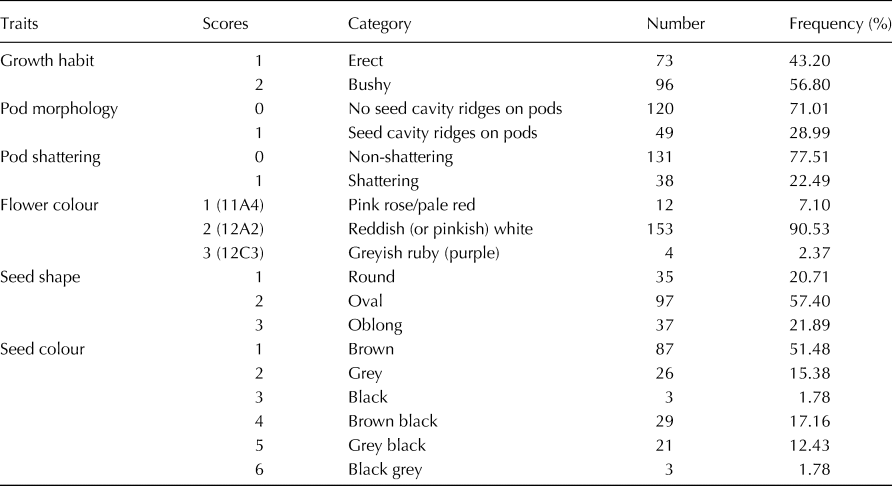
The descriptive statistics revealed high levels of variations in the studied qualitative traits (Table 1). About 57% of the accessions showed a bushy growth habit, while 43% exhibited an erect pattern. The proportions of pods that shattered upon plant maturity were 22%. Also, pod morphology of 71% of the materials had no seed cavity ridges, while 29% had seed cavity on pods. Seed colour was observed in five categories, i.e. brown, grey, black, brown-black, grey black and black grey. The brown colour was dominant and was recorded on 52% of the accessions, while black and black grey were the less dominant colours; both were observed on 2% of the accessions. Three flower colours were observed across the germplasm; reddish-white colour was the most common and was seen on 91% of the studied materials. Simultaneously, greyish ruby was regarded as a rare colour and found on only 2% of the accessions. The flower types (pink rose-pale red, greyish ruby (purple) and reddish or pinkish white) observed in this study are shown in online Supplementary Figs. S1, S2 and S3, respectively. AYB seeds had diverse seed shapes, i.e. oblong, round and oval. Oval-shaped seeds were reported on 57% of the accessions, while round types were found on about 21% of the germplasm (Table 1).
Frequency distribution of qualitative traits across accessions

Means analysis of quantitative traits
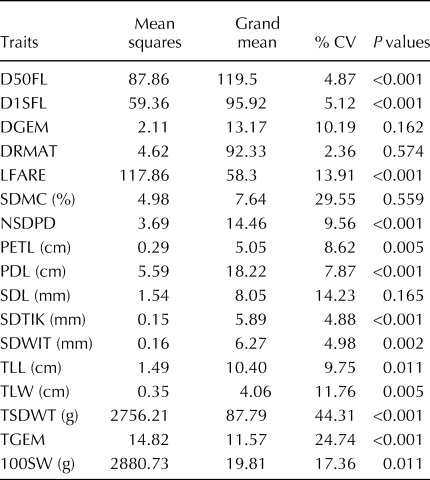
The result of the ANOVA for the studied quantitative traits is presented in Table 2. Highly significant (P < 0.01) differences were revealed for days to 50% flowering (D50FL), days to first flowering (D1STFL), leaf area (LFARE), number of seeds per pod (NSDPD), pod length (PDL), seed thickness (SDTIK), total seed weight (TSDWT) and petiole length (PETL) whereas terminal leaf length (TLL) showed significant differences (P < 0.05) for the studied accessions. The highest grand mean of 119 d was recorded for days to 50% flowering across the accessions, while the lowest mean was 4.06 for terminal leaf width. The most variable mean across the quantitative traits was obtained for 100 seed weight (100SW) with a mean square value of 2880.73, while the least variable mean was recorded for seed thickness (SDTIK) with a mean square value of 0.15.
Mean squares, grand mean, coefficient of variation (% CV) and P values of 17 quantitative traits in AYB evaluated at Jimma in 2019/20 cropping season

D50FL, days to 50% flowering; D1SFL, days to first flowering; DGEM, days to germination; DRMAT, dry matter; LFARE, leaf area; SDMC, moisture content; NSDPD, number of seed per pod, PETL, petiole length; PDL, pod length; SDL, seed length; SDTIK, seed thickness; SDWIT, seed width; TLL, terminal leaf length; TLW, terminal leaf width; TSDWT, total seed weight; TGEM, total germination; 100SW, 100 seed weight.
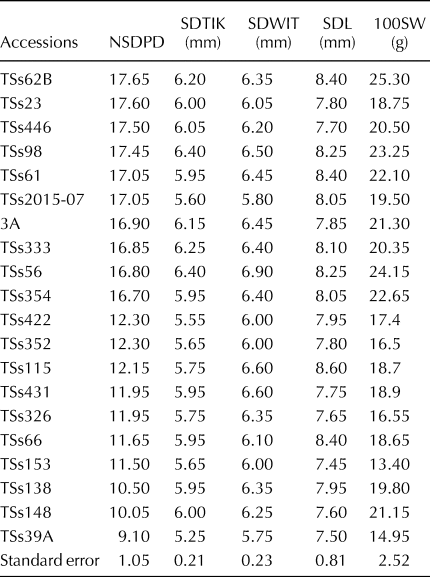
As shown in Table 3, the selected accessions based on the number of seeds per pod (NSDPD) showed considerable differences in the mean values across the presented traits. TSs62B produced the highest (17.65 ± 1.05) mean value for the number of seeds per pod (NSDPD), which was almost twice the mean value of the accession (TSs39A) that had the lowest (9.10 ± 1.05) mean for the same trait. Seed thickness (SDTIK) also varied across the accessions, and the highest mean (6.40 ± 0.21 mm) was observed in TSs98 and TSs56, whereas the lowest (5.25 ± 0.21 mm) mean was produced by TSs39A. TSs56 was identified as the accession with the highest seed width (SDWIT) extending up to 6.90 ± 0.23 mm, whereas the TSs39A was the narrowest accession with a mean width value of 5.75 ± 0.23 mm. Accession TSs115 had the longest (8.60 ± 0.81 mm) axis on its seeds, while the shortest (7.45 ± 0.81 mm) axis on the grains was recorded for TSs153. A sizeable mean variation ranging from 13.40 to 25.30 g was found for 100 seed weight (100SW). TSs62B was found to have the highest 100SW (25.3 ± 2.52 g), while TSs153 produced the lowest 100SW (13.40 ± 2.52 g). Accession 3A flowered early with a mean value of 84.50 d; other accessions that bloomed early were TSs10A and TSs33 with a mean value of 84.00 d. The mean performance of selected traits across all the studied germplasm is presented in online Supplementary Table S2.
Means and standard errors of seed related traits across 20 AYB accessions

The first 10 accessions are accessions with the highest means, whereas the bottom 10 are accessions with the lowest means. Accessions are presented with respect to NSDPD, number of seeds per pod; SDTIK, seed thickness; SDWIT, seed width; SDL seed length; 100SW 100 seed weight.
AYB diversity analysis based on qualitative traits
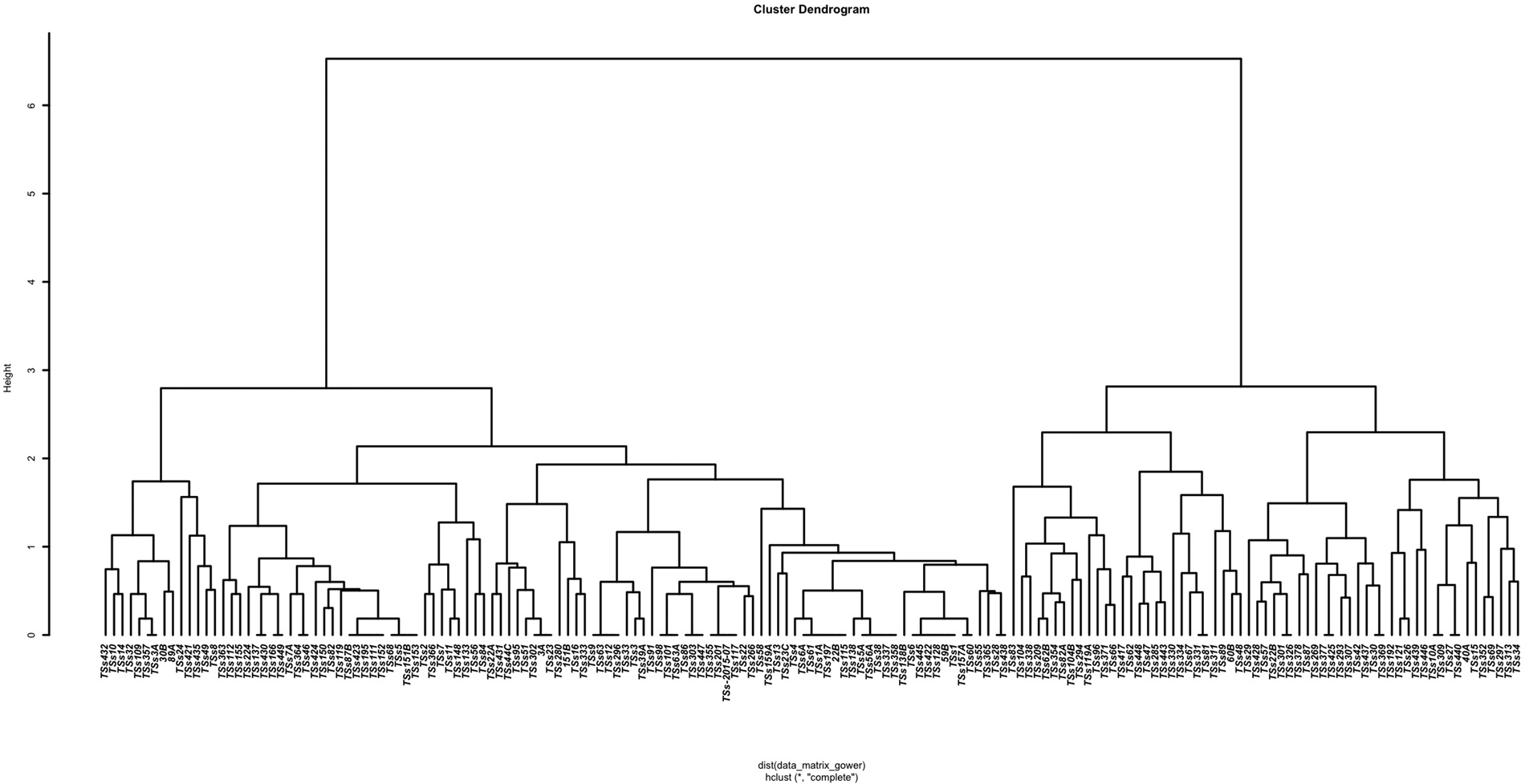
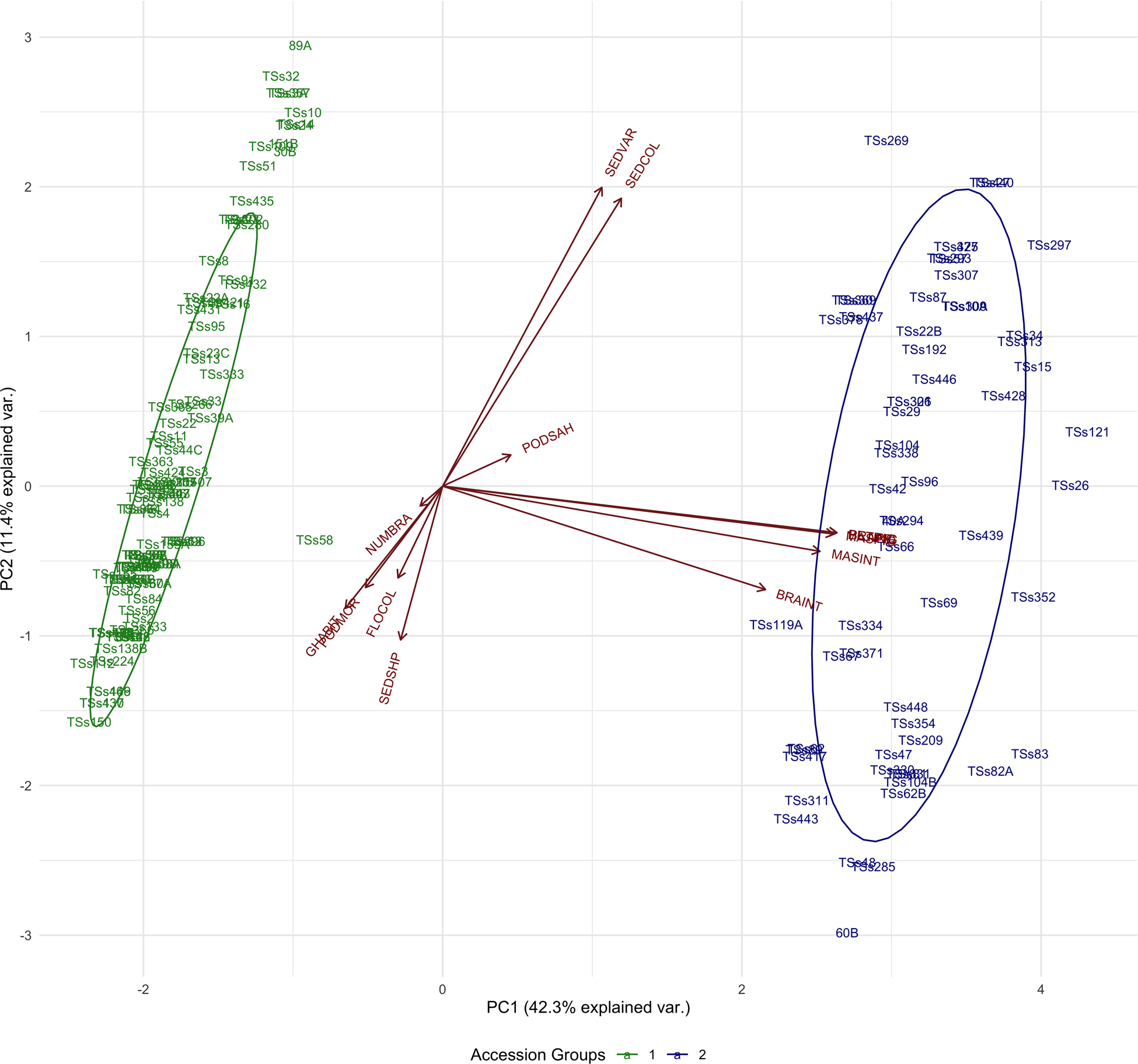
Cluster analysis based on Gower's (Reference Gower1971) distance matrix method grouped the 169 accessions into two major groups (Fig. 1). The mean distance between the 169 accessions was 0.37, whereas the maximum distance of 0.85 was observed among 30B, TSs330, TSs297 and TSs84 (online Supplementary Table S3). Accession TSs84 is of Nigerian origin; however, the first three accessions' passport data were not available. Cluster I had the largest number of materials, 108 of which 48 were of Nigerian origin; TSs77 of Ghana origin was also in the group. The maximum distance in group 1 was 0.51; between TSs58 and TSs24 (of Nigerian origin). Accessions in group I was closely associated with the number of branches (NUMBRA), pod morphology (PODMOR), growth habit (GHABIT) and flower colour (FLOCOL) (Fig. 2). Moreover, cluster II had a grouping of 61 with a maximum distance of 0.54 exhibited between TSs311 and TSs439, both with no passport data. The majority of cluster II accessions had no passport data; TSs67 and TSs66 of Bangladesh origin were also located in the cluster. TSs66 was positively associated with main stem pigmentation intensity (MASINT) and branch pigmentation (BRAPIG). Also observed in cluster II is a strong association between TSs334 (no passport data) with branch pigmentation intensity (BRAINT). Accessions in both clusters I and II were associated with seed colour (SEDCOL) and seed variegation (SEDVAR).
Dendrogram showing the clustering pattern of 169 AYB (S. stenocarpa) accessions as revealed by 14 qualitative traits. The dendrogram was computed based on Gower (Reference Gower1971) distance.

PCA biplot showing the association between qualitative traits and group of accessions in clusters.

PCA of qualitative traits evaluated in AYB
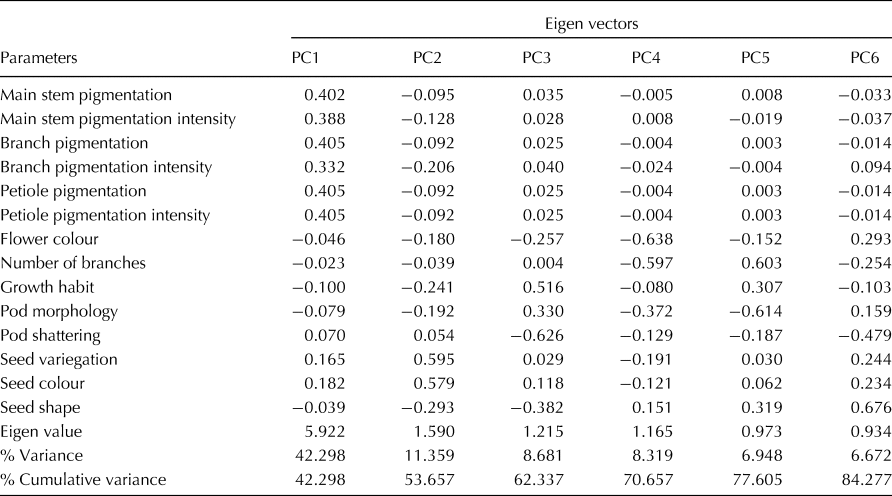
To uniquely group accessions and traits associated with, PCA was carried out using computed means of 14 qualitative attributes. Table 4 explains the first six PC axes and each component's contribution to the observed variations. The first four PCs with eigenvalues greater than one were found essential and contributed to 70.7% of the germplasm's total variations. Their eigenvalues ranged from (5.922) to (1.165). PC1 made the highest contribution of 42.3% to the germplasm's total variance for the qualitative traits. As presented in the PCA biplot (Fig. 2), the first PC formed a strong association and had positive loadings with branch pigmentation intensity, main stem pigmentation intensity, branch pigmentation and pod shattering. However, flower colour, number of branches, growth habit, pod morphology and seed shape loaded negatively against PC1 (Table 4). PC2 with an eigenvalue of 1.6 contributed 11.4% of the total variation and was correlated with the number of branches, growth habit, pod morphology, flower colour and seed shape (Fig. 2). Major traits that contributed and were responsible for 8.7% of the total variation in PC3 include flower colour (−0.257), growth habit (0.516), pod morphology (0.330), seed variegation (0.029) and seed shape (−0.382). The fourth PC accounted for 8.3% of the germplasm's total variations and was positively loaded with seed shape (0.151), whereas the other traits contributed negatively to the PC axis.
PCA of studied AYB accessions

Discussion
In the face of the prevailing climate change and rising population growth, there is an urgent need to assess the potentials of available food crops, such as AYB (one of the African orphan crops), for humans' nutritional benefit. However, to efficiently utilize AYB, there is a dire need to characterize and understand the materials' potential for improvement. Characterizing germplasm based on phenotypic differences is the first step in any crop improvement programme; it helps generate baseline information that can be utilized in the crop's genetic improvement. To the best of our knowledge, the current study is the first report on the morphological characterization of AYB under Ethiopian conditions. This study is also the first to investigate well above a hundred fifty accessions of diverse geographical origin.
This research showed high variability across the studied germplasm, as significant differences were found for several phenotypic characters. The ANOVAs for the 17 quantitative traits showed significant differences (P < 0.01) among most quantitative characters, suggesting considerable phenotypic variation in the studied germplasm. Similar significant differences were reported across quantitative traits except for days from sowing to emergence (Popoola et al., Reference Popoola, Adegbite and Obembe2011) and rachis length (Agbolade et al., Reference Agbolade, Popoola, Kioko, Adewale, Ajiboye, Ajewole, David and Komolake2018). Moreover, Ojuederie et al. (Reference Ojuederie, Balogun, Akande, Korie and Omodele2015) reported significant differences across both qualitative and quantitative traits. Studies showed that quantitative features are essential in improving legumes and cereals (Adebisi et al., Reference Adebisi, Kehinde, Salau, Okesola, Porbeni, Esuruoso and Oyekele2013). Furthermore, Adewale et al. (Reference Adewale, Kehinde, Aremu, Popoola and Dumet2010) highlighted the importance of analysing seed size parameters in AYB characterization studies. The seed characters investigated in the present research distinguished the studied materials significantly. The maximum mean value (6.90 mm) of seed width reported agrees with the values 7.10, 8.60 and 7.21 mm observed by Adewale et al. (Reference Adewale, Dumet, Vroh-Bi, Kehinde, Ojo, Adegbite and Franco2012); Ojuederie et al. (Reference Ojuederie, Balogun, Akande, Korie and Omodele2015) and Popoola et al. (Reference Popoola, Adegbite and Obembe2011), respectively. Also, the mean value of seed thickness (6.40 mm) obtained in this study is in line with the previous findings of 6.60 and 6.77 mm reported by Ojuederie et al. (Reference Ojuederie, Balogun, Akande, Korie and Omodele2015) and Adewale et al. (Reference Adewale, Kehinde, Aremu, Popoola and Dumet2010), respectively. Similarly, the seed length analysis (8.60 mm) corresponds with earlier reports' values (Popoola et al., Reference Popoola, Adegbite and Obembe2011; Adewale et al., Reference Adewale, Dumet, Vroh-Bi, Kehinde, Ojo, Adegbite and Franco2012; Ojuederie et al., Reference Ojuederie, Balogun, Akande, Korie and Omodele2015). The average number of seeds per pod (17.65) and the 100 seed weight mean value (23.50) obtained in the present characterization study is in similitude to results from researchers (Adewale et al., Reference Adewale, Dumet, Vroh-Bi, Kehinde, Ojo, Adegbite and Franco2012; Ojuederie et al., Reference Ojuederie, Balogun, Akande, Korie and Omodele2015; Ajibola and Olapade, Reference Ajibola and Olapade2016). In the current report, TSs62B showed superiority for the number of seeds per pod and 100 seed weight. The accession could be selected for yield improvement in AYB because of the positive contributions of such traits in crop improvement. Accession 3A, TSs10A and TSs33 flowered earlier and could be choice materials for early maturity.
Qualitative traits, including seed colour, are critical morphological traits for classifying AYB (Adewale et al., Reference Adewale, Dumet, Vroh-Bi, Kehinde, Ojo, Adegbite and Franco2012). Based on the results obtained, the seed colour variations were reasonably efficient at characterizing the AYB germplasm into five categories. Earlier studies have reported the specific ability of seed colour in AYB classification (Popoola et al., Reference Popoola, Adegbite and Obembe2011; Adewale et al., Reference Adewale, Dumet, Vroh-Bi, Kehinde, Ojo, Adegbite and Franco2012; Abdulkareem et al., Reference Abdulkareem, Animasaun, Oyedeji and Olabanji2015). Additional attributes that explained the variations across the studied materials included seed shapes, in which oval shape was dominant, representing 57.4% of the accessions. Prior research conducted by Adewale et al. (Reference Adewale, Dumet, Vroh-Bi, Kehinde, Ojo, Adegbite and Franco2012) and Ojuederie et al. (Reference Ojuederie, Balogun, Akande, Korie and Omodele2015) also reported an oval shape as the most common shape in AYB. Another qualitative trait that distinctively classified the accessions was growth habit; while some plants showed erect (43.2%) pattern, others exhibited bushy habit (56.8%). Accessions that showed upright growth habit produce more pods than the bushy types.
Pods produced by erect types were well aligned on branches such that they formed far above the ground level, therefore well protected from soil pest damage, unlike bushy types. AYB plants with erect features could be selected to generate populations useful in developing upright plant types for easy agronomic management and better yield. Pod shattering before harvest is a peculiar feature in characterizing legumes (Bailey et al., Reference Bailey, Mian, Carter, Ashley and Boerma1997). It was revealed in this study that 22.5% of the studied germplasm have tendencies to shattering. The findings differ from the result of Adewale et al. (Reference Adewale, Dumet, Vroh-Bi, Kehinde, Ojo, Adegbite and Franco2012), where 92% of accessions were reported to exhibit some breaking level. The low percentage shattering observed across the present materials might be due to the germplasm's inherent genetic potential. Non-shattering accessions could be considered as promising materials for further improvement. The cluster analysis obtained from qualitative traits grouped the 169 accessions into two major groups. The highest distance matrix of 0.85 (online Supplementary Table S3) recorded in the current study indicates the considerable variation across the materials. The distance matrix is a measure of proximity between individuals; therefore, the higher the distance, the more diverse the materials. Accessions 30B, TSs330, TSs84, and TSs297, were identified as the most diverse due to the gap between them; hence they are potential materials for hybridization programmes. A previous study reported a distance matrix of 0.57 across 79 IITA AYB germplasm (Adewale et al., Reference Adewale, Dumet, Vroh-Bi, Kehinde, Ojo, Adegbite and Franco2012).
Moreover, accessions in PCA biplot in cluster I showed association with the number of branches, growth habit, pod morphology and seed shape. Hence, they might be utilized to improve the traits mentioned above. One of the characteristics of great importance revealed by the PCA biplot in cluster II was pod-shattering; accessions in the group could be explored further for improvement. Pod shattering is known among the constraint associated with grain yield in legumes.
According to Chakravorty et al. (Reference Chakravorty, Ghosh and Sahu2013), PCA identifies the crucial traits that influence the different PCs contributing to a germplasm's total variations. Accessions determined to be distinct could be choice materials for direct use for production or as parents in crossing programmes (Ariyo, Reference Ariyo1987). The current study attributed 70% of the total variations observed across the 17 quantitative traits to the first four PCs with eigenvalues greater than one. Moreover, 62.3% of the absolute differences were attributed to PC1 to PC3. The PCA result shows that the 17 quantitative traits investigated revealed the inherent uniqueness among the studied AYB accessions. In line with this study's findings, Aremu and Ibirinde (Reference Aremu and Ibirinde2012) attributed 57% of the total variation of 50 AYB germplasm sourced from IITA, Nigeria, to the first four PC at an eigenvalue of one.
Similarly, Ojuederie et al. (Reference Ojuederie, Balogun, Akande, Korie and Omodele2015) reported that the first four PCs were responsible for 62% of observed variations in forty AYB collections (27 sourced from IITA, Nigeria and 13 from Institute of Agricultural Research and Training (IAR&T), Ibadan, Nigeria) they studied. In a related report, Popoola et al. (Reference Popoola, Adegbite and Obembe2011) investigated 25 accessions sourced from IITA, genebank, Nigeria and attributed 54% of identified variations to the first four PCs (54%). Interestingly, the cluster dendrogram and the PCA biplot obtained in the current study were in total agreement in classifying the studied accessions.
The phenotypic characterization of 169 AYB accessions evaluated in Jimma, Ethiopia, showed considerable diversity across the 31 traits investigated. Traits including growth habit, number of seeds per pod, 100 seed weight and total seed weight are significant in boosting AYB production in Jimma Zone.
Supplementary material
The supplementary material for this article can be found at https://doi.org/10.1017/S1479262121000095
Acknowledgements
The authors thank the MoBreed Intra-Africa Mobility Program of the European Union for funding the research and IITA, genebank, Nigeria for providing the seeds. The support provided by the pulse, oil and fibre (POF) team at Jimma Agricultural Research Center is appreciated.