Behavioral and neurological evidence suggest that during adolescence the capacity for self-regulation increases (Casey, Getz, & Galvan, Reference Casey, Getz and Galvan2008; Steinberg, Reference Steinberg2008; Steinberg et al., Reference Steinberg, Albert, Cauffman, Banich, Graham and Woolard2008). Two facets of self-regulation, the ability to control behavioral impulses (impulse control) and the ability to behave in ways that support long-term goals (future orientation), demonstrate linear gains across adolescence, with growth in these capacities slowing as youth reach early adulthood (Albert & Steinberg, Reference Albert and Steinberg2011; Monahan, Steinberg, Cauffman, & Mulvey, Reference Monahan, Steinberg, Cauffman and Mulvey2009, Reference King, Lengua and Monahan2013; Steinberg, Reference Steinberg2008; Steinberg et al., Reference Steinberg, Albert, Cauffman, Banich, Graham and Woolard2008). At the same time, there is substantial variability in the rate and consistency with which development of these capacities proceeds (Harden & Tucker-Drob, Reference Harden and Tucker-Drob2011; King, Lengua, & Monahan, Reference King, Lengua and Monahan2013; Monahan et al., Reference Monahan, Steinberg, Cauffman and Mulvey2009, Reference Monahan, Steinberg, Cauffman and Mulvey2013; White et al., Reference White, Marmorstein, Crews, Bates, Mun and Loeber2011). A great deal of evidence suggests that weak impulse control and low future orientation contribute to risky behavior, especially the types that peak during adolescence, such as delinquency (Cauffman & Steinberg, Reference Cauffman and Steinberg2000; Krueger et al., Reference Krueger, Hicks, Patrick, Carlson, Iacono and McGue2002; Monahan et al., Reference Monahan, Steinberg, Cauffman and Mulvey2009, Reference Monahan, Steinberg, Cauffman and Mulvey2013). However, surprisingly little is known about how environmental factors might shape the developmental trajectories of impulse control and future orientation during adolescence. The present study investigates how highly stressful experiences (witnessing and being a victim of violence) are linked to the development of impulse control and future orientation from adolescence to early adulthood.
Empirical Research on Exposure to Violence and Self-Regulation
Over the past 20 years, much has been learned about how exposure to violence affects socioemotional development. Stressful experiences, in general, increase risk for a wide range of psychopathology, including both internalizing and externalizing disorders (Cohen, Janicki-Deverts, & Miller, Reference Cohen, Janicki-Deverts and Miller2007). Higher levels of exposure to violence specifically (as a witness, perpetrator, or victim) are linked with a wide range of problem behaviors, including early sexual debut, multiple sexual partners, early pregnancy, delinquency, and substance use (Berenson, Wiemann, & McCombs, Reference Berenson, Wiemann and McCombs2001; Cisler et al., Reference Cisler, Begle, Amstadter, Resnick, Danielson and Saunders2012; Miller, Benson, & Galbraith, Reference Miller, Benson and Galbraith2001; Wright, Fagan, & Pinchevsky, Reference Wright, Fagan and Pinchevsky2013). For example, one study found that exposure to violence during adolescence was associated with greater sexual permissiveness and social deviance (delinquency and substance use) during adolescence and young adulthood (Brumbach, Figueredo, & Ellis, Reference Brumbach, Figueredo and Ellis2009). Moreover, evidence suggests that exposure to violence affects emotional functioning, with higher exposure to violence during childhood associated with greater depressive symptoms and anxiety (Cisler et al., Reference Cisler, Begle, Amstadter, Resnick, Danielson and Saunders2012; Zona & Milan, Reference Zona and Milan2011).
To date, however, surprisingly little research has examined how exposure to violence may affect the development of self-regulatory capacity. There is behavioral and neurological evidence to suggest associations between exposure to violence and self-regulation. One recent study found that exposure to high levels of stressful life events in childhood predicted both the initial level and the stunted developmental trajectory of impulse control over 3 years' time in preadolescence (King et al., Reference King, Lengua and Monahan2013). In a multisite study of early adolescents (between 10 and 14 years old) followed for 4.5 years, victimization was associated with lower levels of self-control 1 year later across the entire age range of the sample (Agnew et al., Reference Agnew, Scheuerman, Grosholz, Isom, Watson and Thaxton2011). In contrast, another study found that exposure to violence and witnessing violence were unrelated to levels of self-restraint (a construct that included impulse control) at the beginning and the end of sixth grade (Sullivan, Farrell, Kliewer, Vulin-Reynolds, & Valois, Reference Sullivan, Farrell, Kliewer, Vulin-Reynolds and Valois2007).
In addition to behavioral evidence, neurological evidence from both animal and human studies suggests that exposure to violence may affect the development of self-regulation (Blair, Reference Blair2010). Studies conducted with animal models consistently find that early experiences of stress affect stress hormone reactivity (leading to either greater or lesser responsiveness). The adverse effects of early stressful experiences on the stress response system may lead, in turn, to reduced connectivity between limbic structures and the prefrontal cortex (Kinnunen, Keonig, & Bilbe, Reference Kinnunen, Keonig and Bilbe2003; Liu, Diorio, Day, Francis, & Meaney, Reference Liu, Diorio, Day, Francis and Meaney2000; Veenema, Reference Veenema2009). For example, two studies of rats have found that these neurological effects are particularly notable in the ventral medial and orbitofrontal prefrontal cortex, regions that are important for regulating stress response, regulating emotion, and coordinating thought and action in the control of behavior (Barbas & Zikopoulos, Reference Barbas and Zikopoulos2007; Holmes & Wellman, Reference Holmes and Wellman2009). Adolescents with symptoms of posttraumatic stress disorder have lower prefrontal cortex volume and perform more poorly on memory and executive functioning tasks than do youth without symptoms of posttraumatic stress disorder. Taken together, there is behavioral and neurological evidence to suggest that exposure to violence might affect an adolescent's development of impulse control and future orientation.
Theoretical Perspectives on Exposure to Violence and Self-Regulation During Adolescence
Beyond the empirical evidence that stressful experiences may affect the development of self-regulation, there are two theoretical perspectives that offer different, though not necessarily competing, explanations for how and why environmental stressors such as exposure to violence shape the development of impulse control and future orientation. The first is the adolescent vulnerability hypothesis, which suggests that because of the biological changes associated with puberty, adolescents may be more affected by stressors compared to individuals in earlier or later developmental periods (Casey et al., Reference Casey, Jones, Levita, Libby, Pattwell and Ruberry2010; Romeo, Reference Romeo2010). The second is the depletion model, which suggests that impulse control and future orientation derive from a common, finite pool of “self-regulation.” Consequently, excessive use of any form of self-regulation leads to subsequent decreases in the capacity to exert self-control (Baumeister, Vohs, & Tice, Reference Baumeister, Vohs and Tice2007; Muraven & Baumeister, Reference Muraven and Baumeister2000). We review each one in turn in terms of their respective predictions about the association between stress and the development of impulse control and future orientation.
The adolescent adversity hypothesis posits that adolescence is a period of heightened vulnerability to environmental inputs because of dynamic developmental changes taking place in both the endocrine systems that regulate stress response and the brain systems that gauge and react to external stimuli (Casey et al., Reference Casey, Jones, Levita, Libby, Pattwell and Ruberry2010; Romeo, Reference Romeo2010). The hypothalamic–pituitary–adrenal axis, a key component of the stress-response system, is one system that undergoes major maturational change during adolescence (see reviews by Romeo, Reference Romeo2005; Romeo & McEwen, Reference Romeo and McEwen2006). During this maturational period, individuals may be especially reactive to stress (Romeo, Reference Romeo2010). Consistent with this perspective, midadolescents (ages 15–17) exhibit a greater endocrine reaction (i.e., release a greater amount of the stress hormone cortisol) to highly stressful tasks than do preadolescents (Gunnar, Wewerka, Frenn, Long, & Griggs, Reference Gunnar, Wewerka, Frenn, Long and Griggs2009). Adolescents have been found to demonstrate heightened reactivity in other contexts at well (Graber, Brooks-Gunn, & Warren, Reference Graber, Brooks-Gunn and Warren2006; Quevedo, Benning, Gunnar, & Dahl, Reference Quevedo, Benning, Gunnar and Dahl2009). For example, adolescents evince a more vigorous reaction in the amygdala, a brain structure that plays a key role in responding to threat, than do children or adults in response to negative stimuli (e.g., reward omission or faces displaying negative emotions; Casey et al., Reference Casey, Jones, Levita, Libby, Pattwell and Ruberry2010). Moreover, in addition to reorganization of the hypothalamic–pituitary–adrenal axis, adolescence is marked by development of the prefrontal cortex, which subserves multiple aspects of self-regulation. Exposure to stress may affect the development of this structure. High levels of stress, such as child maltreatment, are associated with lower executive functioning during adolescence (Pechtel & Pizzagalli, Reference Pechtel and Pizzagalli2010), possibly through decreased structural volume in the prefrontal cortex (Hanson et al., Reference Hanson, Chung, Avants, Rudolph, Shirtcliff and Gee2012). Heightened endocrine reactivity, combined with the relative immaturity of the self-regulatory systems in the adolescent brain, may produce a “perfect storm” for disrupted maturation due to external stressors during adolescence (Romeo, Reference Romeo2010).
If it is the case that adolescence is a developmental period marked by increased sensitivity to stressors in the environment, we would expect stress exposure during adolescence to be linked to the development of self-control above and beyond previous exposure to stress, and we would expect associations between stress and self-regulation to be particularly strong during adolescence compared to early adulthood. If contextual stressors alter the development of the stress-reactivity system, then higher levels of stress exposure may alter the overall trajectory of development of self-regulation, and these effects may be especially strong during adolescence and wane across the transition to adulthood. This premise (i.e., stressful exposure will be more strongly related to impulse control and future orientation during adolescence compared to adulthood) remains untested.
Another theoretical orientation that suggests that stress will likely influence impulse control and future orientation during adolescence is the depletion model of self-regulation. A distinct, nondevelopmental model of self-regulation, the depletion model posits that self-regulation is a depletable resource that can be strengthened with use but also exhausted by overuse (Baumeister et al., Reference Baumeister, Vohs and Tice2007; Muraven & Baumeister, Reference Muraven and Baumeister2000). This depletion model has been repeatedly tested in experimental paradigms, and the results consistently suggest that coping with stressors (which requires self-regulation resources) leads to decreased self-regulatory capacity in subsequent tasks. For example, coping with stressors has been shown to temporarily diminish cognitive control resources, including short-term memory and response inhibition (Baumeister et al., Reference Baumeister, Vohs and Tice2007; Inzlicht & Schmeichel, Reference Inzlicht and Schmeichel2012). Traditional tests of the depletion model have examined how stress leads to lower levels of self-regulation in the short term (hours or days) and used behavioral measures of regulation, such as timing how long it takes to give up on an unsolvable task (Baumeister et al., Reference Baumeister, Vohs and Tice2007). However, some evidence suggests that this effect may generalize to longer periods of time and to self-report measures of self-regulation (i.e., 1 year; Agnew et al., Reference Agnew, Scheuerman, Grosholz, Isom, Watson and Thaxton2011). According to this model of self-regulatory capacity, if adolescents are forced to deploy coping resources in response to stress, their self-regulatory resources will be depleted, resulting in reduced overall levels of impulse control or future orientation. However, this theory views depleted self-regulatory capacity following exertion as a temporary condition. Consequently, the model would predict acute reductions in self-regulation following periods of stress exposure rather than a general suppression in the developmental trajectory of self-regulation among youth exposed to stress.
The Current Study
In summary, there are empirical and theoretical reasons to expect that exposure to violence would shape the development of impulse control and future orientation in adolescence and early adulthood, but it is generally unknown whether stressful experiences shape individual differences in self-regulation (between-person differences), whether stressful experiences can cause within-person fluctuations in self-regulation, or both. Thus the goal of the current study was to examine the impact of exposure to violence (both witnessing violence and victimization) on the development of the self-regulatory constructs of impulse control and future orientation. Specifically, we tested whether (a) high mean levels of exposure to violence across adolescence and early adulthood suppressed (flattened) trajectories of development in these capacities, consistent with the adolescent adversity hypothesis; (b) transient increases in exposure to violence resulted in subsequent deflections (downward) off one's own trajectory of development in impulse control and future orientation, consistent with the depletion model; and (c) these deflections were more pronounced during adolescence than in early adulthood, consistent with the adolescent adversity hypothesis.
We explored these questions in a sample of juvenile offenders followed prospectively from ages 14 to 25. Youth convicted of serious offenses represent a population with a relatively high level of exposure to stressful experiences, such as poverty, mental illness, family dysfunction, and dangerous neighborhoods (Chung & Steinberg, Reference Chung and Steinberg2008; Mulvey et al., Reference Mulvey, Steinberg, Piquero, Besana, Fagan and Schubert2010; Tolan, Gorman-Smith, & Henry, Reference Tolan, Gorman-Smith and Henry2003). As such, though these youth are not representative of the general population, they are a useful sample in which to explore how individual differences in exposure to violence affect self-regulation. It is likely that earlier risk factors, including exposure to violence, partially contribute to the delinquent behavior that made individuals eligible for this study. As such, our study can be understood as investigating variation in exposure to violence within a sample that is already demonstrating some of the theorized effects of early exposure to violence. Fortunately, we have access to a measure of accumulated exposure to violence prior to the start of the study, which should help us delineate the effects of earlier environmental stressors. While our sample consists entirely of youth who have committed a felony or similarly serious offense, only about 10% of the sample has been identified as persisting offenders, approximately the same percentage of the sample observed in community-based samples. Although persistent offenders have been shown to exhibit stunted development of impulse control and future orientation, the majority of the sample demonstrates increases in impulse control and future orientation consistent with studies of non-justice-involved youth (Monahan et al., Reference Monahan, Steinberg, Cauffman and Mulvey2013). Thus, although the nature of the sample confers possible limitations with respect to the generalizability of the findings, it also confers advantages in terms of being able to characterize relations among key constructs, such as exposure to stress and self-regulation. The sample provides wide variability in both exposure to violence and self-regulation, and the longitudinal design allows for examination of developmental changes across adolescence and early adulthood (Monahan et al., Reference Monahan, Steinberg, Cauffman and Mulvey2009, Reference Monahan, Steinberg, Cauffman and Mulvey2013). In the present study, we focus on exposure to violence (witnessing violence or being the victim of violence) as our key index of environmental stress.
Method
Participants
Participants in the present study were adolescents enrolled in the Pathways to Desistance study (Mulvey et al., Reference Mulvey, Steinberg, Fagan, Cauffman, Piquero and Chassin2004), a longitudinal study of serious juvenile offenders in Phoenix, Arizona, and Philadelphia, Pennsylvania (see Schubert et al., Reference Schubert, Mulvey, Steinberg, Cauffman, Losoya and Hecker2004, for complete details of study methodology). The goal of the Pathways study was to examine correlates of criminal desistance across adolescence and early adulthood. Adolescents were eligible for study participation if they were between 14 and 17 years of age and had been charged with a felony or similarly serious nonfelony offense (e.g., misdemeanor weapons offenses or misdemeanor sexual assault). Because a large proportion of offenses committed by adolescents are drug offenses, the proportion of enrolled males whose enrollment offense was a drug offense was capped at 15% of the sample at each study site. All youth whose cases were being considered for trial in the adult system and who had been arraigned were eligible for enrollment.
Of eligible youth, 67% of those whom we located and invited to participate in the research agreed to enroll in the study. Compared with youth who declined to participate in the study, enrolled participants had more prior arrests leading to formal charges (2.1 vs. 1.5 for nonparticipants), were somewhat younger at first arrest (13.9 vs. 14.2 years for nonparticipants), were somewhat younger at adjudication (15.9 vs. 16.1 years for nonparticipants), and were more likely to be non-Hispanic Caucasian (25% vs. 20% for nonparticipants).
The final sample for the study was 1,354 adolescents, followed prospectively for 7 years (86% male). The baseline interview was conducted an average of 36.9 days (SD = 20.6) after participants' adjudication (for those adolescents in the juvenile system), or if participants were eligible for prosecution as an adult, their decertification (i.e., waiver) hearing in Philadelphia or their adult arraignment in Phoenix. At the time of the baseline interview, this group of participants were predominantly of lower socioeconomic status (e.g., less than 4.5% of the participants' parents held a 4-year college degree, and 40% of the participants' parents had less than a high school education) and were ethnically diverse, with 41% African American, 35% Hispanic American, 20% non-Hispanic Caucasian, and 4% other. The present study uses data from the baseline interview as covariates in statistical models and prospective information collected in the sample for tests of the research questions.
Procedures
The juvenile court in each site provided the names of eligible adolescents based on age and adjudicated offenses. Interviewers attempted to contact each eligible juvenile and a parent or guardian to obtain juvenile assent and parental consent. Once consents had been obtained, interviews were conducted in a facility (if the participant was confined), in the home, or in an agreed-upon location in the community.
The baseline interview was administered over 2 days in two, 2-hr sessions. Interviewers and participants sat side by side facing a computer, and questions were read aloud to avoid comprehension or reading difficulties. Participants were informed that we had an obligation to maintain confidentiality from the federal government, which prohibited our disclosing any information obtained during the study to anyone outside the project staff. Youths were informed that the only exceptions to a promise of confidentiality were (a) if child abuse was suspected, or if the participant (b) expressed plans to hurt himself or someone else, (c) had a specific plan to commit a crime in the future, or (d) disclosed that someone was in jail for a crime that the participant had committed. Interviews were conducted out of earshot of other individuals whenever possible. All recruitment and assessment procedures were approved by the institutional review boards of the participating universities. Adolescents were paid $50 for their participation in the baseline interview (when allowed by facility rules).
Each of the follow-up interviews was completed in one 2-hr session. Participants were reinterviewed every 6 months for the 3 years following the baseline interview; after 36 months, participants were interviewed annually for the remaining 4 years of the study. Follow-up interviews were conducted only if completed no more than 6 weeks prior to or 8 weeks after a target interview date (i.e., a 6- or 12-month interval depending on the baseline interview date). Participant compensation for the follow-up interviews increased gradually over time to a maximum of $150 in order to minimize attrition. Retention of the sample was excellent. From the baseline interview to the 84-month follow-up, 829 individuals (61.2%) included in the present analyses completed all 11 interviews; 238 individuals (17.6%) completed 10 interviews; 99 individuals (7.3%) completed 9 interviews; 60 individuals (4.4%) completed 8 interviews, 39 individuals (2.9%) completed 7 interviews, 21 individuals completed 6 interviews (1.6%), and 68 individuals completed 5 interviews or fewer (5%).
To create uniform time measurement for the purposes of the present analyses, we combined data from the 6- to 36- month annual follow-up interviews into yearlong intervals by averaging impulse control, future orientation, and exposure to violence across the 6- and 12- month assessments, the 18- and 24-month assessments, and the 30- and 36-month assessments, respectively. Individuals had to provide data at both time points to have valid data for any annual period. The present analyses therefore include a total of seven time points, each 1 year apart. Control variables for the present analyses are drawn from the baseline interview; growth analyses use all assessments postbaseline. This was done because the baseline interview asked about lifetime exposure to violence; follow-up intervals asked about exposure to violence since the prior interview. Because the design of the study is an accelerated cohort design, there were a different numbers of participants at each age that was used in the growth models (remember baseline data was omitted). Based on valid data on the outcome variables, the following numbers were available at each age (15 years, n = 150; 16 years, n = 384; 17 years, n = 758; 18 years, n = 1110; 19 years, n = 1,189; 20 years, n = 1,181; 21 years, n = 1,186; 22 years, n =1,038; 23 years, n = 790; 24 years, n = 424; and 25 years, n = 95).
Measures
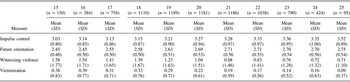
Of interest to the present study are measures of impulse control, future orientation, and exposure to violence (witnessing violence and being a victim of violence). Means and standard deviations of these variables are presented in Table 1.
Means (standard deviations) of key variables

Impulse control
Impulse control was measured by a seven-item subscale from the Weinberger Adjustment Inventory (Weinberger & Schwartz, Reference Weinberger and Schwartz1990; e.g., “I say the first thing that comes into my mind without thinking enough about it”). The measure asks participants to assess how accurately a series of eight statements matched their own behavior in the previous months (on a 5-point scale, from false to true). The scale was found to have adequate reliability (as indexed by Cronbach α = 0.76) and good fit to the baseline data (as indicated by confirmatory factor analysis): impulse control (normed fit index = 0.95, comparative fit index = 0.95, and root mean square error of approximation = 0.07). Previous studies have indicated that the impulse control subscale has predictive validity with respect to criminal behavior (Bechtold, Cavanagh, Shulman, & Cauffman, in press; Monahan et al., Reference Monahan, Steinberg, Cauffman and Mulvey2009, Reference Monahan, Steinberg, Cauffman and Mulvey2013).
Future orientation
The Future Outlook Inventory (Cauffman & Woolard, Reference Cauffman and Woolard1999) was used to assess future orientation. The Future Outlook Inventory is an eight-item measure that includes items from the Life Orientation Task (Scheier & Carver, Reference Scheier and Carver1985), the Zimbardo Time Perspective Scale (Zimbardo, Reference Zimbardo1990), and the Consideration of Future Consequences Scale (Strathman, Gleicher, Boninger, & Edwards, Reference Strathman, Gleicher, Boninger and Edwards1994). The inventory asks participants to rank the degree to which each statement reflects how they usually act, on a scale of 1 (never true) to 4 (always true). A future orientation score is calculated based on the mean of items from the scale (e.g., “I will keep working at difficult, boring tasks if I know they will help me get ahead later”). The scale showed good reliability and an excellent fit to the baseline data (α = 0.68, normed fit index = 0.96, comparative fit index = 0.97, root mean square error of approximation = 0.03). Previous studies have found that the future orientation scale is correlated with problem behaviors in the expected direction, such that lower future orientation is associated with higher levels of problem behavior (Cauffman & Steinberg, Reference Cauffman and Steinberg2000; Monahan et al., Reference Monahan, Steinberg, Cauffman and Mulvey2009, Reference Monahan, Steinberg, Cauffman and Mulvey2013).
Exposure to violence (experiences with violence prior to study enrollment and recent exposure to violence)
Two scales from the exposure to violence measure were used (Selner-Ohagan, Kindlon, Buka, Raudenbush, & Earls, Reference Selner-Ohagan, Kindlon, Buka, Raudenbush and Earls1998): victimization and witnessing violence. At the baseline interview, individuals responded reported on their prior witnessing or being a victim of violence. Note that the prior experiences with violence reflect any exposure to violence prior to enrollment in the study. As such, this variable reflects different durations of prior exposure based on the participant's age at enrollment. At follow-up interviews, participants reported on their recent experiences, that is, whether they had witnessed or been a victim of violence since the previous interview. Participants responded to six different items (chased where might be seriously hurt; beat up, mugged, or seriously threatened; raped; attacked with a weapon; shot at; and shot) that asked if they had been victimized (“Have you been …”) or had witnessed the violence (“Have you seen anyone …”). One additional item was asked on the witnessing violence scale: individuals were asked if they had seen anyone get killed as the result of violence, such as being shot, stabbed, or beaten to death.
Each prospective assessment of witnessing violence and being a victim of violence during adolescence and early adulthood reflects levels of violence exposure in the past year. Exposure to violence reported at the baseline interview is used as a covariate in our statistical models in order to account for continuity in exposure to violence (victimization and witnessing violence). Recent exposure to violence is used to derive estimates of average levels of exposure to violence and more proximal associations between exposure to violence and impulse control and future orientation. Within each age, between 37.7% and 69.5% of youth reported witnessing no violence since the past interview, while between 75.3% and 93.8% of youth reported no victimization since the past interview.
Control variables
Two demographic control variables were used in the analyses: sex (female compared to male) and ethnicity (non-White compared to White). In addition, because engaging in risky and delinquent activities and being placed in secure confinement (incarceration) can increase risk of exposure to violence, we control for levels of antisocial behavior and proportion of time spent incarcerated. Antisocial behavior was assessed as the count of 22 different aggressive or income-generating antisocial acts (e.g., “Taken something from another person by force, using a weapon,” “Carrying a weapon,” “Stolen a car or motorcycle to keep or sell,” and “Used checks or credit cards illegally”; Huizinga, Esbensen, & Weiher, Reference Huizinga, Esbensen and Weiher1991). Variety scores, a count of the number of different types of antisocial acts that an individual endorsed, were calculated at each age. Time spent incarcerated was calculated as the self-reported proportion of the recall period (i.e., time since the prior interview) that a youth was incarcerated.
Plan of analysis
We were interested in two basic questions: (a) how are between-person differences in exposure to violence across time related to developmental patterns of impulse control and future orientation; and (b) are within-person variations in exposure to violence (witnessing and victimization) associated with subsequent trajectory deviations in impulse control and future orientation? We used an autoregressive latent trajectory (ALT; Bollen & Curran, Reference Bollen and Curran2004) model that simultaneously estimates (a) associations between growth models and (b) time-specific associations between variables (i.e., how victimization at age 15 is linked to psychosocial maturity at age 16, how victimization at age 16 is linked to psychosocial maturity at age 17, and so on, over and above the developmental trajectory). The advantage of the ALT modeling framework is that it simultaneously estimates growth curve and simplex models in a single structural equation model. The model is flexible, meaning that that different models can be tested and compared, allowing statistical tests of various theoretical possibilities (Curran & Willoughby, Reference Curran and Willoughby2003), such as developmental differences in the associations between exposure to violence and impulse control and future orientation.
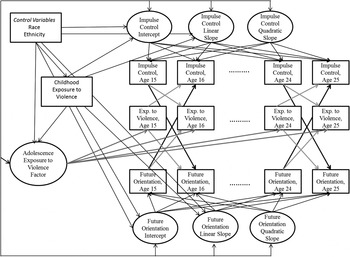
More specifically, the ALT model simultaneously estimates latent growth parameters for two sets of repeated measures while also estimating the time-specific bidirectional relations between the two constructs at the level of repeated measure indicators (see Figure 1 for an illustration of the statistical model). In our model, we simultaneously estimated growth models for impulse control and future orientation by age, to capture the developmental changes in these variables. In contrast, for exposure to violence (victimization and witnessing violence), we estimated a single latent factor by fixing the loadings of exposure to violence to be equal to one across time, which essentially captures the mean level of exposure to violence across time points. This latent mean level of exposure to violence is estimated based on reports of recent exposure to violence. Prior (accumulated) exposure to violence assessed at the baseline interview is modeled as a predictor of this mean level. Stated differently, the latent factor for exposure to violence captured a measure of the chronicity of witnessing violence or being victimized during adolescence and early adulthood as reported prospectively across the follow-up interviews. Individual variation from this mean (between-person differences) was estimated by the variance of the latent factor, and consequently, we estimated how individual variation in chronic exposure to violence was linked to different developmental patterns of impulse control and future orientation across adolescence and early adulthood.
Simplified illustration of estimate structural equation model. Exposure to violence is witnessing violence or victimization depending on the model. Correlations are included between observed time points (e.g., impulse control at age 15 with exposure to violence at age 15, impulse control and future orientation at age 15, exposure to violence at age 15, and future orientation at age 15). Street time (proportion of time incarcerated) and antisocial behavior are covaried at each age from the exposure to violence measure. A latent factor is derived of street time and antisocial behavior that is correlated with lifetime exposure to violence. These observed variables and correlations and age-specific covariates are omitted for clarity.

In the cross-lagged aspects of the model, we simultaneously estimated how within-person deviations from one's own mean level of exposure to violence over time (i.e., temporary increases or decreases in exposure to violence relative to one's own mean level) related to higher or lower levels of self-regulation at a given age than would be expected based on individual trajectories. These paths inform us about the extent to which an acute increase or decrease in violence exposure relative to one's typical violence exposure temporarily boosts or stalls an individual's rate of growth in self-regulation. We also estimated the associations between impulse control and future orientation. We estimated these effects, accounting for time-specific correlations between variables (i.e., the correlation between age 15 exposure to violence and age 15 impulse control, the correlation between age 16 exposure to violence and age 16 impulse control, etc.) and time-specific autoregressive paths between exposure to violence (i.e., the association between exposure to violence at age 15 and exposure to violence at age 16, exposure to violence at age 16 and exposure to violence at age 17, etc.).
Our ALT framework also allows us to account for the effects of additional variables of interest. Prior exposure to violence before enrolling in the study (witnessing violence or victimization) was included in the model as a predictor of the latent variables (intercepts and slopes of impulse control and future orientation, and mean levels of adolescent and early adulthood exposure to violence). Because prior exposure to violence was assessed at the baseline interview, the age range of the growth models and ALT model spans from ages 15 to 25 (i.e., the data for the growth models only used follow-up data). Specifically, latent intercepts and growth factors of impulse control and future orientation and the latent factor of adolescent and young adult chronicity of violence exposure were regressed on prior exposure to violence before the study began. By including lifetime exposure to violence in the model, we can be more certain that associations observed between self-regulation and recent exposure to violence are not due to the effects of previous childhood and adolescent exposure to violence. In addition, all intercepts and slopes (for impulse control and future orientation) were regressed on sex (females compared to males) and ethnicity (non-White compared to White). Finally, at each age, we covaried antisocial behavior and time spent incarcerated, partialing variance due to these factors from our estimate of exposure to violence. We also introduced a latent factor that captures the average level of antisocial behavior across adolescence and early adulthood, and allowed it to be correlated with chronic exposure to violence across the study. This accounts for how antisocial behavior or time incarcerated may affect an individual's likelihood of exposure to violence.
When estimating the ALT models testing the associations among exposure to violence, impulse control, and future orientation, we tested for developmental variation in the magnitude of the time-specific associations among exposure to violence, impulse control, and future orientation. That is, we tested whether the effect of acute stress (victimization or witnessing violence) on impulse control and future orientation varied from adolescence (ages 15 to 18) to early adulthood (ages 19 to 25). We did so by comparing the chi-square fit statistics for a model in which the paths in each developmental period were constrained to be equal to a model in which these paths in each developmental period were allowed to vary.
We estimated all models in Mplus Version 5 software (Muthén & Muthén, Reference Muthén and Muthén2008). Prior to estimating the full ALT model, we estimated unconditional growth models of impulse control and future orientation to identify the form of growth for each variable. After determining the form and function of growth in impulse control and future orientation by age, we estimated the full ALT model.
Results
Unconditional growth models of impulse control and future orientation
We estimated unconditional growth curves of impulse control and future orientation. For all analyses, the intercept of the growth curve was set to age 15, meaning that the intercept is interpreted as the mean level of the variable at age 15. Residual variance in impulse control and future orientation was fixed to be equal across all ages (15 to 25).
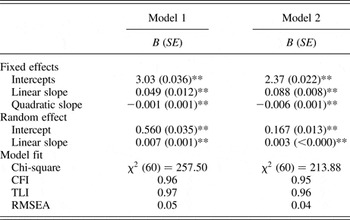
For both impulse control and future orientation, we found evidence of quadratic growth (Table 2). Specifically, impulse control and future orientation increased across adolescence, with growth in each construct slowing during the transition into adulthood. Model fit was adequate for each model, and significant individual variance was found in the intercept and linear growth. The level of impulse control at age 15 was negatively correlated with the rate of change in impulse control over time, indicating that those who had higher impulse control at age 15 demonstrated less change in impulse control across adolescence compared to those who had relatively lower levels of impulse control at age 15. Similarly, the intercept and slope of future orientation was negatively correlated. There was no significant individual variance in the quadratic rate of growth for impulse control or future orientation. Consequently, in subsequent models this parameter was fixed to be equal across all individuals.
Unconditional growth models of impulse control (Model 1) and future orientation (Model 2)

Note: CFI, Comparative fit index; TLI, Tucker–Lewis index; RMSEA, root mean square error of approximation.
**p < .01.
Witnessing violence, impulse control, and future orientation
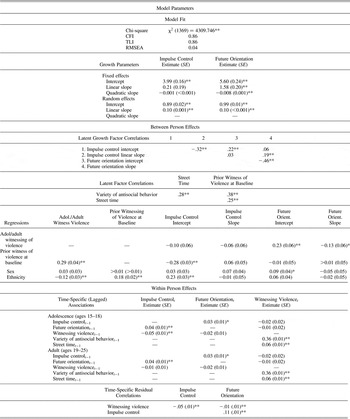
In the first model, we tested the associations among witnessing violence, impulse control, and future orientation. Evidence suggested that the time-specific associations between witnessing violence and subsequent impulse control varied significantly from adolescence to early adulthood, Δχ2 (1) = 5.18, p = .02. There was no evidence of developmental variation in the effects of witnessing violence on subsequent future orientation, Δχ2 (1) = 0.03, p = .15. Consequently, we report the analyses with the developmental differences in the association between witnessing violence and impulse control. Table 3 presents the final models.
Parameters estimates of witnessing violence, impulse control, and future orientation

Note: CFI, Comparative fit index; TLI, Tucker–Lewis index; RMSEA, root mean square error of approximation; Adol./Adult, adolescent and early adulthood.
*p < .05. **p < .01.
Between-individual associations
In terms of demographics, females reported higher levels of future orientation at age 15. Sex was unrelated to lifetime levels of witnessing violence, mean levels of witnessing violence in adolescence and early adulthood, the intercept or slope of impulse control level, or the slope of future orientation. Minority individuals reported higher levels of lifetime witnessing of violence and higher levels of impulse control at age 15. Minority youth reported lower mean levels of witnessing violence across adolescence and early adulthood. There were no other associations with ethnicity.
Higher prior levels of exposure to violence at the baseline interview were associated with higher levels of chronic witnessing of violence in adolescence and early adulthood and lower levels of impulse control at age 15, but were not associated with the rate of change in impulse control or the level or rate of change in future orientation.
Accounting for prior witnessing of violence and demographics, we examined correlations among growth parameters for impulse control and future orientation and the latent witnessing violence factor, which reflects mean levels of witnessing violence across adolescence and early adulthood (i.e., chronic levels of witnessing violence across adolescence and early adulthood). Note that the mean level of witnessing violence across adolescence and early adulthood is adjusted for individual differences in antisocial behavior and time incarcerated.
The levels (or intercepts) of impulse control and future orientation were positively associated, but the level of impulse control at age 15 was unrelated to the rate of change in future orientation over time and the level of future orientation at age 15 was unrelated to the rate of change in impulse control over time. In addition, the rate of change in increase in impulse control across time was positively related to the rate of change in future orientation across the same developmental period, suggesting that as one aspect of self-regulation increased, so did the other. Finally, higher mean levels of exposure to violence across adolescence and early adulthood were associated with higher levels of future orientation ate age 15, but slower growth in future orientation over time. In contrast, the mean level of witnessing violence during adolescence and early adulthood was not correlated with the level or the rate of change in impulse control.
Within-individual associations
We next examined the within-person effects in the model (i.e., the time-specific associations between variables). At each age, we used time spent incarcerated and antisocial behavior as covariates of self-reported witnessing of violence. For example, age 15 witnessing of violence was regressed on time incarcerated and antisocial behavior at age 15 and age 16 witnessing of violence was regressed on time incarcerated and antisocial behavior age at 16. Within each age (i.e., all variables at age 15, all variables at age 16, etc.), impulse control and future orientation were positively correlated, and witnessing violence was negatively correlated with both of these constructs.
Time-specific deviations from trajectories of future orientation were positively associated with levels of impulse control the next year and vice versa (impulse control predicted subsequent change in future orientation). However, fluctuations in both impulse control and future orientation were unrelated to differential witnessing of violence the following year, and deviations from mean levels of witnessing violence were unrelated to future orientation. In contrast, when individuals experienced an increase in witnessing violence above their expected level, impulse control declined (relative to their expected trajectory) the following year. However, this was only true in adolescence; the effect was not significant during adulthood. That is, witnessing a higher than usual level of violence (i.e., greater than the individual's mean) was linked to subsequent declines in impulse control during adolescence (ages 15 to 18) but not in early adulthood (ages 19 to 25).
Victimization, impulse control, and future orientation
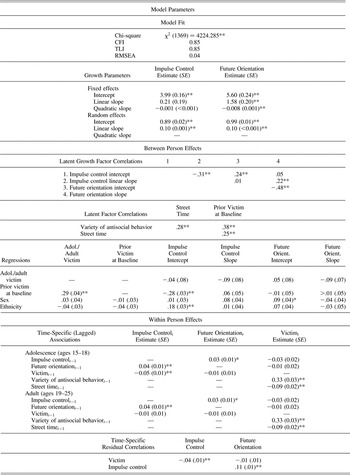
In the second model, we tested the associations among violent victimization, impulse control, and future orientation. Evidence suggested that the time-specific associations between victimization and subsequent impulse control varied significantly from adolescence to early adulthood, Δχ2 (1) = 5.05, p = .03. There was no evidence of developmental variation in the effects of witnessing violence on subsequent future orientation, Δχ2 (1) = 0.03, p = .15. As such, we report the analyses with the developmental differences in the association between victimization and impulse control (see Table 4).
Parameters estimates of victimization, impulse control, and future orientation

Note: CFI, Comparative fit index; TLI, Tucker–Lewis index; RMSEA, root mean square error of approximation; Adol./adult, adolescent and early adulthood.
*p < .05. **p < .01.
Between-individual associations
Associations between sex and ethnicity and impulse control and future orientation were identical to the associations in the model examining witnessing violence (see Witnessing Violence, Impulse Control, and Future Orientation Section). In addition, higher levels of prior victimization as reported at the baseline interview were associated with greater chronic victimization during adolescence and early adulthood and with lower levels of impulse control at age 15. Lifetime victimization was unrelated to the slope of impulse control, the intercept of future orientation, or the slope of future orientation.
Accounting for lifetime victimization, sex, and ethnicity, we examined correlations among growth parameters for impulse control and future orientation and the latent factor of victimization during adolescence and early adulthood, which assess between-persons differences in these constructs. (Recall that the mean levels of victimization across adolescence and early adulthood takes into account antisocial behavior and time spent incarcerated.) Consistent with the previous model on witnessing violence, level of impulse control at age 15 was negatively correlated with the rate of change of impulse control over time, and level of future orientation at age 15 was negatively correlated with the rate of change in future orientation over time. In addition, greater impulse control at age 15 was associated with higher future orientation at age 15. Level of impulse control at age 15 was unrelated to developmental change in future orientation. Similarly, level of future orientation at age 15 was unrelated to the rate of change in impulse control. However, the rate of change in impulse control was correlated with the rate of change in future orientation, such that increases in one parallelled increases in the other. We found no evidence that level of victimization across adolescence and early adulthood was related to impulse control or future orientation, controlling for demographics, antisocial behavior, time incarcerated, or childhood exposure to violence.
Within-individual associations
Similar to the previous models, within each age, impulse control and future orientation were positively correlated, and victimization was negatively correlated with both impulse control and future orientation. Time-specific variability in impulse control and future orientation was unrelated to subsequent victimization. In addition, within-person deviations from mean levels of victimization were not associated with future orientation. However, within-person increases above mean levels of victimization were linked to declines in impulse control at the subsequent age, but only during adolescence; this effect was not significant during adulthood. Stated differently, when an individual reported a higher level of victimization relative to his or her typical level of victimization, it was associated with less impulse control the following year than would be predicted by his or her trajectory, but only during adolescence (ages 15 to 18). In early adulthood, within-person variation in victimization was unrelated to change in impulse control.
Discussion
It is well established that harsh environments can have deleterious effects on development. The present study is novel in its nuanced examination of when and how aversive environments influence the development of self-regulatory capacities across adolescence and early adulthood. We found evidence that exposure to violence during adolescence and early adulthood was associated with slower growth in future orientation over time, but more acute exposure to violence was unrelated to impulse control, suggesting that cumulative levels of exposure to violence during adolescence and early adulthood shape the development of future orientation. In contrast, mean levels of adolescent and young adult exposure to violence or witnessing of violence were not associated with developmental change in impulse control. However, when individuals experienced an increase in exposure to violence (witnessing violence or victimization) relative to their typical exposure, impulse control declined the following year in adolescence, but not in young adulthood. Overall, it appears that the association between average environmental stress and impulse control may be set prior to adolescence: once exposure to violence prior to enrollment in the study was accounted for, there was no additional impact of mean levels of exposure to violence across adolescent and young adult on impulse control. However, increases in violence exposure during the adolescent years do appear to have short-term (deleterious) effects on impulse control. This suggests that the development of impulse control is sensitive to changes in violence exposure only during adolescence.
Our results are consistent with evidence that suggests that exposure to stressful events may alter the development of self-regulation in adolescence, possibly due to the effects of stress on neurological development. Taken as a whole, our results imply that early and cumulative exposure to violence places one at risk for diminished self-regulation control during adolescence. However, perhaps because adolescence is marked by continued maturation of brain structure and function as well as developmental gains in self-regulation, adolescents remain vulnerable, in terms of their subsequent self-regulatory capacities, to increases in exposure to violence, whereas adults do not. This is consistent with evidence that hormonal responses to stress peak during midadolescence to late adolescence compared to younger adolescents and adults (Gunnar et al., Reference Gunnar, Wewerka, Frenn, Long and Griggs2009).
An unexpected finding was that, despite moderate correlations between impulse control and future orientation, the associations between exposure to violence and impulse control and future orientation differ. Although both constructs are components of self-regulation, both self-report studies and behavioral studies have found that the two constructs have unshared variance (Cauffman & Steinberg, Reference Cauffman and Steinberg2000; Steinberg et al., Reference Steinberg, Graham, O'Brien, Woolard, Cauffman and Banich2009), indicating that the two constructs tap into different processes. While neurological studies have provided evidence of the neurological regions and circuitry related to impulse control (Liston et al., Reference Liston, Watts, Tottenham, Davidson, Niogi and Ulug2006; Somerville & Casey, Reference Somerville and Casey2010), the neurological underpinnings of future orientation are less well understood. It may be that slight differences in the neural circuits subserving impulse control and future orientation result in the differential susceptibility of these capacities to stress exposure. Alternatively, it could be that the impact of stress on future orientation is mediated or partially mediated by the impact of stress on impulse control. Additional research that attempts to clarify the developmental patterning and relatedness of these constructs is needed.
Another unexpected finding in the present study is that higher levels of victimization during adolescence and early adulthood are associated with greater future orientation at age 15 but slower growth in future orientation over time. One possibility is that individuals who are victimized develop greater planning abilities in order to attempt to avoid subsequent victimization. However, this association may also be an artifact of selection factors specific to the present sample. We are hesitant, therefore, to make too much of this result; further research is needed to determine whether this association is meaningful.
One interesting finding derived from the present study is that within-person variation in exposure to violence was linked to subsequent changes in self-regulation, but the reverse was not true. That is, we found no evidence that the link between poor-self regulation and violence exposure was due to poorly self-regulated individuals (those low in impulse control or future orientation) placing themselves in harm's way. Thus, the association between stress exposure and self-regulation appeared to flow from environmental factors to self-regulatory capacities and not the reverse.
As noted previously, the present study is among the first to examine how exposure to stress influences the development of self-regulation in adolescence. However, one prior study that did so reached different conclusions. Sullivan et al. (Reference Sullivan, Farrell, Kliewer, Vulin-Reynolds and Valois2007) assessed change across two time points in “self-restraint” (measured similarly to impulse control in the present study) and its relation to violence exposure in a sample of 913 rural sixth-grade students. While the authors report an inverse relation between initial levels of self-restraint and initial violence exposure, they uncovered no evidence of longitudinal effects of violence exposure (witnessing or victimization) on later levels of self-restraint. Rather, they found that lower self-restraint was related to higher violence exposure 1 year later. The differences in outcome between our study and this prior one could be due to any number of discrepancies between the two studies (age, length of follow-up, or other population characteristics). One likely culprit is the low levels of violence exposure reported in their sample: the mean for witnessing was 7.8 on a scale ranging from 6 (none) to 24; and the mean for victimization was 5.1 on a scale ranging from 4 (none) to 16. In addition, in the model that tested effects of violence exposure on later self-restraint, both witnessing and victimization were included in the model, meaning the analysis only examined incremental effects of these highly correlated measures: zero-order correlations suggested that Time 1 witnessing (r = –.20) and victimization (r = –.23) were significantly associated with Time 2 self-restraint. A third potential source of discrepancy is Sullivan et al.'s use of a two-time-point design, which makes it difficult to parse true change over time from measurement error. Still, the differences in findings may suggest that the relations between violence exposure and self-restraint vary across different populations (e.g., rural vs. urban, school-based sample vs. high-risk youth).
Theoretical implications of the current study
From a theoretical perspective, it is notable that the results of our study support the theoretical predictions of both the adolescent adversity hypothesis and the depletion model. Exposure to relatively higher witnessing of violence during adolescence and early adulthood was associated with suppressed development of future orientation, consistent with the idea that experiencing these sorts of adversity affect developmental change. Moreover, among individuals who experienced a spell of increased exposure to violence compared to typical level of exposure, we observed subsequent declines in impulse control. This pattern is consistent with the idea that self-regulation is a finite resource that can be depleted. This is a particularly noteworthy finding because most studies of the depletion model of self-regulation examine the associations in a very short-term time interval, not over the span of 1 year (cf., Agnew et al., Reference Agnew, Scheuerman, Grosholz, Isom, Watson and Thaxton2011). However, these effects were limited to adolescence in our analysis. While our data do not allow for a comparison of the effect of stress on self-regulation in childhood versus adolescence, our results indicate that the association between exposure to violence and subsequent levels of impulse control is stronger in adolescence than in early adulthood. Future research should compare preadolescents, adolescents, and young adults. Such a study would provide greater information about developmental variation in vulnerability to stressful experiences.
Strengths and limitations of the current study
One of the strengths of the present study is its use of a sample that experiences significant levels of violence exposure: delinquent youth. Such a sample facilitates reliable estimation of the effects of this environmental stressor. Other methodological strengths include a large sample and longitudinal design paired with high retention rates. Due to these features, we were able to estimate sophisticated statistical models that permit testing of alternative hypotheses and allow us to make inferences about causal direction with some degree of confidence. However, because the sample consisted of individuals convicted of felony (or similarly serious) offenses, the results may not generalize to other populations. Still, although offenders may differ in some ways from other youth, there is little reason to suspect that relations between stress and development are fundamentally different in this population than among nonoffender youth, though the youth in the present sample almost certainly represent the higher end of the range for violence exposure and perhaps sensitivity to environmental stress. Another limitation is that, because of the relatively small number of females in the sample, we were not able to test whether the patterns observed varied as a function of sex. In addition, while we were able to test the adolescent adversity hypothesis by comparing adolescents to adults, because our study began in adolescence, we were unable to test how adolescents compared to children. Future studies should pursue this question.
Another set of limitations relates to our measures. Our index of exposure to violence is one that is commonly used to study violence and victimization; however, it does not allow us to distinguish between situations in which an individual was an active participant in the violent incident and those in which he or she was an observer. To address this, we accounted (in our statistical model) for individuals' own antisocial behavior and time spent incarcerated, both of which likely increase the probability of witnessing or being the victim of violence. It is also the case that our measure of prior exposure to violence is based on a long period of recall (between 14 and 18 years depending on the participant's age at enrollment), which means that it may be subject to memory failures.
In addition, all of our measures rely on self-report. However, research suggests that self-reports of sensitive information, such as victimization, can be accurate if care is taken to build interviewer rapport and minimize embarrassment of participants (Tourangeau & Yan, Reference Tourangeau and Yan2007). Given the long-term relationship between interviewers and participants, we believe that any embarrassment was minimized and individuals honestly reported. Moreover, it is difficult to imagine a better measure of exposure to violence in one's lifetime than one's own report. While self-report of sensitive information is preferred, ideally we would have obtained non-self-report assessments of impulse control and future orientation. At the baseline interview only, parents reported on their youth's level of impulse control, lifetime victimization, and lifetime witnessing of violence. While the two reporters' responses are significantly correlated (r = .18 for impulse control, r = .28 for victimization, and r = .20 for witnessing violence; see Bechtold et al., in press, for discussion of correlation between parent- and youth-reported impulse control), it is important to note that youth report higher levels of exposure to violence than what their parents estimate for them at the baseline (94.6% of youth report having ever witnessing violence or being victimized, while only 66.8% of parents report that their child has ever witnessed violence or been victimized). While we have no reason to believe that self-reports would bias results in the pattern we observed here, a mixed-method approach may strengthen future studies. Beyond the accuracy of these self-report measures, previous studies have suggested that there is predictive validity of these two measures in the expected direction, such that lower levels of impulse control and future orientation are associated with more problem behaviors (Cauffman & Steinberg, Reference Cauffman and Steinberg2000; Monahan et al., Reference Monahan, Steinberg, Cauffman and Mulvey2009, Reference Monahan, Steinberg, Cauffman and Mulvey2013).
Conclusions
Whereas a great deal of research and theory identifies the early childhood environment as critical for healthy development, the present analysis underscores the continuing influence of environmental factors during and beyond adolescence. Exposure to violence appears to have a consistently negative impact on impulse control, at least until age 25. Over and above this effect, spikes in violence exposure during adolescence can further impede the development of impulse control. Such disruptions in self-regulation could place a youth at increased risk for destructive behaviors, such as substance abuse and crime, which have been linked to lower self-control. Consequently, interventions to reduce family and community violence may serve to promote optimal development for adolescents and young adults as well as for younger children and could potentially ward off a host of downstream repercussions. Conversely, conditions that expose adolescents and young adults to violence, such as concentrated poverty, incarceration, or combat, may delay or inhibit the achievement of maximal levels of self-regulation. Although further research is needed to confirm these extrapolations, the present findings should nevertheless spur scholars and policymakers to consider the developmental and social consequences of stressful environments.