Significant outcomes
• Oestrogen receptor (ER) status, which is a well-known biological prognostic factor in breast cancer, is related to the severity of specific aspects of depressive symptoms or QOL impairment, implying a role of the ER in affective and behavioural regulation. However, anti-oestrogen treatments significantly influence these relationships.
Limitations
• All subjects were those referred to psychiatric consultation services. Therefore, the findings could not be generalised to other populations. Further large-scale prospective studies are required to investigate the specific influence of ER status on psychosocial variables during different courses of breast cancer and its treatment.
Introduction
The prevalence of depression in breast cancer patients has been estimated to be high (∼10–25%), which highlights the importance of its identification and appropriate treatment (Reference Weinberger, Forrester, Markov, Chism and Kunkel1). Depression is a significantly challenging barrier to successful cancer treatment, and there is evidence of increased morbidity in depressed cancer patients (Reference Spiegel and Giese-Davis2). However, the underlying mechanism of depression in patients with breast cancer is not clear, and it is considered to be multifactorial and to include biological factors such as hormonal and immunological changes as well as genetic susceptibility (Reference Bower3,Reference Snoj, Akelj, Lièina and Pregelj4).
Among them, although it is a well-known and useful biological marker for the selection of patients who are likely to benefit from specific therapeutic agents (Reference Davies and Godwin5), the relationship of ER status to psychiatric symptoms in breast cancer is largely unknown. In one previous study, ER status was found to be significantly related to global psychological distress as measured by a self-report scale (Reference Razavi, Farvacques and Delvaux6). However, in two other studies, it was not related to self-reported anxiety (Reference Rosenqvist, Berglund and Bolund7) or the prevalence of clinical depression (Reference Chen, Zheng and Zheng8) in breast cancer patients. Moreover, it is unknown whether ER status is associated with particular aspects of quality of life (QOL). Considering this lack of information, it is clearly necessary to further investigate the psychosocial correlates of ER status in order to better understand its potential role in mediating the development of specific psychiatric symptoms among breast cancer patients. Hence, in this preliminary study, we investigated the relationship of ER status to depressive symptoms and QOL in breast cancer patients.
Materials and methods
Participants
Subjects were 77 female outpatients with breast cancer who were referred to psychiatry consultants by their treating physicians based on their subjective complaints related to depressive symptoms and objective psychiatric symptoms such as depressed mood, loss of interest or pleasure, and disturbed sleep. At the time of psychiatric consultation, all subjects met the Diagnostic and Statistical Manual of Mental Disorders, 4th edn, Text Revision (DSM-IV-TR) diagnostic criteria for a current major depressive episode (9). None of the subjects met any of the following exclusion criteria: presence of other Axis I psychiatric disorders, presence of psychotic symptoms, use of psychotropic drugs in the previous 4 weeks, intracranial metastasis, and serious general physical conditions. Informed consent was obtained from all subjects after a full explanation of the study procedure. The study protocol was approved by the institutional review board, and all procedures used in the study were conducted in accordance with international ethical standards, Declaration of Helsinki.
Assessment
Subjects’ demographic data, cancer-related clinical information, and performance status as measured by the Eastern Cooperative Oncology Group (ECOG) score (Reference Oken, Creech and Tormey10) were collected. All subjects were evaluated with the 17-item Hamilton Depression Rating Scale (HAMD) (Reference Hamilton11) and the Clinical Global Impression-Severity of Illness (CGI-S) for depression (Reference Guy12). Subjects’ QOL was assessed using the Functional Assessment of Cancer Therapy-Breast (FACT-B) (Reference Brady and Cella13).
The 17-item HAMD is a clinician-rated multidimensional scale that is widely used to assess depressive symptoms (Reference Hamilton11). A four-factor model of the HAMD based on evidence from factor analysis studies (Reference Pancheri, Picardi, Pasquini, Gaetano and Biondi14) was used. The factors were somatic anxiety, psychic anxiety, depression, and anorexia. FACT-B is a 37-item self-report scale that assesses QOL in breast cancer patients (Reference Brady and Cella13). It consists of the FACT-General (FACT-G) and Breast Cancer Subscales (BCS) (Reference Brady and Cella13). FACT-G includes the following four subscales: Physical Well-Being (PWB), Social/Family Well-Being (SWB), Emotional Well-Being (EWB), and Functional Well-Being (FWB) (Reference Brady and Cella13). Subjects used a five-point Likert scale to identify the degree to which each item accurately described their experiences of the previous week.
Oestrogen receptor status
ER status was determined by immunohistochemical analysis using a tissue microarray. The immunohistochemical analyses used an ER antibody (1D5; Dako, Carpinteria, CA, USA), and the dilution factor was 1 : 50. The primary antibodies were mouse monoclonal antibodies. A cut-off value of 1% or more positively stained nuclei in ten high-power fields was used to define ER positivity (Reference Hammond, Hayes and Dowsett15).
Data analysis and statistical methods
The subjects were divided into two groups according to the expressed ER, and demographic and clinical characteristics were compared between the two groups. To evaluate the relationship of ER status to depressive symptoms and QOL, the HAMD, CGI-S, and FACT-B scores were compared between the groups with and without ER expression using two-tailed t-tests. For HAMD and FACT-B, the factor and subscale scores were also compared. The relationships of ER status to symptoms and QOL were further analysed using generalised linear models (GLM). Statistical significance was set at p < 0.05 (two-tailed), and Bonferroni corrections were made for multiple comparisons where appropriate.
Results
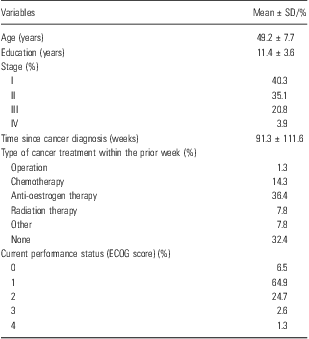
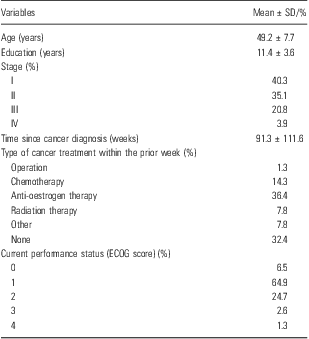
The demographic and clinical characteristics of the subjects are presented in Table 1. The mean age was 49.2 ± 7.7 years. Fifty-eight (75.3%) subjects had stage I or II breast cancer, and the majority (96.1%) of subjects had a score of 2 or lower on the ECOG.
Demographic and clinical characteristics of the subjects (n = 77)
ECOG, Eastern Cooperative Oncology Group.
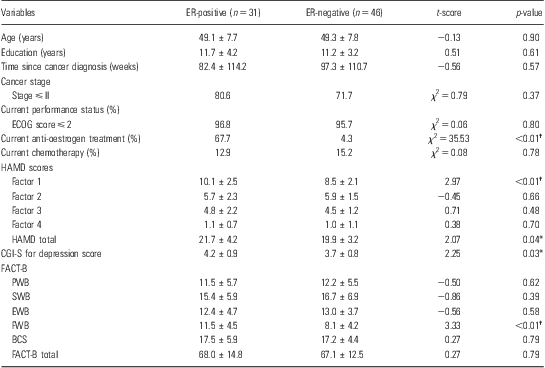
Immunohistochemical analysis showed that 31 (40.3%) subjects were ER-positive, while 46 (59.7%) were ER-negative. There were no significant differences in age (t = −0.13, df = 75, p = 0.90), years of education (t = 0.51, df = 75, p = 0.61), or time since cancer diagnosis (t = −0.56, df = 75, p = 0.57) between the ER-positive and ER-negative groups (Table 2). In addition, the two groups did not significantly differ in terms of cancer stage (χ 2 = 0.79, p = 0.37) or current performance status as measured by the ECOG (χ 2 = 0.06, p = 0.80) (Table 2). There was a significant group difference regarding the administration of anti-oestrogen treatment, in that the majority (67.7%) of ER-positive subjects were receiving anti-oestrogen therapy such as tamoxifen or anastrozole, while only two (4.3%) of ER-negative subjects were receiving it (χ 2 = 35.53, p < 0.001) (Table 2). The proportion of subjects who were currently receiving chemotherapy did not significantly differ between the ER-positive and ER-negative groups (χ 2 = 0.08, p = 0.78) (Table 2).
Comparison of demographic and clinical variables between the ER-positive and ER-negative groups

BCS, Breast Cancer Subscales; CGI-S, Clinical Global Impression-Severity of Illness; ECOG, Eastern Cooperative Oncology Group; ER, oestrogen receptor; EWB, Emotional Well-Being; FACT-B, Functional Assessment of Cancer Therapy-Breast; FWB, Functional Well-Being; HAMD, Hamilton Depression Rating Scale; PWB, Physical Well-Being; SWB, Social/Family Well-being.
*p < 0.05, †p < 0.01.
The ER-positive group showed significantly higher HAMD total (t = 2.07, df = 75, p = 0.04) and CGI-S for depression (t = 2.25, df = 75, p = 0.03) scores compared with the ER-negative group (Table 2). The ER-positive group showed a significantly higher score on the HAMD somatic anxiety factor (t = 2.97, df = 75, p = 0.004), which remained significant after correction for multiple comparisons (Table 2). No significant group differences were found in the other HAMD factor scores. As for QOL measured using FACT-B, the ER-positive group showed a significantly higher score compared with the ER-negative group on the FWB subscale (t = 3.33, df = 75, p = 0.001), which remained significant after correction for multiple comparisons (Table 2). No other significant group differences were observed in FACT-B scores.
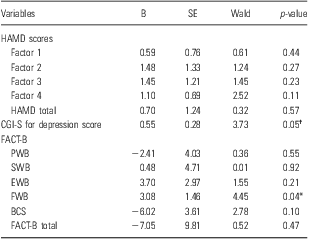
The relationships of ER status to depressive symptoms and QOL were further analysed using GLM, after controlling for the influence of the current anti-oestrogen treatment (Table 3). The analysis revealed that ER status was significantly related to the FWB subscale score of the FACT-B (B = 3.08, Wald score = 4.45, p = 0.04) (Table 3). There was a statistical tendency that ER status was associated with the CGI-S score (B = 0.55, Wald score = 3.73, p = 0.05) (Table 3). The relationship between HAMD scores and ER status was not significant after controlling for the influence of the current anti-oestrogen treatment using GLM (Table 3).
Results of the GLM analysis after controlling for the influence of the current anti-oestrogen treatment
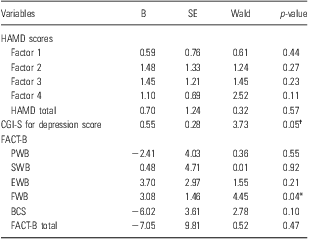
BCS, Breast Cancer Subscales; CGI-S, Clinical Global Impression-Severity of Illness; EWB, Emotional Well-Being; FACT-B, Functional Assessment of Cancer Therapy-Breast; FWB, Functional Well-Being; GLM, generalized linear model; HAMD, Hamilton Depression Rating Scale; PWB, Physical Well-Being; SWB, Social/Family Well-being.
*p < 0.05, †p < 0.1.
Discussion
In the present study, we investigated the relationship of ER status to the specific aspects of depressive symptoms and QOL in patients with breast cancer. To our knowledge, this is the first report on the relationship between ER phenotype and the specific aspects of depressive symptoms and QOL in patients with breast cancer. The ER-positive group showed higher HAMD total, HAMD somatic anxiety factor, and CGI-S scores compared with the ER-negative group. However, after controlling for the effects of the current anti-oestrogen treatment using GLM, only the relationship between CGI-S score and ER status trended towards significance. These results suggest that the severity of depressive symptoms in breast cancer patients could be associated with ER phenotype; however, anti-oestrogen treatments significantly influence this relationship.
It is not clear whether anti-oestrogen treatment for breast cancer patients causes or exacerbates depressive symptoms, although it frequently causes hot flashes, which may lead to further distress (Reference Henry, Stearns, Flockhart, Hayes and Riba16). In particular, in our study, the ER-positive group had a significantly higher score on the HAMD somatic anxiety factor, which supports the possibility that hormonal therapy is associated with distressful somatic symptoms that may exacerbate depression.
Oestrogen directly stimulates the corticotropin-releasing hormone gene and is thus able to stimulate hypothalamic–pituitary–adrenal (HPA) function (Reference Holsboer and Künzel17). In addition, oestrogen reciprocally interacts with the serotonergic and noradrenergic systems (Reference Holsboer and Künzel17,Reference Rubinow, Schmidt and Roca18), both of which play a significant role in mood regulation. ERs are also broadly distributed within areas of the brain, including the hippocampus, frontal cortex, and hypothalamic nuclei, which have been strongly implicated in depressive disorders (Reference Holsboer and Künzel17). Interestingly, tamoxifen, an ER antagonist, has been reported to reduce acute manic symptoms in women with bipolar disorder (Reference Kulkarni, Garland and Scaffidi19,Reference Zarate, Singh and Carlson20). The anti-oestrogen properties of tamoxifen may counteract the antidepressant effects of oestrogen, exacerbating depressive symptoms (Reference Weinberger, Forrester, Markov, Chism and Kunkel1). Thus, the ER phenotype itself may be associated with the severity of depression as a pivotal component of the oestrogen-signalling pathway in the brain; however, selective ER modulators, such as tamoxifen, substantially influence the relationship between ER status and the severity of depressive symptoms in breast cancer patients.
In the present study, the ER-positive group showed a significantly higher score on the FWB subscale of the FACT-B and there was also a significant correlation between ER status and the FWB subscale score in the GLM analysis, indicating that the ER-positive group had better FWB than the ER-negative group. The FWB subscale primarily measures individuals’ ability to engage in fulfilling work and participate in leisure activities (Reference Brady and Cella13). Our results suggest that subjects with ER-positive tumours were more satisfied in these areas. These results may reflect the overall better prognosis of subjects with ER-positive tumours compared with those with ER-negative tumours, given the substantial benefits provided by specific agents in the treatment of ER-positive disease (Reference Henry, Stearns, Flockhart, Hayes and Riba16).
In the present study, all subjects were those referred to the psychiatric consultation service and they had all been diagnosed with depressive disorder. This poses limitations known as ceiling and floor effects, in terms of measuring the severity of depressive symptoms and QOL. A direct comparison between our results and those of previous investigations is therefore difficult because of the differences in study design. Razavi et al. (Reference Razavi, Farvacques and Delvaux6) investigated 93 breast cancer patients, not accounting for psychiatric comorbidity, and found that ER-negative patients had more self-reported distress than ER-positive patients did. The ER-negative group also had more severe self-reported anxiety and paranoid ideation (Reference Razavi, Farvacques and Delvaux6). However, the authors clearly suggested that the relationship between biological prognostic factors and psychosocial variables in breast cancer patients could be influenced by additional factors such as treatment modality (Reference Razavi, Farvacques and Delvaux6). Our study supports this assertion by revealing that hormonal therapy influences the relationship between ER status and the severity of depressive symptoms.
Unlike its relationship to overall disease-free survival, the relationship of a biological prognostic factor to psychosocial variables may not be stable and may change depending on the phase of the disease and treatment (Reference Razavi, Farvacques and Delvaux6). Further prospective studies are required to investigate the specific influence of ER status on psychiatric symptoms in various phases of the disease.
The interpretation of the results of the present study should be considered in light of some limitations. The severity of depressive symptoms could also be influenced by other demographic factors such as stressful life events and a family history of psychiatric disorders (Reference Snoj, Akelj, Lièina and Pregelj4). Furthermore, we did not measure serum hormone levels, which may influence the severity of depression (Reference Bromberger, Schott and Kravitz21). In addition, further molecular delineation of ER phenotypes, such as ERα and ERβ, would have provided more insightful information because ERα and ERβ may have different roles in regulating neuroendocrine function and behaviour in the brain (Reference Weiser, Foradori and Handa22).
In conclusion, the results of the present study suggest that ER status, which is a well-known biological prognostic factor, may be related to the severity of certain aspects of depressive symptoms or QOL impairment, implying its role in affective-behavioral regulation. However, anti-oestrogen treatments significantly influence these relationships. Further large-scale prospective studies are required in order to investigate the specific influence of ER status on psychosocial variables during different courses of breast cancer and its treatment.
Acknowledgements
This study was supported by a research grant from Lundbeck A/S. For J.H. Kim, this work was supported in part by a grant of the Korean Health Technology R&D Project, Ministry of Health & Welfare, Republic of Korea (A070001) and by the Gachon University Gil Medical Center Research Fund. The authors declare no conflicts of interests. Authors contributions: J.H. Kim was involved in the study design, enrolment of subjects, data analyses, and writing the manuscript. B.J. Lee, J.N. Bae and B.J. Hahm participated in subject enrolment and data analyses. J.N. Bae and B.J. Hahm coordinated the study and revised the manuscript for important intellectual content.