Introduction
Over 9% of older adults meet the criteria of major depressive disorder (MDD), and up to 37% of older adults report sub-threshold depressed mood (Meeks et al., Reference Meeks, Vahia, Lavretsky, Kulkarni and Jeste2011). Late-life depression has been shown to exacerbate suffering, morbidity, and mortality and impair health quality of life, daily functioning, cognitive functioning, and relationships in older adults. Disrupted sleep and depressed mood are highly comorbid (Irwin, Reference Irwin2015). This is of particular concern given that an estimated 50% of persons 55 years and older report some form of sleep problem, including initiating or maintaining sleep (Ancoli-Israel and Ayalon, Reference Ancoli-Israel and Ayalon2006). Insomnia and poor sleep quality in older adults are often associated with elevated levels of disturbed mood (Irwin, Reference Irwin2015), whereas interventions that remediate sleep disturbance among older adults show synonymous improvements in depressed mood (Manber et al., Reference Manber, Bernert, Suh, Nowakowski, Siebern and Ong2011; Black et al., Reference Black, O'Reilly, Olmstead, Breen and Irwin2015).
In studies with older adult samples, insomnia predicted onset of MDD one year later (Perlis et al., Reference Perlis2006) and incident depressive symptoms four years later (Jaussent et al., Reference Jaussent2011). Poorer sleep quality predicted the occurrence of MDD two (Lee et al., Reference Lee, Cho, Olmstead, Levin, Oxman and Irwin2013) and five years later (Maglione et al., Reference Maglione2014). Findings by Jaussent et al. (Reference Jaussent2011) indicate that difficulty in initiating and maintaining sleep were stronger predictors than global sleep quality on incident depressive symptoms four years later in older adults. The available literature reports on the effect of sleep disturbance at baseline on depressed mood across one year or more in older adults, but the coinciding change in insomnia symptoms and/or sleep quality and depressed mood in this age group remains unclear.
The objective of our secondary data analysis was to test the association between changes in measures of insomnia symptoms and global sleep quality on changes in depressed mood occurring across ten weeks in older adults participating in either of two behavioral sleep interventions. In accordance with prevailing biobehavioral theory (Irwin, Reference Irwin2015) and empirical findings in older adults linking poor disturbed sleep and depressed mood (Jaussent et al., Reference Jaussent2011), we hypothesized that change in disturbed sleep would be positively associated with coinciding changes in depressed mood after adjusting for group assignment.
Methods
The present investigation is a secondary analysis of prospective data from a sample of older adults aged (N = 49), who participated in a randomized clinical trial investigating the comparative efficacy of two behavioral interventions –mindfulness awareness practices (MAPs) treatment and a sleep hygiene (SHE) comparison condition – on remediating sleep problems. Consistent with systematic reviews of late-life depression, participants were considered older adults if they were aged 55 years and older (Meeks et al., Reference Meeks, Vahia, Lavretsky, Kulkarni and Jeste2011).
Procedures
Data were obtained from a single-site, parallel group randomized controlled trial as previously described in detail (Black et al., Reference Black, O'Reilly, Olmstead, Breen and Irwin2015). Inclusion criteria were being 55 years of age or older and self-report of sleep disturbance signified by a Pittsburgh Sleep Quality Index (PSQI) score > 5. Participants attended one pre-treatment assessment visit, six intervention sessions, and one post-treatment assessment visit. Data collection at pre-treatment and post-treatment occurred ten weeks apart. The University of California at Los Angeles Institutional Review Board approved all research procedures.
Measures
Sleep data were obtained with two different and well-validated self-report questionnaires: the Athens Insomnia Scale (AIS) (Cronbach's α = 0.90 (Soldatos et al., Reference Soldatos, Dikeos and Paparrigopoulos2000)) and the PSQI (Cronbach's α = 0.83 (Buysse et al., Reference Buysse, Reynolds, Monk, Berman and Kupfer1989)) The AIS is a self-report eight-item scale that measures insomnia symptoms based on two domains – nocturnal sleep disturbance (first five items) and resulting daytime dysfunction (last three items) (i.e. daytime sleepiness) – with each item rated from 0 to 3 and higher scores denoting more insomnia symptoms. The PSQI assesses sleep quality and disturbance using an algorithm from seven self-report components of sleep, each rated from 0 to 3 with higher scores indicating poorer sleep quality. Our outcome of interest, depressed mood, was measured using the 21-item Beck Depression Inventory-II (BDI-II) (Cronbach's α = 0.91 (Beck et al., Reference Beck, Steer and Brown1996)). Measures of biological covariates included age, sex, body mass index (BMI), and leukocyte nuclear factor-kappa B (NF-κB), which biologically links a portion of sleep disturbance and depressed mood (Irwin and Cole, Reference Irwin and Cole2011).
Statistical analysis
We used Stata 14 (StataCorp, 2015) to conduct all statistical procedures. Using difference scores in two partially adjusted linear regression models, we tested whether ΔAIS and ΔPSQI was associated with ΔBDI-II, adjusting only for group assignment and baseline BDI-II score. This adjustment was made to control for any differences associated with group assignment as well as any correlation between baseline and change in BDI-II. In the two fully adjusted models, we added age, sex, BMI, and NF-κB activation as biological covariates. We used multiple imputation with 100 iterations to model missing data for N = 10 participants who did not have complete data at ten-week follow-up due to attrition at follow-up assessment. We compared regression estimates for ΔBDI-II on ΔAIS and ΔPSQI between complete cases only and multiply imputed full data. Since BDI-II items 16 and 17 pertain to sleep and fatigue and may have divergent validity issues with AIS and PSQI, we also tested separate, multiply imputed models that omitted these items from the BDI-II.
Results
Our analytic sample consisted of 49 older adults with a mean baseline age of 66.3 years. Of these participants, 67% (33 of 49) were female and 16% (8 of 49) identified with a non-white ethnicity. The mean BMI of the sample was 24.8, 29% (14 of 49) were employed, and 51% (25 of 49) were married at baseline. On average, AIS (ΔM = −1.8, SD = 3.4), PSQI (ΔM = −1.9, SD = 2.9), and BDI-II (ΔM = −2.2, SD = 8.3) values all decreased over time. ΔAIS correlated with ΔPSQI (r = 0.62, p < 0.01) and ΔBDI-II (r = 0.55, p < 0.01), and ΔPSQI was correlated with ΔBDI-II (r = 0.33, p = 0.04).
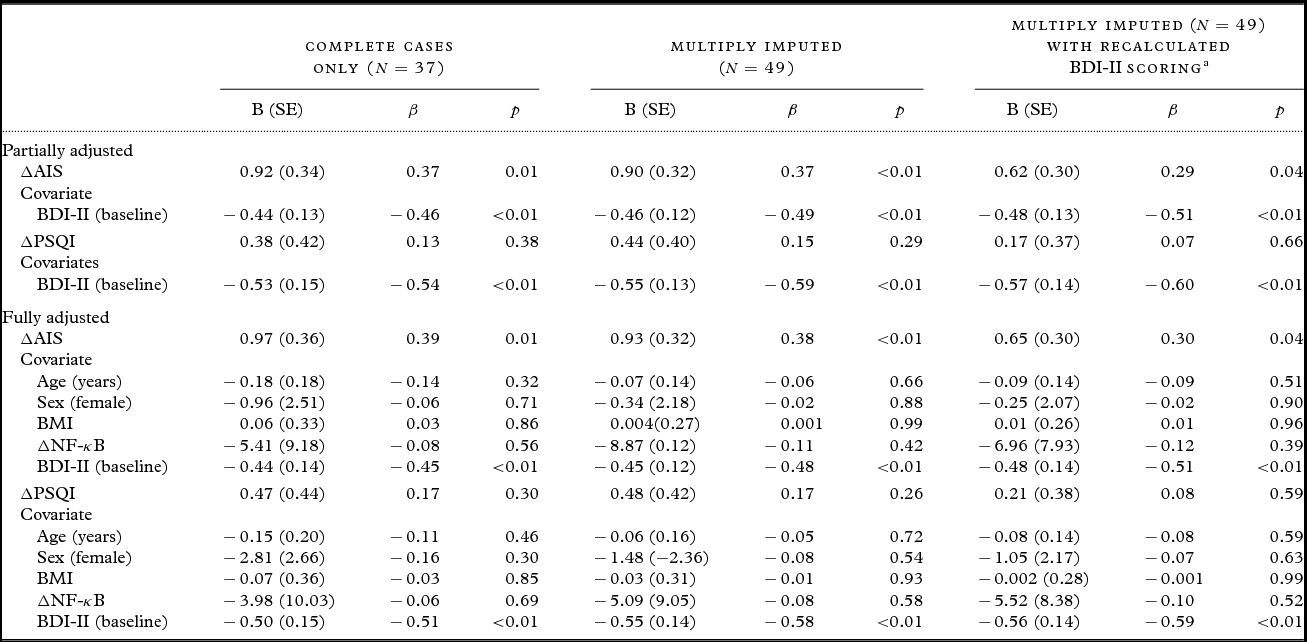
Table 1 displays our linear regression models of ΔBDI-II regressed on ΔAIS and ΔPSQI using the sample with complete cases (N = 39) and with imputed data (N = 49). When adjusting for treatment assignment and baseline outcome only, ΔAIS was positively associated with ΔBDI-II scores within complete cases (β = 0.37, p = 0.01) and within the imputed data (β = 0.37, p < 0.01). When fully adjusting for biological covariates – age, sex, BMI, and ΔNF-κB activation – improvement in AIS scores was associated with improvement in BDI-II scores within complete cases (β = 0.39, p = 0.01) and within the multiply imputed data (β = 0.38, p < 0.01). Estimates for ΔAIS did not differ between the completed cases only and the imputed data by more than 4% for either partially adjusted or fully adjusted models. When recalculating BDI-II without the sleep- and fatigue-related items, the association between ΔAIS and ΔBDI-II reduced in magnitude with both partial (β = 0.29, p = 0.04) and full adjustment (β = 0.30, p = 0.04).
Partially and fully adjusted multiple linear regression models of change (Δ) in sleep measures (AIS, PSQI) predicting change (Δ) in depressed mood (BDI-II)

Note: AIS = Athens Insomnia Scale, PSQI = Pittsburgh Sleep Quality Index, BDI-II = Beck Depression Inventory, BMI = Body Mass Index; NF-κB = Nuclear Factor-Kappa B in p65 ng/µg of total protein; Group = random assignment to group in main trial. All models adjusted for group assignment, which was non-significant and did not change the estimates for ΔAIS and ΔPSQI by more than 10%.
a Recalculated BDI-II scoring with sleep- and fatigue-related items (16 and 17) omitted from calculation.
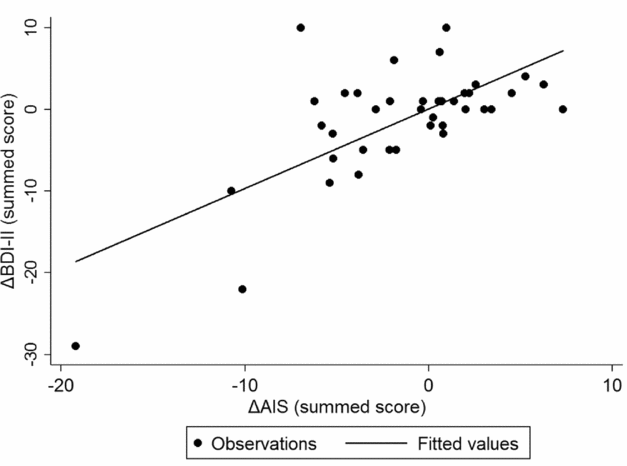
Figure 1 illustrates a scatterplot of the relationship between ΔAIS scores and ΔBDI-II scores and includes the estimated regression line for the fully adjusted model with multiply imputed full data and the recalculated BDI-II scoring (without sleep and fatigue items). The AIS domains of change in nocturnal sleep disturbance (r = 0.32, p < 0.05) and daytime dysfunction (r = 0.53, p < 0.01) were each correlated with ΔBDI-II. Change in PSQI scores was not significantly associated with change in BDI-II scores with partial (p = 0.26) or full adjustment (p = 0.59).
Scatterplot of change (Δ) in BDI on change (Δ) in AIS score. Estimated regression line (B = 0.65, SE = 0.30, β = 0.30, p = 0.04) from fully adjusted model in Table 1 using the multiply imputed data (N = 49) with recalculated BDI-II scoring (without sleep- and fatigue-related items).

Discussion
Our study of older adults with sleep problems indicates that change in insomnia symptoms positively associated with coinciding changes in depressed mood across ten weeks after adjusting for important biological covariates. Both domains of AIS (nocturnal sleep disturbance and related daytime dysfunction) appeared to be significantly correlated with change in depressed mood, although change in daytime dysfunction stood out as the stronger correlate of change in depressed mood. Change in global sleep quality as assessed with the PSQI was not associated with change in depressed mood during this time period.
The present study supports existing literature demonstrating the longitudinal association between insomnia symptoms and depressed mood in older adults (Irwin, Reference Irwin2015). Our findings also suggest that the measure of insomnia (AIS) rather than sleep quality (PSQI) is significantly associated with depressed mood in an older adult sample reporting at least moderate levels of sleep problems. These findings are consistent with research by Jaussent et al. (Reference Jaussent2011), which suggests that the association between insomnia and subsequent onset of depressive symptoms four years later appears to be driven by difficulty in initiating and difficulty in maintaining sleep, but not poor sleep quality. Rather, poor sleep quality appeared primarily in participants with pre-existing symptoms of depression. In the present study, the AIS might also be a stronger correlate with depressed mood than the PSQI because the general sleep difficulties captured by the PSQI may reflect comorbidities with common medical problems in older adults (e.g. chronic pain, cardiovascular health, respiratory problems, etc.).
Findings from this prospective study are informative regarding whether changes in insomnia and global sleep quality coincide with changes in depressed mood after ten weeks. Initial behavioral intervention research showing synonymous improvements in sleep and depressed mood among older adults further provides rationale for the possible utility of preventing depression syndromes by targeting the maintenance of adequate sleep in older adults with insomnia symptoms (Black et al., Reference Black, O'Reilly, Olmstead, Breen and Irwin2015).
Limitations
Interpretation of our findings should be weighed against limitations inherent in having only two time points of data, which allows for linear change from baseline to post-intervention, but does not account for non-linear shapes in trajectories. Future research with three or more assessment points will be useful to clarify the temporal relationship between insomnia symptoms and depressed mood in older adults. Analysis of larger samples will allow for greater generalizability to the older adult population and assessment of potential subgroup differences underlying associations between sleep and mood (i.e. sex and racial/ethnic differences).
Conflict of interest
None.
Description of authors’ roles
Li – analysis conceptualization, analysis, interpretation of findings, and writing. Kechter – interpretation of findings and writing. Olmstead – analysis and supportive writing. Irwin – resources, supervision, funding acquisition, interpretation of findings, and writing. Black – investigation (principal investigator), supervision, study conceptualization, methodology, funding acquisition, interpretation of findings, and writing.
Acknowledgments
Funding and resource support for this secondary analysis was received from the National Institute on Aging via a grant to the University of Southern California/University of California Los Angeles Center on Biodemography and Population Health (P30AG017265 to David S. Black), from the National Center for Complementary and Integrative Health (L30AT008380 to David S. Black), and from the American Mindfulness Research Association (to Michael Li). The original clinical trial received funding and resourced from grants UL1TR000124 and 1UL1RR033176 from the University of California, Los Angeles Clinical and Translational Science Institute; grant 5T32-MH019925 from the National Institute of Mental Health; the Cousins Center for Psychoneuroimmunology at the UCLA Semel Institute for Neuroscience.
Acronyms:
Pittsburgh Sleep Quality Index (PSQI)
Athens Insomnia Scale (AIS)
nuclear factor-kappa B (NF-κB)
Beck Depression Inventory-II (BDI-II)