





Introduction
School meal programs offer a vehicle to improve children’s diets, reduce the prevalence of obesity and related conditions, improve academic performance and school attendance and help to alleviate food insecurity(Reference Chen, Reitzel and Obasi1). In the USA, approximately 30 million children participate in school lunch and 15 million in school breakfast, with the majority being from low-income or food-insecure households as meals are available at reduced or no cost to these families(2). School meal programs were initially created to address child hunger and undernutrition. However, given the rising rates of childhood obesity, the 2010 Healthy, Hunger-Free Kids Act set nutrition standards(Reference Mozaffarian, Fleischhacker and Andrés3) to align with the Dietary Guidelines for Americans. The standards limit nutrients of concern such as sodium, added sugars and unhealthy fats and increase offerings of fruit, vegetables and whole-grain-rich products(4,5) . While school meals are considered among the healthiest options for children in terms of nutrient content(Reference Au, Rosen and Fenton6,Reference Kinderknecht, Harris and Jones-Smith7) , there is still room for improvement.
Ultra-processed foods (UPF) are industrially produced products that contain ingredients not typically used in home cooking, such as stabilisers, colourants, flavours, emulsifiers and sweeteners(Reference Monteiro, Cannon and Levy8) and are usually calorie-dense, high in added sugars, unhealthy fats and sodium(Reference Martini, Godos and Bonaccio9). UPF are designed to make foods hyper-palatable, increase their profitability and extend their shelf life(Reference Monteiro, Cannon and Levy8). Cohort studies have linked UPF consumption to an increased risk of excessive weight gain(Reference Vedovato, Vilela and Severo10), adiposity(Reference Zancheta, Rebolledo and Smith Taillie11) and lipid abnormalities(Reference Leffa, Hoffman and Rauber12) in children. Two clinical trials in adults have also shown that UPF consumption is associated with increased calorie intake, weight gain and higher body fat levels(Reference Hall, Ayuketah and Brychta13,Reference Hamano, Sawada and Aihara14) . Despite these health risks, UPF account for 67 % of total caloric intake among US children(Reference Wang, Martínez Steele and Du15). While there is no study in the USA that evaluates the consumption of UPF from school meals, in the UK, it is estimated that more than 70 % of lunch calories come from UPF, with a higher proportion from lunches brought from home (83%) compared with school meals (70%)(Reference Parnham, Chang and Rauber16).
Given that school meals can contribute about half of the calories in children’s diets(Reference Cullen and Chen17), reducing the UPF content in school meals presents a key opportunity to improve child health outcomes and reduce health disparities. Accordingly, there is growing policy interest in limiting UPF in school meals in the USA. At least ten states have introduced legislation aimed at reducing UPF in school meals. In California, the setting for this work, Governor Newsom’s Executive Order N-1-25 directs state agencies to identify policy actions to reduce UPF consumption, including in school settings(19). As a result, the recently passed California Real Food, Healthy Kids Act (AB-1264) defined UPF based on food additives and nutrients of concern and mandates the phase-out of UPF from school meals by 2035(20).
Scratch-cooking, defined as cooking with minimally processed ingredients, offers a promising strategy to reduce the reliance on UPF in school meals and improve overall diet quality. Preparing meals from scratch can help school districts meet nutrition requirements, particularly in terms of sodium, saturated fat and added sugars. This approach can also reduce students’ exposure to unnecessary food additives and increase student participation in school meals by offering fresher, more appealing and culturally relevant options(Reference Chelius, Bacon and Orta-Aleman21). However, implementing scratch cooking and reducing UPF in school meals may present logistical and financial challenges for school food service directors (FSDs). This study examines the perceived barriers and facilitators for FSDs to increase scratch cooking as a strategy to reduce UPF in school meals.
Methods
Study design
This is a mixed-methods study, including surveys and interviews, that examined FSDs’ perceived barriers and facilitators in providing scratch-cooked meals and reducing UPF in school meals served through the US Department of Agriculture (USDA) school nutrition programs.
The study used a community-engaged approach, developed in collaboration with two community-based health advocacy organisations, the Dolores Huerta Foundation and Cultiva La Salud, which work in predominantly low-income Latino and agricultural communities in California’s San Joaquin Valley. These community partners helped identify the study objectives based on local needs and provided ongoing guidance and feedback throughout the research process. In addition, we convened a Community Advisory Board composed of representatives from the California Department of Education, and the California Department of Food and Agriculture, three FSD, the founder of a school food cooperative and members of two nonprofit organisations focused on improving school meals. The Community Advisory Board contributed to the study design, the development of the interview guide, the interpretation of the findings and the formulation of policy and practice recommendations.
Study population
The 185 school districts in the San Joaquin Valley were stratified into four groups based on locale (rural and urban) and their receipt of a freshly-prepared-meals award (FPM), which is supplementary funding from the Kitchen Infrastructure and Training grants (KIT) offered to school districts in California that attest to providing freshly prepared meals in at least 40 % of the meals offered. The sampling strata were as follows: rural districts receiving the grant (FPM-R; n 55), rural districts not receiving the grant (NFPM-R; n 71), urban districts receiving the grant (FPM-U; n 38) and urban districts not receiving the grant (NFPM-U; n 21). Within each stratum, districts were randomly ranked. We contacted the first forty-three FSDs from these randomised lists (eleven in NFPM-R, ten in FPM-R, ten in FPM-U and twelve in NFPM-U) via email (APT) and then followed up with phone calls (APT and DM). A total of twenty FSDs agreed to participate (six in NFPM-R, four in FPM-R, six in FPM-U and four in NFPM-U). (Supplementary Figure 1). Among the participants we contacted, twelve did not respond, seven declined due to time constraints, one refused for privacy concerns, two declined without providing any reason and one was on leave. We reached data saturation with twenty interviews, as no new themes emerged. Participating and non-participating districts did not differ by district characteristics (urban/rural locale, recipient of freshly prepared meal grant or KIT funds) or school characteristics (student enrollment, racial/ethnic composition and proportion of students eligible for free/reduced-price meals) (Supplementary Table 1).
Interview guide
The interview guide was developed by study researchers with input from the Community Advisory Board. The guide was based on the Socio-Ecological Model, which acknowledges that multiple levels of influence shape the procurement and provision of school meals. These constructs include policies such as federal, state and local guidance and regulations, community factors such as food vendors and the food environment, organisational influences such as school infrastructure and capacity, interpersonal dynamics such as the engagement of parents and students and individual elements including FSD’ perceptions and beliefs(Reference Golden, McLeroy and Green22). The guide covered topics such as the FSDs’ roles, school meal planning and purchasing processes, perceptions of school meal healthfulness, knowledge and beliefs about UPF, barriers and facilitators to increasing scratch-cooked meals/reducing UPF and students’ acceptance of scratch-cooked meals. Based on input from our community advisory board, questions also covered breakfast participation, although that is not the focus of the current analysis. The interview guide was pilot-tested before the study started with two FSDs not included in the study.
Data collection
From January to June 2024, we conducted twenty semi-structured interviews with FSDs, each lasting 45–60 min, followed by a 10-minute survey. The survey collected information on individual socio-demographic data (age, gender, race and ethnicity), percentage of students who participate in school breakfast and lunch and obstacles to increasing scratch-cooked meals rated on a Likert scale (1 = not an obstacle, 5 = extremely difficult obstacle). Two female researchers conducted the interviews via Zoom. APT is a Latina postdoctoral scholar with an MSc in Nutrition and a PhD in Global Health, an English second-language speaker and a mother. DM, a senior research scientist, holds an MSc and PhD in Nutrition, is white and is also a mother. When scheduling the interview, we emailed the consent form to participants, providing general information about the study’s objective. We informed participants that they could bring an additional person to the interview if they believed that person could provide further insights on the topic. One FSD was joined by the Child Nutrition Coordinator and another by a cafeteria aide. On the day of the interview, we reviewed the consent form with participants and obtained verbal consent before beginning the interview. The interviewers had no prior interaction with the participants before the study. Interviews were conducted in English and were video- and audio-recorded and transcribed verbatim by research assistants. All transcripts were de-identified by removing FSDs’ names, school districts’ names and other names or personal information that may identify them. District-level demographics were obtained via public online data from the California Department of Education(23). Participants received $50 gift cards for their participation; three FSDs declined this compensation. The Stanford University Institutional Review Board approved the study (IRB #70983).
Analysis
A hybrid thematic analysis (inductive and deductive) was performed to analyse the qualitative data(Reference Kiger and Varpio24). Three analysts (APT, AG and AZDG) initially coded five interviews independently to capture emergent topics, achieving consensus through discussion. Then, the three analysts, along with the interviewer (DM), collaboratively developed an initial codebook that mapped these topics onto a priori themes based on the socio-ecological model, identifying barriers and facilitators within each theme. The analysts then double-coded all interviews using the final codebook, resolving discrepancies through discussion, adding new codes and refining the codebook as necessary. Reflexivity was maintained throughout the process by discussing potential biases and perspectives among the research team. Member checking was conducted with the Community Advisory Board and FSDs by sharing the preliminary findings to obtain feedback and ensure the results reflected the perspectives and experiences of the FSDs. NVivo software was used for data coding and management.
Quantitative data were analysed using summary statistics (frequencies and percentages). Likert scale responses were collapsed into three categories (not an obstacle, neutral and an obstacle). Quantitative analyses were conducted using Stata SE version 17. Findings were integrated with qualitative data themes to provide a comprehensive understanding of the barriers and facilitators for providing scratch-cooking meals.
Results
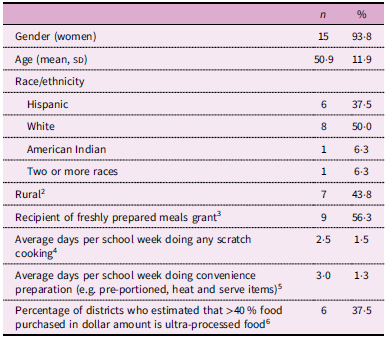
Most participants were women (93·8 %), of White (50 %) or Hispanic (37·5 %) race/ethnicity, with a mean age of 50·9 years (sd = 11·9). FSDs reported serving scratch-cooked items an average of 2·5 d per week (sd = 1·5) and using convenience-prepared foods about 3 days per week (sd = 1·3). Additionally, 38 % estimated that 40 % or more of the food purchased in their district during the current school year consisted of UPF (Table 1).
Socio-demographic characteristics of food service directors participating in the study (n 16) 1

Table 1. Long description
A table showing socio-demographic characteristics of food service directors. The table has 11 rows and 3 columns. The columns are labeled 'n', '%', and various socio-demographic characteristics. Row 1: Gender (women), 15, 93.8 percent. Row 2: Age (mean, sd), 50.9, 11.9. Row 3: Race/ethnicity. Row 4: Hispanic, 6, 37.5 percent. Row 5: White, 8, 50.0 percent. Row 6: American Indian, 1, 6.3 percent. Row 7: Two or more races, 1, 6.3 percent. Row 8: Rural, 7, 43.8 percent. Row 9: Recipient of freshly prepared meals grant, 9, 56.3 percent. Row 10: Average days per school week doing any scratch cooking, 2.5, 1.5. Row 11: Average days per school week doing convenience preparation (e.g., pre-portioned, heat and serve items), 3.0, 1.3. Row 12: Percentage of districts who estimated that more than 40 percent food purchased in dollar amount is ultra-processed food, 6, 37.5 percent.
UPF, ultra-processed foods.
1 Note: 4 participants did not complete survey.
2 Following National Center for Education Statistics (NCES) classification, rural and town locales were classified as ‘rural’ and suburban and urban locales as ‘urban’.
3 Supplementary state-level Kitchen Infrastructure and Training (KIT) funding granted to districts who attested that at least 40 % of their school meals are freshly prepared onsite (Freshly Prepared Meals grant).
4 Response obtained from the following question: In a typical week, how many days at a typical school does your School District use each of the following for reimbursable meals? School-made/scratch or modified scratch preparation (use of minimally processed foods, some degree of ingredient preparation and cooking when needed, e.g. spaghetti with scratch-prepared sauce).
5 Response obtained from the following question: In a typical week, how many days at a typical school does your School District use each of the following for reimbursable meals? Convenience preparation (pre-portioned, heat and serve items, e.g. frozen burrito).
6 Response obtained from the following question: During the current school year, what is your best estimate of the percentage of ultra-processed foods* (in dollar amount) purchased in your district? * Ultra-processed foods are usually packaged food with a lot of ingredients and some of them you don’t recognize nor have in your kitchen. UPF doesn’t look much like the original ingredients (like fruits or vegetables) because they go through extensive factory processing – some examples include chips, ready-to-eat cereal, some packaged pastries, and some heat-and-serve items.
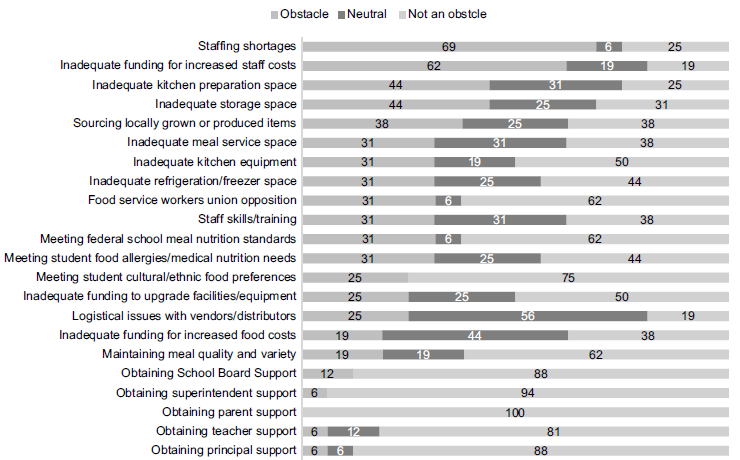
Figure 1 presents results from the quantitative survey in which FSDs rated on a Likert scale the extent to which various factors pose obstacles to increasing scratch cooking. Two-thirds of FSDs identified staffing shortages and inadequate funding for labour as obstacles, followed by insufficient storage and kitchen preparation space. In contrast, FSDs rated the following as not being an obstacle: gaining support from parents and school leadership, accommodating cultural food preferences, meeting federal nutrition standards, opposition from food workers’ unions and maintaining meal quality and varieaty. Responses were mixed regarding factors such as sourcing local foods, having meal service space, refrigeration/freezer capacity and staff training.
Perceived barriers from School Food Service Directors to increase scratch cooking in school meals (n 16).

Guided by the socio-ecological model, seven themes emerged from the interviews as influencing the adoption of scratch cooking in schools. At the policy level, state and federal regulations were identified as critical factors. At the organisational level, key elements included food procurement, grants and funding, kitchen infrastructure and equipment, as well as staff capacity and training. At the interpersonal level, student preferences and at the personal level, training and support for FSDs, as well as FSDs’ educational background, played a significant role in the transition to scratch cooking initiatives (Tables 2 and 3).
Barriers to implementing scratch cooking in school meals in San Joaquin valley school districts

Table 2. Long description
The table presents barriers to implementing scratch cooking in school meals, organized into several themes: State and federal regulations, California regulations, Food procurement, Grants and funding, Kitchen infrastructure and equipment, Staff capacity and training, Students' preferences, and Food service director capacity and training. The table has two columns: Description and Illustrative quote. The Description column lists specific challenges or issues within each theme, while the Illustrative quote column provides quotes that illustrate these challenges. The table contains 8 rows and 2 columns. Row 1: State and federal regulations, Challenges of balancing USDA nutrition regulations with scratch cooking. Row 2: California regulations limit the ability to source from local vendors. Row 3: Food procurement, USDA commodities are processed by manufacturers into ultra-processed products. Row 4: USDA-compliant K-12 products are ultra-processed. Row 5: Remote locations limit vendor options and access to fresh foods. Row 6: Grants and funding, Uncertainty about future funding limits long-term planning for scratch cooking. Row 7: Grant writing and reporting requirements discourage districts from applying. Row 8: Kitchen infrastructure and equipment, Small, outdated kitchens and lack of proper equipment prevent districts from implementing scratch cooking. Row 9: Transition of food availability and district priorities over time. Row 10: Staff capacity and training, Limited staff and part-time or split-shift schedules make it difficult for districts to expand scratch cooking. Row 11: Lack of training and cooking skills prevents from implementing scratch cooking. Row 12: Students' preferences, Scratch-cooked meals are harder to share, increasing food waste. Row 13: Students often don't eat scratch-cooked meals, leading to waste. Row 14: Competition from nearby fast-food restaurants and coffee shops. Row 15: Food service director capacity and training, Food safety concerns create hesitation around scratch cooking. Row 16: FSD without a nutrition background struggle to understand and meet regulations. Row 17: Lack of district support for FSD hinders their ability to submit grant applications.
FSD, food service directors.
Numbers in brackets (e.g. ID 01) refer to individual participant numbers.
Facilitators to implementing scratch cooking in school meals in San Joaquin valley school districts

Table 3. Long description
A table summarizing factors influencing the adoption of scratch cooking in school meals, organized into seven themes: State and federal regulations, Food procurement, Grants and funding, Kitchen infrastructure and equipment, Staff capacity and training, Food waste and students preferences, Food service director capacity and training. The table has two columns: Description and Illustrative quote. The Description column lists the themes, and the Illustrative quote column provides quotes related to each theme. The table has 18 rows, each row corresponding to a specific factor within the themes. Row 1: Description: Universal school meals help school district to move towards scratch-cooking, Illustrative quote: We just recently did get to add a manager position due to our increased participation [due to school meals for all]. So that's great to add some new employment opportunities and, and fresher food. That site was a pack-out site and now they are cooking in their kitchen. So that's exciting to see. Row 2: Description: Scratch cooking help them to meet USDA nutrition standards, Illustrative quote: It's easier to prepare [food from scratch] because of some of the salt restrictions and all of that. So it's, it's easier for us to prepare them, [because we can add the flavoring,"we can add seasonings", we can make them have the flavor that the kids are used to]. Row 3: Description: USDA commodities provide minimally processed foods, Illustrative quote: That's not the only raw meat we've done ... we've done turkey, we've done pork, and that is because these items come from USDA. So they come from USDA, you want to utilize them as best you can[2]. Row 4: Description: Department of defense products provides fresh and local products, Illustrative quote: We love DOD. Every director loves DOD. You know, the produce that you can get it is fairly local ... and there's so many fruits and things that we wouldn't normally be able to get from our produce vendor because of cost. Row 5: Description: Minimally processed food is less costly, Illustrative quote: The only reason why [we serve minimally processed food] is because when it's ultra processed it's kind of pricier. Row 6: Description: KIT funding helps to move towards scratch cooking, Illustrative quote: We got the KIT funds and so that you know that meant that we had even more money ... I [was] buying the cheapest burrito that I could find from Gold Star when we were poor. But now that we're not poor, right? I'm gonna be looking at a nicer product, right? ... or you know, maybe I'm gonna figure out a way to make that burrito so that it's more like scratch. Row 7: Description: KIT funding allows them to buy equipment for scratch cooking, Illustrative quote: [KIT funds] really helped me move towards scratch cooking and allowed us to purchase a new tilt skillet ... it allow us to buy equipment, to buy extra serving utensils, warmers. And those are items that you do need to continue to scratch cook[17]. Row 8: Description: Having the adequate equipment helps to move towards scratch cooking, Illustrative quote: We've systemically replaced all of our equipment to help the kitchen succeed. They have brand new, large capacity food processors so they can make dice, slice, julienne, all the good things, right. We make pico de gallo from scratch ... They all are getting flat top ranges so that we can do saute, stir fries. Row 9: Description: Having kitchens in each school facilitates scratch cooking, Illustrative quote: So with us having the ability and having full kitchens, complete full kitchens, I'm talking about ovens, skillets, steamers, 3 compartment sinks like we can run seamlessly and cook a whole meal for a very, very mass amount of people ... it makes it a lot easier when you have a full kitchen to work with and you can do a lot more things from scratch. Row 10: Description: Staff training help staff to manage raw foods, Illustrative quote: We have some staff that are very confident in cooking raw foods. Poultry or anything like that but then we have some staff that aren't at all and are very nervous ... but we do raw hamburgers, we do raw turkey breast, we do our turkey gravy, so slowly but surely we are implementing that ... and they're getting more confident and it comes with training. Row 11: Description: Students prefer less processed food, Illustrative quote: We try to make everything fresh on campus as we can. Because that's something that we noticed that the students liked. They didn't like the pre-packaged stuff[6]. Row 12: Description: Students prefer food that is culturally relevant, Illustrative quote: When we give them something that's yummy as like lasagna, that's a foreign concept. But if we have something on the menu like pozole, because it's ethnically relevant. Oh, they kill it. They'll just, they'll clean us out and go, hey, we want more. Row 13: Description: Partnerships with local communities to distribute excess food, Illustrative quote: I actually started a partnership, a rare partnership with the with the public health service department ... So the public health department collects any waste that's it's not food waste but it's food that would have gone to the trash ... like a whole produce, milk that hasn't been open, juice that hasn't been open, any hot entrees that wasn't, exposed to any time and temperature abuse ... So they pick up daily or every other day from our school sites and that is distributed back out to the community ... And honestly, we saved over a million pounds in waste just in the past year[16]. Row 14: Description: Engagement programs help parents and students to accept more meals cooked from scratch, Illustrative quote: [Parents and students] have been very receptive to the changes. Because again, we are over communicators. The way we communicate what our program is doing, the changes we're making ... we have very, very little to minimal challenges. Row 15: Description: Reading and understanding food labels help them to make better decisions, Illustrative quote: I read labels. I don't like to give them MSg even though the science now is saying that that's not as bad for you but I don't like to give them additives. I really like to know, ok at the labels and make sure that they were not giving a lot of stuff [like] that[13]. Row 16: Description: Lack of ingredients, a small number of ingredients, and all of them that when you read the ingredient you know what it is ... we don't want hydroxy sulfite, like we want water ... we're looking for from the earth, to the earth. Row 17: Description: Food service director capacity and training, Illustrative quote: I read labels. I don't like to give them MSg even though the science now is saying that that's not as bad for you but I don't like to give them additives. I really like to know, ok at the labels and make sure that they were not giving a lot of stuff [like] that[13]. Row 18: Description: Lack of ingredients, a small number of ingredients, and all of them that when you read the ingredient you know what it is ... we don't want hydroxy sulfite, like we want water ... we're looking for from the earth, to the earth.", "EDH": "
KIT, Kitchen Infrastructure and Training; USDA, US Department of Agriculture.
Numbers in brackets (e.g. ID 01) refer to individual participant numbers.
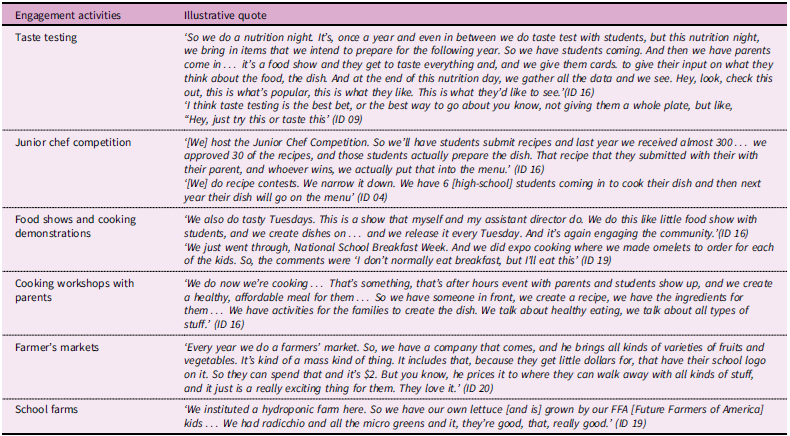
Engagement activities for parents and students reported by food service directors from San Joaquin valley school districts

Table 4. Long description
A table with six rows and three columns. The columns are labeled Engagement activities, Illustrative quote, and numbers in brackets. The rows are labeled Taste testing, Junior chef competition, Food shows and cooking demonstrations, Cooking workshops with parents, Farmer’s markets, and School farms. Row 1: Engagement activities, Taste testing; Illustrative quote, So we do a nutrition night. Its, once a year and even in between we do taste test with students, but this nutrition night, we bring in items that we intend to prepare for the following year. So we have students coming. And then we have parents come in its a food show and they get to taste everything and, and we give them cards. To give their input on what they think about the food, the dish. And at the end of this nutrition day, we gather all the data and we see. Hey, look, check this out, this is whats popular, this is what they like. This is what theyd like to see. I think it taste testing is the best bet, or the best way to go about you know, not giving them a whole plate, but like, Hey,just try this or taste this; numbers in brackets, (16) (9). Row 2: Engagement activities, Junior chef competition; Illustrative quote, [We] host the Junior Chef Competition. So well have students submit recipes and last year we received almost 300 we approved 30 of the recipes, and those students actually prepare the dish. That recipe that they submitted with their with their parent, And whoever wins, we actually put that into the menu. [We] do recipe contests. We narrow it down. We have 6 [high-school] students coming in to cook their dish and then next year their dish will go on the menu; numbers in brackets, (16) (4). Row 3: Engagement activities, Food shows and cooking demonstrations; Illustrative quote, We also do tasty Tuesdays. This is a show that myself. And my assistant director we do we do this like little food show with students, and we create dishes on and we release it every Tuesday. And its again engaging the community. We just went through, National School Breakfast Week. And we did expo cooking where we made omelets to order for each of the kids. So, the comments were I dont normally eat breakfast, but Ill eat this; numbers in brackets, (16) (19). Row 4: Engagement activities, Cooking workshops with parents; Illustrative quote, We do now were cooking Thats something, thats after hours, event with parents and students show up, and we create a healthy, affordable meal for them So we have someone in front, we create a recipe, we have the ingredients for them We have activities for the families to create the dish. We talk about healthy eating, we talk about. All types of stuff in that and that now were Its; numbers in brackets, (16). Row 5: Engagement activities, Farmer’s markets; Illustrative quote, Every year we do a farmers market. So, we have a company that comes, and he brings all kinds of varieties of fruits and vegetables. Its kind of a mass kind of thing. It includes that, because they get little dollars for, that have their school logo on it. So they can spend that and its $2. But you know, he prices it to where they can walk away with all kinds of stuff, and it just is a really exciting thing for them. They love it; numbers in brackets, (20). Row 6: Engagement activities, School farms; Illustrative quote, We instituted a hydroponic farm here. So we have our own lettuce [and is] grown by our FFA [Future Farmers of America] kids We had radicchio and all the micro greens and it, theyre good, that, really good; numbers in brackets, (19).
Numbers in brackets (e.g. ID 01) refer to individual participant numbers.
State and federal regulations
FSDs noted that state and federal regulations hinder scratch cooking. For example, USDA standards complicate scratch cooking due to the need to calculate the nutrient content of meals served, which can lead to reliance on packaged products with Child Nutrition (CN) labels to help FSDs be compliant with nutrition standards. One FSD stated, ‘I got to have that CN [Child Nutrition] label to meet regulations… if you want to do something scratch cooking, that puts on a whole other level of complexity that I wish we had more support on doing that.’
Conversely, some FSDs argued that scratch cooking helps them to adapt the recipes to make them culturally relevant for the students and to meet USDA standards by allowing control over fat and sodium levels: ‘It’s easier to prepare [food from scratch] because of some of the salt restrictions and all of that. So, it’s easier for us to prepare them, [be]cause we can add the flavoring, we can add seasonings, we can make them have the flavor that the kids are used to.’ Most FSDs acknowledged that Universal School Meals programs improved their budgets, enabling more scratch cooking and additional hiring.
Food procurement
FSDs noted that preparing minimally processed meals was a challenge due to the prevalence of UPF available and marketed to schools. As one FSD explained, ‘It’s hard for [school food] to be minimally processed, in part because of the products available. The ones with CN [Child Nutrition] labels and those specifically marketed as school products are not minimally processed.’ Additionally, although USDA commodities are mostly minimally processed, FSDs often send them to manufacturers for processing and then come back to their school as UPF: ‘I’m sending my chicken [from USDA commodities] to, let’s say, Tyson and getting chicken patties and chicken nuggets.’ Some FSDs believed that while buying minimally processed food could be cheaper, the higher labour costs associated with preparing scratch-cooked meals pose a challenge.
Grants and funding
FSDs appreciated the California Department of Education funding for kitchen infrastructure and training. However, uncertainty about future funding prevents them from making sustainable changes. As one FSD noted: ‘Thinking into the future, budget is always going to be a concern… not knowing where that’s going to go is always something that’s top of my mind.’ Additionally, grant writing and reporting requirements discouraged them from applying, especially in districts with limited administrative support: ‘I just haven’t had the support to explore those opportunities… I would love to be able to do those things, but I just am having a hard time managing my day-to-day.’
Kitchen infrastructure and equipment
As noted, FSDs found California Department of Education funding helpful for updating equipment and infrastructure, but the use of that funding varied. Some chose to upgrade equipment with skillets, choppers and flat top ranges to support scratch cooking, while others purchased ovens to continue their ‘heat and serve’ practices. Limited kitchen space also prevented them from making equipment upgrades, as one FSD noted: ‘We all got KIT [Kitchen, Infrastructure and Funding] funds, we have to spend them, but in little, tiny kitchens, it’s hard… you can’t put in like a braiser or anything because you have no hood.’ FSDs noted that on-site kitchens facilitated scratch cooking ‘It makes it a lot easier when you have a full kitchen to work with and you can do a lot more things from scratch.’
Staff capacity and training
Limited staffing was a common challenge for increasing scratch cooking. Some FSDs relied on part-time staff, which was sufficient for heating and serving but inadequate for food preparation. Budget constraints and uncertainty about future grants restricted hiring. For example, some FSDs mentioned that they could only hire staff who work 4-hours/day because full-time staff would need to receive benefits, which their existing budget cannot cover. Training was another concern, as one FSD noted, ‘It’s very challenging [to do scratch cooking]. They’re not trained cooks. They’re trained to heat and serve. So, as we increase the amount of real cooking, we have to also increase that training for them.’ FSDs also noted concerns about food safety, particularly regarding staff training for preparing raw foods, especially raw meat.
Student’s preferences
Some FSDs reported that students have shown increased interest in fresher meals. However, some noted that when they offer scratch-cooked meals, students often will not eat them. A related concern is the potential increase in food waste, either because students do not eat the meals or because, unlike packaged food, scratch-cooked items are harder to redistribute or donate. Despite these challenges, some FSDs have implemented strategies to increase student and parent engagement to increase participation, consumption and reduce food waste. These include taste tests, bringing farmers’ markets to schools for children to purchase fruit and vegetables, chef competitions and cooking workshops (Table 4). One FSD described a partnership with the local Department of Public Health, which collects leftover or unused food from the school district and distributes it to the community, noting that this effort saved ‘over a million pounds in waste just the past year.’
Food service director training and support
Some FSDs with nutrition or culinary backgrounds reported feeling more confident in reducing UPF and implementing practices such as training staff or reading ingredient labels to avoid food additives. As one FSD explained, ‘I read labels. I don’t like to give them MSG [Monosodium Glutamate]… [I like to] look at the labels and make sure that we are not giving them a lot of stuff like that.’ In contrast, other FSDs expressed a desire for more training and support, particularly in navigating nutrition regulations: ‘I open [the food buyer guide], and it’s mumbo jumbo to me…unless you’re a registered dietitian, you don’t know what all of that means.’
Discussion
Guided by the socio-ecological model, this study identified key barriers and facilitators to increasing scratch cooking in school meals, as reported by FSDs from a diverse sample of school districts in California’s largely rural, agricultural and low-income San Joaquin Valley. Labour costs, staff shortages and inadequate kitchen infrastructure were the most common challenges. State and federal funding have helped support the transition to scratch cooking in some districts. However, others faced challenges using the funding effectively due to limited kitchen space, outdated infrastructure and uncertainty about future funding. Food procurement was also a barrier, as many school districts send unprocessed USDA foods (also known as commodities) to food manufacturers, resulting in UPF, and most food products available from school food vendors are ultra-processed. While student preferences were mentioned as a challenge by some FSDs, others described successful strategies to engage students and parents, which helped boost participation in school meals.
Staff shortages and labour costs were important barriers to expanding scratch cooking in school meal programs. A previous study surveying 200 FSDs across California similarly identified labour costs as the main challenge to transitioning towards more scratch-cooked meals(Reference Vincent, Gunderson and Friedman25). Due to high labour costs, we found that many school districts depend on part-time or split-shift staff, which limits the time available for meal preparation and forces districts to use ‘heat and serve’ practices that rely on more processed meals. Research suggests that it is possible to offer scratch-cooked meals without significantly increasing overall costs. Astudy that evaluated the costs of school meal entrées prepared from scratch v. those made with food sent to an external processor found that scratch-cooked meals had significantly lower food costs and higher labour costs; however, the overall cost did not differ between the two approaches(Reference Woodward-Lopez, Kao and Kiesel26).
Still, increasing scratch cooking requires a full-time workforce with greater cooking skills and fair wages. Current wage disparities make it more difficult to recruit and retain full-time, permanent school food service staff. For example, California’s law mandates a $20 per hour minimum wage for fast-food workers(27) compared with the minimum wage of $16·50 in California, which most school kitchen staff receive(28). To address these challenges, it is critical to identify stable state or federal funding that would enable districts to hire more full-time staff with fair wages and benefits, ultimately supporting the expansion of scratch cooking and improving staff retention.
Although budget uncertainty was identified as a concern and a key decision point to move towards scratch cooking, Universal School Meals has also helped FSDs to improve their budget by increasing student participation. Therefore, continuing Universal School Meal policies could support school districts in transitioning to scratch cooking. A study in California found that medium and large school districts offering universal school meals had, on average, lower costs per breakfast and lunch compared with those without Universal School Meals, without compromising meal quality(Reference Long, Marple and Andreyeva29). One possible explanation for this finding is economies of scale(Reference Bernet and Singh30), in which the cost per meal decreases as a result of serving a higher number of meals, which allows fixed costs such as administrative, labour and equipment costs to be distributed over a larger number of meals. Therefore, higher participation through Universal School Meal programs may help reduce the cost per meal, making it more feasible for districts to invest in the staffing and infrastructure required for scratch cooking.
Another important finding was the commonly described procurement of UPF through the USDA food processing program. This program allows school districts to send USDA foods (e.g.cheese, flour and tomato paste) to food manufacturers, who, in turn, return processed food products (e.g. frozen pizza)(31). While the program is intended to improve the utilisation of USDA foods, it may inadvertently promote the production and consumption of UPF in school meals. Although these products are often formulated to meet USDA nutrition standards, they may still be high in nutrients of concern and may contain cosmetic additives of concern for potential adverse health effects, such as emulsifiers (e.g. carrageenan, polysorbates), sweeteners (e.g. sucralose, acesulfame), food colours (e.g. red 40, yellow 5, blue 1, titanium dioxide), flavour enhancers (e.g. monosodium glutamate), preservatives (e.g. butylated hydroxyanisole) and among others(Reference Whelan, Bancil and Lindsay32).
Furthermore, while these products are appealing to school districts due to student preferences and convenience, studies have documented associations between UPF consumption and adverse health outcomes, including obesity, even after adjusting for overall diet quality(Reference Dicken and Batterham33). In addition, serving UPF in school meals does not support the development of healthy eating habits, representing a missed opportunity to shape food preferences during childhood(Reference Varela, De Rosso and Ferreira Moura34). To address this issue, the USDA could consider establishing requirements that encourage school food processors to limit the production of UPF and prioritise the development of minimally processed foods that are not classified as UPF(Reference Monteiro, Cannon and Levy8). School districts could also prioritise partnering with local food processors to support the local economy, promote more sustainable diets and contribute to broader strategies aimed at mitigating climate change(Reference Willett, Rockström and Loken35). In the long term, the USA could follow Brazil’s best practices, where 90 % of the food procured for school meals programs is required to be unprocessed or minimally processed(Reference Popkin, Barquera and Corvalan36).
It is important to note that agriculture is the primary economic activity for many families in the San Joaquin Valley, where this study was conducted. Yet, some FSDs reported that procuring local foods remains a barrier to implementing scratch cooking in schools. Several barriers to procuring local foods have been identified, including uncertainty about supply quantity, higher costs, delivery challenges and food safety concerns(Reference Smith, Wleklinski and Roth37). An important structural barrier is the buying power of large food corporations within the food system(38). A small number of corporations dominate what is grown, processed and distributed, thereby limiting the availability of locally sourced foods in the San Joaquin Valley. For instance, even when farmers wish to sell directly to schools, their produce may already be contracted or pre-committed to large corporate buyers. Local farmers also face challenges, including meeting low price requirements, navigating the school procurement process and maintaining the production capacity needed to fulfill the school district’s demands(Reference Nieto-Friga, McKee-Brown and Shi39).
To address these barriers, creating and strengthening regional food hubs that aggregate produce from small farms and connect local farmers with school districts can improve access to fresh, locally grown foods. The California Farm to School Program, led by the California Department of Food and Agriculture, has championed several initiatives to reduce these barriers, such as the Resilient Food Systems Infrastructure Program, the Farm to Community Food Hub(40) and Farm to School Incubator Program, which has provided $87 million in funding to 375 farm to school projects with the objective of connecting children to locally sourced produce in schools and childcare centres(41). To help increase scratch cooking in schools, it is essential to continue funding for these programmess and identify efforts to simplify the procurement process to make it easier for local farmers to sell their products to schools and to provide incentives for FSDs to prioritise local food procurement.
Another barrier identified by FSDs is a lack of adequate kitchen equipment and infrastructure. The USDA National School Lunch Program Equipment Assistance Grant allocated $12 million to the state of California between 2021 and 2024(42), and the California Kitchen Infrastructure and Training funds provided approximately $720 million in 2021 and 2022 to school districts in California(43). However, kitchen infrastructure and equipment remained a concern, highlighting the variability in how districts allocate and utilise these resources. For example, while some districts used the funds to upgrade kitchen facilities and invest in equipment that supports scratch cooking, others opted to purchase additional ovens to continue pre-existing heat-and-serve practices. This variability in resource utilisation highlights a need for guidance and more structured technical assistance. To better support the intended goals of these grants, state agencies such as the State Departments of Education or Public Health could consider providing technical assistance alongside funding to help districts make better use of the resources and effectively identify and implement strategies that promote scratch cooking practices. Additionally, the state departments could create an online training course that FSDs and staff could take, addressing the most common barriers to moving towards scratch cooking, such as nutrition education, culinary skills, recipe development and food safety.
Some FSDs expressed concerns about students’ food preferences and potential food waste when considering a shift towards more scratch cooking. However, a study conducted in California found that scratch-cooked meals were associated with fewer participation barriers, including more favourable perceptions of taste, freshness and healthfulness(Reference Zuercher, Orta-Aleman and French44). Similarly, focus groups with middle and high school students indicated a preference for fresh, minimally processed foods and a perception of packaged or UPF as unhealthy(Reference Chelius, Bacon and Orta-Aleman21). In our study, one school district that primarily offers scratch-cooked meals on-site reported that scratch cooking helps to tailor the meals according to the school demographics and has also implemented several engagement initiatives with parents and students to showcase how meals are prepared. Strategies such as taste testing, chef competitions, cooking workshops and school gardens involving both parents and students may help increase acceptance and positive perceptions of scratch-cooked meals, particularly during the transition period, when students may be more likely to notice changes in the food. Integrating food and nutrition education into the school curriculum can also support a smoother transition by reinforcing the connection between what students learn in class and what is served in the cafeteria.
This study has several limitations that should be considered. First, the study was conducted in school districts located in California’s San Joaquin Valley, a region with specific demographic, economic and agricultural characteristics. As a result, the findings may not be fully generalisable to other regions in California or the USA with different contexts. However, to increase the transferability of our findings, we included FSDs from both urban and rural areas, as well as from districts that received and did not receive grants to enable freshly prepared meals. Additionally, we conducted a community validation with our Community Advisory Board, which includes FSDs from other geographic areas and key personnel who work with districts from other regions. Second, the study may be subject to selection bias as we observed a relatively low response rate. However, no notable differences were observed between participating and non-participating districts in terms of district characteristics (rural/urban locale, freshly prepared meals grant receipt and KIT funds) or school characteristics (student enrollment, racial/ethnic composition and eligibility for free/reduced-price meals). Nonetheless, it is possible that FSDs who chose to participate had specific characteristics, such as more interest or involvement in scratch cooking, which may not reflect the broader population of FSDs in the region. Third, the study may be influenced by social desirability bias, in which FSDs may have reported practices or beliefs that they perceived to be potentially aligned with the goals of the study. However, we observed great variability in opinions and practices. Despite these limitations, the results of this study provide valuable information for informing future implementation efforts aimed at increasing scratch cooking in school meals.
Conclusion
This study provides valuable information to better understand the barriers and facilitators school districts face in increasing scratch cooking efforts. Barriers such as limited staff, inadequate kitchen infrastructure and the ubiquity of UPF make it difficult to transition to scratch cooking. Given the current window of opportunity and interest at local, state and federal levels to improve the nutritional quality of school meals, these findings offer timely and important insights to guide the implementation of policies and practices aimed at reducing UPF by increasing scratch cooking. These efforts should include technical assistance, along with funding to hire and retain staff, update kitchen infrastructure and provide training for food service staff and directors. Additionally, strategies are needed to disincentivise the procurement of UPF in school meals and incentivise the procurement of minimally processed foods. Because school meals are a powerful tool to improve children’s nutrition and health, advancing school policies that support even higher-quality meals is imperative.
Supplementary material
To view supplementary material for this article, please visit https://doi.org/10.1017/S1368980026103139.
Acknowledgements
We thank the FSD who participated in the interviews and the Community Advisory Board: Jane Alvarado-Banister, Jennifer McNeil, Anne Moertel, Dee Abbema, Amanda Harvey, June Richardson, Joe Cook, and and a member who prefers to remain anonymous.
Author contributions
A.P.T. conceptualised the study, collected and analysed the data, wrote the original draft of the manuscript and secured funding. D.M. collected the data and critically reviewed the manuscript. A.Z. and A.G. analysed the data and critically reviewed the manuscript. A.S., A.D.L.R., D.D., G.I., C.H., K.H. and L.D.R. contributed to study conceptualisation and critically reviewed the manuscript. A.I.P. contributed to study conceptualisation, securing funding and writing the original draft of the manuscript. All authors reviewed and approved the final manuscript.
Financial support
This work was supported by the National Institute of Diabetes and Digestive and Kidney Diseases funded DREAMS Center for Diabetes Translation Research under award number P30DK092924 (APT), Stanford Maternal and Child Health Research Institute (APT), William and Nancy Thompson Family Foundation (AP, CH, KH, APT) and Stanford Impact Labs (AP and APT). Research reported in this publication was also supported by the National Heart, Lung, and Blood Institute of the National Institutes of Health under award No. K24HL169841. The content is solely the responsibility of the authors and does not necessarily represent the official views of the National Institutes of Health. Funders had no role in the design, analysis or writing of this manuscript, or decision to submit the manuscript for publication.
Competing interests
None.
Ethical standards
This study was conducted according to the guidelines laid down in the Declaration of Helsinki, and all procedures involving research study participants were approved by the Stanford Institutional Review Board. Verbal informed consent was obtained from all subjects. Verbal consent was witnessed and formally recorded.




 Open access

