An inverse relationship between surgical volumes and early mortality has been described in both cardiothoracic surgical programmes and general surgical programmes.Reference Reames, Ghaferi, Birkmeyer and Dimick1 In congenital and paediatric heart surgery, this relationship was investigated and documented for overall programmatic outcomes involving the entire case mix,Reference Jenkins, Newburger, Locke, Davis, Coffman and Iezzoni2–Reference Hannan, Racz, Kavey, Quaegebeur and WilliamsReference Sollano, Gelijns and MoskowitzReference Welke, Diggs, Karamlou and UngerleiderReference Welke, O’Brien, Peterson, Ungerleider, Jacobs and Jacobs6 as well as for operations including the Norwood operationReference Checchia, McCollegan, Daher, Kolovos, Levy and Markovitz7–Reference Hirsch, Gurney, Donohue, Gebremariam, Bove and OhyeReference Pasquali, Jacobs and HeReference Hornik, He and Jacobs10 and the arterial switch.Reference Hirsch, Gurney, Donohue, Gebremariam, Bove and Ohye8, Reference Karamlou, Jacobs and Pasquali11 In a multi-institutional analysis using the Society of Thoracic Surgeons Congenital Heart Surgery Database, the authors concluded that “there was an inverse association between paediatric cardiac surgical volume and mortality that became increasingly important as case complexity increased. Although volume was not associated with mortality for low-complexity cases, lower-volume programmes under-performed larger programmes as case complexity increased”.Reference Welke, O’Brien, Peterson, Ungerleider, Jacobs and Jacobs6 Pasquali et al stressed that analysis of outcomes and quality improvement should not only focus on early mortality, but should also include the recognition and management of complications. Furthermore, the need exists to develop and operationalise a measure to assess “failure to rescue” in paediatric heart surgery.Reference Pasquali, Li and Burstein12, Reference Silber, Williams, Krakauer and Schwartz13 In our previous study, we analysed the volume–outcome relationship using the verified data set of the European Association for Cardio-Thoracic Surgery Congenital Database. Our analysis suggested that after adjustment for case mix, higher volume is associated with lower rate of mortality and morbidity. We also found that when complications occurred, the chance of rescue from these complications was higher in large-volume centres.Reference Kansy, Ebels, Schreiber, Tobota and Maruszewski14
The aim of this study was to use the multi-institutional data from the entire European Congenital Heart Surgeons Database to determine the nature of the association between centre volume and outcomes including in-hospital mortality, post-operative complications, and mortality in those who suffer a complication because of failure to rescue.
Material and methods
The present study was carried out according to the policy of the European Congenital Heart Surgeons Database (www.echsacongenitaldb.org, paragraph 2). As the individual patients were not identified, the need for parental consent was waived by the European Congenital Heart Surgeons Database Committee. The study was accepted by the European Congenital Heart Surgeons Database Director according to the policy of the database.
Database
This study was designed as a retrospective cohort analysis. Data were obtained from the European Congenital Heart Surgeons Database.15 The European Congenital Heart Surgeons Database collects procedure-related data on patients undergoing surgery for paediatric and congenital heart defects. Data collected in the database include basic demographic information, anatomical diagnoses, associated non-cardiac abnormalities, pre-operative risk factors, intra-operative data, type of surgical procedure, and post-operative complications, as well as hospital and 30-day mortality. The database is entirely anonymous regarding identifiable information of the patient, hospital, or surgeon.
The European Congenital Heart Surgeons Database was established by the European Congenital Heart Surgeons Association in 1992. From 1999 to 2008, the Database has been sponsored by two associations:
∙ European Association for Cardio-Thoracic Surgery, and
∙ European Congenital Heart Surgeons Association.
Beginning in 2008, further activity and development were supported by the European Congenital Heart Surgeons Association only. In May 2015, the name of the database was changed to the European Congenital Heart Surgeons Database.15
STAT Mortality Score
The Society of Thoracic Surgeons – European Association for Cardio-Thoracic Surgery Congenital Heart Surgery Mortality Score (STAT Mortality Score) is an empirically derived tool for analysing mortality associated with operations for congenital and paediatric heart disease. The STAT Mortality Score was developed in 2009 from an analysis of 77,294 operations entered into the European Association for Cardio-Thoracic Surgery Congenital Heart Surgery Database and the Society of Thoracic Surgeons Congenital Heart Surgery Database16 between 2002 and 2007. Procedure-specific mortality rate estimates were calculated using a Bayesian model that adjusted for small denominators. Operations were sorted by increasing risk and grouped into five categories (STAT Mortality Categories) that were designed to be optimal with respect to minimising within-category variation and maximising between-category variation.Reference O’Brien, Clarke and Jacobs17
Society of Thoracic Surgeons Morbidity Score
The Society of Thoracic Surgeons Morbidity Score is an empirically derived tool for analysing morbidity associated with operations for congenital and paediatric heart disease. The Society of Thoracic Surgeons Morbidity Score was developed from an analysis of nearly 63,000 operations from the Society of Thoracic Surgeons Congenital Heart Surgery Database and is based on major post-operative complications and post-operative length of stay. Both major post-operative complications and post-operative length of stay were used because models that assume a perfect one-to-one relationship between post-operative complications and post-operative length of stay are not likely to fit the data as well. Major complication was defined as the occurrence of any one or more of the following six post-operative complications: acute renal failure requiring temporary or permanent dialysis; neurological deficit persisting at discharge; atrioventricular block requiring a permanent pacemaker; requirement of mechanical circulatory support such as intraaortic balloon pump, ventricular assist device, extracorporeal membrane oxygenation, or mechanical cardiopulmonary support system; phrenic nerve injury/paralysed diaphragm, and unplanned re-operation. Procedure-specific morbidity estimates were calculated using a Bayesian model that adjusted for small denominators. Operations were sorted by increasing risk and grouped into five categories (Society of Thoracic Surgeons Morbidity Categories) that were designed to be optimal with respect to minimising within-category variation and maximising between-category variation.Reference Jacobs, O’Brien and Jacobs18
Study population
The study population consisted of patients aged 18 years or younger who underwent a cardiovascular operation classified in the STAT risk stratification system at a centre participating in the European Congenital Heart Surgeons Database between 1 January, 2003, and 31 December, 2013. Patients weighing <2.5 kg undergoing ductus arteriosus ligation as their primary procedure were excluded. Only centres with a mean annual volume of 50 or more operations and who submitted data for at least 2 years were included. Data were submitted by 100 congenital cardiac surgical centres. All the data were internally validated by an integrated software module that rejects all records that do not meet the given criteria and sends these data back for correction; 14.63% of the data were additionally verified using an on-site back-to-back data verification protocol in which the database staff visited the sites and verified the accuracy of 100% of the records for the following fields: hospital mortality, post-operative length of stay, intermittent positive pressure ventilation time, date of birth, date of admission, date of surgery, date of discharge/mortality, body weight, case category, cardiopulmonary bypass time, aortic cross-clamp time, and circulatory arrest time. In cases in which patients had multiple operations during the same admission, only the first operation (the index cardiac operation) was analysed. For all operations involving combinations of procedures, the operation was classified according to the component procedure with the highest STAT Mortality Score.
Data collection
The data collected included the following: patients’ age, weight, and the presence of any non-cardiac abnormality/genetic syndrome or other pre-operative risk factors, as defined in the European Congenital Heart Surgeons Database. The STAT Mortality Score and the Society of Thoracic Surgeons Morbidity Score were assigned to each index cardiac operation. Centre characteristics included annual centre surgical volume of the STAT Score-classified cases during the study time frame. The centres were divided into four volume-related groups with annual caseloads as follows:
∙ below 150,
∙ 150 to 250,
∙ 251 to 350, and
∙ above 350.
Outcomes
The outcomes in each volume-related group included the following:
∙ in-hospital mortality, which was defined as death during the same hospitalisation, regardless of timing;
∙ proportion of patients with any post-operative complication, as listed in the European Congenital Heart Surgeons Database;
∙ proportion of patients with one of the six major complications listed in the Society of Thoracic Surgeons Morbidity Score; and
∙ in-hospital mortality in those patients with any and/or major complications.
Statistics
Statistical analysis was performed using Statistica for Windows, MedCalc Software, and IBM SPSS Statistic v.21. Centre volume was analysed as a continuous variable and then as a categorical variable. Patients and centre characteristics were described as overall and within-volume groups, and reported as mean values and 95% confidence intervals. Analysis of variance test and χ2 test were used to test the equality of patient and centre characteristic factors. Unadjusted outcomes were compared between centre volume groups using χ2 test and logistic regression analysis. Each outcome was adjusted for the following: non-cardiac/genetic abnormality, pre-operative risk factors, age, weight, the STAT Mortality Score, and the Society of Thoracic Surgeons Morbidity Score. Multivariate stepwise logistic regression was used to identify the differences between groups with the adjusted in-hospital mortality, onset of any and/or major complication, and in-hospital mortality in those patients with any and/or major complication. The discrimination of the unadjusted and adjusted models was assessed by calculating the c-statistic.
Results
Centres
We identified 121,023 operations in European Congenital Heart Surgeons Database from 1 January, 2003, to 31 December, 2013, that met our inclusion criteria. There were 100 centres with an average annual paediatric cardiac surgical volume range from 50 to 1462 cases. These centres were grouped into four volume categories. Initially, the distribution among groups was as follows:
∙ group <150 cases per year – 50 centres,
∙ group 150–250 cases per year – 26 centres,
∙ group 251–350 cases per year – 12 centres,
∙ group >350 cases per year – 12 centres.
We tested the normality of in-hospital mortality and onset of complications in each group. The distribution of in-hospital mortality was not normal only in the group >350 cases per year (Shapiro–Wilk W=0.66, p=0.00037), because in one centre the in-hospital mortality was 18.47% with 95%CI (16.62–20.33). The in-hospital mortality z-score for this centre was 4.58. In multiple post-hoc comparisons, the in-hospital mortality in this centre was significantly higher compared with the others 99 centres. As homogeneity in the groups was needed for our statistical analysis, we decided to exclude this centre from further analysis (Shapiro–Wilk W=0.97, p=0.8948; 95% confidence interval 2.43–4.66). After this exclusion, further analysis was carried out on the 119,345 procedures performed in 99 CHS centres. In group >350 cases per year, 11 centres remained.
Patients
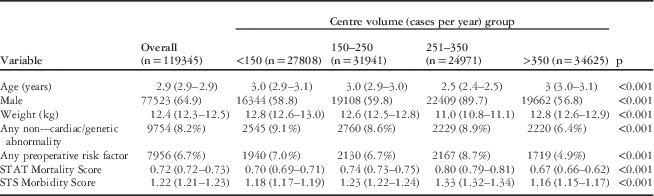
Patient characteristics, overall and stratified by volume category, are listed in Table 1. The post-hoc multiple comparisons showed that patients in the group 251–350 cases per year were significantly younger and lighter compared with the other groups (p<0.001). Non-cardiac/genetic abnormalities occurred less frequently in the group>350 cases per year compared with the other groups. Lower-volume centres (group <150, group 150–250, and group 251–350 cases per year) tended to have a greater proportion of patients with pre-operative risk factors when compared with the group >350 cases per year. The post-hoc multiple comparisons showed that STAT Mortality Score and the Society of Thoracic Surgeons Morbidity Score were significantly higher in group 251–350 cases per year when compared with the other groups, (p<0.001).
Patients characteristic.

The results are expressed as mean values and 95% confidence intervals (95%CI)
Outcomes
Unadjusted outcomes are presented in Table 2.
Unadjusted in-hospital outcomes.
The results are expressed as mean values and 95% confidence intervals (95%CI); p-value calculated with the χ2 test
Mortality
The overall unadjusted mortality rate for the cohort was 4.63% and was significantly higher in lower-volume centres (p<0.001). The logistic regression model confirmed higher risk of in-hospital mortality (p<0.001) in group <150 cases (odds ratio 1.49), in group 150–250 cases (odds ratio 1.95), and in group 251–350 cases per year (odds ratio 1.31) compared with the group >350 cases per year. The discrimination of this model was low (area under the curve=0.57; 95% confidence interval 0.567–0.572).
Complications
The unadjusted onset of all complication was 23.4% with significantly higher (p<0.001) incidence in the group 251–350 cases per year (26.2%). In the logistic regression model, the risk of complications was higher in the group 251–350 cases per year (odds ratio 1.15, p<0.001). The discrimination of this model was low (Area Under the Curve=0.528; 95% confidence interval 0.525–0.531); however, the major complications occurred most frequently in groups <150 and 150–250 cases per year compared with groups 251–350 cases per year (5.12% and 5.46% to 4.74%, respectively; p<0.002). In the logistic regression model, the risk of major complications was higher in the group 150–250 cases per year (odds ratio 1.09, p=0.019). The discrimination of this model was also low (area under the curve=0.514; 95% confidence interval 0.511–0.516).
Failure to rescue
The unadjusted mortality rate in those with any complication was 13.82% and was significantly higher in lower-volume groups (p<0.001). The logistic regression model confirmed the higher risk of in-hospital mortality in groups <150 cases and 150–250 cases per year (odds ratio 1.44 and odds ratio 1.54, respectively, p<0.001). The discrimination of this model had an area under the curve value of 0.552 (95% confidence interval 0.547–0.558). The unadjusted mortality rate in those with major complications was 27.94%, and was significantly lower in the group >350 cases per year (23.83%, p<0.001). In the logistic regression model, the risk of in-hospital mortality was higher in groups <150, 150–250, and 251–350 cases per year compared with the group >350 cases per year (odds ratio 1.23, 1.49, and 1.28, respectively; p<0.01). The discrimination of this model had an area under the curve value of 0.541 (95% confidence interval 0.529–0.554).
Adjustment of the outcomes for patient risk factors, the STAT Mortality Score, and the Society of Thoracic Surgeons Morbidity Score
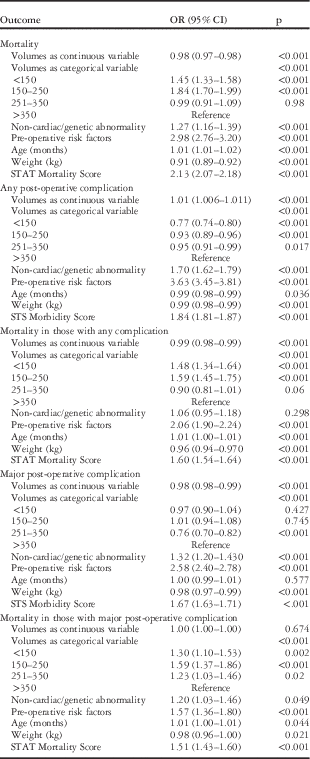
Adjusted outcomes are presented in Table 3.
Adjusted in-hospital outcomes (non-cardiac/genetic abnormality, pre-operative risk factors, age, weight, STAT Mortality Score, and STS Morbidity Score).
OR=odds ratio; 95%CI=95% confidence interval
The odds ratio quoting for 50-case increase in the volumes as the continuous variable
STAT Mortality Score: The Society of Thoracic Surgeons – European Association for Cardio-Thoracic Surgery Congenital Heart Surgery Congenital Heart Surgery Mortality Score
STS Morbidity Score: The Society of Thoracic Surgeons Morbidity Score
When mortality and risk of complications were modelled as a function of programmatic volumes only, the c-statistic (area under the curve) was low (0.57–0.51). These results indicate that volume alone was a poor predictor of mortality and prevalence of complication. Adjustment of the outcomes for patient risk factors, the STAT Mortality Score, and the Society of Thoracic Surgeons Morbidity Score improved the discrimination of the models substantially (mortality area under the curve=0.806, all complication area under the curve=0.727, and major complication c-statistic=0.728). After adjustment, there was a significant relationship between centre volume and each of the outcomes examined – that is, mortality, any complications, and major complications (p<0.001 for volume as a continuous variable). The risk of in-hospital mortality was significantly higher (p<0.001) in lower-volume groups: <150 cases (odds ratio=1.49) and 150–250 cases per year (odds ratio=1.84). The risk of any complications was significantly higher in the group >350 cases per year (<0.018). The risk of major complications was significantly lower in the group 251–350 cases per year (odds ratio=0.76; p<0.001). There was a significant association of centre volume with the mortality rate in patients with any complications. The odds ratio in centres with <150 versus >350 cases per year was 1.48 (95% confidence interval 1.34–1.64), and in centres with 150–250 versus >350 cases per year it was 1.59 (95% confidence interval 1.45–1.75). There was also a similar association in patients with major complications. The odds ratio in centres with <150, 150–250, and 251–350 cases per year versus >350 cases per year was 1.30, 1.59, and 1.23, respectively.
Discussion
In this study, we have used all the cardiac operations classifiable by the STAT Mortality Score reported to the large multi-institutional European Congenital Heart Surgeons Database between 2003 and 2013. All the data were internally validated by an integrated software module that rejects all records that do not meet the given criteria and sends these data back for correction. The initial analysis of the association between the centre volume and the outcomes was performed using the raw hospital mortality data that was not adjusted for patient risk factors and complexity of procedures. This initial analysis showed that in-hospital mortality was higher in low-volume centres, the risk of complications was higher in large-volume centres, and the mortality in patients who suffered from complications was higher in low-volume centres. Although these findings were statistically significant, the discrimination and sensitivity of those models were suboptimal. After adjustment for patient risk factors and complexity of procedures, the results of our analysis were confirmed but the power of these models became much stronger. Our study confirmed the intuitive belief of many surgeons that high-volume programmes are safer. The accumulation of team experience and expertise in big centres, especially when dealing with relatively rare congenital and paediatric cardiac malformations and high-risk procedures, provides better chance for survival. At the same time, the risk of complications is higher in large and busy centres; however, the chance of rescue from these complications is higher because of the acquired experience of the large and busy team. Our study suggests that concentration of work in the large and busy centres increases the safety of patients and improves the quality of care provided for paediatric heart surgery. Further studies are necessary to define the specific risk factors in different congenital and paediatric cardiac conditions demanding rare and high-risk procedures.
Limitations of the study
In this study, 14.63% of the data underwent on-site back-to-back data verification, for which the database staff visited the centres and verified the accuracy of 100% of the records for the following fields: hospital mortality, post-operative length of stay, intermittent positive pressure ventilation time, date of birth, date of admission, date of surgery, date of discharge/mortality, body weight, case category, cardiopulmonary bypass time, aortic cross-clamp time, and circulatory arrest time. This protocol differs from other databases where a sampling method of verification is used. In our previous study using the verified data set of the European Association for Cardio-Thoracic Surgery Congenital Database, we found similar results. Our previous analysis suggested that after adjustment for case mix, higher volume is associated with lower rate of mortality and morbidity and also that when complications occurred the chance of rescue from these complications was higher in large-volume centres.Reference Kansy, Ebels, Schreiber, Tobota and Maruszewski14)
Our strategy of eliminating the single extremely outlying centre is logical. At this very large centre, the outcomes were many times worse than the average for all other centres. If we had included this centre in our analysis, our analysis could have been criticised for the lack of homogeneity of the very high-volume group. This decision was supported by consultation with our biostatistician and also with a logistic regression model that included this centre and documented that the inclusion of this centre had no impact on the results.
Finally, it is not that obvious that the rate of programmatic mortality and the rate of programmatic morbidity should be very directly correlated. The enhanced ability to treat complications in high-volume centres has been described by others.Reference Pasquali, Li and Burstein12 In fact, the term failure to rescue has been developed and introduced in outcome analyses of cardiothoracic surgery and also in other surgical specialties. Although some may expect that higher mortality centres should also have higher morbidity, our data and detailed statistical analysis proved otherwise.
Conclusions
This analysis documents that the risk of in-hospital mortality is lower in higher-volume centres. These findings confirm the intuitive belief of many surgeons that high-volume programmes are safer. The accumulation of team experience and expertise in big centres, especially when dealing with relatively rare congenital and paediatric cardiac malformations and high-risk procedures, provides better chance for survival. Our study suggests that concentration of work in the large and busy centres increases the safety of patients and improves the quality of care provided for paediatric heart surgery.
Acknowledgements
The authors would like to thank all data submitters – congenital heart surgeons from Europe and from all over the world. Without their work, this paper would have never been written.
Conflicts of Interest
None.