





Introduction
This article is a dialogue between colleagues and friends Bunuba/ Walmajarri, multidisciplinary artist Natalie Davey and settler performance maker and academic Renée Newman, about the role of art, story, mapping and “jarriny” (totem) in “knowing” water. It considers custodianship as a critical direction for response and recovery operations to an extreme weather event, specifically referring to the 2023 Fitzroy River floods. Fitzroy Crossing is a small town located in the Kimberley’s in northern Western Australia, and approximately 2,500 km away from the capital city of Western Australia, Perth. The town is home to about 1,000 people, with four times that in the surrounding Fitzroy River including over 50 nearby communities. The Martuwarra/Fitzroy River covers over 90,000 km of the region, feeds into countless water systems and communities. On the 28th December Ex-Tropical Cyclone Ellie hit the Kimberley’s, leading to the Fitzroy River flooding on New Years Eve/Day, flooding land it had never flooded before. We argue that artists open new ways of understanding and responding to extreme weather events, by offering up different modes for representing the lived experience of a changing weather and landscape and with this may come the potential for art (and artistic methodologies) to be a mechanism for engaging communities around disaster preparedness and climate resilience.
We begin with an Acknowledgement. An Acknowledgement of Country is a significant cultural activity/act undertaken in Australia at the beginning of an event (conference presentation, meeting, performance and so on) which is simultaneously standard and unmandated, wherein Aboriginal and Torres Strait Islander peoples are recognised as the first peoples of Australia. An Acknowledgement brings attention to the original people, customs, lore and language of the place where the speaker is situated in that moment. It is both a statement of fact (of the cultural, ethnic and language groups of these areas) and a performance of intent (to act ethically and respectfully, acknowledging that sovereignty was never ceded and that the systems of oppression that began in the late 1700s continue to be felt today).Footnote 1 Thus, it is important we, the authors, acknowledge the Country from where we belong. We acknowledge that we are writing this article on Whadjuk Noongar boodja, the lands, skies and waterways of Perth, southern Western Australia (Renée Newman) and of the language groups of Bunuba, Gooniyandi, Walmajarri, Wangkatjungka and Nyigina, that make up the current township site of Fitzroy Crossing, in the Kimberley region, in northern Western Australia (Natalie Davey). We pay our collective respects to custodians past and present, support emerging leaders and acknowledge the complex and complicated impact of colonisation that continues to reverberate. We recognise and celebrate the necessary and important work that Aboriginal and Torres Strait Islander peoples make, across platforms, industries/sectors and disciplines, to ensure that Aboriginal and Torres Strait Islander people never just survive the displacement strategies of the colonial operation, but thrive, in this most extraordinary country made up of countless Countries.Footnote 2
Across some 2,500 km, Natalie Davey and Renée Newman speak together on the page, through art, face to face, online and phone conversations. Utilising “yarning” as a methodology – borrowing from Dawn Bessarab and Bridget Ng’andu (Reference Bessarab and Ng’andu2010) – we initially carried out “conversational yarning” as friends sharing experiences, discussing artistic methodologies and the aftermath of the floods and following this “research topic yarning” (Reference Bessarab and Ng’andu2010, p. 40) where this project sharpened its focus. Yarning is commonly understood in Australia as a form of relaxed conversation and storytelling amongst Indigenous people and yet “yarning is much more than conversation; yarning can be formal or informal discussions that honour and recognise the importance of story in knowledge exchange” (Shay, Reference Shay2021, p. 63). For us, “research topic yarning” extended our conversation, while remaining relaxed and informal, with a definitive purpose: “Research topic yarning is a conversation with a purpose” (Bessarab & Ng’andu, Reference Bessarab and Ng’andu2010, p. 40) and the purpose was to ask how might art, and artistic methodologies, educate about the impact of climate change and extreme weather events? Respecting the origins of this paper, and the wider project of interrogating the potential impact of artist-led methodologies in opening up to see, and consider new ways of seeing, the climate crisis, we decided that rather than writing up our conversation as an interview, we would write a dialogue foregrounding the third person “we,” woven with artwork by Natalie Davey, and supported by Indigenous knowledge systems, or ways of knowing and being, as well as post-human and/or new materialist scholarship on rivers and waterways.Footnote 3
While we began this section with an Acknowledgement of Country it is equally important to acknowledge the heritage of the authors, and map out what voice is, or means, in this paper. Renée Newman is a fifth generation Australian with heritage from England and Ireland. She is a performance maker and academic. Her research – be that scholarship or artistic – involves derivations of care: care for self, society and ecology. For the last decade she has taught and supervised close to 30 master of arts by research and doctoral research candidates predominantly using creative arts methodologies including what is known as “practice-as-research.” Despite its varied application across art form the common element is the utilisation of the tools, techniques and methods of an artist within their practice/discipline is considered a valid form of data collection. Therefore, this paper not only utilises “yarning” as a methodology but also the discussion of artistic process, technique, materiality and the analysis of form, also considered as research. She has taught, and created, site-based and site-specific performance as well as teaching and publishing in studies around leadership relating to sustainability. She believes that the artist, their process and their work, have a critical role to play as change agents confronting the climate crisis or “metacrisis,” a term used at various times here.
Natalie Davey has Bunuba, Walmajarri, Scottish and English heritage, and lives in Fitzroy Crossing. She is a custodian in the Bunuba (Bunaba) Danggu (Dongu) Muway community. Natalie is a multidisciplinary artist (painting, sound art, film, animation etc) often with Mangkaja Arts. Her two predominant languages are English and Kimberley Kriol, and as a language conservationist she works with Wangki Radio, the community radio station of Fitzroy Crossing. She produces and presents “Danggujarra,” a language-focused show, alongside her father, Bullen Rogers. This radio programme became a disaster relief lifeline in the weeks after the flood subsided, as a point of connection for the community scattered across various places including Derby and Broome. In 2024 she was an Encounter Fellow with the National Museum of Australia.Footnote 4 Natalie won the 2024 Telstra Multimedia Award at the National Aboriginal and Torres Strait Islander Art Awards (NATSIAA) for River Report, a multimedia artwork capturing the days during the devastating 2023 Fitzroy Crossing floods using video, animation, painting and story. She follows this with a multimedia installation for the 2026 Sydney Biennale titled Nightscapes. The significance of Natalie‘s artistic practice is not only important from a disciplinary expertise perspective (which is beginning to be recognised at this national level) but also because she represents the perspective of artists engaging with climate change, extreme weather events and Indigenous knowledge holders’ relationship to people, place and story. In addition, Natalie took on a leadership role during and in the aftermath of the floods, which we speak about to a certain extent in this paper, with her “code switching” between representation to government bodies and community engagement. This responsibility appears in different ways in her artworks, although is likely to emerge more in future works, especially in what we discuss as “stage three.” What is critical for the reader to understand is that what Davey does in her role in representing Fitzroy Valley community members, or in her role as ranger, or as language conservationist, or as an artist, all these things exist within an interconnected system of responsibility to people, place, flora and fauna. This article explores the possibility of art and art making as a different mode of addressing climate crisis response, disaster preparedness and disaster response and relief – for community, government agencies, educators and policy-makers – through the recent work of one artist, Natalie Davey.
The story
Water is inside us, around us, sustains us and according to the United Nations Water Organisation, “climate change is primarily a water crisis (UN-Water, n.d.).” In advanced capitalist economies water is too often considered primarily as a resource (often scarce yet always necessary) and yet shifting the perspective from thinking about water to working with water as an interdependent collaborator may influence the taking of responsibility for water, a custodianship, if you like (see Bailey-Charteris, Reference Bailey-Charteris2024; Chen et al., Reference Chen, MacLeod and Neimanis2013). Water, and in this case a river, is a life force. In the instance of the 2023 Fitzroy River floods the life force became life changing. This paper explores the interaction of art and Indigenous knowledge systems including custodianship of land, sky and waterways, suggesting that in the increasingly chaotic reality of climate change, human relationships with water need attending to: “we are bodies of water, but we also reside within and as part of a fragile global hydrocommons, where water – the lifeblood of humans and all other bodies on this planet – is increasingly contaminated, commodified and dangerously reorganised” (Neimanis, Reference Neimanis2013, p. 27). Similar to Alexandra Lasczik et al. when they ask, “what potentials for teaching/learning does an artful geo- onto-episto-eco-ethico-politico engagement with water produce?” (Reference Lasczik, Rousell, Ofosu-Asare, Foley, Hotko, Khatun and Paquette2020, p. 147) we ask how art and art making might enable us to understand the way we (society, the global community) work with, and understand water better, or perhaps more specifically, how art responding to the 2023 Fitzroy River floods can teach those of us who did not experience this event directly to better understand this new story that extreme weather is sharing.
The Derbal Yerrigan/Swan River has been a very important river for Renée growing up. Although she spent more time at the beach and in the ocean than the river, she was always aware of the river. The water creeping along carving out the landscape as it moved from the ocean into Guildford and the Swan Valley – the legacy of the Wargul or serpent figure of the creation story of the Whadjuk Noongar people, and a place of sustenance and growth. In her lifetime the river had never flooded, it had been topsy turvy and quite stagnant at times with the ever evolving ecology (including the impact of human intervention of storm runoff, diesel boats, algae bloom and fertiliser drainage) and other times, especially in a downpour of rain the river might spill over onto the road running parallel to its edge, and temporarily flood a small section, at most prompting a thrill as a giant puddle was driven through. This type of “spill” wouldn’t change the course of the landscape, wipe out animal communities or threaten people’s lives (although diesel, algae and fertiliser in the waterways would clearly impact the lives of human, flora and fauna). However, Renée Newman knows of flood through other means including a story from her grandmother of a flood that happened 40 years before she was born. Her grandmother was born in 1927 in the regional town of Northam, and the Avon River, flowing through the town, burst its banks and flooded the area. Renée was never particularly surprised by this; her grandmother was prone to drama and a force of nature. But the tickler of the story was that the baker kept her safe, and warm, in his oven, to protect the newborn in her earliest hours. This story helped to define Renée’s perception of her grandmother, a dramatic arrival no doubt, but what lasted with this story was a community meeting fear with safety and warmth. We believe story, and with this memory (individual and collective) intertwines with story, helps to define us and our relationship to people and place.
Martuwarra RiverOfLife, Lachlin Carracher and Anne Poelina write about the “voice and authority” of the Fitzroy River:
Martuwarra itself is an educator – a living water system that teaches principles of balance, reciprocity and interdependence. In this way, the unfolding metacrisis is framed as an educational transition, where modern societies must unlearn anthropocentric paradigms and learn anew from Country. (Reference Carracher and Poelina2025, p. 1270)
Natalie is an observer of the river day after day, as part of not only their cultural custodianship of the river and all that exist in, through and around it, but also as part of their artistic practice. However, what happens when this observation leads to worldwide attention and countless media calls, and while you are live streaming, the river breaches the banks and overnight takes over your home? What happens when the people who make up your community don’t know where to go or what to do because the river had never gone there or that way before, or even the whole idea of a body or bodies of water not knowing where to go because the water has never been like that before? We speak of the sentience of water because the water is a critical life force and a shifting growing entity with millions of organisms (Niemenis, Reference Neimanis2013). As Bronwyn Bailey-Charteris notes, “water has become a central material and metaphor of our times” (Reference Bailey-Charteris2024, p. 1) further suggesting that there is an “urgent need for a more nuanced understanding of the hydrological cycle, one that reflects on the bodily entanglements and relational qualities of bodies of water and acknowledges the hydrological cycle as embodied” (Bailey-Charteris, Reference Bailey-Charteris2024, p. 1). From our perspective, water is not only a resource necessary for survival but also carries story.
Story is relational, and as Bailey-Charteris argues, water is embodied, and thus, so is story. However, how do we speak about something when there’s no story for it? For Natalie there are stories for the Martuwarra, or the Fitzroy River, flooding (a common annual event) but not this flood, the flood that changed the landscape, where geographic features disappeared, and birthing trees were lost. When story speaks to creation, to the intersections of ecological, spiritual, social and ceremonial responsibilities, when story is at the heart of social cohesion, what happens when there is no story for a catastrophic event. Is this a situation of no story at all, or no story yet? Like the creation stories of how land formations occurred, or changes in the seasons and food sources or what relationship humans had to the creation spirits perhaps the floods will form new stories or versions of the original with a new ending. It is not our place to speak of certain stories nor necessarily speculate on how stories will be told in the future about this event, however in order to understand, and to educate, about the relationship of the flood to art making, as well as art making to disaster preparedness and climate crisis education, it is important to understand the nature, and intersectional impact, of this extreme weather “event,” and beyond this, how Natalie’s art might be a new story of the Martuwarra.
The event
The Fitzroy River Flood of 2023 was a profound extreme weather event; with record-breaking flooding that led to widespread damage and displacement – something like 240 properties damaged and 1,500 people evacuated and close to 40,000 people impacted (Carter et al., Reference Carter, Chan, Chang, Casburn, Dudgeon, Elliott, O’Dell, Rego and Thomas2024). The Kimberley region recorded over 800 mm of rain in a week, leading to major disruptions. A critical 700 km stretch of the Great Northern Highway was closed, isolating communities from critical infrastructure including food and medicine. The Fitzroy River reached record levels, peaking at 14.23 m at Fitzroy Crossing. The Great Northern Highway bridge at Fitzroy Crossing sustained damage beyond repair, severing connection to Broome and Darwin (the two connection points for chain of supply for food, medicine and so on) and cutting the town in half.Footnote 5 After the event it was anticipated to take several years to replace the bridge, a vital supply chain for food and medicine and connection point to outside the Fitzroy Valley region, but it was completed within a year. The recovery stage was vast and is arguably still ongoing. The Australian Defence Force was involved in the recovery stages. The Government’s Freight Subsidy Package offered financial aid to mitigate the rise in freight costs affecting industries and businesses in the region. Temporary accommodation provided short to medium-term housing during the restoration of damaged properties although there are still differing perspectives on the impacted communities access to accommodation; from Natalie perspective this varied from people returning home to houses filled with mould, increases in mosquito-borne diseases, people not being told they could return home months after the fact, not enough support for people with particular needs (people living with disability or chronic health issues) or a general lack of understanding around cultural protocol and kinship systems. The Fitzroy Valley community has a history of trauma – from transgenerational trauma associated with colonisation including the impact of policies leading to the Stolen Generation to decades of underinvestment in critical infrastructure and employment opportunities:
Children were separated from their families when the Fitzroy River Bridge was destroyed, and some couldn’t make contact via phone or internet. Families forced to relocate were separated from each other. With a history of children being forcibly removed due to government policy, separation from family exacerbates pre-existing trauma for many Aboriginal people (Carter et al., Reference Carter, Chan, Chang, Casburn, Dudgeon, Elliott, O’Dell, Rego and Thomas2024, p. 11).
The floods not only transformed the landscape and caused massive disruption across core infrastructure basic to human survival (food, shelter, heath/medical supplies, education and so on) but it also exposed historic disadvantage. Weather events illuminate injustice providing an opportunity – for government, support services, for science, and beyond – to respond practically in ways that support education about this injustice.
The event highlighted the vulnerability of communities, infrastructure and the environment in this region, to extreme weather events. In response, disaster recovery assistance was activated to support the affected areas, the bridge was rebuilt and employed local people but as often is the case the floods exposed social issues that pre-existed the floods, including continued housing issues (and homelessness), mental health issues and education and industry disruption. “The floods and the destruction to roads, communities and people’s homes and lives shone a light on the underinvestment in our communities, and the lack of infrastructure to support an adequate response in emergencies (Carter et al., Reference Carter, Chan, Chang, Casburn, Dudgeon, Elliott, O’Dell, Rego and Thomas2024, p. 3).” Questions around preparedness, and resilience, in the face of a natural disaster were, and continue, to be raised:
Communities in the Fitzroy Valley are some of the most disadvantaged in Australia and are equally resilient in the face of the repeated shocks, disruptions and tragedies they have experienced over many years. The impact of this flood cannot be understood in isolation of this context. (Carter et al., Reference Carter, Chan, Chang, Casburn, Dudgeon, Elliott, O’Dell, Rego and Thomas2024, p. 12)
A declared national emergency – where federal, state and local government agencies are activated to save people’s lives – is one thing but the scale of the recovery/repair operation cannot be underestimated. Too often people can be lost in the bureaucratic puzzle and cultural nuance can be lost in the disaster response and recovery stages. Natalie regularly speaks of a code switching – swapping between her role as a daughter, a sister, cousin, custodian, ranger and conservationist, an archivist especially in language reclamation, and her role as an artist – she not only moves between languages (English and Kimberley Kriol) but also between the languages of Commonwealth Scientific and Industry Research Organisation (CSIRO), the Department of Fire and Emergency Services and the cultural protocol of complex kinship systems, family relationships and responsibilities for protecting Country.
Core to her approach is understanding the interconnectivity of all things – nature, language, art, cultural expression, protocol and story. The river is no exception:
(the) River is a teacher of reciprocity and life-sustaining law; Elders are educators enacting intergenerational pedagogy by demanding care for future generations; governance negotiations as classrooms of the future, where Indigenous and settler systems learn to speak across differences; and education as emerging outside of formal institutions, in moments of change, resistance and transition. The educational lens shows that these are not simply contextual descriptions, but lessons with actionable recommendations. Such pedagogy challenges modern educational norms that alienate humans from nature, offering instead a transformative curriculum of belonging to one living. (RiverOfLife et al., Reference Carracher and Poelina2025, p. 1280)
In January 2023 the river was teaching us all that it had not (in human memory) behaved quite in this way before and since then, that the landscape has remained changed, and that we must continue to listen and learn. Whether it is extreme weather, water extraction, pastoral industry impact or the threat of fracking by “learning from Martuwarra we are provided a pathway through the metacrisis by reminding global citizens to not view the world in isolation, to ground action in place and regional context” (RiverOfLife et al., Reference Carracher and Poelina2025, p. 1280). It is critical to foreground a place-based contextual understanding of the lived experience of the people and region of where the environmental degradation is occurring. Furthermore, art is vital for preserving story, language, memories, solving problems, and enhancing understanding, and can be a vessel for enhancing current systems, or creating new ones, with a multicultural, multilinguistic and culturally sensitive understanding. This understanding that not only do Indigenous knowledge systems play an important role in healing from disasters, in the response and recovery stages but also that art and artists have a unique role to play in disaster preparedness, response and recovery. Their methodological attuning to observation, documentation, curation and material practices can play a role in wholesale systems change for all agencies and networks in extreme weather and disaster events.
The event in three stages
We understand the event in three stages; these stages are interlinked and have a unique artistic representation documenting, archiving and advocating awareness around the disaster. We have yarned at great length about the importance of seeing the flood in these stages for two principal purposes. One, to help Natalie to rationally order the impact of the flood as a type of therapeutic processing. Two, to help manage the sheer volume of data that she collected during and in the months and years after. This data is in artistic form – sound, sketches, maps, paintings, film, installation – and stories from the community, reports from disaster services and beyond. The first stage is the weather event itself and the artwork the River Report. The second stage is a multimedia installation – Nightscape – premiering at the 2026 Sydney Biennale which captures her own personal experience of 36 hours of the flood. The third stage is a disaster and recovery mapping that captures the experiences of community during and after the event, and with recovery and restoration continuing three years on. This third stage is a future project, something in its early gestation, but will likely be an artist-led, community driven communication system that aims to honour the complexities of a disaster response while educating a culturally safe as well as effective and nuanced preparedness programme. This kind of event will happen again. The community know this. They know, and have known for some time, the brutal pace of climate change. However, custodianship of the skies, land and waters, and all creatures within these places and spaces, does not change. It in fact becomes even more pressing, for Indigenous and non-Indigenous alike to take custodianship of all that is within and around us, to protect, to conserve and to adapt. That is a job for today, tomorrow and the ever after.
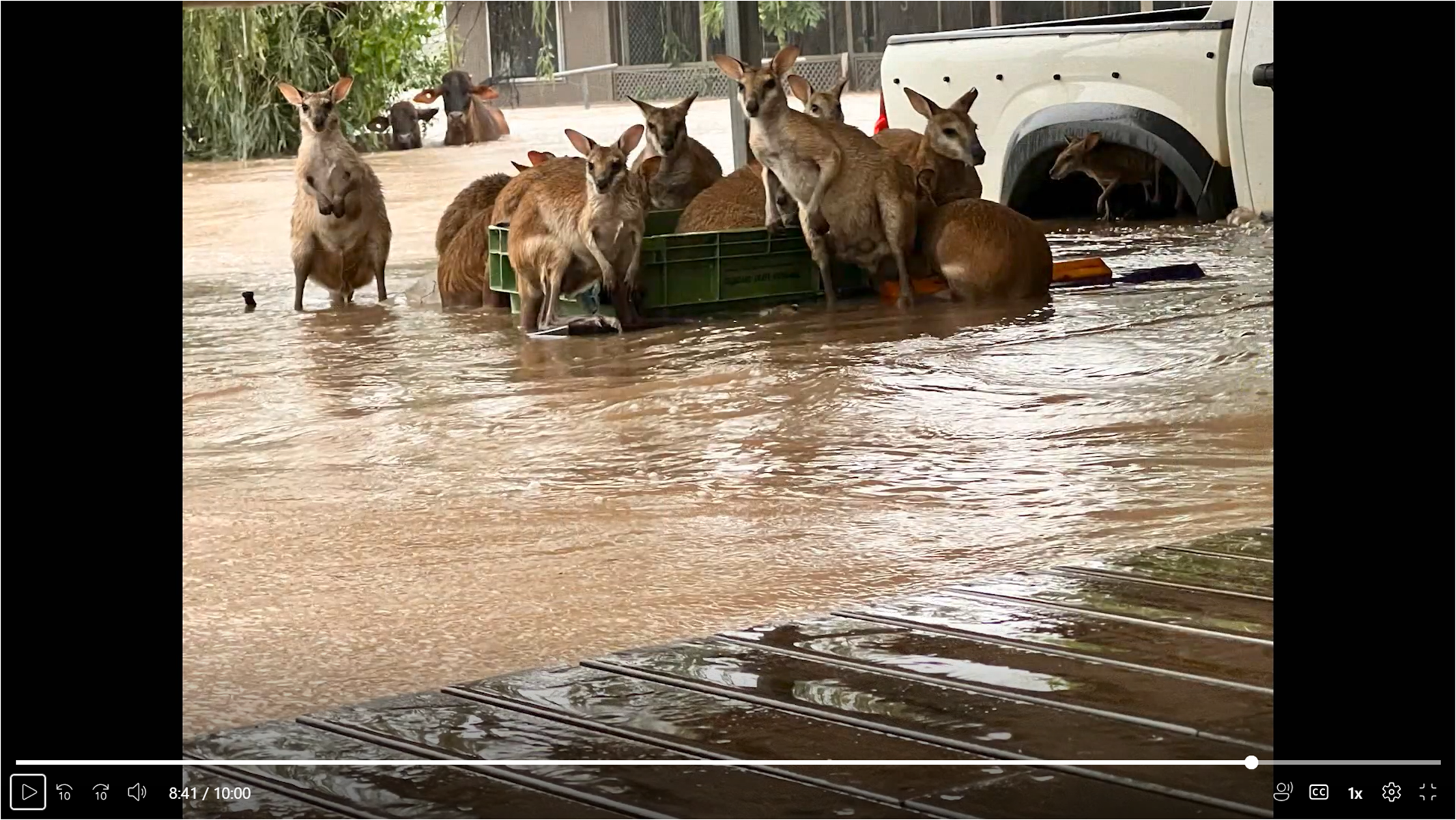
Today, Natalie is combing through the recordings of the floods rising. She recorded/documented most of those days as the river expanded and flooded and beyond. Her video footage was what was used in the news, for example, images of the wallabies trying to survive by balancing on a car trailer. Natalie has a vivid memory of waking in the middle of the night to the sounds of bumps under her floor – it was the animals trying to get in, trying to escape the rising water – that was when she realised that the house was now under threat. These recordings are what will form the bulk of the sound design for the second stage multi-media installation at the Sydney Biennale. She was evacuated soon after that night (3rd January 2023). It was terrifying. That night is only one part of the story, and the story involves a multiplicity of elements and voices. So, how do you speak about an event that has no story (yet)? We argue that you ask “the artist” (as in the role of the artist and not one particular artist because no one person can take on this responsibility). The “artist” documents, observes, experiments with materials (for Natalie this is etching, print on paper, oil and water colour, photography, animation, fashion, jewellery, sound design and more), they curate and archive (for Natalie she screenshot every single media request and online conversation) and above all, listens; to the community, the place, the animals, the wind, the river. The remaining paper will interrogate the event, the River Report (film) and surrounding artworks made in the aftermath of the event; the elements that make up stage one.
The River Report and other artworks
In our conversations Natalie talks about how her process in responding to the floods began by describing everything as it happened. There is an exacting nature in Natalie’s process; prioritising the precise direction and the timings of the weather changes, the river rising, the animals responding and so on. This early stage of sketching and mapping becomes an ordering of chaos. Natalie has been recording the weather for many years or doing what she calls her seasonal “OBVS” (observation) for a long time. It is a way in which she can oscillate between and translate the various cultures she navigates, as well as the myriad roles she plays–as artist, custodian and ranger. During the event these seasonal observations became a river reporting through film which she uploaded to the internet through Facebook “lives.” After this, and for some time after, came the painting and mapping of the event.
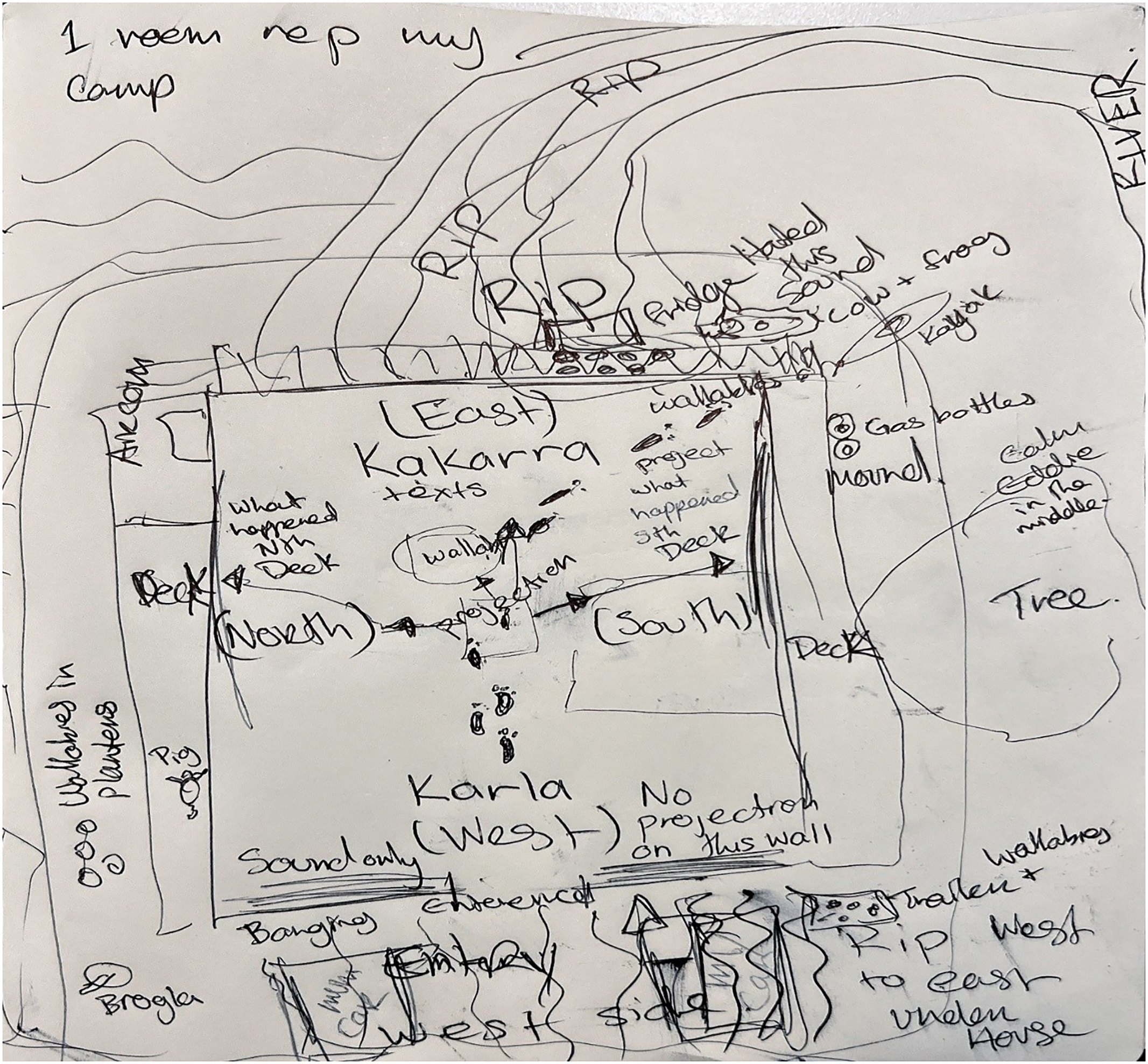
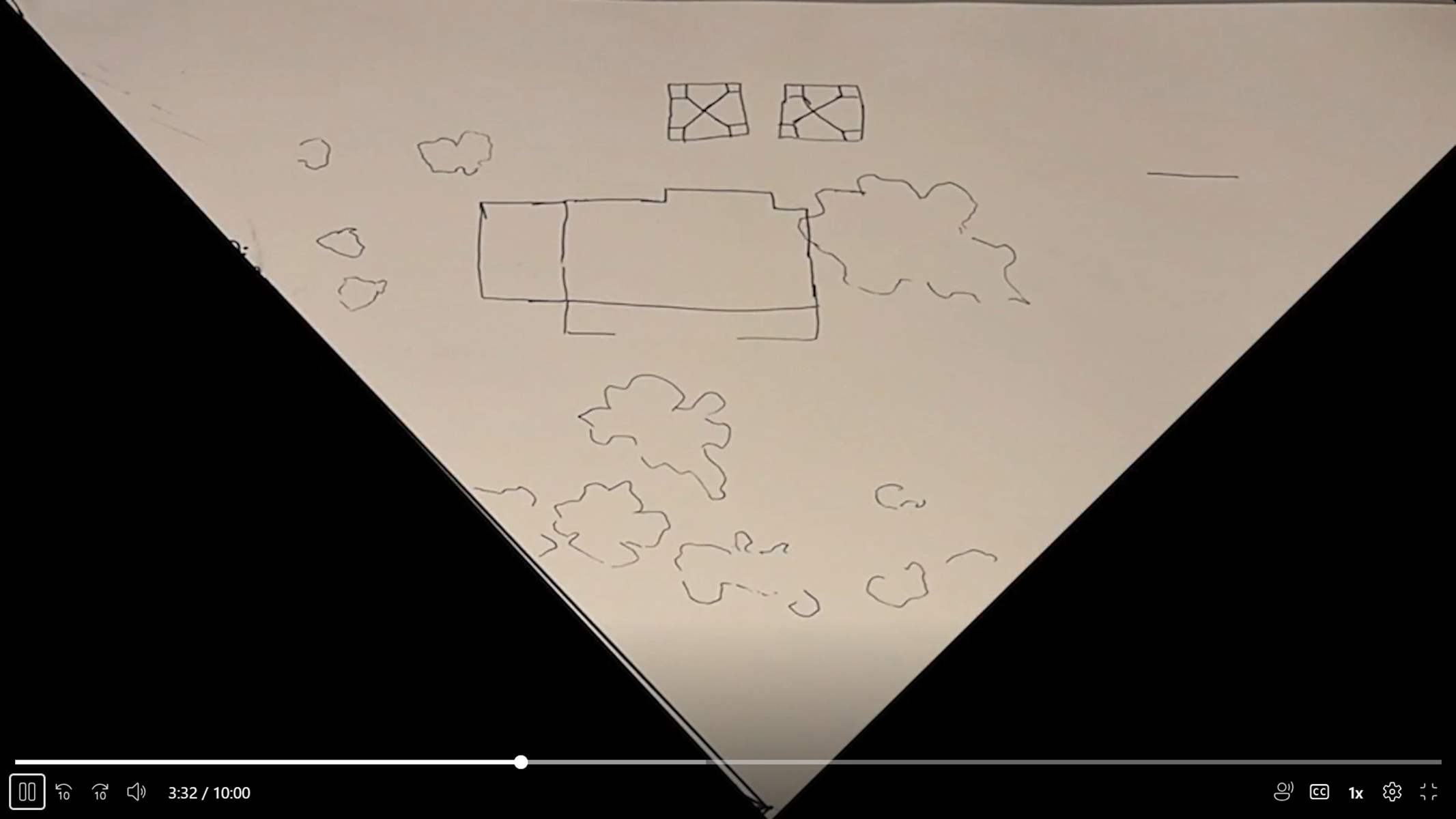
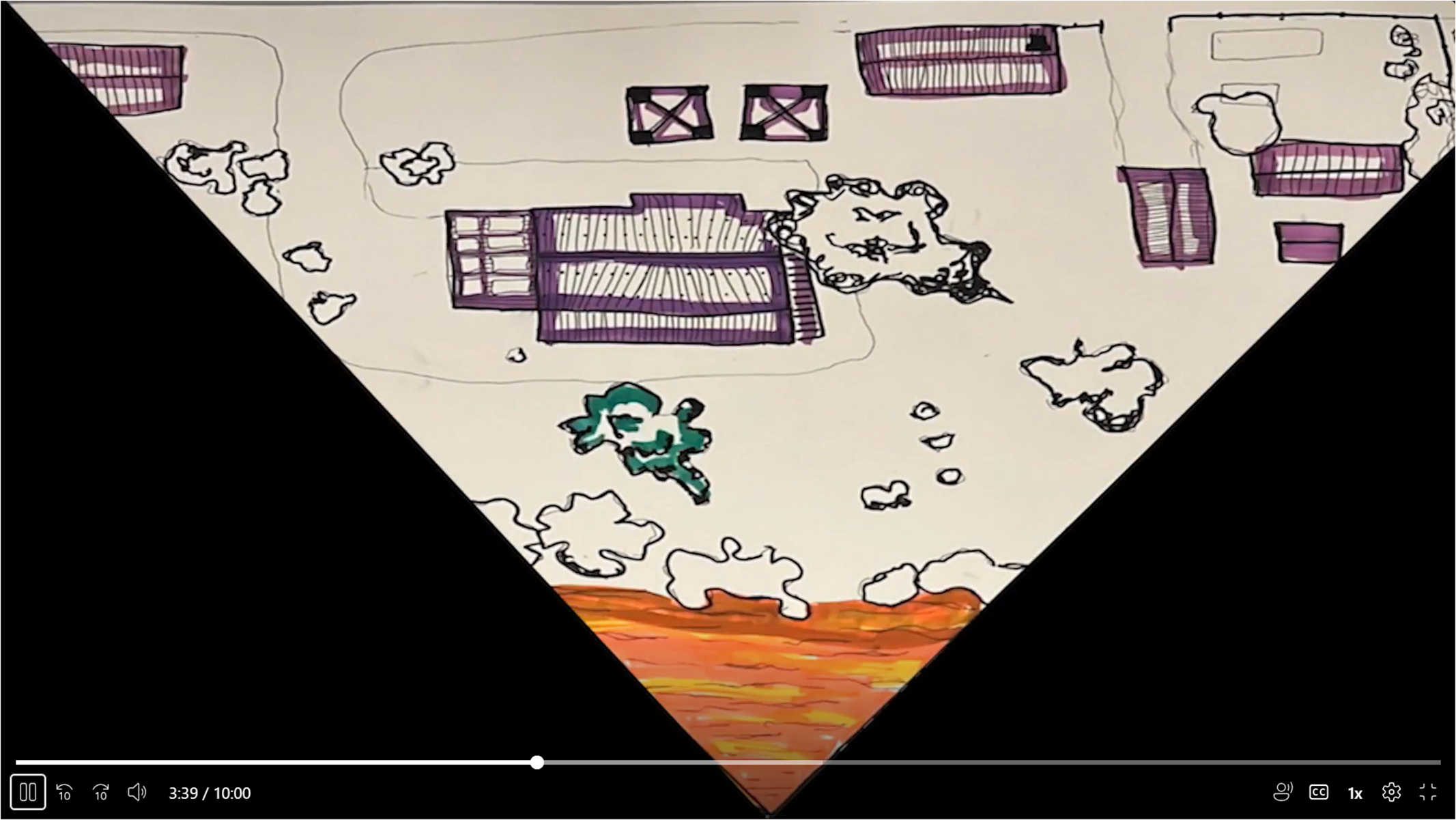
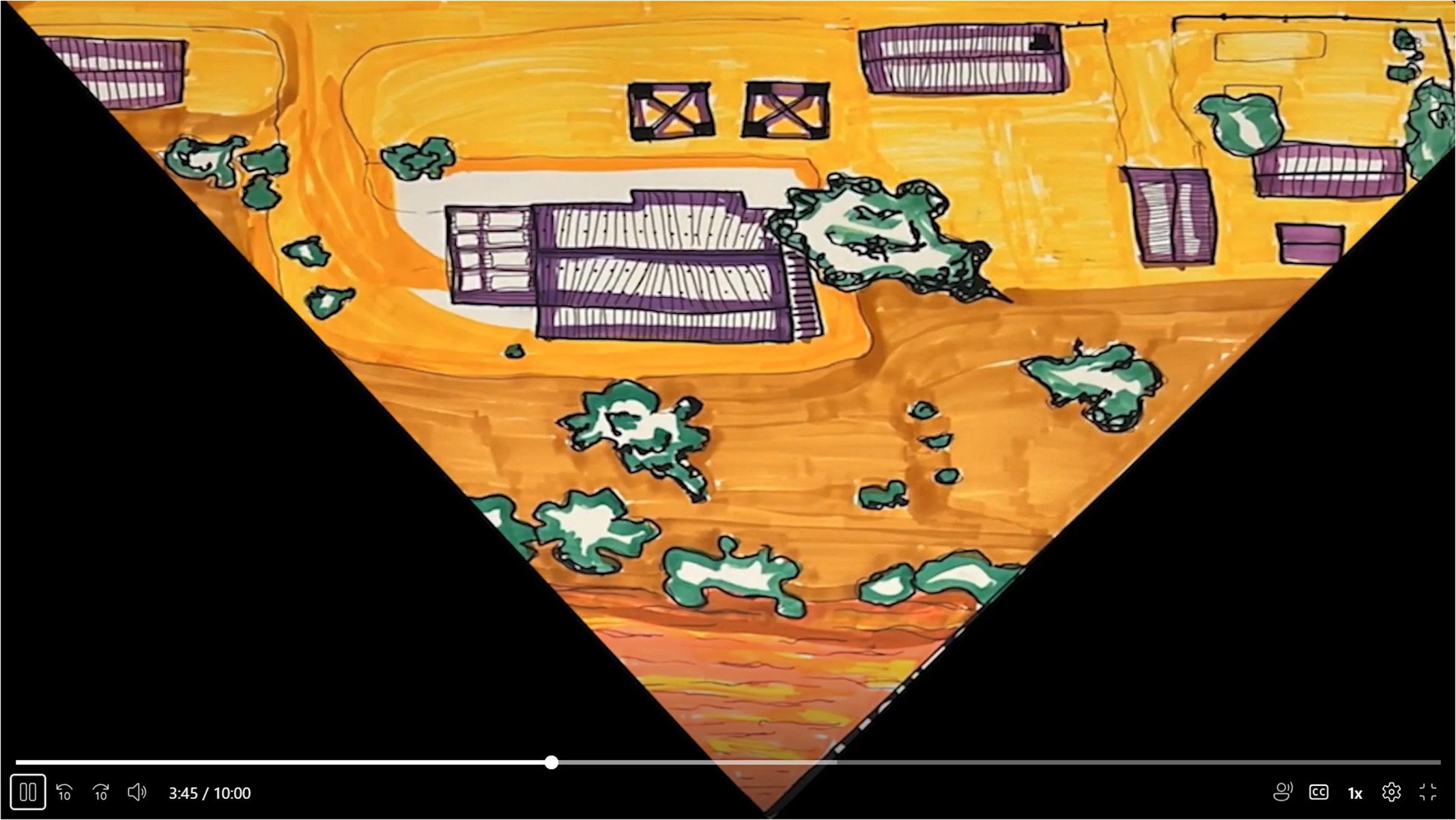
Figure 1 (House Flood Sketch) is a rough sketch Natalie drew of her house. It is a blueprint for Nightscapes and many subsequent artworks have this as a reference point. She did not have time to stop and think and write things down when the event was happening, however live feeds on social media became vitally important as a mode of communication with the outside world, documenting the changes within the event itself, observing the river as it rose, and later this became the foundation of the River Report as a complete artwork.
A sketch depicting a flooded house with various annotations and labels.

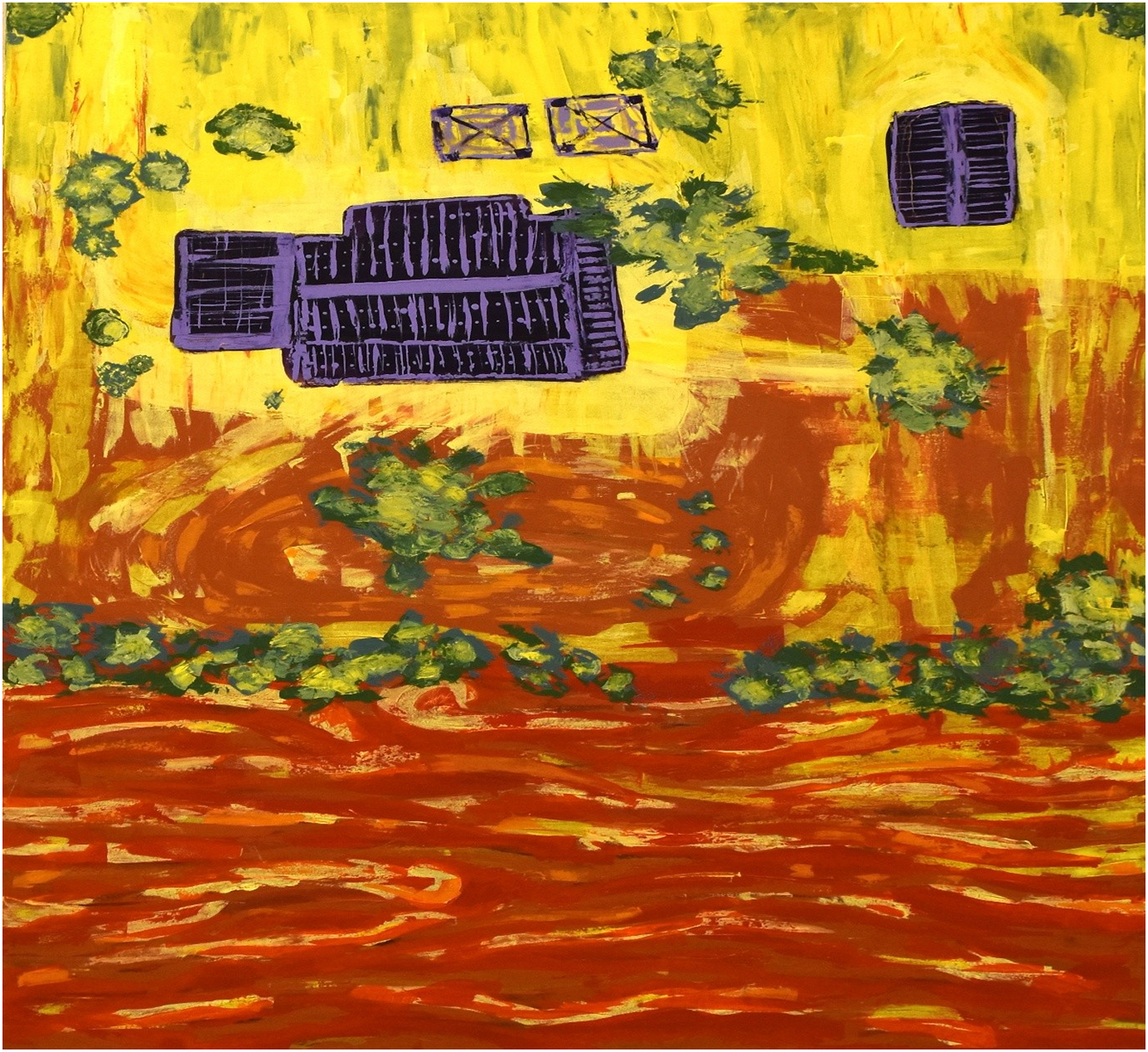
After the event Natalie started thinking, talking and making about the water, including the direction of the water as it came to the house. The first painting (Figure 2) captured the levels, direction and energy of the water. She used materials salvaged from the house. The sponges on her paint brushes had been underwater and were muddy and so she ripped off the foam to reveal the plastic underneath and these became scrapers, used to create the undulations and flow of the water. She repurposed the material that were irrevocably changed by the flood to move the energy and the paint around to capture the movement of the water. Not only was there a need to reclaim or reinvent the usual objects and materials of painting transformed by the flood but also a need, in the months after, to recall the rapid flow of the river and the affective nature of this work – in the title, the brushstrokes, the texture and tone of the work – recalling the trauma of the event.
RIP. 2023. Acrylic on canvas. Natalie Davey. Courtesy of artist.

The flood brought down the bridge, it shifted rocks in the river and landmarks that once had a story around its creation and meaning and purpose for the community. The flood displaced cultural sites and brought down trees and houses and displaced animals. Swimming cows, wallabies balancing on a car trailer, snakes and crocodiles attempting to flee – everything was changed. In the flood’s aftermath, as Natalie describes in a podcast interview in 2023 with host of “RegenNarration” Anthony James, “the water has passed but the earth has shifted (James Reference James2023).” Nothing is the same again. For Natalie all representation – documentation, archive, Facebook live, film, photography, print work and more – is a map or a collection of maps of this irreversible and irrevocable change.
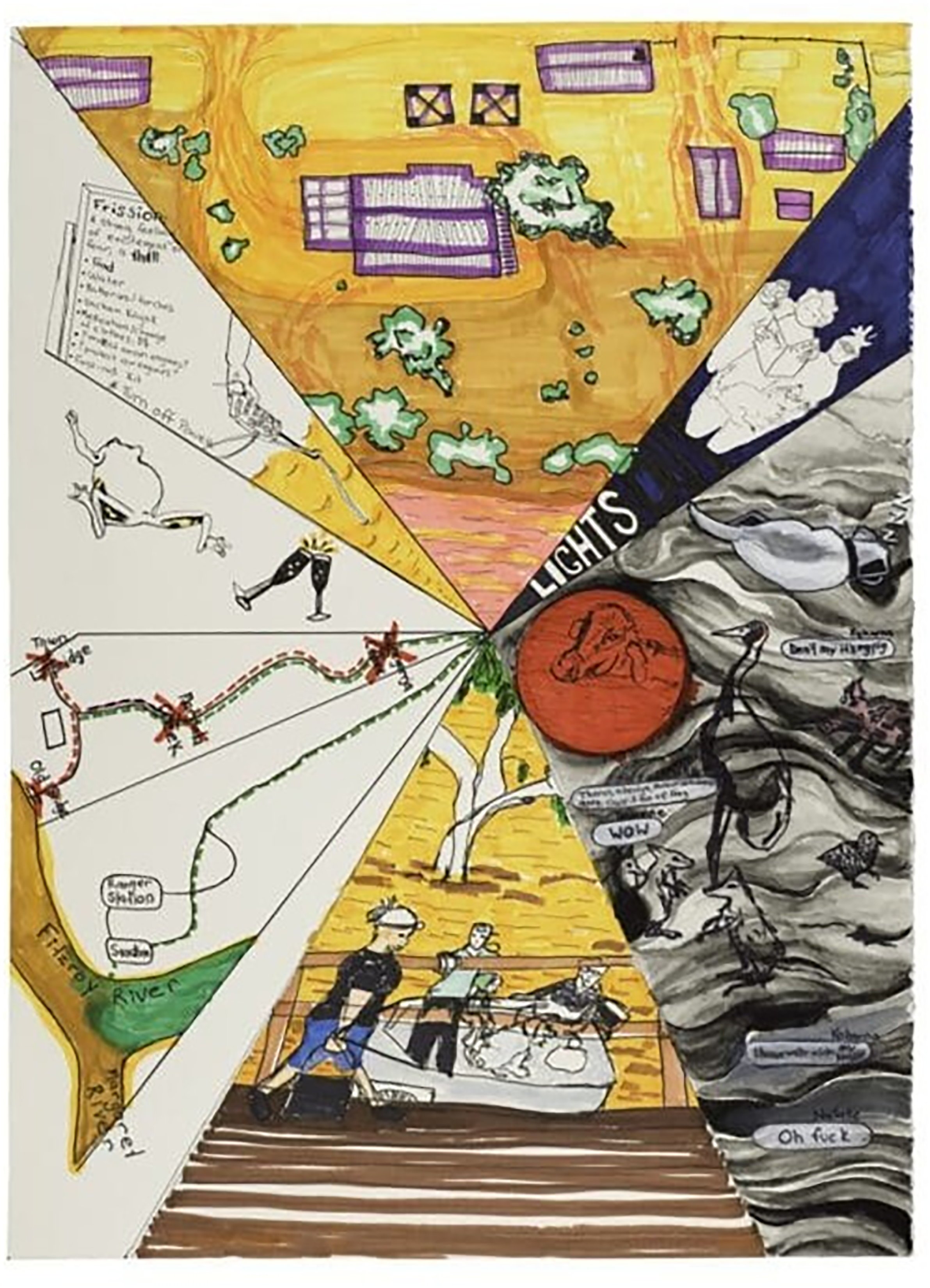
One such map (Figure 3) details how people responded to the event, how they were desperate for information, how the Facebook films were just as much about informing community about what was happening as they were of documenting the event itself, and the confusion during and after the event.
The River Report. 2024. Multimedia audio visual and work on paper. Natalie Davey, Courtesy of the artist.

Author 1 has always loved maps; the detail of road maps, the maps of seasonal changes, the circularity of weather maps and weather forecasting systems, these are the things that cannot really exist in 2D because when depending on facing northwest or southeast, the map will be different. What happens to the map when the landmark that normally tells a particular story, now tells a different story, because the landmark does not exist any longer. These are all the things she wants to capture; story, people, and place, and time and all that make up Country. This is a map, a complex map.
However, a map can only contain so much and the capabilities of mixed media and in particular multimedia (through film, animation and photography) can capture multiple things all at once. Which is why this medium was helpful for the River Report (the film) in mapping the changes during the event – it is an archive of the time and the changes of the river over what was five to six days, from the 29th December 2022 to the 3rd January 2024.
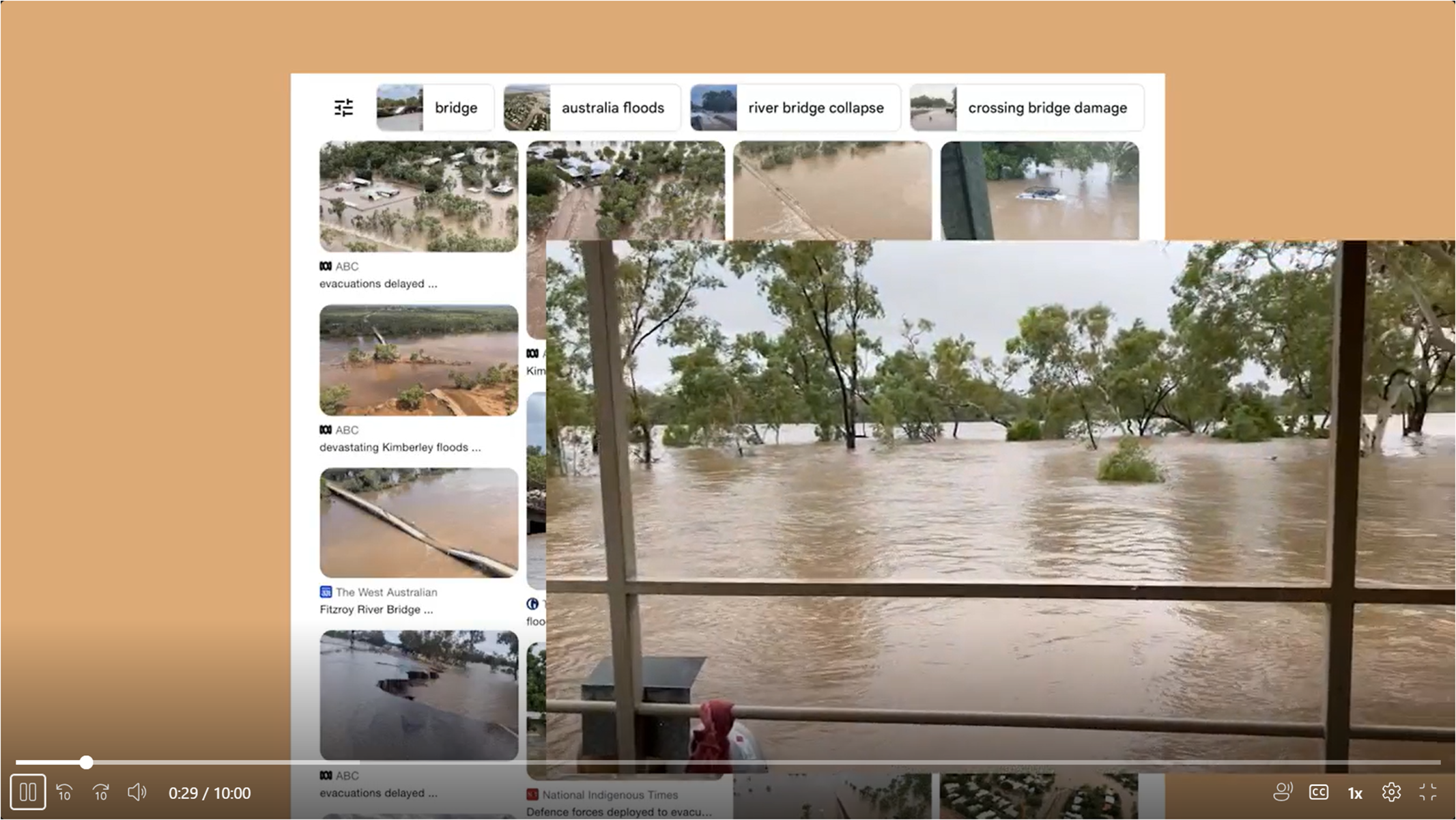
A river observation in previous years might include noting birds and measuring the water levels, observing riverbanks and all these different points, and it is important to have all these observations included, in this noting process, so as to mark out and map seasons. This can be compared then to the scientific predictive weather forecasting. Because the Fitzroy River (Martuwarra) floods, this is a naturally occurring annual phenomenon, it just does not normally flood like the way it did across that New Year of 2023. There are reams and reams of literal pen and paper notes, journal entries, sketches and all these capture seasonal observations, which is part of the general observation practice that Natalie understands is her role as custodian of Country. Yet, with the flood and the subsequent River Report this was an opportunity to turn this attunement into a formalised artwork that consisted of, and considered, the layers, the complexity, the angst, the anguish, the fear. Figure 4 illustrates the mixed media of the film, drawing from the many news sources juxtaposed with her own experience as the flood rose. Figures 5–7 illustrate the recurring motif of the house surrounded by water, the levels rising, the flow of the water and increasing pressure. Importantly, the accompanying dialogue marks this anxiety too, with Natalie declaring “I have nowhere else to go.” What the River Report represents here is a type of hydrological mapping, a pictorial disaster occurrence in aesthetic modes rather than weather forecasting or disaster evacuation documentation.
River Report. 2024. Photograph, video and film recordings. Natalie Davey. Courtesy of artist.

River Report. 2024. Animated version of work on paper. Natalie Davey. Courtesy of artist.

River Report. 2024. Animated version of work on paper. Natalie Davey. Courtesy of artist.

River Report. 2024. Animated version of work on paper. Natalie Davey. Courtesy of artist.

There is a point in the film where the camera (shot on phone 13) scans the rapidly rising water and after having just said that all animals were welcome on her veranda, noting that she had not yet seen snakes, she spots a snake wrapped in a tree branch. It is escaping the water and Natalie remarks that since the arrival of cane toads to the area (an introduced and invasive species) there are far fewer King Brown snakes, and it is a turning point, in hearing the anxiety in her voice, a key moment in reminding the viewer that already so much change has taken place.
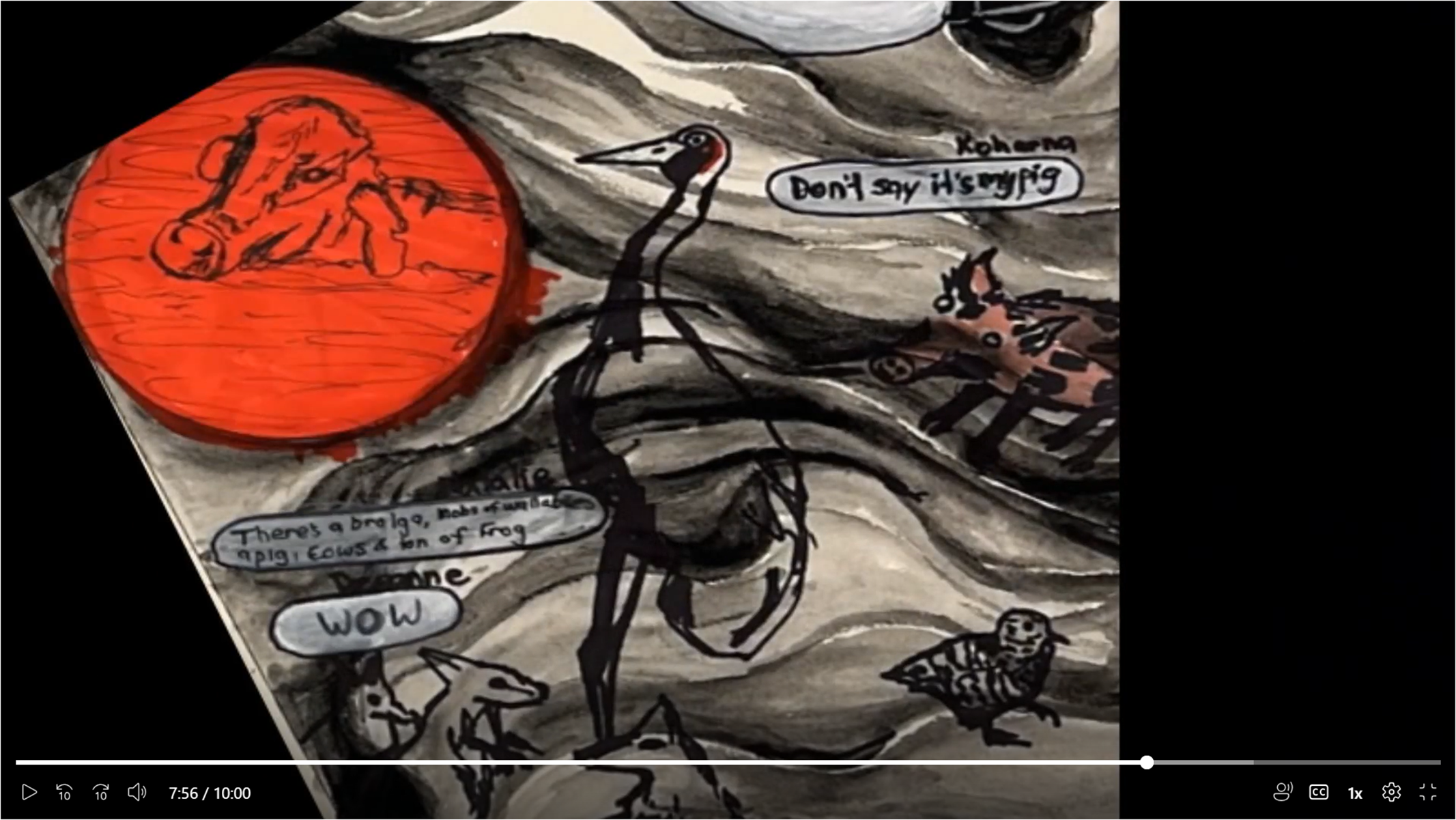
Figure 8 captures the confusion, the extreme nature of the flood and the animal response to it; pigs inside houses, cows swimming alongside verandas, wallabies taking refuge on a car trailer with commentary from Natalie at one point saying “there is a frog riding a wallaby, it’s just crazy … everything is just much, much, much.” We need a flood to nourish Country but this was a major, disruptive, different kind of never felt before kind of flood. The River Report is an artwork and a map, and it is an education tool. An artwork like this teaches those who have not (yet) experienced flood, or any extreme weather event, just like the dialogue between us has taught Renée so much about of what it was like during and in the aftermath. This, and art more broadly, that is about the experience of extreme weather events opens up a unique pathway for climate change education, to assist growth in understanding the permanence of climate change weather events on systems, society and ecology; because the water has passed but the earth has shifted.
River Report. 2024. Animated version of work on paper. Natalie Davey. Courtesy of artist.

We need custodians, we need Jarriny – the falling star and the barramundi
There is a story that goes back generations, probably her grandfathers’ grandfather, back when Natalie’s family was originally further south in the Great Sandy Desert, but her ancestor dreamt of a star falling, and they moved north. She had never been to this ancestral area, but she did dream continuously about it. Her family told Natalie that this was her jarriny; which means that she is obligated to share and talk about her totem/s creation story as well as ongoing relationship to it and thus she will need to paint it and tell that story. She finds it hard to paint this star falling, or the tree that cannot be saved, especially because it is very difficult to carry on a story which she knows she is obligated to tell, of a place she’s never been, for stories she did not grow up with, not in the way the dreams tell her about where the star fell. However, she knows she will need to find a way to capture the failing star, just like she will need to find a way to paint the flood. By her own admission Natalie has not yet found a way to map the animals in the flood, in its entirety or totality, if that is even possible. To a certain extent she does in the representation of the wallabies in photographic and filmic form in the River Report shown in Figure 9.
River Report. 2024. Photograph. Natalie Davey. Courtesy of artist.

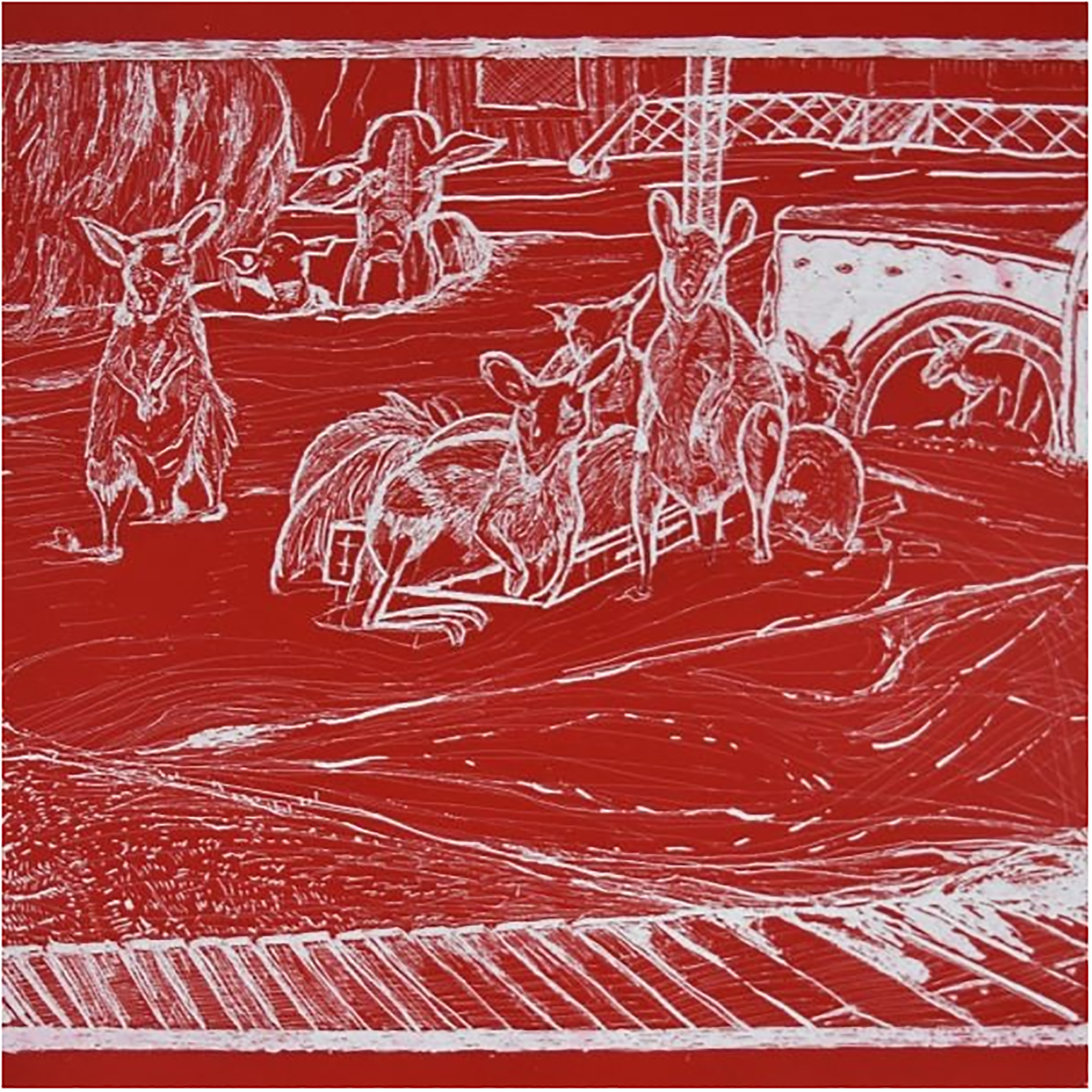
This image is in part inspiration for the representation of the wallabies and floating cow in the etching on tin in Figure 10. The brilliance of the red ochre, the frenetic white lines and the tension of the calm quiet expressions of the animals touches on the discordant, catastrophic setting of the waves of river water lapping at the wooden slats of her home.
Staying afloat. 2024. Etching on tin. Natalie Davey. Courtesy of artist.

The floods brought into stark relief the survival rights of all things – the wallabies on the car trailer, the frog riding the wallaby, the stranded cow, the flocks of birds, the snakes and all the animals and plants impacted by these rising waters. Natalie speaks of how the Nightscape installation is an extension of River Report to give Country (animals, place and so on) more voice, or to better tell their story. However, that is for another conversation after the artwork premieres in 2026. What we will speak of, and end on, is Natalie’s other jarriny – the balga or barramundi.
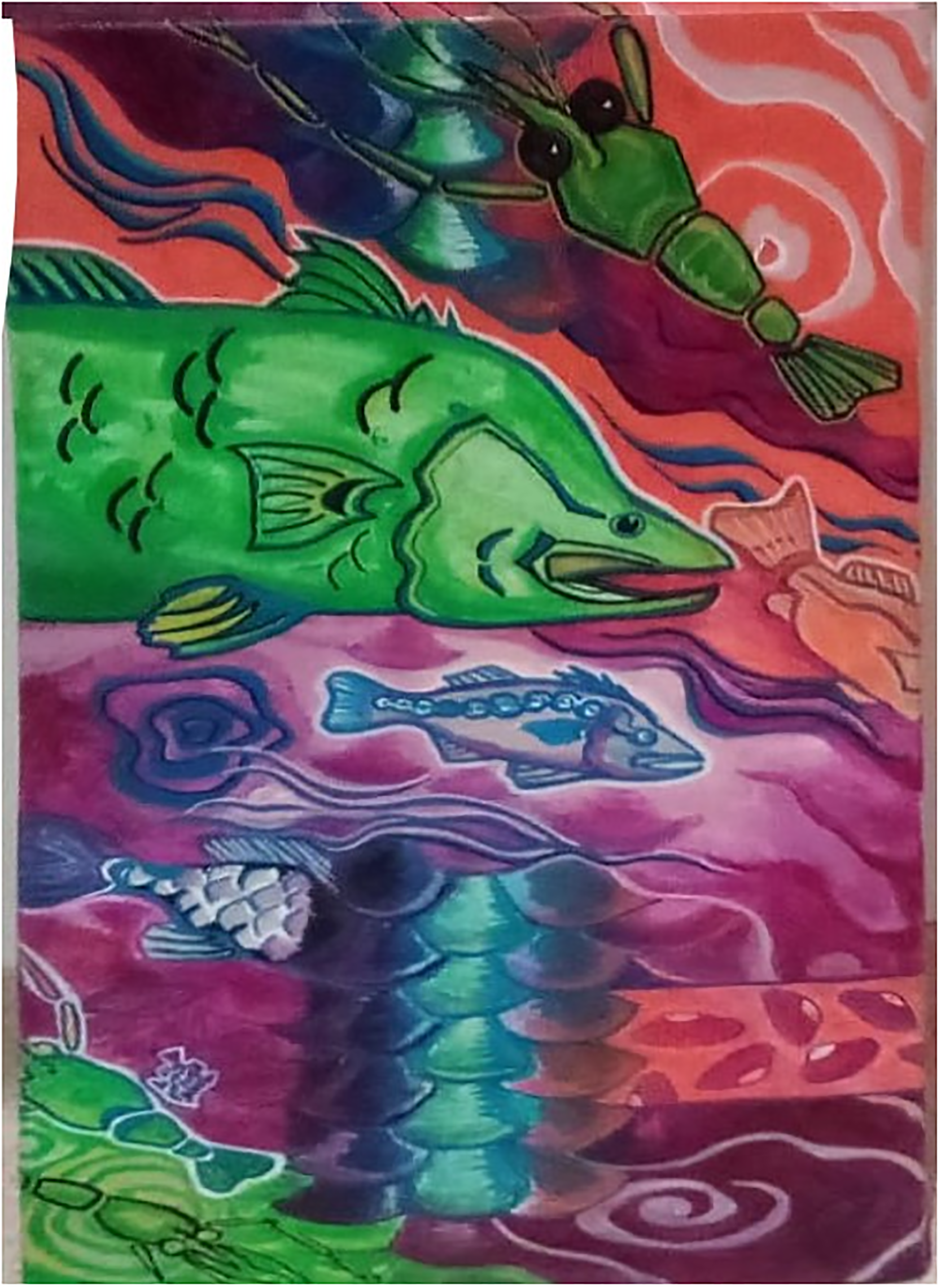
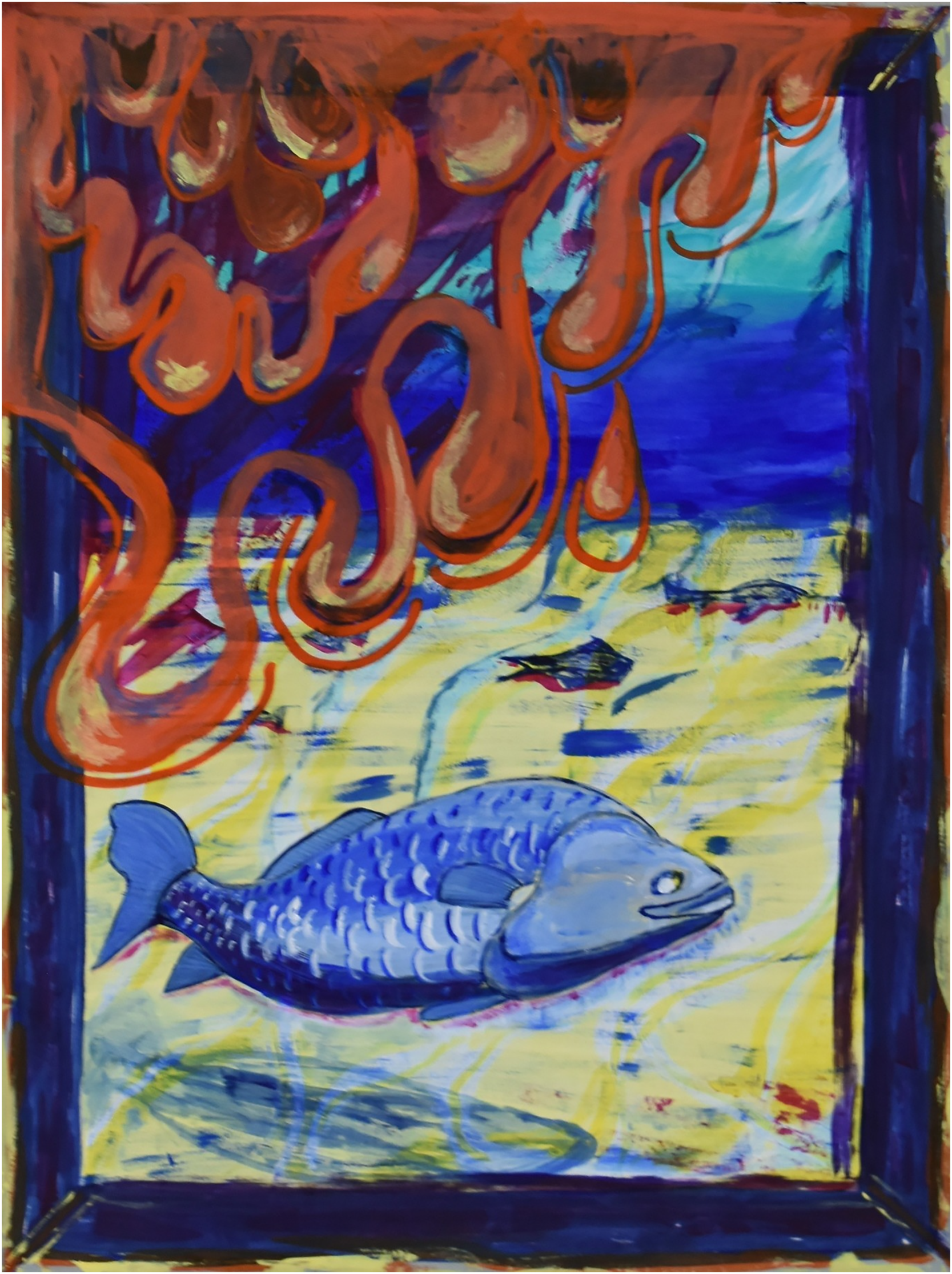
The individual human is considered inseparable from their jarriny and thus also to the natural, more-than-human world, and thus the Natalie’s jarriny, the balga/barramundi, is an extension of herself. Since the flood she has found it hard to compose a self-portrait – of her as barramundi or in human form. The river observations and the River Report is a responsibility to note the river and the conditions of the river for the barramundi to thrive. When the barramundi is existing in place, in the river system that thrives, it looks like Figure 11, where the Balga (animal and human custodian) prospers in a healthy ecosystem.
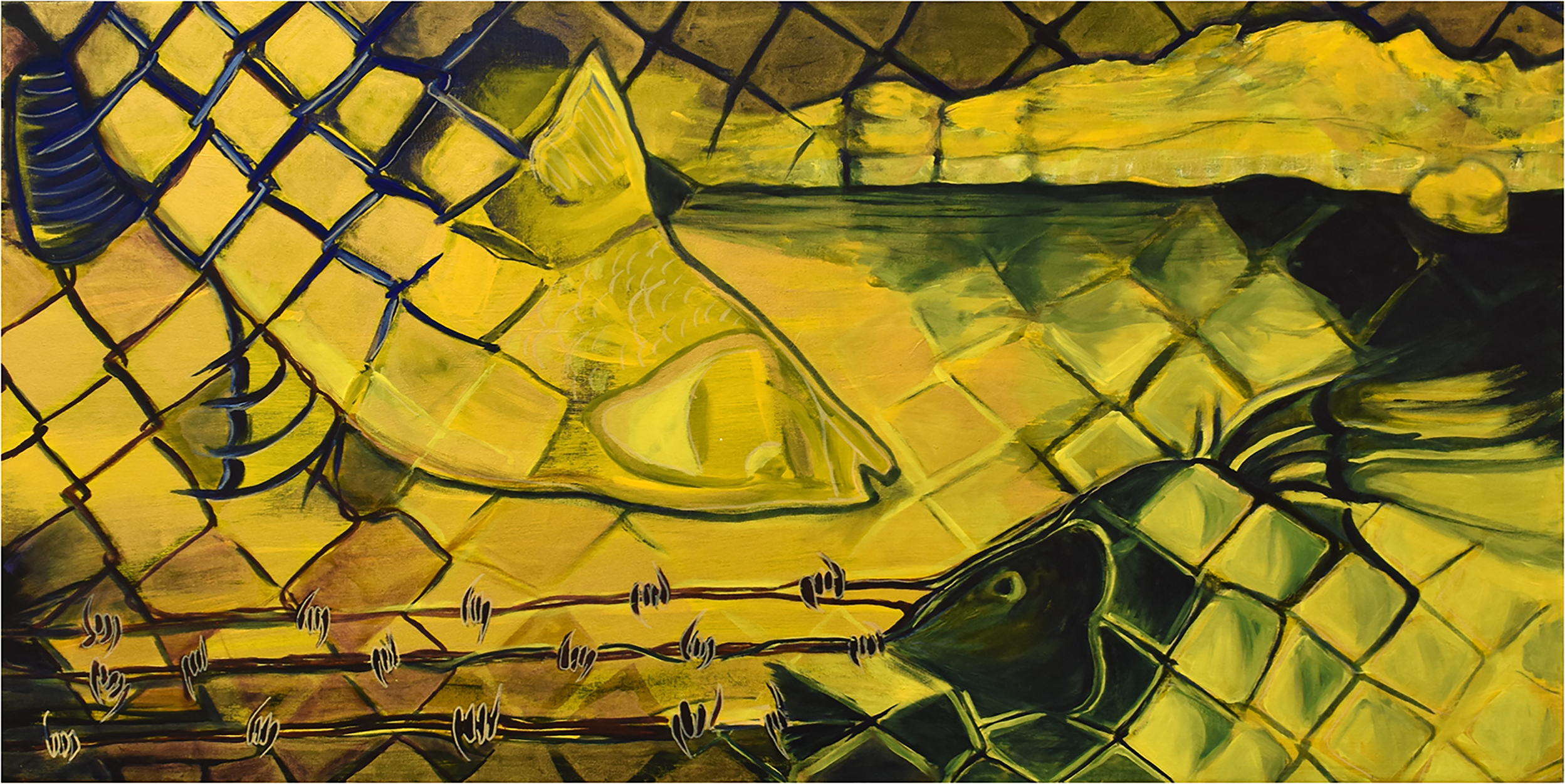
However, in the aftermath of the event and during the confusion of evacuation, temporary accommodation and crisis support services, when multiple communities required targeted yet nuanced support, were literally and figuratively lost, the barramundi began to look like Figure 12.
Balga. 2020, Acrylic on canvas. Natalie Davey. Courtesy of artist.

Balga. 2024. Acrylic on canvas. Natalie Davey. Courtesy of artist.

This work captures the frustration of challenging systems whilst being a spokesperson for multiple communities, and code switching between recovery agencies and community. It represents the miscommunication, or at times complete lack of communication, about the flood response and recovery systems and services. The barbed wire replaces the fishing line; stuck within flawed systems and traumatised by an extreme weather event that irrevocably changed the people, place, plants, animals and “energy” of Country. Artistic methodologies have a unique capability to speak truth to power, to teach through a materiality, a particular type of attuned observation, that can sit alongside systems, policy-makers and disaster relief bureaucracy. The proposed stage three, briefly mentioned at the top of this paper, aims to pull together a resource that captures the myriad experiences of Fitzroy River residents during and after the floods, the informal modes of communication between people, the official methods of communication, support and relief, through the methods of artistic thinking, making and doing. This article raises the possibility of art and art making as a different mode of addressing climate crisis response, disaster preparedness and disaster response and relief in the interrogation of the recent work of Natalie Davey. Perhaps then also through our dialogue we also realise that there is a next step for art as an education piece, in articles like this, and hence, the role Renée has to play in helping to facilitate that conversation in the academy. The next stage will be to discuss the material process in making, and the response to, Nightscape. Arguably the biggest project will be stage three which aims to be a pedagogical tool for policy-makers, emergency relief agencies and for community at large, to learn from what the 2023 floods taught, and how an artist-led, community driven, with Indigenous knowledge systems at its core including the notion of a custodianship ontology that can be adopted by all humans (Aboriginal and non-Aboriginal peoples), might well be a future pathway that is entirely unique. The role of universities in assisting a community-led project like this is important too – to chart the process, question the prevailing paradigms, analyse the data, and in collaboration, offer solutions. They play an important role in assisting in the dispersal of knowledge about extreme weather events and climate crisis more broadly. Furthermore, we feel strongly that stage 3 needs to be a community-led, Indigenous-led and artist-led research project. The balga may have represented systemic entanglement in Figure 12 however, as healing begins a new balga must emerge and a form of custodial entanglement takes place.
Figure 13, Soul Fish, is Natalie’s attempt at capturing impending and enduring change caused during and in the aftermath of the floods. The change to the life force that is the river, and to the gravity of the obligation and responsibility to protect the balga/barramundi and its (and her) home, and with this responsibility comes a desire to see how art and the artist might deliver a different paradigm for addressing systemic social injustice and climate crisis, with multi-species justice and Indigenous knowledge systems as its core onto-ethical driver.
Soul Fish. 2024. Acrylic of paper. Natalie Davey. Courtesy of artist.

When stage three happens – when the artist-led and community driven disaster preparedness/response/recovery system is developed, designed and delivered – the cycle will be complete. The first stage was motivated by an artist displaced from Country and needing to process the event itself – through print making, painting and multi-media including film. The second stage takes this further still and digs into the experience of the flood itself by asking the audience to sit inside an immersive multimedia installation representing the night the floods took over Natalie’s home. Stage three will propose a way in which the artist-led approach offers a different way of understanding disaster response and recovery, educate cultural safety and enable the 2023 flood to be a kind of dynamic archive that is full of educational possibility. It will not be in place of policy or procedure but sitting alongside, offering a new way for understanding and facilitating community preparedness. For now, at the time of writing, Natalie is back to creating river reports, the language conservation radio broadcast, observing seasonal change, representing her community in myriad ways (from CSIRO to launching the feature documentary Disaster Conversations) and preparing for the Sydney Biennale with Nightscape. The radio broadcast programme will remain a language programme but there is something vital about radio as an emergency and recovery mechanism – a tool that has been used for a century worldwide as a vehicle of messaging important concerns, of communicating resistance, of connecting communities. The Facebook live films did the same thing and the radio programme, and other modes of communicating urgent news, is an interesting space to interrogate further. This will be something to unpick more in stage three. Natalie is always noting, always mapping, finding ways to use the familiar in new ways (like the radio, like the repurposed paint brush and more), and she observes that it is not only simply how to survive (an extreme weather event) but also hints there is thriving taking place within some spaces.
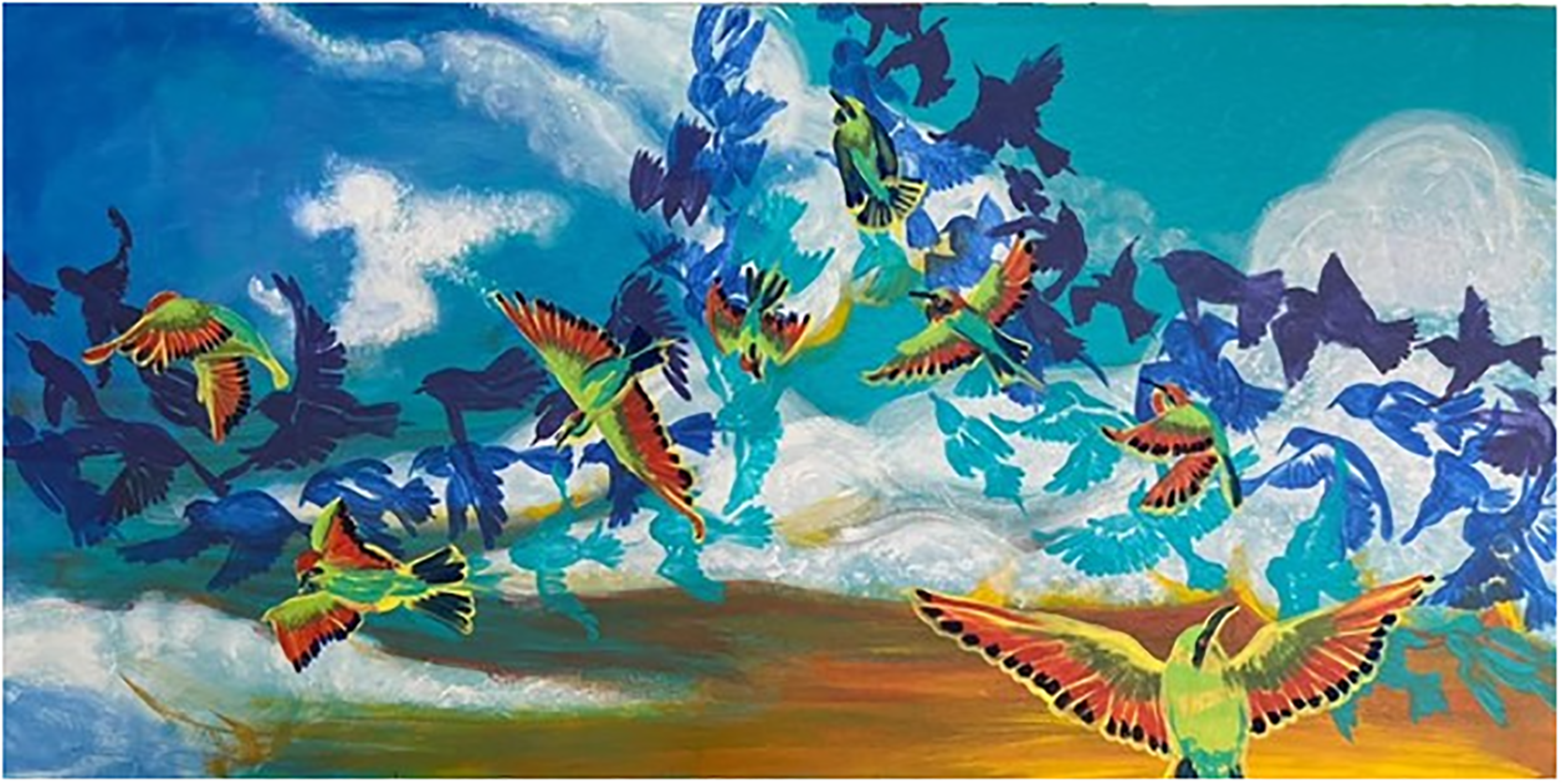
This Rainbow Bee Eater (Figure 14) painting came about because these birds responded to the floods by taking to the skies in abundance. They were one of the first things to break Natalie’s “flood daze,” they were calling her to sit aside the trauma and to connect back into Country. This is a vibrant and joyous painting. Rainbow Bee Eater and Soul Fish are indicative of the complex journey in, through and after extreme weather events, and represent an extension of how Natalie continues to map place, story and jarriny. It is through the artist that the extreme weather event can be understood better – we observe, document, curate, archive and materially represent story, people and place. We conclude, from our perspective as visual artist and performance maker and after our detailed yarning (including artistic analysis about each of Natalie’s works) has ended, that art, whatever form it make take, is where our relationship to all things (earth, sky, water, animal, weather and beyond) can be reimagined. This way the flood is never just crisis, “but a moment of profound collective learning” (RiverOfLife et al., Reference Carracher and Poelina2025, p. 1280). It is through the artist – alongside the scientist, emergency respondent, and the policy-maker – that society can learn how to respond to a rapidly changing climate.
Rainbow Bee Eater. 2024. Acrylic on canvas. Natalie Davey. Courtesy of artist.

Acknowledgements
We would like to thank the editorial team of this special issue. We would also like to acknowledge family, the water and Country.
Financial support
This research received no specific grant from any funding agency, commercial or not-for-profit sectors.
Ethical statement
Nothing to note.
Author Biographies
Natalie Davey is a multidisciplinary artist. Her art practice includes acrylic painting, soundscapes, photography, audio visual works, jewellery, animation, design for clothing, logos and illustrations for children’s books. Central to her work and belief is that people, place, flora and fauna are always connected. She believes acknowledging and working with these interconnections is central to knowing who we are and caring for everything and everyone around us. Natalie Davey has Bunuba, Walmajarri, Scottish and English heritage, and lives in Fitzroy Crossing in the Kimberley’s in Northern Western Australia. She is a custodian in the Bunuba (Bunaba) Danggu (Dongu) Muway community.
Renée Newman is an educator and performance maker based on Whadjuk Noongar Country, in Perth, Western Australia. Her research as an artist includes co-authorship writing techniques; site-specific and audio (walking) performance; contemporary performance with verbatim text; and dramaturgy. She is interested in intersections in art and “care”–for self, society, ecology and beyond. She is senior lecturer at the Western Australian Academy of Performing Arts at Edith Cowan University, Course Coordinator of the Bachelor of Performing Arts Honours and current Associate Dean (Research). She has published for Educational Philosophy Theory; Sustainability; Theatre, dance and performance training journal; Platform; and Performance Research as well as Routledge.

 Open access

