A secundum-type atrial septal defect is a common congenital lesion, comprising 7% of isolated congenital cardiac defects.Reference Carlson, Justino and O'Brien1 Surgical management of atrial septal defect was the treatment of choice in the past. However, with the advancements in invasive cardiology, transcatheter closure in suitable patients is the first line of treatment. Since the introduction of transcatheter closure in 1974 by King and Mills, several devices have been developed. The Amplatzer septal occluder (AGA Medical Corporation, Golden Valley, Minnesota, United States of America) is the most frequently used device for atrial septal defect occlusion. Atrial septal defect occlusion is usually performed under general anaesthesia with the help of transoesophageal echocardiography.Reference Podnar, Martanovic, Gavora and Masura2–Reference Tseng, Hsiao, Lin, Wang and Tsai7 Guidelines used in transcatheter closure of atrial septal defect recommend the use of transoesophageal echocardiography during the procedure. However, in selected patients, transthoracic echocardiography can be used instead of transoesophageal echocardiography. The aim of this study is to evaluate our clinical experience using the Amplatzer septal occluder for catheter closure of the secundum-type atrial septal defect under transthoracic echocardiography guidance.
Methods
A total of forty patients between 3 and 17 years of age with a mean of 7.9 plus or minus 3.8 years with secundum-type atrial septal defect were eligible for transcatheter closure with the Amplatzer device (AGA Medical Corporation, Golden Valley, Minnesota, United States of America) under transthoracic echocardiographic guidance. Patients with high-quality echocardiographic views were selected for closure with this technique.
All patients were evaluated at our institution with transthoracic two-dimensional and colour Doppler echocardiography with multiple subxyphoidal (frontal and caval position) and precordial windows (modified parasternal four chamber and short-axis aortic position). Inclusion criteria for patient selection and the protocol of device closure were reported previously in detail.Reference Celiker, Ozkutlu, Karagoz, Ayabakan and Bilgic8–Reference Hijazi, Cao, Patel, Rhodes and Hanlon12 After performing over 200 transcather closures under transoeosophageal echocardiographic guidance, we noticed that a small defect size was associated with a higher success rate. We observed that almost all of the centrally placed small defects that had a ratio of defect size to the total septal diameter of less than 0.33 were easily and safely closed by transcatheter technique. The largest atrial septal defect diameter measured with coloured Doppler in different views was selected as the reference diameter for the procedure. The ratio of defect size to the total septal diameter was calculated in every patient, and patients who had a value less than 0.33 were considered eligible for transthoracic closure.
Routine examination before the procedure included thorough physical examination, electrocardiogram, chest X-ray, and transthoracic echocardiography. Informed parental consent was obtained for each patient. There were two patients who had previously undergone radiofrequency ablation for supraventricular tachycardia in our institution, one who had an insignificant small ventricular septal defect, and one who had two small atrial septal defects.
All procedures were performed under conscious sedation with or without the presence of the anaesthesia team in the catheter laboratory. In all patients, haemodynamic work-up (including pulmonary artery pressure measurement, calculation of the amount of the left-right shunt through the atrial septal defect, and the angiograms) was performed. Balloon sizing (AGA Medical Corporation, Golden Valley, Minnesota, United States of America) was used in five patients. The largest atrial septal defect diameter was used as the reference diameter for device selection. Devices were deployed under fluoroscopic and transthoracic echocardiographic guidance. Special attention was paid to detect impingement on the atrioventricular valves or any obstruction of the caval or pulmonary veins and a residual shunt by transthoracic echocardiography. In addition, gentle pushing of the delivery cable forwards and backwards (Minnesota Wiggle) was carried out to ensure a stable position. The echocardiographer performed transthoracic echocardiography to confirm proper placement of the device, making sure that one disk was deployed in each chamber. If the device was satisfactorily well positioned and no shunt or a trivial shunt was observed, the device was unscrewed from the cable.
Patients were observed for 24 hours and were discharged after an evaluation with chest X-ray, electrocardiogram, and transthoracic echocardiography. Reassessment was made at the first month and every 6 months thereafter with transthoracic echocardiography and Holter monitoring. Patients received prophylactic antibiotics during the procedure and for any intervention within 6 months after device implantation. Acetylsalicylic acid 3–5 milligrams per kilogram per day was given for 6 months after the procedure.
Statistical analyses were performed using SPSS version 16.0 (SPSS Inc., Chicago, Illinois, United States of America) for Windows. A value of p less than 0.05 was considered to be statistically significant. Results are expressed as mean plus or minus standard deviation. Comparison of parameters between the groups was performed with Mann–Whitney U-test.
Results
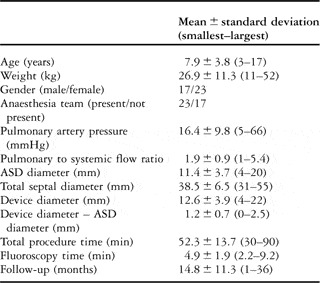
Between November 2006 and December 2009, the secundum-type atrial septal defect was closed with the Amplatzer septal occluder in 40 patients with transthoracic echocardiographic guidance, while transoesophageal echocardiography was used in 69 patients. Device closure was performed in 40 patients under transthoracic echocardiographic guidance. Of the 40 patients, 23 (58%) were female. The anaesthesia team was present in 23 of the 40 procedures. Balloon sizing was used in five patients. The mean age of these patients was 7.9 plus or minus 3.8 years with a range of 3 to 17 years. Patients weighed between 11 and 52 kilograms with a mean weight of 26.9 plus or minus 11.3. The mean pulmonary to systemic flow ratio was 1.9 plus or minus 0.9 with a range of 1 to 5.4, the mean pulmonary artery pressure was 16.4 plus or minus 9.8 millimetres of mercury ranged from 5 to 66. The mean atrial septal defect diameter determined by transthoracic echocardiography was 11.4 plus or minus 3.7 millimetres ranged from 4 to 20. Total septal diameter was 38.5 plus or minus 6.5 millimetres ranged from 31 to 55, and the mean device diameter and the difference between device diameter and atrial septal defect were 12.6 plus or minus 3.9 millimetres with a range from 4 to 22 and 1.2 plus or minus 0.7 with a range from 0 to 2.5, respectively (Table 1). In patients with larger defects and questionable rims and those who had poor transthoracic image quality in whom transthoracic approach was not considered a safe enough method, transoesophageal guidance was used.
Patient characteristics.

ASD = atrial septal defects
The mean total procedure time was 52.3 plus or minus 13.7 minutes with a range from 30 to 90 minutes and the mean fluoroscopy time was 4.9 plus or minus 1.9 minutes with a range from 2.2 to 9.2 (Table 1). Immediately after deployment of the device, two patients (5.1%) had trivial residual shunt with transthoracic echocardiography. At the time of discharge, no residual shunt was observed on the echocardiogram. There was one patient who had two atrial septal defects that were situated very close to each other, but were away from the surrounding tissues (atrioventricular valves, pulmonary veins, and both caval veins). A single device of 15 millimetres was placed through the larger defect, which also occluded the small defect close to it, and the device was released twice in this patient for proper placement. There were no major complications like device fracture, embolisation, or migration.
Follow-up
The mean time of follow-up was 14.8 plus or minus 11.3 ranged from 1 to 36 months. Careful assessment of symptoms that might be related to device deployment, routine physical examination, electrocardiogram, and echocardiography was performed in the follow-up visits. There was one patient who had prolapsus of the mitral valve and trivial mitral regurgitation before device closure, and the degree of mitral regurgitation did not change after the procedure. Another patient had trivial aortic regurgitation before the procedure, which remained at the same degree during the 2-year follow up. Echocardiographic examinations of the other patients were normal.
Holter examination was performed 1 month later and annually after the procedure in every patient. There were three patients with rare supraventricular extrasystoles, one patient with rare ventricular extrasystoles, and one patient with wandering atrial pacemaker rhythm on the holter monitorisation. None of the patients had any significant symptoms of palpitation or syncope and these findings were considered to be clinically insignificant.
Discussion
Transcatheter closure of the atrial septal defects has gained widespread use in the last decades. Several different devices are available for the procedure; however, the most experience is with the Amplatzer device. Pre-intervention selection of suitable patients is done by transthoracic echocardiography, and transoesophageal echocardiography is used during the closure procedure in most of the centres. Alternative methods such as intracardiac echocardiography have been included in the reference books.Reference Hijazi, Wang, Cao, Koenig, Waight and Lang13, Reference Fu and Hijazi14 We think that transthoracic echocardiography, such as intracardiac echocardiography, can also be used as an alternative method during the procedure.
Both transthoracic and transoesophageal echocardiography imaging have advantages and disadvantages. Transoesophageal echocardiography provides a better resolution of the septum and the defect than transthoracic echocardiography because it is positioned closer to the heart. However, it has the disadvantage of the endotracheal anaesthesia requirement in children and the presence of an observational blind area. However, transthoracic echocardiography has the advantages of not requiring general anaesthesia, of having more experience in its use, and the convenience of presenting multi-planar views of the heart that can be sufficient for the assessment of the atrial septal defects in suitable patients. However, age, lung disease, obesity, thoracic deformity, or other acoustical impediments can influence the image quality of transthoracic echocardiography.
Recently, intracardiac echocardiography has emerged as an alternative technique for visualisation of the septum and the defect during transcatheter closure. It provides higher resolution of images, does not require endotracheal anaesthesia, does not interfere with fluoroscopy imaging, and has the advantage of constant visualisation during the procedure. However, it is a new technology, and therefore not much experience is available regarding its use. Besides, it is a very expensive technique compared with conventional methods. In addition, it requires at least an eight French sheath, which can be problematic in small children.15
Jan et alReference Jan, Hwang, Lee, Fu, Chiu and Chi16 compared the atrial septal defect diameters measured with intracardiac echocardiography, transthoracic echocardiography, angiographically, and with balloon sizing. They estimated the stretched defect diameter using the formula transthoracic echocardiography diameter × 1.09 + 3.9 millimetres. They showed that there was a very good correlation with the predicted diameter and the actual stretched diameter using angiographic and intracardiac echocardiographic measurements, supporting our opinion that transthoracic echocardiography can be used in suitable cases.
Transcatheter closure of the atrial septal defect with transoesophageal echocardiography has been performed since 1999 in our institution. Approximately 200 patients underwent transcatheter closure of atrial septal defects until 2006. Between November 2006 and December 2009 the secundum-type atrial septal defect was closed with the Amplatzer septal occluder in 40 patients (17 males) with transthoracic echocardiography guidance, while transoesophageal echocardiography was used in 69 patients. Patients were selected for transcatheter closure under transthoracic echocardiography guidance according to defect size, adequate rim size and strength, and adequate image resolution with transthoracic echocardiography. The anaesthesia team is not a constant part of the catheter lab staff in our institution. They are scheduled to help with our procedures that require the use of transoesophageal echocardiography during catheterisation. We had the anaesthesia team ready in the catheter lab during the initial experience with transthoracic closure. We planned to perform endotracheal anaesthesia and convert to transoesophageal echocardiographic guidance if it was thought necessary. Suitable patients, according to the criteria stated above, were admitted to the catheterisation lab without the anaesthesia team and conscious sedation was used.
The mean atrial septal defect diameter of our patients was 11.4 plus or minus 3.7 millimetres with a range from 4 to 20. Our patients included two with small diameters – 4 and 5 millimetres. Both of these patients had unexplained syncopal attacks; one patient had two defects, however, which were situated very close to each other and a slightly larger device was efficient in closing both defects. However, the Amplatzer septal occluder had to be released twice in this patient for proper alignment.
During the procedure, multiple views were used to determine the atrial septal defect diameter, and the largest recorded defect size was used as the reference for device selection. With small defects, the rims are usually intact, and therefore we used an Amplatzer septal occluder size slightly larger than the reference atrial septal defect diameter. In five of our patients, the defect size could not be accurately measured, and therefore balloon sizing was used. In larger defects (greater than 20 millimetres), the rims are usually weak, soft, and floppy, and the measurement of accurate defect diameter might be a more challenging task under transthoracic echocardiography. In addition, with the presence of large defects, the accompanying smaller defects might be overlooked with transthoracic echocardiography. For these reasons, we feel that transoesophageal echocardiography is more appropriate for larger defects because it provides a higher resolution. We think that the ratio of defect size to the total septal diameter can be used as a guide for selection of suitable patients. Defects that are placed centrally with adequate rim size and structure that have the above-mentioned ratio smaller than 0.33 are eligible for transcatheter closure with almost a certain chance of closure. Therefore, we think that patients with a ratio less than 0.33 with adequate image impedance can be selected for transcatheter closure under transthoracic echocardiography.
There are very few publications about the use of transthoracic echocardiography in transcatheter closure of atrial septal defects. Li et alReference Li, Kong and Ji17 recently published a study in which they used transthoracic echocardiography in 88 patients, aged between 4 and 67 years (mean 33.7 plus or minus 17.3). They grouped their patients according to the defect size, and included large defects in their study. Their results show that in defects smaller than 20 millimetres, transthoracic echocardiography is a highly efficient, safe, and successful method. They used endotracheal anaesthesia in children smaller than 10 years. Our patients included those who were smaller than 10 years, showing that conscious sedation can also be successfully used in small children.
In conclusion, use of transthoracic echocardiography is a safe and effective method for transcatheter closure. We think that after acquisition of efficiency in transcatheter closure methods, in selected cases, in which the defects are small and the rims are adequate and transthoracic echocardiography provides high image quality, transthoracic echocardiography can be substituted with transoesophageal echocardiography. The fact that transthoracic echocardiography imaging does not require endotracheal anaesthesia makes it a more comfortable technique for the patient, exposes the patient to less complication risks compared with general anaesthesia, and might decrease the procedure time. However, transthoracic echocardiography should not be used when there are large and multiple defects, or the rims are thin and soft and the image resolution is inadequate.