At certain times in the history of a discipline, theories extend beyond the empirical facts that have been discovered to test them; at other times, new facts come to light that cannot be comprehended in terms of the theories available. For the past decade or more, European integration has thrown up a series of facts that escape the theories on offer. How can one explain the outcomes of referendums which shape the course of European integration? What explains public opinion, competition among political parties and the populist pressures that have thrust Europe into domestic politics? Why has the process of decision making over Europe changed? These questions have drawn comparativists to examine the European Union, but this research has rarely been guided by theories of regional integration.
The purpose of theory is to frame research agendas – to direct empirical research to interesting developments, to find and solve empirical puzzles, as well as to generalize.Footnote 1 In this article we outline a research programme that seeks to make sense of new developments in the politics of the European Union (EU) and the middle-range theories that account for them.
We do so by using the building blocks of the multi-level governance approach to European integration. Multi-level governance conceives regional integration as part of a more general phenomenon, the articulation of authority across jurisdictions at diverse scales. In earlier work we detected direct connections between domestic groups and European actors that contradicted the claim that states monopolize the representation of their citizens in international relations.Footnote 2 Here we extend this line of argument by analysing how domestic patterns of conflict across the European Union constrain the course of European integration. Domestic and European politics have become more tightly coupled as governments have become responsive to public pressures on European integration.
A theory of regional integration should tell us about the political choices that determine its course. In order to explain the level and scope of integration, we need to understand the underlying conflicts: who is involved, on what issues and with what consequences. We therefore pay detailed attention to the substantive character of the debate over regional integration.Footnote 3 What do key actors strive for?
The debate on Europe is complex, but recent research has shown it has structure. It is coherent, not chaotic. It is connected to domestic political conflict, not sui generis. And, while some have tried, no one has succeeded in reducing the debate to rational economic interest. For reasons that we turn to next, we believe that it is impossible to do so.Footnote 4
Every theory is grounded on a set of assumptions – intellectual short cuts – that reduce complexity and direct our attention to causally powerful factors. We claim that identity is decisive for multi-level governance in general, and for regional integration in particular. The reason for this derives from the nature of governance.
Governance has two entirely different purposes.Footnote 5 Governance is a means to achieve collective benefits by co-ordinating human activity. Given the variety of public goods and their varying externalities, efficient governance will be multi-level. But governance is also an expression of community. Citizens care – passionately – about who exercises authority over them. The challenge for a theory of multi-level governance is that the functional need for human co-operation rarely coincides with the territorial scope of community. Communities demand self rule, and the preference for self rule is almost always inconsistent with the functional demand for regional authority. To understand European integration we need, therefore, to understand how, and when, identity is mobilized.
We describe the research programme as postfunctionalist because the term reflects an agnostic detachment about whether the jurisdictions that humans create are, or are not, efficient. While we share with neofunctionalism and intergovernmentalism the view that regional integration is triggered by a mismatch between efficiency and the existing structure of authority, we make no presumption that the outcome will reflect functional pressures, or even that the outcome will reflect these pressures mediated by their distributional consequences. Political conflict makes all the difference, and that conflict, we argue, engages communal identities.
Our argument can be broken down into three logical steps. First, we theorize public and party preferences over European integration. Secondly, we theorize the conditions under which public and party preferences matter, i.e. the conditions under which European integration is politicized in high profile debate. Thirdly, we conclude by hypothesizing the consequences of politicization for the substantive character of European integration.Footnote 6 Before we lay out this argument we suggest why neofunctionalism and intergovernmentalism have become less useful guides for research on the European Union.
Neofunctionalism and intergovernmentalism
Both neofunctionalism and intergovernmentalism refine a prior and simpler theory – functionalism – which shaped thinking about political integration among scholars and policy makers from the end of the First World War until the 1950s.Footnote 7 Functionalism assumed that the sheer existence of a mismatch between the territorial scale of human problems and of political authority generates pressures for jurisdictional reform. David Mitrany, the principal functionalist thinker after the Second World War, believed that the welfare benefits of supranationalism would impel reform.
Later, scholars elaborated explanations from a more detached scientific standpoint. They retained the functionalist insight that regional integration is a response to the collective benefits of extending the territorial scope of jurisdictions, but they were well aware that the mismatch between collective welfare and the structure of authority does not speak for itself.
Neofunctionalists were puzzled by the speed and breadth of regional integration in Europe in the 1950s and 1960s.Footnote 8 How, they asked, could rapid jurisdictional reform take place among embedded national states? They identified several political processes that intervened between functionality and the structure of authority.Footnote 9 Jurisdictional reform had to be initiated and driven by transnational interest groups demanding supranational authority to reap (mainly economic) benefits. Once set in motion, the process was self-reinforcing. As integration deepened and supranational institutions gained power, so more transnational interests would be drawn to the supranational level. Supranational actors would themselves demand more authority. Progress in one area would give rise to pressures for integration in other areas. Transnational mobilization, supranational activism and policy spill-over would intervene between sectoral pressures for jurisdictional reform and institutional outcomes.
After the debacle of Charles de Gaulle’s opposition to supranationalism and the empty chair crisis of 1965–66, neofunctionalist predictions appeared too rosy. The most influential alternative approach – intergovernmentalism – describes a family of theories that conceive regional integration as an outcome of bargaining among national states.Footnote 10 The puzzle was not the speed or breadth of regional integration, but the decision of national states to create an international regime in the first place. Given their power and resources, why should states pool authority? Robert Keohane’s answer was that international regimes provide states with the functional benefit of facilitating mutually advantageous co-ordination.Footnote 11
Neofunctionalists and intergovernmentalists engaged in a decades-long debate about whether the impetus for regional integration comes from national governments or from supranational or transnational actors, whether supranational institutions such as the European Commission are autonomous from national governments, and whether regional integration transforms national states. To a considerable extent, neofunctionalists and intergovernmentalists talked past each other. Neofunctionalists were most concerned with day-to-day policy making, while intergovernmentalists were concerned with the major treaties.Footnote 12 But we should not be dismayed that facts did not settle the issue. Facts do not stand up for themselves in validating or invalidating a theory, but are deployed and debated. Such debate rarely yields a clear winner. What distinguishes positive from negative research agendas is the ability of a theory to shed light on new facts without adopting ad hoc hypotheses.
Disagreements between neofunctionalists and liberal intergovernmentalists should not obscure two commonalities. First, both conceived preferences as economic. Neofunctionalists argued that Pareto-improving economic gains lie behind demands for regional integration. Transnational interest groups and supranational actors pursue incremental economic reform along the line of least resistance. This would eventually transform the national state, and even identities, in a European direction. Liberal intergovernmentalists stressed that preferences over European integration reflected the distribution of economic gains among states or business groups.
Secondly, both neofunctionalism and liberal intergovernmentalism focus on distributional bargaining among (economic) interest groups. Neofunctionalists hypothesized that such groups would operate at the supranational, as well as at the national level. Intergovernmentalists conceived interest-group pressures within discrete national arenas. Business groups lobby national governments because this is the most direct way to exert political influence over EU decision making.Footnote 13
A central claim of this article is that one must probe beyond the economic preferences of interest groups to understand the course of European integration. An approach stressing interest-group calculation is more appropriate for European integration in the late 1950s to the late 1980s than either before or since. Only after the defeat of a European Defence Community in the French National Assembly in 1954 by 319 to 264 votes did proponents of regional integration turn to the market.Footnote 14 Market making was considered by many as a second-best solution. Jean Monnet considered it third best – after the failure of political union, he devoted his efforts to integration in nuclear energy. Historically, the turn to market integration was preceded by conflict among, and within, political parties on the merits of German rearmament and pooling sovereignty over defence.Footnote 15
In the 1990s, partisan conflict intensified as market integration was extended to monetary union, and as political union once again came on the agenda. According to Stefano Bartolini, European integration reverses a centuries-long process of national boundary construction by providing exit options for individuals who had previously been nationally bounded.Footnote 16 Hanspeter Kriesi, Edgar Grande and colleagues argue that European integration and globalization constitute a critical juncture for conflict in Europe.Footnote 17 The issue has spilled beyond interest group bargaining into the public sphere.
Hence, it does not make sense to regard functional economic interest groups as inherently decisive for European integration, but as decisive only under certain conditions. Neofunctionalism and liberal intergovernmentalism generalize from the first three decades of integration, when the creation of a European legal system was driven by the demand for adjudication of economic disputes between firms.Footnote 18 The implications for most people (except perhaps for farmers) were limited or not transparent. Public opinion was quiescent. These were years of permissive consensus, of deals cut by insulated elites. The period since 1991 might be described, by contrast, as one of constraining dissensus. Elites, that is, party leaders in positions of authority, must look over their shoulders when negotiating European issues. What they see does not reassure them.
Writing in 1958, Haas defended an elite perspective on the grounds that the general public was indifferent or impotent:
The emphasis on elites in the study of integration derives its justification from the bureaucratized nature of European organizations of long standing, in which basic decisions are made by the leadership, sometimes over the opposition and usually over the indifference of the general membership.Footnote 19
Neofunctionalism had the profound insight that this was a temporary state of affairs. As more issues shifted to the European level, elite decision making would eventually give way to a process of politicization in which European issues would engage mass publics.Footnote 20 However, neofunctionalists believed that politicization would lead national governments towards further integration.Footnote 21 The assumption was that European polity building would follow the logic of state building where popular pressures for welfare contributed to centralization. Intergovernmentalism, for its part, had little to say on the topic: public contestation was placed outside the theory on grounds of parsimony.Footnote 22
The Structure Of Debate Over Europe
The elite-centred view of European integration survived the creation of a European Parliament and even direct elections from 1979. European elections were popularity tests for national governments.Footnote 23 European integration, as several researchers found, was largely a non-issue for the public.
This view rests on three assumptions, none of which now hold. First, the public’s attitudes towards European integration are superficial, and therefore incapable of providing a stable structure of electoral incentives for party positioning. Secondly, European integration is a low salience issue for the general public (in contrast to its high salience for business groups), and therefore has little influence on party competition. And, thirdly, the issues raised by European integration are sui generis, and therefore unrelated to the basic conflicts that structure political competition.
The experience of the past fifteen years – and the research it generated – has dismantled each of these assumptions. Public opinion on European integration, as we discuss below, is rather well structured,Footnote 24 affects national votingFootnote 25 and is connected to the basic dimensions that structure contestation in European societies.Footnote 26
With the Maastricht Accord of 1991, decision making on European integration entered the contentious world of party competition, elections and referendums. Content analysis of media in France, the Netherlands, Germany, Britain, Switzerland and Austria reveals that the proportion of statements devoted to European issues in national electoral campaigns increased from 2.5 per cent in the 1970s to 7 per cent in the 1990s.Footnote 27 In the 1990s, between a tenth and an eighth of all policy statements in a sample of British and Swiss media contained references to Europe.
Analysing a dataset of 9,872 protests from 1984 through 1997, Doug Imig and Sidney Tarrow conclude that ‘European integration is highly salient to a growing range of citizens across the continent’.Footnote 28 On conservative assumptions, they find that the proportion of social movement protest oriented to Europe has risen from the 5–10 per cent range in the 1980s to between 20 and 30 per cent in the second half of the 1990s.
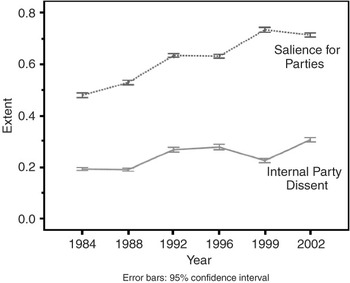
An expert survey conducted by Kenneth Benoit and Michael Laver finds that European integration was the third most important issue in national party competition in Western Europe in 2003, behind taxes v. spending and deregulation/privatization, but ahead of immigration. European integration topped the list in Britain, France, Cyprus and Malta. In Eastern Europe, joining the European Union was typically the most salient issue.Footnote 29 At the same time – no coincidence – conflict over Europe within national parties has intensified in almost all EU countries (see Figure 1).Footnote 30
Salience and dissent on European Integration in national political parties, 1984–2002 Sources: Expert surveys conducted for 1984, 1988, 1992, 1996, 1999 and 2002 by a research team at the University of North Carolina, Chapel Hill (Leonard Ray, ‘Measuring Party Orientations Towards European Integration’, European Journal of Political Research, 36 (1999), 283–306; Marco Steenbergen and Gary Marks, ‘Evaluating Expert Surveys’, European Journal of Political Research, 46 (2007), 347–66). Salience and dissent are recoded on a scale from 0 to 1; average of expert codings by party. Salience: ‘Over the course of 2002, how important has the EU been to the parties in their public stance? (1 = European integration is of no importance at all, to 4 = European integration is of great importance)’. Dissent: ‘How much internal dissent has there been in the various parties over European integration over the course of 2002? If you believe that a party is completely united on European integration, please circle 1. If you believe it is extremely divided, circle 10’. (Previous years used a five-point scale.)

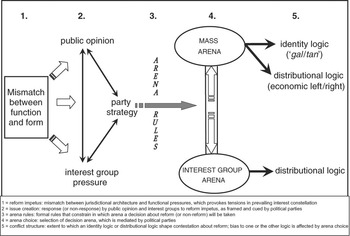
Figure 2 provides a schematic overview of our argument concerning domestic politicization. The key variable is the arena in which decision making takes place, which we represent as a barbell from mass politics to interest group politics. We conceive the arena both as a dependent variable and as an independent variable. The process begins on the left-hand side with a reform impetus (1) arising from a mismatch between functional efficiency and jurisdictional form, leading to issue creation (2) as political parties respond to public opinion and interest groups. Political parties frame arena choice (4) – whether an issue enters the arena of mass politics or is contained in the interest group arena – but they are constrained by arena rules (3), the formal rules in a polity concerning arena choice (for example, rules mandating or prohibiting referendums). Arena choice, in turn, shapes whether the conflict structure (5) on the issue is biased towards identity or distribution.
A model of domestic politicization

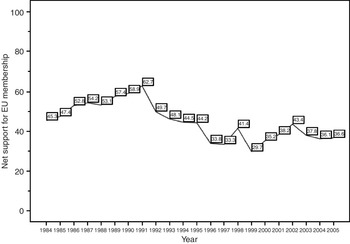
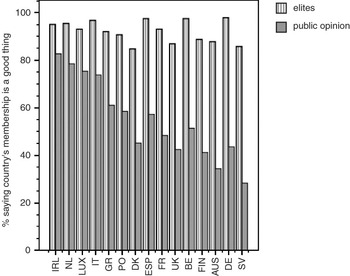
We claim that politicization of European integration has changed the content, as well as the process of decision making. This argument does not require that the public has become significantly more Eurosceptical. Figure 3 reveals that the level of public support in 2005 is not much lower than in 1985. The decisive change is that the elite has had to make room for a more Eurosceptical public. Figure 4 compares the level of elite and public support for European integration across the European Union in 1996, the one year for which we have comparable data. The gap varies from large in Ireland (12 per cent), Luxembourg (17 per cent) and the Netherlands (18 per cent), on the left of the figure, to extremely large in Sweden (57 per cent) and Germany (54 per cent), on the right.Footnote 31 In 1985 the public could be ignored; in 2005 this was no longer an option.
Net support among public opinion, 1984–2005 Note: Eurobarometer surveys from 1984 through 2005. Public opinion data for members of the European Union, so for 1984–86, ten members; for 1986–89, plus Spain and Portugal; for 1990–94, plus East Germany; for 1995–2004, plus Austria, Finland and Sweden; for 2005, 25 members. Weighted for country population. Responses for the membership question: ‘Generally speaking, do you think that your country’s membership is a good thing, a bad thing, or neither good nor bad?’

The Elite–Public Gap, 1996 Note: National elite data are from a survey conducted among 3,700 respondents of the political, administrative, socio-economic, media and cultural elites in the then-fifteen member states (see Jacqueline Spence, The European Union: A View from the Top (Waver, Belgium: EOS Gallup Europe, 1997). Public opinion data for the membership question are averaged across the two Eurobarometers of 1996. Both surveys are weighted for country population. Countries are arrayed according to the size of the elite–public gap, from the lowest gap on the left to the largest on the right.

Closed shops of government leaders, interest groups and Commission officials have been bypassed as European issues have entered party competition. On major issues, governments, i.e. party leaders in positions of executive authority, try to anticipate the effect of their decisions on domestic publics. Public opinion on European integration has become a field of strategic interaction among party elites in their contest for political power.
Public Opinion
Not until the 1980s did researchers begin to take EU public opinion seriously.Footnote 32 The point of departure was to hypothesize the objective consequences of market integration for individual economic well-being, using data on income, occupation and education.Footnote 33 Later models extended economic theorizing to socio-tropic effects (for example, country-level indicators of inflation or growth), subjective effects (such as, ‘Will 2007 be better, worse or the same as it comes to the financial situation of your household?’), and subjective socio-tropic effects (for instance, ‘Will the economic situation in our country be better, worse, or the same in 2007?’). Such models explain about a fifth of the variance in public opinion on Europe. But could researchers assume that the economic calculations driving their models capture attitudes among unsophisticated respondents?
If individuals have neither the knowledge nor the time to figure out their economic interests in relation to European integration, perhaps they rely on cues. These cues could be ideological, deriving from an individual’s position on left/right distributional conflict, or they could come from the media, intermediary institutions such as trade unions or churches, or from political parties. In fact, there is evidence for each of these.Footnote 34 However, when one examines the content of such cues, it is clear that they engage identity as well as economic interest.
The reason for this is that the European Union is more than a means to lower economic transaction costs. It is part of a system of multi-level governance which facilitates social interaction across national boundaries, increases immigration and undermines national sovereignty. Economic losers are more prone than economic winners to feel culturally threatened, but the fit is loose.Footnote 35
Since 2002, researchers have probed how national identity shapes attitudes over Europe.Footnote 36 This work draws on social identity theory which posits that group identifications shape individual self-conception. Humans have an ‘innate ethnocentric tendency’, which leads a person to favour his or her own group over others.Footnote 37 But favouritism for one’s own group does not automatically lead to conflict or hostility towards others.Footnote 38 Individuals typically have multiple identities. They identify with territorial communities on vastly different scales, from the local to the regional, to the national and beyond. What appears decisive is not the group with which one identifies, but how different group identities relate to each other, and whether and how they are mobilized in elite debate.
To explain how identity affects public opinion on Europe we must apply generalizations to specific circumstances. Three generalizations are particularly relevant:
— Identity has greater weight in public opinion than for elites or interest groups.
— Identity does not speak for itself in relation to most political objects, but must be politically constructed.
— The more exclusively an individual identifies with an ingroup, the less that individual is predisposed to support a jurisdiction encompassing outgroups.
The jurisdictional shape of Europe has been transformed, but the way in which citizens conceive their identities has not. Since 1992, when the European Union’s public opinion instrument, Eurobarometer, began to ask questions about identity, the proportion of EU citizens who describe themselves as exclusively national, for example, British, French or Czech only, rather than national and European, European and national, or European only, has varied between 33 and 46 per cent, with no discernible trend. Neil Fligstein argues cogently that the experience of mobility and transnational social interaction spurs European identity,Footnote 39 but the pace of such change is much slower than that of jurisdictional reform. Younger people tend to interact across national borders more than older people and, on average, they attest stronger European identity, but there is no evidence of an aggregate shift towards less exclusive national identities since the early 1990s, the period for which we have reasonably good data. Until generational change kicks in, Europe is faced with a tension between rapid jurisdictional change and relatively stable identities.
Two things would have to happen to activate such a tension politically, and both have happened. First, the tension must be salient. The scope and depth of European integration have perceptibly increased,Footnote 40 and their effects have been magnified because they are part of a broader breakdown of national barriers giving rise to mass immigration and intensified economic competition.
Secondly, political entrepreneurs must mobilize the tension. Connections between national identity, cultural and economic insecurity and issues such as EU enlargement cannot be induced directly from experience, but have to be constructed. Such construction is most influential for individuals who do not have strong prior attitudes and for attitudes towards distant, abstract or new political objects.Footnote 41 Hence, public opinion on Europe is particularly susceptible to construction: i.e. priming (making a consideration salient), framing (connecting a particular consideration to a political object) and cueing (instilling a bias).
It is not unusual for an individual to have a strong national attachment and yet be positively oriented to European integration. What matters is whether a person conceives of her national identity as exclusive or inclusive of other territorial identities. Individuals with exclusive national identities are predisposed to Euroscepticism if they are cued to believe that love of their country and its institutions is incompatible with European integration. Recent research by Catherine de Vries and Erica Edwards suggests that populist right parties are decisive in this regard. The stronger the party, the more likely it is that individuals with an exclusive national identity are Eurosceptics. The association indicates the limits as well as the power of framing, for individuals with inclusive identities are apparently not affected by either the existence or strength of a populist right party.Footnote 42
The claim that identity as well as economic interest underlies preferences over jurisdictional architecture sharply differentiates postfunctionalism from neofunctionalism and liberal intergovernmentalism. Identity is causally important to the extent that an issue has (a) opaque economic implications and (b) transparent communal implications that are (c) debated in public forums by (d) mass organizations rather than specialized interest groups.Footnote 43 A brake on European integration has been imposed not because people have changed their minds, but because, on a range of vital issues, legitimate decision making has shifted from an insulated elite to mass politics. This is the message of Figure 2. Even if preferences have not changed much, the game has.
This has pushed Europe into national politics and national politics into decision making on Europe. In this sense the European system of multi-level governance has become more tightly coupled. But this has not led to homogenization. Public responses to Europe are refracted through national institutions and patterns of discourse that reflect distinct historical trajectories. Thomas Risse observes that ‘Europeanness or “becoming European” is gradually being embedded in understandings of national identities’.Footnote 44 Public opinion researchers have hypothesized the effects of Catholic v. Protestant beliefs; of civic v. ethnic citizenship models; of co-ordinated v. market-liberal economic governance; of the communist legacy in Central and Eastern Europe, and of distinctive imperial experiences.Footnote 45 National peculiarities are more pronounced among publics than elites because publics are more nationally rooted and are more dependent on information filtered by national media.Footnote 46
European politics has become multi-level in a way that few, if any, anticipated. The European Union is no longer insulated from domestic politics; domestic politics is no longer insulated from Europe. The result is greater divergence of politically relevant perceptions and a correspondingly constricted scope of agreement.
Political Parties
When researchers first tried to make sense of the politicization of European integration after the tumultuous response to the Maastricht Accord, they asked a simple question: how do European issues connect (or fail to connect) to the existing pattern of domestic conflict? An initial hunch was that contestation about the European Union would map on left v. right, which structures political conflict in most European countries.Footnote 47 The logic of coalition building would then be distributional (as in Figure 2), pitting parties representing economic factors (mainly labour v. capital) against each other. Coalitions would have to be broad to meet supermajoritarian hurdles within and across EU institutions. One coalition would encompass Christian democrats supporting social market capitalism and social democrats advocating market correcting measures at the European level, while seeking to preserve national spaces for redistribution. An opposing coalition would have conservatives and economic liberals as its core, and a Europe-wide (or wider) deregulated market as its goal. Labour and most social movements would undergird the first coalition, business and finance the second.
Evidence has accumulated for this conception of European politics. Left/right contestation structures competition on Europe among national political parties, roll-call voting in the European Parliament, social movement contention, media debates, the attitudes of European Commission officials, the positions adopted by member states in the Council of Ministers, and treaty bargaining.Footnote 48
However, left/right conflict over European issues is not the same as left/right conflict over national policies because the scope for economic redistribution is throttled in Europe. Convergence to a single European model would impose a dead-weight cost on diverse national welfare systems. Moreover, redistribution at the European level is not merely from the rich to the poor, but from the rich north and west to the poorer south and east. That is to say, redistribution at the individual level involves redistribution across member states – a large impediment to reform. If this were not enough, the left is faced with the challenge of cultural diversity which has increased considerably with enlargement to Central and Eastern Europe.Footnote 49 Citizens are loath to redistribute income to individuals who are not perceived to belong to the same community. Currently, the European Union redistributes 0.75 per cent of its total economic product through agricultural and cohesion policies. This is a small proportion when compared to European states, though it is larger than that redistributed by any other international organization. Given the great and growing cultural diversity of the European Union, how much higher could this proportion go?Footnote 50
Consequently, left/right conflict at the European level is about social regulation, rather than redistribution. This alienates the radical left which regards the European Union as a one-sided capitalist project endangering social protection at the national level. Social democrats also wish to protect national welfare regimes from a European joint-decision trap, but see virtues in co-ordinating fiscal policy at the European level and in building a ‘citizens Europe’. Social democratic parties, which formed governments or governing coalitions in thirteen of fifteen member states in 1997, pushed through the Amsterdam Treaty, which extended EU competence in employment, social regulation, women’s rights, human rights and the environment.Footnote 51
In the second half of the twentieth century, politics in national states was oriented mainly to left/right conflict over policy outputs (‘who gets what’), rather than the more combustible issue of the boundaries of the political community (‘who is one of us’). European integration engages identity as well as distributional issues, but how would such pre-material issues be expressed?Footnote 52
In early 2000, the authors of this article were poring over newly collected data on the positioning of national political parties across the European Union. We expected to see a strong association between the left/right position of a party and its stance on European integration, but to our surprise, this was eclipsed when we substituted a non-economic left/right dimension, ranging from green/alternative/libertarian (or gal) to traditionalism/authority/nationalism (or tan).Footnote 53 We came to realize that our analysis of politicization as a conflict between regulated capitalism and market liberalism was seriously incomplete.Footnote 54
Our hunch is that the statistical association between gal/tan and party positioning on European integration runs through something we do not measure directly: national identity. If this is correct, then the force that shapes public opinion on European integration also structures debate among political parties.
The association between gal/tan and support for European integration is particularly strong for parties located on the tan side of this dimension. Tan parties, such as the French Front National or the Austrian Freiheitliche Partei, reject European integration because they believe it weakens national sovereignty, diffuses self-rule and introduces foreign ideas. They oppose European integration for the same reasons that they oppose immigration: it undermines national community.
Conservative parties are also influenced by their location at the moderate tan side of the gal/tan dimension. They too defend national culture and national sovereignty against immigrants, against international regimes and against multiple territorial identities. In conservative parties, however, nationalism competes with neoliberalism. Nationalists resist dilution of national sovereignty in principle, while neoliberals are prepared to pool it to achieve economic integration. The clash between nationalism and neoliberalism has dominated the internal politics of the British Conservative party since the Maastricht Treaty, alienating the party from its traditional constituency – affluent, educated, middle-class voters – whose pragmatic Europeanism fits uncomfortably with the party’s Euroscepticism. Similar disagreements in the Gaullist Rassemblement pour la République (RPR) propelled two anti-Europeanist factions to break away in the early 1990s. In Germany, Angela Merkel, leader of the traditionally pro-European Christian democrats (CDU), has had her hands full with Eurosceptics in the Christlich Soziale-Union (CSU). In 2005 the CDU adopted the CSU’s call for a petition against Turkey’s membership of the European Union.
The result is that the line-up of supporters and opponents of European integration has changed. In 1984, two years before the single market, the main source of opposition was social-democratic and radical left.Footnote 55 By the late 1990s, the largest reservoir of opposition was among radical tan parties.Footnote 56
The association between gal/tan attitudes and attitudes towards European integration is weaker on the gal side. However, the success of tan parties in connecting European integration to their core concerns has spurred their opponents. Green parties have come to consider European integration as part of their project for a multi-cultural European society – notwithstanding their misgivings about the European Union’s democratic deficit and central bureaucracy. For left-gal parties, the European Union remains a difficult proposition because it combines gal policies with market liberalism. Les Verts and Groenlinks came out in favour of the Constitutional Treaty in the 2005 French and Dutch referendums, and they paid a price in terms of internal dissent and defection of their voters to the ‘No’ camp.Footnote 57
Party conflict on European integration is simpler and more polarized in Central and Eastern Europe because gal/tan and left/right positions reinforce, rather than crosscut, each other. The axis of party competition that emerged after the collapse of communism runs from left-tan to right-gal, pitting market and cultural liberals against social protectionists and nationalists. Hence the two sources of Euroscepticism in Western Europe – tan and left – go together in the East. Left parties, including unreformed Communist parties, tend to be tan, and tan parties, including agrarian and populist parties, tend to be left. In Western Europe, the mobilization of national identity and of left concerns about the loss of national protection is expressed in different parties; in Eastern Europe, they are fused.
If we are right in arguing that jurisdictional issues are tapped by a gal/tan dimension of party competition, we can expect the following:
— European integration reinforces a previously subsidiary non-economic dimension. This non-economic dimension taps pre-material (rather than post-material) values arising from group (non)membership.
— This is bad news for mainstream political parties to the extent that it introduces salient concerns that cannot easily be accommodated in left/right contestation. A political party confronted by such an issue risks dividing its supporters.
— As the scope of European integration expands to non-economic issues, so Euroscepticism is likely to become more tan.
— Politicization is most pronounced in countries with populist tan parties.
Tan parties emphasize national values and this complicates transnational coalition-building. However, supermajoritarian decision rules (and unanimity on constitutional issues) magnify the influence of strategically located minorities with intense preferences. Opponents of reform are therefore less dependent on EU-wide coalition building than are supporters. A reform may be blocked if Eurosceptical parties gain control of government in one or two countries or if a simple majority of the public of one or two countries votes ‘No’ in a referendum.
When does an issue become politicized?
To understand which issues are politicized we need to investigate strategic interaction among political parties. As European integration has grown in scope and depth, it has proved ripe for politicization. But there is nothing inevitable about this. Whether an issue enters mass politics depends not on its intrinsic importance, but on whether a political party picks it up. This is represented in Figure 2 as the interaction between public opinion, interest group pressures and party strategy. The consequence of party strategy for arena choice is mediated by the formal rules in a political system (for instance, on referendums) that facilitate or impede the shift of an issue from interest group politics to mass politics.
Mass politics trumps interest group politics when both come into play. Interest groups are most effective when they have the field to themselves. When the spotlight of politicization is turned on an issue, when political parties and the public are focused on an issue, interest group lobbying may actually be counter-productive. As David Lowery summarizes: ‘the influence of organized interests – all other things equal – seems to be negatively associated with the scope of lobbying battles as measured by the number of organizations involved, the intensity of their lobbying, and how attentive the public is’.Footnote 58
We assume that party leaders seek to politicize an issue when they see electoral advantage in doing so. We single out three (dis)incentives: a party’s position on the issue in relation to other parties and the electorate; a party’s ideological reputation; and the extent to which a party is united or divided on the issue.
— The greater a party’s potential electoral popularity on an issue, the more it is induced to inject it into competition with other parties. The key term here is ‘potential’, for party leaders strategize under uncertainty. How will opinion shift on an issue when it is debated? Will voters come to perceive the issue as salient, if they do not already? Elections are contests about what issues are important, and a party’s decision to raise an issue in party competition rests on its strategic calculation that the issue will count, and will count in a particular direction.
— The ability of party leaders to chase votes by strategic positioning is constrained by reputational considerations and the ideological commitment of party activists. Political parties are not simply machines for aggregating the votes necessary to catapult ambitious individuals into government. Parties are membership organizations with durable programmatic commitments. These commitments constrain strategic positioning. Moreover, a party must strive to convince voters that it will actually do what it says it will do.
— Leaders are reluctant to raise the heat on an issue that threatens to divide their party. Disunity not only reduces a party’s electoral popularity; it is the most frequent cause of party death.
This logic of party interaction and issue politicization appears consistent with what we know about the debate on European integration. Until the 1980s, most major parties steered clear of the issue. First, European integration was not salient among the public. The creation of a single European market was conceived as trade liberalization which had large and transparent effects on importers and exporters, but small and opaque effects for the general public. Secondly, to the extent that citizens had opinions on Europe, they were more sceptical than mainstream parties. Christian democratic and liberal parties had long staked out pro-integrationist positions. Until the 1980s, social democratic parties were dubious about economic integration, but once they came to realize that exit was not feasible, most campaigned for regulated capitalism, which would extend the scope of integration.Footnote 59 Thirdly, internal dissent was the reward for mainstream parties that toyed with the issue. The identity concerns raised by European integration are orthogonal to left/right conflict which predominated in European party competition. When nationalist-oriented Gaullists or British conservatives campaigned against further integration, they were resisted by market liberals with harsh results for party unity.Footnote 60
Notwithstanding the general reluctance of elites to politicize European integration, some interesting exceptions arose when societies were confronted with basic decisions related to joining, enlarging or deepening the regime. The sheer existence of constitutional issues that cut against the axis of party competition is both a constant irritation and a standing temptation for party leaders. The flash point is the referendum. Referendums are elite-initiated events which can have elite-defying consequences. They are used for immediate effect, but their institutional impact has a considerable half-life. Referendums are not easily forgotten.Footnote 61
The process of legitimating the Maastricht Accord (1992) was a turning point in the causal underpinnings of European integration. It opened a complex elite bargain to public inspection, and precipitated referendums and a series of national debates that alerted publics to the fact that European integration was diluting national sovereignty. The rejection of the Maastricht Accord in Denmark and its near rejection in France revealed an elite–public gap and sustained the populist notion that important EU decisions could no longer be legitimized by the executive and legislature operating in the normal way – direct popular approval was required.
Most mainstream parties continued to resist politicizing the issue. But a number of populist, non-governing, parties smelt blood. Their instinctive Euroscepticism was closer to the pulse of public opinion. On the far left, opposition to European integration expressed antipathy to capitalism; on the populist right, it expressed defence of national community.
European integration has been the project of mainstream parties of the centre right and centre left. For reasons we have spelled out, these parties have generally shied away from the issue. The debate on Europe has been framed by opponents of European integration, i.e. populist tan parties, nationalists in conservative parties, and radical left parties. Where the challenge comes from tan populists and national conservatives, the debate is conducted in terms of identity. Where the challenge comes from radical leftists, the debate is about distribution.
Conclusion
Our aim has been to draw on recent advances in the study of public opinion, political parties and identity in order to frame hypotheses about preferences, strategies and outcomes of regional integration. With respect to preferences over regional integration, we hypothesize sources of variation in the influence of identity across individuals, groups and countries. We argue that strong territorial identity is consistent with both support and opposition to regional integration; what matters is the extent to which identity is exclusive and whether it is cued by Eurosceptical political parties. We have reason to believe that identity is more influential (a) for the general public than for cognitively sophisticated individuals or functional interest groups, (b) for populist tan parties than for radical left parties, and (c) when regional integration is political as well as economic.
To explain when identity matters for the course of regional integration we theorize strategic competition among political parties. We have kept things simple by assuming that how an issue relates to the major conflicts in a society, and whether it is politicized or not, are determined by political parties seeking votes and avoiding internal conflict, while constrained by their ideology. Our account appears consistent with basic facts we observe: for example, that most mainstream parties are more Euro-supportive than voters, that mainstream parties have tried and failed to depoliticize the issue, that major EU issues are orthogonal to economic left/right competition, and that the heat has been raised mainly by oppositional parties or factions, particularly those on the populist right and radical left.
To the extent that exclusive identity infuses preferences and to the extent that European issues are politicized, so we expect to see downward pressure on the level and scope of integration. Domestic politics has become more tightly coupled with European outcomes. Treaty bargaining among national governments is mightily constrained by the fear of referendum defeat. Even when referendums are not on the agenda, party leaders in government worry about the electoral consequences of their European policies. A wide gap between public and elite, an increase in intra-party conflict, a series of referendum defeats and a deep reluctance on the part of governments to hazard public debate on further integration are consistent with the thrust of our argument.
Conflict over Europe is ideologically structured. Party government does not exist at the European level, but partisanship is influential in national responses to Europe and in European institutions. It is important to distinguish between rhetoric and reality when examining where national governments stand on Europe. Governments purport to represent all citizens living in their respective territories, and this leads them to frame their demands as expressions of national interest. When British Prime Minister John Major returned home from the Maastricht negotiations, he famously claimed ‘Game, set, and match’ for the United Kingdom. But his chief victory, an opt-out from the Social Charter, was reversed as soon as a Labour government came to power.
Ideology may impede – or facilitate – the formation of supermajoritarian coalitions. Ideology may structure a negotiation, and thereby stabilize coalitions, reduce the number of effective actors and provide focal points for alternative agendas.Footnote 62 However, the mobilization of exclusive national identity among mass publics is likely to raise the heat of debate, narrow the substantive ground of possible agreement and make key actors, including particularly national governments, less willing to compromise. Several observers have noted an intensification of national stubbornness in European negotiations. As European multi-level governance has become more closely coupled, so leaders have less room to manœuvre.
The problem with extrapolating this into the future is that people who can influence events may work around these constraints. We have endogenized politicization as an outcome of party strategy and public opinion. We consider treaties and referendums as instruments of human purpose, rather than fixed elements of political architecture, and this raises the question of how political leaders will respond.
First, and most obviously, controversial referendums are likely to be suppressed by repackaging reform into smaller, and therefore less referendum-prone, bundles.Footnote 63 The challenge would then be to preserve the possibilities of log-rolling and side-payments across individual reforms. If this were not possible, then the scope for reform would narrow.
It is difficult to believe that politicization itself could be stuffed back in the bag. Institutional reforms could, however, lower the heat by providing greater flexibility for recalcitrant member states to opt out, or by making it easier for sub-sets of member states to co-operate, or by shifting decisions to non-majoritarian regulatory agencies. While we cannot predict which of these strategies will be tried out and which will work, we do predict that politicization will stimulate decisional reform.
The consequences of politicization would, of course, be transformed if the underlying preferences of citizens were to change. Identities change slowly, but they are far from fixed, and the way they constrain attitudes over European integration depends on party cues. Historically, identities were aligned with state jurisdictions because national rulers created the means to educate and socialize citizens, and reinforced national solidarity by impelling their populations into international conflicts. European integration, thankfully, is marked by absence of the coercion that has created states and nations.Footnote 64 European integration can, therefore, be regarded as an experiment in identity formation in the absence of the chief force that has shaped identity in the past.
The research programme we present has several lacunae, the most important of which appear to us to be (a) an incomplete account of the construction of identity; (b) elegant (read simplistic) expectations about the relative causal weight of identity and distributional calculus; and (c) inadequate attention to geopolitics.Footnote 65
We have argued that the European Union is part of a system of multi-level governance which is driven by identity politics as well as by functional and distributional pressures. Conceptions of the political community are logically prior to decisions about regime form. In the European Union, the debate about who ‘we’ are is politically charged and causally influential. Postfunctionalist theory does not expect jurisdictional design to be functionally efficient, or even to reflect functionality mediated by distributional bargaining. Functional pressures are one thing, regime outcomes are another. Community and self-governance, expressed in public opinion and mobilized by political parties, lie at the heart of jurisdictional design.