


As the first 100 days of President Donald J. Trump’s second term in the White House drew to a close, Peter Baker (Reference Baker2025), chief White House correspondent for the New York Times, wrote that Trump had “done more in his first 100 days to change the trajectory of the country than any president since Franklin D. Roosevelt.” Much of that change had come not through the president’s work with Congress but instead through policy changes he issued unilaterally. While Congress largely remained on the sidelines, Trump issued executive orders, proclamations, memoranda, and more that impacted almost every facet of American life and exceeded the conventional boundaries of presidential power.
Much of the scholarly research on unilateral policy during President Trump’s first term has focused on how his use of executive actions did not represent a significant break from his predecessors. In an analysis of Trump’s first year in office, Potter et al. (Reference Potter, Rudalevige, Thrower and Warber2019, 618) emphasize how Trump’s policy making was similar to that of previous administrations, stating that “the Trump White House continues to largely fall in line with recent presidencies regarding development of an administrative strategy to shape the policy process.” In a follow-up article by the same authors after the end of Trump’s first term, they arrive at much the same conclusion (Potter et al. Reference Potter, Rudalevige, Thrower and Warber2022). Kriner (Reference Kriner, Roberts, Lieberman and Mettler2021, 137), while noting an increase in significant executive actions during Trump’s first year in office and highlighting actions Trump took in opposition to the will of Congress, concludes that “[W]ith a few exceptions, Trump’s record of unilateral accomplishment looks neither imperial nor all that exceptional.”
These studies provide a narrative of Trump’s first term. With his electoral victory in 2024 returning him to the White House, this article continues that narrative. Whereas previous arguments may not be entirely out of place in the context of Trump’s first term in office, the first 100 days of his second term have left no doubt that this is a president willing to test the bounds of presidential unilateralism. Whether we review the sheer volume of unilateral policy making or the substantive changes to the US political system Trump is implementing, the first 100 days of his second term are significant.
…the first 100 days of his second term have left no doubt that this is a president willing to test the bounds of presidential unilateralism.
Furthermore, Trump’s use of unilateral policy-making tools raises profound questions about the separation of powers and the health of US democracy. Studies of presidential power and democratic backsliding in the United States repeatedly emphasize concerns about the expansive exercise of unilateral power. For example, in their sweeping historical study of threats to US democracy, Mettler and Lieberman (Reference Mettler and Lieberman2020) list executive aggrandizement as one of the four most pernicious. Similarly, in their recent book on the worrisome development of a “strongman presidency” in the United States, Howell and Moe (Reference Howell and Moe2025, 2) warn that “the exercise of unchained unilateral power, shorn of democratic constraint, is the essence of what strongman leadership is all about.” The exercise of unilateral power and its impact on the functioning of US democracy is investigated in this study in the context of the opening months of the second Trump administration.
DATA
To examine the use of unilateral power during the first 100 days of President Trump’s second term and analyze how it compares to other presidential terms, I collected a dataset of all substantive executive actions from the first 100 days of Trump’s second term, Joe Biden’s term, and Trump’s first term.Footnote 1 I collected all documents included in the “Presidential Documents” category of the ProQuest Legislative and Executive Publications database between January 20 and April 30 of the relevant year.Footnote 2 I excluded those without an immediate and substantive policy impact, including ceremonial proclamations, remarks announcing the nomination of cabinet secretaries and other positions, letters and messages to Congress, and signing statements.
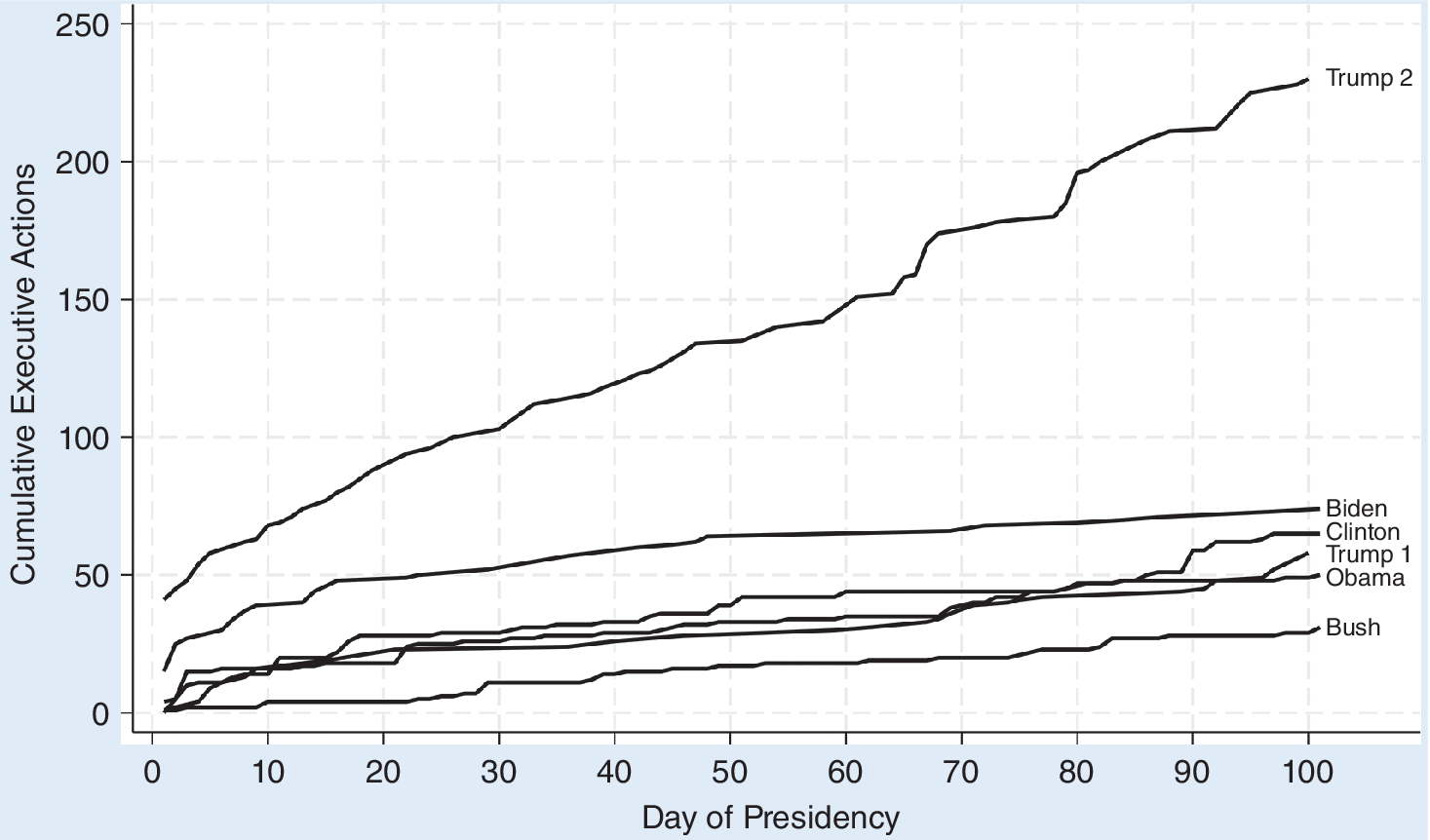
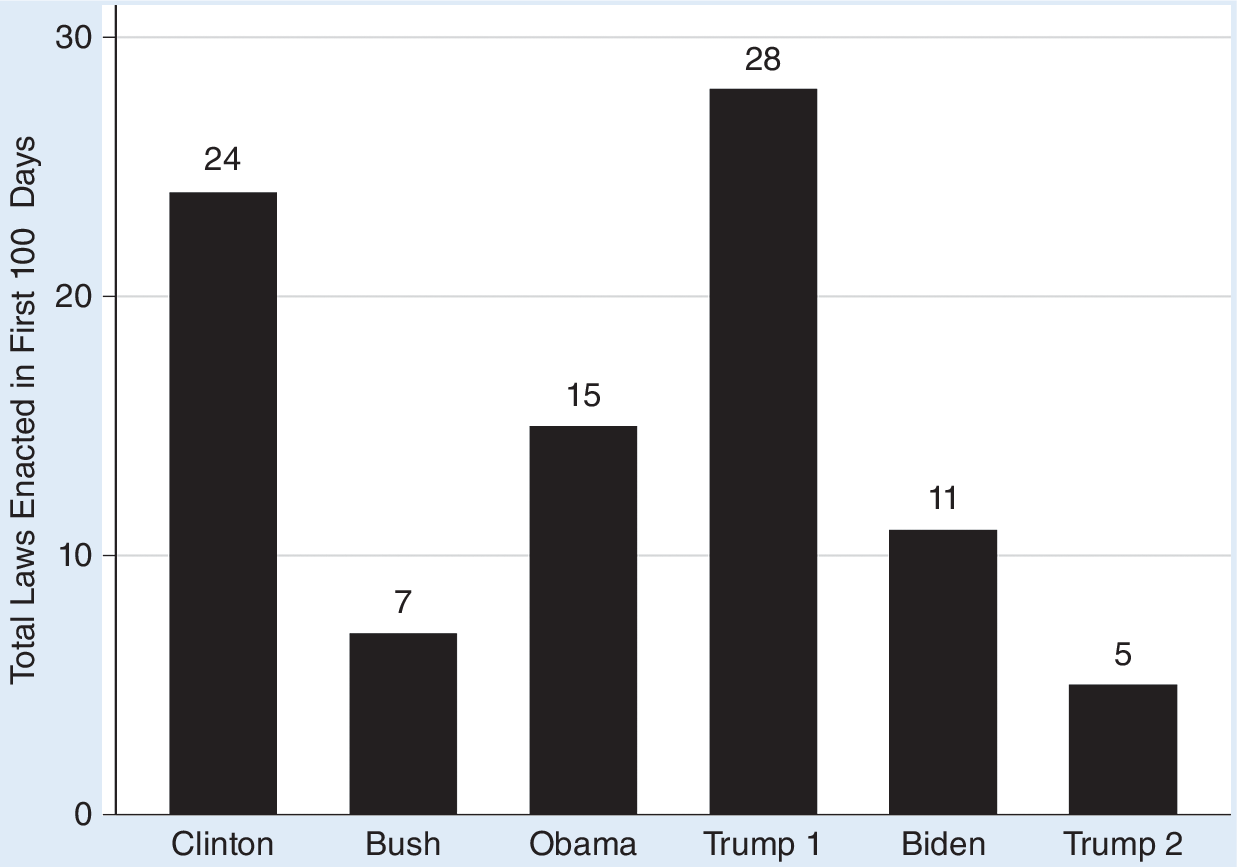
Whereas most of these analyses focus on Presidents Trump and Biden, figure 1 also includes data on the number of substantive actions from the first 100 days of the Barack Obama, George W. Bush, and Bill Clinton presidencies, for which I followed the same process. The number of laws enacted in the first 100 days of each administration from Clinton forward (figure 2) was calculated using the Congress.gov database.
Cumulative Executive Actions, First 100 Days

Figure 1 Long description
The X-axis is labeled Day of Presidency, ranging from 0 to 100 in increments of 10. The Y-axis is labeled Cumulative Executive Actions, ranging from 0 to 250 in increments of 50. Six lines track the cumulative totals for different administrations.
Trump 2 starts at approximately 40 actions on day 1 and follows a steep, linear increase with several sharp vertical steps, ending at approximately 230 actions by day 100.
Biden starts at approximately 15 actions and follows a steady upward slope, ending at approximately 75 actions.
Clinton, Trump 1, and Obama follow similar trajectories, clustered between 50 and 65 actions by day 100. Clinton ends at approximately 65, Trump 1 at approximately 58, and Obama at approximately 50.
Bush shows the lowest activity, starting near zero and maintaining a shallow slope to end at approximately 30 actions by day 100.
Laws Enacted in First 100 Days

To code for the topic of each executive action, I used the codes provided by the Comparative Agendas Project (CAP) for executive orders in President Trump’s first term, and I followed the CAP coding scheme to manually code all other unilateral directives.Footnote 3 To examine which executive actions appeared on the front page of the New York Times, I searched for a series of terms related to executive action in the ProQuest Historical Newspapers and ProQuest Recent Newspapers databases of New York Times articles published between January 20 and May 10 of the relevant year. I reviewed each article that came up in the search for mentions of specific executive policies.Footnote 4
THE PACE OF EXECUTIVE ACTION AND LEGISLATIVE PRODUCTIVITY
Much of the scholarly analysis of the first 100 days of Trump’s first term focused on how the number of executive actions he issued did not differ significantly from what other presidents had done. Analyses of the number of executive orders have inherent limitations: they do not reveal information on the substance of those actions or how far an action might deviate from conventional understandings of the constitutional use of unilateral power. For these reasons, this study’s analysis does not rely on counts alone but also considers policy areas, media coverage, and the substantive impact of specific actions. However, counts of executive action feature prominently in extant research on presidential unilateralism, providing an objective point of comparison among presidential administrations (Bolton and Thrower Reference Bolton and Thrower2016, Reference Bolton and Thrower2021; Christenson and Kriner Reference Christenson and Kriner2020; Howell Reference Howell2003). For these reasons, this article begins with an examination of the number of executive actions issued during the first 100 days of Trump’s second term compared to those of recent past presidents. Figure 1 presents the cumulative number of substantive executive actions issued for each day of the first 100 of each administration from Clinton to Trump’s second term.
Figure 1 reveals important information about the total number of executive actions issued in the first 100 days of each of Trump’s terms as well as the pace of unilateral policy making. As shown in the figure, in the first 100 days of his second term, President Trump was issuing unilateral directives at a much faster pace than his predecessors, including his own benchmark from 2017. He issued an astounding 41 substantive actions on his first day alone, including 12 actions on government operations, seven on immigration, and four on energy policy. This signaled his desire to put in place the initial pieces of many aspects of his agenda from the onset. President Biden issued 15 actions on his first day in office and Trump issued only one on the opening day of his first term.
Trump managed to maintain this rapid pace of unilateral policy making well past Day One. Over time, the gap between the number of executive actions issued by Trump in his second term and that of all other administrations listed continued to widen. In the first 100 days of his second term, Trump issued a total of 231 substantive executive actions, compared to 74 for Biden and 58 for Trump in his first term. The number of actions issued by President Trump in 2017 places him firmly within the expected range based on other administrations: slightly more than Obama and slightly less than Clinton. However, in 2025, Trump clearly sought to flex the power of his pen on Day One, and he continued to do so throughout his first 100 days back in the White House.
In the first 100 days of his second term, Trump issued a total of 231 substantive executive actions, compared to 74 for Biden and 58 for Trump in his first term.
However, unilateral action is only one aspect of any president’s policy agenda. Figure 2 lists the number of laws enacted in the first 100 days of each administration from figure 1, providing a more complete picture of the overall policy-making environment. The consequences of President Trump’s myopic focus on executive action are apparent in this figure. Trump signed only five laws in the first 100 days of his second term, less than 20% the legislative productivity of his first 100 days in 2017. The number of enactments at the outset of Trump’s second term is lower than all other administrations listed in figure 2. The only other president that came close to such low levels of enactments was George W. Bush in the first months of 2001. However, Bush is the only president shown who began his administration without his party controlling both chambers of Congress. Therefore, in general, Bush faced more partisan opposition to his legislative agenda compared to Trump in 2025.
President Trump’s reliance on unilateral action at the expense of legislation allows him to act quickly and navigate around the need to build support among other political actors. However, governing through executive action also leads to a much less durable policy legacy for two key reasons. First, executive actions can be revoked by subsequent presidents. An insightful study by Thrower (Reference Thrower2017) on the lifespan of executive orders finds that orders relying on clear, recent statutory precedents tend to last longer. Therefore, if Trump is using unilateral action in legally dubious ways, his actions likely will be particularly prone to revocation by future presidents. However, as Thrower’s (Reference Thrower2017) study also reveals, whether Republicans maintain control of the White House or do not likely will have a significant impact on the longevity of Trump’s unilateral policies.
Second, because executive actions circumnavigate the legislative branch, they are more vulnerable to court challenges and have the potential to be overturned by federal courts. Although foundational research on this topic reveals that courts are reticent to overturn executive orders (Howell Reference Howell2003), there is increasing evidence that this may be changing (Epstein and Posner Reference Epstein and Posner2018). Furthermore, the New York Times reported that more than 200 lawsuits were filed against the Trump administration in the first 100 days of his second term.
However, the key outstanding question is whether these potential institutional checks can push back effectively on Trump’s exercises of unilateral power when they go beyond established precedent and constitutional norms. Will Congress reassert its authority to legislate? Will the courts push back on abuses of power and, if they do, will President Trump abide by those rulings? These are open questions with profound implications for the future of US democracy.
THE TOOLS OF THE UNILATERAL PRESIDENCY
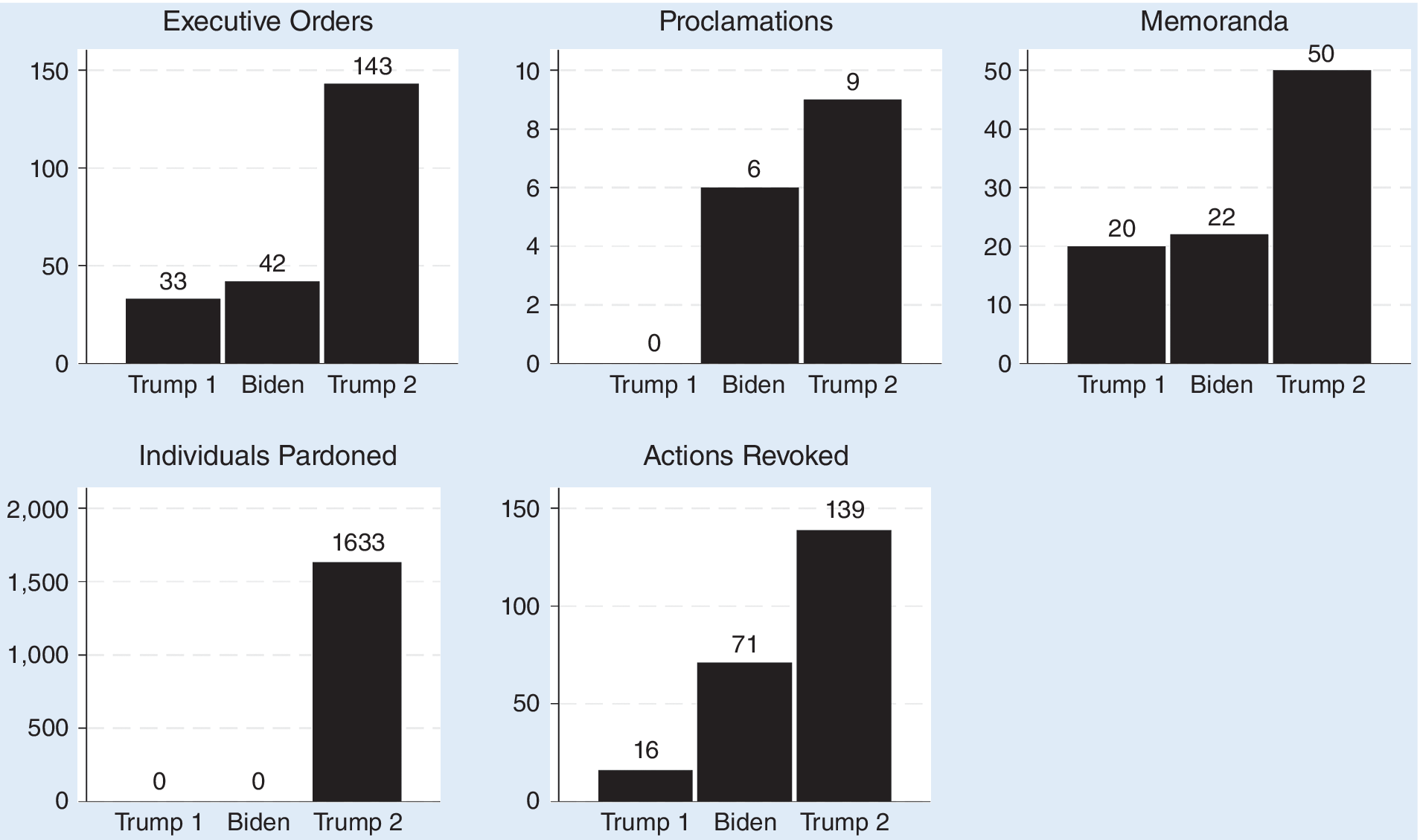
When presidents seek to change policy unilaterally, they have numerous tools at their disposal. Figure 3 lists the number of actions for the three most common types of directives—executive orders, proclamations, and memoranda—as well as the number of individuals pardoned and the number of previous executive actions revoked.
Executive Actions by Type

Figure 3 Long description
The figure consists of five bar charts arranged in two rows. Each chart shares the same X-axis categories: Trump 1, Biden, and Trump 2.
Top-left chart: Executive Orders. Y-axis ranges from 0 to 150. Trump 1 has 33, Biden has 42, and Trump 2 has 143.
Top-center chart: Proclamations. Y-axis ranges from 0 to 10. Trump 1 has 0, Biden has 6, and Trump 2 has 9.
Top-right chart: Memoranda. Y-axis ranges from 0 to 50. Trump 1 has 20, Biden has 22, and Trump 2 has 50.
Bottom-left chart: Individuals Pardoned. Y-axis ranges from 0 to 2,000. Trump 1 and Biden both have 0, while Trump 2 has 1,633.
Bottom-center chart: Actions Revoked. Y-axis ranges from 0 to 150. Trump 1 has 16, Biden has 71, and Trump 2 has 139.
Figure 3 shows that Trump’s prolific use of unilateral power was not due to any single type of unilateral directive. He simply was more active in his use of all of the major tools of executive action at his disposal. Nevertheless, some patterns stand out regarding specific types of unilateral actions.
President Trump issued a substantial number of executive orders and memoranda in the first 100 days of his second term, and he used these tools to impact policy on a wide range of topics. Although he issued only nine nonceremonial proclamations, the relatively small number of actions in this category are notable for their substance. The lines between different types of executive actions often can be blurred. However, conventionally, executive orders and memoranda pertain to issues that can be addressed within the executive branch, whereas proclamations can reach beyond the government to call on “citizens outside of government or on other countries…to acknowledge the proclamation and comply with it” (Cooper Reference Cooper2014, 171). In the first 100 days of his second term, Trump used proclamations to implement a series of aggressive changes to immigration policy. He declared an emergency at the southern border, invoked the Alien Enemies Act to address what he referred to as an “invasion,” and barred the entry of certain individuals who were seeking asylum. He also used proclamations to raise tariffs on steel, aluminum, and automobiles—one piece of his far-reaching and controversial takeover of US trade policy.
The first 100 days of President Trump’s second term also were notable for his aggressive revocation of existing executive actions. Revocations were not a significant part of Trump’s strategy at the outset of his first term, but during the first 100 days of his second term, he revoked 139 different unilateral policies—almost twice as many as President Biden during that same period in 2021. In fact, on his first day in office, Trump revoked 78 actions with a single executive order (Trump Reference Trump2025b). These revocations again reveal the stark reality of a policy-making approach that relies on unilateral action over legislation. These policies can be reversed quickly when partisan control of the White House changes.
Perhaps the most notable aspect of figure 3—and worrisome for the health of the democratic ideal of the rule of law—is President Trump’s use of the pardon power. Although Trump did not issue a single pardon in the first 100 days of his first term (and neither did Biden), Trump pardoned an estimated 1,633 individuals in the opening months of 2025. Most of the pardons were the result of a single proclamation, issued on the first day of his second term. The proclamation pardoned 13 named individuals involved in the January 6th insurrection and then granted “a full, complete, and unconditional pardon to all other individuals convicted of offenses related to events that occurred at or near the United States Capitol on January 6, 2021” (Trump Reference Trump2025a). Because of the sweeping language used in the proclamation, the exact number of individuals who were pardoned cannot be ascertained from the document alone. However, as the BBC reported based on US Department of Justice records, at the time the pardons were issued, an estimated 1,583 individuals had been charged with crimes related to the January 6th insurrection (Matza Reference Matza2025), which is the number used in this study. In addition to the January 6th pardons, Trump pardoned another 50 individuals during the first 100 days of his second term.
EXECUTIVE ACTION BY ISSUE AREA
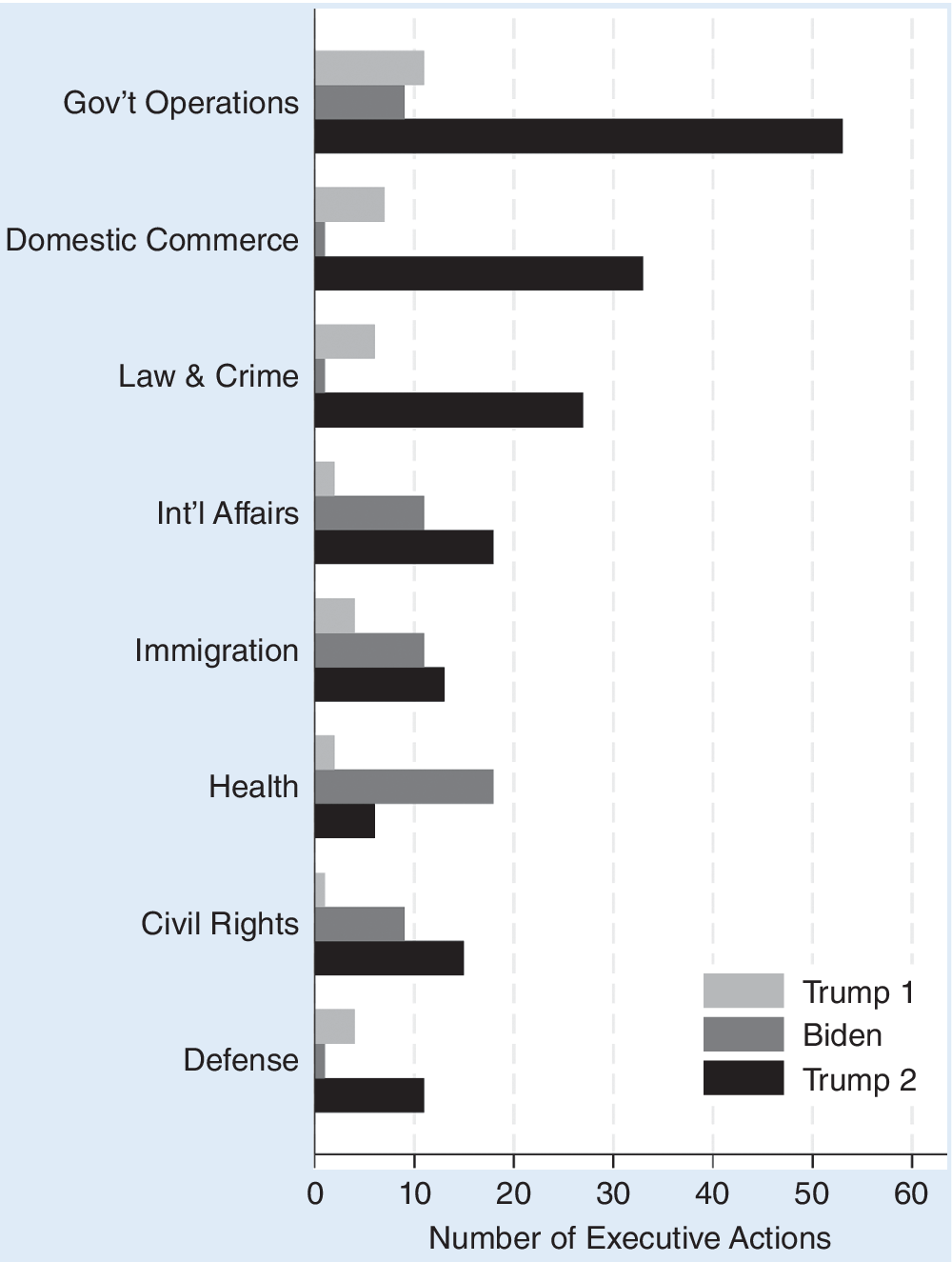
Another way to better understand President Trump’s use of unilateral policy making and how it compares to President Biden and Trump’s first term is by examining the most common issue areas to which these policies pertain. Figure 4 presents the number of executive actions within the eight most common issue areas in the dataset used here.
Number of Executive Actions by Issue Area

Figure 4 Long description
The X-axis represents the Number of Executive Actions from 0 to 60. The Y-axis lists eight issue areas. A legend in the bottom right identifies light gray as Trump 1, medium gray as Biden, and black as Trump 2.
* Gov't Operations: Trump 2 has the highest count at approximately 53, followed by Trump 1 at 11 and Biden at 9.
* Domestic Commerce: Trump 2 leads with 33, Trump 1 has 7, and Biden has 1.
* Law and Crime: Trump 2 has 27, Trump 1 has 6, and Biden has 1.
* Int'l Affairs: Trump 2 has 18, Biden has 11, and Trump 1 has 2.
* Immigration: Trump 2 has 13, Biden has 11, and Trump 1 has 4.
* Health: Biden leads this category with 18, followed by Trump 2 at 6 and Trump 1 at 2.
* Civil Rights: Trump 2 has 15, Biden has 9, and Trump 1 has 1.
* Defense: Trump 2 has 11, Trump 1 has 4, and Biden has 1.
Figure 4 highlights the drastic differences in the number of policy changes Trump implemented at the outset of his second term, especially in the areas of government operations, foreign trade, and crime policy. Although government operations may seem like a mundane issue area, policies in this topic include those that impact the structure of the executive branch and who has access to its resources—two key areas that impact that health of democratic governance. At the outset of his second term, Trump used his unilateral powers to shift the inner workings of the executive branch in both of these ways. Notably, many of the actions in this category sought to punish those who President Trump deemed “enemies” by restricting their access to government information and facilities. These actions targeted prominent law firms that Trump viewed as oppositional to his own interests. He issued eight executive orders or memoranda of this type during the first 100 days of his second term.
In addition to government operations, figure 4 reveals the massive amount of movement in the areas of foreign trade—primarily focused on tariff policies—and law and crime, which includes the 21 documents that pardoned an estimated total of 1,633 individuals. An interesting area in which President Trump did not issue significantly more actions compared to President Biden was immigration, although this issue has still been a focus of Trump’s current administration, as indicated by the substance of these actions. Trump’s immigration directives during the first 100 days of his second term included several far-reaching policy changes, such as the declaration of a national emergency at the southern border and an action increasing the use of the Guantanamo Bay detention facility for detained migrants.
Energy policy is not shown in figure 4 because it was not one of the most prevalent issue areas across the dataset. However, energy policy is notable for the stark difference in attention it was given between President Trump and President Biden at the outset of their respective terms. In the first 100 days of his second term, Trump issued 11 actions focused on energy policy. By contrast, Biden did not issue a single action on energy policy in the first 100 days of his administration.
Nevertheless, during the four years that Biden was in office, he did shift energy policy in significant ways. Many of Trump’s actions in this area at the beginning of his second term sought to reverse course from the Biden administration’s energy regulations. In Executive Order 14154, entitled “Unleashing American Energy,” Trump (Reference Trump2025c) revoked 12 Biden-era orders (and another one from the Jimmy Carter administration). The order establishes a series of goals for energy policy that stand in stark contrast to the goals of environmental- and climate-minded activists, including “to encourage energy exploration and production on Federal lands and waters” and “to eliminate the ‘electric vehicle mandate’ and promote true consumer choice” (Trump Reference Trump2025c).
MEDIA COVERAGE AND SIGNIFICANT EXECUTIVE ACTIONS
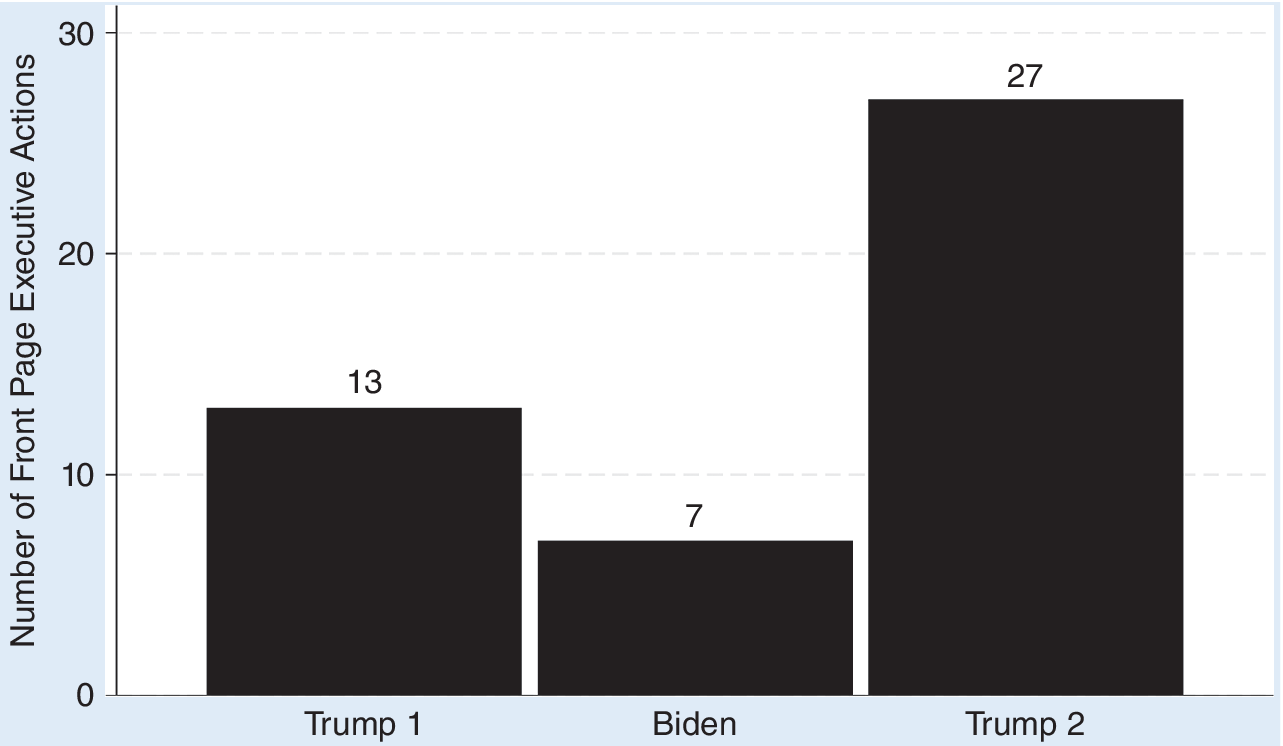
With so many unilateral directives issued in the first 100 days of any modern presidency, especially President Trump’s second term in office, no one could plausibly learn about every single one. Additionally, not all executive actions have the same policy significance—these tools often are used for routine administrative tasks. A common way scholars have separated significant executive actions is through measures of media coverage (Childree Reference Childree2025; Chiou and Rothenberg Reference Chiou and Rothenberg2017; Christenson and Kriner Reference Christenson and Kriner2020; Howell Reference Howell2003). This study used a similar strategy by examining actions that appeared on the front page of the New York Times. Although this is not a direct measure of substantive policy impact, it transmits important information on the prominence of an executive action by revealing the actions the nation’s largest newspaper deems worthy of front-page news coverage. For this reason, this coverage also serves as a useful proxy for actions that the public most likely will learn about. Figure 5 presents the number of executive actions issued in the first 100 days of Trump’s two terms, as well as Biden’s, that received front-page coverage in the New York Times.
Number of Executive Actions Receiving New York Times Front-Page Coverage

Not only was Trump issuing an enormous number of executive actions to begin his second term, he also was using the power of the pen in ways that generated a significant amount of news coverage: 27 policies were covered on the front page of the nation’s largest newspaper. Additionally, although Trump issued fewer executive actions in the first 100 days of his initial term compared to Biden, he nevertheless had substantially more actions appear on the New York Times front page in his first term than Biden did.
What policy changes did Trump implement through these front-page executive actions? Table 1 provides key information on each significant action from the first 100 days of his second term.
Executive Actions in New York Times Front-Page Stories, Trump’s Second Term

Table 1 Long description
The table contains four columns: Date, Type, Title, and Topic.
* 1/20/25: Memo, Return to In-Person Work, Government Operations.
* 1/20/25: E O, Reevaluating and Realigning United States Foreign Aid, International Affairs.
* 1/20/25: Pardon, Granting Pardons and Commutation of Sentences for Certain Offenses Relating to the Events at or Near the United States Capitol on January 6, 2021, Law and Crime.
* 1/20/25: E O, Ending Radical and Wasteful Government D E I Programs and Preferencing, Civil Rights.
* 1/20/25: E O, Protecting the American People Against Invasion, Immigration.
* 1/20/25: E O, Protecting the Meaning and Value of American Citizenship, Immigration.
* 1/20/25: E O, Protecting the United States from Foreign Terrorists and Other National Security and Public Safety Threats, Defense.
* 1/20/25: E O, Restoring the Death Penalty and Protecting Public Safety, Law and Crime.
* 1/20/25: E O, Defending Women from Gender Ideology Extremism and Restoring Biological Truth to the Federal Government, Civil Rights.
* 1/20/25: E O, Restoring Names That Honor American Greatness, Public Lands.
* 1/21/25: E O, Ending Illegal Discrimination and Restoring Merit-Based Opportunity, Civil Rights.
* 1/27/25: E O, Prioritizing Military Excellence and Readiness, Civil Rights.
* 1/29/25: Memo, Memorandum on Expanding Migrant Operations Center at Naval Station Guantanamo Bay to Full Capacity, Immigration.
* 2/1/25: E O, Imposing Duties to Address the Flow of Illicit Drugs Across Our Northern Border, Foreign Trade.
* 2/1/25: E O, Imposing Duties to Address the Situation at Our Southern Border, Foreign Trade.
* 2/1/25: E O, Imposing Duties to Address the Synthetic Opioid Supply Chain in the People’s Republic of China, Foreign Trade.
* 2/3/25: E O, Progress on the Situation at Our Northern Border, Foreign Trade.
* 2/3/25: E O, Progress on the Situation at Our Southern Border, Foreign Trade.
* 2/5/25: E O, Keeping Men Out of Women’s Sports, Civil Rights.
* 3/6/25: E O, Addressing Risks from Perkins Cole L L P, Government Operations.
* 3/14/25: E O, Addressing Risks from Paul Weiss, Government Operations.
* 3/20/25: E O, Improving Education Outcomes by Empowering Parents, States, and Communities, Education.
* 3/21/25: Memo, Memorandum on Preventing Abuses of the Legal System and the Federal Courts, Government Operations.
* 3/25/25: E O, Addressing Risks from Jenner & Block, Government Operations.
* 3/27/25: E O, Addressing Risks from WilmerHale, Government Operations.
* 3/27/25: E O, Restoring Truth and Sanity to American History, Government Operations.
* 4/2/25: E O, Regulating Imports with a Reciprocal Tariff to Rectify Trade Practices That Contribute to Large and Persistent Annual United States Goods Trade Deficits, Foreign Trade.
The table includes examples of many of the trends revealed in the previous figures. Six of the 27 actions pertain to tariffs. Four actions punish law firms for opposing Trump in some way, and the pardon of the January 6th insurrectionists also appears on this list. Additionally, there are several actions on issues related to civil rights, including restrictions against diversity, equity, and inclusion (DEI) programs; a declaration that “it is the policy of the United States to recognize two sexes” (Trump Reference Trump2025d); and a ban on transgender individuals serving in the military. Immigration policy received several mentions in front-page news stories, including the executive order entitled “Protecting the Meaning and Value of American Citizenship,” which sought to end birthright citizenship.
PRESIDENTIAL POWER BEYOND OFFICIAL UNILATERAL DIRECTIVES
So far, this article has focused primarily on what scholars and policy makers view as the conventional tools of the president’s unilateral agenda—executive orders, proclamations, and executive branch memoranda. As the analyses of President Trump’s use of these tools have shown, by almost any measure, he is expanding and stretching the unilateral presidency far beyond what he did at the outset of his first term. He also has been more willing to act unilaterally compared to President Biden and other recent presidents.
However, focusing on these conventional, publicly available policy documents underemphasizes the extent to which Trump has exercised the unilateral powers of the presidency because some of his most far-reaching and controversial initiatives do not appear in documents such as executive orders and memoranda. Perhaps the most prominent example of this type of unilateral policy making that is more difficult to trace in published policy documents is his Department of Government Efficiency (DOGE). This entity, led by Elon Musk, was established through an executive order on Trump’s first day in office. Yet, DOGE’s specific actions, which transformed the executive branch in dramatic and controversial ways, were not the result of specific executive actions issued by the president. The initiative never came close to reaching the initial stated goal of cutting $2 trillion from the federal budget. Nevertheless, it wreaked havoc on the executive branch by firing workers, canceling federal contracts, and making significant cuts to humanitarian assistance—often using tactics that have led to constitutional concerns and court challenges (Fowler and Bond Reference Fowler and Bond2025; Schreiber Reference Schreiber2025).
President Trump also sought to control the decision making of universities in unprecedented ways that do not appear directly in highly visible unilateral directives such as executive orders and memoranda. In March 2025, his administration canceled $400 million in federal government funding to Columbia University, citing concerns of anti-Semitic behavior (Goldstein Reference Goldstein2025). In April 2025, Trump responded to Harvard University’s refusal to agree to a list of demands issued by his administration by canceling $2.2 billion in grants (Patel Reference Patel2025).
The DOGE efforts to transform the administrative state and the attacks on universities are both examples of stark exercises of executive power that do not appear in the most common data sources that scholars use to catalogue unilateral action. These actions provide further examples of President Trump stretching presidential power well beyond historical precedent by seeking to dismantle elements of the administrative state created by Congress as well as to control the actions of private universities.
CONCLUSION
In the first 100 days of his second term, President Trump issued an enormous number of executive actions, more than three times as many as he did during that same period in 2017—and he did so while largely neglecting Congress and the legislative process. Many of his executive actions in the opening months of 2025 focused on remaking the federal government, imposing tariffs, and issuing pardons, along with other changes to crime policy. However, due to the numerous executive actions Trump issued, his unilateral agenda is having wide-ranging impacts in many other areas of American life, including substantial changes to immigration enforcement and energy policy. His executive actions also stand out for their media salience and significance, with many more actions appearing on the front page of the New York Times compared to Biden’s presidency or Trump’s own first term. Additionally, the extensive number of pardons and attacks on his perceived “enemies” represent worrisome uses of presidential power for personal gain and to carry out campaigns of targeted retribution.
As President Trump continues to push against the conventional limits of the unilateral presidency, attention increasingly turns to other key institutions with the potential to check presidential power. Research shows that while the practical effects can be limited, Congress (Chiou and Rothenberg Reference Chiou and Rothenberg2017; Howell Reference Howell2003), the courts (Epstein and Posner Reference Epstein and Posner2018; Howell Reference Howell2003), and the public (Childree, Yang, and Kriner Reference Childree, Yang and Kriner2025; Christenson and Kriner Reference Christenson and Kriner2020; Reeves and Rogowski Reference Reeves and Rogowski2022) all have mechanisms through which they can serve as a check on the president—or at least make an expansive use of unilateral policy making politically costly. The future health of US democracy and the separation of powers will depend in large part on the behavior of these other institutions and whether they are willing and able to reassert their power to rein in the unilateral presidency.
As President Trump continues to push against the conventional limits of the unilateral presidency, attention increasingly turns to other key institutions with the potential to check presidential power.
DATA AVAILABILITY STATEMENT
Research documentation and data that support the findings of this study are openly available at the PS: Political Science & Politics Harvard Dataverse at https://doi.org/10.7910/DVN/69MTFX.
CONFLICTS OF INTEREST
The author declares that there are no ethical issues or conflicts of interest in this research.


 Open access

