INTRODUCTION
Potato production currently covers about 160 000 ha in Ethiopia, largely in smallholder systems where production is at subsistence level; the national average yield (9 t ha−1) is far below attainable yields of 40 t ha−1 on research fields (APHRD, 2009; Berihun and Woldegiorgis, Reference Berihun, Woldegiorgis, Woldegiorgis, Schulz and Berihun2013; CSA, 2014). The major factors that hinder potato productivity are poor production and management practices, limited access to clean and affordable seed tubers, potato diseases (Bekele et al., Reference Bekele, Abate, Asefa, Woldegiorgis, Schulz and Berihun2013; Gildemacher et al., Reference Gildemacher, Kaguongo, Ortiz, Tesfaye, Gebremedhin, Wagoire, Kakuhenzire, Kinyae, Nyongesa, Struik and Leewis2009; Hirpa et al., Reference Hirpa, Meuwissen, Tesfaye, Lommen, Oude Lansink, Tsegaye and Struik2010), declining soil fertility (Woldegiorgis et al., 2001) and weak linkages between research and extension services (Berihun and Woldegiorgis, Reference Berihun, Woldegiorgis, Woldegiorgis, Schulz and Berihun2013). These factors negatively affect the importance of potato as a staple food, and a source of income and nutrient-rich food amongst smallholders (Hirpa et al., Reference Hirpa, Meuwissen, van der Lans, Lommen, Oude Lansink, Tsegaye and Struik2012; Kolasa, Reference Kolasa1993). The introduction and promotion of new varieties, use of quality seed and other production technologies are the main strategies of the Ethiopian Institute of Agricultural Research to improve potato production and the livelihood of low income farmers (Berihun and Woldegiorgis, Reference Berihun, Woldegiorgis, Woldegiorgis, Schulz and Berihun2013).
Currently, more than 98% of the planted potato seed tubers (seed) are saved by farmers (Gildemacher et al., Reference Gildemacher, Kaguongo, Ortiz, Tesfaye, Gebremedhin, Wagoire, Kakuhenzire, Kinyae, Nyongesa, Struik and Leewis2009). This means that (semi-) public and private sector institutions only supply seed to relatively few farmers. This situation is typical for the seed systems in many countries and most staple crops in Africa (Louwaars and De Boef, Reference Louwaars, de Boef and Edeme2013; McGuire and Sperling, Reference McGuire and Sperling2016; Rubyogo et al., Reference Rubyogo, Sperling, Muthoni and Buruchara2010). A small formal seed sector does however not imply that farmers are deprived of improved varieties. If the introduction of improved varieties by formal or semi-formal entities is tied into a dynamic informal system of farmer-to-farmer seed exchange, the diffusion of the new varieties may actually be very effective. It has been claimed that informal seed exchange mechanisms may actually provide farmers with better access to improved seed than the formal seed sector introductions, for a range of reasons: the sources of seed are usually nearby and timely available, farmers can verify the quality and performance of the material and the exchange may not require cash (e.g. Almekinders et al., Reference Almekinders, Louwaars and de Bruijn1994; Coomes et al., Reference Coomes, McGuire, Garine, Caillon, McKey, Demeulenaere, Jarvis, Aistara, Barnaud, Clouvel, Emperaire, Louafim, Martin, Massol, Pautasso, Violon and Wencélius2015; Seboka and Deressa, Reference Seboka and Deressa1999; Sperling and McGuire, Reference Sperling and McGuire2010). It has however also been observed that these informal farmer-based exchange mechanisms encounter social barriers that are present in rural society in many different forms (see Coomes et al., Reference Coomes, McGuire, Garine, Caillon, McKey, Demeulenaere, Jarvis, Aistara, Barnaud, Clouvel, Emperaire, Louafim, Martin, Massol, Pautasso, Violon and Wencélius2015). For example, barley seed flow depends on the performance of farmers bridging intergroup connection (Abay et al., Reference Abay, De Boef and Bjørnstad2011). In the context of sorghum and maize, seed exchange is limited to neighbourhood groups (Labeyrie et al., Reference Labeyrie, Rono and Leclerc2014). Seed dissemination is also associated with the availability of hired labour (Jones et al., Reference Jones, Audi and Trippa2001) and reciprocal ties involving labour exchange and sharing-cropping arrangements that determine the nature of access to seed (McGuire, Reference McGuire2008). In addition, social ties involved in seed exchange can be vulnerable to the change in the structure of local institutions (Samberg et al., Reference Samberg, Shennan and Zavalet2013). Few studies have however empirically addressed the flow of seed from farmer-to-farmer to assess the effect of these social barriers on the diffusion of seed of newly introduced varieties (Cromwell and Tripp, Reference Cromwell and Tripp1994; Grisley and Shamambo, Reference Grisley and Shamambo1993; McGuire, Reference McGuire2007). These studies pointed out that seed exchange often remains restricted within certain social groups shaped by gender, kinship or ethnicity. We studied practices of potato seed sharing of recently introduced improved potato varieties in the Chencha wereda of the Southern Nations, Nationalities, and Peoples’ Region in Ethiopia. Our study specifically analysed how social differences defined by wealth, gender and religion, influenced the farmer-to-farmer diffusion. Next to the frequency of sharing, we also assessed the terms and motivations for sharing seed and the amount of seed that was shared. We discuss the results in relation to the potential of farmer networks to provide access to improved planting materials.
METHODS
Study setting, project context and respondent selection
Field data were collected from June to October, 2013 in four kebeles Footnote 1 of the Chencha wereda. The Chencha wereda is located in the Gamo Gofa zone, 40 km from Arba Minch in the southern part of Ethiopia. Potato is introduced into this wereda about five decades ago, and is more planted in the 33 out of the 45 kebeles, where climate is cooler (2578–3200 m above sea level), soils are relatively fertile, and land holdings somewhat larger. In these kebeles, each household grows new and/or old potato varieties, although the area and production technology vary strongly, depending on household resources (Y. Tadesse et al., unpublished data).
We carried out the research in four of these 33 kebeles: Losha, Laka, Yoyera and Gendo Gembella; the total number of households of these kebeles is 407, 306, 370 and 273, respectively. Heads of households in each kebele are dominantly male (87–97%). The households in Laka (93%) and Gendo Gembella (95%) are primarily orthodox. In the case of Losha (80%) and Yoyera (75%), protestant followers are proportionally abundant. In 2010 and 2011, Vita, an Irish based Non-Governmental Organization (NGO) that is active in the region since 2006, provided 500 kg of seed tubers of the variety Gudene or Jalene to 120 potato farmers (30 farmers per kebele). These farmers also were trained in the use of improved potato production and management practices, such as fertilization and ridging. The NGO had selected the 120 farmers on the basis of their capacity to acquire inputs, for being known to the project staff as ‘hard-working’. The NGO expected that these farmers would be functioning as models for their neighbouring farmers and that in this way improved technology would spread to the rest of the community.
From the list of 30 farmers in each of the four kebeles who originally accessed improved seed potatoes, we randomly selected five in each kebele. We used these farmers as the entry points for the seed network, hereafter referred to as ‘first-generation farmers’. To identify additional participants who acquired seed from the first-generation farmers, we used the snowball sampling technique (Creswell, Reference Creswell2007) to trace how the variety spread from these farmers through the communities and beyond: First-generation farmers were asked to whom they had provided seed tubers of the improved varieties after the first harvest, in order to identify farmers that we refer to in this study as second and subsequent third-generation farmers. A total of 178 recipients were identified, of which twelve could not be located for an interview. The data collection, thus, involved 20 first-generation, 125 second-generation and 21 third-generation farmers. Together, during planting time, potato seed was shared between them on 146 occasions, namely 125 between first and second-generation farmers and 21 between second and third-generation farmers. Farmers within the seed sharing networks were not representative for the wider population. This is because the project selected recipient farmers on purpose, and we ‘traced’ the seed from there onwards, with the aim of understanding the pattern of seed sharing and dissemination. In this study, we use ‘sharing’ or ‘transaction’ for each seed lot that a farmer provides to another farmer. We consider the sharing had different conditions. We called these conditions the ‘terms of sharing’, i.e. as a gift, in exchange for labour or otherwise, or on the basis of cash.
Data collection and analysis
The first author conducted 45–60 minute in-depth interviews. Farmers were asked about three domains of information: (i) their demographic characteristics (gender, age, wealth status and religion), (ii) the source of seed acquisition and associated relations, (iii) their seed sharing and seed saving practices. During interviews, farmers within the seed sharing networks identified the type of social relationship (relatives, neighbours, friends or acquaintances) they had with seed providers and/or receivers. The interviews involved those found home, either man or wife. There were also cases where both man and wife, or mother and the oldest child were part of the interview; this was the case when they had active role in the seed sharing.
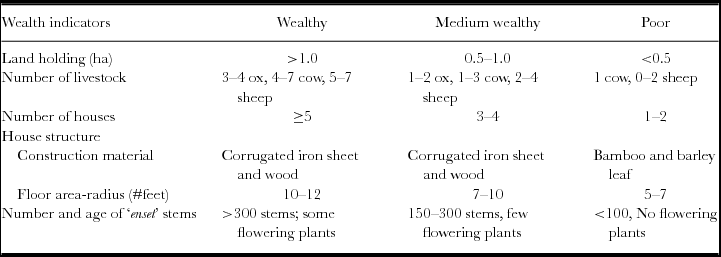
To define the economic status of each respondent, the local administrators and six to eight community members were invited to an open discussion. This was done in each kebele. Participants were asked to describe the characteristics of households of different wealth status. They used size of land holding, number of livestock, house structure (floor area and construction materials) and number and age of ‘enset’ (Ensete ventricosum) plantations as the main indicators and utilized them for categorizing each of the participants as relatively wealthy, medium wealthy and poor (Table 1).
Characteristics of wealth status at household level.
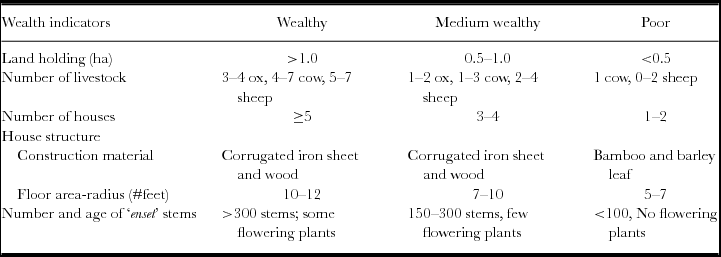
#one feet ≈ 30 cm.
The data analysis consisted sequentially of transcription, identifying themes, mapping and interpretation. SPSS® was used for descriptive statistics – a chi-square test of independence. To visualize seed sharing networks, we used the Node® Excel® software.
RESULTS
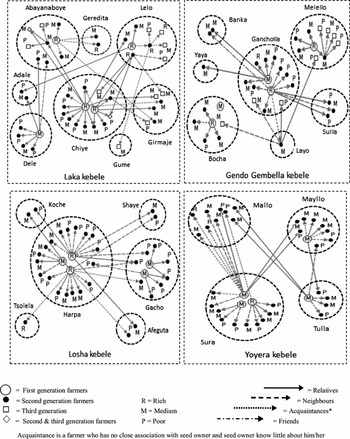
Figure 1 maps the farmer to farmer seed flows in the four kebeles, with the information on wealth class and type of relationship between seed sharers. This information in combination with information on gender, the terms of sharing and the amount of seed shared forms the basis for data and analysis in the presented tables.
Distribution patterns of seed potato amongst farmers of different wealth status over three generations, between and within villages in four kebeles.

Farmers’ socio-economic characteristics
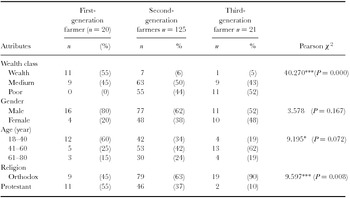
The proportion of wealthy farmers was highest in the group of first-generation farmers, i.e. the farmers who directly received seed from the project intervention, whereas there were no poor farmers within this group (Table 2). In the second and third-generation farmers, approximately 50% of the farmers were poor. The fraction of male and female farmers was similar over the three generation of farmers. The first-generation farmers had the largest fraction of young farmers (18–40 years old). Orthodox and protestant farmers were more or less represented equally in the first generation of farmers, but in the second and third-generation farmers there were more Orthodox farmers.
Socio-economic characteristics of first-, second- and third-generation farmers.

*Significant association between the type of generation and farmers’ age (P < 0.01); ***at P < 0.01, the type of generation and farmers’ wealth status are dependent on one another; and type of generation and religion; (n = 146).
Farmer to farmer seed sharing between wealth classes
All but one of the first-generation farmers shared potato tuber seed, with 3 to 13 other farmers; on average, they shared seed 6.6 times with others. The one farmer who did not share was a medium wealthy farmer in Gendo Gembella who lost his initial seed lot because of bacterial wilt. The sharing of seed by the first-generation farmer resulted in a total of 125 second-generation farmers. From the 125 second-generation farmers, only six shared seed with two to four other farmers; on average they shared 3.5 times. None of the second-generation farmers from Losha and Yoyera kebele shared seed with other farmers. This was mainly because they had planted only for one season, and/or they wanted first to multiply potatoes for their own use.
Wealthy farmers shared seed with other wealthy farmers in only 7% of the total number of transactions (n = 94). Instead, wealthy farmers most often shared seed with medium wealthy (52%) and poor farmers (40%). The seed sharings of medium wealthy farmers (n = 52) showed a similar pattern: 44% was with medium wealthy and 54% was with poor farmers. None of the poor farmers shared seed with other farmers. Of all seed shared (n = 146), 43% was between relatives – parents, children, sisters, brothers and in-laws – and 33% was between neighbours. The rest was between acquaintances (16.5%) and friends (7.5%).
The effect of gender and religion on seed sharing
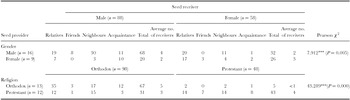
On average, male farmers shared seed with six other farmers, whilst female farmers shared with five other farmers. Male farmers shared seed more often with male farmers than with female farmers (68 and 32 times out of 100, respectively) whereas female farmers shared seed more or less equally with female and male farmers (26 and 20 out of 46, respectively) (Table 3). Male farmers mainly shared seed with their male neighbours. Female farmers shared seed mostly with their female relatives, and to a lesser extent with male farmers they acquainted. They hardly shared with female acquaintances. No male farmers shared seed with female friends, or vice versa.
Seed sharing of first- and second-generation farmers differentiated by social relation, and in and between gender and religion groups.

***Significant association between the seed provider and the seed receiver gender; between the seed provider and the seed receiver religion; at P < 0.01.
The majority of Orthodox farmers shared seed with Orthodox farmers only (Table 3). Protestant farmers also disseminated seed more often to farmers of their own religion. On the few occasions that Orthodox farmers shared with Protestant farmers, in most cases, this involved their relatives and neighbours. In the case of Protestant farmers, sharing of seed with farmers was mainly with neighbours followed by relatives.
Seed sharing within and between villages
Wealthy and medium wealthy farmers shared seed more often with farmers within the same village (56% and 69%, respectively), mostly with their neighbours (approximately 40%) (see Figure 1). Sharing of seed outside the village was predominately with farmers they acquaint by wealthy farmers and with relatives by medium wealthy farmers.
Male farmers shared seed more within (average of four farmers) than outside (average of two farmers) their villages (Table 4). In most cases, they shared with their neighbours followed by relatives. Female farmers, however, shared more or less equally with others outside their villages; on average with three farmers, mainly relatives.
The sharing of seed of farmers with other farmers within and between villages by gender.

*The relation between seed providers’ gender and geographical seed dispersion was significant at P < 0.1; (n = 146).
Terms and amount of seed sharing
Farmers shared seed with their relatives (43%), neighbours (32%) friends (7%) and persons they acquainted (16%). The transactions were on different terms: as a gift, in exchange against labour, seed or straw or on a cash basis. The terms and amount of seed tubers transacted depend on the amount of seed they had and their type of relationship (Table 4). It was also influenced for example by how well they knew the farmer and the level of mutual support in agricultural and social activities. A woman farmer, for instance, stated that ‘as compared to others I provided a large amount of seed to my neighbour as a gift because she helped me in transporting manure to different plots. She is also the one who looks after my children when I go to market’. In this study, gift is used for seed that is given without explicit arrangement for payment or exchange.
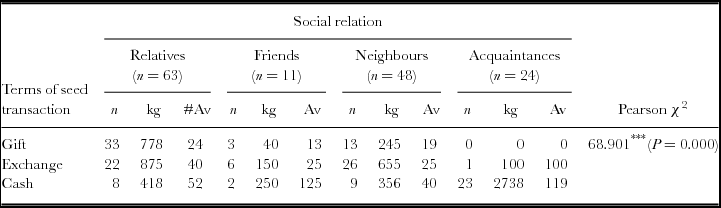
Of all seed transactions (n = 146), 34% was shared as a gift, mostly with relatives, whereas exchange was the basis for sharing in 38% of the cases, mostly between neighbours and relatives (Table 5). Acquaintances accessed seed almost exclusively on the basis of cash, but also 43% of the seed transactions between relatives, friends and neighbours was on the basis of cash. On average, seed transactions as gifts were amounting 22 kg of seed tubers, the exchange amongst relatives, friends and neighbours were 31 kg. Overall, the largest amounts of potato seed were shared on terms of cash.
Terms and amounts of seed dispersed through various social relations of suppliers with receivers.
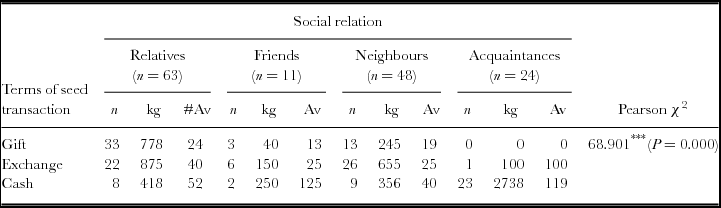
#Average kilogram of seed shared with a farmer; *** At P < 0.01, the terms of seed transaction and the type of social relations of suppliers with receivers is dependent on one another; (n = 146).
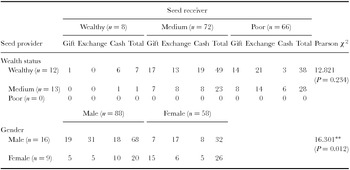
Gift, exchange and cash were more or less equally important terms of sharing amongst wealthy and medium wealthy farmers (Table 6). They shared seed with poor farmers mostly on the basis of exchange (53%) or as a gift (33%). Cash was less important as a term for sharing with the poor farmer.
Terms of seed sharing between farmers of different wealth classes and gender.

**Significant at P < 0.05.
Exchange (48%) was the dominant term of seed transaction amongst male farmers whilst many female farmers shared seed most often as a gift (43%), manly with other female farmers (57%) (Table 5). Cash transactions were similarly important for male (26%) and female farmers (32%).
Motivations of farmer to share seed of new potato varieties
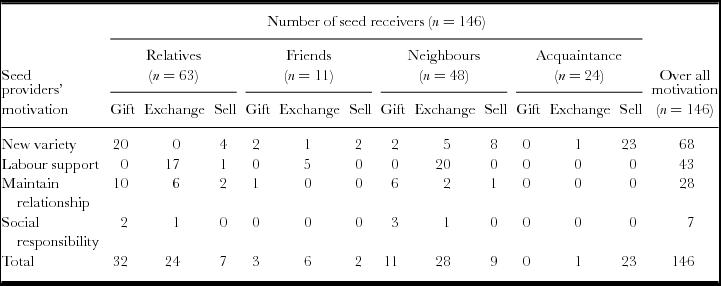
The introduction of a new variety was the dominant reason for farmers to share potato seed as a gift with relatives and to sell to acquaintances (Table 7). One of the medium wealthy farmers, for instance, reported ‘I shared seed with my parents and brothers because I have got a new variety that has a high yield as compared to what we normally used to plant’. This also explains why farmers shared most seed after the first harvest. When discussing if they shared seed in following seasons, farmers said they saw no use in it, because they had shared the seed of the new variety with those who they considered should have the variety as well. Labour support in agricultural activities (transporting farm yard manure, land preparation, planting and harvesting) was another reason for sharing seed, mainly with relatives and neighbourhoods. Farmers stated that those who supported them in agricultural activities usually had limited financial capacity and were not able to buy the seed of new varieties. This was mentioned more often amongst wealthy farmers. One wealthy farmer explained his reason for sharing as follows: ‘if I could not get the support from my three relatives and four neighbours, it would have been very hard to plant all my potato seed and transport the harvest. Planting more potato demands more labour, this is expensive for me. Sharing seed tubers with my supporters was the best option for paying for the labour of my relatives and neighbours’. An important reason to share seed with neighbours as a gift was to maintain their relationship. In this case, the initiative for sharing potato seed was mostly from farmers who produced the seed. They said that these farmers might not be very willing to provide labour support in the next cropping season if they were not given some seed. In four cases (out of the total of 146 transactions), farmers shared the seed as a gift ‘out of precaution’. One farmer said: ‘This year I planted the new potato near to a farmer's house but far from my own. To prevent stealing, I shared seed with him as a gift’.
Motivations of farmers for sharing seed potatoes.
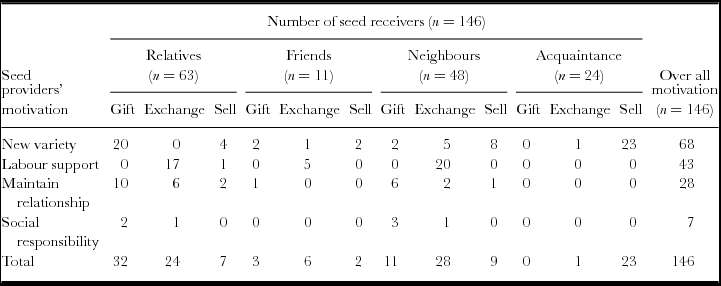
The feeling of social responsibility was another reason for sharing seed, particularly with relatives and farmers in the neighbourhood who were senior and poor. This happened mostly when the farmers recognized the presence of a new variety and seed owners felt those farmers would be keen to have the new cultivar and harvest similar yields. Respondents also said that providing seed for free to poor and elder farmers improves one's social acceptability.
On-farm seed saving
The practice of saving seed of the new variety from the harvest for next planting differed significantly for farmers of different wealth categories (χ 2 = 12.235, P = 0.002, at 99% confidence interval). All wealthy (n = 8), 82% of medium wealthy farmers (n = 72) and 59% of the poor farmers (n = 66) who received seed from other farmers, maintained the seed of the newly introduced variety. Farmers listed four major reasons for not saving the seed of the new varieties which they had acquired through their social network: (i) potato disease, (ii) small volume of seed, (iii) lack of agronomic knowledge and (iv) supplying potato to the local market as a ware. The most important reason for not saving seed varied between wealth classes. For 6 of the 13 medium wealthy farmers who did not save the seed was to meet the need for cash: They sold all potatoes shortly after harvest (n = 13). For medium wealthy farmers (5 of 13) who acquired a relatively larger volume of seed from other farmer (25–100 kg), it was the loss of a major portion of potato crop because of disease. They associated the disease (mostly wilting) with the poor quality of seed they had accessed. For most poor farmers (24 of 39), the small quantity (5–10 kg) of seed they had acquired was the main reason for saving no seed: this only allowed for planting a small area and all harvested tubers were used for consumption. Lack of knowledge on the improved potato production practices were also another reason (9 of 39). This resulted in minimal yield that could serve only for consumption. Farmers described the reasons for harvesting low yields as follows: ‘the way I cultivated the new and old potato varieties was the same’, ‘I was not used to variety attributes and management’, and ‘I applied least cultivation frequency and small amount of fertilizer’. Supplying potato to local markets was only a reason for 3% of poor farmers who did not save seed.
DISCUSSION
In this paper, we analysed how social differences influence the dissemination of seed of recently introduced new potato varieties amongst farmers in rural communities in Ethiopia. Our data showed that the flow of potato seed of new varieties in the informal seed system was influenced by wealth, gender and religion, but also that the diffusion of seed was not exclusively restricted within wealth, gender and religion categories.
The farmers’ wealth status was the most important factor influencing the sharing of seed. As compared to medium wealthy farmers, wealthier farmers shared seed with a larger number of poor and medium wealthy farmers. Since poor farmers in this study did not share seed – because the amount of seed they accessed and planted was too small and they often lost their crop due to potato diseases and lack of agronomic knowledge – the seed of the new varieties flowed one-directionally, down from higher wealth categories to the lowest.
We also found that both male and female farmers shared seed of improved potato varieties, although men shared more with men, and women more with women. As compared to men, the female farmers shared seed potatoes more often with a farmer of the other gender. This is perhaps because, as compared to male famers, women farmers in this study also seek labour support for agricultural activities, but they have less cash to contract labour. Women also had a dominant role in sharing seed outside their villages, mostly in small quantities as a gift to relatives. This can be explained by the fact that when women in Chencha marry, they move to the home in the village of the husband; this gives women more close relatives outside the village with whom they share seed. Seed sharing with acquaintances, mainly for cash, facilitated sharing across gender. These acquaintance networks are highly valued by farmers who are financially able to buy relatively large volumes of seed. Cross-societal sharing between wealth categories, genders and religions was mostly through family ties and in the form of gifts. Seed-for-labour was an important mechanism for poor farmers to access seed of improved varieties. This aligns with the notion that labour–neighbour networks are an important means for accessing resources and benefits that cannot be gotten through kinship networks (Hoang et al., Reference Hoang, Castella and Novosad2006) or because of lack of cash. This further indicates that such social networks also represent a form insurance that provides seed and food security (Fafchamps and Lund, Reference Fafchamps and Lund2003).
Studies in other crops also show that wealthy farmers play a more significant role in the diffusion of new varieties (e.g. Subedi et al., Reference Subedi, Chaudhary, Baniya, Rana, Tiwari, Rijal and Jarvis2003) and that poorer farmers are unlikely to be main diffusers because they do not have sufficiently large yields to cover their own demand (Sperling and Loevinsohn, Reference Sperling and Loevinsohn1993). In this study, however, we unpacked the influence of social differentiations in the diffusion of seed potato by tracing the seed and analysing the seed sharing characteristics. The collected data demonstrate that, overall, 2 years after the introduction of seed lots by the NGO, seven times more farmers had accessed the seed of the new varieties that the NGO introduced to a limited number of farmers. No poor farmers received seed tuber directly from the NGO. The fraction of poor farmers, however, had increased to 40% in the group of farmers who had accessed seed 2 years later, although only almost half of them saved seed for next planting season. The conclusion that the wealthier farmers are the most frequent seed sharers, and the most effective in diffusing improved seed through informal seed diffusion, also to the poor, should however be treated with caution. In this study, the first-generation farmers received 500 kg of seed tubers which allowed them to plant a considerable area with the new varieties: The harvest was likely to be large enough to share 5–10 kg with two to six others. In addition, they had support from the technicians of the NGO. Farmers who received 5–10 kg amounts of seed tubers from the first or second-generation farmers must have needed time to evaluate and bulk-up the seed before sharing it with others. Similarly, however, the assumption that poorer farmers would be frequent sharers of seed if they had been provided with adequate amounts (plus inputs and technical support) is also questionable: most research so far indicates that the poorest farmers are in the most difficult position to save seed from their own harvest.
CONCLUSIONS
The results from this study show that the farmer seed network was a powerful mechanism for the diffusion of seed of the new potato varieties: Seed sharing provided access to the varieties by many more farmers than only the group who initially received tuber seed from the NGO. The seed which was introduced by the NGO crossed social barriers formed by differences in wealth, gender and religion, but the study also confirmed that there is no equal access to seed in informal seed networks, as suggested by Coomes et al. (Reference Coomes, McGuire, Garine, Caillon, McKey, Demeulenaere, Jarvis, Aistara, Barnaud, Clouvel, Emperaire, Louafim, Martin, Massol, Pautasso, Violon and Wencélius2015). For farmers with limited financial capacity, the relationships with better-off neighbours provided them access to seed of improved varieties, in exchange of their labour. The flow of planting material of the new varieties from wealthy to medium and poorer classes suggests a strong interdependence amongst different wealth groups which may strengthen social safety nets and informal ‘insurance’ institutions. It also means that poor farmers without such labour opportunities may have had very limited access to the improved seed. Data also indicate that poor farmers are not very functional seed distributors in informal networks: they had difficulties to maintain the improved varieties after acquiring an initial seed lots because the initial volumes of seed they acquired were smaller, they lacked inputs and up-to-date agronomic knowledge, they had less land and thus less surplus to save and may therefore have more difficulties to save seed for next planting or for sharing. From the point of view of the NGO, therefore, introduction of seed lots to wealthy and medium wealthy farmers may well have been the most effective strategy. In other words, this study shows that introduction of new technologies into a community needs to understand the dynamics of social differentiation within the community. Without such understanding, it is difficult to know what targeting strategy can work and which will work best. In this study, introduction of seed of a new potato variety to better off farmers made it also available to the poorest. We do however not know how many of the poor did not access the new seed because they were not part of the social networks in which this new seed circulated. In terms of improving potato productivity amongst the poorest of the poor, other, integrated intervention strategies have to be considered. The introduction of seed of improved varieties to poor farmers would need to be accompanied with access to the knowledge and inputs to successfully grow these varieties (Y. Tadesse et al., unpublished data) and possibly the creation of opportunities for non-farm income generating activities and/or making low-interest loans available.