1. INTRODUCTION
For decades sociolinguistic research has been concerned, among other things, with the notion of dialect change and the processes behind it. In the Nordic countries several studies have focused on the extent of dialect levelling and how this levelling proceeds. The Nordic countries diverge here. In western Norway and the eastern parts of Finland, dialects are generally not levelling towards the standard, though this seems to be the case in Sweden, Denmark and other parts of Norway (Edlund Reference Edlund2003; Ivars Reference Ivars2003; Pedersen Reference Pedersen2003, Reference Pedersen, Auer, Hinskens and Kerswill2005; Sandøy Reference Sandøy, Gunnarsson, Bergström, Eklund, Fridell, Hansen, Karstadt, Nordberg, Sundgren and Thelander2004; Røyneland Reference Røyneland2005, Reference Røyneland2009).
Traditionally, Swedish dialectology holds that levelling towards a national standard, or vertical convergence (Auer Reference Auer2000), is the driving force in language change. This is the theory behind several studies of traditional dialects. Already in the 1850s, scholars claimed that the Swedish dialects were levelling with such speed that the traditional dialects would soon be extinct (Edlund Reference Edlund2003). The concern for the traditional dialects led to an extensive collection of dialect samples from all over Sweden, today forming an essential part of the archives at The Institute of Language and Folklore in Sweden.
Recent studies show that dialects of different parts of Sweden are indeed still levelling towards the national standard (Helgander Reference Helgander, Kotsinas and Helgander1994, Reference Helgander1996; Grönberg Reference Grönberg2004). When new data recorded within the project Dialect Levelling in West Sweden is compared with data recorded in the same region by The Institute of Language and Folklore in the mid-20th century, it too appears as if dialect levelling is progressing. It seems that West Sweden no longer has any speakers of the traditional dialect.
Given this situation, we ask: How much have the dialects actually changed? More specifically, we ask the linguistic question: To what extent has the dialect as a linguistic system changed? And we ask the sociolinguistic question: How much has the dialect situation (i.e. who uses what linguistic variants when) changed?
In this paper, I aim to problematize the concept of dialect change by focusing on the methods of selecting informants in the past and at present. I wish to make a methodological point of how we may and may not compare older data with newly-recorded data, and the conclusions we may draw from these comparisons. I will start, however, with a brief presentation of the project Dialect Levelling in West Sweden.
2. DIALECT LEVELLING IN WEST SWEDEN
The project Dialect Levelling in West SwedenFootnote 1 (Svahn, Grönberg, Nilsson & Ottesjö Reference Svahn, Grönberg, Nilsson and Ottesjö2006) focuses on the dialect situation in the first decade of the 21st century in West Sweden compared to the dialects spoken in the same region in the 1940s–1960s.
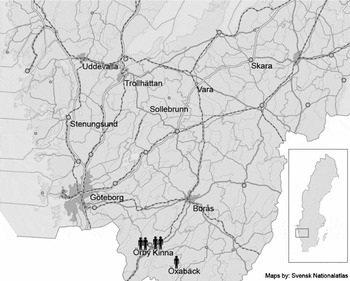
Eight small towns and villages in West Sweden were selected for the project: Kinna, Borås, Trollhättan, Sollebrunn, Vara, Skara, Stenungsund and Uddevalla (see map in Figure 1). These locations were chosen due to their distance of approximately 50–100 km away from Gothenburg (which is the second largest city in Sweden) and their economic status in the region (in terms of employment opportunities, etc.). Kinna, Borås, Trollhättan, Sollebrunn, Vara and Skara traditionally belong to one dialect area and Stenungsund and Uddevalla to another.
Map of locations relevant to the project Dialect Levelling in West Sweden. Black figures represent the home of the informants in this study.

Grönberg (Reference Grönberg2004) suggests that the Gothenburg variety of Swedish has spread at least some 30–40 km into the region, and the purpose of choosing the above locations was to investigate what the dialect situation is even further away from Gothenburg.
The Dialect Levelling project aims to map how dialects in these locations have changed during the past fifty years and whether they have levelled, either towards the Gothenburg variety or towards the national standard variety. Dialect change is seen as a process where both external and internal factors are at work, and the project links variation to infrastructure, urbanization, identity and lifestyle. The project has both a qualitative and a quantitative dimension, and employs conversation analysis as a method to explain intra-individual variation (Nilsson forthcoming b).
At every location, group interviews with four groups of adolescents (young men and women in both vocationally- and academically-oriented study programs) have been conducted; in total, 94 teenagers have been recorded. Of these, 70 informants’ use of phonological, morphological and some lexical variables have been analysed. Some of the adolescents have also made their own recordings without researchers present, for instance in their homes, at school with friends and elsewhere, providing the project with self-recorded data to compare the interview data to. These informants have also filled out an extensive survey about their lifestyles. In addition, some older informants have been interviewed and together with the recordings from the mid-20th century mentioned above, this data makes it possible to study dialect change in both real and apparent time (Bailey Reference Bailey, Chambers, Trudgill and Schilling-Estes2002).
3. A SIGNIFICANT CHANGE IN METHOD
As mentioned above, the major aim of the project Dialect Levelling in West Sweden is to answer the question how dialects have changed since the 1940s–1960s. In answering this question it is necessary to ask how we may compare data collected in the 1940s–1960s with data collected in 2007–08. In Sweden (much more so than in other Nordic countries) dialectology and sociolinguistics have been two separate traditions up until quite recently (Svahn Reference Svahn2003:512). This means that during the 20th century, dialect studies in Sweden (with a few exceptions like Nordberg Reference Nordberg1972, Reference Nordberg1985 and Thelander Reference Thelander1979) were usually conducted within a tradition that did not consider speaker variables.
During the 1940s–1960s, the focus was on documenting the traditional dialects as variant linguistic systems. The informant was usually a non-mobile rural maleFootnote 2 (Chambers & Trudgill Reference Edlund1998; Svahn Reference Svahn, Gunnarsson, Entzenberg and Ohlsson2007), which by no means makes Sweden an exception. This informant would be recorded with the purpose of preserving the dialect for future generations, as well as making the dialect available for description as a linguistic system. Consequently, the research focus was the dialect as a linguistic system and not the dialect situation or dialect in use (Malmberg Reference Malmberg1962; Lilja Reference Lilja1996; Svahn Reference Svahn2003, Reference Svahn, Gunnarsson, Entzenberg and Ohlsson2007; Bockgård forthcoming). Neither intra-individual nor inter-individual variation entered the picture.
Today, most sociolinguistic studies do not select informants by linguistic criteria, but rather base the selection on speaker variables, in order to identify informants who are in some way representative of the community in question. This is done in order to enable the description of the sociolinguistic situation, and, in contrast with the research focus of the1940s–1960s, focus on the dialect in use.
Evidently, there is a significant methodological difference between the mid-20th-century Swedish dialectology and the present-day socio-dialectology. This change in method cannot be ignored when comparing informants from the two points in time. Instead, we need to ask how the method for selecting informants affects the picture of dialect change. In order to answer this, I have conducted a study of two informants recorded in 1948 compared with three informants recorded 2007–08.
4. THE INFORMANTS AND THEIR REALIZATION OF LINGUISTIC VARIABLES
The five informants in this study are all from around the small rural village of Kinna (see map in Figure 1) located approximately 70 km from Gothenburg, where a specific variety of West Swedish (called Marbo or Markmål; see Götlind Reference Götlind1940–1947 and Landtmansson 1947–1950) has traditionally been spoken. Two of the informants were recorded in 1948 while the remaining three were recorded in 2007 and 2008.
By comparing these five individuals and their realization of linguistic variables I will study to what extent the selection of informants may affect our idea of dialect change, as well as how much the dialect as a linguistic system on the one hand and the dialect situation on the other have changed.
Hilda Larsson,Footnote 3 and her use of dialect, is the starting point for this study. Hilda Larsson was born in 1887 in Örby (see Figure 1), a small village connected to Kinna, where she lived all her life. The recording was made in 1948 and is kept in the archives of the Institute for Language and Folklore in Uppsala, Sweden, together with some additional information about the recording. It is most likely that the interviewer who recorded Hilda Larsson chose his informants in the way standard at the time: by searching for as traditional a speaker as possible. Thus Hilda Larsson was selected most probably because of her use of traditional dialect. Given that the notes accompanying the recording in the archives claim that this is a ‘good’ recording, we may suppose that she was also considered a traditional dialect speaker by the dialect researchers of her time. This means that the recordings fulfilled the expectations of what the dialect in question ‘should’ sound like (see also Lilja Reference Lilja1996).
The recording of Hilda Larsson was analysed for the purpose of this study as to her use of phonological and morphological features deviating from the national standard Swedish (Götlind Reference Götlind1940–1947; Landtmansson 1947–1950, 1952). In total, Hilda Larsson used 24 dialectal variants (see also Nilsson, forthcoming a) categorically. The morphological features that deviate from standard in her data are: strong verb inflection were standard Swedish has weak; gender and numeral inflection of verbs; binding vowels in compounds; vowel lengthening and shortening; noun and adjective inflections, and pronoun, adverb and discourse particle forms that are not found in the standard. Phonological features deviating from the standard are (all in specific word positions): [w] instead of [v], uvular [ʀ] instead of the standard [r]; also [ɔ] is pronounced [ɵ], and [ɔ] and [ʏ] are pronounced [ɶ]; [ɪ] is pronounced [ɛ]; [œːr] and [æːr] are realized [øːr] and [ɛːr]; and the standard [a] is pronounced [ɔ]; two types of diphthongs are also found as well as realizations of [iː] and [uː] that could be described as ‘tense’, and lowered. These 24 variables were excerpted from the recordings of the other four informants and form the basis of the analysis of possible dialect levelling or indeed dialect loss. Each of these variables has two variants, categorized as standard and dialect, respectively.
I first compared Hilda Larsson's data with the data from a young male speaker, Anders Ågren, recorded for the Dialect Levelling project. At the time of the recording, Anders Ågren was 17 years old and lived in Öxabäck (see Figure 1), a small rural village 10 km from Kinna. The reasons for selecting Anders Ågren as an informant for the Dialect Levelling project were that he was a young man in a vocational study program and his early schooling had been in this region. Linguistic criteria were of no importance here, i.e. he was not chosen for his use or non-use of certain dialectal features. When we compare Anders Ågren's use of dialect variants with Hilda Larsson's, it soon becomes apparent that Anders Ågren uses far fewer dialect variants than Hilda Larsson did 60 years earlier: out of Hilda Larsson's 24 variants, Anders Ågren uses only two: the discourse particle and the lowered [iː]. Anders Ågren even displays intra-individual variation in his use of the two dialect features: he uses both standard and dialect variants of these two variables. As regards the other 22 variables, he uses the standard variants categorically.
For an observer comparing only Anders Ågren's and Hilda Larsson's uses of dialect features, extensive dialect change seems to have taken place, bordering on dialect loss.
However, when we compare Hilda Larsson with another young man recorded in the same group interview as Anders Ågren, Samuel Andersson, we get a different picture. Like Anders Ågren, Samuel Andersson was born in Kinna in 1989 and, at the time of the recording, had always lived in the area; thus, he was selected as an informant for essentially the same reasons as Anders Ågren.
Samuel Andersson uses far more dialect variants than Anders Ågren; in total, he uses 16 dialect variants, four of them categorically (the lowered [uː] and [iː] as well as [øːr] and [ɛːr]), while there is intra-individual variation as to 12 of the variables between the dialect variant and the standard variant. The dialect variants that he does not use in the recording are the different verb inflections, the dialectal pronoun form, binding vowel, lengthening of vowels, [w] instead of [v], [ɵ] instead of [ɔ] or [œ] instead of [ʏ]. Samuel Andersson's case offers another picture of dialect change: dialect change is definitely under way, but the inter-individual variation in the village is significant in that some speakers in this region have very few dialect variants (e.g. Anders Ågren) while others have more (e.g. Samuel Andersson).
Of course, apart from being much younger than Hilda Larsson was when she was recorded, Anders Ågren and Samuel Andersson were chosen for reasons different from those that identified Hilda Larsson. What would happen today, then, if we were to find informants based solely on the fact that they speak the traditional dialect, i.e. using the same method of recruitment that led to the selection of Hilda Larsson?
I have tried to answer this by selecting an informant on the basis of her use of dialect variants. Asking around in the village of Kinna, I got in touch with Gertrud Jansson, who is considered by fellow villagers to speak a very traditional dialect. Gertrud Jansson was born in 1944 in Örby and had always lived there, except for a few years when she studied to become a teacher in the nearby town of Borås (see Figure 1). Gertrud Jansson was the same age at the time of recording as Hilda Larsson was when she was recorded 60 years earlier. Furthermore she even lived in the same small village. Hence, Gertrud Jansson seems an appropriate choice for the comparison.
Comparing Gertrud Jansson's data with Hilda Larsson's, the supposed dialect change does not seem as extensive as might be expected. Gertrud Jansson uses 20 of Hilda Larsson's original 24 dialect variants. The variants she does not use are the two different verb inflections, the dialectal pronoun forms and the [w], which were used in a very limited geographical area (Landtmansson Reference Landtmansson1952). Like Samuel Andersson, Gertrud Jansson displays some intra-individual variation: she uses both the standard variant and the dialect variant of five variables, both morphological (noun and adjective inflection) and phonological (both [ʀ] and [r], the /l/ pronounced with and without a retroflex flap as well as both [ɔ] and [œ]).
Most people in the village would presumably agree that Gertrud Jansson is a traditional dialect speaker. So, what did a speaker considered not to be traditional sound like in 1948? We can get an idea of this by studying John Erik Hagberg.
John Erik Hagberg was born in 1877 in Kinna and lived there for all his life. The archive notes accompanying the recording say that he has a ‘levelled dialect’ so, according to researchers in 1948, John Erik Hagberg was not a traditional dialect speaker. Of the 24 variables, Hagberg uses 19. He shows intra-individual variation on eight of them, meaning that he has categorical dialect variants for 11 out of 24 variables. One of the variables is not used at all in the recording; thus we cannot know how he would have realized that variable, but the other dialect variants present in the recording are actually the same as those Gertrud Jansson used in 2008.
Comparing Gertrud Jansson's and John Erik Hagberg's use of variables with that of the other informants reveals that Samuel Andersson does not use any dialect variants other than Gertud Jansson and John Erik Hagberg. The dialect variants Anders Ågren uses are also used by all the other informants. Thus, the informants' use of the dialect variants forms something similar to a scale of implication.
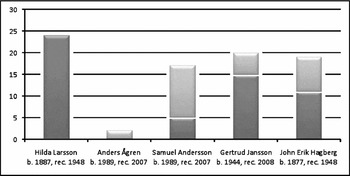
In Figure 2 above, I have illustrated all five informats’ use of dialect variants. The darker grey shade indicates consistent use of a dialect variant, while the lighter shade indicates intra-individual variation, viz. between the dialect variant and the standard variant. The informants are presented from left to right in the same order they were presented above, starting with Hilda Larsson. The vertical axis indicates the number of dialect variants used by each informant. Hence, the maximum is 24. The informants’ year of birth (‘b.’) and the year of the recording (‘rec.’) are stated below each bar.
Number of variables with categorical use of the dialect variant (dark grey) and number of variables with intra-individual variation (light grey).

Figure 2 illustrates that the difference in the use of dialect variants between someone recorded in 1948 (Hilda Larsson) and someone recorded in 2007 (Anders Ågren) can be substantial. It also illustrates the opposite, that there is hardly any difference, as is the case with a comparison between the 1948 data (John Erik Hagberg) and the 2008 data (Gertrud Jansson). According to these two sets of data, collected 60 years apart, there is no difference in the number or the type of dialect variants used and thus no language change.
Figure 2 also shows inter-individual variation both in 1948 (compare Hilda Larsson with John Erik Hagberg) and in 2007–08 (compare Anders Ågren, Samuel Andersson and Gertrud Jansson).
Figure 2 demonstrates furthermore that the three informants recorded in 2007– 08 all display intra-individual variation. This is something these informants share with all the other informants recorded by the Dialect Levelling project. It seems that this is a significant feature characteristic of the dialect situation in the early 21st century.
It is important to point out that John Erik Hagberg also displayed intra-individual variation in 1948. Perhaps this variation is part of the reason why researchers of the time labelled him as ‘levelled’.
4.1 Inter-individual variation
As mentioned above, there has been inter-individual variation at this location in West Sweden in 1948 as well as in 2007–08. Time alone cannot explain the differences in dialect use since it is possible to find data from both periods with the same number of dialect variants (witness the comparison between Gertrud Jansson and John Erik Hagberg).
Previous research suggests that analyses of dialect speakers’ geographical, social and psychological spaces can help explain inter-individual variation (Britain forthcoming a, b). Consequently I have conducted a qualitative analysis of the informants’ mobility in the area, their social networks and activities, and their attitudes towards their own dialect. As present-day methods of collecting data are quite different from those employed in 1948, we know much more about the lifestyles of the informants recorded today, i.e. Anders Ågren, Samuel Andersson and Gertrud Jansson, than about John Erik Hagberg and Hilda Larsson. Nevertheless the analysis of the recordings and archive notes reveals some important similarities and differences between the informants.
The informants studied here were all born, and spent their entire lives, in the same area – in and around the village Kinna in West Sweden. However, the available information reveals that John Erik Hagberg (born in 1877) was unusually mobile for his time, travelling around the region in his capacity as a parish constable. He also worked as an auctioneer. In other words, he oriented geographically towards locations outside his village. This could also be said about Anders Ågren (born in 1989), the least traditional dialect speaker, who, for example, travelled to Gothenburg to shop for clothes. Anders Ågren is also orienting himself towards an urban life psychologically, and claims that he wants to move to a larger city. On the other hand, Samuel Andersson (also born in 1989), wants to either stay in Kinna or move to an even smaller village in the region. He dislikes Gothenburg and urban life and his social network is very local. In his spare time he plays ice hockey as a member of the local team, goes hunting and fishing, and spends time with his family and neighbours, whereas Anders Ågren says he hangs out with friends in his spare time.
Like Samuel Andersson, Hilda Larsson (born in 1887) must have also had a very local social network; she lived with her siblings in the same remote village most of her life. Furthermore, she was crippled by disease and must therefore have been fairly immobile. Gertrud Jansson (born in 1944), too, had a local network of friends and co-workers. She also made a point of keeping her traditional dialect. As a young teacher, she was told by the headmaster of the school where she worked to shift to the standard variety. This made her hold on to her traditional dialect even more strongly, as she felt that this was part of her identity. Samuel Andersson also strongly favours traditional dialect over the national standard variety, whereas Anders Ågren suggests that the traditional dialect is something farmers use. How John Erik Hagberg and Hilda Larsson felt about their dialect we will never know.
In some ways, Anders Ågren and John Erik Hagberg are quite similar. They both (in their respective time) psychologically and geographically orient towards urban and modern life, and are considered to be levelled at the time of recording. Hilda Larsson, Samuel Andersson and Gertrud Jansson, on the other hand, also show similarities in their more locally-oriented lifestyles. These three also share a similar feature; they all have a certain ‘tense’ voice quality, traditionally associated with the Marbo dialect.
Of course, these five individuals cannot give us the entire picture of how dialect has changed in this area between 1948 and 2007–08. However, these individuals can make us aware of how important it is to problematize methods for the selection of informants and to keep this in mind when we talk about dialect levelling and change.
5. DIALECT CHANGE OR CHANGE IN DIALECT SITUATION?
At the beginning of this paper, the question was raised of whether there has been a change in the dialect system or in the dialect situation. The answer, of course, depends on at least two prior decisions: how we collect data, i.e. how we choose the informants, and how we define the notion of ‘a traditional dialect’. Do we define traditional dialect in the same way as researchers did some 50 or 60 years ago? Or, put simply, are 20 variants, as in the case of Gertrud Jansson's data, enough to consider a speaker as a traditional dialect speaker today? Or does the intra-individual variation together with the loss of some features make dialect speakers appear less traditional?
When comparing an individual recorded in the early 21st century (Gertrud Jansson), chosen for the same reasons which were used in the1940s, with individuals recorded in the 1940s (Hilda Larsson and John Erik Hagberg), the dialect system does not seem to have changed very much. Today, an informant considered to be a traditional dialect speaker (Gertrud Jansson) uses 20 of the 24 variants which a traditional dialect speaker (Hilda Larsson) used in the1940s. However, if we were to embrace the restricted view of dialect that researchers had in 1948, a speaker with 20 dialect variants would be considered levelled (as John Erik Hagberg was in his time). By 1948s standards there has been a change in the dialect as a system: to find someone like Hilda Larsson today might prove impossible. I would like to suggest, however, that the systemic change is rather small. Other research seems to support this: for example Eva Sundgren's real-time study of the dialect in the Swedish town of Eskilstuna also shows how the levelling towards standard is far less rapid than some scholars have expected (Sundgren Reference Sundgren2002).
The traditional dialect of this area in West Sweden still seems to exist, with a slight change in some individuals’ use, and a large change in others’. Nevertheless all the informants in this study use traditional dialect features. Even Anders Ågren, who only uses two variants, uses one variant that is quite geographically restricted to the Kinna area (i.e. the lowered /i/). It seems that depending on how we choose informants we may find many or only a few traditional features. The dialect situation, however, seems actually to have undergone a significant change. The individuals studied here are probably all unique dialect speakers in their respective times. Today, Anders Ågren is the least traditional dialect speaker of all the adolescents recorded in the specific dialect area by the Dialect Levelling project, while Samuel Andersson is the most traditional speaker. Informants who speak as much traditional dialect as Gertrud Jansson does are probably quite rare today. But it is possible that this was true in 1948 as well: Hilda Larsson was chosen as an informant because she spoke a traditional dialect, and she may well have been more traditional than many others in Kinna and the surrounding area at the time. On the other hand, in 1948, there were probably very few, if any, who used as few dialect variants as Anders Ågren does in 2007 in this area; thus, a speaker like John Erik Hagberg, with 19 dialect variants out of 24 variables and some intra-individual variation, was considered levelled. Perhaps it is possible that many speakers (at least those born in the second half of the 19th century) had a dialect variety somewhere between Hilda Larsson's and John Erik Hagberg's in the 1940s–1960s, whereas today the span is much wider, with Gertrud Jansson's variety at the one end and Anders Ågren's at the other (see Figure 2 above). It is probable that there is more inter-individual variation today than 60 years ago.
It would seem that the dialect situation has changed more than the dialect as a linguistic system. Hence, there seems to be a good reason for discussing dialect change as a process from two angles: dialect as a system as well as the dialect situation.
Of course, it is well known that the definition of traditional dialect as a uniform system without any internal variation is idealized through and through. Nevertheless, the definition of dialect today is a matter of serious discussion since it is evident that dialect features are still present, both in West Sweden and elsewhere, and what has changed is their varied use, both inter-individually and intra-individually. For the present purpose I only wish to draw the reader's attention to this matter of definition, but to solve the problem is not the aim of the present paper. Furthermore, a definition of dialect may be of two significantly different types: it may concern solely the level of language use or it may include the level of attitudes and norm ideals (Kristiansen Reference Kristiansen, Jaworski, Coupland and Galasinski2004). Again, this matter has not been dealt with in the present paper, though obviously highly relevant for the final solution.
6. CONCLUDING REMARKS
I would like to end this paper on a methodological note. This study shows the importance of problematizing the method for selecting informants when studying dialect change, and that it is important to consider what it really is we wish to compare. It is also important to consider whether the informants are to represent the dialect system or the dialect situation.
I would also like to suggest, that the way the above informants were analysed, supports the value of qualitative analyses. By studying the use of dialect variants, it becomes clear that both the inter- and intra-individual variation is large in a dialect area of today, and that today's dialect situation is characterized by this variation. Taking into account the social spaces of each individual also helps to explain this inter-individual variation. Finally, I would like to suggest that qualitative analyses help us understand both the past and the current dialect situation, and may thereby give us a better understanding of the processes behind dialect change.
ACKNOWLEDGEMENTS
I am most grateful to Frans Gregersen, Ewa Jaworska, Tore Kristiansen, Unn Røyneland, Eva Sundgren and Margareta Svahn for their insightful and valuable comments. I would also like to thank Christian Sjögreen for help with the text and the figures, as well as the participants of the conference ‘Dialectological and folk dialectological concepts of space’ held in Freiburg in November 2008 for comments on an earlier version of this paper.