

“For rebellion is as the sin of witchcraft”
In an entry in her published correspondence, Letters from the Mountains, dated October 14, 1791, the Scottish writer and poet Anne Grant naturalized the traditional hereditary power of the nobility and the monarchy, noting: “In short, every thing that decorates, or enlightens, is best seen from an eminence.” Begging her reader “to permit me to Burkify a little longer,” Grant assured her that
I should be very much grieved to see that good old lady, or gentleman, (I know not which to call it,) the Constitution, cut up and dismembered, because it has a few wrinkles or grey hairs, or to see Medea’s old kettle put on again, while Mr. – and Lord L. stood chief cooks, and Tom Paine scullion. I think I see Mary W – and so many more public-spirited ladies bringing aprons – full of herbs, like witches, to the magic cauldron.1
The idea of radical writers and Jacobin sympathizers as witches was popular among Romantic-era counterrevolutionary writers and artists in Great Britain, who viewed the French Revolution and its aftermath as an appalling subversion of the patriarchal authority of church and state.
The reference to Medea specifically links witchcraft to politics: the sorceress Medea convinces King Pelias’s daughters that she can turn an old ram into a new ram with her magical powers. After Medea cuts the ram into pieces and boils it in magic herbs, a young ram jumps out of the pot. The daughters of Pelias do the same to their father, chopping him into pieces and throwing him into the cauldron. The image of Mary Wollstonecraft and other “public-spirited ladies” as witches like Medea, fueling the fires of dissent and revolution, tapped into deep cultural and historical anxieties regarding women’s active participation in public life and their potential to recruit others in their seditious efforts.
Witchcraft, with its association with the female demonic, resonated during the British Romantic period with what were perceived as the anarchic energies of revolutions in general and the French Revolution in particular. As Marilyn Butler noted, “the pursuit of the ‘jacobinical’ became a national pastime, a witch-hunt” after 1789, metaphorically and – as I will argue in the pages that follow – literally.2 This resurgence of interest in the idea of witchcraft and its subversive potential was invoked at a time of political and social instability, on the one hand, as Grant’s description of Wollstonecraft and other pro-revolutionary women suggests, as a mechanism of social control, and on the other hand, as a relic of the not-so-distant past, an imaginary space in which dangerous female power could be explored without censure.
In The Witch: A History of Fear, from Ancient Times to the Present, Ronald Hutton provides four definitions of the figure of the witch: “someone who causes harm to others by mystical means … any person who uses magic; … the practitioner of a particular kind of nature based Pagan religion; or … a symbol of independent female authority and resistance to male domination.”3 Although Hutton states that the latter two definitions were introduced in the nineteenth century, all four of these definitions apply, in varying degrees, to the figure of the Romantic witch who emerged in British literature and art in the late eighteenth century. Representations of witches in the Romantic period ranged from malevolent crones to female visionaries. Some Romantic witches practiced their dark arts on the edges of their communities while others were embedded in familial structures as rebellious daughters and wives. Some sought justice for the victims of patriarchal injustice while others functioned as protective spirits of the place –fiercely guarding the land and its people. While some prophesied a more equitable future, others lashed out in anger. What all these versions of the Romantic witch shared was a perspective that was female, supernatural and resistant to the status quo. The figure of the Romantic witch, imagined in opposition to what she was not, provided Romantic writers and artists with a counter-narrative centered around the pagan energies and subversive power of the female supernatural.
The presence of witches in a time of revolution was not accidental. The connections between witchcraft, revolution, and social upheaval have been well documented by early modern historians such as Stuart Clark and Peter Elmer. As Clark notes in Thinking with Demons: The Idea of Witchcraft in Early Modern Europe, the proliferation of witches during periods of political crises was not an “incidental product … of social trauma … On the contrary, the very notion of witchcraft was inseparable from how disorder was often conceived and experienced.”4 In Witchcraft, Witch-Hunting, and Politics in Early Modern England, Elmer points to how witchcraft functions in political contexts in two very different ways: sometimes “helping to reinforce normative behaviour and underscore the social, religious and political status quo,” and at other times, “encouraging criticism of those holding the reins of power, particularly when the position of the latter was rendered unstable and vulnerable to challenge by broader political events.”5
These seemingly contradictory uses of witchcraft in periods of political instability gesture toward the capaciousness of the figure of the Romantic witch as a powerful and flexible symbol of social and political disorder. By the end of the eighteenth century, most educated people in Britain no longer believed in witchcraft. The notorious witch hunts led by Matthew Hopkins during the Civil War decades in the mid seventeenth century marked the end of the widespread panic regarding witchcraft in England. The last execution of an English witch, Alice Molland, took place in Devonshire in 1685, and the last conviction, that of Jane Wenham, came in 1712. During the early eighteenth century, many Britons began to think of the belief in witchcraft as an artifact of superstition and prejudice. This skepticism was expressed in legal terms by the Witchcraft Act of 1736, which took aim at those who pretended “to exercise or use any kind of witchcraft, sorcery, enchantment, or conjuration, or undertake to tell fortunes,” by sentencing them to a year in prison and the public humiliation of four visits to the pillory.6
Although the belief in witchcraft declined sharply in the eighteenth century across Great Britain – with the exception of small villages and rural outposts – witches began to proliferate in literature and art as well as in lurid accounts of the violence of the French Revolution, in which women played an active role. The connection between witchcraft and revolution in England during the Civil War decades, and again in the Romantic period, demonstrates that the idea of witchcraft was deeply ingrained in how Britons understood and experienced cataclysmic change and social upheaval. The Romantic-era witches, who stalked the pages of Gothic poetry and prose and glared menacingly from the paintings and sketches of Fuseli and Blake, embodied revolutionary anger and the possibility of radical social transformation. The seventeenth-century witch hunts revealed deep anxieties about women and their subversive potential. What was different in the Romantic period is that in addition to these gendered anxieties and the misogyny that fueled them, the idea of witchcraft also opened a space for some writers and artists to envision alternative ways of being and interacting in the world that were not founded on the submission and subordination of women and other marginalized groups.
As Jonathan Barry notes, early modern historians have recently turned their attention to witchcraft “as a linguistic phenomenon and one embedded in narrative.” This involves “an emphasis on the intertextuality of witchcraft cases … relating them both to the past and to the future, considering their shaping by reference to previous stories, authorities or cultural models.” Barry’s insight that with witchcraft “we are dealing, fundamentally, with stories passing through time not with fixed realities” helps us to understand the Romantic witch in conversation with, and shaped by, the stories of the women accused and tried for practicing witchcraft in the seventeenth century as well as earlier stories and folklore about female magic and enchantment.7 The latter included stories of local, pagan magic connected to the land and nature – naiads, dryads and genius loci – as well as classical stories of witches such as Medea and Circe, and myths of collective female magic, including the Fates and the Furies. All of these versions were available to Romantic-era writers and artists, who used the figure of the witch to reimagine the present in relation to the past and to project into the future, reshaping and adapting the figure of the witch for their own purposes, sometimes casting themselves as magicians or sorceresses in the process. In a period that produced both the Great Enchantress and the Wizard of the North, when poets like Coleridge and Shelley explored the “witchery of sound” and “the still cave of the witch of Poesy,” the idea that the creative act itself was a species of enchantment resonated for many writers and artists at the time.8
The focus on representations of witchcraft in Romantic literature and art in Romanticism Bewitched has no precedent in Romantic-period scholarship. Two books written forty years apart, investigate the ways in which the canonical Romantic male authors represent themselves as magicians and their poetry and prose as spells or incantations. In Romanticism and Popular Magic (2019), Stephanie Elizabeth Churms explores the influence of popular magic and superstition on Romantic-era writers such as John Thelwall, William Wordsworth, Samuel Taylor Coleridge and Robert Southey. Building upon recent research on witchcraft and popular magic in England by social historians such as Owen Davies, Churms investigates the integration of everyday magic – including spells, curses, fortune-telling and charms – into the works of these authors. Whereas Churms focuses on popular forms of magic, Anya Taylor’s Magic and English Romanticism (1979) discusses Coleridge’s theory of imagination and his poetical practice as an extension of Neoplatonic and occultist ideas. Although Coleridge is the primary focus of Taylor’s book, she also includes chapters on Percy Shelley’s appropriation of these ideas in his attempt to enact radical social change and on the resistance to magic and magical language registered by Wordsworth, Byron and Keats. While there is some common ground between Churms’ historicist methodology and my own, Romanticism Bewitched expands the discussion to include women writers as well as novelists and artists, and positions this widespread engagement with the idea of witchcraft, cutting across political and gendered lines, as a reaction to the political and social instability of the period. The focus on witchcraft in my book also enables discussion of the gendered implications of the historical trajectory of the persecution of so-called witches and its influence on the Romantic writers and artists who invoked the female demonic in their literary and artistic works.
The Romantic witch carried with her the vestiges and the trauma of the gendered violence of the seventeenth-century witch hunts. Often aligned with nature, meting out punishment or prophesying a better, more equitable world, she represented and demanded justice for those who had been erased by history. A crucial difference between the exploration of the figure of the witch by writers in the Romantic period and representations of mad and monstrous women in Victorian literature was that the Romantic witch embodied anger imbued with revolutionary fervor, anger infused by hope and not despair. As Nina Auerbach, Sandra Gilbert, Susan Gubar, and others have shown, during the Victorian era, the idea of the female demonic was gradually burnished and hardened into a cultural myth of female monstrosity.9 In contrast, the witch in Romantic-era literature was a capacious and dynamic figure. Unaware of the fate and collective neuroses of Bertha Mason and her Victorian sisters, the Romantic witch populated the literature and art of the period, enjoying the freedom of possibility and unleashing her anger purposefully and productively.
Buoyed by the spirit of revolution, the figure of the Romantic witch was inherently political, often animated by, and gathering her power from, the urgent need for sweeping societal change as articulated, for example, by Mary Wollstonecraft: “Rousseau exerts himself to prove, that all WAS right originally: a crowd of authors that all IS now right: and I, that all WILL BE right.”10 In Maria, or The Wrongs of Woman (1798), Wollstonecraft underscores that systemic violence towards women, and the complicity of the legal system, are “wrongs” that must be addressed in order for society to evolve. The abuse that Maria suffers in her marriage is psychological and physical; when she attempts to escape, she is institutionalized. Her warden, Jemima, is sexually abused as a teenager and turns to prostitution as the only means available to support herself. Despite their class differences, Maria and Jemima are both victims in a society in which women have no rights. As Wollstonecraft pointedly reminds her readers in the first lines of Maria when Maria wakes up to find herself in the madhouse, the contemporary conditions for women far surpass any fictionalized Gothic abuses of power:
Abodes of horror have frequently been described, and castles, filled with spectres and chimeras, conjured up by the magic spell of genius to harrow the soul, and absorb the wondering mind. But, formed of such stuff as dreams are made of, what were they to the mansion of despair, in one corner of which Maria sat, endeavouring to recall her scattered thoughts!11
Although Wollstonecraft does not address the subject of witchcraft directly, the character of Jemima engages in witchlike behavior: aborting her unborn child and convincing a man to turn out his pregnant mistress, who commits suicide because there is nowhere else for her to go. Jemima describes herself as “a monster” who is “hunted from hole to hole, as if she had been a beast of prey, or infected with a moral plague.”12 However, as Wollstonecraft demonstrates, Jemima’s monstrous decisions are driven by the need to survive. Maria, or The Wrongs of Woman details the social and material conditions that force women to do things that are morally reprehensible, actions that transform women into female monsters or witches.
Wollstonecraft’s ambivalence regarding the idea of magic is informed by her particular attention to the psychological and physical violence that women encounter in their everyday lives and by the collusion of the imagination in perpetuating this violence. In The Memoirs of Emma Courtney (1796), Mary Hays similarly interrogates the all-too-easy demonization of women who do not abide by societal expectations, describing the limitations imposed on women as a magic circle that conspires to subordinate women and prevents them from realizing their full potential as citizens: “Why are we bound, by the habits of society,” she asks, “as with an adamantine chain? Why do we suffer ourselves to be confined within a magic circle, without daring, by a magnanimous effort, to dissolve the barbarous spell?” Later in the novel, Emma Courtney realizes that any effort on her part to lift the spell would be futile without a radical reset in her own thinking as well as in the social prejudices of her contemporaries: “Hemmed in on every side by the constitutions of society, and not less so, it may be, by my own prejudices – I perceive, indignantly perceive, the magic circle, without knowing how to dissolve the powerful spell.”13 Mary Wollstonecraft connects this idea of the “magic circle” to the imagination in her Letters Written During a Short Residence in Sweden, Norway, and Denmark (1796): “I must fly from thought, and find refuge from sorrow in a strong imagination – the only solace for a feeling heart. Phantoms of bliss! ideal forms of excellence! again inclose me in your magic circle, and wipe clear from my remembrance the disappointments which render the sympathy painful.”14 As Wollstonecraft and Hays argue, the imagination is a double-edged sword, offering women a species of magic that provides psychological relief while potentially lulling them into inaction, using their own habits of mind against them and preventing them from breaking free of the spell that binds them.
The collusion of the imagination with visionary flights of fancy, and the dangers this posed for women, is a thread that Wollstonecraft’s daughter, Mary Shelley, Walter Scott, and Joanna Baillie would expand upon later in their representations of the figure of the historical witch. Their explorations of the victimization of women during the witch hunts situate the contemporary wrongs of women documented by Wollstonecraft and Hays within a historical trajectory of violence towards women that intensifies in periods of social and political uncertainty.
What Shelley, Scott, and Baillie offer in their historically based literary works is context, sympathy, and models for the constructive use of anger in re-visioning a better, more equitable world. Scott’s historical novels and Baillie’s tragedy, Witchcraft, are infused with sympathy for the women accused of witchcraft. The same is true of Mary Shelley’s sympathetic representation of the fate of witches and female visionaries in her historical novel, Valperga: or The Life and Adventures of Castruccio. In Valperga, Shelley uses the figure of the witch to explore female anger as an appropriate response to the deep-seated misogyny that resulted in the murders of thousands of women accused of witchcraft in the seventeenth century and continued to work its dark magic in destroying the reputation of her mother in her own time.
The advantage that the Romantic witch had over later incarnations of the female demonic was that belief in witchcraft, although it had waned considerably by the end of the eighteenth century, was still relatively recent history. In 1768, John Wesley argued that “the giving up of witchcraft is in effect giving up the Bible,” and many people in the Romantic period continued to believe in the incursions of magic in their day-to-day lives.15 By 1789, the Witchcraft Act of 1736 had only been in effect for a little more than fifty years. Popular magic was alive and well in the countryside, where white witches were still consulted in the villages, and in the cities, where female prophets like Joanna Southcott attracted thousands of followers. As William Godwin recalled in the conclusion of Lives of the Necromancers (1835), in his early years, “scarcely a village was unfurnished with an old man or woman who labored under an ill repute on this score … I remember, when a child, that I had an old woman pointed out to me by an ignorant servant-maid, as being unquestionably possessed of the ominous gift of the ‘evil eye,’ and that my impulse was to remove myself as quickly as might be from the range of her observation.”16 In rural villages Goody Blakes continued to bewitch Harry Gills, and Walter Scott collected contemporary stories of purported witchcraft that he shared in his Letters on Demonology and Witchcraft.
As Willem de Blécourt and Owen Davies point out in Witchcraft Continued: Popular Magic in Modern Europe, the decline in witchcraft belief after the witch trials was uneven, and women accused of witchcraft continued to be targets of violence. In fact, as the authors note, “physical violence against suspected witches stands out as one of the most prominent traits of witchcraft” after the seventeenth century.17 This is exemplified by the case of Ann Izzard, who was accused of witchcraft in 1808 in the village of Great Paxton in Cambridgeshire, England. The villagers suspected that Izzard was bewitching their children and decided to take matters into their own hands on two separate occasions, dragging her from her bed, beating her, and scratching her with pins, and threatening to duck her in the village pond. Although many of the attackers were subsequently arrested and sentenced to a month’s imprisonment, five years later Izzard and her daughter were again accused of witchcraft, and rumors that she was a witch persisted even after she and her husband moved to another village.18
If violence towards purported witches was the legacy of witchcraft belief after the seventeenth century, this was the exception rather than the rule in England during the witch hunts. In England, there was an initial surge in witchcraft accusations and trials between 1560 and 1620, followed by a lull in the 1630s, a spike during the years of the Civil War, and then a steep decline after 1660. Five hundred and thirteen people, primarily poor, elderly women, were tried for witchcraft between 1560 and 1700, but only 112 were executed. The surge in witchcraft accusations in the civil war decades was explicitly connected by royalists to the threat of insurrection as Peter Elmer notes: “During the civil war … loyal preachers consistently harangued their audiences with dire warnings of the fate awaiting those who, like Saul, engaged in the ‘witchcraft of rebellion’ … [citing] extensively from the Malleus Maleficarum.” The use of the Malleus Maleficarum, the standard medieval text on witchcraft noted for its virulent misogyny, by ministers expatiating “on the parallels between rebels and witches” is an example of its sustained influence in England (an influence that will be discussed at length in Chapter 1).19
The history of witch-hunting in Scotland differed substantially from that in England in terms of the sheer number of executions of purported witches and the widespread, embedded belief in witchcraft that resulted from Scotland’s deeply conservative religious climate in the sixteenth and seventeenth centuries. During this period, approximately 4,000 people were accused of witchcraft in Scotland, and about two-thirds of the accused (or five times the European average) were executed. Most of these executions took place during six major witch hunts that occurred in 1591, 1597, 1628–1630, 1643, 1649, and 1661–1662. The timeline for the decline in witchcraft accusations also differed from that in England: although 1662 marked the end of the most severe witch-hunting, Scotland continued to prosecute purported witches well after that. The last execution of a witch took place in 1706, a little more than twenty years after England’s last execution.20
The atrocities committed during the witch hunts in England and Scotland continued to haunt Britons in the Romantic period, especially after 1794 and the Reign of Terror. Walter Scott’s account in his Letters on Demonology and Witchcraft, describing the mass extermination of women during the seventeenth century, was informed by his belief that periods of revolution and political instability are susceptible to the overzealous application of penal laws as a consequence of superstitious fear and ignorance: “When the alarm of witchcraft arises, Superstition dips her hand in the blood of the persons accused, and records in the annals of jurisprudence their trials and the causes alleged in vindication of their execution.”21 The connection between politics, superstition, and violence directed at women was underscored by Scott and other Romantic-era writers, who often cited the example of Joan of Arc. As Scott notes, “The death of the innocent, high-minded, and perhaps amiable enthusiast, was not, we are sorry to say, a sacrifice to a superstitious fear of witchcraft, but a cruel instance of wicked policy mingled with national jealousy and hatred.”22 The authors of The Philosophy of Witchcraft concur: “The murder of Joan of Arc, furnishes another proof of the powerful influence of this absurd belief on the minds even of the learned and educated classes. This patriotic female had the semblance of a trial, by judges appointed by the English Monarch, and Witchcraft, not love of country, was the crime laid to her charge.”23 The fracturing of families as a result of accusations of witchcraft is highlighted by Germaine de Staël, who reminds her readers that it was Joan of Arc’s father, “the unhappy fanatic,” who “presents himself voluntarily amidst the knights and lords of the court, to accuse her of witchcraft.”24
The sympathy expressed by Scott and Staël for Joan of Arc reveals the collective horror of Romantic authors, regardless of their politics, regarding the atrocities committed during the witch hunts. In contrast to Scott’s deeply entrenched conservative views, the French-Swiss writer Staël was a political centrist, opposed both to the Jacobins and the reactionary ultra-royalists in her country. Even William Godwin, whose radical political views and atheism ran counter to those of both Scott and Staël (the latter holding a heterodox, reason-based Christian philosophy), wrote at length and with great admiration for Joan of Arc. In Lives of the Necromancers, Godwin describes her “courage and spirit of enterprise,” as well as her poise during her first trial: “Joan, though oppressed and treated with the utmost severity, displayed so much acuteness and presence of mind, that the court … contented themselves with sentencing her to perpetual imprisonment.” Godwin’s detailed account of how “the hatred of her enemies” continued unabated, resulting in her death by fire, illustrates how the story and the fate of Joan of Arc resonated with Romantic-era writers who struggled to understand the historical, social, and political forces that resulted in the brutal massacre of so many women during that dark period in history, including the visionary Joan of Arc.25
The historical methodology of this book is informed by the Romantic-era understanding of the connections between the figure of the witch and a history of violence against women during periods of political and social turmoil. Romanticism Bewitched is indebted to the research on gender and witchcraft conducted by the political theorist and feminist activist Silvia Federici, feminist historians such as Christina Larner and Lyndal Roper, and recent scholarship on misogyny and women’s anger. In the Romantic imagination, the witch emerges as a revolutionary figure whose very existence threatens or calls into question the status quo. Romanticism Bewitched builds on and extends Silvia Federici’s arguments in Caliban and the Witch and Witches, Witch-hunting, and Women that the accusations of witchcraft in the sixteenth and seventeenth centuries that brought about the execution of hundreds of thousands of purported witches were triggered by the rise of capitalism, revealing how capitalism is founded on, and thoroughly implicated in, racist and sexist social relations: “For capitalism must justify and mystify the contradictions built into its social relations – the promise of freedom vs. the reality of widespread coercion, and the promise of prosperity vs. the reality of widespread penury – by denigrating the ‘nature’ of those it exploits: women, colonial subjects, the descendants of African slaves, the immigrants displaced by globalization.”26 Although all these groups suffered (and, I might add, continue to suffer) to justify the inherent contradictions within the social structure, women and the power they had previously possessed posed the most obvious threat: “The figure of the witch … is the embodiment of a world of female subjects that capitalism had to destroy; the heretic, the healer, the disobedient wife, the woman who dared to live alone, the obeah woman who poisoned the master’s food and inspired the slaves to revolt.”27
In Witchcraft and Religion, the historian Christina Larner poses a provocative question: “Was Witch-Hunting Woman-Hunting?” As she argues, the possibility that witch-hunting was the result of widespread cultural mistrust of women is a strong one: “The stereotype witch is an independent adult woman who does not conform to the male idea of proper female behaviour. She is assertive … She has the power of words – to defend herself or to curse.”28 Larner goes on to note that many more women were persecuted and tried as witches than men: “In areas at the centre of the witch-hunt, in Germany, France, Switzerland and Scotland, 80 per cent of the accused were female. For areas on the periphery – in England and Russia, for example – the proportion of females was nearer 95–100 per cent.” Larner’s point here is that there is compelling evidence that the gendering of witchcraft was grounded in historical fact. Importantly, however, she also outlines a powerful counterargument, reminding us that “[t]hose who were prosecuted for witchcraft were not, except during certain mass panics, randomly selected.” They were persecuted and tried as witches because “[t]hey were disturbers of social order,” comparable to “violent males,” and were punished accordingly.29
As Larner persuasively argues, the claim that the historical phenomenon of the European witch hunts stemmed from an understanding of misogyny as dislike of or an ingrained prejudice against women limits our ability to analyze the sociopolitical structures and tensions that led to accusations of witchcraft. Women were singled out as witches because of their perceived weakness and inherent instability, but the witch-hunts ultimately reflected a widespread process of social control: “Witch beliefs represent the inverse of the positive values of any given society. In a patriarchal society the characteristics of the ideal women will be delineated by men … and women will identify with this male-delineated ideal. Individual women who deviate too far from it will be identified as witches.”30 In sum, Larner suggests that witch-hunting was not, in fact, woman-hunting – it was the consequence of the identification and persecution of female deviance as a threat to the overall integrity of church and state.
The persecution of women as witches was, as Federici and Larner note, not merely a case of bias or prejudice: women who refused to accept their subordinate role posed a genuine threat to the stability of the social order. It was misogyny in the sense that Kate Manne defines it in Down Girl: The Logic of Misogyny as “primarily a property of social environments in which women are liable to encounter hostility due to the enforcement and policing of patriarchal norms and expectations.” As Manne notes, “misogyny functions to enforce and police women’s subordination and to uphold male dominance, against the backdrop of other intersecting systems of oppression and vulnerability, dominance and disadvantage, as well as disparate material resources, enabling and constraining social structures, institutions, (and) bureaucratic mechanisms.”31 The misogyny directed at the figure of the witch played out against other intersecting systems of discrimination targeting vulnerable groups, including racial minorities and older women. This is true in Romantic representations of the witch as well. The obeah women in the works by Charlotte Smith and Maria Edgeworth are associated with the Maroon population; Walter Scott’s Meg Merrilies is a member of the Romany community; Rebecca in Ivanhoe is Jewish; and the older, poor women in Scott’s novels and in Joanna Baillie’s Witchcraft are those who are drawn to witchcraft.
As the inclusion of Rebecca suggests, the figure of the witch was not always a crone-like woman existing at the margins of a community. She could also be a wife, a mother, or a beautiful young woman like Rebecca who is rescued by Ivanhoe and, following the logic of the chivalric romance, appears likely to marry him, until Scott has second thoughts. The threat that these women pose to the family dynamic is their ability to give birth and to infiltrate and “taint” the body politic through their offspring. In Witchcraft and Religion, Larner argues that the seventeenth-century witch hunts targeted women because “all women threaten male hegemony with their exclusive power to give life; and social order depends on women conforming to male ideals of female behavior.”32 As Federici points out, the need to control women intensified during the seventeenth century, when a population crisis “turned reproduction and population growth into state matters, as well as primary objects of intellectual discourse.” As Federici goes on to argue, “the intensity of the persecution of ‘witches’ and the new disciplinary methods that the state adopted in this period to regulate procreation and break women’s control over reproduction, are also to be traced to this crisis.”33 The Romantic period experienced a similar perceived crisis concerning procreation and reproduction, but from the opposite perspective. Fears about the earth’s capacity to sustain rapid population growth were stoked by Thomas Malthus, an English economist and foundational Utilitarian thinker, in his An Essay on the Principle of Population (1798). Malthus’s essay argued that population growth would always tend to outrun the food supply, and that human reproduction must therefore be sharply curtailed. In the seventeenth century and again in the Romantic period, the idea of witchcraft brought with it fears of dangerous female sexuality and a perceived need to control women and their bodies in order to maintain the integrity of the social order.
In The Witch in the Western Imagination, Lyndal Roper points to how the figure of the witch gives “form to the deepest fears a society can have about motherhood, because she embodies the envious woman who devours children and destroys fertility.” Yet Roper reminds us too of the “submerged pagan energy” that “gave the figure of the witch much of her anarchic energy.”34 Although anxieties about women and witchcraft persisted in the Romantic period, the figure of the witch also emerged as an alternative source of spiritual or religious power. As Romanticism Bewitched demonstrates, Mary and Percy Shelley were both attentive to the buried history of the witch and her potential. Percy Shelley’s utopian vision of the Witch of Atlas is a composite of classical goddesses, and traces of a submerged matriarchal religion can be found throughout Mary Shelley’s novel, Valperga. The strains of the Ave Maria – the hymn to the Holy Virgin marking the closing of the day – that reverberate throughout the novel gesture to the historical tensions between the cult of Jesus and the cult of Mary. As Shelley reminds us, the patriarchal structure of Christianity and its historical success as the dominant religion in western culture hinged upon the repression of an alternative feminist theology – so-called witches and female prophets. As this connection between witches and women visionaries suggests, Romanticism Bewitched builds upon my previous book, Romantic Women Writers, Revolution and Prophecy: Rebellious Daughters, 1786 – 1826, which explores the connections between revolution and prophecy in the work of British Romantic women writers. At a time in which the Romantic prophetess Joanna Southcott was accused of being a witch, Romantic women writers were similarly put to the test: were they divinely or demonically inspired? Rebellious Daughters traced the ways in which Romantic women writers used the idea of divine authority in their written works. Romanticism Bewitched explores the ways in which Romantic writers and artists engaged with the idea of the female demonic and female magic as harbingers of cataclysmic change.
Nervous Laughter: Macbeth’s Dear Witches and the Politics of Gender in the Early Eighteenth Century
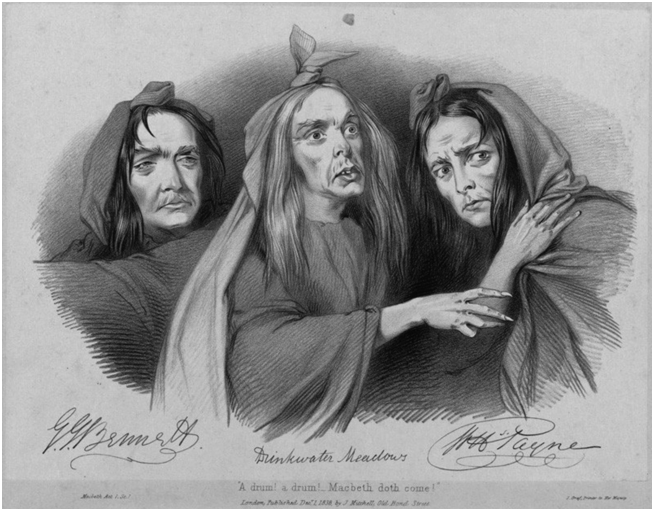
Eighteenth-century and Romantic theatergoers were captivated by Shakespeare’s plays, and it was during this period that he became the most popular and celebrated English dramatist. Among his plays, Macbeth continued to find favor with eighteenth-century audiences. Sir William Davenant’s rollicking Restoration version, written in 1663–1664 and published in 1674, dominated the British stage until the mid eighteenth century. Davenant’s adaptation reflected the growing skepticism, from the Restoration onward, regarding the reality of witchcraft by significantly downplaying the machinations of the Weird Sisters. This is evident in several of his rewritten scenes involving the witches, including the concluding couplet in the opening scene, where Davenant changes “Fair is foul, and foul is fair” to “To us fair Weather’s foule & foule is faire.” Another example occurs in Act 1, when Banquo and Macbeth encounter the witches. In Shakespeare’s text, Banquo asks “Live you? Or are you aught / That man may question?” This is altered by Davenant to “Live you? Or are you things / Crept hither from the lower world to fright / Th’Inhabitants of this?”35 As Peter Dyson observes, the reworking of the “fair/foul” passage as a declaratory statement on the weather rather than a portent of the “ambiguity of evil” that underlies the tragedy, and the extended description of the witches as denizens of Hell, serve to scale “down the moral universe of the play … (making) the nature of the evil therein more readily measurable.”36 In addition, as David Francis Taylor notes, the threat of the witches was minimized in Davenant’s Macbeth by the fact that they were regularly portrayed as comic figures (see Figure I.1): “Throughout the century, the weird sisters, and also the character of Hecate, were played by male actors who specialized in physical comedy … it was not until the mid-nineteenth century that the weird sisters were staged as figures of genuine occult terror.”37 The terror of Shakespeare’s witches was further undercut early in the eighteenth century by the inclusion of other forms of entertainment between scenes as well as the songs and dances performed by the witches, as the full title of Davenant’s version, Macbeth; a Tragedy. With All the Alterations, Amendments, Additions, and New Songs, suggests.
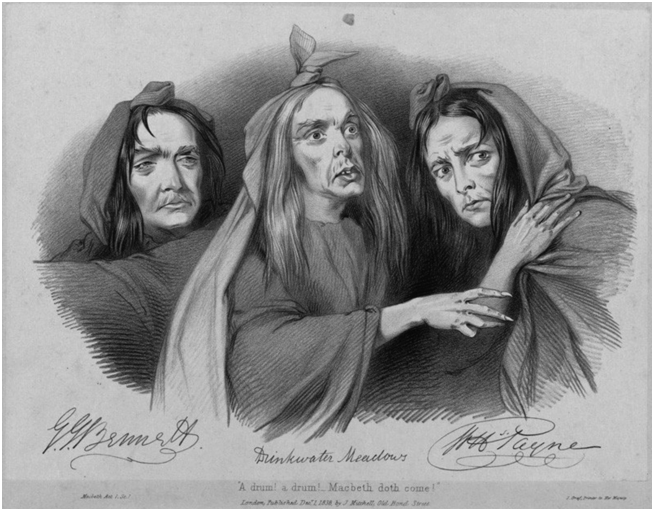
Despite the vaudevillian atmosphere and the fact that Shakespeare’s witches were no longer the source of dread and horror that they had been earlier, the gendered politics of the tragedy persisted in the early eighteenth century. Although the Weird Sisters no longer had the capacity to terrify audiences, the suspicion of female deviancy continued to haunt performances of Macbeth, spilling over into generalized anxieties regarding women’s usurpation of male power. This is evident in Joseph Addison’s reminiscence in The Spectator on Saturday, April 21, 1711, regarding his annoyance several years prior with an attention-seeking fashionable woman and her disruptive commentary at a performance of Macbeth:
Some Years ago, I was at the Tragedy of Mackbeth, and unfortunately a Woman of Quality that is since Dead; who, as I found by the Noise she made, was newly returned from France. A little before the rising of the Curtain, she broke out into a loud Soliloquy. When will the dear Witches enter? and immediately upon their first Appearance, asked a Lady that sate three Boxes from her, on her Right Hand, if those Witches were not charming Creatures. A little after, as Betterton was in one of the finest Speeches of the Play, she shook her Fan at another Lady, who sate as far on her Left Hand, and told her with a Whisper, that might be heard all over the Pit, We must not expect to see Balloon to night. Not long after, calling out to a young Baronet by his Name, who sate three Seats before me, she asked him whether Mackbeth’s Wife was still alive; and before he could give an Answer, fell a talking of the Ghost of Banquo. She had by this time formed a little Audience to her self, and fixed the Attention of all about her. But as I had a mind to hear the Play, I got out of the Sphere of her Impertinence, and planted my self in one of the remotest Corners of the Pit.38
This anecdote concludes an extended disquisition by Addison bemoaning the contagion of vulgar French fashion and manners among British women and their corrosive effects on British society more generally. The cultural invasion of French manners and customs that Addison describes, and its consequences for England, is explicitly gendered and implicitly politicized. After his clarification that it is British manners and not “our Politicks” that are under siege, Addison goes on to “heartily wish that there was an Act of Parliament for Prohibiting the Importation of French Fopperies.”39
In Addison’s description, the aggressiveness of the Woman of Quality’s attempt to form a weird sisterhood of her own by rallying the two women on either side and inviting them to join her in disrupting the performance and upstaging the actors introduces the unnerving possibility of domestic witchcraft: the public performance of political and social deviance engaged in by non-supernatural agents, women of means who exert power and influence within their social circles. As Catherine M. S. Alexander observes, “In addition to the implications of evil influence or spell-binding which survived from Shakespeare, the change supplied by Davenant, and the reputations for comic playing and disguise of the actors, Addison provides political associations, patriotic implications, a commentary on public behaviour, and a sense of duplicity (both in his tale and the implications of its subject-matter).”40 I would add, too, that the contagion of “French fopperies” as described by Addison is spread through wealthy women, theatre-goers who can afford box seats. The fact that the attempt to form an impromptu sisterhood of witches is conducted by a “Woman of Quality,” with influence over her husband and others, blurred the line between the Weird Sisters and Lady Macbeth and associated the words and actions of contemporary women with witchcraft.
Horace Walpole’s The Dear Witches; An Interlude; being a Parody on some Scenes of Mackbeth, written over thirty years later, brings Addison’s Woman of Quality back to the stage, this time not as a casual observer but in the role of Hecate.41 Published anonymously in Old England; or, The Constitutional Journal, on June 18, 1743, Walpole’s satire is a scathing condemnation of the political figures who were responsible for the downfall of his father, Sir Robert Walpole, in the previous year. Under the reigns of George I and II, Sir Robert Walpole had a spectacular political career for over forty years, rising to the offices of First Lord of the Treasury and Chancellor of the Exchequer, effectively becoming the Prime Minister, although that was not the title in use at the time. However, his unpopular decision to declare war on Spain in 1739 contributed to increasing skepticism within his own party regarding his leadership, and he resigned in February 1742.
Walpole’s Dear Witches is an extension of Addison’s exploration of the connections between the political and the female demonic. In his note “To the PRINTER,” Horace Walpole suggests that his parody was written at the behest of the Countess of W[ilmingto]n, who turns out to be Addison’s “Woman of Quality”: “the Countess herself having been the Lady, who is so remarkably taken Notice of there for her Passion for Witches.” The countess has aged, and so too have her cronies. The scenes with the witches were “pitch’d upon” by the “good old Lady,” according to Walpole, “as best suited to the Capacities of some elderly Gentlewomen, whom she had chosen to bear her Company in the Performance.” Like her younger self, Walpole’s Countess of Wilmington collapses the distinction between Lady Macbeth and Hecate: “her late Husband was Sp[ea]k[e]r of the H[ous]e of C[ommo]ns, and in regard to his Memory, my Lady has ever retain’d an Inclination to Politics; I mean to the Politics of those Times, for it is many Years since she has read a Journal or Pamphlet, and does not in the least trouble her Head about what has happened since.”42 Like Lady Macbeth, her status as the wife of the Speaker of the House of Commons situates her as adjacent but not privy to political power. What the Countess has, however, like Lady Macbeth, is influence, and an interest in politics, which Walpole suggests is especially dangerous because of her determined ignorance.
The five scenes featuring the Weird Sisters that Walpole has chosen stages the end of his father’s political career as the triumph of the female demonic. In the first scene, the witches, using their marital status and powers of duplicity, invade the Treasury “in a stormy, troubled Year,” looking for ways to subvert and undermine the stability of the political structure. The witches continue to scheme in the second scene, conspiring together to use “motions” and “precedents” to “make Elections void.” Walpole uses Shakespeare’s allusion to the tradition of men playing the parts of the witches to underscore that his witches are in fact his father’s political opponents, leaving the lines from Shakespeare untouched: “You seem’d to be Women, / And yet your Beards forbid me to interpret that you are so.” The witches hail Macbeth as Privy Counsellor, and as the Earl of Bath, predicting that he and Banquo will both be Treasurer. Walpole’s Macbeth eagerly questions the witches:
Walpole’s reference to Spencer Compton, 1st Earl of Wilmington, who stepped in to serve as Prime Minister after Robert Walpole, as a “Prosperous Gentlewoman” hints that it is his wife, the Countess of Wilmington, who is in charge. This suggestion of the influence of the female demonic on contemporary politics is borne out when the countess appears as Hecate in the fourth scene, chastising the other witches for not including her, “the Mistress of your Charms, / The Lady-President of Harms,” in their use of the supernatural to encourage Macbeth’s political ambitions. The final scene is staged in the Treasury Chamber with the witches tossing ingredients into a “Great Caldron burning” with the chorus: “Double, Double, Toil and Trouble! / Parties burn and Nonsense bubble!” After Macbeth is presented with three visions, the witches “dance round him, turn his Brain, and vanish – He goes off raving.” 43
In Walpole’s satire, his father has replaced the murdered king and those responsible for his political demise are ridiculed as witches, as male actors, and as the aged wives of prominent political figures. In The Spectator, Addison hinted that there was something potentially more ominous going on than the threat of the contamination of “French fopperies.” In Dear Witches, Walpole makes the threat explicit: the men who contributed to his father’s downfall did so through illegitimate means – duping their constituents with a show of magic, explicitly gendered as female and evil, and were possibly encouraged to do so by their wives.
In 1744, one year after Walpole’s Dear Witches was published, David Garrick introduced a production of Macbeth that adhered much more closely to Shakespeare’s original text. However, Garrick did not change Davenant’s portrayal of the Weird Sisters as comic figures. As Edward Tomarken notes, Garrick chose this approach because casting them as evil entities would have distracted audiences from his representation of Macbeth as a sympathetic character, worthy of our pity.44 Garrick’s investment in eliciting sympathy for Macbeth is most evident in Macbeth’s final speech that Garrick added to the play:
In Garrick’s Macbeth, the female demonic is embodied by Lady Macbeth, whose outsized ambition is responsible for Macbeth’s actions and his descent into hell. As Nick Moschovakis points out, “Garrick’s performances introduced a different interpretation of Lady Macbeth’s role. It was now that she began to come into her own, not merely as a negative exemplum for wives – and their husbands – but as an independent and overbearingly ‘evil’ force.”46 As will be discussed in Chapter 1, Garrick’s introduction of Lady Macbeth as the true villain in the tragedy was embodied and literalized by Hannah Pritchard, who played Lady Macbeth opposite Garrick for twenty years, from 1748 to 1768.
As Rebecca Rogers observes, eighteenth-century productions of Macbeth did not reflect the tensions between England and Scotland during the Jacobite uprisings, nor later, when Scottish nationals were appointed to positions of prominence in London after the Seven Years’ War. However, the increasing focus in the mid to late eighteenth century on Lady Macbeth as the embodiment of the female demonic demonstrates the pervasiveness, and ongoing threat, of the gendered dynamic in contrast to the “Scottishness” of the play.47 In his commentary on Shakespeare, Samuel Johnson was clearly influenced by Garrick’s representation of Lady Macbeth as well as Hannah Pritchard’s performance, writing that “Lady Macbeth is merely detested.” Elizabeth Montagu concurred in her Essay on the Writings and Genius of Shakespear (1769) describing Lady Macbeth’s mind as “naturally prone to evil.”48 Although earlier eighteenth-century adaptations of Macbeth downplayed the supernatural elements, Johnson was not as quick to discount the supernatural power of the witches, and its effect on Macbeth and the audience, both in Shakespeare’s time and in his own. In Johnson’s notes on Macbeth in his 1765 edition of Shakespeare, the opening stage direction, “Enter three Witches,” provides him with an opportunity to write at length about the widespread belief in witchcraft during the time Shakespeare wrote Macbeth. Johnson reminds us that the appearance of the witches on stage would have been experienced by the audience as a genuine encounter with the supernatural, exposing the spectators as well as Macbeth to bewitchery. Although most of Johnson’s contemporaries no longer believed in witchcraft, he argued that the residual effect of witchcraft belief continued to inform their response to the play, despite the Restoration and eighteenth-century tendency to downplay the dark magic of the Weird Sisters. The spell may be psychological, but, as Johnson points out, the enchantment is experienced nonetheless: “the goblins of witchcraft still continued to hover in the twilight” long after the belief in witchcraft had subsided.49 As Edward Tomarken argues,
For Johnson, Macbeth is the tragedy of a man who in succumbing to the temptations of sorcery has unknowingly entered a realm where conscience is no longer a guide on the path of virtue. For Elizabethans, this realm is literally that of Hecate: for post-Elizabethans … it is an interior landscape, a psychological witches’ brew made up of superstition and conscience.50
Samuel Johnson’s discussion of the psychological power of enchantment in Macbeth was an important turn in how Macbeth was read and interpreted later in the eighteenth century.
“We Should Rejoice When Good Kings Bleed”: Macbeth, Witchcraft, and the French Revolution
In addition to the historical trajectory of the seventeenth-century witch hunts, literary sources such as Shakespeare’s works provided Romantic-era writers and artists with a template and the language to articulate the threat (or the promise) of the incursions of the female demonic in our world as familial, social and political. Of all the witchcraft “stories passing through time,” Macbeth was the one that the Romantics turned to repeatedly. The themes in Macbeth of regicide and insurrection, female monstrosity, and the role of the female supernatural in shaping human destiny exerted a profound influence on Romantic representations of the figure of the witch.
As Jonathan Bate observes, “If one tragedy were to be singled out for its political importance throughout the period from 1760 to 1830, it would have to be Macbeth.”51 After the American and French Revolutions of 1776 and 1789, the idea of the subversion of political authority and regicide took hold of the British imagination in a way that it hadn’t since the execution of Charles I in 1649. The French Revolution prompted fears of popular insurrection among Britons loyal to the monarchy, and these anxieties surfaced in the theatrical performances staged throughout the country. “In the wake of the Revolution and the English reaction to its excesses,” as Jonathan Mulrooney points out, “the city’s playhouses rehearsed nightly the unsettled relations between lower and upper classes that would haunt the British polity throughout the next century.”52 During the 1790s, Macbeth was performed sixty-nine times, surpassed only by Hamlet, and fifty-six of these performances occurred after the execution of Louis XVI in January 1793, including twenty-nine between 1794 and 1795.53
It was in April 1794 that John Philip Kemble staged a production of Macbeth at Drury Lane that departed dramatically from the earlier versions that cast the Weird Sisters as comic figures. As W.C. Oulton’s History of the Theatres of London (1796) records, Kemble’s witches “no longer wore mittens, plaited caps, laced aprons, red stomachers, ruffs, &c. (which was the dress of those weird Sisters, when Mess. Beard, Champness, &c. represented them with Garrick’s Macbeth) or any human garb, but appeared as preternatural beings.” Oulton continues, noting that it was Kemble’s aim “to strike the eye with a picture of supernatural power” and “to avoid all [the] buffoonery” of the earlier productions.54 In addition, Kemble introduced a new scene at the end of the second act, in which the witches praise Macbeth’s intention to kill the king:
In the 1794 production. Kemble removed the bloody, embodied ghost of Banquo featured in the earlier versions and substituted an invisible one, suggesting that Banquo’s ghost exists solely in Macbeth’s imagination. As Nick Moschovakis notes, “Like Kemble’s treatment of the witches, this innovation seems meant to make something deeply serious – as opposed to playfully theatrical – out of an encounter with the forces that tempt humanity to transgress imposed limits on its knowledge and power.”56 By reinvesting the witches with their powers, Kemble locates the threat of evil as external. Macbeth’s vision of Banquo’s ghost becomes even more disturbing precisely because it is internal: it is either the consequence of enchantment by the Weird Sisters or the product of his own corrupted imagination. After the regicide of Louis XVI, Shakespeare was appropriated by conservative and anti-Jacobin sympathizers, who contrasted the “Englishness” of Shakespeare with French radicalism.
As Addison’s Dear Witches episode reminds us, there was a clear precedent for an oppositional structure with Shakespeare firmly entrenched as emblematic of English taste and culture doing battle against the infiltration of dangerous French manners and ideas. In both instances, the Weird Sisters played an active and symbolic role. In 1794, the same year that Kemble broke with tradition by introducing his regicidal witches, Thomas Ford published a counterrevolutionary parody of the three witches titled: Confusion’s Master-Piece: or, Paine’s Labour’s Lost, Being a Specimen of some well-known Scenes in Shakespeare’s Macbeth. In this brief, ten-page pamphlet, Ford recasts the witches as French citizens: “‘I come, Roberspierre! [sic],’ ‘Danton calls,’ ‘Right is wrong, and wrong is right,’ … ‘Double, double, strife and trouble; /‘Faction, blaze! and treason bubble!’”. . .”57 As David Francis Taylor observes, in the aftermath of the French Revolution, Macbeth’s witches embodied “a particular kind of political agency – an agency at once illegitimate, surreptitious, and emphatically corporate.”58 Although these representations of witchcraft were decidedly anti-French, they also carried a strain of xenophobia that extended to the Scottish, suggesting a desire to cordon off the dangerous influence of Scottish superstition and folk magic – an influence that was explicitly gendered and deeply entwined with anxieties about female power.
Many critics were vociferous in their condemnation of the depiction of the witches as supernatural beings on the Romantic stage. Samuel Taylor Coleridge described it as a “vulgar stage error” to transform “the Weird Sisters into witches with broomsticks.”59 William Hazlitt agreed that “the Witches of Macbeth are indeed ridiculous on the modern stage, and we doubt if the Furies of Aeschylus would be more respected.”60 Charles Lamb concurred: “[A]ttempt to bring these beings on to a stage, and you turn them instantly into so many old women, that men and children are to laugh at. Contrary to the old saying, that ‘seeing is believing,’ the sight actually destroys the faith.”61 Whereas Samuel Johnson argued that contemporary audiences although they no longer believed in witchcraft could substitute other, analogous sources of terror in their viewing of the witches, Coleridge, Hazlitt, and Lamb argued that their physical appearance on stage drained them of the supernatural horror that Shakespeare had imbued them with. No human actor could encompass all that the witches represented, which was much more than witchcraft. As Coleridge notes: “They were awful beings: and blended in themselves the Fates and Furies of the ancients with the sorceresses of Gothic and popular superstition.”62 William Blake made this point as well: “Those who dress [the witches in Macbeth] for the stage … consider them as wretched old women, and not, as Shakespeare, intended, the Goddesses of Destiny.”63 Keeping the witches on the page and off the stage was, in the view of these critics, the only way to preserve their mystery, or what Hazlitt described as their “power over the soul.”64
These comments from Coleridge, Hazlitt, Lamb and Blake, written between 1809 and 1817, suggest a major shift in perspective on the witches: an argument that Shakespeare intended for them to be more than witches and not exclusively evil: goddesses of destiny, fates and furies. The source for these critics’ insistence that they knew Shakespeare’s intention was the 1808 republication of Holinshed’s Chronicles of England, Scotland, and Ireland by Joseph Johnson. This was the historical source that Shakespeare used for “the ten plays dealing with English history and three others, King Lear, Cymbeline, and Macbeth.”65 The Weird Sisters are not described as witches in Holinshed’s Chronicles. When Macbeth and Banquo encounter them, they are described as “thrée women in strange and wild apparell, resembling creatures of elder world.” Similarly, the Chronicles note that “the common opinion was that these women were either the Weird Sisters, that is … .the goddesses of destiny, or else some nymphs or fairies endued with knowledge of prophecy.”66
The understanding of Shakespeare’s witches as something more than evil incarnate, and not easily translated into our moral lexicon, enriches our understanding of the Romantic witch in her many forms. The same is true of the Romantic fascination with the character of Lady Macbeth. Although Hecate and the Weird Sisters in Macbeth embody the disruptive potential of the female demonic, for the Romantics, the paradigmatic performance of female monstrosity was Lady Macbeth’s oft-quoted and notorious appeal to satanic forces:
This summoning of Satan’s “murth-ring ministers,” aligns Lady Macbeth early on with Hecate, and the three Weird Sisters, and the illocutionary force of her invocation severs her – once and for all – from her community, her gender, her religion, and any softer sensibilities the audience might associate with a female character. Lady Macbeth’s incantatory utterance functions as a performative speech act that accomplishes what it sets out to do in the moment it is uttered. With these words Lady Macbeth succeeds in securing what J. L. Austin describes as the “uptake” of her audience: we believe her when she disavows her sex.68 The audience’s collective faith in her sincerity, coupled with her own intent, effectively transforms her into a fourth witch hell-bent on killing the king and bloody revolution.
Lady Macbeth’s summoning of spirits also associates her with witchcraft, while her demand that her breast milk be transformed into poison evokes the trope of monstrous motherhood. The generalized anxieties about contemporary women and their potential for witchlike behavior, as articulated by Addison and Walpole in the early and mid eighteenth century, centered on the incursions of female deviancy as an internal threat within the home – a danger exacerbated by women’s proximity to political power as wives of men in prominent positions of power. This threat was embodied by the character of Lady Macbeth, staged as a domestic witch intent on subverting traditional gendered norms from within the familial structure. This idea of witchcraft practiced at home on unsuspecting, vulnerable, or weak men had a tremendous influence on how the incursions of the female demonic were represented in Romantic literature and art.
Romantic critics engaged deeply with the blurring of the line between witch and woman in the complex and terrifying character of Lady Macbeth. Samuel Taylor Coleridge objected to “the prejudiced idea of Lady Macbeth as a Monster: as a being out of nature and without conscience.” Instead, he argued that her character is far more nuanced – that she is a woman who “bull[ies] conscience,” who “endeavours to stifle its voice, and keep down its struggles.”69 William Hazlitt expanded upon this conception of Lady Macbeth as a monstrous woman, with an emphasis on her womanliness, when he describes Lady Macbeth as “a great bad woman, whom we hate, but whom we fear more than we hate.” He contrasted her “swelling exultation and keen spirit of triumph, this uncontroulable eagerness of anticipation, which seems to dilate her form and take possession of all her faculties” to the “cold, abstracted, gratuitous, servile malignity of the Witches.” As Hazlitt observed, she serves only herself: “her fault seems to have been an excess of that strong principle of self-interest and family aggrandizement, not amenable to the common feelings of compassion and justice.”70 For these commentators and many of their contemporaries, Sarah Siddons in the role of Lady Macbeth was the embodiment of the female supernatural, terrifying and otherworldly. Hazlitt described her performance as “something above nature. It seemed almost as if a being of a superior order had dropped from a higher sphere to awe the world with the majesty of her appearance. Power was seated on her brow, passion emanated from her breast as from a shrine; she was Tragedy personified.”71
At the core of the many contemporary descriptions of Siddons’s performances as Lady Macbeth was a consensus that, when she played the role, she became Lady Macbeth and something more: emanating and projecting supernatural power that was more terrifying because it came from a woman – an extraordinary, gifted woman, but a woman, nonetheless. As Julie A. Carlson notes, “As a character Lady Macbeth thematizes what Siddons as actress always represents: that femininity and power are closely allied.”72 Siddons’s ability to embody the ferocity, ambition and pathos of Lady Macbeth as a woman, and not as a monstrous other, in her performances was a display of witchlike power experienced by her audience as both terrifying and sublime, giving expression to the sense of danger and the vestiges of witchcraft belief that continued to haunt the tragedy, as Samuel Johnson noted earlier in the century.
Siddons’s powers of enchantment and their effect on her audience exemplify how the figure of the Romantic witch opened a space to imagine and to explore the constructive and destructive potentials of female magic. While some Romantic witches confirmed the worst fears surrounding female magic and its pernicious influence, other Romantic witches invited more positive reactions, ranging from fascination to sympathy as well as the deep admiration bordering on awe that Siddons inspired. As the pages that follow will demonstrate, during the French Revolution and its aftermath, many Romantic artists and writers employed the figure of the witch to explore the implications of a new and potentially radically different social order that was not based on unequal power relations, with varying degrees of enthusiasm or horror.
Chapter 1, “Visualizing Witchcraft,” continues the discussion of eighteenth-century representations of Lady Macbeth as a monstrous wife and mother, examining a series of paintings that portray Lady Macbeth as dominating and exerting control over her timid spouse. After the French Revolution, British caricaturists cast Jacobin sympathizers as the witches in Macbeth, while visual artists such as Johan Zoffany, Henry Fuseli, and William Blake invoked the figure of the witch to fuel fears regarding dangerous female sexuality and the horrific consequences of giving women social and political power. Mary Wollstonecraft, who embodied these fears for Fuseli and Blake, along with Germaine de Staël and Sarah Siddons, responded by emphasizing the psychological elements of Macbeth and representing Lady Macbeth as a sympathetic character. Chapter 2, “Gothic Witches,” analyzes Ann Radcliffe’s representation of contemporary female artists and authors like herself and Sarah Siddons as witches or enchantresses in “On the Supernatural in Poetry,” and offers examples of the wide variety of witches in Romantic-period Gothic literature, with sections on mother witches, political witches, marvelous witches, Faustian witches and serpent witches. The Romantic-era Gothic writers discussed include well-known authors such as Radcliffe, Matthew Lewis, Samuel Coleridge, and Charlotte Dacre as well as lesser-known writers (at least to us now) such as Catherine Smith, Mary Julia Young and George Brewer.
Whereas male poets such as Coleridge and Keats used the figure of the witch to explore the relationship between the shapeshifting powers of the female demonic and male creativity, Chapter 3, “Charlotte Smith and Maria Edgeworth: Gender and Black Magic,” reveals how women novelists like Charlotte Smith and Maria Edgeworth remapped contemporary cultural anxieties in Britain about witches and transgressive female energies onto the colonial landscape of Jamaica. Both authors position the female practitioners of Obeah as compelling alternatives to the degradation of women and the enslaved populations in the colonies. Chapter 4, “The Shelleys on History and the Female Demonic,” investigates how Percy and Mary Shelley engaged with the idea of witchcraft. In The Witch of Atlas, Percy Shelley creates an alternative, skeptical myth of origins, playfully posing the question: what if God (or Christ) was a witch with a sense of humor? Like her mother, Mary Wollstonecraft, and other Romantic-era women writers, Mary Shelley was rightfully suspicious of representations of female magic. All her novels reflect on and chronicle how women who have or pretend to possess power, supernatural or otherwise, are inevitably marginalized or written out of the narrative by the men they love, and the collusion of the social and historical contexts in which they find themselves.
Chapters 5 through 7 focus on Walter Scott and on the significant role witches play in his novels and in his broader vision of social progress. The presence of witches in the Waverley novels is suggestive of social and occasionally political disorder, but their presence – like the context of revolutionary crises – also provides Scott’s male characters with opportunies to confront something larger than themselves, a possibly inimical force, and to evolve in this process. Walter Scott, not satisfied with collecting works of demonology, decided to write one himself. Chapter 5, “The Waverley Novels, Demonology, and ‘The Wizard of the North,’” investigates the tensions in Scott’s Letters on Demonology and Witchcraft between his impartiality as a demonologist and a writer of historical fiction, his antiquarian impulse, and the genuine sympathy he has for women accused of witchcraft. Chapter 6, “Guy Mannering: Gender, Magic, and Translation,” tests this sympathy through the introduction of Meg Merrilies, the Roma sibyl and witch, whose rural magic is contrasted with Guy Mannering’s academic magic. Scott’s struggle to maintain authorial control against the incursions of Merrilies’s witchlike powers compels him to consciously assume the more distanced role of an antiquarian collecting stories of female enthusiasm in subsequent novels, offering up prognoses of mental instability for the witches in The Antiquary, The Pirate and Ivanhoe. Chapter 7, “Specimens of Female Enthusiasm and Witchcraft: The Antiquary, Ivanhoe and The Pirate,” introduces an entirely new and different witch figure: Rebecca, a lovely young Jewish healer with leadership potential, whose prospective marriage to Ivanhoe is thwarted by racial prejudice and misogynistic suspicions that brand her as a witch. Romanticism Bewitched concludes with a discussion of Joanna Baillie’s Gothic tragedy Witchcraft, written as a response to what she perceived as a missed opportunity in Scott’s The Bride of Lammermoor to investigate the psychological and social dimensions of the historical phenomenon of witchcraft. Chapter 8, “The Demonization of Domesticity: Scott’s The Bride of Lammermoor and Baillie’s Witchcraft,” explores Baillie’s argument that the decidedly unsympathetic treatment of the female supernatural by Scott and others perpetuates damaging stereotypes and diverts our attention from the real problem – a social structure founded on inequity.
What many Romantic-era artists and authors share is a fascination with the revolutionary potential of women’s anger, real or imagined, as a catalyst for change. In “The Uses of Anger,” Audre Lorde writes that “Anger is a grief of distortions between peers, and its object is change.”73 Expanding upon this idea of anger as grief, Myisha Cherry observes that people who are angry “are grieving that someone has taken something away from them, they are grieving rights, they are grieving dignity.”74 The French Revolution was fueled by anger – the anger of people who believed that their rights were violated by the excesses of the monarchy and the clergy – and the repercussions of that anger reverberated across the Channel, as Britons watched with increasing alarm as the revolution spiraled out of control into the Reign of Terror. The figure of the Romantic witch – angry and antagonistic to patriarchal structures and traditions, or prophesying a better, more equitable future – embodied the hopes, fears and, in some cases, the ambitions of Romantic writers and artists as they tried to anticipate or envision a world not predicated on male authority and privilege, a world in which the status quo no longer applied.