Severe acute respiratory syndrome coronavirus 2 (SARS-CoV-2), the coronavirus disease (COVID-19) virus, became a global pandemic in which there were confirmed active cases of 37 901 241 and death cases of 487 226 as of January 19, 2022 (worldometer). 1 India has already passed through 2 waves (first wave in mid of September 2020, second wave at the beginning of May 2021) of the pandemic, including highly infectious variants of concern such as Lineage B.1.617.2 (Delta variant), losing many lives. Oxygen supply in the hospitals was found to be a major challenge; even industrial oxygen was supplied to meet the crisis. The reason for losing lives may be due to the unpreparedness of the health care system of India for this unprecedented pandemic. Around half a million people died, and cases of black fungus surfacing during the second wave made the situation worse. 2 Extensive efforts like strict social distancing measures; the shutdown of public transportation, educational institutions, and religious centers; declaring micro-containment zone; opening of temporary COVID hospitals in urban and village areas; enhancement of the health care workforce, and financial support to the underprivileged class were made by the government to contain the COVID-19 spread. Reference Biswas3 But, the level of damage that happened was found to be very high and may be due to religious gatherings, political rallies, social gatherings, and socioeconomic status. According to the experts, there were possibilities of a third wave from December to January due to a new variant (omicron). Considering the pandemic situation, it is well understood that proactive preparedness is highly essential to cope with the situation by integrating and expanding the motivation of people and the government through the formation of intentions and culmination in decisions. Reference Paton4
Preparation for an emergency by any government means acting positively to any intimidation arising from the environment in a way that reduces the hazardous effects on the health and safety of its citizens. The accomplishment of emergency preparedness takes place through a process of planning, training, and exercise accompanied by the acquisition of equipment and apparatus to support emergency action. Reference Gillespie and Colignon5 The objective of the study was to evaluate the readiness of the government to cope with the future wave of the pandemic from the Indian public’s perspectives and to find out ways for avoiding a future disaster.
Background of the Study
Realizing the importance of preparedness, the World Health Organization (WHO) introduced planning strategies and courses to help countries create awareness for the prevention and spread of COVID-19. 6,7 Preparedness and planning are essential to respond effectively to outbreaks and epidemics. 8 National rates of COVID-19 infection and fatality have varied dramatically since the onset of the pandemic. Understanding the conditions associated with this cross-country variation is essential for guiding investment and preparedness to cope with a future pandemic. 9
Chaudhary et al. (2022) reported on the preparedness of Indian states and union territories against the COVID-19 pandemic considering 10 parameters related to demographic, socioeconomic, and health care aspects. Opinions of medical experts have been considered to ascertain the relative importance of decision criteria as well as sub-criteria. The state and the central government need to develop region-specific mitigation strategies to combat the COVID-19 pandemic along with the preparedness map.10 Escaping of the infected patients from the hospitals, social stigma of isolation, non-pharmaceutical intervention, limited government health care facilities, major use of unorganized private health care facilities, and limited expenditure on health care facilities by the government have been reported to be the major concerns in containment and combating the COVID-19 pandemic. 11
Another important component to handle an emergency is hazard assessment and risk reduction. Detecting the threats previously faced by the community and applying technology for quick detection of possible future potential threats are the elements of hazard assessment. To cope with natural and technological hazards, incorporation of knowledge of the local environment is very important. Reference Perry and Lindell12 So, this study was undertaken to assess the government’s preparedness to handle the third wave of the pandemic, through a survey among the Indian public of selected states. This study would pave future remedial pathways for better control of health emergencies.
Materials and Methods
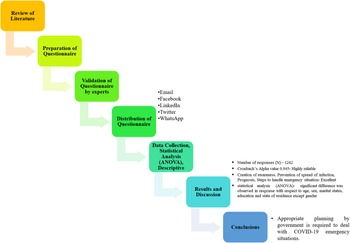
The survey was conducted during August and September 2021. The workflow of the study has been depicted in Figure 1.
Flow chart of study.

Design
An institutional-based cross-sectional prospective survey was carried out. The sample size was calculated by an online sample size calculator named Raosoft. The calculated sample for this study was 1250 with a 5% error margin and a confidence interval of 95%.
Study Population
The survey was conducted among the adult population of India. Prior approval was obtained from the institutional ethics committee, Institute of Pharmacy and Technology, Salipur, India (Reference no 13-06-21) for conducting the study. Furthermore, appropriate guidelines were followed and consent was obtained from the participants.
Exclusion and Inclusion Criteria
The participants above 18 years of age with education above higher secondary school were included in the study. Those below 18 years of age or above 18 years but not willing to participate or responded partially were excluded from the study.
Study Instrument
A questionnaire containing 30 items was prepared based on a literature review. Approval from professionals having expertise in the related field was considered following their suggestions and appropriate modifications. The query form was circulated among 30 participants as a sample to check its reliability and validity. The questionnaire comprised 7 questions on demographic details of the participants, 6 questions related to awareness creation, 6 questions related to steps taken to prevent the spread of infection, 1 question related to prognosis, and 9 questions related to the steps for handling the emergency.
Data Collection
The Google survey query form was distributed through social media platforms like Twitter, LinkedIn, Facebook, WhatsApp, and email to selected persons from different parts of India. The snowball sampling method was adopted for the study. The authors randomly selected contacts above 18 years of age with education above higher secondary school from different parts of India. The survey instrument was first circulated among randomly selected contacts and requested for further circulation among their contacts with a similar background to avoid responder bias.
Data Management
The collected data were saved in an Excel file. The incomplete responses were removed from the study.
Statistical Analysis
All collected data were converted to an SPSS file and statistical analysis (descriptive statistics, ANOVA) was performed using SPSS software. The obtained responses were compared concerning their age, gender, occupation, education, and state of their residence. The frequency and percentage, F-value, and significance for the ANOVA were presented in a table format. The reliability scale was applied to determine the alpha value of the pretested sample.
Results and Discussion
Demography of the Participants
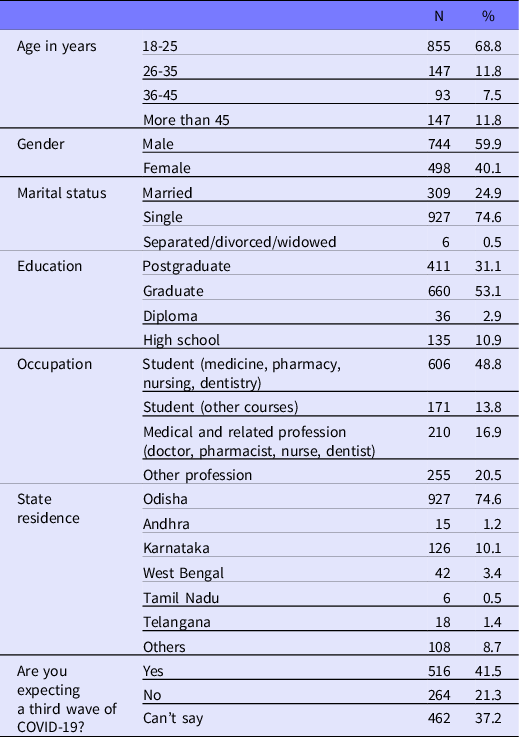
The Cronbach’s alpha value was found to be 0.945, for the study instrument, indicating high reliability. Overall, 1250 participants completed the survey, of which 8 responses were not considered as they were incomplete. There were 744 (59.9%) male and 498 female participants. The majority of the participants were between the age group of 18 and 25 (855 [68.8%]). Most of them were single (927 [74.6%]), and 660 (53.1%) were graduates. Students related to health care courses (606 [48.8%]) were the major participants in the survey. The majority of the participants (927 [74.6%]) were residents of Odisha state; 516 participants expected the third wave of COVID-19 infection. The demographic details are represented in Table 1.
Demographic details of the participants

Steps to Create Awareness
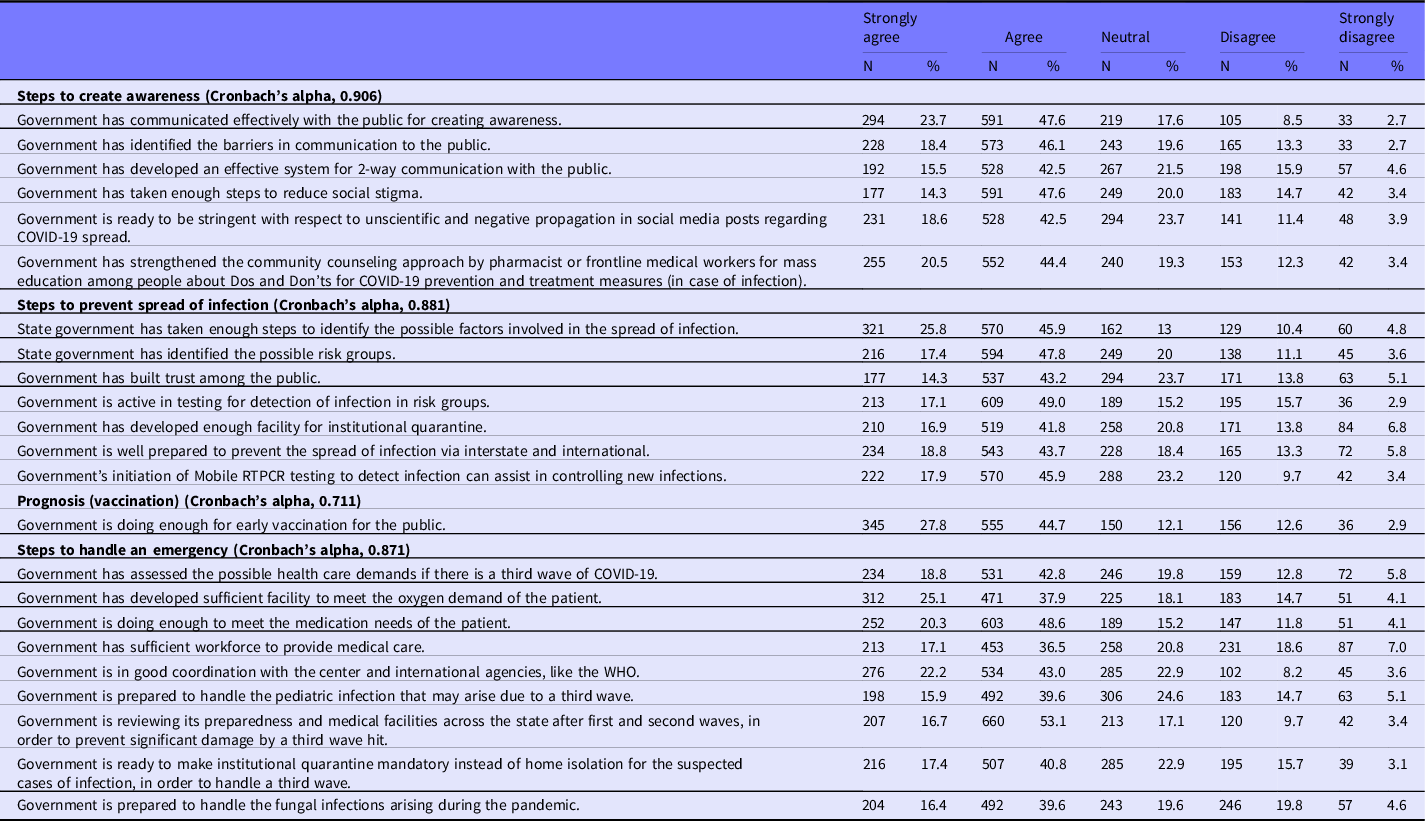
A total of 885 participants strongly agreed or agreed that the government has communicated effectively with the public to create awareness. The majority of the participants (801) either strongly agreed or agreed that the government has identified the barrier in communicating with the public. Around 720 participants felt that the government has developed a 2-way system of communication with the public, whereas 768 participants were of the opinion that the government has taken steps to reduce social stigma. A relatively a good number of participants (759) felt that the government is ready to be stringent concerning unscientific and negative propagation in social media regarding the COVID-19 spread. A total of 807 participants opined that the government has strengthened the community counseling approach with pharmacists or frontline medical workers for mass education (Table 2).
Perception of participants toward the preparedness of the government of a third wave of the COVID-19 pandemic

Steps to Prevent the Spread of Infection
The majority of the participants (ie, 891, 810, 714, 822, 729, 777, 792) either agreed or strongly agreed that the state government has taken enough steps to identify the possible factors involved in the spread of infection and possible risk groups, to build trust among the public, to test for infection in risk groups, to develop enough facility for institutional quarantine, to take steps to prevent the spread of infection via interstate and international migration, and use mobile RTPCR testing to detect infection for controlling new infections (see Table 2).
Prognosis (Vaccination)
Most of the participants (900 [72.5%]) either agreed or strongly agreed that the government has done enough for early vaccination of the public (see Table 2).
Steps to Handle an Emergency
About 61.6% (765) participants either agreed or strongly agreed that the government has assessed the possible health care demands in the case of the third wave of COVID-19; 783 (63%), 855 (68.9%), and 666 (53.6%) agreed or strongly agreed that the government has developed sufficient facilities to meet the oxygen demand, medication needs, and workforce to provide medical care to the patients; 810 (65.2%) and 690 (55.5%) participants agreed or strongly agreed that the state government is in good coordination with the center as well as international agencies like the WHO and is prepared to handle the possible pediatric infection during the third wave; 867 (69.8%) participants either agreed or strongly agreed that the government is reviewing its preparedness and medical facilities across the state after the first and second waves; and 723 (58.2%) participants either agreed or strongly agreed that the government is ready to make mandatory institutional quarantine for suspected cases, whereas 696 (56%) participants agreed or strongly agreed that the government is prepared to handle the fungal infections arising during the pandemic (see Table 2).
Statistical Analysis (ANOVA)
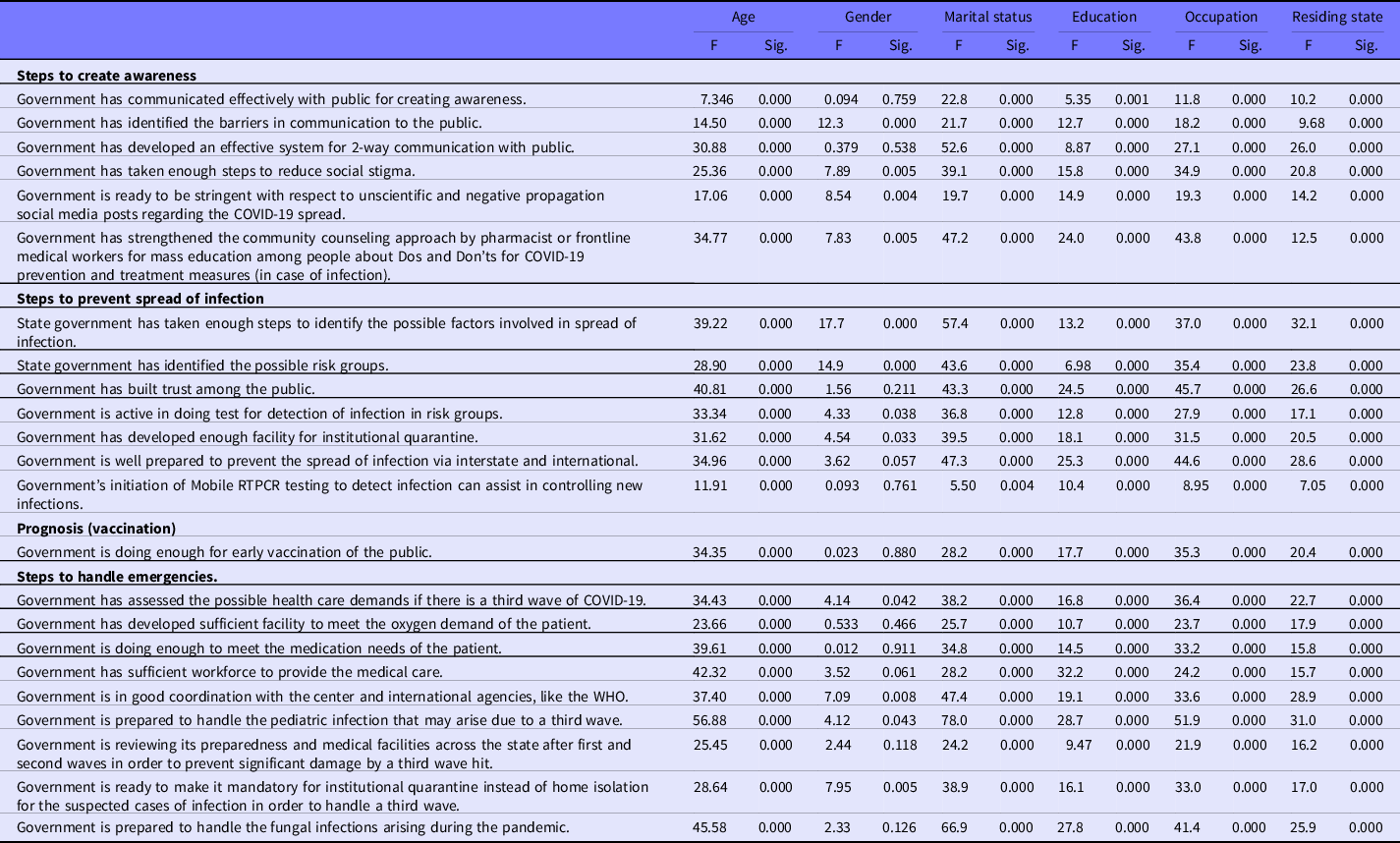
The opinions of the participants were found to be statistically (ANOVA) significant concerning age, marital status, education, and state of residence. However, statistical significance was not seen with respect to gender for concerns like the government has communicated effectively with the public for creating awareness, has developed an effective system for 2-way communication with the public, has assessed the possible health care demands if there is a third wave of COVID-19, has developed sufficient facility to meet the oxygen demand of the patient, has done enough to meet the medication needs of the patient, has sufficient workforce to provide medical care, has built trust among the public, is active in testing for infection in risk groups, is well prepared to prevent the spread of infection via interstate and international migration, has initiated mobile RTPCR testing to detect infection for controlling new infections, has reviewed its preparedness and medical facilities across the state after first and second waves in order to prevent significant damage by third wave, and is prepared to handle the fungal infections arising during the pandemic (Table 3).
ANOVA with respect to age, gender, marital status, education, occupation, and residing state

Discussion
In pandemic preparedness, the government should be the leader in coordination and communication. In our study, we found that most of the participants agree with the effectiveness of identifying barriers in communication by the government, which is similar to the earlier report (Wood et al. and as per the WHO). Reference Hyland-Wood, Gardner, Leask and Ecker13,14 As per the earlier report, social stigma is an important determinant of social justice during COVID-19. In this study, the majority of the participants agreed that the government has taken enough steps to reduce social stigma for which there is no similar earlier report. Reference Bhattacharya, Banerjee and Rao15 The outbreak of misinformation causes mass anxiety and uncertainty—running in parallel to the viral pandemic. Social media have played a significant role in mediating the communication of information about COVID-19, although coverage of social media is often negative. Reference Das and Ahmed16 The participants agree that the government is ready to be stringent concerning unscientific and negative propagation in social media posts regarding the COVID-19 spread; there is no similar earlier report.
The majority of the participants agreed that the government has strengthened the community counseling approach by using pharmacist or frontline medical workers for mass education among people, which agrees with the earlier report of Rony et al. (2021). Reference Zeenny, Dimassi and Sacre17 Also, participants agree that the government has taken enough steps to identify the factors and possible risk groups in the spread of infection, trust building, and early detection as per the recommendation of the WHO 18 ; however, no such previous reports have been found. As per our study findings, participants agree that the government has developed enough facilities for institutional quarantine for controlling the spread of COVID-19, which is in congruence with the earlier report. Reference Sudha, Sujatha and Gopakumar19 The government is well prepared to prevent the spread of infection via interstate and international migration and also initiated mobile RTPCR testing as per our findings, but no such earlier reports could be found. Maximum participants agree that the government is doing enough for early vaccination of the public, which is similar to the earlier report. Reference Panda, Giri, Nagarajappa and Basha20 There are reports matching our findings in terms of government preparedness for the emergency in the third wave of the COVID-19 pandemic such as pediatric infection, workforce requirements, institutional quarantine, and medical facilities. 21,22 It is revealed in our study that participants feel the government is well prepared to handle the fungal infection during the third wave of COVID-19 pandemic, but there is no such earlier report. The WHO plays an important role in terms of providing guidelines to combat the third wave of the pandemic. Our study revealed that participants are of the opinion that the government is in good coordination with international agencies like the WHO, but there is no such previous matching report.
Strengths of the Study
-
Highly reliable study instrument.
-
Sampling from a varying group concerning education, gender, marital status, occupation, and state of residence.
-
Similarity in opinion.
Limitations
Though the sample size is 1242, most of the participants (927 [74.6%]) are from Odisha state and participants were selected from India without any verification of their residence.
Conclusion
The majority of the participants agree that the government has taken enough steps to create awareness of vaccination and for the prevention of the spread of infection. Around a quarter of the participants do not agree about the government’s preparedness to handle the possible emergency of a third wave of COVID-19 pandemic. Considering their opinion, we cannot be fully assured that the government is well prepared to handle the emergency. So, it is high time for the government to plan appropriately to maintain an emergency fund, develop a health infrastructure, reduce social stigma, and prevent the spread of unscientific as well as negative propagation. It is paramount to make the public realize the credibility of WHO information in health emergencies.
Acknowledgments
The authors would like to thank the Deanship of scientific research at Umm Al-Qura University for supporting this work by grant code (22UQU4290565DSR43).