Introduction
Serum lactate measurement has been used to identify critical medical illness and initiate early treatment strategies.Reference Broder and Weil 1 – Reference Rivers, Nguyen and Havstad 3 The blood lactate concentration reflects a balance between production and uptake of lactate in tissues, and is normally between 0.5–1.8 mmol/L. Lactate is formed by reduction of pyruvate, and is metabolized by oxidation to pyruvate in the reaction, catalyzed by the cytosolic nicotinamide adenine dinucleotide (NAD)-dependent lactate dehydrogenase. Overabundance of lactic acid has many causes, including inhibition of lactate dehydrogenase and hindrance of the thiamine dependent pyruvate dehydrogenase enzyme. From a resuscitation standpoint, high lactic acid values as a product of global tissue hypoxia are a primary concern. Excess lactate levels from tissue hypoxia correspond to severity of circulatory failure. In a landmark article, Broder and Weil revealed that an excess lactate value of greater than four millimoles per liter (mmol/L) prognosticates a fatal outcome in multiple shock states.Reference Broder and Weil 1 Shock is defined as inadequate perfusion to meet tissue demand. Blood pressure has been shown to be a poor indicator of shock and tissue hypoxia.Reference Rady, Rivers and Nowak 4 The literature repeatedly presents evidence of normal blood pressure values in critically ill patients and an associated need for further resuscitation.Reference Rady, Rivers and Nowak 4 – Reference Callaway, Shapiro, Donnino, Baker and Rosen 6
The advent of early goal-directed therapy for septic shock has advanced the paradigm shift in the focus on early intervention for critical illness.Reference Rivers, Nguyen and Havstad 3 The original early goal-directed therapy article encouraged moving identification and care forward from the intensive care unit (ICU) to the emergency department (ED). The next logical progression in time-dependent care would extend to the prehospital care environment. The signal for early recognition of critical illness manifested in earlier literature. This is particularly true in the case of trauma publications.Reference Blow, Magliore, Claridge, Butler and Young 7 , Reference Lavery, Livingston, Tortella, Sambol, Slomovitz and Siegel 8
The development of reliable point-of-care lactic acid measurement devices makes prehospital investigation of this marker highly feasible.Reference Shapiro, Fisher and Donnino 9 – Reference Gaieski, Drumheller, Goyal, Fuchs, Shofer and Zogby 11 There is current literature serving as initial forays into the use of lactic acid measurement in the Emergency Medical Services (EMS) setting. Jansen et al, showed, prospectively, that higher prehospital ground lactate values could independently predict hospital mortality.Reference Jansen, van Bommel, Mulder, Rommes, Schieveld and Bakker 12 Guyette showed the mortality predictive value of prehospital lactic acid in the rotorcraft transport of trauma patients.Reference Guyette, Suffoletto, Castillo, Quintero, Callaway and Puyana 13
In the interest of further exploring the use of prehospital lactic acid measurement, the authors sought to further investigate aeromedical applications. This brief report represents a pilot study of prehospital point-of-care lactic acid measurement in medical patients undergoing rotorcraft transport. The investigators hypothesized that point-of-care lactate measurement in the prehospital aeromedical environment would identify medical patients with high mortality as a primary endpoint. The authors secondarily sought to evaluate the ability of prehospital lactic acid to influence fluid, transfusion, and intubation and affect early central venous catheter (CVC) placement.
Methods
This was a prospective, observational study of medical patients undergoing transport by a university-based emergency medical helicopter service. Critically ill, medical, nontrauma patients who were transported from September 2007 through February 2009 by University of Massachusetts Memorial LifeFlight were eligible for enrollment.
This was a pilot study investigating aeromedical lactic acid measurement. No power calculation was performed. The investigators set a study period time and collected available data through the set study duration. Lactic acid values were recorded and reported prospectively. Data pertaining to pre- and post-transport variables and mortality were obtained retrospectively. A waiver of consent was obtained from the University of Massachusetts Institutional Review Board.
All adult, nontrauma, medical patients were eligible for participation. The study was not open to prisoners. Patients specifically transported for acute myocardial infarction were excluded. Patients not transported to the University of Massachusetts were not included for final evaluation due to inability to review records. Pregnant patients and patients with special needs were not excluded. Initial study protocol involved prospective patient selection for lactic acid testing based on an alternate-day schedule. Eligible patients received a fingerstick lactic acid evaluation using the Lactate Plus point-of-care device (Nova Biomedical, Waltham, Massachusetts USA). An unblinded, critical care transport nurse trained in the use of this device performed the test. Testing was initiated as patient condition allowed. A single point-of-care lactic acid value was obtained. The lactic acid value was recorded as part of the patient's record.
When a lactic acid level was obtained, the critical care nurse reported the value to the receiving physician on arrival. The available patients’ records were reviewed retrospectively. Flight records were evaluated for pre- and post-transport interventions including fluid resuscitation, transfusion, intubation, and central venous catheter (CVC) placement. The hospital records were reviewed for demographic data including age and presenting diagnosis. Acuity scores (Apache IV) were calculated with this data as well. All records and charts were reviewed by a limited set of data abstractors trained by the primary investigator (PI) to limit heterogeneity. The PI reviewed all information prior to inclusion into the final database.
The above variables were recorded and analyzed. In regards to data analysis, categorical variables were compared between groups by Fisher's Exact Test, and continuous variables were compared by t-test.
There should be note of a research protocol change: during the study, alternate-day lactic acid collection revealed a disparity in collection. Interim analysis showed only a 38% collection of lactic acid values for eligible patients. The protocol was subsequently modified to permit collection regardless of day of the week. This protocol change was permitted in conjunction with the Institutional Review Board.
Results
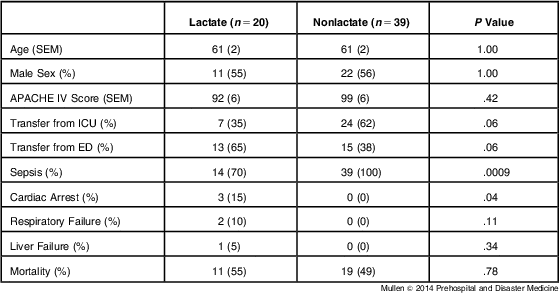
A total of 59 medical patients were enrolled during the study period. Twenty patients received a fingerstick lactate evaluation. Thirty-nine patients were evaluated without the finger stick lactic acid. In regard to demographics, the patients were well matched for age, gender, calculated acuity, and mortality (Table 1). There were differences in transport origin and diagnosis. Sixty-five percent of patients receiving a point-of-care lactate were more likely to be transported initially from an emergency department. Sixty-two percent of patients not receiving a fingerstick lactic acid were transported from an intensive care unit (ICU) environment. These differences approached statistical significance (P = .06).
Demographics

Abbreviations: SEM, standard error of the mean
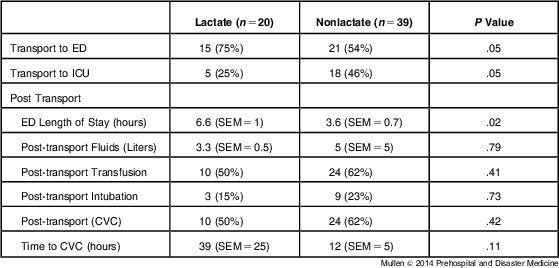
The medical diagnoses differed between the two groups (Table 1). Patients without lactate testing all carried the diagnosis of severe sepsis or septic shock. Patients with a lactic acid evaluation predominantly carried the diagnosis of severe sepsis or septic shock. The lactate group also included diagnoses such as respiratory failure, liver failure, and cardiac arrest. The cardiac arrest cases on review of the records were not determined to originate from coronary pathology. The difference in sepsis diagnoses between the two groups was statistically significant (P = .0009). The patients did differ in regard to post-transport destination. Patients undergoing lactate evaluation were predominantly transported to the ED as opposed to the ICU (Table 2). Differences in post-transport definition were statistically significant (P = .05).
Transport Variables

Abbreviations: CVC, central venous catheter; ED, emergency department; ICU, intensive care unit; SEM, standard error of the mean
The primary endpoint of the study was the ability of an elevated prehospital lactic acid to predict mortality in the aeromedical environment. A lactic acid value = 4 mmol/L was the predetermined evaluation point based on prior literature.Reference Broder and Weil 1 The mean lactic acid value for the patient cohort was 7.04 mmol/L (SEM = 1.2). Thirteen patients had a lactic acid value ≥4 mmol/L. Seven patients had a lactic acid <4 mmol/L. The mortality rate for patients with a lactic acid level ≥4 mmol/L was 62%. The mortality for patients with a lactic acid value<4 mmol/L was 43%. These differences were not statistically significant (P = .64). Calculation of the odds ratio for death did reveal an increased risk for death in the high lactic acid cohort (OR = 2.1; 95% CI, 0.3-13.8).
The mortality associated with lactic acid values was investigated in regards to survivors and nonsurvivors. Survivors had a mean lactic acid level of 5.1 mmol/L (SEM = 1.4). Nonsurvivors had a mean value of 8.6 mmol/L (SEM = 1.9). These values approached statistical significance (P = .16).
Secondary endpoints included investigation of change in post-transport variables with the addition of a lactic acid value. Specific values included post-transport fluid resuscitation, transfusion, intubation, placement of a central venous catheter (CVC) and time to central venous catheter placement (Table 2). Patients without lactic acid level evaluation received more fluids, more transfusions, and had a shorter time to central venous catheter placement. These values were not statistically significant in comparison to the lactic acid group. Time to CVC in the nonlactate cohort did approach statistical significance (P = .11).
Discussion
Elevated lactic acid has been a valuable early-warning sign for deterioration in the critical illness population.Reference Broder and Weil 1 – Reference Rady, Rivers and Nowak 4 , Reference Blow, Magliore, Claridge, Butler and Young 7 The prehospital ground and aeromedical trauma data currently published are promising.Reference Jansen, van Bommel, Mulder, Rommes, Schieveld and Bakker 12 – Reference Van Beest, Mulder, Oetomo, van den Broek, Kuiper and Spronk 14 In the ground prehospital study by van Beest, a lactic acid level >4 mmol/L predicted a statistically higher mortality and length of hospital stay in that patient study group.Reference Van Beest, Mulder, Oetomo, van den Broek, Kuiper and Spronk 14 Jansen showed a prehospital ground lactic acid level >3.5 mmol/L also predicted a higher mortality and provided a better prognostic variable than vital signs.Reference Jansen, van Bommel, Mulder, Rommes, Schieveld and Bakker 12 Guyette revealed the utility of adding prehospital aeromedical lactic acid to trauma variables to improve prediction of mortality, need for surgery, and progression to organ dysfunction.Reference Guyette, Suffoletto, Castillo, Quintero, Callaway and Puyana 13 Such studies provided the impetus to investigate prehospital lactic acid monitoring in the critically-ill medical patient receiving aeromedical transport.
This particular study did not present the same robust results as the above-mentioned manuscripts. The anticipated primary endpoint was not fully accomplished. Patients in the high lactic acid group (≥4 mmol/L) did have a higher reported mortality, but did not have the statistical significance to substantiate the prediction value of this marker. High lactic acid levels do seem to offer an early signal. The odds ratio for death was 2.1 in the high lactate faction, with a wide confidence interval. An additional predictive signal was noted in the analysis of the survivors versus the nonsurvivors in the lactic acid study set. The nonsurvivors did have an elevated lactic acid level that approached significance. This indicates a potential use, as opposed to a more confident mortality marker.
Though promising in this investigation, elevated lactic acid was not as strong a predictor of mortality as it was in other studies. This is likely due to multiple limiting factors. Small sample size plays a significant limiting role. All the other prehospital studies included over 100 patients in their patient sample cohorts; Guyette evaluated over 1000 patients.Reference Guyette, Suffoletto, Castillo, Quintero, Callaway and Puyana 13 With additional patients, it is likely this investigation would have shown statistical significance in regards to mortality. The lactic acid group diagnoses were quite heterogeneous in relation to small sample size. This permits a compounded effect of outlying lactic acid values. Patients receiving lactic acid value analysis were transported predominantly from an ED setting as opposed to an ICU. Patients with lactic acid level analysis were also more likely to be transported to an ED care area. It is possible these patients were encountered in a different phase of illness and in a different phase of resuscitation. Variation of care also may occur more often in the ED environment. This may impact mortality outside lactic acid evaluation. UMass Lifeflight on average has a transport time of <30 minutes in its catchment area. Short transport time may affect mortality as well. In addition, the flight nurses were unblinded to the results and may have adjusted resuscitation and rapidity of transport in response to lactic acid values.
The use of lactic acid in this study did not seem to facilitate post-transport transfusion, intubation or CVC placement, or time to CVC insertion. While not statistically significant, the nonlactic acid cohort received more post-transport intervention on analysis. The flight nurses did inform receiving physicians of the prehospital lactic acid without a change in these secondary evaluated endpoints.
Limitations
There were several limitations affecting these results. The small sample size remains the predominant limitation. Of note, pre-transport interventions did appear to impact the post-transport analysis. There was less post-transport intubation in the lactic acid group as 15 out of 20 (75%) patients were intubated prior to transport. Pre-transport CVC placement also would impact post-transport data evaluation. The post-transport setting likely impacted interventions. Nonlactic acid cohort patients were transported to the ICU setting more often than lactate cohort patients. The controlled ICU area may more readily enact post-transport interventions as opposed to the less-predictable ED arena.
Despite its limitations, this study remains a unique pilot evaluation investigating the use of point-of-care lactic acid values to evaluate medical patients in flight. The study will serve to ignite further interest in this new research prospect.
Conclusion
Prehospital aeromedical point- of- care lactate measurement may help stratify mortality in critically-ill medical patients. This limited study provides an initial signal that high lactic acid levels in aeromedical transport patients may correlate with mortality. Preliminary analysis did not find a significant change in post-transport management. Ongoing inquiry with a larger sample size may further define mortality risk and effect on post-transport care. Early prehospital resuscitation is the “undiscovered country” in critical care. This pilot evaluation opens the door for multiple avenues of investigation.