BACKGROUND
Over the past 25 years, scientific dating has become an integral part of the processes for conservation and repair of historic buildings in England. Precise dating informs decisions about the preservation of buildings, allows us to identify significant fabric, and aids in the specification of appropriate repair strategies. Small differences in a date can lead to great differences in the significance of the extant building, and thus to great differences in the costs of the agreed solution for a particular case.
Outcomes of this sort clearly demonstrate the value of precise dating in informing repair and conservation decisions for historic buildings, and have led to dendrochronology becoming widely applied as part of these processes. In consequence, Historic England (and its predecessor, English Heritage) alone has funded tree-ring dating on more than 1500 buildings over the past 20 years to inform such decisions.
THE PROBLEM
In providing the required precise dating for historic buildings in England, the scientific dating method of choice is dendrochronology. The vast majority of Medieval buildings in England are constructed of oak, which is widely and successfully dated (English Heritage 1998). There are three situations, however, in which tree-ring analysis may fail to produce calendar dating:
-
1) When a building produces oak tree-ring sequences that simply do not match against the available reference chronologies;
-
2) When a building is constructed from a species other than oak; and
-
3) When the timbers in a building contain less than the 50 rings that are normally required for successful dendrochronology.
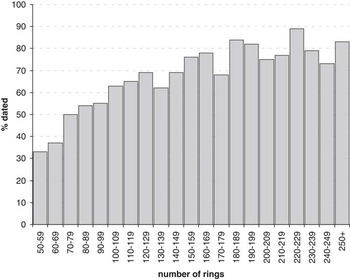
Of these three situations, the length of the available oak tree-ring sequences is by far the most common limitation. It is clear that the probability that an oak sequence will remain undated is inversely related to the number of tree rings in the sequence (Figure 1), and indeed very short series (<45 rings) would usually not be selected for sampling by the dendrochronologist.
The proportion of oak samples dated by dendrochronology in England compared to the number of rings contained in the measured sequence.

It is clearly important to provide precise dating in those cases where tree-ring analysis cannot, and so we would like to be able to turn to 14C wiggle-matching to provide dating of an equivalent level of precision and reliability. We do not, however, generally need to wiggle-match long tree-ring sequences (as these will normally have been successfully dated by dendrochronology), but rather we wish to date those timbers that have relatively few growth rings. But substantial weight, both in conservation terms and in financial terms, can rest on our results, so it is essential that the chronologies produced are both sufficiently precise and sufficiently accurate to reliably direct conservation decisions.
THE DATA SET
A previous study, in which we had successfully wiggle-matched part of a 303-ring pine series dating to AD 1367–1670 from Jermyn Street, London (Tyers et al. Reference Tyers, Sidell, van der Plicht, Marshall, Cook, Bronk Ramsey and Bayliss2009), suggested that AMS laboratories could now provide the level of precision and accuracy required for such applications. We therefore determined to test whether we can provide accurate dating by wiggle-matching short tree-ring series (~30 annual rings) in the Medieval period. It is in this period that scientific dating is most often required, since later buildings more commonly have associated documentary records.
The relevant period is before the set of 14C measurements on single-year tree-ring samples (Stuiver Reference Stuiver1993), which provides such detailed understanding of variations in atmospheric 14C between AD 1510 and 1954. This may be relevant because the placement of short calendar series against the calibration curve is more reliant on the curve accurately reflecting short-term variations in atmospheric 14C than is the wiggle-matching of longer series.
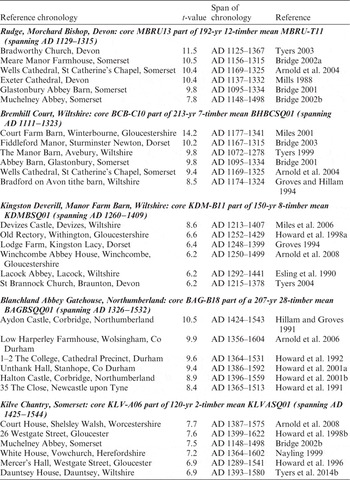
Five oak tree-ring series were selected for sampling to cover the period from which standing buildings commonly survive in England. Evidence for the dendrochronological dating of these sequences is provided in Table 1 (the ring-width data for these series are provided in the referenced reports).
Results of cross-matching with relevant independent site reference chronologies the site sequences containing the timbers sampled for 14C dating.

The earliest is a 132-ring core from Rudge Farmhouse, Morchard Bishop, Devon (50.85°N, 3.78°W), which spans the years AD 1129–1260, as it is included in a 192-yr site master chronology dated to AD 1129–1315 (Groves Reference Groves2005). A core consisting of 89 heartwood rings from Bremhill Court, Wiltshire (51.46°N, 2.03°W) spans the years AD 1220–1308, as it is included in a 213-ring site master chronology that has been dated to AD 1111–1323 (Hurford et al. Reference Hurford, Howard and Tyers2010). A 126-ring core from Manor Farm Barn, Kingston Deverill, Wiltshire (51.13°N, 2.22°W) has been dated to spanning AD 1284–1409, as it forms part of a 150-ring site master chronology dated as spanning AD 1260–1409 (Tyers et al. Reference Tyers, Hurford and Bridge2014a). A 138-ring core from Blanchland Abbey Gatehouse, Northumberland (54.46°N, 2.06°W) spans AD 1395–1532, and is included in a 207-ring site master sequence that has been dated to AD 1326–1532 (Arnold et al. Reference Arnold, Howard and Hurford2009). Finally, a 120-ring core from Kilve Chantry, Somerset (51.19°N, 3.22°W) has been dated as spanning AD 1425–1544, this also being the date range of the two-timber mean site chronology of which it forms part (Arnold et al. Reference Arnold, Howard, Outram, Cook and Bronk Ramsey2015)
14C measurements were made on a total of 86 single-year tree-ring samples from these cores in 2011–2013. The 43 dated at the Scottish Universities Environmental Research Centre were prepared to α-cellulose using Method F outlined in Hoper et al. (Reference Hoper, McCormac, Hogg, Higham and Head1998), combusted to carbon dioxide (Vandeputte et al. Reference Vandeputte, Moens and Dams1996), graphitized (Slota et al. Reference Slota, Jull, Linick and Toolin1987), and dated by AMS (Freeman et al. Reference Freeman, Cook, Dougans, Naysmith, Wilcken and Xu2010). The 43 samples dated at the Oxford Radiocarbon Accelerator Unit were processed using an acid-alkali-acid (AAA) pretreatment followed by bleaching with sodium chlorite as described by Brock et al. [Reference Brock, Higham, Ditchfield and Bronk Ramsey2010: Table 1 (UW)], graphitized (Dee and Bronk Ramsey Reference Dee and Bronk Ramsey2000), and measured by AMS (Bronk Ramsey et al. Reference Bronk Ramsey, Higham and Leach2004). All δ13C values, relative to VPDB, were obtained by IRMS from the gas combusted for graphitization.
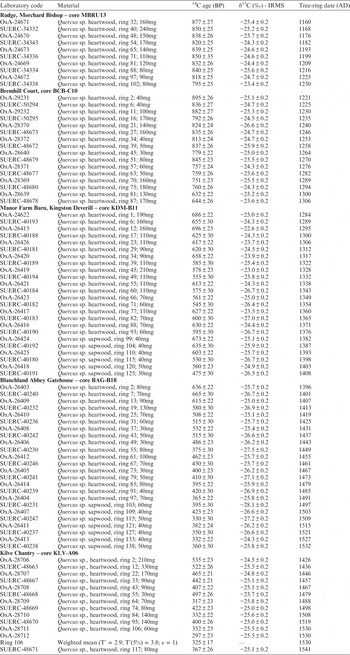
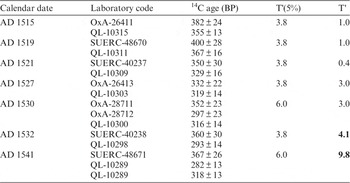
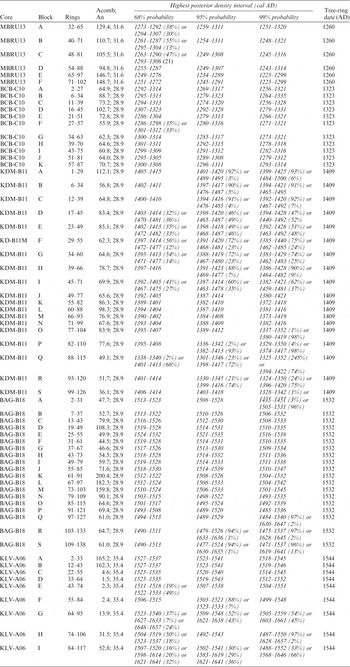
The conventional 14C ages reported for these samples, along with the rings dated from each core, are listed in Table 2. The quoted errors are each laboratory’s estimates of the total error in their dating systems. Eight pairs of replicate measurements are available on rings dated to the same calendar year (Table 3). Five pairs of 14C ages are statistically consistent at 95% confidence, one pair is inconsistent at 95% confidence but consistent at 99% confidence, and two pairs are inconsistent at more than 99% confidence [Ward and Wilson Reference Ward and Wilson1978; T’(5%)=3.8, ν=1 for all]. The results are therefore more scattered than would be expected on statistical grounds. The quoted δ13C values are even more dispersed, with only three pairs being statistically consistent at 95% confidence, and the other six being inconsistent at more than 99% confidence [Ward and Wilson Reference Ward and Wilson1978; T’(5%)=3.8, ν=1 for all]. These results cannot be regarded as satisfactorily reproducible.
Details of sampled tree rings and 14C results.

Statistical consistency of 14C ages and δ13C measurements on rings of the same calendar date (Ward and Wilson Reference Ward and Wilson1978; T'(5%)=3.8; ν=1); values in bold indicate that the relevant replicate pair are statistically inconsistent at 95% confidence.

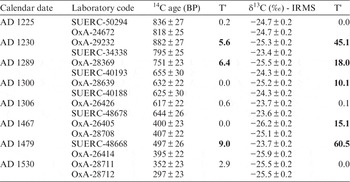
Five pairs of replicate and two pairs of triplicate measurements are also available on rings dated by AMS (this study) and gas proportional counting (Stuiver Reference Stuiver1993) to the same calendar year (Table 4). Of these seven sets of 14C ages, five are consistent at 95% confidence, one set is inconsistent at 95% confidence but consistent at 99% confidence, and one set (AD 1541) is inconsistent at more than 99% confidence. These results are again more scattered than would be expected on statistical grounds.
Statistical consistency (Ward and Wilson Reference Ward and Wilson1978) of 14C ages (this study and Stuiver Reference Stuiver1993) on rings of the same calendar date; values in bold indicate that the relevant measurements are statistically inconsistent at 95% confidence.

WIGGLE-MATCHING THE ENTIRE SEQUENCES
The first step in the analysis of this data is to wiggle-match the 14C measurements from each core, combining the 14C dates with the calendar interval between the dated tree rings known from dendrochronology. This was undertaken using the Bayesian approach to wiggle-matching first described by Christen and Litton (Reference Christen and Litton1995), implemented using OxCal v 4.2 (Bronk Ramsey Reference Bronk Ramsey2009) and the IntCal13 atmospheric calibration data for the Northern Hemisphere (Reimer et al. Reference Reimer, Bard, Bayliss, Beck, Blackwell, Bronk Ramsey, Buck, Cheng, Edwards, Friedrich, Grootes, Guilderson, Haflidason, Hajdas, Hatté, Heaton, Hoffmann, Hogg, Hughen, Kaiser, Kromer, Manning, Niu, Reimer, Richards, Scott, Southon, Staff, Turney and van der Plicht2013).
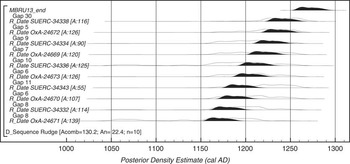
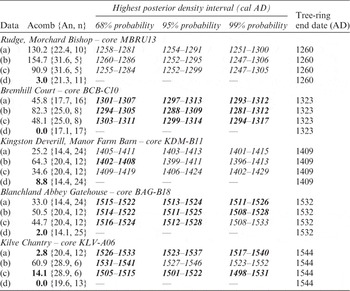
Figure 2 shows the model for core MBRU13 from Rudge Farmhouse. This has good overall agreement (Acomb=130.2, An=22.4, n=10; Bronk Ramsey et al. Reference Bronk Ramsey, van der Plicht and Weninger2001), and estimates the final ring of the sequence to have been formed in cal AD 1254–1291 (95% probability; MBRU13_end; Figure 2). This is compatible with the date of AD 1260 produced for this ring by dendrochronology (Table 5).
Probability distributions of dates from MBRU13. Each distribution represents the relative probability that an event occurs at a particular time. For each of the dates two distributions have been plotted: one in outline, which is the result of simple 14C calibration, and a solid one, based on the wiggle-match sequence. Distributions other than those relating to particular samples, correspond to aspects of the model. For example, the distribution MBRU13_end is the estimated date of the final ring of this core. The large square brackets down the left-hand side of the diagram along with the CQL2 keywords (Bronk Ramsey Reference Bronk Ramsey2009) define the model exactly.

Summary of wiggle-matching the five timbers sampled for 14C dating, (a) 14C measurements, (b) OxA- only, (c) SUERC-only, (d) 14C measurement with known tree-ring end date of sequence. Acomb values in bold - overall model has poor agreement. HPD intervals in bold are incompatible with the tree-ring analysis.

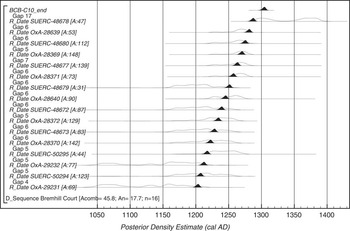
Figure 3 shows the model for core BCB-C10 from Bremhill Court. This also has good overall agreement (Acomb=45.8, An=17.7, n=16), and estimates the final ring of the sequence to have been formed in cal AD 1297–1310 (95% probability; BCB-C10_end; Figure 3). This is not compatible with the date of AD 1323 produced for this ring by dendrochronology (Table 5). The highest posterior density (HPD) interval for this distribution at 99% probability is cal AD 1293–1312, which is similarly incompatible with the tree-ring analysis.
Probability distributions of dates from BCB-C10. The format is identical to that of Figure 2. The large square brackets down the left-hand side of the diagram along with the CQL2 keywords define the model exactly.

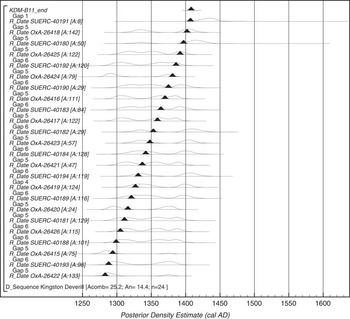
Figure 4 shows the model for core KDM-B11 from Kingston Deverill. This also has good overall agreement (Acomb=25.2, An=14.4, n=24), and estimates the final ring of the sequence to have been formed in cal AD 1403–1413 (95% probability; KDM-B11_end; Figure 4). This is compatible with the date of AD 1409 produced for this ring by dendrochronology (Table 5).
Probability distributions of dates from KDM-B11. The format is identical to that of Figure 2. The large square brackets down the left-hand side of the diagram along with the CQL2 keywords define the model exactly.

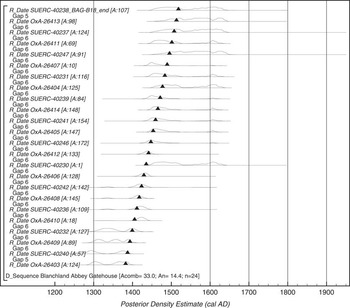
Figure 5 shows the model for core BAG-B18 from Blanchland Abbey. Again, this model has good overall agreement (Acomb=33.0; An=14.4; n=24). It estimates that the final ring was laid down in cal AD 1513–1524 (95% probability; SUERC-40238_BAG-B18_end; Figure 5). This is not compatible with the date of AD 1532 produced for this ring by dendrochronology (Table 5). The HPD interval for this distribution at 99% probability is cal AD 1511–1526, which is similarly incompatible with the tree-ring analysis.
Probability distributions of dates from BAG-B18. The format is identical to that of Figure 2. In this case, the final ring of the core has a 14C date and so SUERC-40238_BAG-B18_end is the estimated date for the end of the sequence. The large square brackets down the left-hand side of the diagram along with the CQL2 keywords define the model exactly.

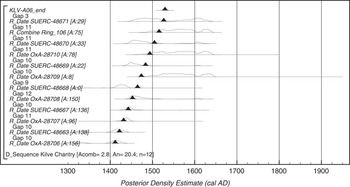
Figure 6 shows the model for core KLV-A06 from Kilve Chantry. This model has poor overall agreement (Acomb=2.8, An=20.4, n=12), with two samples having particularly poor individual indices of agreement [OxA-28709 (A:8) and SUERC-48668 (A:0)]. This model estimates that the final ring was laid down in cal AD 1523–1537 (95% probability; KLV-A06_end; Figure 6). This is not compatible with the date of AD 1544 produced for this ring by dendrochronology (Table 5). The HPD interval for this distribution at 99% probability is cal AD 1517–1540, which is similarly incompatible with the tree-ring analysis.
Probability distributions of dates from KLV-A06. The format is identical to that of Figure 2. The large square brackets down the left-hand side of the diagram along with the CQL2 keywords define the model exactly.

Wiggle-matching of the 14C results quoted by each laboratory separately was then undertaken on the five timbers. Again, the HPD intervals at 95% probability were incompatible with the respective tree-ring dates for the Bremhill Court and Blanchland Abbey Gatehouse cores, and compatible with the respective tree-ring dates for the Rudge and Kingston Deverill cores (Table 5). The HPD interval at 95% probability for the wiggle-match for the core from Kilve Chantry using measurements produced at Oxford included the date for this ring produced by dendrochronology; the wiggle-match for this timber using measurements produced at East Kilbride did not (Table 5).
The indices of agreement provided by OxCal for wiggle-matching (Bronk Ramsey et al. Reference Bronk Ramsey, van der Plicht and Weninger2001: 384) do not indicate that these models are problematic. Of the 15 models so far described, only two [Kilve Chantry (a) and (c)] have poor overall agreement, although seven producedate ranges that are incompatible with the tree-ring dating at more than 99% probability (Table 5). When the tree-ring date for the final ring of each core is input into the model, using the C_Date function of OxCal, then all five cores produce models with poor overall agreement (even the two cores whose 14C dates are otherwise compatible with the dendrochronology).
WIGGLE-MATCHING PARTIAL SEQUENCES
Given that the length of the available oak tree-ring sequence is the usual limitation on successful dendrochronology in historic buildings from England, we ran a series of short wiggle-matches on sequences, between 25 and 35 rings in length, from each core. These models would determine whether accurate results could be obtained by wiggle-matching such short sequences, and also help to identify whether there was any part of the period covered by the dated cores where inaccurate model outputs were more common.
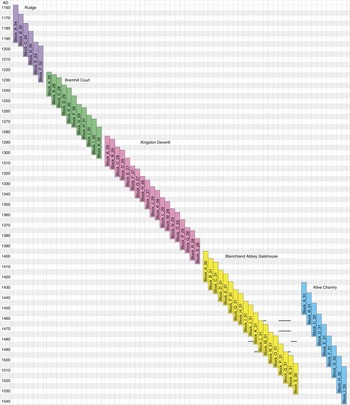
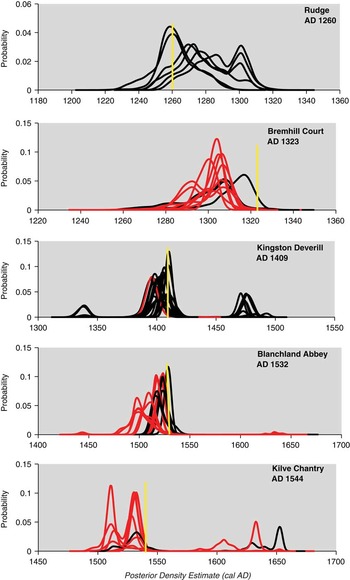
Each core was divided into sequential blocks of approximately 30 yr, for which five or six 14C ages were available (Table 2; Figure 7). The results from each block were incorporated into a wiggle-match model that estimated the date of the final ring of the complete core. These estimates could then be compared with the known date for the final ring as derived from dendrochronology to determine the accuracy of the short wiggle-matches. The results of the 64 wiggle-matches on “blocks” of 25–35 rings are given in Table 5 and summarized in Figure 8. The HPD interval at 95% probability was compatible with the tree-ring date for the final ring of the relevant core in just over half of models (51.6%). All six short sequences from Rudge and 18 of the 19 short sequences from Kington Deverill produced estimates at 95% probability compatible with the known date of the last ring of their tree-ring sequences. Wiggle-matching short sequences from the other three sites—Bremhill Court, Blanchland Abbey, and Kilve Chantry—produced HPD intervals at 95% probability that are incompatible with the tree-ring dates for the final ring of those cores in the majority of cases (76.9%).

Posterior density estimates for the final ring of each sampled core, derived from the short wiggle-matches based on sequences of 25–35 tree rings (Figure 7). Distributions where the HPD interval at 95% probability includes the tree-ring date for this ring are shown in black, and those where it does not in red (Table 6). See online version of the article for color figures.

THE LONGEST WIGGLE-MATCH (AD 1160–1544)
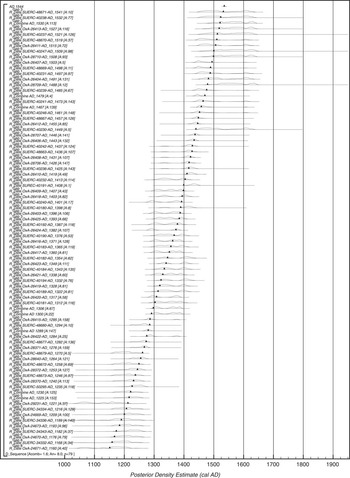
A wiggle-match comprising 14C measurements on 79 dated rings from all five sites is shown in Figure 9. This model has poor overall agreement (Acomb: 1.6; An: 8.0; n=79). The HPD interval for the final ring is cal AD 1532–1537 (95% probability; AD 1544; Figure 9), or cal AD 1531–1539 (99% probability). Neither interval includes the date obtained for this ring by dendrochronology of AD 1544.
Probability distributions of dates from the five-core combined English tree-ring sequence (AD 1160–1544). The format is identical to that of Figure 2. The large square brackets down the left-hand side of the diagram along with the CQL2 keywords define the model exactly.

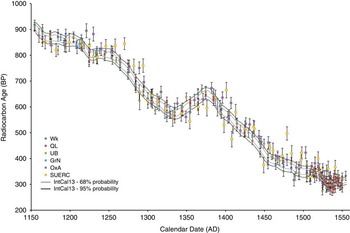
Figure 10 shows the 14C ages obtained on single known-age tree rings as part of this study in comparison to the 14C ages covering this period included in IntCal13 (Reimer et al. Reference Reimer, Bard, Bayliss, Beck, Blackwell, Bronk Ramsey, Buck, Cheng, Edwards, Friedrich, Grootes, Guilderson, Haflidason, Hajdas, Hatté, Heaton, Hoffmann, Hogg, Hughen, Kaiser, Kromer, Manning, Niu, Reimer, Richards, Scott, Southon, Staff, Turney and van der Plicht2013). These are on decadal samples (Wk; Hogg et al. Reference Hogg, McCormac, Higham, Reimer, Baillie and Palmer2002), single-year and decadal samples (QL; Stuiver et al. Reference Stuiver, Reimer and Braziunas1998), decadal and bidecadal samples (UB; Hogg et al. Reference Hogg, McCormac, Higham, Reimer, Baillie and Palmer2002; Pearson et al. Reference Pearson, Pilcher, Baillie, Corbett and Qua1986), and decadal and 23-yr and 24-yr samples (van der Plicht et al. Reference van der Plicht, Jansma and Kars1995).
Radiocarbon ages from known age tree-ring rings AD 1150–1550: single years (OxA, SUERC; this study), decadal samples (Wk; Hogg et al. Reference Hogg, McCormac, Higham, Reimer, Baillie and Palmer2002), single-year and decadal samples (QL; Stuiver et al. Reference Stuiver, Reimer and Braziunas1998), decadal and bidecadal samples (UB; Hogg et al. Reference Hogg, McCormac, Higham, Reimer, Baillie and Palmer2002; Pearson et al. Reference Pearson, Pilcher, Baillie, Corbett and Qua1986), decadal and 23-yr and 24-yr samples (GrN: van der Plicht et al. Reference van der Plicht, Jansma and Kars1995).

There are no clear systematic offsets. The short wiggle-matches might suggest that accurate dating is particularly difficult in the decades around AD 1300 and in the decades around AD 1500 (Figure 8). All 14C data around AD 1300 are, however, tightly grouped. There is more variation around AD 1500, but no more so than, for example, around AD 1400 (where the Kingston Deverill wiggle-matches produce consistently accurate outputs).
CONCLUSIONS
The difficulty in accurately wiggle-matching the short, 25–35-yr, tree-ring sequences that were the objective of this research is not entirely surprising, given the reliance of this approach on a detailed understanding of the structure of the 14C calibration curve (which is currently mostly based on measurements on decadal wood samples). In fact, just under half (47.7%) of the short wiggle-matches produced date ranges at 95% probability, which did not include the age of the final tree-ring determined by dendrochronology (Table 6; Figure 8).

Given the good accuracy produced in previous studies on post-Medieval buildings (Tyers et al. Reference Tyers, Sidell, van der Plicht, Marshall, Cook, Bronk Ramsey and Bayliss2009; Bayliss et al. Reference Bayliss, Bronk Ramsey, Cook, Freeman, Hamilton, van der Plicht and Tyers2014), the inaccurate results produced by three of the five long wiggle-matches undertaken as part of this study was unexpected (Table 5; Figures 3, 5, 6). It is therefore clear from this study that AMS 14C wiggle-matching in the Medieval period cannot be relied upon to produce dating that is accurate to within the precision quoted.
While the causes of the difficulties in accurate wiggle-matching in this period are explored further, we would urge caution to those wishing to use this technique on similar material (cf. Nakao et al. Reference Nakao, Sakamoto and Imamura2014), particularly if the results will inform the long-term preservation and conservation of the structures involved.
ACKNOWLEDGMENTS
We would like to thank Alison Arnold, Robert Howard, Matthew Hurford, and Martin Bridge for undertaking the tree-ring dating of the buildings on which this study is based, and the staff of the Oxford Radiocarbon Accelerator Unit and Scottish Universities Environmental Research Centre for undertaking the 14C measurements.