Introduction
Psychotic relapse can have substantial and potentially irreversible consequences (Lieberman, Reference Lieberman1996). Identifying the early signs of relapse could be clinically beneficial, but the predictive value of such signs remains unclear. Although 80% of symptomatic exacerbations are preceded by prodromal symptoms at least 2 weeks prior to relapse (Gaebel & Riesbeck, Reference Gaebel and Riesbeck2014), studies suggest that prodromal symptoms do not occur in some patients (Gaebel et al. Reference Gaebel, Frick, Köpcke, Linden, Müller, Müller-Spahn, Pietzcker and Tegeler1993; Marder et al. Reference Marder, Wirshing, Van Putten, Mintz, McKenzie, Johnston-Cronk, Lebell and Liberman1994). Previous studies broadly classified these signs as psychotic (hearing voices) or non-psychotic (decreased appetite, sleep problems) (Birchwood et al. Reference Birchwood, Smith, Macmillan, Hogg, Prasad, Harvey and Bering1989). Retrospective data showed a stressful life event occurring 2 to 3 weeks prior to relapse was a predictor for episodes of schizophrenia (Birley & Brown, Reference Birley and Brown1970; Day et al. Reference Day, Nielsen, Korten, Ernberg, Dube, Gebhart, Jablensky, Leon, Marsella, Olatawura, Sartorius, Stromgren, Takahashi, Wig and Wynne1987). However, retrospective data collection may be susceptible to recall bias. Furthermore, an impending relapse could also cause stressful life events.
Cognitive deterioration occurring before the onset of psychosis, which may progress in the earliest phases of the illness (Kahn & Keefe, Reference Kahn and Keefe2013), is a strong, cross-sectional predictor for functional outcome. Despite its importance, no study has investigated the longitudinal changes in cognition prior to relapse in first-episode psychosis, and only a handful of studies have examined cognitive function at baseline as a predictor for relapse (Alvarez-Jimenez et al. Reference Alvarez-Jimenez, Priede, Hetrick, Bendall, Killackey, Parker, McGorry and Gleeson2012). Cognitive functions at baseline predictive of relapse include memory function (Verdoux et al. Reference Verdoux, Lengronne, Liraud, Gonzales, Assens, Abalan and van Os2000), delayed visual reproduction (Verdoux et al. Reference Verdoux, Lengronne, Liraud, Gonzales, Assens, Abalan and van Os2000), Wisconsin Card Sorting Test perseverative errors (Chen et al. Reference Chen, Hui, Dunn, Miao, Yeung, Wong, Chan and Tang2005), Trail Making Test-B (Wölwer et al. Reference Wölwer, Brinkmeyer, Riesbeck, Freimüller, Klimke, Wagner, Möller, Klingberg and Gaebel2008), working memory (WM) and verbal learning (Rund et al. Reference Rund, Melle, Friis, Johannessen, Larsen, Midbøe, Opjordsmoen, Simonsen, Vaglum and McGlashan2007). In addition, evidence from the Edinburgh High Risk Study confirmed that intelligence quotient and verbal memory deteriorated (over 18 months) before the onset of psychosis in subjects at high risk for psychosis compared with controls (Cosway et al. Reference Cosway, Byrne, Clafferty, Hodges, Grant, Abukmeil, Lawrie, Miller and Johnstone2000), indicating that cognitive deterioration may be predictive of the progression to psychosis. The longitudinal investigation of cognitive function prior to relapse will therefore provide a unique opportunity to examine novel markers that could be useful as predictors of relapse.
Impairment in WM has been proposed to be a core deficit in schizophrenia linked to prefrontal cortical dysfunction (Manoach, Reference Manoach2003; Silver et al. Reference Silver, Feldman, Bilker and Gur2003). Collateral evidence from studies on prodromal subjects indicated that WM deficits were reliable risk markers for psychosis (Frommann et al. Reference Frommann, Pukrop, Brinkmeyer, Bechdolf, Ruhrmann, Berning, Decker, Riedel, Möller, Wölwer, Gaebel, Klosterkötter, Maier and Wagner2011; Fusar-Poli et al. Reference Fusar-Poli, Deste, Smieskova, Barlati, Yung, Howes, Stieglitz, Vita, McGuire and Borgwardt2012). As verbal WM and visuospatial WM both have distinct and shared features (Della Sala et al. Reference Della Sala, Gray, Baddeley, Allamano and Wilson1999), investigating these cognitive functions as putative predictors of relapse could be informative. Elucidating the nature of WM deficits would further our understanding of the underlying neuropsychological mechanisms of relapse.
In the current study, we investigated WM deterioration as an early brain dysfunction prior to relapse as part of a randomized controlled trial (RCT) on medication discontinuation and relapse in remitted first-episode psychosis (Chen et al. Reference Chen, Hui, Lam, Chiu, Law, Chung, Tso, Pang, Chan, Wong, Mo, Chan, Yao, Hung and Honer2010). Chen et al. (Reference Chen, Hui, Lam, Chiu, Law, Chung, Tso, Pang, Chan, Wong, Mo, Chan, Yao, Hung and Honer2010) found a two-fold reduction in the relapse rate in patients who continued medication. The prospective monthly measurements of WM and monitoring of relapse in this RCT provided a unique opportunity to explore predictors of relapse in first-episode psychosis. We hypothesize that relapse is associated with prior WM deterioration, stressful life events and medication discontinuation.
Method
Study design and setting
The parent RCT of this study was a 12-month double-blind, randomized, placebo-controlled trial comparing relapse rates between medication maintenance and discontinuation in 178 remitted first-episode psychosis patients (ClinicalTrials.gov; identifier: NCT00334035) (Chen et al. Reference Chen, Hui, Lam, Chiu, Law, Chung, Tso, Pang, Chan, Wong, Mo, Chan, Yao, Hung and Honer2010). Participants were recruited from an early intervention service for first-episode psychosis in Hong Kong. After written informed consent was obtained, participants were randomly assigned to the medication discontinuation (placebo) group and medication continuation (quetiapine) group. Raters who performed the monthly symptoms assessments (psychiatrists) and cognitive assessments (research assistants) were blind to the group assignment. The study was approved by the relevant institutional review boards and conformed to Good Clinical Practice Guidelines and the Declaration of Helsinki.
Participants
Inclusion criteria were: (1) 18 to 65 years of age; (2) a diagnosis of schizophrenia or non-affective psychosis (schizophreniform disorder, schizo-affective disorder, brief psychotic disorder or psychosis not otherwise specified) according to the fourth edition of the Diagnostic and Statistical Manual for Mental Disorders (DSM-IV) (American Psychiatric Association, 1994) and confirmed by experienced psychiatrists according to the Chinese version of the Structured Clinical Interview for DSM-IV (So et al. Reference So, Kam, Leung, Chung, Liu and Fong2003); (3) good antipsychotic medication adherence for at least 1 year; (4) no previous relapse or symptom exacerbation; and (5) fully remitted (non-psychotic) at baseline. Exclusion criteria were: (1) a diagnosis of drug-induced psychosis; (2) concurrent treatment with clozapine, mood-stabilizing medications or depot medication; (3) at risk of violence or suicide; or (4) a history of significant alcohol or substance abuse.
Patients who relapsed (n = 23) in the first 2 months after randomization (during transition from baseline medication to quetiapine or placebo), dropouts (n = 46), or those with missing WM data (n = 7) in the first 2 months were excluded to ensure that changes in cognitive function could be meaningfully explored. A total of 102 participants were included in the current analysis.
Participant demographics and clinical information
Demographic information including age, gender, years of education, type and duration of previous antipsychotic treatment prior to study entry, and social and occupational functioning as measured by the Social and Occupational Functioning Assessment Scale (SOFAS) (American Psychiatric Association, 1994) was recorded at baseline. The Interview for the Retrospective Assessment of the Onset of Schizophrenia (Häfner et al. Reference Häfner, Riecher-Rössler, Hambrecht, Maurer, Meissner, Schmidtke, Fätkenheuer, Löffler and van der Heiden1992), a standardized semi-structured interview for identifying onset information, was used to assess the age of first illness onset and duration of untreated psychosis (DUP). DUP was defined as the period in days from the first appearance of psychotic symptoms to the receipt of antipsychotic treatment. To minimize recall bias, DUP was determined based on collateral information from face-to-face interviews with patients and their close relatives and from the case notes.
Main outcome: relapse
Relapse was prospectively assessed monthly for 1 year by psychiatrists. Relapse was defined as the re-emergence of definite positive symptoms (Vaughn et al. Reference Vaughn, Snyder, Jones, Freeman and Falloon1984) as a score above the threshold in one of five key psychotic symptoms on the Positive and Negative Syndrome Scale (PANSS) (Kay et al. Reference Kay, Fiszbein and Opler1987) (⩾3 for delusions, ⩾4 for conceptual disorganization, ⩾3 for hallucinations, ⩾5 for suspiciousness, or ⩾4 for unusual thought content), a score of 3 (mildly) or above on the Clinical Global Impressions (CGI) scale (Guy, Reference Guy and Guy1976) severity of illness subscale, and a score of 5 (minimally worse) or above on the CGI improvement subscale. The CGI scale is an instrument that can quickly quantify the patient's current illness state (illness severity subscale) and determine a change in the patient's condition, whether improved or worsened, compared with his/her previous condition since the last assessment (improvement subscale); both are scored on seven-point scales (1 = normal/very much improved to 7 = extremely ill/very much worse, respectively). The inter-rater reliability for each of the five PANSS positive symptoms for defining relapse was assessed by nine psychiatrists using an independent sample of 20 patients. In each item, a weighted κ was calculated between two raters, and then all raters’ comparisons were averaged to generate the weighted κ for a specific item: 0.81 for delusions, 0.78 for conceptual disorganization, 0.92 for hallucinations, 0.78 for suspiciousness, and 0.72 for unusual thought content.
Predictors monitored monthly: maintenance medication, stressful life events and cognitive function
Adherence to antipsychotic medication (quetiapine 400 mg/day) or medication discontinuation (placebo) during the study period was monitored monthly (Chen et al. Reference Chen, Hui, Lam, Chiu, Law, Chung, Tso, Pang, Chan, Wong, Mo, Chan, Yao, Hung and Honer2010). Adherence was monitored by the treating clinicians and by pill counting throughout the 1-year follow-up period. Follow-up telephone contact was made in the first 2 months to ensure adherence and to check for any drug-related problems. Those found to be non-adherent were discontinued from the trial.
Stressful life events, including death of a loved one/relative/friend, divorce or separation, serious conflict with co-workers/family/friend, or major financial crisis, were determined by a 12-item List of Threatening Experiences questionnaire (Brugha et al. Reference Brugha, Bebbington, Tennant and Hurry1985).
The Letter–Number (LN) span, a subtest of the Wechsler Memory Scale (Wechsler, Reference Wechsler1987), was used to assess verbal WM. Participants heard a random series of alternating letters and numbers and were then asked to mentally rearrange the sequence first by number (in ascending order) and then by letter (in alphabetical order). The test consists of eight levels increasing in difficulty (four alphanumeric sets per level). The highest level completed was recorded as the performance score.
The Visual Patterns Test (VPT), a highly reliable measure of visual memory (Della Sala et al. Reference Della Sala, Gray, Baddeley, Allamano and Wilson1999), was used to assess visual WM. Participants were shown a series of stimulus cards (each for 3 s) with various patterns of black and white squares on a checkerboard grid and were then asked to recall and reproduce the patterns by marking only black squares on a blank grid. The test consists of 14 levels increasing in complexity (three patterns per level, 42 in total). The highest level completed was recorded as the performance score. Two alternative versions of the test were available to minimize practice effects.
Practice effects (i.e. improvements in performance due to learning over time) from repeated neuropsychological assessments need to be taken into consideration. Practice effects are more likely to occur in executive function tasks where feedback is given to participants (e.g. the Wisconsin Card Sorting Test – can be learnt if you understand the rules) and with highly structured visual pattern stimuli rather than with unstructured stimuli (Silverstein et al. Reference Silverstein, Bakshi, Chapman and Nowlis1998). The VPT uses unstructured stimuli and is least affected by practice effects.
Statistical analysis
Statistical analyses were carried out using IBM® SPSS® version 20.0. Clinical and demographic comparisons were performed to ensure that there were no differences between the included and excluded subjects. Binary logistic regression analyses were computed to test the potential predictors of relapse. Independent variables were visual WM deterioration from VPT, verbal WM deterioration from LN span, number of stressful life events, and medication (maintenance or placebo). Subgroup logistic regression analyses for relapse were also conducted in the medication and placebo groups. Finally, significant predictors identified in the simple logistic regression were entered into a multiple logistic regression using a stepwise forward conditional approach to test for unique variances contributed by each significant predictor. A value of p < 0.05 was considered statistically significant.
WM deterioration was computed for relapsers by subtracting the last test score before relapse from the previous test score, and for non-relapsers by subtracting the last test score (month 12) from the previous test score (month 11). Patients with a positive change in this score were categorized into the ‘deterioration group’, while those with negative or no changes were categorized into the ‘no deterioration group’. There were no significant correlations between the changes in VPT and LN performance in the last 2 months preceding relapse/study end (r = 0.146, p = 0.144); therefore, they were explored in the regression model as two independent variables.
To examine the potential problem of practice effects relating to the differential frequency of repeated cognitive testing between the two groups and to explicitly test the WM hypothesis in predicting relapse, a Monte Carlo simulation was conducted to obtain an empirical significance level for the relationship between WM deterioration and relapse. Non-relapsers would have taken the WM tests 12 times and possibly have better scores due to practice effects, whereas relapsers would have taken fewer tests according to the month of relapse and possibly have worse scores due to less practice. Changes in cognitive performance in the last 2 months prior to relapse in the relapse group were compared against changes that occurred at any time point in the non-relapse group, rather than only comparing the last 2 months. In each simulation, a new relapse group (resampled relapse group) was randomly selected from the subject pool (n = 102) by holding constant the number of patients relapsed and the proportion of months in which a relapse occurred. The members of the comparison group were the true non-relapsers and cognitive data from all time points were used. This random resampling procedure was repeated 1000 times. The resulting test statistics were then compared against those of the true relapse group. Finally, an empirical significance was generated by counting the number of times the resampled relapse group had a significant difference that was as large as the true relapse group. The number of counts should be minimal or zero if an actual relationship exists in the true relapse group.
Results
Basic demographics and clinical characteristics
We compared the baseline characteristics between included (n = 102) and excluded (n = 76) subjects. No differences in regards to age, gender, DUP, PANSS and SOFAS scores were observed.
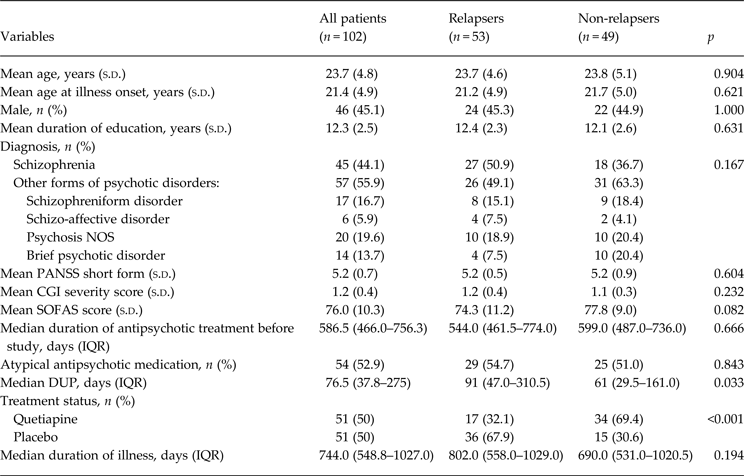
The mean age of included participants was 23.7 (s.d. = 4.8) years (range 18–43 years) and 45% were male (Table 1). Around 44% were diagnosed with schizophrenia and half were receiving atypical antipsychotic treatments at study entry. The mean age of onset was 21.4 (s.d. = 4.9) years (range 14–42 years) and median DUP was 76.5 days (interquartile range 37.8–275.0 days). The overall symptom severity scores at study entry were low (mean global severity of illness rating was 1 or ‘not mentally ill’). The level of functioning as assessed by the rating scale was moderately high.
Baseline characteristics of patients

s.d., Standard deviation; NOS, not otherwise specified; PANSS, Positive and Negative Syndrome Scale; CGI, Clinical Global Impressions; SOFAS, Social and Occupational Functioning Assessment Scale; IQR, interquartile range; DUP, duration of untreated psychosis.
No differences were found between relapsers (n = 53) and non-relapsers (n = 49) in regards to PANSS scores 1 month before termination or for other baseline variables including age, age of onset, gender, years of education, duration of antipsychotic treatment before study, duration of illness, pre-morbid functioning, functioning, and symptom scores.
Logistic regression analysis
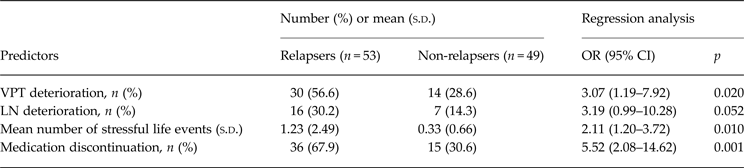
During the 1-year follow-up study, 53 patients (52%) had a psychotic relapse. Patients with VPT deteriorations were three times more likely to relapse than those without (Table 2). As expected, a stressful life event 1 month prior to relapse was found to be a significant predictor. Patients in the medication discontinuation (placebo) group were five times more likely to relapse than those in the maintenance medication group. The model had a Nagelkerke R 2 of 0.374 and an overall correct classification rate of 77.5%. The change in psychopathology (PANSS) before relapse was added as a variable in the regression model, but it did not significantly predict relapse (p = 0.787) and did not affect the existing findings.
Logistic regression of relapse in all patients

s.d., Standard deviation; OR, odds ratio; CI, confidence interval; VPT, Visual Patterns Test; LN, Letter–Number span test.
Relapse was not predicted by the interactive term between VPT deterioration and medication discontinuation [odds ratio (OR) 0.21, 95% confidence interval 0.03–1.35, p = 0.10].
Relapse predictors in the medication maintenance and discontinuation groups
Logistic regressions were performed separately in the medication maintenance and discontinuation groups to determine if there were any group-specific early-warning signs. Relapse was preceded by the VPT deterioration beginning 2 months prior to relapse only in the discontinuation (placebo) group (Table 3). The model accounted for 35% of the variance with 78.4% correct prediction.
Logistic regression of relapse in the medication maintenance (quetiapine) group and the discontinuation (placebo) group

s.d., Standard deviation; OR, odds ratio; CI, confidence interval; VPT, Visual Patterns Test; LN, Letter–Number span test.
Multiple logistic regression analysis
The multiple logistic regression analysis shows that VPT deterioration (p = 0.013), stressful life events (p = 0.014) and medication discontinuation (p = 0.001) were significant predictors of relapse at 1 year. The model had a correct classification rate of 72.5% and explained 33.6% of the variance (Nagelkerke R 2). Specifically, VPT deterioration contributed an additional 6.7% variance to the overall model, whereas stressful life events and medication discontinuation contributed 9.2 and 17.7%, respectively (Table 4).
Multiple logistic regression (forward stepwise) of relapse in all participantsa

OR, Odds ratio; CI, confidence interval; VPT, Visual Patterns Test.
a n = 102, 72.5% classified correctly, Cox and Snell R 2 = 0.252, Nagelkerke R 2 = 0.336.
Empirical significance for the relationship between WM and relapse
A Monte Carlo simulation was conducted to tackle the potential problem of practice effects with repeated testing in cognitive assessments. Comparison of the resampled relapse and real non-relapse patients supported the VPT findings. In the simulation, VPT deterioration significantly predicted true relapse (χ2 = 19.19, p < 0.001), supported by the fact that none of the 1000 random groups reached the significance level of the true relapse group. Although the χ2 test showed that LN deterioration was associated with true relapse (χ2 = 5.00, p = 0.03), 41 out of 1000 random groups reached an equivalent or lower level of significance, implying that LN might not be a reliable predictor.
In addition, we compared cognitive data at similar time points between the relapsers and non-relapsers. Because relapsers took on average 4 months to experience a relapse, we compared cognitive data between months 2 and 3 for the non-relapse group and the relapse group. Interestingly, the observed results regarding VPT and relapse still held when using these parameters. In other words, the changes in scores across months were fairly constant among the non-relapse group throughout the study period. Therefore, we are reassured that practice effects had minimal impact on the current observed results.
Discussion
WM deterioration preceding relapse
Evidence suggests that cognitive dysfunction at psychosis onset predicts later clinical deterioration (Wölwer et al. Reference Wölwer, Brinkmeyer, Riesbeck, Freimüller, Klimke, Wagner, Möller, Klingberg and Gaebel2008), functional impairment (Milev et al. Reference Milev, Ho, Arhdt and Andreasen2005) and relapse (Verdoux et al. Reference Verdoux, Lengronne, Liraud, Gonzales, Assens, Abalan and van Os2000; Chen et al. Reference Chen, Hui, Dunn, Miao, Yeung, Wong, Chan and Tang2005; Rund et al. Reference Rund, Melle, Friis, Johannessen, Larsen, Midbøe, Opjordsmoen, Simonsen, Vaglum and McGlashan2007; Hui et al. Reference Hui, Wong, Tang, Chang, Chan, Lee, Lam, Chiu, Chung, Tso, Pang, Chan, Wong, Mo, Chan, Hung, Honer and Chen2013). Building on this knowledge regarding cognition and clinical course, we found that visual WM deterioration in the preceding 2 months (but not as a baseline predictor) predicted relapse in remitted first-episode psychosis patients. These findings are not only relevant to the understanding of the relationship between cognitive deficits and psychosis but also prodromal syndromes in general. In parallel with the emerging evidence that cognitive deficits predict transition to psychosis (Frommann et al. Reference Frommann, Pukrop, Brinkmeyer, Bechdolf, Ruhrmann, Berning, Decker, Riedel, Möller, Wölwer, Gaebel, Klosterkötter, Maier and Wagner2011; Fusar-Poli et al. Reference Fusar-Poli, Deste, Smieskova, Barlati, Yung, Howes, Stieglitz, Vita, McGuire and Borgwardt2012), our novel finding on cognitive deterioration as a marker for subsequent recurrence of illness lends further support to the notion that additional pathological processes take place prior to and after onset of illness.
We would argue that the relationship between WM deterioration and relapse was not precipitated by psychopathological changes preceding the relapse, as our cohort was free of any residual positive symptoms during study entry and the use of stringent relapse definition meant very mild relapse was detected early (Chen et al. Reference Chen, Hui, Lam, Chiu, Law, Chung, Tso, Pang, Chan, Wong, Mo, Chan, Yao, Hung and Honer2010). Further, our psychopathology ratings in the month preceding relapse were not correlated with visual WM score. It was, therefore, not the proliferation of the psychotic symptoms that led to cognitive deterioration preceding relapse.
We observed WM deterioration shortly before relapse with the VPT (visual WM) but not with LN span (verbal WM). In this study, the two WM variables were not correlated. Based on findings from neuroimaging studies, visual WM is most reliant on structures in the posterior parietal cortex or visual occipital cortex, including the lateral occipital complex and intraparietal sulcus (Todd & Marois, Reference Todd and Marois2004, Reference Todd and Marois2005; Xu & Chun, Reference Xu and Chun2006). By contrast, verbal WM (specifically LN sequencing) is less dependent on these areas and more dependent on prefrontal cortical structures such as the orbitofrontal cortex and dorsolateral prefrontal cortex (Haut et al. Reference Haut, Kuwabara, Leach and Arias2000). Independent verbal and visual WM systems have also been demonstrated in imaging (Todd & Marois, Reference Todd and Marois2004) and behavioural studies (Cocchini et al. Reference Cocchini, Logie, Della Sala, MacPherson and Baddeley2002). Furthermore, evidence from familial studies indicated that visuospatial WM impairment, which was illness/state-dependent, may be a stronger predictor of psychosis than verbal WM deficit, and is a potential intermediate phenotype (Skelley et al. Reference Skelley, Goldberg, Egan, Weinberger and Gold2008; Maziade et al. Reference Maziade, Rouleau, Mérette, Cellard, Battaglia, Marino, Jomphe, Gilbert, Achim, Bouchard, Paccalet, Paradis and Roy2011). The intraparietal and intraoccipital sulci in the human brain serve as loci of memory representations, whereas the dorsolateral prefrontal cortex plays a key role in the active maintenance of visuospatial stimuli (Mottaghy et al. Reference Mottaghy, Gangitano, Sparing, Krause and Pascual-Leone2002; Grimault et al. Reference Grimault, Robitaille, Grov, Lina, Dubarry and Jolicœur2009). Prefrontal hypoactivation was linked to impairments in both the maintenance and manipulation of visual WM in schizophrenia (Cannon et al. Reference Cannon, Glahn, Kim, Van Erp, Karlsqodt, Cohen, Nuechterlein, Bava and Shirinyan2005), although reports varied (Manoach, Reference Manoach2003). Our results suggest that prefrontal dysfunction and abnormal prefrontal–parietal connectivity specific to the visual WM network may be involved in relapse.
Differences in task demands could also be a contributing factor for the significant findings associated with visual WM (VPT) rather than verbal WM (LN span). Although the tests in this study were not explicitly selected to assess cognitive processes in WM (encoding, maintenance, manipulation), differential loading on these subcomponents may account for some disparity in their predictive power. The VPT involves maintenance of abstract visual patterns, whereas LN span requires maintenance and manipulation of auditory stimuli. Several studies found deficits in encoding and maintenance, with comparatively spared manipulation, in both visual and verbal WM (Tek et al. Reference Tek, Gold, Blaxton, Wilk, McMahon and Buchanan2002; Lencz et al. Reference Lencz, Bilder, Turkel, Goldman, Robinson, Kane and Lieberman2003; Hill et al. Reference Hill, Griffin, Miura, Herbener and Sweeney2010; Thakkar & Park, Reference Thakkar and Park2012). This suggests that the observed deficits in manipulation may stem from the impaired ability to maintain memory traces, since traditional WM tasks (e.g. n-back, LN span) do not sufficiently isolate each component. This also explains the mixed findings in the prediction of relapse. For example, Wölwer et al. (Reference Wölwer, Brinkmeyer, Riesbeck, Freimüller, Klimke, Wagner, Möller, Klingberg and Gaebel2008) reported that baseline LN was not predictive of clinical deterioration at 1 year, whereas Rund et al. (Reference Rund, Melle, Friis, Johannessen, Larsen, Midbøe, Opjordsmoen, Simonsen, Vaglum and McGlashan2007) found associations between baseline WM, verbal memory, and relapse at 1 year. The performance of cognitively complex WM tasks may be degraded long before onset, whereas deterioration in simpler maintenance-only tasks could represent further reductions in processing capacity (Nuechterlein & Dawson, Reference Nuechterlein and Dawson1984), and may serve as more sensitive predictors of psychotic relapse. Further research is needed to clarify whether greater predictive power is due to task modality, complexity or interactions between the two.
Rund et al. (Reference Rund, Barder, Evensen, Haahr, Hegelstad, Joa, Johannessen, Langeveld, Larsen, Melle, Opyjordsmoen, Røssberg, Simonsen, Sundet, Vaglum, McGlashan and Friis2016) suggested different patterns of neurocognitive function over time among patients with different clinical profiles. They found that first-episode psychosis patients who were in remission during the first year had a better neurocognitive course throughout the 10-year follow-up period than those who were in unstable remission (remission and relapse) and non-remission during the first year. The longitudinal data also showed that a certain subgroup of patients who are unstable/non-remitted had a more fluctuating neurocognitive course over the 10-year follow-up than other patients in general. Consistent with Rund et al. (Reference Rund, Barder, Evensen, Haahr, Hegelstad, Joa, Johannessen, Langeveld, Larsen, Melle, Opyjordsmoen, Røssberg, Simonsen, Sundet, Vaglum, McGlashan and Friis2016) our data further elaborated on these neurocognitive fluctuations in patients who were not fully remitted, indicating that neurocognitive decline occurred prior to relapse. In our study on remitted first-episode psychosis patients, we explored the neurocognitive markers of patients’ first relapse at 1 year. Whether relapsed patients’ neurocognitive function improved during remission and declined again before the next relapse would be an important question to answer. From our single case study of a female first-episode psychosis patient (Chen et al. Reference Chen, Chen and Ho2000), the extent of neurocognitive and brain dysfunction in relation to repeated episodes was examined in a 5-year prospective longitudinal follow-up study. Her clinical and physiological status was found to be reversible in the first relapse until the patient developed treatment resistance in the second relapse. On the other hand, her cognitive functioning was normalized 2 months after treatment from her first and second relapse episodes. We believe to what extent the episodes of relapse will have impact on the patients’ neurocognitive functioning over time and whether the neurocognitive declines are reversible with repeated relapses will require further investigation in a prospective long-term follow-up study.
Stressful life events
The role of independent stressful life events in schizophrenia relapse has been well documented in retrospective (Birley & Brown, Reference Birley and Brown1970; Day, Reference Day, Nielsen, Korten, Ernberg, Dube, Gebhart, Jablensky, Leon, Marsella, Olatawura, Sartorius, Stromgren, Takahashi, Wig and Wynne1987) and prospective studies (Ventura et al. Reference Ventura, Nuechterlein, Lukoff and Hardesty1989). However, previous findings were inconsistent regarding the timing of stressful life events. Retrospective data suggested that independent events were clustered around 2 to 3 weeks preceding relapse (Birley & Brown, Reference Birley and Brown1970; Leff et al. Reference Leff, Hirsch, Gaind, Rohde and Stevens1973), whereas a prospective study found significantly more independent life events occurred in the month prior to relapse (Ventura et al. Reference Ventura, Nuechterlein, Lukoff and Hardesty1989), which was in agreement with our findings.
Limitations
The study had several limitations. Although we alternated two versions of VPT during the assessments, practice effects could still have occurred in the non-relapsers who took the maximum number of 12 tests. Practice effects in the LN test might also explain the nearly significant finding as an early sign of relapse (similar OR to VPT), but fewer patients showed deterioration in LN (n = 23) than VPT (n = 44). We, therefore, subtracted the latest WM score from the previous score so the practice effects spanned only one period, rather than from baseline to relapse or termination. The results were also confirmed by the Monte Carlo simulation. By randomly assigning patients as relapsers or non-relapsers, while fixing the values for the true number of relapsers and the proportion of months having a relapse, we found that none of the simulations reached the significance level of the true relapse model. Finally, schizophrenia research suggests that practice effects occur only in highly structured visual pattern stimuli rather than unstructured stimuli, which are used in the VPT (Silverstein et al. Reference Silverstein, Bakshi, Chapman and Nowlis1998).
Visual WM deterioration was only significant in patients in the placebo group, suggesting a possible interaction between medication discontinuation and visual WM deterioration. However, interaction between these two predictors of relapse was not significant, possibly due to the small sample size or a power effect, given the small number of relapsers in the maintenance treatment group. Future studies should test interacting variables at the biological, environmental and psychological levels as proposed by Gaebel & Riesbeck (Reference Gaebel and Riesbeck2014) to better examine the complicated interactions between vulnerability, stressors and protective factors, and to enhance predictive power. Due to logistics and to minimize patient burden, only two WM tests were used. We therefore did not have data from other cognitive functions that may also be predictive of relapse, nor did we measure other non-specific early-warning signs of relapse. The high functioning level and low rate of substance misuse in this first-episode psychosis cohort also need to be considered before generalizing the findings in other settings.
Conclusions
Our novel finding of visual WM deterioration as a potential early brain dysfunction at 2 months preceding relapse in psychosis has clinical and research significance, given that it also explained an additional 6.7% of the variance among other predictors including medication discontinuation and stressful life events. The observed cognitive deterioration also occurred independent of any change in psychopathology prior to relapse. Testable predictors of relapse would be an important addition to the long-term management of patients with psychosis and could lead to effective strategies for relapse prevention. This study provides evidence that WM deficits involving the prefrontal cortex and its connectivity to parietal regions may increase the risk of psychotic relapse. As most neurocognitive treatments are based on neuropsychological deficits from localized brain areas, enhanced neurocognitive paradigms will need to be developed to investigate the neural correlates of WM subcomponents and functional connectivity in WM networks.
Acknowledgements
This work was supported by the Research Grants Council of Hong Kong (HKU 7655/05 M) and the AstraZeneca Pharmaceuticals Investigator Initiated Studies Award. W.G.H. was supported by the Jack Bell Chair in Schizophrenia and the British Columbia Mental Health and Addictions Services.
Declaration of Interest
E.H.M.L reported participating on the advisory boards for AstraZeneca and Eli Lilly. W.G.H. reported participating on advisory boards or performing consultations for In-Silico Biosciences, Otsuka/Lundbeck, Roche and Eli Lilly. E.Y.H.C. reported participating on the advisory board for Otsuka and receiving research funding from AstraZeneca, Janssen-Cilag, Pfizer, Eli Lilly, Sanofi-Aventis and Otsuka, and an educational grant from Janssen-Cilag. No other disclosures were reported.