INTRODUCTION
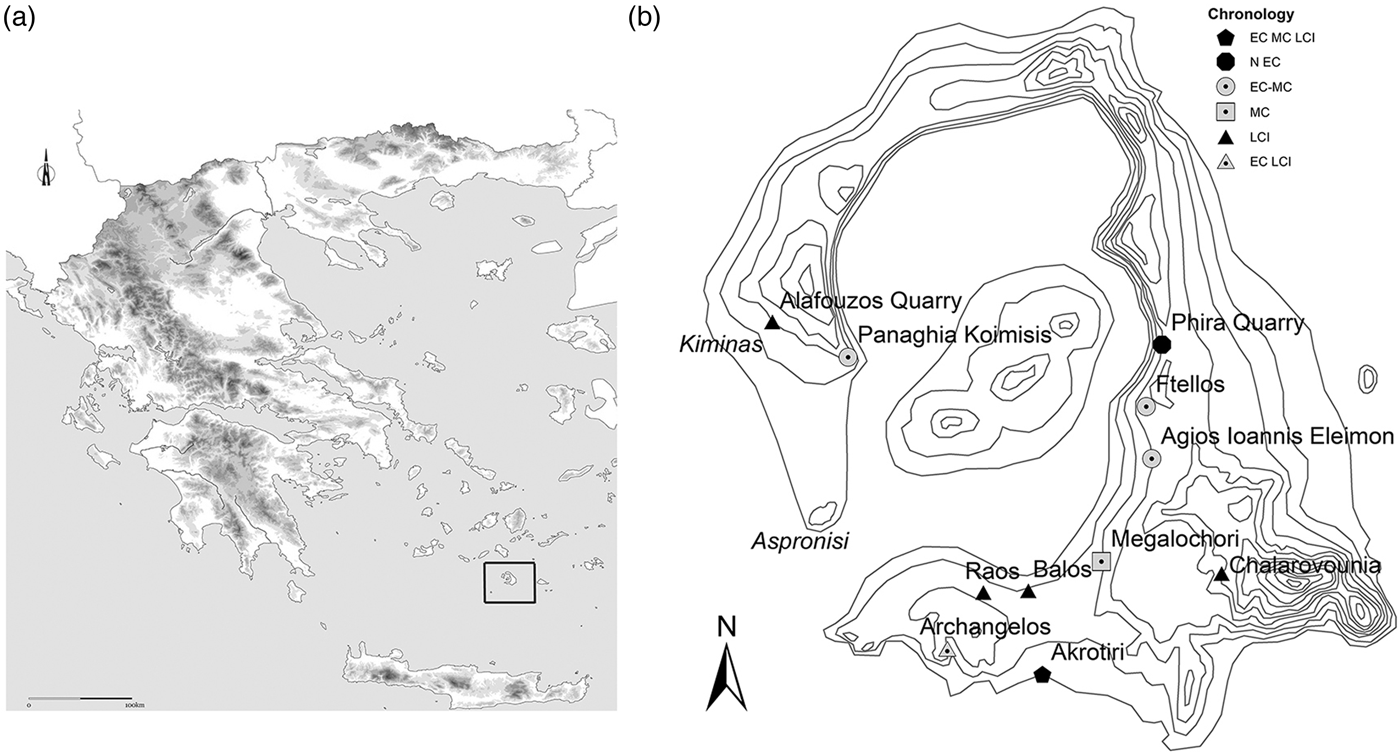
The current analysis enables us to investigate aspects of pottery production and consumption at pre-eruption Thera in respect of a settlement outside the locality of Akrotiri. A number of pottery fabrics from Panaghia Koimisis at Therasia, which formed part of the single pre-eruption island of Thera (Figs 1a and 1b), are extensively presented and a fabric typology for the site is established. Fabrics from Panaghia Koimisis are compared with fabrics which had been previously documented at Akrotiri, giving the opportunity to explore wider patterns of pottery production and consumption on pre-eruption Thera. Are the pottery fabrics from Panaghia Koimisis distinguishable from those identified as local at Akrotiri? Is Panaghia Koimisis considered a place for pottery production or a site of consumption? Can we attest, in terms of pottery technology and provenance, contacts between the two prehistoric communities of Panaghia Koimisis and Akrotiri?
(a) Therasia and Thera in the southern Cyclades, Greece; (b) Pre-eruption morphology of Thera with Bronze Age sites (N: Neolithic; EC: Early Cycladic; MC: Middle Cycladic; LC: Late Cycladic).

With regard to the origin and frequency of the imported pottery consumed at Panaghia Koimisis, broader matters are explored such as whether the imports arrived at the site directly or were channelled through Akrotiri. Furthermore, a discontinuity in the use of low-calcareous, earlier Theran pottery fabrics in the later Middle Cycladic period at Panaghia Koimisis is demonstrated, a change which has already been certified by previous research on Akrotiri and which possibly indicates broader transformations in the pottery production on pre-eruption Thera.
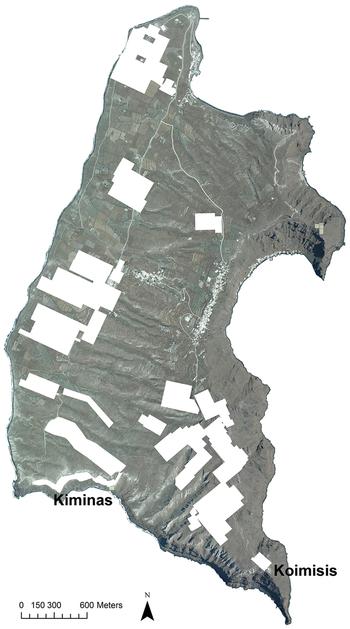
The prehistoric site of Panaghia Koimisis was discovered in the context of an intensive archaeological field survey carried out on Therasia (Cyclades), Greece, between 2007 and 2011 (Fig. 2). Pottery densities were recorded on the surface showing the occupation of the island in the Bronze Age, as well as in Archaic, Classical, Hellenistic, Late Roman, Byzantine and modern times (Sbonias, Farinetti and Kordatzaki Reference Sbonias, Farinetti and Kordatzaki2015).Footnote 1
The Therasia 2007–2011 archaeological survey.

Concerning the prehistoric habitation, Cycladic pottery came to light at three separate locations in the southern part of the island (Fig. 2). The first two limited concentrations of material are associated with the Late Cycladic I settlement, which was situated in the area of Kiminas and destroyed by the Santorini Minoan eruption. It was the mining operations of the nineteenth century in the area of Alafouzos quarry (Kiminas) that allowed the localisation and excavation by Fouqué of a Late Cycladic building, which constituted part of a larger settlement in the southern end of Therasia (Fouqué Reference Fouqué and McBirney1998 [1879]; Tzachili Reference Tzachili2005, 244–6; Reference Tzachili2006, 111–44; Sbonias, Tzachili and Moulou Reference Sbonias, Tzachili and Moulou2015, 58–61, 67–9).
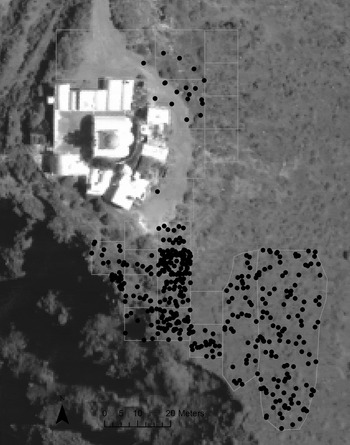
The third location at Panaghia Koimisis is situated further east at the south-eastern tip of the island and is associated with a previously unknown settlement (Figs 2 and 3) (Sbonias, Farinetti and Kordatzaki Reference Sbonias, Farinetti and Kordatzaki2015; Sbonias, Tzachili and Moulou Reference Sbonias, Tzachili and Moulou2015, 61–74). Here, higher densities of prehistoric pottery were found on the pre-eruption terraces of the slope, where the layers of the Minoan ash are thin or completely eroded. Nowadays the newly found site is located at the most south-eastern tip of the island, on the edge of the caldera, above the sea. However, Therasia actually formed part of the single ring-shaped island of pre-eruption Thera and had a plain to the south, extending to the current sea area between Therasia and Aspronisi (Aston and Hardy Reference Aston and Hardy1990; Druitt and Francaviglia Reference Druitt and Francaviglia1990; Friedrich, Seidenkrantz and Nielsen Reference Friedrich, Seidenkrantz, Nielsen, McGuire, Griffiths, Hancock and Stewart2000; Heiken, McCoy and Sheridan Reference Heiken, McCoy and Sheridan1990; Vougioukalakis Reference Vougioukalakis2015) (Fig. 1b). The southern part of Therasia was at that time habitable, protected from the north winds, at the edge of the flattest area and close to the entrance to the caldera, which was probably deeper in the southern section and offered a safe and spacious harbour (Vougioukalakis Reference Vougioukalakis2015, 26). The archaeological survey, combined with the geological study, the geophysical work and the trial trenches that have now been carried out, help us to understand the layout of the naturally defended prehistoric settlement at Panaghia Koimisis (Sbonias, Farinetti and Kordatzaki Reference Sbonias, Farinetti and Kordatzaki2015). It was built on the top and the upper terraces of a hill, close to the pre-eruption caldera, the south-eastern limit of which did not differ substantially from the present one. The southern part of the settlement by the cliff of the caldera is not preserved, having collapsed due to the Minoan eruption (Fig. 3). For the needs of this paper, Thera refers to the pre-eruption island, unless otherwise specified in the text.
Surface distribution of dated prehistoric pottery at Panaghia Koimisis (1 dot = 1 sherd).

Based on the preliminary archaeological study of the surface material two phases of habitation were recognised at Panaghia Koimisis (Kordatzaki Reference Kordatzakiforthcoming; Reference Kordatzaki2015; Marthari Reference Marthariforthcoming): the Early Cycladic period, which is represented by significant amounts of pottery, and the late Middle Cycladic period, attested by a more limited distribution of surface material from the uppermost terraces of the hill. However, the current excavation of the site testifies that the settlement was inhabited throughout the Middle Cycladic period. With regard to the ongoing excavation, it looks as though the site was inhabited intensively during the Early Cycladic period, constituting an important settlement at that time, and that habitation continued in a more limited nature until the end of the Middle Cycladic period (Sbonias, Tzachili and Efstathiou Reference Sbonias, Tzachili and Efstathiouforthcoming).
GEOLOGICAL BACKGROUND
Therasia is covered exclusively by volcanic geological formations composed of ash and pumice; volcanic lavas, mainly of quartz-andesitic composition; tuffs and scoriae. It is worth mentioning that there was never a pre-volcanic formation composed of metamorphic, sedimentary and carbonate lithologies (Pichler, Günther and Kussmaul Reference Pichler, Günther and Kussmaul1980). Extremely limited outcrops of thin paleosoils occurred on Therasia during the Bronze Age, containing a low portion of silts and clays, but they were not exploitable.Footnote 2
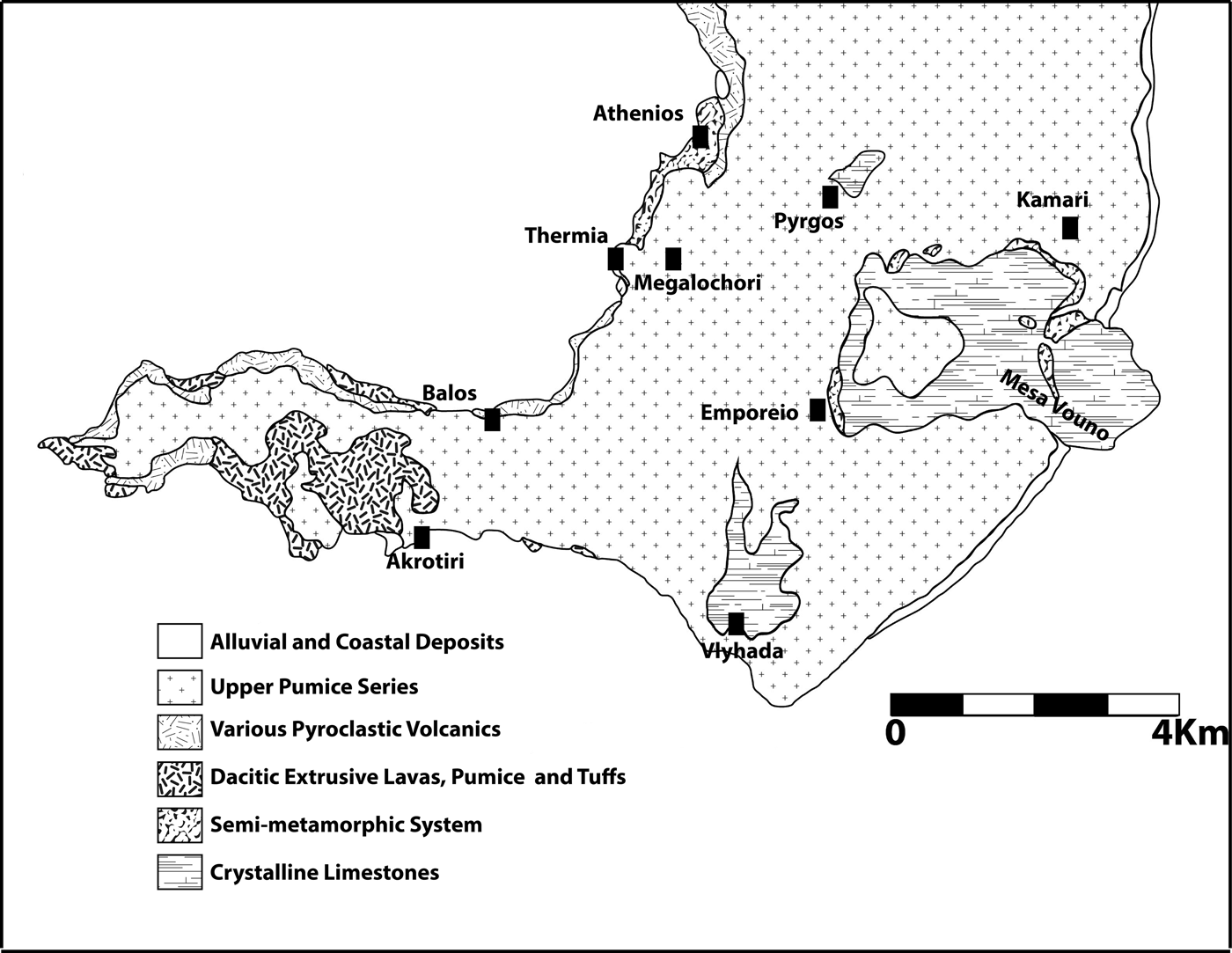
Modern Thera consists mainly of volcanic lithologies, which prevail throughout the island, while limited occurrences of pre-volcanic formations occur in the southern part (Higgins, M.D. and Higgins, R.A. Reference Higgins and Higgins1996, 170–95; Pichler, Günther and Kussmaul Reference Pichler, Günther and Kussmaul1980; Vougioukalakis Reference Vougioukalakis2015). More particularly, extensive outcrops of pumice, ash, volcanic lavas (andesitic, quartz-latiandesitic, dacitic and rhyodacitic in composition), scoriae, tuffs (locally, fossil-bearing in the southern part of Thera), and variable pyroclastic formations and intercalations appear. The pre-volcanic lithologies of Thera consist of a semi-metamorphic system outcropping at places in the area between Athenios and Thermia, as well as locations between Megalochori and Mesa Vouno, where extensive formations of crystalline limestones also exist (Fig. 4). The pre-volcanic semi-metamorphic system, which possibly extended further south before the Minoan eruption, consists of metamorphic rocks originating from pelites, sandstones, cherts, carbonates, conglomerates and volcanic lithologies (Einfalt Reference Einfalt1978, 461, 466; Pichler, Günther and Kussmaul Reference Pichler, Günther and Kussmaul1980; Skarpelis and Liati Reference Skarpelis and Liati1990, 172; Vaughan and Wilson Reference Vaughan, Wilson, Zerner, Zerner and Winder1993, 180). The limited existence of clay deposits on Thera nowadays might be indicative of their more extensive occurrence (and use) in the past, before the Minoan eruption (Einfalt Reference Einfalt1978, 459, 461; Friedrich, Seidenkrantz and Nielsen Reference Friedrich, Seidenkrantz, Nielsen, McGuire, Griffiths, Hancock and Stewart2000, 76–9; Hilditch Reference Hilditch2008, 192; Vaughan Reference Vaughan, Hardy, Doumas, Sakellarakis and Warren1990, 482).
Simplified and modified geological map of the southern part of Thera, in the wider vicinity of Akrotiri.

THE POTTERY ASSEMBLAGE
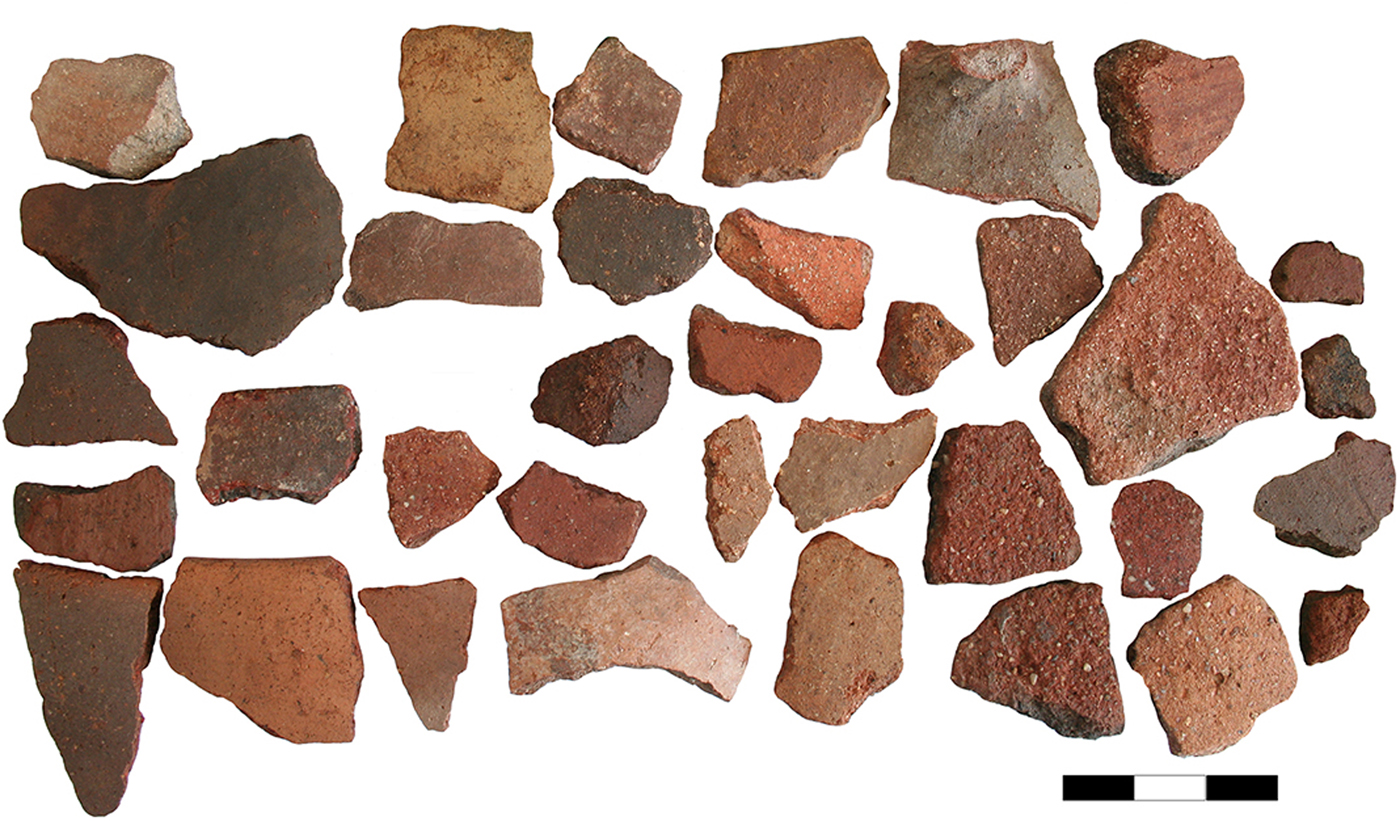
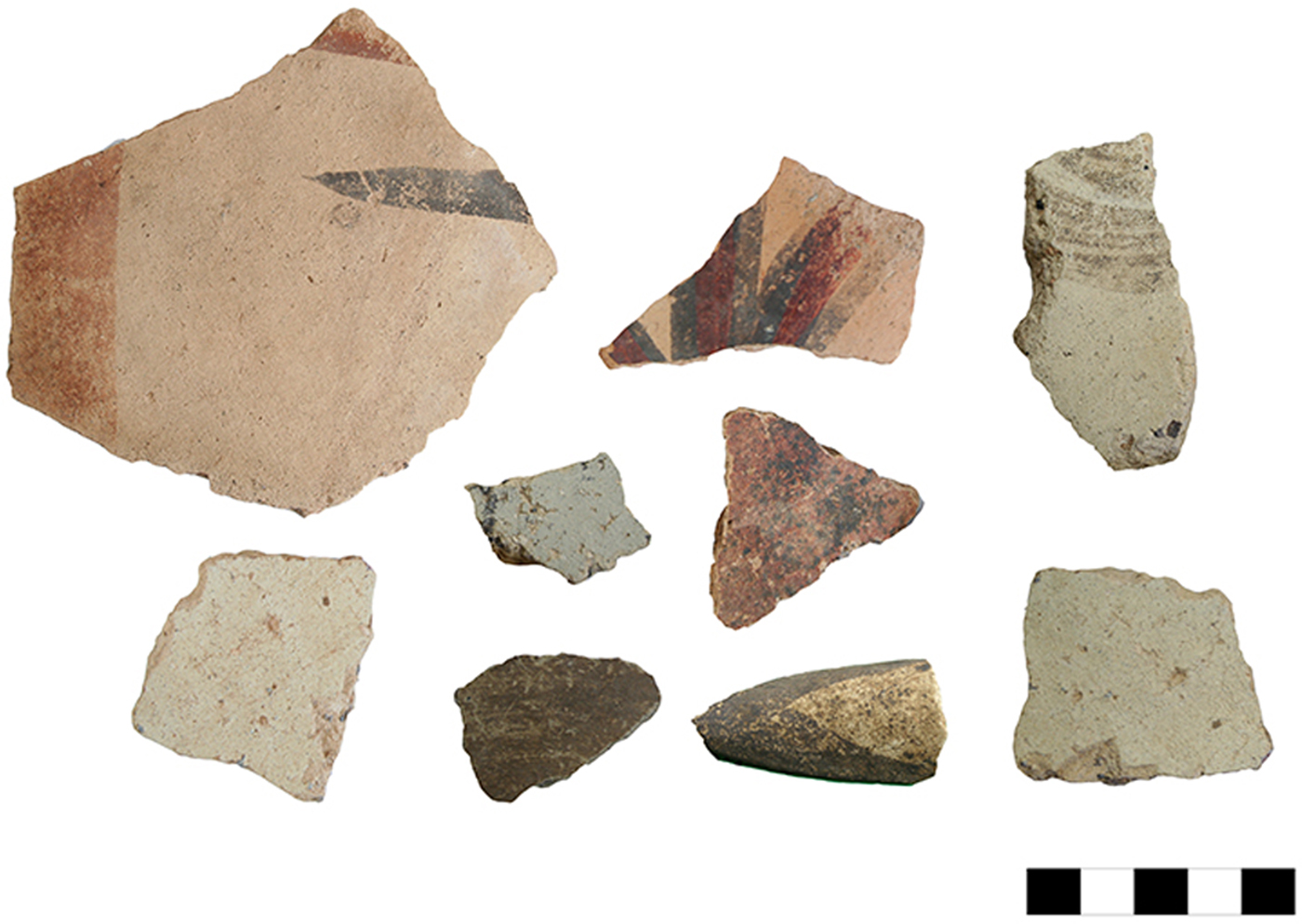
No more than 50 pottery sherds of the total 540 sherds collected at Panaghia Koimisis are associated with diagnostic parts of pots, such as rims, bases and handles. The pottery is handmade and no clear indications for wheel-thrown or wheel-finished pots have been found so far. Generally it consists of coarser wares, with fewer sherds of medium and semi-fine wares. The vast majority is associated with various low-calcareous fabrics, ranging in colour from red and orange to black, and comprises plain and monochrome-slipped sherds either smoothed and polished or burnished (Fig. 5).Footnote 3 Pottery correlated with pale, higher calcareous, fabrics is less frequent and is associated with the Cycladic White Ware including plain, monochrome-slipped (both black- and red-slipped), dark-on-light pattern-painted and bichrome-painted sherds (Fig. 6) (Marthari Reference Marthariforthcoming; for the Cycladic White Ware, see for example Nikolakopoulou et al. Reference Nikolakopoulou, Georma, Moschou, Sofianou, Brodie, Doole, Gavalas and Renfrew2008; Vaughan, Kilikoglou and Papagiannopoulou Reference Vaughan, Kilikoglou, Papagiannopoulou, Vandiver, Druzik, Madrid, Freestone and Wheeler1995). With regard to the shapes, the finds include mainly open pots, such as bowls, many cooking pots, other deep open pots such as kadoi, pithoi and other large storage vessels, as well as a few closed pots and rare spindle whorls.
Plain and monochrome-slipped sherds (which constitute the vast majority of the survey assemblage).

Dark-on-light pattern-painted and bichrome-painted pottery included within the survey assemblage.

METHODOLOGY
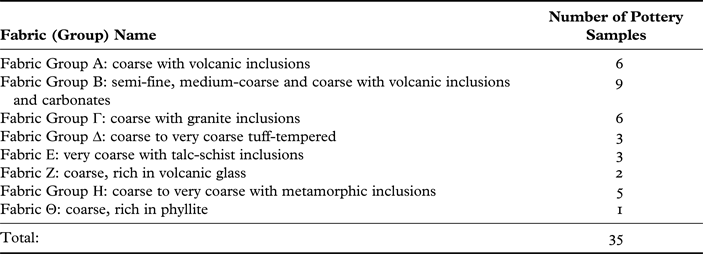
Given the limitations and restrictions of surveying pottery, this paper presents the scientific data and results of the petrographic analysis performed on selected prehistoric pottery samples from Panaghia Koimisis, which were recovered in the context of the archaeological survey. The scientific study was carried out during the preliminary stages of the research in an explorative context. Among the objectives was the potential contribution of fabric typology to dating the survey pottery, as the bulk of the pottery assemblage is associated with undecorated, coarse and undiagnostic body sherds. Securely dated sherds of distinctive vessel forms and characteristic wares were associated with particular fabrics within the survey assemblage and compared with Cycladic pottery fabrics of known date. When determining the provenance of the pottery we took into account the composition of the pottery fabrics, as defined through petrographic analysis of the ceramic material, in association with the published geological profile of the Cyclades, and the origin of similar fabrics from Akrotiri and other Cycladic islands.Footnote 4 On the basis of the range of variation within the typology, the wares and the macroscopically defined fabrics, 35 sherds were chosen for petrographic analysis (Table 1). The pottery samples were thin-sectioned and analysed under a Zeiss Axioskop 40 polarising microscope.
Overview of the Therasia fabric typology.

POTTERY PETROGRAPHIC ANALYSIS
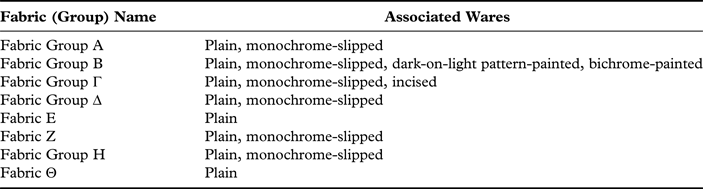
In total, five fabric groups, in addition to three individual fabrics, were defined through petrographic analysis (Table 1; for an association between particular pottery fabrics and wares, see Table 2). The main differentiation concerns pottery fabrics identified as Theran and fabrics considered as imported from other Cycladic islands.
Pottery fabrics and associated wares.

Theran pottery fabrics
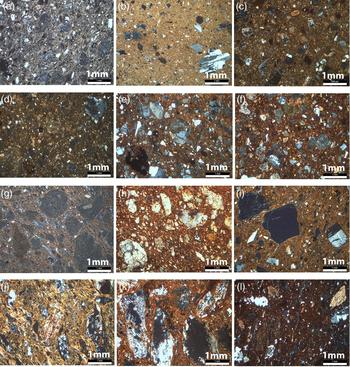
Fabric group A is a coarse, low-calcareous fabric group characterised by volcanic rock fragments, plagioclase and clinopyroxene and occasionally very rare metamorphic rock fragments (such as strained polycrystalline quartz and quartz-biotite schist) (Fig. 7a). Some of the pottery samples also contain hornblende, orthopyroxene and biotite, possibly as constituent minerals of the volcanic lavas. Occasionally, variable amounts of volcanic glass and pitchstone are included, and very rarely scoria. Abundant magnetite and red oxides were observed within the samples. More particularly, volcanic lavas of intermediate to acid composition show variable textures including porphyritic, microlitic and trachytic varieties. Plagioclase is fresh, often with zoning, and clinopyroxene usually displays twinning. Both probably occur as dissociated phenocrysts from the actual volcanic rocks. Based on the presence/absence and the frequency of tuffs, two separate fabrics were defined: fabric A1 with abundant tuffs and fabric A2 with very few to absent tuffs.
(a) Fabric A2 (XP, 25x); (b) Fabric B1 (XP, 25x); (c) Fabric B2 (XP, 50x); (d) Fabric B3 (XP, 25x); (e) Fabric Γ1 (XP, 25x); (f) Fabric Γ2 (XP, 25x); (g) Fabric Δ1 (XP, 25x); (h) Fabric E (XP, 25x); (i) Fabric Z (XP, 25x); (j) Fabric H1 (XP, 25x); (k) Fabric H4 (XP, 25x); (l) Fabric Θ (XP, 25x).

The inclusions of this fabric group are associated with volcanic and metamorphic lithologies, similar to the lithologies exposed at the southern end of Thera, in the wider area of Akrotiri. This suggests that this might have been the source of the raw materials. It seems that for the clay paste preparation primary clays were used, possibly coming from the abovementioned geological formations. The presence of tuffs in some of the samples, but not in others, might be indicative of the exploitation of multiple deposits and/or of natural variation within the deposits.
The optical activity of the micromass varies significantly from active to inactive and indicates that the pottery samples were fired at varying temperatures. Concerning the firing atmosphere, and based on the colour homogeneity/heterogeneity of the sherd sections, variable conditions were observed with prevalence of combined mixed and oxidised or combined mixed and reducing stages.
This fabric group constitutes the predominant group within the assemblage. It is associated with a wide spectrum of plain and monochrome-slipped pots, including bowls of variable size, cooking pots, other large open pots (kadoi) and storage vessels (including pithoi), as well as a very few closed pots and spindle whorls.
Based on the examination of thin sections available at the Fitch Lab, this fabric group is similar to thin-sectioned pottery samples from Early Cycladic Akrotiri. Regarding comparative petrographic data, fabric group A is similar to Early Cycladic cooking fabrics identified as local at Akrotiri, and it seems that it is absent from the Middle Cycladic phase there (Hilditch Reference Hilditch2008; Müller Reference Müller2009, 62–5, 317; Vaughan Reference Vaughan, Hardy, Doumas, Sakellarakis and Warren1990, 479–81). We must stress that fabric group A has similarities to Vaughan's Early Cycladic various Pink-Red ware group, for which she excluded a Theran origin (Vaughan Reference Vaughan, Hardy, Doumas, Sakellarakis and Warren1990, 479–81). All securely dated sherds from Therasia associated with this fabric group belong exclusively to the Early Cycladic period.
Fabric group B is a fossiliferous and calcareous group with wide internal variability regarding the amount and type of the carbonate material (e.g. microfossils, ostracods, [bio]micritic and [bio]sparitic lumps) (Figs 7b, 7c and 7d). The samples were checked for coarseness, and semi-fine, medium-coarse and coarse fabrics were distinguished. Taking into consideration the type and frequency of the carbonates, three fabrics were defined, including a less fossiliferous one (fabric B1), a second one dominated by microfossils (fabric B2) and a third one characterised by abundant micritic lumps (fabric B3).
All three fabrics are characterised by volcanic rock fragments similar in type and texture to those included in fabric group A, as well as plagioclase and clinopyroxene, most probably as dissociated phenocrysts from the volcanic rocks, in various frequencies. Occasionally, there are very few to very rare metamorphic inclusions (such as strained polycrystalline quartz, quartz-biotite schist and phyllite). Sedimentary rock fragments (such as sandstone and chert, the latter occasionally radiolarian) and crystalline limestone occur very rarely or are entirely absent.
The composition of this fabric group is compatible with the geology in the wider vicinity of Akrotiri and the volcanic and semi-metamorphic lithologies exposed there, indicating that the raw materials of fabric group B came from this part of Thera. Based on published data, these fossiliferous clays correspond well (mineralogically and chemically) with the volcanically intruded marine rocks, such as the fossil-bearing tuffs appearing in parts of the area west of Akrotiri, and thus these types of clay might originate from this area (Friedrich, Seidenkrantz and Nielsen Reference Friedrich, Seidenkrantz, Nielsen, McGuire, Griffiths, Hancock and Stewart2000; Hilditch Reference Hilditch2008, 258; Müller Reference Müller2009, 73–4).
Similar lithologies also characterise the island of Melos and similar fabrics have been identified there, making the differentiation between the Melian and the Theran fossiliferous fabrics extremely difficult (Einfalt Reference Einfalt1978; Fytikas Reference Fytikas1977; Higgins, M.D. and Higgins R.A. Reference Higgins and Higgins1996, 170–95; Hilditch Reference Hilditch2008, 260–3; Jones Reference Jones1986, 280; Knappett et al. Reference Knappett, Pirrie, Power, Nikolakopoulou, Hilditch and Rollinson2011; Pichler, Günther and Kussmaul Reference Pichler, Günther and Kussmaul1980; Vaughan Reference Vaughan, Hardy, Doumas, Sakellarakis and Warren1990). Since large amounts of sherds of this fabric were found in Akrotiri and the fabric was in continuous use there from the Early Cycladic to the Late Cycladic periods, the suggestion of a Theran origin for the raw materials prevails.
The variability observed in the type of the carbonates possibly reflects the use of variable clays for the clay paste preparation. Moreover, their uneven distribution within some of the samples, combined with the variation in their frequency, might be indicative of clay-mixing practices and/or of natural variability within the deposits. The bimodal grain size distribution observed in some of the pottery samples suggests tempering practices for the clay paste preparation. The optical activity of the samples varies from active to inactive, indicating a range of firing temperatures. Based on the colour of the sherd sections, variable firing atmosphere conditions were attested, indicative either of fully oxidised or of combined oxidised and reducing/mixed stages.
This fabric group is associated with the Cycladic White Ware and includes plain; monochrome-slipped, occasionally with a distinctive thick, dark-coloured slip (either black or red in colour); dark-on-light pattern-painted; and bichrome-painted vessels (Table 2). Associated shapes are storage vessels including pithoi, bowls and cooking pots, as well as a few closed pots. Given the associated wares and shapes within the assemblage, this fabric group is securely dated to the late Middle Cycladic period in Therasia. However, due to the appearance of this fabric at Akrotiri already from the Early Cycladic period onwards, an Early Cycladic date for some of the plain, undiagnostic survey sherds cannot be excluded (Hilditch Reference Hilditch2008, 208; Vaughan Reference Vaughan, Hardy, Doumas, Sakellarakis and Warren1990, 471–3; Vaughan and Williams Reference Vaughan, Williams, Renfrew, Brodie, Morris and Scarre2007, 110–25).
Fabric group B is assumed as local at Akrotiri and was used continuously there from the Early Cycladic to the Late Cycladic periods (Hilditch Reference Hilditch2008, 196–210; Müller Reference Müller2009, 74, 317; Vaughan Reference Vaughan, Hardy, Doumas, Sakellarakis and Warren1990, 471–3; Williams Reference Williams1978, 508–9). It was also identified as local at Phylakopi on Melos and as an import on other Cycladic islands, such as Aghia Irini on Keos and Mikre Vigla on the island of Naxos (Davis and Williams Reference Davis and Williams1981, 296–7; Vaughan Reference Vaughan1989, 154–8; Reference Vaughan, Hardy, Doumas, Sakellarakis and Warren1990, 472–3; Vaughan and Williams Reference Vaughan, Williams, Renfrew, Brodie, Morris and Scarre2007).
Fabric group Δ is a coarse to very coarse, possibly higher calcareous, fabric group dominated by tuff inclusions and occasional metamorphic rock fragments, such as strained polycrystalline quartz and quartz-biotite schist. Based on the frequency of the volcanic lavas, two fabrics were recognised; fabric Δ1 which contains very rare lava fragments (Fig. 7g), and fabric Δ2 with common lava fragments.
The raw materials of this group are compatible with the volcanic formations and the metamorphic rocks which occur in the wider area of Akrotiri. Based on the bimodality of the grain size distribution of the predominant tuffs, tempering practices are possible. Iron-rich argillaceous striations might be indicative of clay-mixing practices for the clay paste preparation. The micromass varies from active to inactive, reflecting a range of firing temperatures from low to high. Variable atmosphere conditions during firing were attested, and more particularly fully mixed or combined mixed and oxidised stages were observed.
This fabric group constitutes a small group within the assemblage, and includes medium-sized vessels and deep large pots (e.g. kadoi), both plain and monochrome-slipped. The majority of sherds belonging to this group cannot be dated securely. Since similar fabrics were defined within the Final Neolithic to Early Cycladic II cooking pots from Akrotiri, this fabric group might be associated with the Early Cycladic phase at Therasia (Müller Reference Müller2009, 64, 317).
Imported pottery fabrics
Fabric group Γ is a low-calcareous, coarse fabric group dominated by granite inclusions, a few of which are metamorphosed (Figs 7e and 7f). Monocrystalline quartz, feldspars, biotite and occasional chlorite and granodiorite are included. Based on the frequency and the prevalent type of hornblende (brown or green hornblende), as well as the presence/absence and frequency of biotite, three separate fabrics were defined: fabric Γ1 defined by the presence of a few brown hornblende; fabric Γ2 with abundant green hornblende; and fabric Γ3 with frequent biotite (Figs 7e and 7f). Variation was also observed in the weathering of feldspars.
The raw materials of this fabric group are compatible with the geology of Naxos (Higgins, M.D. and Higgins, R.A. Reference Higgins and Higgins1996, 170–95; Jansen Reference Jansen1973). Paros and eastern Crete (Papanikolaou Reference Papanikolaou1996; Papastamatiou Reference Papastamatiou1959) are also characterised by similar lithologies, but the comparative pottery petrographic analysis shows similarities with the local Naxian pottery fabrics (Hilditch Reference Hilditch2008, 233; Jones Reference Jones1986, 263; Müller, Kilikoglou and Day Reference Müller, Kilikoglou, Day, Spataro and Villing2015, 39; Vaughan Reference Vaughan1989, 151–4, 157–8; for the so-called granitic and granodioritic Mirabello fabric from east Crete, see Nodarou and Moody Reference Nodarou, Moody, Molloy and Duckworth2014).
For the clay paste preparation, the primary clays that were used are associated with granite, granodiorite and metamorphic lithologies, the latter derived from acid plutonic rocks. There are no clear indications of clay-mixing and tempering practices. The compositional variability observed within fabric group Γ reflects the use of clay types which are similar, but not the same. It seems that a range of raw material sources were exploited, possibly indicative of separate production areas on the island of Naxos. The variation observed in the optical activity of the micromass, ranging from active to slightly active, suggests different firing temperatures. The clay matrices show evidence of various firing atmosphere conditions. Some of the clay matrices of the samples are homogeneous, suggesting fully oxidised stages, whereas others are heterogeneous in colour, indicative of combined mixed/reducing and oxidised stages.
Fabric group Γ is mainly associated with medium-sized pots and larger vessels, such as bowls and S-profile closed pots. Both plain and monochrome-slipped sherds, occasionally with burnishing, as well as a couple of incised sherds, were correlated with this group. This fabric group was associated with Naxian imports in Akrotiri throughout the whole Cycladic period, while similar Naxian imported fabrics were found on Keos and Keros as well (Hilditch Reference Hilditch2007, 240–1; Reference Hilditch2008, 228–34, 345; Knappett et al. Reference Knappett, Pirrie, Power, Nikolakopoulou, Hilditch and Rollinson2011; Müller Reference Müller2009, 68, 69, 317; Vaughan Reference Vaughan, Hardy, Doumas, Sakellarakis and Warren1990, 476–7; Williams Reference Williams1978, 509).
Fabric E is a very coarse, low-calcareous fabric predominated by talc-schist inclusions (Fig. 7h). Occasional very few epidote, chlorite, biotite and muscovite aggregates and very rare strained polycrystalline quartz occur.
The raw materials of this fabric might be indicative of dolomite lithologies exposed to metamorphism, and possibly originate in the west Cyclades. There are no indications for clay-mixing and tempering practices for the clay paste preparation. The optical activity of the matrices indicates a tendency for higher firing temperatures in an oxidising atmosphere.
This fabric includes medium-sized and larger plain pots, such as bowls, deep bowls and cooking pots, as well as larger storage jars, and is associated with the so-called talc ware. Based on comparative petrographic data, pots of the talc-schist fabric were broadly circulated in the Cyclades during the Early Cycladic I and II periods. Possibly, talc ware originates in the west Cyclades, on islands such as Siphnos and Seriphos (Broodbank Reference Broodbank2007, 126; Müller Reference Müller2009, 70; Sotirakopoulou Reference Sotirakopoulou1999, 499; Vaughan Reference Vaughan, Hardy, Doumas, Sakellarakis and Warren1990, 478; Vaughan and Williams Reference Vaughan, Williams, Renfrew, Brodie, Morris and Scarre2007, 119; Vaughan and Wilson Reference Vaughan, Wilson, Zerner, Zerner and Winder1993, 179–80; Wilson Reference Wilson1999, 69).
Fabric Z is a low-calcareous, coarse fabric characterised by angular volcanic glass and altered volcanic lavas, as well as fresh plagioclase crystals, the latter often as phenocrysts within glassy matrices (Fig. 7i). The volcanic glass occasionally shows perlitic or vesicular texture. Lavas include microlitic and porphyritic varieties, the latter usually with plagioclase phenocrysts. Taking into consideration the composition of this fabric and the angularity of the inclusions, the raw materials possibly derived from pyroclastic formations covering extensive parts of both Thera and Melos (Fytikas Reference Fytikas1977; Pichler, Günther and Kussmaul Reference Pichler, Günther and Kussmaul1980).
There are no indications for clay-mixing practices, and for the clay paste processing primary clays were used. With regard to the firing conditions the pottery samples were fired at lower temperatures under fully mixed atmosphere.
This fabric is associated with pots of variable size, although less often with small pots, including both plain and monochrome-slipped sherds. Based on comparative petrographic analysis similar pottery fabrics were defined for the Early Cycladic period on Thera and Melos (Vaughan Reference Vaughan, Hardy, Doumas, Sakellarakis and Warren1990, 473; Vaughan and Williams Reference Vaughan, Williams, Renfrew, Brodie, Morris and Scarre2007, 115–16). Due to its rarity within the survey pottery (see ‘Discussion of the analytical data and conclusions’ below) and its infrequency in the pottery thin sections from Akrotiri available at the Fitch, a Melian provenance for the raw materials of this fabric is more likely.
Fabric group H is a coarse to very coarse metamorphic group dominated by inclusions of variable composition. Based on the type of the metamorphic rock fragments and the associated set of minerals, four separate fabrics are included in this group (Figs 7j and 7k). Two of the fabrics (fabrics H1 and H2) are dominated by schist inclusions composed of quartz and muscovite and occasionally of epidote, garnet, sphene, biotite, feldspars and possible chloritoid. Frequent micritic lumps (mainly in fabric H1) and variable amounts of strained polycrystalline quartz and monocrystalline quartz are also included. Very rare volcanic lavas and volcanic glass are occasionally found. Fabric H3 is dominated by schist inclusions composed mainly of quartz, muscovite, epidote, chlorite and chloritised biotite, and fabric H4 is characterised mainly by strained polycrystalline quartz and schist composed of quartz and oxidised mica.
The composition of the first two fabrics (H1 and H2) is indicative of metamorphic lithologies associated with blueschist facies rocks, and the raw materials of fabric H3 might be associated with greenschist metamorphic facies rocks. Moreover, the inclusions of the fourth fabric (fabric H4) imply low-grade metamorphic lithologies of pelitic composition.
Primary clays of variable composition and origin were used for the clay paste preparation, suggesting different production areas (Higgins, M.D. and Higgins R.A. Reference Higgins and Higgins1996, 170–95). In particular, and with regard to the geological profile of the islands, evidence points towards fabrics H1 and H2 originating on Ios and Syros (Hecht, J. Reference Hecht1985; Maar and Vink Reference Maar and Vink1981). The similarities these fabrics share with Iotic pottery fabrics imply that both most likely originate on Ios (Hilditch and Kiriatzi Reference Hilditch and Kiriatzi2005). The inclusions of fabric H3 are indicative of greenschist metamorphic facies rocks, and thus the raw materials point to a provenance from the west Cyclades, e.g. Kea, Kythnos, Siphnos and Seriphos (Davis Reference Davis1966; Reference Davis1982; De Smeth Reference De Smeth1975). Due to similarities with Keian pottery fabrics, a Keian origin seems quite possible (Hilditch Reference Hilditch2004). Although similarities with known fabrics have not been confirmed so far in respect of fabric H4, a provenance from Naxos, Amorgos or Mykonos is possible, since these islands are characterised by low-grade metamorphic lithologies of pelitic origin (Avdis Reference Avdis2004; Dürr Reference Dürr1985; Jansen Reference Jansen1973).
There are no clear indications of clay-mixing practices in any of the four fabrics in group H. All samples have optical active micromass, implying consistently lower firing temperatures. Regarding the firing atmosphere and based on the colour discontinuity throughout the section of the sherds, variable conditions were observed. More particularly, the sherds were fired either under intensive reducing stages combined with a short final oxidation stage or under combined mixed and reducing stages.
This group was associated with both plain and monochrome-slipped, small and medium-sized bowls. All the sherds included in this fabric group are undiagnostic and thus none could be securely dated through typological and stylistic analysis. Using comparative petrographic data, fabrics H1, H2 and H3 were identified as imported fabrics within the Akrotiri assemblage and associated with Early and Middle Cycladic pottery (Hilditch Reference Hilditch2008, 223; Müller Reference Müller2009, 71; Vaughan Reference Vaughan, Hardy, Doumas, Sakellarakis and Warren1990, 479).
Fabric Θ is a coarse, low-calcareous fabric with abundant phyllite and a few shale rock fragments, as well as strained polycrystalline quartz and schist inclusions; the latter derived from pelitic rocks (Fig. 7l). Due to the optical inactive micromass, the pottery sample was fired at higher firing temperatures. The raw materials of this fabric are associated with low-grade metamorphic lithologies compatible with islands such as Amorgos, Mykonos, Naxos or even Crete.
This fabric is not at all frequent within the assemblage and was associated with very few plain undiagnostic body sherds. Based on comparative petrographic data, similar fabrics were defined as local on Amorgos, and thus fabric Θ possibly originates on this island (Jones Reference Jones1986, 263, 267; Vaughan Reference Vaughan, Marangou, Renfrew, Doumas and Gavalas2006, 100). Furthermore, they were recorded as imported fabrics in the Early and Late Cycladic Akrotiri pottery (Müller Reference Müller2009, 66, 67; Vaughan Reference Vaughan, Hardy, Doumas, Sakellarakis and Warren1990, 479; Williams Reference Williams1978, 511–12).
DISCUSSION OF THE ANALYTICAL DATA AND CONCLUSIONS
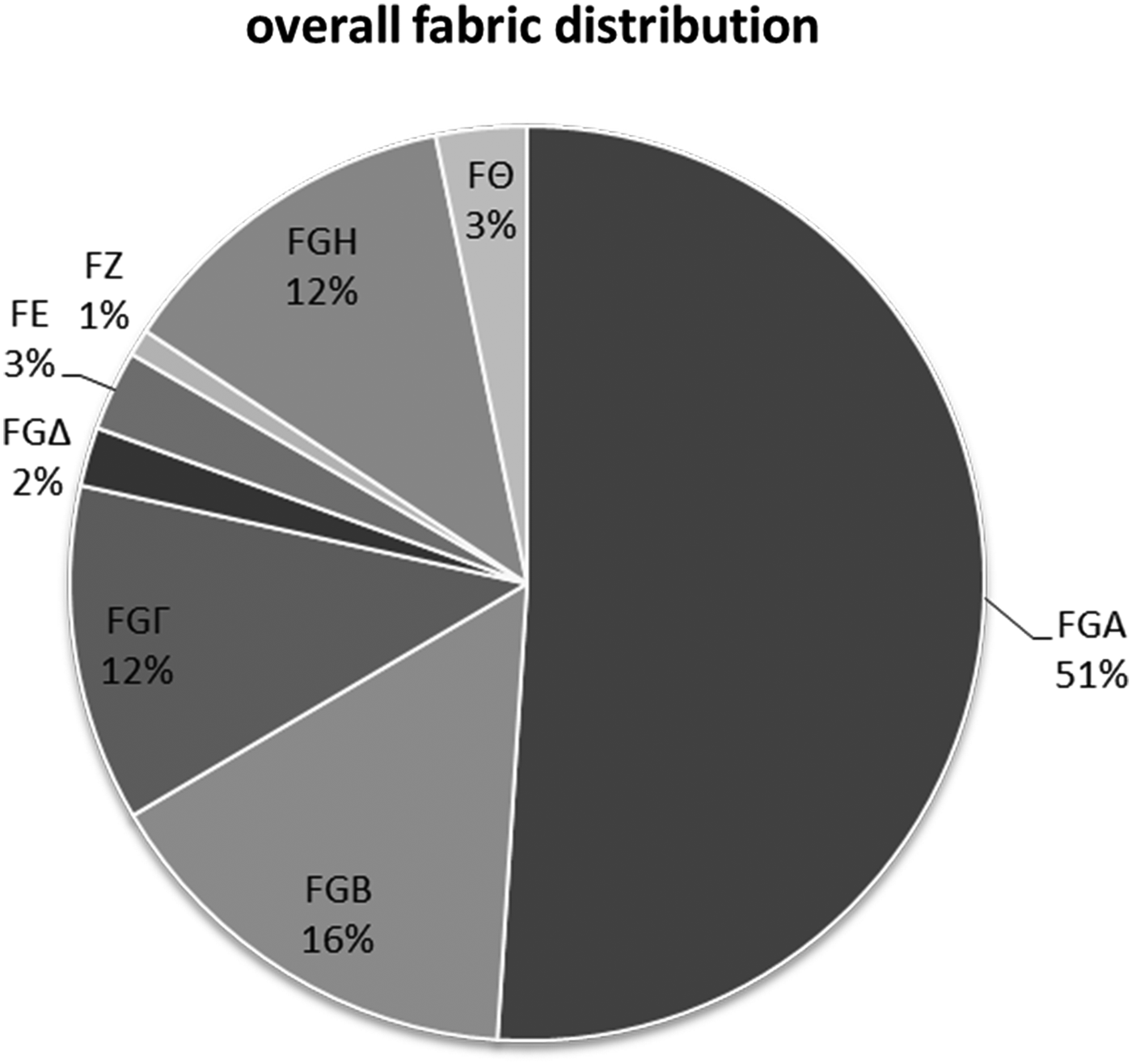
Three out of eight fabric groups and individual fabrics from Panaghia Koimisis – A, B, and Δ – were identified as Theran fabrics and might represent pottery produced in the wider vicinity of Akrotiri and brought to the site. The overall frequency of the fabrics demonstrates the prevalence of the low-calcareous fabric group A, since it represents over fifty per cent of the total number of the sherds (Fig. 8).Footnote 5 The calcareous fabric group B comprises 16 per cent of the assemblage, while only two per cent is correlated with fabric group Δ. The prevalence of the Early Cycladic fabric group A indicates that Panaghia Koimisis was intensively inhabited during the Early Cycladic period.
Overall frequency of the fabric groups (FG) and individual fabrics (F) at Panaghia Koimisis.

With regard to the origin of the raw materials of these fabrics, we must stress that exploitable clays did not occur on Therasia in the Bronze Age, and thus sources have to be detected elsewhere (see the section ‘Geological background’ above). The coexistence in all three fabric groups of volcanic and metamorphic rock fragments attests that the raw materials’ sources, and the potential exploited clays, were located in the southern part of Thera and the wider vicinity of Akrotiri. The additional occurrence of microfossils in fabric group B, deriving from the fossil-bearing tuffs, further supports this claim. Besides this, all three have similarities (compositionally and texturally) with clay recipes identified as having been produced locally in the broader area of Akrotiri. In short, primary clays were used and higher and lower calcareous clay pastes were prepared. Clay-mixing and tempering practices were possibly used for the clay paste preparation of fabric groups B and Δ. Variable firing atmosphere conditions and temperatures were observed even within the same fabric. The surface treatment of the sherds of these fabrics corresponds well with the surface treatment of similar fabrics from Akrotiri.
On the other hand, the possibility that the wider area of Akrotiri was the place where the raw materials were exploited, but not necessarily the actual region of pottery production for the pots consumed at the site, cannot be ruled out. Possibly, potters belonging to a common Theran potting tradition and operating in the wider area of Panaghia Koimisis might have exploited the same clay resources as potters from the broader area of Akrotiri (for a discussion of the pottery production on Thera, see Hilditch Reference Hilditch2008, 275–80).
Concerning the imported pottery, substantial amounts of Naxian pots (associated with the rich-in-granite fabric group Γ) were recorded, comprising 12 per cent of the total pottery (Fig. 8). Fabric group H also comprises 12 per cent of the assemblage and the vast majority of the sherds of this group seems to be Iotic in origin.Footnote 6 More particularly, an Iotic origin seems fairly possible for the garnet-bearing fabrics H1 and H2, and a Keian one for fabric H3. Other Cycladic islands, such as Syros, Kythnos, Siphnos and Seriphos, constitute candidates for the origin of these fabrics. Such islands are characterised by a geological range compatible with the composition of the pottery fabrics, but little petrographic work has been carried out to confirm this. Further investigation is needed to clarify the origin of fabric H4.
Other imported fabrics are less common within the ceramic assemblage. Fabric E, associated with the talc ware and very likely originating on Siphnos or Serifos, represents three per cent. Fabric Z is notably uncommon, comprising only one per cent of the total sherds. Due to its tiny quantities within the assemblage and to similarities with the rich-in-pyroclastic inclusions fabrics from Melos, a Melian provenance is most likely, although an argument can still be made for a Theran origin. With regard to the provenance of the phyllite-rich fabric Θ, which constitutes a modest three per cent, an origin from the neighbouring Amorgos seems quite likely.
Based on the overall frequency of the fabrics, it is clear that fairly high amounts of Naxian imports were consumed at Panaghia Koimisis. Comparative petrographic data confirmed intensive pottery exchanges between Akrotiri and Naxos throughout the entire Cycladic period (Hilditch Reference Hilditch2008; Müller, Kilikoglou and Day Reference Müller, Kilikoglou, Day, Spataro and Villing2015, 39). Similarly, there were many pots from the neighbouring Ios and surprisingly few from the adjacent Amorgos. The modest frequency of the talc ware (fabric E) within the survey assemblage corresponds well with its frequency in Early Cycladic Akrotiri (Broodbank Reference Broodbank2007, 127; Sotirakopoulou Reference Sotirakopoulou1999, 71, 497–9). This indicates that Panaghia Koimisis, as is the case for Akrotiri, might belong to that group of places with higher concentrations of talc ware (for more, see Broodbank Reference Broodbank2007, 127; Vaughan and Wilson Reference Vaughan, Wilson, Zerner, Zerner and Winder1993, 182–3). Clear indications for the consumption of Melian pots are extremely limited, and interestingly none of the fabrics at the site could be associated with Cretan pottery fabrics, at least in terms of the survey assemblage.Footnote 7
This research confirms major changes in Theran pottery production between the Early and Middle Cycladic periods, as previous studies on pottery from Akrotiri demonstrated (Hilditch Reference Hilditch2008; Müller Reference Müller2009; Vaughan Reference Vaughan, Hardy, Doumas, Sakellarakis and Warren1990). A prevalent potting tradition related to the production of low-calcareous fabrics (associated with fabric group A) was verified for the Early Cycladic period at Panaghia Koimisis. This type of fabric correlates with plain and monochrome-slipped sherds and includes various shapes, such as bowls, cooking pots, storage vessels and other large open pots, as well as a few closed pots and spindle whorls. The overall frequency of the fabrics at the site suggests the total absence of Theran, low-calcareous, fabrics during the late Middle Cycladic period and continuity in the predominance of the pale, higher calcareous fabrics (associated with fabric group B). The pale fabrics correlate with a large spectrum of wares, such as plain, monochrome-slipped, dark-on-light pattern-painted and bichrome-painted sherds, and are comprised of cooking pots, pithoi and bowls, as well as a few closed pots. Based on comparative analytical data, this shift towards more calcareous clay pastes starts emerging in Akrotiri at the very end of the Early Cycladic period and the beginning of the Middle Cycladic phase, leading to a prevalence of the pale, higher calcareous, fabrics by the late Middle Cycladic phase (Hilditch Reference Hilditch2008, 261; Müller Reference Müller2009; Müller, Kilikoglou and Day Reference Müller, Kilikoglou, Day, Spataro and Villing2015, 39; Nikolakopoulou et al. Reference Nikolakopoulou, Georma, Moschou, Sofianou, Brodie, Doole, Gavalas and Renfrew2008).
In conclusion, during the Early and Middle Cycladic periods the prehistoric communities of Panaghia Koimisis and Akrotiri interacted intensively through the circulation of either pottery or raw materials. The possibility that the vast majority of the pottery consumed at Panaghia Koimisis was produced at Akrotiri is high. However, the hypothesis that local potters might have operated in the wider area of Panaghia Koimisis is also probable, at least during the Early Cycladic period, when the site was a more extensive settlement. According to this theory, potters from both Panaghia Koimisis and Akrotiri exploited the same clay sources, available within the southern peninsula of Akrotiri, and produced the pots under a common, wider, Theran potting tradition. None of the pottery fabrics at Panaghia Koimisis could be attributed to a distinct, possibly local, potting tradition in terms of raw materials used, pottery technology (exploitation and manipulation of the raw materials, preparation of the clay pastes and firing) and surface treatment. Generally, until structures associated with pottery production are found on Therasia and Thera, the question of whether Panaghia Koimisis was a place for pottery production or a place for pottery consumption remains open.
The considerable change in the Theran potting tradition, from low-calcareous Early Cycladic fabrics towards pale, higher calcareous, late Middle Cycladic fabrics, could reflect a strategic shift into specialised productions, such as into the exclusive manufacture of Cycladic White Ware. Additionally, exhaustion of clay reserves suitable for the production of the Theran low-calcareous fabrics might have caused the disappearance of this recipe.
A wide Cycladic pottery network is attested, well established from previous analyses, in which Panaghia Koimisis participated as a consumer. The comparative petrographic data supports the idea that vessels associated with the Theran low-calcareous Early Cycladic fabrics were not exported. Pottery from particular neighbouring islands, such as Naxos and Ios, was intensively consumed at the site, as opposed to others (e.g. Amorgos and Melos) from which there were very few imports, at least within the survey pottery. This might reflect preferences of the consumers for particular goods and possibly might indicate specific affiliations with certain islands. Pots from more distant islands, such as Kea, were also consumed at Panaghia Koimisis. The amount of talc ware in the settlement is equal to that of Akrotiri and thus supports the possibility that some imports might have come directly to the settlement, at least during the Early Cycladic period. On the other hand, indications for intensive consumption of Cretan products at Panaghia Koimisis are so far limited, in contrast to the picture from Middle Cycladic Akrotiri (Hilditch Reference Hilditch2008; Knappett and Nikolakopoulou Reference Knappett, Nikolakopoulou, Laffineur and Greco2005; Knappett et al. Reference Knappett, Pirrie, Power, Nikolakopoulou, Hilditch and Rollinson2011). Marthari (Reference Marthari and Danezis2001, 113) observes that there is an absence of Minoan pottery imports at other small sites, such as Ftellos and Aghios Ioannis Eleimon, as well. From this we can infer that in Akrotiri there was some filtering and funnelling of at least some of the imports, reflecting particular pottery consumption strategies on pre-eruption Thera during the Middle Bronze Age. Yet it may also imply that the extensive Early Cycladic settlement gradually became more limited in nature, with less access to imports, as is demonstrated by the smaller amount and more limited distribution of Middle Cycladic pottery recorded in the survey. Possibly, this could also reflect wider transformations in the settlement pattern within and across Thera over time, which finally led to the prevalence of Akrotiri and the weakening of other sites of pre-eruption Thera, such as Panaghia Koimisis, at the end of the Middle Cycladic period (for a general discussion, see for example Marthari Reference Marthari and Danezis2001; Nikolakopoulou et al. Reference Nikolakopoulou, Georma, Moschou, Sofianou, Brodie, Doole, Gavalas and Renfrew2008, 322). Hopefully, the excavation that started in 2014 at Panaghia Koimisis, and future systematic technological and provenance analysis on stratified sherds found there, will shed more light on some issues that seem to emerge from the current analysis and will be further tackled in future studies.
ACKNOWLEDGEMENTS
The ‘Island Cultures in a Diachronic Perspective: the case of Therasia’ was co-funded by the European Union (European Social Fund – ESF) and Greek national funds in the context of the Operational Program ‘Education and Lifelong Learning’ of the National Strategic Reference Framework (NSRF) 2007–2013, I.D. 687, Mis: 377272. We would like to thank the Greek Ministry of Culture for the issuing of the relevant sampling permit. Moreover, we would like to express our thanks to the Institute for Aegean Prehistory (INSTAP) for their financial support for the petrographic study of the pottery and the ongoing excavation at Panaghia Koimisis.