I. INTRODUCTION
Aniline is a basic raw material for the production of methylene diphenyl diisocyanate (MDI), rubber chemicals, dyes, and pharmaceuticals. The industrial production of aniline is mainly carried out by catalytic hydrogenation of nitrobenzene.Reference Li, Yu, Yao, Ji and Liang1 The use of supported Raney Ni catalysts in the hydrogenation of nitrobenzene has attracted great interest due to their high activity and low price.Reference Chen, Yao, Wang and Zhang2–Reference Wang, Yuan, Nie, Hou and Zheng4 However, the drawbacks of high temperature, high H2 pressure, and low reaction rate for Raney Ni catalysts limit their application to a large extent.Reference Relvas, Andrade, Freire, Lemos, Araujo, Pinho, Nunes and Ribeiro3,Reference Wang, Yuan, Nie, Hou and Zheng4 Noble metals (Pt, Pd, Rh, etc.) are known for their high activity and selectivity in hydrogenation reactions, but their wide applications are restricted by their high cost and scarce source.Reference Perez, DeLecea and Solano5–Reference Sangeetha, Shanthi, Rao, Viswanathan and Selvam7 Developing highly dispersed supported catalysts with high activity and selectivity has been suggested to be one of the alternatives in the utilization of noble metal catalysts.Reference Wildgoose, Banks and Compton8,Reference Georgakilas, Gournis, Tzitzios, Pasquato, Guldi and Prato9 In the last decades, extensive efforts have been made toward the synthesis of cost-effective and highly active catalysts in the hydrogenation of nitrobenzene using noble metal catalysts.
Activated carbon (AC) is a widely used support in heterogeneous reactions because of its low cost, high specific surface area, and resistance for acidic and basic media.Reference Perez, DeLecea and Solano5,Reference Gurrath, Kuretzky, Boehm, Okhlopkova, Lisitsyn and Likholobov10,Reference Jin, Qian, Liu, Wei, Wang and Zhang11 The main problem of AC as catalyst support is the presence of abundant micropores, which lead to the steric hindrance for reactants to contact the active sites.Reference Gurrath, Kuretzky, Boehm, Okhlopkova, Lisitsyn and Likholobov10 As one of the advanced carbon materials, carbon nanotubes (CNTs) have attracted extensive attention owing to their intrinsic properties, such as high surface area, unique physical properties and morphology, high electrical conductivity, and complete absence of micropores, which make them extremely attractive as supports for heterogeneous catalysis.Reference Serp, Corrias and Kalck12 CNTs supported Pd catalysts have received particular attention because of their outstanding activity and selectivity in a variety of reactions, including C–C bond formation,Reference Chen, Hou, Wang, Cao and He13–Reference Yoon and Wai15 selective hydrogenation,Reference Tessonnier, Pesant, Ehret, Ledoux and Pham-Huu16 pollutant degradation,Reference Chen, Yang, Liu and Wang17 and fuel cellReference Krishna Kumar and Ramaprabhu18 reactions.
So far, several methodologies have been developed for the preparation of Pd/CNTs catalysts, including electroless deposition,Reference Ang, Hor, Xu, Tung, Zhao and Wang19 microemulsion,Reference Yoon and Wai15,Reference Wang, Pan and Wai20 thermal deposition,Reference Verde, Keer, Miki-Yoshida, Paraguay-Delgado, Alonso-Nunez and Avalos21 surfactant self-reduction,Reference Lee, Huang, Kuo and Lin22 supercritical CO2,Reference Sun, Liu, Han, Miao, Miao and An23 ethylene glycol reduction,Reference Chen, Hou, Wang, Cao and He24 and arc-discharge in solution.Reference Bera, Kuiry, McCutchen, Kruize, Heinrich, Meyyappan and Seal25 While these strategies are effective to anchor Pd nanoparticles (NPs) on CNTs, a close examination of them reveals that they involved either a sophisticated synthetic procedure or complex equipment to achieve high dispersion of Pd NPs on CNTs. Electrochemistry has been demonstrated to be a powerful technique for the preparation of Pd/CNTs catalysts, being both rapid and facile, and thus allowing the chemist to easily control the nucleation and growth of metal NPs.Reference Guo and Li26,Reference Tang, Chen, Huang, Wang, Ren, Nie, Kuang and Yao27 However, the main disadvantage of using electrochemistry to prepare Pd/CNTs catalysts is that bulk production is very difficult.Reference Guo and Li28 In an early study,Reference Chen, Hu, Zou, Shao and Wang29 a phase transfer method was devised to prepare Pd/CNTs catalysts, where benzyl mercaptan was used to bridge Pd NPs and CNTs. However, this method is restricted by the following shortages: (i) benzyl mercaptan is expensive and harmful to human health and environment; (ii) benzyl mercaptan would poison and deactivate the catalysts in some reactions. Therefore, a cost-effective and environmentally benign method for preparing Pd/CNTs catalysts is still highly desirable.
In this paper, we demonstrated the preparation of CNT supported Pd NP catalysts based on a hydrogen-bonding self-assembly (SA) method. The whole process was carried out in benign aqueous medium at room temperature, without using any organic solvent and/or non-degradable surfactants. We have examined its catalytic potential in hydrogenation of nitrobenzene with promising industrial applications; the as-prepared catalysts exhibited high activity and selectivity in the hydrogenation of nitrobenzene. The recycling experiments indicate that the catalysts can be used consecutively at least five times, without significant loss in activity and selectivity.
II. EXPERIMENTAL
A. Materials
Trisodium citrate dehydrate (99%) and sodium borohydride (98%) were purchased from Alfa Aesar (Tianjing, China). Palladium(Ⅱ) chloride (ReagentPlus®) was procured from Sigma-Aldrich and used as received. Multi-walled CNTs (above 99 wt% purity) were purchased from Chengdu Institute of Organic Chemistry (China). (AC, AR), Al2O3 (AR), SiO2 (AR) and MgO (AR) were obtained from Sinopharm Chemical Reagent Co., Ltd. (Shanghai, China). All the solutions were prepared using deionized water.
B. Preparation of Pd NPs
Pd NPs were prepared according to Zhou and Lee’sReference Zhou and Lee30 method with a slight modification. Details of the preparation of Pd NPs in this work are as follows: under vigorous stirring, 0.084 g of trisodium citrate was dissolved in 61.5 mL of deionized water followed by the addition of 18.6 mL of PdCl2 aqueous solution (1.0 g/L). At this condition, the molar ratio of citrate/Pd salt was 3.10. Subsequently, an excess of freshly prepared ice-cold NaBH4 aqueous solution (0.1 M, 2 mL) was added to the above solution, the color of the solution became dark brown immediately indicating the formation of Pd NPs (4.3 nm). The Pd NP suspensions with different sizes were prepared by controlling the molar ratio of citrate/Pd salt at 6.52, 3.10, and 0.85, respectively.
C. Preparation of catalysts
About 0.1 g of CNTs was dispersed in 100 mL of deionized water through a short sonication process (∼10 min). The as-prepared Pd NP suspension with different sizes was added to the above CNT suspension under vigorous stirring. After 10 h, the aqueous phase in the mixture became colorless, suggesting that Pd NPs have assembled on CNTs. The sample was then filtered, washed thoroughly with deionized water, and dried overnight at 60 °C in a vacuum. The catalysts prepared by this method were denoted as Pd/CNT-SA-3.6, Pd/CNT-SA-4.3, and Pd/CNT-SA-6.0 where the figures represent the Pd particle size.
For comparison, Pd/CNT catalysts were also prepared by the conventional impregnation method (denoted as Pd/CNT-IM). In a typical procedure, 0.1 g of pristine CNTs was suspended in PdCl2 aqueous solution (1.0 g/L). After sonication at room temperature for about 10 min, the suspension was dried overnight at 120 °C. The sample was then calcined at 300 °C for 3 h and reduced with hydrogen at 250 °C for 2 h. Pd catalysts supported on conventional supports such as AC, Al2O3, SiO2, and MgO were prepared by the same procedures as above.
D. Catalyst characterization
Brunauer–Emmett–Teller (BET) measurements were performed on a Micromeritics ASAP 2020 instrument at liquid nitrogen temperature. The morphology of the Pd/CNTs catalysts was determined with a JEOL 2010 transmission electron microscope (TEM; Tokyo, Japan) equipped with a LaB6 filament at 200 kV and an energy dispersive x-ray analyzer (EDX, phoenix). X-ray diffraction (XRD) patterns were obtained by a PANalytical X’Pert PRO x-ray diffractometer using Cu Kα radiation. X-ray photoelectron spectroscopic (XPS) analysis was performed on a VGESCALAB 210 spectrometer with Mg Kα radiation (hv = 1253.6 eV). The binding energies were calibrated by placing the C1s peak at 284.6 eV. Inductively coupled plasma atomic emission spectrometry (ICP-AES, ARL 3520) was used to determine the Pd content in the catalysts. All the samples measured were dissolved with aqua regia.
E. Catalytic test
Catalytic measurements were performed in a stainless steel autoclave batch reactor (50 mL). In a typical experiment, 0.025 g of the catalyst, 9.5 g of the solvent (ethanol) and 0.5 g of nitrobenzene were put into the reactor and purged 30 times with H2 at room temperature. The reaction was then carried out at 40 °C and a H2 pressure of 1 MPa for 15 min under vigorous stirring (1000 rpm). The pressure in the reactor gradually dropped, indicating the conversion of nitrobenzene. When the reaction was completed, the catalysts were separated from the products by centrifugation (3000 rpm), washed thoroughly with ethanol three times, and then reused in the next catalytic cycle under the same conditions. For comparison, 6.6 mL of neat Pd NP suspension (4.3 nm) containing the same amount of Pd in Pd/CNT-SA-4.3 (25 mg) was added to perform the reaction. The composition of the products was determined by gas chromatography (PerkinElmer Autosystem XL, Perkin-Elmer Corporation, Norwalk, CT) equipped with a flame ionization detector (FID) and a SE-54 capillary column. The products were further confirmed by GC-MS (Agilent 6890N/5973N, Aglient Technologies, Inc., Wilmington, DE).
III. RESULTS AND DISCUSSION
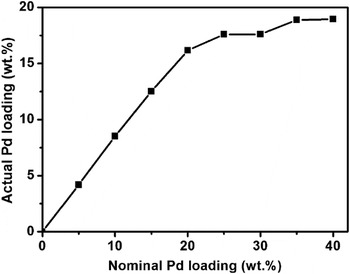
In this work, the Pd NPs prepared by using sodium citrate as the capping agent can be well dispersed in water to form a colloid solution. The colloid solution is very stable, and no aggregation was observed by keeping it at room temperature even for 3 months. The size of these NPs, as shown in previous studies,Reference Zhou and Lee30 can be adjusted in the range of 3–6 nm. Upon mixing with CNTs, which was dispersed in water by ultrasonication, Pd NPs would be anchored on the surface of CNTs, as witnessed by the disappearance of the color of the colloidal solution. To determine how much Pd NPs had been anchored on CNTs, the actual Pd loadings in the final products, which were determined by ICP-AES, are plotted as a function of the relative amount of Pd NPs (4.3 nm) to CNTs in the mixture (nominal Pd loading). As shown in Fig. 1, the actual Pd loading increases linearly with the nominal Pd loading as the nominal Pd loading is less than 20 wt%. More than 81% Pd NPs would be adhered to CNTs in this nominal Pd loading range. However, as the nominal Pd loading is increased above 20 wt%, the actual Pd loading on CNTs increases slightly, suggesting that the density of Pd NPs on CNTs was nearly saturated. Therefore, using this SA method, the Pd loading in the catalysts can be controlled in the range of 0–19 wt%. The easy control of Pd loadings on CNTs would benefit the application of Pd/CNTs catalysts in heterogeneous catalytic reactions.
Evolution of actual Pd loading on CNTs as a function of nominal Pd loading.

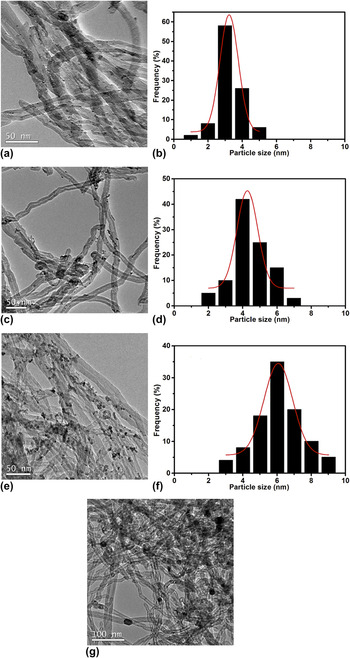
Another important advantage of the present method is that the size of Pd NPs on CNTs can be easily controlled as well, only by adjusting the molar ratio of citrate to Pd salt in the solution. Figure 2 shows typical TEM images, together with the histograms of Pd particle size distribution, for the catalysts with 10 wt% nominal Pd loading and with the molar ratio of citrate to Pd salt in the solution at 6.52, 3.10, and 0.85 respectively. It is clear that Pd NPs with narrow size distributions were deposited on the exterior surface of CNTs in all the samples. The average size and the size distribution of Pd NPs on CNTs were determined by the molar ratio of citrate to Pd salt in the solution. At a high molar ratio of citrate to Pd salt (6.52), the Pd/CNTs catalyst showed a small average Pd NP size and a narrow size distribution [Figs. 2(a) and 2(b)]. The average size of Pd NPs was increased, and the size distribution was slightly enlarged, by decreasing the molar ratio of citrate to Pd salt to 3.10 and 0.85 [Figs. 2(c)–2(f)]. It is noted that further decreasing the molar ratio of citrate to Pd salt below 0.5 did not form a stable colloidal solution of Pd NPs because of the lack of enough capping agents. Inversely, the stable colloidal solution of Pd NPs was not formed either, by increasing the molar ratio of citrate to Pd salt above 7 due to the high concentration of the electrolyte making the initially formed NPs in solution agglomerated.Reference Kim and Sigmund31,Reference Rance and Khlobystov32 Therefore, with the present method, the size of Pd NPs on CNTs can be tuned in the range of 3–6 nm. For comparison, the Pd/CNTs catalyst with 10 wt% nominal Pd loading was also prepared by the conventional impregnation method and characterized by TEM [Fig. 2(g)]. As expected, we find significant aggregation of Pd NPs on CNTs, with NP size distributed in the range of 5–80 nm.
TEM images and size distribution of Pd/CNT catalysts prepared by the SA method with the molar ratio of citrate to Pd salt in the solution at (a), (b) 6.52:1; (c), (d) 3.1:1; (e), (f) 0.85:1; (g) TEM image of Pd/CNT catalysts prepared by the conventional impregnation method.

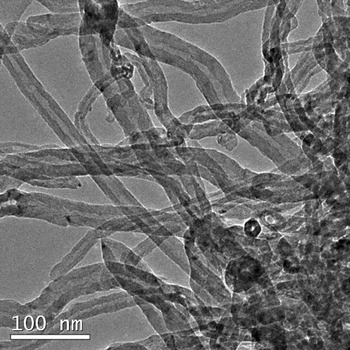
The interaction between Pd NPs and CNTs has been investigated for the assembled Pd/CNTs catalysts. To this end, the zeta potentials of the Pd NP colloidal solution (with the molar ratio of citrate to Pd salt equal to 0.85) and the pristine CNT suspension were determined by Zetasizer (Malvern Instruments Ltd., Malvern, Worcestershire, UK). The values, −40.6 mV for the Pd NP colloidal solution and −5.36 mV for the pristine CNT suspension, confirm that the electrostatic attraction between Pd NPs and CNTs can be ruled out. This is further supported by a control experiment, where HNO3-functionalized CNTs (zeta potential: −51.2 mV) were mixed with the Pd NP colloidal solution overnight. Interestingly, the color of the Pd NP colloidal solution remained nearly unchanged, implying that few Pd NPs were anchored on the HNO3-functionalized CNTs. This is further confirmed by TEM characterization (Fig. 3) showing that almost no Pd NPs were deposited on the surface of CNTs.
TEM image of Pd/CNT catalysts prepared using HNO3-functionalized CNTs.

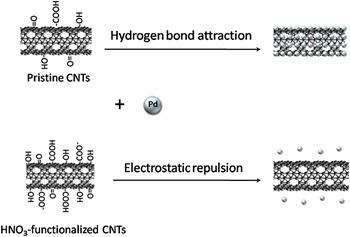
In addition to the electrostatic repulsion, the hydrogen bonding has also been demonstrated to be one of the interactions between NPs and CNTs.Reference Yang, Rochette and Sacher33 According to the earlier study by Yang and Sacher,Reference Yang, Sun, Dodelet and Sacher34 mild sonication of pristine CNTs in water could introduce ∼2 at.% O concentration on the surface of CNTs (alcohol, carbonyl, and acid). On the other hand, the Pd NPs in the colloidal solution were protected by oxygen-containing capping agents. Therefore, the hydrogen bonding might be the origin for the assembly of Pd NPs on pristine CNTs.Reference Yang, Sun, Dodelet and Sacher34 In this case, the hydrogen bonding and the electrostatic repulsion would be the main interactions between Pd NPs and CNTs in aqueous media. The hydrogen bonding was the predominant interaction for assembling Pd NPs on pristine CNTs while electrostatic repulsion outweighed the hydrogen bonding in the case of HNO3-functionalized CNTs. Scheme 1 describes the interaction between Pd NPs and pristine and HNO3-functionalized CNTs.
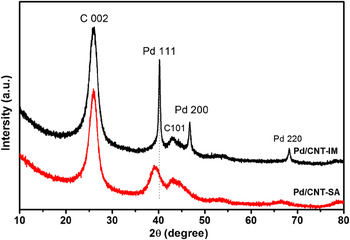
Figure 4 shows the XRD patterns of the Pd/CNTs catalysts prepared by SA and impregnation methods respectively. Characteristic diffraction peaks at 25.9° and 43° are observed for both samples, which correspond to the (002) and (101) reflections of graphite, respectively.Reference Chen, Yang, Liu and Wang17 The diffraction peaks attributed to (111), (200), and (220) crystal planes of metallic Pd are also observed for both samples.Reference Zhu, Kang, Zou, Zhou, Zheng, Xia and Yang35 It is noted that these Pd diffraction peaks shift slightly negatively for the sample prepared by the SA method as compared to the impregnation sample. This phenomenon is associated with the lattice contraction of small particles in the sample prepared by the SA method.Reference Aruna, Mehta, Malhotra and Shivaprasad36 According to Scherrer formula, the average Pd NP size is estimated to be 4.2 nm for the Pd/CNT-SA-4.3 and 28.0 nm for the Pd/CNT-IM, well consistent with the TEM results shown in Figs. 2(c) and 2(g), respectively.
XRD pattern of Pd/CNT catalysts prepared by SA and conventional impregnation (IM) methods.

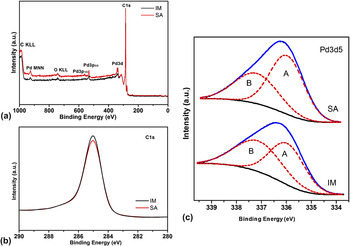
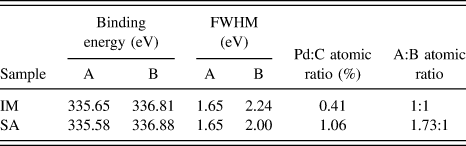
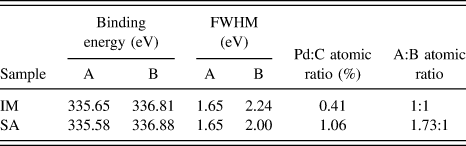
The Pd/CNTs catalysts prepared by SA and impregnation methods were examined by XPS to explore the oxidation states of various species in the catalysts. The wide survey spectra of XPS for both catalysts [Fig. 5(a)] showed Pd XPS and Auger transitions, in addition to the peaks corresponding to C and O. No trace of other heteroatoms was detected, suggesting the high-purity of the catalysts. XPS spectra of C1s for the two samples [Fig. 5(b)] were well-overlapped, except that the intensity of Pd/CNT-SA-4.3 was slightly reduced. The lower intensity of the C1s core level, along with the more intense Pd3d5/2 peak for Pd/CNT-SA-4.3 [Fig. 5(c)], can be attributed to the more uniform distribution of Pd NPs on Pd/CNT-SA-4.3 than on Pd/CNT-IM. Figure 5(c) shows the deconvolution of the Pd3d5/2 spectra, and the corresponding parameters used to fit the spectra are listed in Table I. The Pd3d5/2 XPS peaks were separated into two components, which can be attributed to metallic Pd (peak A) and palladium oxide (peak B), respectively.Reference Huang, Zuo, Han, Li and Zhao37,Reference Liu, Hou, Song, Jiang, Fan, Zhang and Han38 For peak A, both samples displayed the same peak width (FWHM), while for peak B, the peak width for Pd/CNT-IM was larger than that for Pd/CNT-SA-4.3, implying that the former is more easily oxidized when exposed to air. This is further supported by the atomic ratios of peak A to peak B (Table I), where Pd/CNT-IM showed a much lower A:B intensity ratio than Pd/CNT-SA-4.3. The higher content of Pd oxide in Pd/CNT-IM can be explained by the absence of the capping layer on the surface of the NPs. In contrast, the capping layer around Pd NPs in Pd/CNT-SA-4.3 can alleviate the oxidation of Pd NPs in air.
XPS spectra of Pd/CNT catalysts prepared by SA and conventional impregnation methods: (a) survey spectra; (b) C1s spectra; (c) Pd3d5/2 spectra.

XPS analysis of Pd/CNT-SA-4.3 and Pd/CNT-IM catalysts with 10 wt% Pd nominal loading.
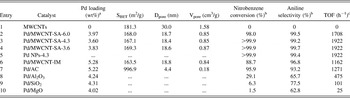
The performance of Pd/CNTs catalysts were tested in the hydrogenation of nitrobenzene and compared with the catalysts supported on conventional supports. Table II summarizes the results of catalytic tests along with the physicochemical properties of the catalysts. In the blank test, bare CNTs showed no activity, implying that Pd is the catalytically active species in the reaction. It is also found that the support played an important role in the performance of the catalysts. Among the supports investigated, carbon supports were the best, with a TOF value above 1000 h−1 during 15 min of the reaction, far greater than that for conventional oxide supports. The performance of catalysts was also determined by their preparation methods. Pd/CNT-SA shows higher activity and selectivity than Pd/CNT-IM and Pd/AC. The excellent performance of Pd/CNT-SA can be attributed to the smaller Pd NP size (Fig. 2) and the larger fraction of metallic Pd (Table I) on the surface of NPs. Furthermore, the high external surface area and the complete absence of micropores in CNTs can prevent significant mass transfer limitation, which contributes to the enhancement of catalytic performance. In contrast, the presence of a large fraction of micropores inside AC was expected to significantly hinder the reactant and product diffusion, resulting in a lower activity despite the high specific surface area of the catalyst.
Physicochemical properties of Pd catalysts supported on various supports and their performance in the hydrogenation of nitrobenzene.

a Determined by ICP-AES.
b Reaction conditions: catalyst 0.025 g; nitrobenzene 0.5 g; ethanol 9.5 g; reaction temperature 40 °C; reaction time 15 min; and H2 pressure 1 MPa.
c Mol nitrobenzene converted per mol Pd per hour.
To determine the size effect of Pd/CNT-SA on the catalytic activity, we have prepared three Pd/CNT-SA catalysts with different Pd sizes. As illustrated in Table II (entry 2–4), all Pd/CNT-SA catalysts provide relatively high selectivity to aniline (>99%). Pd/CNT-SA-6.0 exhibited a relatively lower activity (98.0%) than Pd/CNT-SA-4.3 and Pd/CNT-SA-3.6 catalysts (>99.9%). Based on the most accepted view, the smaller Pd Nps are expected to be the reasons for the high catalytic activity of Pd/CNT-SA-4.3 and Pd/CNT-SA-3.6 catalysts.
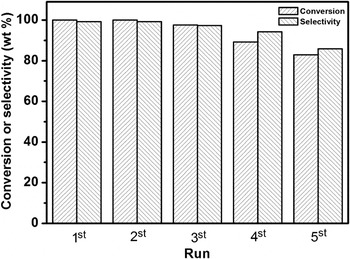
The lifetime and recyclability of catalysts are of great importance from economical and environment points of view. The neat Pd NP (4.3 nm) exhibited excellent activity and selectivity to this reaction (Table II, entry 5). However, Pd NPs-4.3 can be used only once as it is very difficult to recycle. A series of reaction cycles were run in order to investigate the lifetime and reusability of Pd/CNT-SA-4.3 in the hydrogenation of nitrobenzene. As shown in Fig. 6, the catalyst can be used three times without any loss in activity and selectivity. However, from the fourth reaction cycle, the activity and selectivity of the catalyst start to decline slightly with further increasing reaction cycles. The slight decrease of catalytic activity and selectivity can be attributed to Pd leaching during the reaction. Although hydrogen bonding is effective for anchoring of Pd NPs on CNTs, it is not robust enough to prevent metal leaching in the reaction conditions. Further investigations of strengthening the interaction between Pd NPs and CNTs to prevent Pd leaching during the reaction are necessary in the future.
Recyclability of Pd/CNT-SA-4.3 catalyst in the hydrogenation of nitrobenzene. Reaction conditions: catalyst 0.025 g; nitrobenzene 0.5 g; ethanol 9.5 g; reaction temperature 40 °C; reaction time 15 min; and H2 pressure 1 MPa.

Illustration of the assembly of Pd NPs on pristine and HNO3-functionalized CNTs.

IV. CONCLUSIONS
We have demonstrated the preparation of Pd/CNT catalysts with Pd NPs distributed in the range 3–6 nm by employment of a mild, green, and sustainable SA method. The whole process was carried out in benign aqueous solution at room temperature without using any organic solvents and nondegradable surfactants. The as-prepared Pd/CNTs catalysts show higher activity and selectivity in the hydrogenation of nitrobenzene than that of the catalysts prepared by the conventional impregnation method or supported on conventional supports and can be used at least five times without significant loss in activity and selectivity.