Morton Feldman's output in the 1950s and 60s included groundbreaking works that were composed and presented in an original notation on graph paper. Feldman was one of the first composers to present finished works on graph paper, and his earliest graphs seem to have been the very first examples, in modern musical history, of finished works for pitched instruments in which pitches were not specified. They may also represent only the second sustained attempt in the modern era, after Henry Cowell's ‘elastic’ works for dance, to introduce substantial indeterminacy into a group of musical works.Footnote 1
Feldman's graphs also deserve attention because they exerted a significant influence on the development of modern music. They greatly affected composers closely associated with Feldman, especially John Cage and Earle Brown, who would go on to become leading proponents of the use of graphic notations and indeterminacy in musical works.Footnote 2 Given this and their striking visual appearances, it is right to see Feldman's graphs – and not Cowell's elastic works, which were more conventionally notated – as the ultimate source of the spectacular growth in interest among composers in graphic notations and indeterminacy that flourished, especially in the United States and Europe, in the late 1950s and throughout the 1960s.
There are other reasons for interest in these graph works within the narrower field of Feldman studies. In terms of sheer numbers, the fact that the graphs represent approximately one-eighth of Feldman's currently published output means that a comprehensive understanding of his music as a whole is impossible without a detailed account of them. Also, his early aesthetic views are more clearly in action in them than elsewhere in his output, and his tendency to switch between using graph notation and other formats in the 1950s and 60s is a notable aspect of his development as a composer that demands an explanation.
It is more than just the paper Feldman used that connects the graphs with one another and makes it natural to view the resulting works as a single series, even though they were produced, sometimes only occasionally, over an extended period between 1950 and 1967.Footnote 3 Feldman's graphs are all indeterminate, in that they do not specify in detail some of those parameters that tend to be prescribed most exactly in traditional works of Western classical music, and they are his only indeterminate works in which pitch is not fully notated.
A striking aspect of Feldman's graph series is that it is punctuated by a lengthy period of more than four years, which stretched from the end of 1953 until the autumn of 1958, in which no graphs were composed. This period is unlike the gaps between other graphs in the series, not only because it is longer, but also because Feldman subsequently characterized it as connected with a temporary loss of faith in the efficacy of his graph format. In his most important surviving statement about the course of the graph series in this period – written to accompany the LP record Feldman–Brown, which was released in 1962 – Feldman described how, after producing graph music for several years, he began to discover its ‘most important flaw’, which was that it was ‘liberating the performer’ and encouraging an ‘art of improvisation’.Footnote 4 The implication was that performers were not producing the type of sounds that he had envisaged. Their efforts, he said, ‘sounded bad’, and this was why he had ‘abandoned’ this type of music and the graph notation in which he had presented it in 1953.Footnote 5 However, he went on to explain that, notwithstanding his previous reservations, he subsequently returned to it in 1958. His account of the intervening years and his decision to resuscitate his graph music was as follows:
Between 1953 and 1958 the graph was abandoned. I felt that if the means were to be imprecise the result must be terribly clear. And I lacked that sense of clarity to go on. I hoped to find it in precise notation, i.e. ‘Extensions for Three Pianos’ etc. But precision did not work for me either. It was too one-dimensional. It was like painting a picture where at some place there is always a horizon. Working precisely, one always had to generate the movement – there was still not enough plasticity for me. I returned to the graph with two orchestral works. ‘Atlantis’ (1958) and ‘Out of Last Pieces’ (1960), using now a more vertical structure where soloistic passages would be at a minimum.Footnote 6
This is Feldman's principal surviving account of his decision to recommence composing graph music, which was a turning point in his career that would impact his subsequent output for almost a decade.Footnote 7 Yet it is hardly perspicuous. What did he mean by suggesting that the works he had previously composed in conventional notation lacked ‘plasticity’ and that his newer graphs possessed ‘a more vertical structure’? Also, the account is incomplete and at least partially inaccurate in ways not previously highlighted in the secondary literature. For example, it does not explain why he decided to resuscitate his graph format instead of simply continuing to use his newer notations for fixed pitches and flexible durations, which he had begun working with in 1957,Footnote 8 and which we know he regarded as rhythmically superior.Footnote 9 More surprisingly, it omits any mention of Ixion, a published graph work for a large ensemble of three flutes, clarinet, horn, trumpet, trombone, piano, cellos, and double basses, which is dated August 1958.Footnote 10 A comparison between completion dates given in Feldman's graph scores suggests that it was this work, which was composed to accompany Merce Cunningham's dance Summerspace, that marked Feldman's return to graph notation in 1958 and not Atlantis, which was the earlier of the two graphs mentioned in his 1962 liner notes and which was in fact completed in 1959.Footnote 11
In addition to these failings, his account ignores the role the broader musical context may have played in his decision. Although Feldman had previously ‘abandoned’ graph music, the unusual presentation and indeterminate character of his graphs were precursors of the escalating interest in musical indeterminacy and graphic notations in his circle of friends and acquaintances in the mid-1950s. It is reasonable to suppose that this escalating interest in a form of music that he had been influential in developing helped to foster in him a renewed enthusiasm for his graphs at this time.
For example, 1957 saw première performances of some of the first indeterminate works from Europe, with David Tudor – a friend of Feldman's since the 1940s – giving the first performance of Karlheinz Stockhausen's Klavierstück XI at Carl Fischer Hall in New York City in April and Pierre Boulez giving the first performance of his own Troisième Sonate for piano at the Darmstadt Internationale Ferienkurse für Neue Musik in September.Footnote 12 Also, Christian Wolff, another friend of Feldman's, who had previously experimented with indeterminacy in 1950, returned to it decisively in 1957 with his Sonata for three pianos and Duo for Pianists (I). The Sonata was premièred by Tudor, Cage, and William Masselos in New York City in April, and this was followed by the first performance of Duo for Pianists (I), given by Tudor and Cage at Harvard University in December.Footnote 13
In addition to these developments, and no doubt connected with them, Cage's own interest in indeterminacy and graphic notations intensified at this time. He had previously included elements of indeterminacy in his Music for Piano series and in the parts for the open-ended work he referred to as ‘The Ten Thousand Things’, but his interest in using graphic notations and including greater degrees of indeterminacy began to intensify in 1957, when he composed Winter Music for one to twenty pianos and began working on Concert for Piano and Orchestra, which he completed the following year.Footnote 14 This process would culminate in Cage's celebrated lecture on indeterminacy at Darmstadt in September 1958.Footnote 15
The absence of any mention of these contextual factors in Feldman's 1962 liner notes is understandable, given its intended purpose as a device for promoting his own music. His failure to explain why he resuscitated his graph format rather than simply continuing to work with fixed pitches and flexible durations is explicable as an unintended oversight or as precluded by limitations of space.Footnote 16 However, the absence of any mention of Ixion in his text is more difficult to explain. Early in 1960, after finishing Atlantis the previous autumn, Feldman transcribed Ixion for two pianos,Footnote 17 probably because Cunningham needed a version of the music that would make performances of Summerspace outside New York City commercially feasible.Footnote 18 This derivative work, which is also presented in graph format, is the only transcription that Feldman ever published. His failure to mention it, even though it predated …Out of ‘Last Pieces’, which he did mention, increases the extent of his oversight. It also marks out Ixion as special within his output; arguably, this makes it even less likely to have been forgotten by him.Footnote 19
The suggestion that Feldman regarded Ixion as of lesser importance than either Atlantis or …Out of ‘Last Pieces’ and therefore chose not to mention it in a brief synopsis of his career is difficult to accept. The fact that he went to the trouble of transcribing it, the fact that Ixion and the transcription of it were both published and not – like many other works he completed – withheld, and the fact that there are many apparent similarities between Ixion and Atlantis, both in terms of presentation of the score and sound in performance, all suggest otherwise.
Yet another explanation, and the one favoured here, is that including Ixion would have complicated his account of his return to graph music in ways he may not have had the space or inclination to address. For the true story of his return to graph music, which can be partially reconstructed through analysis of published and archival materials, is, as this article will demonstrate, significantly more complex than Feldman's 1962 liner notes suggest.
This article aims to present a more accurate account of the factors that caused this important change in Feldman's direction in 1958 – one that explains why he acted as he did and why, subsequently, he may have chosen not to highlight some of the contributory elements. This account will reveal a previously undocumented graph that marked Feldman's true point of return to graph music, which was subsequently used by Cage, only a month or so before he appeared at Darmstadt in 1958, to derive the published graph now known as Ixion. This previously undocumented graph, some of whose properties can be inferred from surviving materials, differed from those that have been published by being ‘elastic’ in the sense of that term previously introduced by Cowell. This alternative history will also explain how Robert Rauschenberg inadvertently affected the sound of Feldman's later graphs for several years, why Feldman subsequently likened Ixion to an ‘oilcloth’,Footnote 20 and why Ixion in its published form deviates from his other graphs in lacking any indication of tempo and by including repeated or near-repeated groups of symbols. A concluding section draws on this account and highlights unexpected areas of flexibility available to those intending to perform Feldman's music for Cunningham's Summerspace.
Alternatives to graph notation
In his 1962 liner notes Feldman explained that he returned to graph notation after experiencing difficulties while attempting to ‘generate the movement’ in his conventionally notated works. This suggests that in 1958 he regarded his graphs as rhythmically superior to his conventionally notated works from the immediately preceding period, but in what way?Footnote 21 Evidently he was not thinking of his earliest graphs – his Projections – as in them entrances and note durations are formally tied to a steady pulse. It is likely that he was thinking of his subsequent Intersections, in which he introduced a bracket notation that allows the performer to enter at any time within an indicated period.
However, it seems that Feldman was not entirely satisfied with this innovation. In a lecture on his own music delivered in 1972, he explained the genesis of his methods of notating flexible durations for sounds with precisely specified pitches, which emerged in 1957, and suggested that his dissatisfaction with the rhythmic organization of his earlier works extended not only to those that were conventionally notated but also to his Intersections:
In 1950 I began writing a music that gave the choice of pitches to the performer. […] His rhythmic possibilities were pretty much controlled. What I want to emphasise is that my conception of time was still very much limited […] very much related to a steady beat or pulse. The directions to the player told him to enter either on the beat, represented by a box, or off the beat. The metronome markings were consistent throughout each of these compositions. This aspect of my graph music always disturbed me. I couldn't understand, and still can't, how I could give up all control of pitch and not the rhythmic frame that it takes place in.Footnote 22
He went on to explain that the perceived problem with rhythmic aspects of conventionally notated music and his Intersections was
that the rhythmic placement of my sounds never seemed just right. It was years later that I realised that it was […] this aspect of trying to set something into a steady pulse which seemed so contradictory to the music I was writing.Footnote 23
Feldman's position is probably best understood in terms of a perceived inability to anticipate, to the extent that he wished, aspects of the morphology of actual sounds in performance, which he termed their ‘shape’ or ‘proportions’.Footnote 24 His aim was to create a natural sense of flow or movement, which he once referred to as ‘the breathing of the sound itself’, by harnessing aspects of this morphology,Footnote 25 but the difficulty he confronted was that the properties he wished to harness are, in practice, unpredictable. This is because they depend on contextual factors, such as the character of the instrument being played, the way in which the performer plays the instrument, properties of the performing space, and prevailing atmospheric conditions.
From this perspective, placing sounds relative to a regular pulse in conventional staff notation – which, in his 1962 liner notes, he compared with the suffocating effect of traditional illusionistic methods of unifying an image by portraying spatial relationships within it from a single viewpoint – was tantamount to force-fitting unpredictable, potentially irregular elements into a contrived regularity, riding roughshod over aspects of their morphology that he wished to harness in creating a natural sense of flow; it was in this sense that he conceived of conventional notation as lacking what he termed ‘plasticity’ and forcing him to ‘generate’ movement rather than to discover it in the sounds. Although Feldman regarded the bracket notation of the Intersections as superior, because it gave the performer a limited degree of flexibility to mould aspects of rhythm during performance, his perspective was that this was not enough. His reservation cannot have been that the performer is required to sustain each sound until the end of the bracket in which it occurs, thereby anchoring its endpoint to the beat, as this constraint was too easily relaxed. Instead, the difficulty as he saw it was that the imposition of a pulse transformed the grid into a temporal framework that was simply too rigid to accommodate unpredictable, potentially irregular elements.
The solution favoured by Feldman in 1957 was to reduce substantially the precision with which durations were specified in pieces with precisely notated pitches. Feldman said very little in print about how this was supposed to help, but his idea seems to have been that it would allow each individual performer to determine an appropriate rhythm during a performance in view of the morphologies of sounds they were producing.Footnote 26 If the performer was sufficiently sensitive, then this would enable them to discover a natural sense of movement of the type that he sought.
This assessment raises two questions about Feldman's views at this time, neither of them addressed in his surviving comments. One concerns the nature of the link that he envisaged between morphology and movement in his works with precisely notated pitches and flexible durations. Any satisfactory account of this link seems likely to connect it with Feldman's interest in the decay of sounds, which he emphasized in the 1960s.Footnote 27 The account favoured here is that the movement he sought was, in many cases, to derive from the periodic variation in the amplitude of a sequence of sounds from a single instrument, each of which is allowed sufficient space for its decay to be, or begin being, heard when they are presented as a contiguous series. The amplitude of each individual sound begins low, rises to a maximum level, and subsequently fades away gradually. Consequently, a contiguous sequence of such sounds generates an undulating envelope of sound, provided that each sound is given sufficient space. It was these undulations, from low to high amplitude and gradually back to low amplitude, which in many cases underpinned the natural sense of movement that he was seeking. For example, this conception is implicit in the notes provided with many of the works he produced in 1963, which generally included words to the effect that each instrument should enter when the preceding sound begins to fade.
A second question is why Feldman decided to resuscitate graph notation given that he appears to have had reservations at this time about its reliance on pulse. An alternative would have been to continue using his newer notations for fixed pitches and flexible durations which, by the time he resuscitated the graph format in 1958, he had been working with for approximately a year.
Probably Feldman was searching for a different kind of effect. In his works with fixed pitches and flexible durations, in which instruments are usually encouraged to proceed at their own pace after a synchronized start, he compared the sound he was aiming at to ‘a series of reverberations from a common sound source’.Footnote 28 In the graphs, by contrast, he evidently aimed to produce works in which he could explore the superposition of timbres in ways fully or partially controlled by him, without using conventional notation.
A desire to compose works for larger ensembles may have been another factor. Perhaps Feldman was initially uncomfortable with the idea of applying his notations for fixed pitches and flexible durations to larger instrumental combinations because he feared that a proliferation of uncoordinated activity might produce an overly chaotic effect. All his published works from 1957 to 1959 that use these notations are for small ensembles, and he did not produce a work of this type for a larger configuration until 1960, when he composed The Swallows of Salangan for chorus and chamber ensemble. By contrast, the graphs he produced immediately after resuscitating the graph format are for large ensembles.
The Summerspace commission
As previously discussed, the explanation given by Feldman's 1962 liner notes for his new enthusiasm for his graphs in 1958 is incomplete. A pressing catalyst not mentioned was a request from Cunningham for a composition to accompany a new dance production, now known as Summerspace and regarded as one of the dancer and choreographer's ‘signature’ works.Footnote 29 Cunningham mentioned his initial conception of the dance and Feldman's involvement in the project to Rauschenberg, Cunningham's set and costume designer since 1954, in a letter dated 12 July 1958:
I'm trying to get two pieces done for this-here Festival […] one with new work, a new intersection for orchestra by Morty. about 15 minutes long, seems to be doing with people and velocities, at least a hell of a lot of it is on the fast side, four girls and remy and myself, i have the feeling it's like looking at part of an enormous landscape and you can only see the action in this particular portion of it. i hope it's dazzling rather than willy-nilly.Footnote 30
This request triggered Feldman's return to graph music, for the work that he went on to compose for Cunningham was Ixion, his first graph since 1953.Footnote 31 Cunningham's comment that the dance would be ‘about 15 minutes long’ suggests another reason, in addition to those explained in the previous section, why Feldman may have felt that music with fixed pitches and flexible durations would be unsuitable for this project. His works with fixed pitches and flexible durations are inherently of indeterminate length; consequently, they cannot be tailored to fit a defined time span, meaning that it would have been necessary to artificially curtail a performance in order to ensure that it ended simultaneously with the dance. This left him to choose between using conventional notation, which he regarded as rhythmically inadequate at this time, and graph notation, which, we have seen, he regarded as rhythmically flawed but superior.
Perhaps it was Cunningham's comment that ‘you can only see the action in this particular portion of it’ that gave Rauschenberg the idea of camouflaging the dancers when they stopped moving and which eventually led him to select the same pointillistic design consisting of a dense array of luminous dots on a neutral background for the costumes and set, so that the dancers would blend into the background, at least to some extent, when stationary.Footnote 32 In Rauschenberg's words: ‘I wanted to work with the dancers and the movement as camouflage […]. As they moved you could see them, but if they stopped you couldn't.’Footnote 33
In an interview conducted in 1976, Feldman explained that he learned of Rauschenberg's intended ‘pointillistic’ approach and decided to ‘melt into the décor’.Footnote 34 His scheme was to mirror Rauschenberg's idea by producing what he would later describe as a ‘pointillistic’ score, a term that he would also use, subsequently, to describe the intended aural effect of the music.Footnote 35 The slowly unfolding lines of most of his music with fixed pitches and flexible durations, which overlap one another in unpredictable ways, were evidently unsuited to producing this type of sound, and this may have been yet another reason why he turned instead to graph music.
Feldman's method of achieving the desired effect using graph notation was to alter the meaning previously ascribed to number symbols appearing in his graph scores, a move that would have important repercussions on the sound of his subsequent graph music. In the Projections and Intersections, numbers indicate the quantity of sounds to be produced simultaneously. However, in his new graph Feldman used them to indicate the quantity of sounds to be produced consecutively, permitting him to specify more than one sound in a single ictus. This allowed a proliferation of shorter sounds within individual units of pulse that had an evident affinity with Rauschenberg's arrays of luminous dots. In the majority of cases, numbers were used this way in his subsequent graphs.Footnote 36 This would result in a proliferation of attacks that was instrumental in producing a more scintillating sound.Footnote 37
Although Cunningham's initial conception of Summerspace was of a dance with a fixed duration, his view of it appears to have evolved. For practical reasons, explained in the following passage, his subsequent vision of Summerspace was of a dance with a duration that might vary between performing spaces to a greater extent than he typically envisaged for his dances:
in this dance, the lengths of time were enlarged. previous to this, the lengths of the dances had been fixed in short time periods, one minute, 2½, up to 5 minutes, or according to the musical phrase. here I decided to have a dance roughly 15 to 17 minutes long. the time has never been fixed closer than that. different size stages make the lengths different, and extend or diminish the time. mr. feldman's score allows for this. if we did fix it to a length as being ‘what it should be,’ in trying to reproduce this exact length on the next stage, we would be imitating and approximating something. i decided to let it be what it was each time.Footnote 38
One aspect of the published edition of Ixion that differentiates it from Feldman's other published graphs is the absence in it of any indication of tempo, and it is tempting to suppose that this was Feldman's response to Cunningham's request for music with an adjustable span.Footnote 39 Although Feldman may have resorted to this simple device when preparing the score for publication several years after the work was first performed, the suggestion made here is that his initial response was more involved. In fact, some pre-publication copies of the scores of Ixion and Ixion for two pianos circulated with a typed set of notes that include tempo guidance that seems to have been deleted before publication. These are matters taken up again in a later section of this article. Evidently, the issue of intended tempo has a special importance in connection with the work that Feldman composed for Cunningham, given that the music was to accompany a dance with a length that might vary.
Evidence for Ixion as descended from a predecessor work
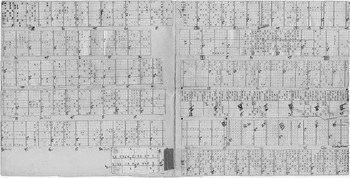
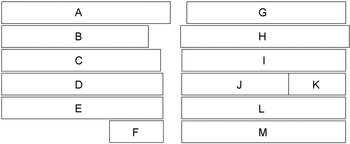
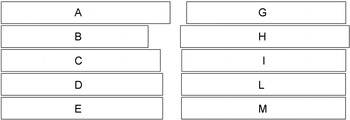
A clearer picture of Feldman's initial response to Cunningham's request for music to accompany his new dance production – and therefore his return to graph music – begins to emerge from a study of a revealing, but previously unpublished, document that will be referred to here as the ‘paperboard score’ of Ixion. This item, reproduced in Figure 1, is now part of the John Cage Collection of Northwestern University Music Library.Footnote 40 The paperboard score is presented on a large sheet of paperboard, measuring 36cm by 72cm. Graph notation has been glued onto the paperboard in two columns, one on each side of a central fold, with each column containing six systems. Most of these are of similar length. However, the system located at the bottom of the first column is much shorter. The organization of the paperboard score is shown schematically in Example 1, with each system labelled for ease of reference in the following discussion.
Ixion, paperboard score. John Cage Collection, Northwestern University Music Library.

Ixion, schematic diagram of paperboard score.

Examination reveals that the paperboard score includes three different types of materials:
• Ten longer strips of graph paper (A–E, G–I, and L–M), which are fairly similar in length. These strips contain numbers that are written in pencil in Feldman's handwriting, and they appear to have been carefully cut from larger pieces of graph paper. Faint traces of numbers that are otherwise erased appear in some of these strips and are still legible in many cases.
• Three shorter strips of graph paper (F, J, and K), which appear to have been torn from one or more larger pieces of graph paper in an untidy manner. These also contain numbers, but these numbers are written in black ink, with no corrections, and they are not in Feldman's handwriting. One of these shorter strips is the short system at the bottom of the first column on the paperboard. The other two sit side by side and form the fourth system in the second column.
• Markings of various types in black and red ink that appear to have been superposed on and around the graph paper. Some of these markings, such as ‘Entrance’ and ‘Carolyn Entrance’, clearly concern Cunningham's dance while others,Footnote 41 such as the labels that indicate elapsed time every fifteen seconds, evidently concern Feldman's music.
The ordering of the instrumental parts within each strip in the paperboard score differs from that found in the grids of the published edition of Ixion. However, a comparison reveals that the musical contents of the two are similar, and it is therefore likely that the paperboard score is the original source of the published edition. The numbers that appear in the paperboard score differ from those that appear in the published edition in relatively few places.Footnote 42 All these are explicable as copying errors; none of them involves what is evidently a deliberate revision. The only substantial differences concern tempo and duration. These are unspecified in the published edition, as previously mentioned. However, in the paperboard score the given indications of elapsed time imply a total duration of fifteen minutes and a range of tempos that differ between subsections. Some verbal guidance of tempo within subsections (‘Slower’, ‘Faster’) is also given.
The provenance of the paperboard score is not described in the inventory of the John Cage Collection of Northwestern University Music Library. However, the reference to Carolyn Brown points to its having been worked on during rehearsals for the first performance of Summerspace, which took place on 17 August 1958 at Connecticut College, New London, Connecticut, and it is reasonable to assume that it was used by Cage when conducting the work on that occasion.Footnote 43
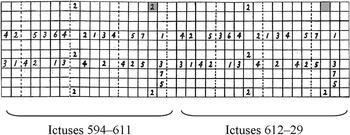
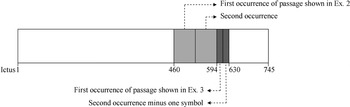
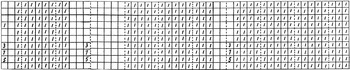
One aspect of the published edition of Ixion, which distinguishes it within Feldman's graph series, is that the score includes repeated or near-repeated passages. The first case involves the exact repetition of a complex sequence of 254 symbols, spanning more than two pages of the score, which is shown in Example 2. This sequence begins on page 12 at ictus 460 and extends over sixty-seven ictuses to end on page 14 at ictus 526, and it is immediately repeated, beginning at ictus 527.Footnote 44 The second case involves the near-repetition of a sequence of thirty-two symbols, which begins on page 15 at ictus 594, immediately after the second occurrence of the passage shown in Example 2, and extends across eighteen ictuses to end at ictus 611 on page 16. This sequence is immediately repeated from ictus 612, except that on its second occurrence one of the thirty-two symbols is omitted. Both occurrences are shown in Example 3. The missing symbol is the number 2 in the top row (allocated to one of the three flutes) that appears at ictus 609. This is not repeated at the corresponding point in the restatement.Footnote 45 The locations of these passages in the published edition of the score are shown schematically in Example 4.
Ixion, published edition, sequence that occurs at ictuses 460–526 and 527–93, with repeated constituent elements highlighted.

Ixion, published edition, sequence occurring at ictuses 594–611 and its near-repetition at ictuses 612–29, with difference highlighted.

Ixion, schematic diagram of published edition of the score showing locations of passages that are repeated or near-repeated.

The two passages in the published edition that repeat, or near-repeat, immediately preceding material correspond to J–K and F in the paperboard score. J–K corresponds to the second occurrence of the longer passage shown in Example 2, while F corresponds to the near-repetition of the shorter passage shown twice in Example 3. J–K and F are the untidily torn strips of graph paper containing numbers that are not in Feldman's handwriting, and it is likely that these were introduced at a different stage of the compositional process from the other materials. An excerpt from K is shown in Figure 2 in order to highlight the handwriting. The unusual presentation of the number 7 in this excerpt, which features a short but pronounced vertical line suspended from the left end of the horizontal element, is a hallmark of Cage's calligraphy.Footnote 46 A similar presentation of the number 7 is found in the published edition of Feldman's Intersection 2 for piano, which is known to be in Cage's handwriting.Footnote 47
Ixion, paperboard score, excerpt. John Cage Collection, Northwestern University Music Library.
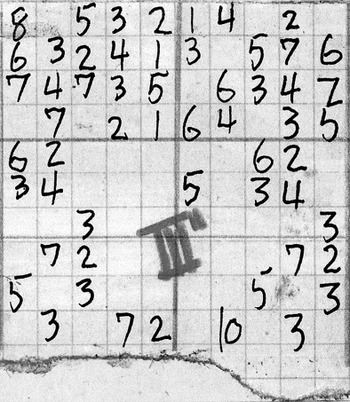
Two of the added elements in the paperboard score, J and K, appear side by side and form the fourth system in the second column of graph notation, as previously mentioned. These exactly reproduce the numbers in the third system, I, in this column, suggesting that Cage copied the third system in this column to produce the fourth.
The other added element, F, which appears at the bottom of the first column, exactly reproduces the numbers at the start of the fifth system, L, in the second column. Given that L probably followed on from I in Feldman's original materials, it is likely that Cage copied two adjacent sections of the grid from Feldman's original materials, one of which now makes up all of I and the other of which now makes up the beginning of L.
Although F is pasted at the base of the first column, annotations – also in Cage's handwriting – indicate that it should be understood as appearing within L, immediately after the section it reproduces.Footnote 48 Consequently, the intended ordering of the materials in the paperboard score is A to F, then G to the first part of L, then F, then the remainder of L to M.
Interestingly, the musical content of F does not differ from that of the material in the first part of L, on which it is based, unlike the corresponding passage in the published edition, which differs in one respect from the immediately preceding passage. Although it is possible that Feldman deliberately introduced a discrepancy when producing the copy of the score he presented to C. F. Peters Corporation for publication, the omission may have been a copying error, in which case an exact replica of the preceding passage was intended. In the corresponding passage in Ixion for two pianos, which was transcribed from Ixion, the repetition is exact. This suggests that the omission of one number in Ixion was indeed a copying error.
These factors suggest that the paperboard score – the original source of the published edition – was put together by Cage from Feldman's original materials, and it is reasonable to assume that the repetitions in Cage's handwriting were introduced as extensions, intended to lengthen the overall duration of the music. This implies that strictly speaking Cage was a co-author of Ixion in its published form. Although it is possible that Cage used his own initiative in lengthening the score that Feldman prepared for Cunningham, the concluding section of this article will argue that this is unlikely. Probably Cage acted as he did because the work that Feldman presented to Cunningham, which was in all likelihood named ‘Ixion’ but which will be referred to in this article as Ixion* to avoid any confusion with the derivative graph that now bears that name, licensed him to do so.
An ‘oilcloth’ that could be shortened or lengthened
Although it is not known if Feldman's instructions about how to lengthen the materials that he presented to Cunningham were written or oral, or if he identified which sections were repeatable, we can reasonably assume that eliminating Cage's repetitions – which were optional additions – will take us closer to the original core of Ixion*. The resulting form is shown schematically in Example 5, which should be read from A to E, then G to I, and then L to M.
Ixion*, schematic diagram of possible core.

As a matter of fact, Example 5 may be identical with the original core of Ixion*, but this is not certain. One possibility is that original material was discarded by Cage. Although this would be consistent with small variations in the lengths of systems A–E, G–I, and L–M in the paperboard score, it is unlikely that substantial cuts were made given that extensions – F, J, and K – were deemed to be necessary. Another possibility is that the intended ordering of the ten systems in Ixion* was indeterminate, in which case their placement in Ixion may be only one of many legitimate arrangements. This is difficult to rule out, but nothing points unambiguously to them having been presented in a different order in the score of Ixion*, which would have implied a subsequent rearrangement. Also, the material in M has the character of an ending, which is where it is located in the paperboard score. The density of indicated sounds rises steeply to a peak of 101 in its last ictus, far above levels found elsewhere in this work, consistent with this being fashioned as a concluding climax.Footnote 49
The first passage that Cage chose to repeat was shown in Example 2. A striking aspect of it is that it contains four occurrences of one substantial group of symbols; these were highlighted in grey in Example 2. This element of repetition within the passage may have been intended to signal that the section containing them could be duplicated if an extension of the work were deemed necessary, although this would make it unclear why Cage repeated the first half of Example 3. If so, then the three areas, of increasing length, towards the end of the score in which the number 1 appears in every cell might also be a signal of a similar type. These are shown in Example 6.Footnote 50 A study of the paperboard score suggests that Cage chose not to take advantage of any implied offer in their case.
Ixion, published edition, sequence that occurs at ictuses 628–78.

There is an independent reason to think that Feldman intended these areas as expandable and retractable. In 1976 he likened Ixion to an ‘oilcloth’ because it had ‘plenty of material to work with, to either shorten or lengthen’.Footnote 51 The significance of this remark for present purposes lies in his description of Ixion as a work that can be made shorter as well as longer. Perhaps he was thinking of the flexibility attributable to the absence of tempo guidance in the published edition of the score when he made this remark but, if so, his reference to there being ‘plenty of material to work with’ appears out of place. However, his remark reads naturally if he was thinking of Ixion* and the fact that he had envisaged that certain passages might be shortened or even excluded. If so, it is reasonable to assume that he regarded the passages in Example 6 in which the number 1 appears in every cell in this way. Although these passages occupy only thirty-eight ictuses in all, and would therefore allow only a modest shortening of the whole, this facility would have been useful in fine-tuning the total duration after replicating longer sections.
The elastic form of Ixion*
In his 1937 essay ‘Relating Music and Concert Dance’, Cowell proposed a closer alignment between music and dance through the production of what he called ‘elastic forms’.Footnote 52 His idea was that a composer writing music to accompany a dance should produce a musical composition that would have adjustable elements that could be altered in order to improve its degree of fit with the dance.Footnote 53 This would allow the music to be altered in response to changes in the dance during rehearsals without entirely undermining its structure.Footnote 54
Cowell went on, in the same article, to suggest several ideas for introducing this type of elasticity. These included the use of melodic phrases or whole sections that could be repeated, rearranged, expanded, contracted, or otherwise altered (within given limits).Footnote 55 He also suggested the use of flexible instrumentations that would allow performances using a variety of solo instruments and instrumental combinations.Footnote 56 These ideas, which Cowell applied in several works, had special utility for him given that at this time he was forced to write music for dance at arm's length. This was due to his incarceration in San Quentin prison.Footnote 57
Feldman's method of dealing with Cunningham's request to write music to accompany Summerspace appears to be so similar to the one that Cowell recommended that one wonders whether he had Cowell's ideas in mind. There is reason to believe that Feldman would have been familiar with Cowell's thoughts on these matters. Cage, who had been close to Feldman since early 1950, had known of Cowell's innovations since the late 1930s, and he would go on to write about them in 1959, the year after Summerspace was premièred.Footnote 58 Feldman composed several works that would accompany dances in 1950–51, making it probable that he and Cage would have discussed Cowell's ideas in the early stages of their friendship,Footnote 59 and Cowell's active support for their music at the time makes this even more likely.Footnote 60 Also, Feldman had been introduced to Cowell by Cage in the early 1950s and Feldman remembered that they ‘talked for hours’ when they first met.Footnote 61
The suggestion that Feldman may have had Cowell and his ideas on elastic form in mind while he worked on Cunningham's request is not intended to belittle the interest of Feldman's efforts or the associated music, but merely to suggest a significant point of contact with a composer whose work his has rarely been associated with. Even if Feldman did not know of Cowell's ideas or did not remember them at the time, this article suggests that the work that he produced to satisfy Cunningham's request possessed the type of form – elastic form – that Cowell had recommended.
Ixion* was not Feldman's only work with elastic form. Northwestern University Music Library has an unpublished score by Feldman for solo piano, written in conventional notation, which can also be elongated.Footnote 62 This score is addressed to Cunningham, and a handwritten note states that the first eight bars can be ‘play[ed] over as many times as needed’, with Feldman adding that ‘For me 3 times sounds just right.’ The score is undated. Since dated items by Feldman in the same collection stem from 1949 to 1964, it is not clear whether it was composed before or after Ixion*.
Feldman had experimented with mobile works that prefigure aspects of Ixion* as early as 1953. In Intermission 6, for one or two pianos, any of the given sounds can be repeated any number of times or omitted altogether, and a performance may, therefore, be of any length. The fact that omissions and repetitions are permitted is, evidently, a point of contact with Ixion* and Cowell, as is the fact that the durations of performances can vary markedly. However, there are differences as well. For example, Intermission 6 gives no indication of the ordering of sounds in performance, which implies formlessness, whereas all aspects of form in Ixion*, other than the length of the expandable and contractable sections, are assumed to have been specified.
Another area of difference concerns the manner in which Feldman expected performers to select material. In the case of Intermission 6, it is likely that he originally envisaged performers deciding which sounds to play spontaneously during the course of a performance, thereby linking it with the culture of spontaneity that permeated contemporary American art, and which Feldman so admired, at this time.Footnote 63 Although there are no surviving indications about when Feldman intended additions to, or subtractions from, Ixion* to be made, he must have intended them to be made before a performance, which was when Cowell envisaged alterations being made to his works with elastic forms. There is no evidence of the elaborate preparations that would have been needed to facilitate selections being made in a coordinated fashion within a large ensemble as a performance progresses. Earle Brown established a workable method of doing so in his Available Forms 1 for orchestra, which is dated July 1961, three years after Ixion* was completed. This work uses a large movable arrow on a placard displaying numbers to communicate decisions made by the conductor during a performance to the orchestra.
Cage's tempo changes for Ixion
In a previous section it was noted that some pre-publication copies of the score of Ixion and the subsequent transcription of Ixion for two pianos appear to have circulated with a set of notes that differ from those with the published edition. How these fit into the preceding account is an outstanding question.Footnote 64 Whereas the set of notes that accompanies the published edition does not specify tempo, the pre-publication set specifies two different scenarios. One is explained like this:
Numbers indicate the amount of sounds to be played on or within the box, each box being equal to MM92 or thereabouts.
An ‘alternative’ scenario, described as the ‘John Cage tempo changes’, gives verbal indications of tempo in each of thirteen subdivisions of the work as follows:
Moderato
- V2
Slower
- I4
Moderato
- I5
Slower
- V5
Faster
- IV6
Slower on second measure
- V6
Lento at second measure at ‘low’
- III7
Slightly faster at ‘high’
- II8
Fast
- V8
Faster
- III12
Suddenly slow
- II13
Accelerando on second measure
- III13
Fast to endFootnote 65
The fact that the John Cage tempo changes are attributed to Cage suggests that they did not reflect Feldman's initial conception of tempo. Nevertheless, it is probable that they were used in the first performance of Ixion in August 1958. Several of them are marked on the paperboard score and all are marked on the two surviving instrumental parts that were prepared by Cage for the first performance.Footnote 66 It is tempting to suppose that they were introduced at Cunningham's request in order to underpin changes in the tempo of the associated dance. However, Carolyn Brown, who danced in the 1958 première, has stated categorically that changes of rhythm in the dance are unrelated to Feldman's music.Footnote 67
There are several puzzling aspects of this alternative set of notes. One is the suggested steady pace of approximately 92 ictuses per minute, which is surprisingly fast given the music's intended purpose of accompanying Cunningham's dance.Footnote 68 At a tempo of 92 ictuses per minute, the 745 ictuses of Ixion would extend only a little over eight minutes, but performances of Summerspace are considerably longer than this. For example, timings marked on the paperboard score suggest that the first performance lasted fifteen minutes, as previously mentioned; this is consistent with Cunningham's initial conception of the dance, set out in his letter to Rauschenberg, as ‘about 15 minutes long’ and his more mature vision of the dance as ‘roughly 15 to 17 minutes long’.Footnote 69 A 1999 recorded performance lasts a little over twenty minutes.Footnote 70
One possibility is that 92 ictuses per minute was the intended tempo if the work were to be played on a stand-alone basis, although why Feldman would have wished it to be played faster without Cunningham's dance is not clear. A more probable scenario, and the one favoured here, is that 92 ictuses per minute was the tempo originally intended for Ixion*, in which case Feldman may have anticipated a greater number of legitimate repetitions than were actually used in creating Ixion. If so, this raises the subsidiary question of why a smaller-than-intended number came to be used. The most likely explanation is that members of the ensemble that played at the première were incapable of performing the work at the indicated pace, necessitating the use of a slower tempo and a smaller-than-intended number of repetitions.
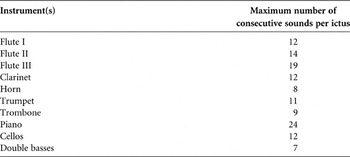
This explanation is credible. With a tempo of 92 ictuses per minute, Ixion is a challenging work to perform, with performers regularly asked to produce large numbers of consecutive sounds within single ictuses each lasting only 0.65 seconds. The extent of the difficulty is evident from a review of the maximum number of consecutive sounds specified within an ictus in each instrumental part, shown in Table 1. Although Feldman indicated in the notes with the published edition how most of the performers should respond if they proved unable to play the indicated number of consecutive sounds in the designated span, it is difficult to believe he intended these get-out clauses to be exercised frequently in an optimum performance.
Ixion, published edition, maximum number of consecutive sounds per ictus, by instrument.

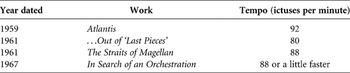
An examination of the tempos recommended by Feldman in the four graphs for larger ensembles composed after Ixion lends additional weight to the view that he originally intended the materials he prepared for Cunningham to be played at a tempo of 92 ictuses per minute and with a greater number of repetitions than Cage included. As shown in Table 2, tempos indicated in three of these works are close to, or identical with, this rate.
Indicated tempos in published editions of graphs for larger ensembles composed after Ixion.

Another puzzle is why the alternative set of notes was subsequently not included with the published edition of Ixion.Footnote 71 Perhaps Feldman became increasingly uncomfortable with the John Cage tempo changes. The fact that he labelled them as Cage's is consistent with the thought that he wished to distance himself from them, and there is independent reason to think that this was likely. This is because they appear contrary to the spirit of Feldman's graph music, in which the proportional character of the graph notation was evidently intended to facilitate a more transparent link with the associated music than is typically found in music presented in more conventional notation.
Remedying graph notation
In his 1962 liner notes, Feldman explained that he had returned to graph music ‘with two orchestral works […] using now a more vertical structure where soloistic passages would be at a minimum’. This description of Atlantis and …Out of ‘Last Pieces’ appears to have been presented as giving his solution to the difficulties that he had experienced in performances of some of his graphs composed before he temporarily broke with graph music in 1953. Elsewhere he made clear his view that the choices made by some performers of these earlier graphs were merely formulaic, reflecting conditioned responses or remembered sequences.Footnote 72
This account of his solution to the difficulties he had previously encountered is too terse to be satisfying. Evidently he saw himself as having responded by composing in what he referred to as a more ‘vertical’ fashion and thereby keeping what he termed ‘soloistic passages’ to a minimum, but what did he mean by these claims? In a lecture hosted by Dore Ashton that was given in the run-up to several performances of …Out of ‘Last Pieces’ by the New York Philharmonic Orchestra in early 1964, Feldman spoke extensively about his graph music and was more forthcoming:
I no longer would have the areas this long. The areas became much shorter. Everything was more compressed. And we always had the orchestra en masse; we never had soloistic situations.Footnote 73
It seems that Feldman saw himself as having responded to the problems that he had previously experienced on three connected fronts: by minimizing the presence of intended continuities in the works themselves; by curtailing the freedom given to performers to inject unwanted continuities in performance; and by reducing the probability that any unwanted continuities that they inject are heard.
There can be no doubt that Feldman's more ‘vertical’ method of composing involved an intensified focus on the internal organization of groups of sounds within single ictuses and that by focusing his efforts in this way, within individual columns of his grids, he saw himself as minimizing the risk of inherent soloism – in the form of intended continuities – in his own thinking and therefore in the works themselves. Ensuring that intended continuities were not present in them would, he felt, make certain that his efforts did nothing to encourage performers to insert continuities of their own making.
Probably this was only one aspect of his method of reducing the risk of unwanted continuities being inserted. Another aspect of his method was to avoid soloism of the type made possible by allocating long stretches of continuous play to single instruments. In doing so, his idea was to purposely limit the performer's scope to forcibly inject conditioned or remembered sequences. Judicious placement of columns of numbers relative to one another in his grids would evidently assist him in achieving this aim, given his ‘vertical’ method of working.
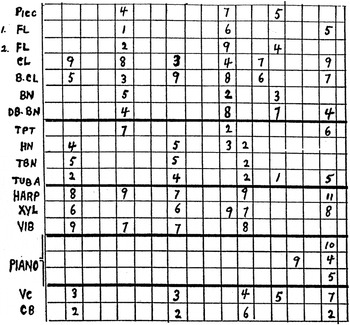
If both these aspects failed, his last line of defence was to avoid soloism in the form of unaccompanied playing. This would reduce the audible impact of a particular instrument injecting formulaic selections by locating its sounds in close proximity to those of other instruments.Footnote 74 Evidently this aspect of his response was closely connected with his ‘vertical’ method of working, which tended to deploy several numbers within single columns in his grids and therefore a proliferation of activity within individual ictuses.Footnote 75Example 7, which shows an extract from page 6 of Atlantis, illustrates these ideas. In this extract Feldman's compositional approach was patently ‘vertical’ in the sense of being focused on individual columns. These columns were evidently conceived of as units, and there is little in this passage to suggest any inherent soloism in Feldman's own thinking. The relative placement of the columns ensures that they are well demarcated and emphasizes their individuality, but it also ensures that individual instruments are only rarely permitted to play in consecutive ictuses, thereby reducing the scope for soloism in the form of continuous play. The fact that most of the vertical groups contain several numbers, and therefore require activity from several instruments, evidently reduces the scope for soloism in the form of unaccompanied playing.
Atlantis, published edition, ictuses 196–213.

With these thoughts in mind, it is significant that music rehearsals for the first performance of Summerspace do not seem to have proceeded smoothly. In interviews, Earle Brown recalled being present when Feldman interrupted proceedings in order to criticize a performer for playing pitches that he disliked, even though they were consistent with the indications given in the score.Footnote 76 The implication is that the performer's selections were not masked by concurrent sounds and that Feldman's solution to the problem of performers making undesirable choices was either not fully formed in Ixion* and Ixion or not entirely successful.
In fact, Feldman's solution does not seem to have been fully formed in Ixion, as performers are regularly required to play throughout extended periods and are sometimes entirely unaccompanied or accompanied by very few other members of the ensemble. The passage highlighted in Example 3 is a case in point, in which the clarinet and trombone are both required to play long sequences of consecutive sounds, sometimes simultaneously with one another and at other times unaccompanied. Even if Feldman originally conceived of this passage ‘vertically’, as a succession of single columns or ictuses of activity, each conceived individually, the use of only two instruments and the placement of columns adjacent to one another leaves scope for the performers to forcibly inject conditioned or remembered sequences and for them to be heard.
This suggests another possible explanation of why Feldman decided not to refer to Ixion in his account of his return to graph music in his 1962 liner notes, namely that he did not regard his emerging response to performance-related problems with his graphs as sufficiently well developed within it. However, there are several factors that argue against this explanation. In fact, there are many places in Atlantis in which Feldman's compositional approach is less patently ‘vertical’ than in Example 7. Also, in this work the piano is required to play unaccompanied throughout several extended periods. Perhaps Feldman saw the performance-related risks as limited, at least in the late 1950s and early 1960s, as the piano part was almost certainly written for Tudor, who had by then been performing Feldman's graph music for many years and must have known what Feldman expected.Footnote 77 Nevertheless, this aspect of Atlantis leaves the work itself inherently susceptible to the same types of problem in performance that had beset some of his earlier graphs, including Ixion.
These are not the only performance-related risks in Atlantis. Feldman's liking for numbers higher than 2 could also be seen as inviting trouble. Except in the piano part, numbers are used to indicate the quantity of consecutive sounds that the performer should play within the given ictus, meaning that the inclusion of higher numbers could allow a performer to inject ingrained or remembered sound sequences even within a single unit of pulse.Footnote 78 This was a continuing legacy of Rauschenberg's influence. In the event of performance-related difficulties of this type, the only line of defence offered by Feldman's work is that they will be made less audible by concurrent sounds from other performers, but there are many places in which instruments are required to play several sounds within a single ictus unaccompanied by other instruments. Evidently, this risk is also present in performances of Ixion.
Arguably, Feldman's response to this problem only began to emerge in …Out of ‘Last Pieces’. In this work the number 1 is used more frequently in the score than in Ixion and Atlantis, and several new symbols designating single notes or chords were introduced, thereby reducing the ease with which undesirable sequences of notes could be inserted by a performer within an ictus. Although this constrained the maximum number of consecutive sounds that each instrument could produce per ictus, the resulting sound remains pointillistic in some passages, with Feldman apparently compensating for the effect of the constraint by using the significantly expanded scale of the ensemble in this work to specify simultaneous activity from a larger number of instruments.
In fact, this evolution of Feldman's graph music would continue after the 1962 liner notes were issued, with the process culminating in his last graph, In Search of an Orchestration, in which the vast majority of sounds indicated are single notes or chords. Feldman himself explained his strategy in In Search of an Orchestration in picturesque fashion in a letter to Earle Brown dated 16 June 1967:
it's a more complex ‘Out of Last Pieces’ with no passage – single notes – long or short […] No crawling up and down those little ole white and black notes for us!!Footnote 79
Implications for performers
This article has argued that Feldman's principal surviving account of his decision to recommence composing graph music in 1958, which appears in his 1962 liner notes, is misleading. It has presented an alternative history that suggests that Feldman's efforts at this turning point in his career were shaped by a complex array of factors, which included not only his dissatisfaction with conventionally notated music at this time and with performances of his earlier graphs, but also the influence of Cage, Cowell, Cunningham, Rauschenberg, and, perhaps, the prevailing musical context.
Central to this alternative history is the assumption that Cage used Ixion* as Feldman intended it to be used, to derive a performable work with an appropriate duration, but at least some of the evidence is consistent with the theory that Cage used his own initiative in cannibalizing the materials that Feldman prepared for Cunningham – contrary to Feldman's intentions – in order to produce a work with the desired span. This would provide a straightforward explanation of why Ixion was not mentioned in Feldman's 1962 liner notes: the work was not mentioned because Feldman was embarrassed by the circumstances that gave rise to it. It is also consistent with the fact that he went on to publish it nevertheless, as we can reasonably assume that he would have felt a duty to Cunningham to do so.
However, this theory leaves important questions unanswered. For example, why did Feldman prepare materials that appear so short with the tempo guidance of 92 ictuses per minute specified in the pre-publication set of notes? If a slower tempo was originally envisaged, why did he subsequently single out 92 ictuses per minute as an appropriate rate? And why, years later, did he suggest that he had provided Cunningham with ‘plenty of material to work with, to either shorten or lengthen’?
The alternative account outlined in previous sections of this article, which presents both Cage and Ixion in a considerably more favourable light, provides credible answers to these questions and is therefore to be preferred. It too can explain why Feldman declined to refer to Ixion in his account of his return to graph music in his 1962 liner notes. One possibility is that he may have regarded the chain of events that gave rise to Ixion in its currently published form as too complex for outlining in a short summary of his career. Another possibility is that, at the time of writing his 1962 liner notes, he may not have decided whether to present his music for Summerspace in published form as Ixion or as Ixion*.Footnote 80
Why did Feldman choose not to recreate Ixion* for publication? Undoubtedly, it was different in type from other graphs that he published in that, unlike them, it was designed to give others the means to construct a range of performable works of varying lengths. Although the unspecified tempo of Ixion marks it out as different from Feldman's other graphs, indeterminacy of tempo is not only more common in Western classical music in general but it is also commonplace in Feldman's works with fixed pitches and flexible durations, meaning that Ixion fits more neatly with the rest of his published output. This may have been a factor in its eventual promotion over its less characteristic parent.
Another possibility is that Feldman's confidence in the utility of Ixion* was undermined by the inability of the performers at the première to play the work at the originally intended speed. If so, then he may have come to see that a sufficient degree of indeterminacy of overall duration could be obtained without resurrecting Ixion* – by taking the derivative work that had been produced from it, with the extensions added by Cage, allowing the performers to select a tempo that was much slower than he had originally envisaged, and accepting a less scintillating sound than he had originally intended.
The account of Feldman's return to graph music outlined in this article may be of interest to those intending to perform Feldman's music for Summerspace. This is because it implies that those performing Ixion* can legitimately tamper with Ixion in certain ways. This will not result in a performance of Ixion but it may still count as a performance of Ixion*. This is provided that the performers do not alter Ixion in ways that transgress the limits originally set by Feldman. While these limits are not known for certain, three interpretative strategies are likely to be consistent with them. These are the elimination of Cage's repetitions, the inclusion of additional repetitions identical in kind to those that Cage introduced, and the expansion and contraction of the areas in Example 6 in which the number 1 appears in every cell. The first strategy is likely to be within the limits set by Feldman because it probably takes us closer to the original core of Ixion*, as previously discussed. The second strategy is likely to be consistent with the limits he set because it duplicates repetitions that Feldman licensed. This strategy would be undermined if Feldman's instructions with Ixion* had limited the number of legitimate repetitions to those included by Cage, but we have no good reason to think that this is likely.
A previous section mentioned that performances of Cunningham's dance sometimes last longer than twenty minutes. Performing Ixion for this length of time would involve playing it at a steady tempo of less than 40 ictuses per minute, resulting in a less scintillating sound than that produced by playing it more quickly. Reverting to the precursor work from which it was derived and expanding its length by adding and, if necessary, subtracting elements in the ways suggested above is a method of producing scintillating music of longer duration consistent with Feldman's original intentions without slowing it down.
The importance of the issue of tempo for the resulting sound is evident from a brief review of two currently available recordings of Ixion for two pianos. A 2002 recording by Kristine Scholz and Mats Persson is played at a steady tempo of around 100 ictuses per minute and has a total duration of approximately 7′30″, while a 1958 recording by Cage and Tudor, which appears to be the one used by the Merce Cunningham Dance Company to accompany its performances of Summerspace in recent years, is played at a variable, but consistently much slower, tempo, and this version lasts a little over 20′. This difference and the more frequent recourse to playing chords in Cage and Tudor's version mean that their 1958 performance lacks the sparkling energy that characterizes the performance by Scholz and Persson. In view of Rauschenberg's dazzling costumes and set and Feldman's previously noted aim to ‘melt into the décor’, it is reasonable to suppose that this sparkling energy is the effect that Feldman originally envisaged.Footnote 81