





Introduction
The concept of “total pain” was introduced by Cecily Saunders (Saunders Reference Saunders2001), a pioneer in the development of hospice care. Since then, much research has revealed the significance of spiritual suffering in palliative care. A terminal diagnosis can trigger death anxiety, demoralization, and depression (Kissane et al. Reference Kissane, Clarke and Street2001). Spiritual distress, arising from existential questions and disillusionment with religious beliefs, can merge with physical pain, creating intolerable suffering (Hofmann et al. Reference Hofmann, Manfredi, Kaiser, Berger, Hinds and Puchalski2018). Treating suffering from spiritual distress can profoundly improve a patient’s psychological state and ability to cope with the process of dying (Austin et al. Reference Austin, Lee, Keall and Lovell2025). Although the critical importance of spiritual care at the end of life is well acknowledged (Giezendanner et al. Reference Giezendanner, Jung and Banderet2017), progress has been hampered by difficulties in assessing and delivering this in practice (Wittenberg et al. Reference Wittenberg, Ferrell and Goldsmith2016).
Research has established that participation in religious communities supports better health outcomes and provides a strong buffer against physical and psychological suffering (Koenig Reference Koenig2012; VanderWeele Reference VanderWeele, Balboni and Peteet2017). Conscious commitment to a spiritual tradition provides resilience and hope for dying individuals, enabling them to make the most of the time they have left (Puchalski et al. Reference Puchalski, Vitillo, Jafari, Gómez-Batiste and Connor2017). However, research shows that both high intrinsic religiosity and committed atheism predict lower death anxiety than moderate religious affiliation or noncommitted secular status (Byrne and Morgan Reference Byrne and Morgan2020), suggesting the protective factor is not religion per se but conscious commitment to values and beliefs, which create a framework for meaning (Weber et al. Reference Weber, Pargament and Kunik2012).
In Australia, the number of people who identify as nonreligious, yet not necessarily atheist, is rapidly increasing. In the 2021 Australian Census, 38.9% of Australians identified as “no religion,” an increase from 30.1% in 2016 (Australian Bureau of Statistics 2022). Studies of Australian patients, families, and healthcare practitioners revealed pervasive difficulties in articulating what spirituality is or what it means to provide spiritual care (Best et al. Reference Best, Butow and Olver2014, Reference Best, Butow and Olver2016; Slape Reference Slape2014; O’Callaghan et al. Reference O’Callaghan, Brooker and de Silva2019, Reference O’Callaghan, Seah and Clayton2020). Spirituality is generally considered private, personal, and individualistic (Keall et al. Reference Keall, Butow and Steinhauser2013; Slape Reference Slape2014; Best et al. Reference Best, Butow and Olver2016), posing potential cultural barriers for developing comprehensive provision of spiritual care in institutionalized settings. As the number of noncommitted, nonreligious individuals entering palliative care increases, the incidence of spiritual suffering can be expected to increase.
In general, postmodern Western cultures have experienced a decrease in religious affiliation, paralleled by the growing popularity of the concept of spirituality. A growing demographic identifies as “Spiritual But Not Religious,” though this remains a vague and ambiguous term (Mendizabal Reference Mendizabal2018). Spirituality is best understood as a sociohistorical phenomenon that arose in Western nations over a long trajectory of secularization. Rather than attempts to define this term, it can be better characterized by prevalent and observable attitudes, beliefs, and behaviors of this social phenomenon. Houtman & Tromp (Reference Houtman, Tromp, Ai, Wink, Paloutzian and Harris2021), in their Post-Christian Spirituality Scale (PCSS), identified a range of attitudes (e.g., individualism, acceptance of different religious traditions, prioritizing freedom of choice, belief in a living cosmos), which allows categorization into high or low post-Christian spirituality beliefs. It is suggested that as membership in organized religions declines, people increasingly embrace post-Christian attitudes toward spirituality.
Thus, in postmodern, multicultural societies, effective spiritual care requires an approach that can encompass disparate spiritual traditions and attitudes. In fact, ritual activity represents one such universal behavior found in all human cultures (Butler et al. Reference Butler, Kissane and Michael2025a). Interestingly, there are increasing reports of informal rituals organically arising in palliative care, ostensibly as an intuitive response to spiritual needs. Indeed, recent scholarship suggests that ritual preceded and provided the basis for organized religion (Dunbar Reference Dunbar2022), implying that humans have used ritual from the origins of human history as a spiritual foundation (Butler et al. Reference Butler, Kissane and Michael2025a). Ritual has been described as “innate, embodied intelligence and know-how” for coping with the challenges of being human (Stephenson Reference Stephenson2015, p. 5). The benefit found in religious membership may primarily result from rituals and ritual activity, which create social bonding (Charles et al. Reference Charles, van Mulukom and Brown2021), provide frameworks that establish meaning (Geertz Reference Geertz and Banton2013; Van Uden and Zondag Reference Van Uden and Zondag2016), and support emotional challenges (Hobson et al. Reference Hobson, Schroeder and Risen2018; Röttger-Rössler Reference Röttger-Rössler2020).
A small number of empirical studies have studied the impact of both religious and nondenominational rituals in palliative care (Butler et al. Reference Butler, Michael and Kissane2025b). Staff and medical professionals use personal and organized rituals to improve job satisfaction, cultivate compassion and a sense of meaning, and significantly reduce staff burnout. Religious rituals can significantly relieve fear of death and spiritual distress. Personally meaningful rituals benefit families and caretakers by reducing stress and grief. Rituals celebrate the meaning and value of the life lived, help prepare for death, and promote intimate bonding with significant others (Bourgeois and Johnson Reference Bourgeois and Johnson2004; Butters Reference Butters2021; Butler et al. Reference Butler, Michael and Kissane2025b).
The potential use of personally meaningful rituals as spiritual support for patients holds great promise (Butler et al. Reference Butler, Michael and Kissane2025b). In the Australian context, where spirituality is often regarded as a private and personal matter, previous research suggests that individuals may engage in a range of practices that provide spiritual meaning and support. We therefore seek to explore what personally meaningful practices people are already doing, and whether these activities are experienced as effective and spiritually beneficial. Our premise is that by examining personal spiritual practices, we gain more knowledge as to how these could be a potential foundation for developing more substantial rituals for spiritual support. This study aims to gain more knowledge toward how meaningful rituals could be implemented as spiritual support for patients without religious affiliation by examining types of spiritual and ritual orientations and activities, as well as associations between spiritual needs, practices, well-being, quality of life, and coping styles.
Methods
Study design
In this cross-sectional study, we recruited patients from across a large regional palliative care service in Victoria, Australia, including both regional and rural dwellers, to ensure diversity. An English-language questionnaire included validated instruments, and approval was obtained from the [Name] Human Research Ethics Committee (name withheld during review).
Setting, participants, and recruitment
Convenience sampling was pragmatic (Golzar et al. Reference Golzar, Noor and Tajik2022) to recruit 102 adult patients who met eligibility criteria of advanced disease and a prognosis of ≤12 months, with data collected between November 2024 and November 2025. Patients were ineligible if they were not English-speaking and the treating clinician judged them to be too frail to complete the questionnaires. The regional health service provides inpatient, consult, ambulatory, and community palliative care services. Its broad nature across settings optimized its informativeness. Potential participants were identified by the treating clinicians and screened against the inclusion and exclusion criteria. Eligible participants were provided with a Participant Information Sheet. Agreement to participate implied consent (McCullough et al. Reference McCullough, McGuire and Whitney2007).
Questionnaire set
The questionnaires could be self-completed or completed with the assistance of a family member (Supplementary material). Questionnaires were de-identified to protect the anonymity of participants and included the following validated instruments:
1. Sociodemographic and Health Data gathering information on age, gender, country of birth, living/marital status, diagnosis, length of illness, occupational status, and religious affiliation.
2. PCSS (Houtman & Tromp, 2021) is a well-validated 7-item sociological measure of the range of nondenominational spiritual beliefs (α = 0.83). Responses are rated on a 6-point Likert scale from strongly disagree (0) to strongly agree (4). Individuals can have high or moderate/low post-Christian spiritual beliefs. Because no validated thresholds are available for the PCSS, participants will be dichotomized using the sample median score (scores ≤ the median: lower levels of post-Christian spirituality; >the median: higher levels of post-Christian spirituality).
3. Spiritual Needs Questionnaire (SNQ) (Büssing Reference Büssing2021) measures spiritual needs across 4 factors (α = 0.71–0.87): religious, existential, inner peace, and giving/generativity. Responses are rated on a Likert scale from Not at All (0) to Very Much (4).
4. Spiritual Practices Questionnaire (SpREUK) (Büssing et al. Reference Büssing, Reiser and Michalsen2012) identifies religious and post-Christian spiritual rituals used. This 24-item scale measures ritual activity across 5 factors (α = 0.76–0.83): existential, religious, humanistic/prosocial, gratitude/awe, and spiritual/mind-body. Responses are rated on a Likert rating scale from Never (0) to Regularly (0).
5. Global Quality of Life Scale (GQoL) (Williams Reference Williams2021) assesses the impact of illness symptoms on physical, emotional, spiritual, social, and financial functioning, using a visual analogue scale from 0 (very bad) to 10 (excellent). These 5 dimensions are summed into a global measure of quality of life (0–10).
6. Functional Assessment of Chronic Illness Therapy–Spiritual Well-Being 12-Item Scale (FACIT-Sp12) (Canada et al. Reference Canada, Murphy and Fitchett2008) comprises 12 questions assessing spiritual well-being measured using a Likert scale of Not at All (0) to Very much (4) across 3 factors: meaning/purpose (0–16), peacefulness (0–16), and faith (0–16).
7. Brief-COPE (Carver Reference Carver1997) is a 14-item, widely used scale that assesses whether adaptive or non-adaptive coping mechanisms are being used to deal with challenges in the individual’s daily life. Responses for 7 factors are rated on a Likert scale from Not at All (0) to Doing a Lot (3).
Data analysis
Summary statistics were used to describe study participants, and results were reported as mean (standard deviation) for age and number (%) for all other variables. Participants’ responses to various scales were grouped into sub-domains using mean/median (standard deviation/interquartile range) scores, calculated in accordance with the relevant scoring algorithms.
Given the distribution’s skewness, Spearman’s correlations with Bonferroni correction for multiple comparisons were used to examine correlations between subscales of different measures. A rho correlation of ≥0.3 explains ≥9% of the variance in the associated construct, which is considered meaningful. Lower correlations may achieve significance, but their contribution is small and not especially meaningful.
Multivariate regression analyses were used to examine whether spiritual practices predict spiritual needs while controlling for patients’ age and gender. The level of significance was set at 0.05 (2-sided).
Results
The mean age of 102 participants recruited for this study was 68.4 years. The majority were female (52.5%), married (56.4%), Australian-born (81.4%), and had an advanced cancer diagnosis (89.2%). Most identified as Christian (54.9%), with 52.9% of participants considering religion not important to them. (Table 1).
Participant sociodemographic and illness characteristics

Table 1 Long description
Characteristics are reported as counts with percentages in a column labeled, N percent, plus age as a mean with standard deviation and range in years. Gender totals 101, with 48 male at 47.5 percent and 53 female at 52.5 percent. Age is 68.45 years on average, with standard deviation listed as SD, and a range from 33 to 92 years. Relationship status totals 101, with 57 married or de facto at 56.4 percent, 17 divorced or separated at 16.8 percent, 14 widowed at 13.9 percent, and 13 single at 12.9 percent. Country of birth lists 83 Australia at 81.4 percent and 19 other at 18.6 percent. Language spoken at home lists 100 English at 98 percent and 2 other at 2 percent. Current occupational status lists 65 retired at 63.7 percent, 22 unable to gain employment due to illness or disability at 21.6 percent, 8 employed at 7.8 percent, 3 full time domestic duties at 2.9 percent, and 4 other at 3.9 percent. Main diagnosis lists 91 advanced cancer at 89.2 percent, 7 advanced non malignant at 6.9 percent, and 4 other at 3.9 percent. Time since diagnosis lists 54 at 1 year to 5 years at 52.9 percent, 18 more than 5 years at 17.6 percent, 15 less than 6 months at 14.7 percent, and 15 at 6 months to 1 year at 14.7 percent. Importance of religion lists 54 not important at 52.9 percent, 28 very important at 27.5 percent, and 20 somewhat important at 19.6 percent. Religious affiliation lists 56 Christianity at 54.9 percent, 38 no religious affiliation nor faith nor belief system at 37.3 percent, and 8 other religion or faith or belief system at 7.8 percent.
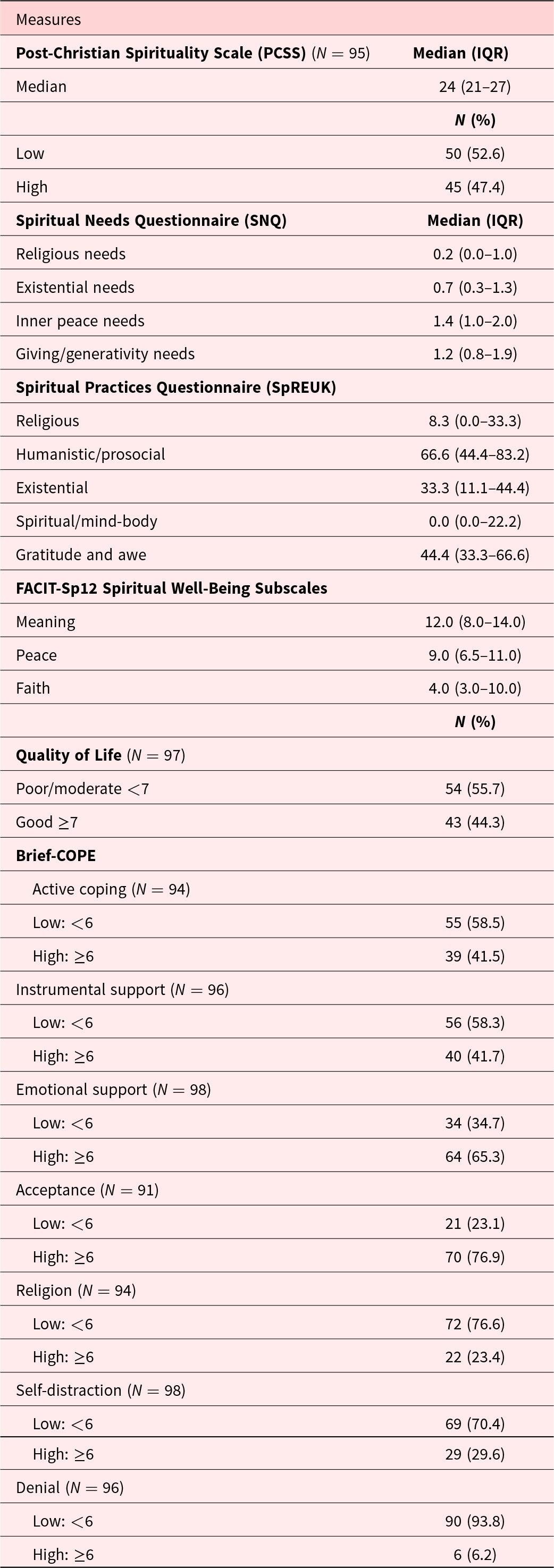
Table 2 presents the descriptive statistics for the questionnaire subscales. Despite the unimportance of religion for the majority, close to half (47.4%) reported high levels of post-Christian spirituality. Among their perceived spiritual needs, participants reported a preponderance of seeking inner peace (median, 1.4; IQR, 1, 2) and of giving/generativity desires (median, 1.2; IQR, 0.8, 1.9). Humanistic/prosocial spiritual practices, such as helping others, doing good deeds, and supporting charity, showed the highest engagement (median, 66.6; IQR, 44.4, 83.2), followed by practices that expressed gratitude and awe (median, 44.4; IQR, 33.3–66.6), while religious and mind-body practices demonstrated very low/median levels with wide variability.
Post-Christian spirituality, spiritual needs, practices, well-being, quality of life, and coping styles (N = 102)

Table 2 Long description
Measures include post Christian spirituality, spiritual needs, spiritual practices, spiritual wellbeing, quality of life, and coping styles, reported as medians with interquartile ranges or as counts with percentages. Post Christian Spirituality Scale, median 24 with interquartile range 21 to 27, with 50 participants low at 52.6 percent and 45 high at 47.4 percent. Spiritual Needs Questionnaire medians with interquartile ranges were religious needs 0.2, 0.0 to 1.0; existential needs 0.7, 0.3 to 1.3; inner peace needs 1.4, 1.0 to 2.0; giving or generativity needs 1.2, 0.8 to 1.9. Spiritual Practices Questionnaire medians with interquartile ranges were religious 8.3, 0.0 to 33.3; humanistic or prosocial 66.6, 44.4 to 83.2; existential 33.3, 11.1 to 44.4; spiritual mind body 0.0, 0.0 to 22.2; gratitude and awe 44.4, 33.3 to 66.6. FACIT Sp12 spiritual wellbeing subscales medians with interquartile ranges were meaning 12.0, 8.0 to 14.0; peace 9.0, 6.5 to 11.0; faith 4.0, 3.0 to 10.0. Quality of life counts were poor or moderate under 7, 54 participants at 55.7 percent, and good 7 or higher, 43 participants at 44.3 percent. Brief COPE counts by low under 6 and high 6 or higher were: active coping low 55 at 58.5 percent and high 39 at 41.5 percent; instrumental support low 56 at 58.3 percent and high 40 at 41.7 percent; emotional support low 34 at 34.7 percent and high 64 at 65.3 percent; acceptance low 21 at 23.1 percent and high 70 at 76.9 percent; religion low 72 at 76.6 percent and high 22 at 23.4 percent; self distraction low 69 at 70.4 percent and high 29 at 29.6 percent; denial low 90 at 93.8 percent and high 6 at 6.2 percent.
Humanistic/prosocial practices: behavioral approaches combining individual personal growth with active and community service.
Spiritual well-being, as measured by the FACIT-Sp12, indicated moderate levels of meaning and peace but relatively low faith, and just over half of the sample (55.7%) reported poor to moderate quality of life. Adaptive coping was evident through emotion-focused coping strategies and was harnessed through acceptance (76.9%) and emotional support (65.3%). Active coping and instrumental support were used only moderately, with religious coping used by about 1 quarter. Noteworthy was the low use of avoidant coping, with low levels of self-distraction and denial.
A Spearman correlation matrix is shown in Tables 3 and 4, linking spiritual activities identified by the SpREUK to the 4 domains of the SNQ and correlations between coping modes and both spiritual needs and practices. Perceived religious needs correlated strongly with the use of religious rituals (rho = 0.87). Existentialistic practices correlated moderately with existential, inner peace, and giving/generativity needs (rho = 0.56–0.69), while humanistic/prosocial spiritual practices were moderately associated with giving/generativity (rho = 0.52) and inner peace needs (rho = 0.42). Spiritual/mind-body and gratitude/awe practices showed moderate correlations with existential and inner peace needs with gratitude and awe practices additionally correlating with giving/generativity needs. In assessing coping styles, patients who use emotion-focused coping stand out for their association with both spiritual needs and practices, with religious needs (rho = 0.48) and use of religious rituals (rho = 0.53) having the strongest associations.
Correlations between the use of rituals and patients’ spiritual needs

Table 3 Long description
Correlations are listed between Use of Rituals, SpREUK categories and Spiritual Needs of Patients, SNP domains, with a correlation value and a p value for each pairing. For Religious rituals, correlations are 0.87 with Religious Needs, 0.48 with Existential Needs, 0.42 with Inner Peace Needs, and 0.29 with Giving or Generativity Needs; each p value is below 0.001. For Humanistic or Prosocial rituals, correlations are 0.29 with Religious Needs with p value 0.013, 0.38 with Existential Needs with p value 0.001, 0.42 with Inner Peace Needs with p value below 0.001, and 0.52 with Giving or Generativity Needs with p value below 0.001. For Existentialistic rituals, correlations are 0.38 with Religious Needs with p value 0.001, 0.63 with Existential Needs with p value below 0.001, 0.56 with Inner Peace Needs with p value below 0.001, and 0.69 with Giving or Generativity Needs with p value below 0.001. For Spiritual or Mind Body rituals, correlations are 0.44 with Religious Needs with p value below 0.001, 0.51 with Existential Needs with p value below 0.001, 0.49 with Inner Peace Needs with p value below 0.001, and 0.40 with Giving or Generativity Needs with p value 0.001. For Gratitude or Awe rituals, correlations are 0.39 with Religious Needs with p value 0.001, 0.41 with Existential Needs with p value below 0.001, 0.44 with Inner Peace Needs with p value below 0.001, and 0.51 with Giving or Generativity Needs with p value below 0.001.
Correlation between coping styles, spiritual needs, and rituals

Table 4 Long description
Correlation coefficients with p values compare spiritual needs of patients and use of rituals against coping styles from Brief Cope, across problem focused, emotion focused, and avoidant maladaptive coping. For spiritual needs of patients, religious is 0.21 with problem focused, 0.48 with emotion focused, and 0.17 with avoidant maladaptive; existential is 0.44, 0.38, and 0.33; inner peace is 0.28, 0.33, and 0.14; giving or generativity is 0.35, 0.34, and 0.26. For use of rituals, religious is 0.26 with problem focused, 0.53 with emotion focused, and 0.07 with avoidant maladaptive; humanistic or prosocial is 0.31, 0.37, and minus 0.02; existentialistic is 0.35, 0.38, and 0.37; spiritual mind body is 0.24, 0.32, and 0.15; gratitude or awe is 0.35, 0.43, and 0.23. Across rows, emotion focused values are consistently higher than problem focused and avoidant maladaptive values, except for existentialistic rituals where avoidant maladaptive is 0.37 and emotion focused is 0.38. P values range from less than 0.001 to 0.849, with the largest p values appearing for humanistic or prosocial rituals with avoidant maladaptive and for religious rituals with avoidant maladaptive.
The results of multivariate modeling (Supplementary material) confirmed that the use of existentialistic practices is associated with high levels of post-Christian spirituality, existential needs, and the existential and inner peace subscales, while controlling for participants’ age, gender, and other SNQ subdomains. Humanistic and prosocial practices predict the need for giving to others and generativity.
Discussion
This study examines the spiritual needs and ritual practices of patients with advanced illness in a contemporary Australian palliative care setting, offering new insights into how spirituality is expressed in a post-modern society. Although just over half of participants identified as Christian, the majority reported that religion was not important to them, and 47.4% endorsed high levels of post-Christian spirituality. Possible confounders for the post-Christian spirituality scale include the age group sampled, the regional setting relative to a purely urban setting, or the clinical nature of the sample relative to what an epidemiological sample and a younger age might reveal. Additionally, the PCSS uses a conceptual, abstract philosophical perspective, which possibly did not resonate with the cultural milieu of this demographic. Indeed, lack of clearly formulated, consciously articulated spiritual frameworks is a fundamental characteristic of secularized post-Christian culture (Houtman and Tromp Reference Houtman, Tromp, Ai, Wink, Paloutzian and Harris2021).
This pattern mirrors broader demographic shifts in Western societies, where formal religious affiliation is declining while individualized, eclectic, and often implicit forms of spirituality are emerging. Within this context, our findings highlight how people nearing the end of life articulate spiritual needs, engage in spiritual practices, and draw upon coping strategies that reflect both longstanding cultural traditions and contemporary secular orientations. While religious rituals continued to be important for those who remained religiously oriented, existential, humanistic, and gratitude/awe spiritual practices dominated among the rest, highlighting diverse pathways to spiritual expressions.
Passive mentalization versus active embodiment
Our results uncovered 2 salient interconnected themes that appear to hold significance in spirituality: an orientation toward a passive, mentalistic engagement and active embodied, concrete experience. While existential needs and practices take on some prominence, these largely involved abstract reflection on meaning, purpose, personal growth, forgiveness, and life beyond death. This contrasts with the concrete, embodied nature of giving/generativity and gratitude/awe practices of giving of oneself, providing solace, sharing experiences, self-assurance, and gratitude for a meaningful life lived and engaging with beauty, nature, and peace. Humanistic and prosocial practices, including acts of charity and good deeds, aligned with giving/generativity and inner peace needs, while gratitude/awe practices resonated with needs for inner calm, quiet, and emotional sharing.
This distinction between active embodied and passive mentalistic orientations is reflected in reported coping strategies. Acceptance emerged as the most preponderant coping strategy, while active coping was less frequently used. The advanced age of the cohort and years living with a terminal diagnosis may explain the high degree of acceptance; however, acceptance can mean peaceful acceptance of a predicament or passive resignation. Notably, the second predominant coping strategy – emotional support – aligns with the prominence of humanistic, relational, and prosocial needs and practices. These findings suggest that relational spirituality, expressed through caring relationships and generative activities (e.g., giving to others), and embodied spirituality, expressed through concrete activities and sensory experiences, may constitute more accessible and practical sources of spiritual support than existential spirituality, which focuses on questions of meaning and purpose, emphasizing silence, reflection, and contemplation as an individual in isolation.
While the population in our study reported a moderate degree of spiritual well-being (FACIT-12), the majority reported moderate/poor quality of life. This discrepancy highlights challenges inherent in measuring spirituality and well-being in seriously ill populations, with subjective, self-report measures assessing fluctuating affective states (Zimmerman Reference Zimmerman2024). Furthermore, Koenig and Carey (Reference Koenig and Carey2024) suggest that a major difficulty in spirituality and religious self-report surveys is “contamination” as conflation of spiritual, religious, and psychological factors. Scales such as the PCSS, SNQ, and SpREUK explore beliefs, values, needs, and practices that may be stable and observable over time. On the other hand, the FACIT-12 and GQoL explore states and feelings, which may be transient or influenced by social desirability (Krumpal Reference Krumpal2013). Affirming meaning or peace may serve as a consolatory, complicating the interpretation of such measures.
These findings and distinctions resonate with broader sociohistorical analyses of the evolution of spirituality in Western societies. The secularization of Western cultures evolved alongside dramatic social, economic, and technological changes that fundamentally transformed foundational understandings of human existence (Taylor Reference Taylor2007). The mystery of the supernatural was replaced by the supremacy of scientific advancements. As beliefs in religion and divine realms diminished, philosophical frameworks for humanism and existentialism rose to prominence. Humanism evolved as a system of values that subsumed and paralleled the Christian value system (Shipton et al. Reference Shipton, Guirguis and Tudu2020), whereas existentialism reflected increased individualism and freedom of choice, privileging inward reflection (Killinger Reference Killinger1961). This major shift is illustrated even in this small sample of the population.
Weber and Kalberg (Reference Weber and Kalberg2013) proposed that, while not completely incompatible, religion had become largely irrelevant to modern society and individuals. An important change has been the gradual disembodiment of spirituality, in which mental activity supersedes embodied ritual activity (Taylor Reference Taylor2007). Existentialism aptly illustrates this movement toward mentalization or inward turn, whereby finding meaning and truth becomes an inward, contemplative, and individual journey. Regression analysis confirmed strong existential inclinations after controlling for demographic variables, but concurrent findings of a low quality of life and limited active coping strategies raise questions about the adequacy of a purely mentalistic spirituality. Avoidant coping was associated only with existential needs and practices, further complicating interpretations.
From these indicators, it is unclear whether the existential spiritual approach has a positive impact. Scholars believe that this movement toward a mentalistic, conceptual spirituality impairs the cultivation of a nourishing, uplifting spiritual practice (Meyers Reference Meyer2012). Some suggest that an imbalanced, disembodied, and conceptual approach to life leads to alienation, isolation, and an impoverished experience of living Taylor, Reference Taylor2007; Malafouris Reference Malafouris2019). Indeed, dissatisfaction with abstract belief systems is a factor contributing to declining participation in traditional Christian institutions, as modern people yearn for actual experiences that bring inspiration, solace, and connection that are lacking in modern industrial societies (Pargament et al. Reference Pargament, Mahoney, Exline, Pargament, Exline and Jones2013).
A new direction in “lived religion” has emerged, examining the foundations and substance of spirituality as embodied activity in daily life (Knibbe and Kupari Reference Knibbe and Kupari2020). Lived religion supports the notion that spirituality requires a holistic mind-body experience, as evident in ancient traditions. Giving and generativity needs, and humanistic and prosocial rituals exemplify this orientation. In this cohort, both emotional and instrumental support were indicated as the prominent coping mechanisms. These are described in the Brief Coping Scale as getting emotional support, comfort, and understanding from others, and seeking advice and useful information from others, respectively. Indeed, in our study, it appears that as religious beliefs recede, and substantive spiritual beliefs are not yet well-formed (Partridge Reference Partridge2021), human relationships and embodied practices form the foundation of what is meaningful and of value at the end of life.
Implications for clinical integration
Postmodern societies face a paradox: societal promotion of a secular mindset that accepts all religious viewpoints as equally valid and a strong desire for embodied spiritual experiences despite the lack of a coherent belief system (Zinnbauer and Pargament Reference Zinnbauer, Pargament, Paloutzian and Park2005). This contributes to a bricolage spirituality – collections of disjointed elements without a coherent core. An approach of ritual is able to encompass this disparity. Research shows that well-established traditional cultural or religious rituals can strongly support palliative care patients and families at the end of life, affirming identity and belonging and creating a passage from life to death. Personally derived idiosyncratic rituals are able to provide psychological and physiological support to families experiencing imminent loss of a loved one (Butler et al. Reference Butler, Michael and Kissane2025b).
Effective implementation of ritual-based spiritual care in palliative care settings may require a 2-stage approach. First, a systematic spiritual needs assessment should precede any intervention to avoid the imposition of standardized or prescriptive models. The second stage would involve a ritual development intervention whereby healthcare professionals such as spiritual care practitioners, chaplains, psychologists, nurses, social workers, or trained volunteers engage patients in guided reflection regarding meaningful symbols, actions, places, objects, relationships, and narratives. Through this collaborative process, personally meaningful activities may be transformed into intentional rituals that help patients express hopes, reconcile relationships, acknowledge losses, celebrate life achievements, or prepare for death.
Given the generally low quality of life reported, further investigation is warranted into which embodied practices enhance satisfaction and engagement with life. Comparative examination of passive versus active rituals and spiritual practices, such as contemplative reflection versus relational aesthetic or celebratory practices, may yield valuable insights. Developing spiritual practices into embodied rituals, such as intentional and elaborated family and friendship gatherings, letter writing, symbolic gift exchanges, enhancement of care environments, and facilitated encounters with nature, may create more substantial experiences aligned with patient values.
Study strengths include the use of validated instruments, our consideration of coping strategies alongside spiritual needs and practices, and the empirical focus on ritual activity. Limitations include restricted generalizability due to sampling from a single regional setting as opposed to urban settings where post-Christian spirituality studies have occurred. The concepts described in the PCSS may have presented a philosophical perspective, which may not have resonated equally across respondents. Future research across diverse settings, including younger participants and mixed-method design, is warranted.
Conclusion
The observed correlations between spiritual needs and the use of spiritual practices provide empirical support for ritual development as a viable and adaptable spiritual resource in palliative care. Further exploration of these findings through qualitative methods may lend weight to the value of these possible implementations. Future studies could test the utilization of a variety of rituals, comparing the benefits of ritual with existential and humanistic orientations. As religious affiliations and spirituality continue to diversify, ritual-based approaches offer a promising inclusive pathway to address spiritual suffering in the post-Christian era.
Supplementary material
The supplementary material for this article can be found at https://doi.org/10.1017/S147895152610368X.
Acknowledgments
We thank Kye Watson for assistance in recruitment and the many participants who willingly gave of their time.
Author contributions
N.M., D.K., C.B., and D.H. designed the study. C.B., D.H., and A.G. completed statistical analysis. All authors were involved in data interpretation and manuscript preparation.
Competing interests
None to declare.



 Open access

