1. Introduction
The introduction of crystal bases in the 1990s by Kashiwara ([Reference Kashiwara8, Reference Kashiwara9, Reference Kashiwara and Nakashima10]) and Lusztig [Reference Lusztig11] was a breakthrough in the representation theory of Lie algebras and quantum groups, structures that have become ubiquitous in modern physics, algebra, and geometry. A crystal basis can be combinatorially identified with certain directed graphs whose edges are labeled by simple root vectors. At the same time, the vertex set of the graph is a basis for the highest-weight representation of a quantum group (as described, for instance, by Hong and Kang in [Reference Hong and Kang7]), and its combinatorial structure is naturally compatible with taking tensor products, describing branching rules, and much more. Crystal bases for all classical Lie algebras can be realized in terms of Kashiwara-Nakashima tableaux. The semistandard Young tableaux (SSYT), which they generalize, have been used extensively in representation theory over the last century.
Another long-running undercurrent to this area of study comes from a more purely combinatorial perspective. When the utility of applying Young tableaux to problems in representation theory became clear, many more generalizations were made than those discussed above. The era of computers accelerated the growth of interest in this area, and today there are robust communities of mathematicians whose work is focused on coding efficient representations (in the colloquial sense) of these structures, often in Python and Sage, so that these may then be used to attack problems in algebra, combinatorics, geometry, and beyond. With a high level of research output surrounding tableaux and tableau-like structures, an active sub-discipline is the effort to identify when two seemingly different types of structure are in fact equivalent. As described by Sheats in [Reference Sheats13], these enumeration problems can frequently be difficult, but they can also illuminate surprising connections between areas of mathematics that appear to have little in common.
It is well-known that SSYT are in bijection with Gelfand–Tsetlin patterns (GTPs) ([Reference Gelfand, Tsetlin and Gelfand5]), arrays of numbers that were introduced using branching rules for the general linear Lie algebra and which have found many subsequent applications. We therefore have two different combinatorial descriptions of the same algebraic objects, one in terms of tableaux and the other in terms of patterns.
Any set in bijection with the vertices of a crystal graph itself acquires the structure of a crystal graph by requiring that the bijection is a crystal isomorphism. This trivial fact makes it obvious that the set of GTPs has the structure of a crystal. However, to the best of our knowledge, this crystal structure has not been made explicit. That is the goal of this paper.
A related result from [Reference Watanabe and Yamamura15] expresses the string length functions in terms of the entries of the GTPs, and these data are enough to theoretically determine the other crystal data, see Remark 3.2.
Our formulas (see Definition3.3) for the crystal data (raising and lowering operators, weight, and string length functions) defined on GTPs have several advantages over the description in terms of SSYT. First of all, they are given by simple arithmetic expressions involving taking the maximum over a set of integers computed directly from the entries of the pattern at hand. There is no need to apply a row- or column-reading function, and subsequently apply a cumbersome signature rule to the result before the actual operation can be performed.
Secondly, particularly interesting is that the expressions are in fact given by tropical (Laurent) polynomials in the pattern entries. It is already well-known that crystal basis theory has deep connections to tropical mathematics, see, for example, [Reference Bump and Schilling1]. It would be interesting to better understand the appearance of tropical polynomials in these expressions.
Lastly, it may be conjectured that similar tropical expressions can be written down in other types, particularly for representations of the symplectic and orthogonal Lie algebras, for which analogs of Gelfand–Tsetlin bases exist [Reference Gelfand, Tsetlin and Gelfand6, Reference Zelobenko14, Reference Molev12]. Moreover, we expect that analogs of these formulas can be used to construct crystal bases for representations of some associative algebras analogous to enveloping algebras of Lie algebras, such as certain Galois orders [Reference Futorny and Ovsienko4].
This paper is organized as follows. In Section 2, we fix some notation and terminology and recall some well-known results regarding SSYT and GTPs. In Section 3, we state and prove the first theorem in which we give explicit formulae for the crystal operators on
 $\mathrm {GTP}(n, \lambda )$
and prove that these equip the set with a crystal basis structure. In Section 4, we prove the second theorem, stating that the natural bijection between the sets
 $\mathrm {SSYT}(n,\lambda )$
and
 $\mathrm {GTP}(n, \lambda )$
is an isomorphism of crystals. The proof relies on the fact that, by the nature of the bijection, we may obtain various useful combinatorial data about a given semistandard tableaux by examining certain sums and differences of the corresponding pattern entries, see Lemma 4.1. In Section 5, we give an example to illustrate how to apply the formulas.
2. Preliminaries
In this section, we recall some well-known definitions and results from the literature that we will use.
2.1. Crystals
We follow [Reference Hong and Kang7]. Let
 $X=\left (A,\, \Pi =\left \{\alpha _i\right \}_{i\in I},\, \Pi ^\vee =\left \{\alpha _i^\vee \right \}_{i\in I},\, P,\, P^\vee \right )$
be a Cartan datum with finite index set
 $I$
.
Remark 2.1. The only Cartan datum we will use in this paper is
 $A_{n-1}$
, where
 $I=\{1,2,\ldots, n-1\}$
, the weight lattice
 $P$
is the abelian group generated by
 $\{{\boldsymbol {e}}_i\}_{i=1}^n$
subject to
 ${\boldsymbol {e}}_1+{\boldsymbol {e}}_2+\cdots +{\boldsymbol {e}}_n=0$
,
 $\alpha _i={\boldsymbol {e}}_i-{\boldsymbol {e}}_{i+1}$
, and
 $\alpha _j^\vee \in {Hom}_{\mathbb {Z}}(P,\mathbb {Z})$
are given by
 $\langle {\boldsymbol {e}}_i,\alpha _j^\vee \rangle = \delta _{ij}-\delta _{i,j+1}$
.
Definition 2.2. A crystal of type
 $X$
is a non-empty set
 $\mathcal {B}$
together with maps
 \begin{align*} \mathrm {wt}\,:\, \mathcal {B} &\rightarrow P, \\ \tilde {e}_i, \tilde {f}_i\,:\, \mathcal {B} &\rightarrow \mathcal {B} \sqcup \{ 0 \}, \quad i\in I,\\ \varepsilon _i, \varphi _i\,:\, \mathcal {B} &\rightarrow \mathbb {Z} \sqcup \{ -\infty \},\quad i\in I, \end{align*}
satisfying for all
 $b,b'\in \mathcal {B}$
and
 $i\in I$
:
-
(i)
 $\tilde {f}_i(b)=b'$
if and only if
$b=\tilde {e}_i(b')$
, in which caseand we write
\begin{equation*} \mathrm {wt}(b') = \mathrm {wt}(b) - \alpha _i, \qquad {\varepsilon }_i(b') = {\varepsilon }_i(b) + 1, \qquad \varphi _i(b') = \varphi _i(b) - 1\end{equation*}
\begin{align*}b{\overset{i}{\longrightarrow }} b'.\end{align*}
-
(ii)
$\varphi _i(b) = {\varepsilon }_i(b) + \langle \mathrm {wt}(b), \alpha _i^\vee \rangle$
. In particular,
$\varphi _i(b) = -\infty$
if and only if
${\varepsilon }_i(b) = -\infty$
. -
(iii) If
$\varphi _i(b) = {\varepsilon }_i(b)=-\infty$
, then
$\tilde {e}_i(b) = \tilde {f}_i(b) = 0$
.


The cardinality of
 $\mathcal {B}$
is the degree of the crystal,
 $\operatorname {wt}$
is called the weight map,
 $\tilde {e}_i$
and
 $\tilde {f}_i$
are called crystal operators, and
 $\varphi _i$
and
 $\varepsilon _i$
are called string length functions.
Definition 2.3. Let
 $\mathcal {B}_1$
and
 $\mathcal {B}_2$
be crystals of type
 $X$
. A morphism
 $\Psi \,:\, \mathcal {B}_1 \rightarrow \mathcal {B}_2$
is a map
 $\Psi \,:\,\mathcal {B}_1\sqcup \{0\}\to \mathcal {B}_2\sqcup \{0\}$
such that
 $\Psi (0)=0$
and for all
 $b,b'\in \Psi ^{-1}(\mathcal {B}_2)$
and
 $i\in I$
:
-
(i)
$\operatorname {wt}(\Psi (b))=\operatorname {wt}(b),\quad {\varepsilon }_i(\Psi (b))={\varepsilon }_i(b),\quad \varphi _i(\Psi (b))=\varphi _i(b)$
. -
(ii) If
$b\overset {i}{\longrightarrow } b'$
then
$\Psi (b)\overset {i}{\longrightarrow }\Psi (b')$
.


If moreover
 $\Psi$
is bijective as a function
 $\mathcal {B}_1\sqcup \{0\}\to \mathcal {B}_2\sqcup \{0\}$
, then
 $\Psi$
is an isomorphism.
2.2. Partitions, Young diagrams, and semistandard Young tableaux
-
1. For a fixed integer
$N \geq 0$
, a partition of
$N$
is a sequence
$\lambda = (\lambda _1, \lambda _2, \ldots )$
of integers
$\lambda _i$
such that
$\lambda _1 \geq \lambda _2 \geq \ldots \geq 0$
and
$|\lambda |:\!=\Sigma _{i\geq 1} \lambda _i = N$
. The length of a partition
$\lambda$
,
$\ell (\lambda )$
, is equal to the highest index
$i$
for which
$\lambda _i \gt 0$
. For
$1 \leq i \leq \ell (\lambda )$
, the
$\lambda _i$
are called the parts of
$\lambda$
. Let
$\mathcal {P}(N)$
be the set of partitions of
$N$
and put
$\mathcal {P} = \bigcup _{N=0}^\infty \mathcal {P}(N)$
.
-
2. If
$\lambda$
is a partition of
$N$
, the Young diagram
$\mathrm {YD}(\lambda )$
is a left-justified collection of boxes where the
$i$
th row has
$\lambda _i$
boxes. The shape of a Young diagram is its partition
$\lambda$
. A tableau is a Young diagram whose boxes are filled with elements from an alphabet. -
3. A subdiagram is a Young diagram
$\mathrm {YD}(\lambda ')$
that is contained in Young diagram
$\mathrm {YD}(\lambda )$
. A skew diagram
$\mathrm {YD}(\lambda /\lambda ')$
is the diagram obtained by subtracting a subdiagram
$\lambda '$
from
$\lambda$
. -
4. A SSYT of shape
$\lambda$
and rank
$n$
is a tableau of shape
$\lambda$
where the boxes are filled with entries from the alphabet is
$[n]=\{1,2,\ldots, n\}$
so that each row is weakly increasing from left to right and each column is strictly increasing from top to bottom.Let
$\mathrm {SSYT}(n,\lambda )$
denote the set of SSYTs of rank
$n$
and shape
$\lambda$
.


2.3. Crystal structure on
$\mathrm {SSYT}(n,\lambda )$

We recall the crystal structure on SSYT. For details, see, for example, [Reference Hong and Kang7, Reference Bump and Schilling1].
Let
 $n$
be a positive integer and
 $\lambda$
be a partition of length at most
 $n$
. Let
 $T\in \mathrm {SSYT}(n,\lambda )$
. The far-eastern reading of
 $T$
, denoted
 $\mathrm {FarEast}(T)$
, is the
 $|\lambda |$
-tuple of letters read off from
 $T$
, reading columns from right to left and each column top to bottom. The map
 $\mathrm {FarEast}\,:\,\mathrm {SSYT}(n,\lambda )\to \{1,2,\ldots, n\}^{|\lambda |}$
is injective and we denote the inverse map by
 $\mathrm {FarEast}^{-1}$
, defined on the image of
 $\mathrm {FarEast}$
.
For
 $i\in \{1,2,\ldots, n-1\}$
, the
 $i$
-bracketing of a tuple of letters
 $x=(x_1,x_2,\ldots, x_{|\lambda |})$
, denoted in this paper by
 $[x]_i$
, is obtained by crossing out the right-most
 $i$
having at least one
 $i+1$
to the right of it, in which case, we also cross out the leftmost of those
 $i+1$
’s, and repeating this recursively (ignoring crossed out entries) until
 $(i,i+1)$
is not a subsequence. The crossed out
 $i$
’s and
 $(i+1)$
’s in
 $x$
are said to be (
 $i$
-)bracketed. Any remaining
 $i$
’s or
 $(i+1)$
’s in
 $x$
are (
 $i$
-)unbracketed.
Definition 2.4 (Crystal structure on
 $\mathrm {SSYT}(n,\lambda )$
, [Reference Hong and Kang7, Reference Bump and Schilling1]). Let
 $n$
be a positive integer and
 $\lambda$
a partition with
 $n$
or fewer parts. Let
 $P$
be the weight lattice of type
 $A_{n-1}$
. Define for
 $i\in \{1,2,\ldots, n-1\}$
and
 $T\in \mathrm {SSYT}(n,\lambda )$
:
 \begin{align*} \mathrm {wt}(T)&\,=N_1(T)\boldsymbol {e}_1+N_2(T)\boldsymbol {e}_2+\cdots +N_n(T)\boldsymbol {e}_n,\text { where} N_i(T)=\#\text {boxes in} \ T \ \text {containing}\ i, \\ \varphi _i(T)&\,=\text {number of}\ i\text {-unbracketed}\ i\text {'s in}\ [\mathrm {FarEast}(T)]_i,\\ \varepsilon _i(T)&\,=\text {number of} \ i\text {-unbracketed}\, (i+1)\text {'s in} \ [\mathrm {FarEast}(T)]_i,\\ \widetilde {f}_i(T) &\,= {\begin{cases} \mathrm {FarEast}^{-1}\big (\text {change leftmost}\ i \ \text {in}\ [\mathrm {FarEast}(T)]_i \ \text {to}\ i+1\big ), & \text {if} \ \varphi _i(T)\gt 0, \\ 0,& \text {otherwise,} \end{cases}}\\ \widetilde {e}_i(T) &\,= {\begin{cases} \mathrm {FarEast}^{-1}\big (\text {change rightmost} \, i+1\ \text {in} \ [\mathrm {FarEast}(T)]_i\ \text {to} \ i\big ), & \text {if}\ {\varepsilon }_i(T)\gt 0,\\ 0,& \text {otherwise.} \end{cases}} \end{align*}
Theorem 2.5 (See e.g. [Reference Hong and Kang7]). Let
 $n$
be a positive integer and
 $\lambda$
be a partition with
 $n$
or fewer parts. The set
 $\mathrm {SSYT}(n,\lambda )$
equipped with the above maps
 $\mathrm {wt},\varphi _i,\varepsilon _i,\widetilde {f}_i,\widetilde {e}_i$
constitutes a crystal of type
 $A_{n-1}$
.
Example 2.6.
Let
 $n=4$
and
 $\lambda =(5,2,2)$
and consider

Let us compute
 $\varphi _2(T)$
and
 $\widetilde {f}_2(T)$
. The far-eastern reading of
 $T$
is
 \begin{equation*} \mathrm {FarEast}(\Lambda )=(3,2,2,2,3,4,1,3,4). \end{equation*}
To find the
 $2$
-bracketing of this, first, cross out the rightmost
 $2$
having a
 $3$
somewhere to its right, and also cross out the leftmost of those
 $3$
’s:
 . Repeating this step once more, ignoring crossed-out entries, we obtain
 at which point the
 $2$
-bracketing is finished, as
 $(2,3)$
is not a subsequence anymore (ignoring crossed-out entries). So

Now we can compute:


Note that when applying
 $\mathrm {FarEast}^{-1}$
, we ignore the bracketing.
Remark 2.7. The
 $i$
-bracketing can be described directly on the tableaux
 $T$
as follows. Go through all the columns of
 $T$
from left to right and do the following. If the column contains an
 $i$
and there is a thus-far-unbracketed
 $i+1$
in the same column, or in a column further to the left, then cross out that
 $i$
along with the rightmost of those
 $i+1$
’s. Then
 $\varphi _i(T)$
is the number of
 $i$
-unbracketed
 $i$
’s in
 $T$
;
 ${\varepsilon }_i(T)$
is the number of
 $i$
-unbracketed
 $i+1$
’s in
 $T$
;
 $\tilde {f}_i(T)$
is obtained from
 $T$
by changing the rightmost
 $i$
-unbracketed
 $i$
in
 $T$
to
 $i+1$
; and
 $\tilde {e}_i(T)$
is obtained from
 $T$
by changing the leftmost
 $i$
-unbracketed
 $i+1$
in
 $T$
to
 $i$
.
2.4. Gelfand–Tsetlin patterns
Let
 $n$
be a positive integers and
 $\lambda$
be a partition with
 $n$
or fewer parts. For us, a GTP with
 $n$
rows and top row
 $\lambda$
is a triangular array of integers

where
-
(i)
$\lambda ^{(i)}_j \in \mathbb {Z}_{\geq 0}$
for
$1\le j\le i\le n$
, -
(ii)
$\lambda ^{(i+1)}_j \geq \lambda ^{(i)}_j \geq \lambda ^{(i+1)}_{j+1}$
for
$1\le j\le i\le n-1$
, -
(iii)
$\lambda ^{(n)}_i = \lambda _i$
for
$1\le i\le n$
.





Condition (ii) is known as the interleaving condition. By convention, we set
 $\lambda ^{(i)}_j=0$
if not
 $1\le j\le i\le n$
. Let
 $\mathrm {GTP}(n,\lambda )$
denote the set of GTPs with
 $n$
rows and top row
 $\lambda$
.
2.5. Bijection between tableaux and patterns
There is a well-known and natural bijection
 $\mathcal {T}$
between
 $\mathrm {GTP}(n,\lambda )$
and
 $\mathrm {SSYT}(n,\lambda )$
. Given a GTP
 $\Lambda \in \mathrm {GTP}(n,\lambda )$
, we obtain a tableau
 $T=\mathcal {T}(\Lambda ) \in \mathrm {SSYT}(n,\lambda )$
by inserting
 $i$
into the squares of the skew diagram
 $\mathrm {YD}(\lambda ^{(i)} / \lambda ^{(i-1)})$
, for
 $i=1,2,\ldots, n$
, where by convention
 $\lambda ^{(0)}$
is the empty partition. Conversely, given
 $T \in \mathrm {SSYT}(n,\lambda )$
, we obtain a pattern
 $\Lambda =\mathcal {T}^{-1}(T) \in \mathrm {GTP}(n,\lambda )$
as follows. Define the top row
 $\lambda ^{(n)}$
of
 $\Lambda$
to be the shape of
 $T$
. That is,
 $\lambda ^{(n)}=\lambda$
. Then, delete all boxes from
 $T$
containing the symbol
 $n$
to obtain tableau
 $T^{(n-1)}$
and define the next row
 $\lambda ^{(n-1)}$
of
 $\Lambda$
to be the shape of
 $T^{(n-1)}$
. Continue in this fashion until all the boxes of
 $T$
have been deleted. Then all the rows of
 $\Lambda$
have been specified.
3. Crystal structure on Gelfand–Tsetlin patterns
In this section, we prove the first main result of the paper. We equip the set of GTPs with explicit crystal data, and prove that this makes
 $\mathrm {GTP}(n,\lambda )$
into a crystal of type
 $A_{n-1}$
. To define the crystal data, we will need some notation.
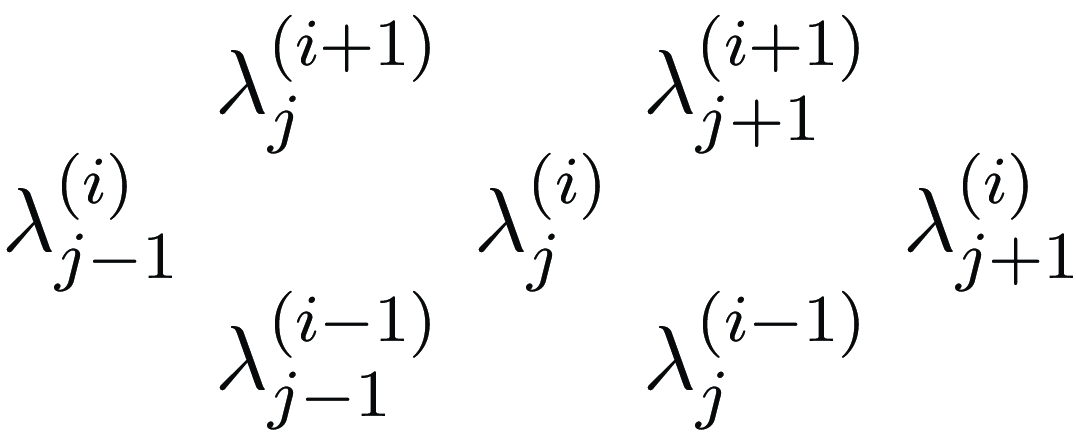
Part of a Gelfand–Tsetlin pattern.

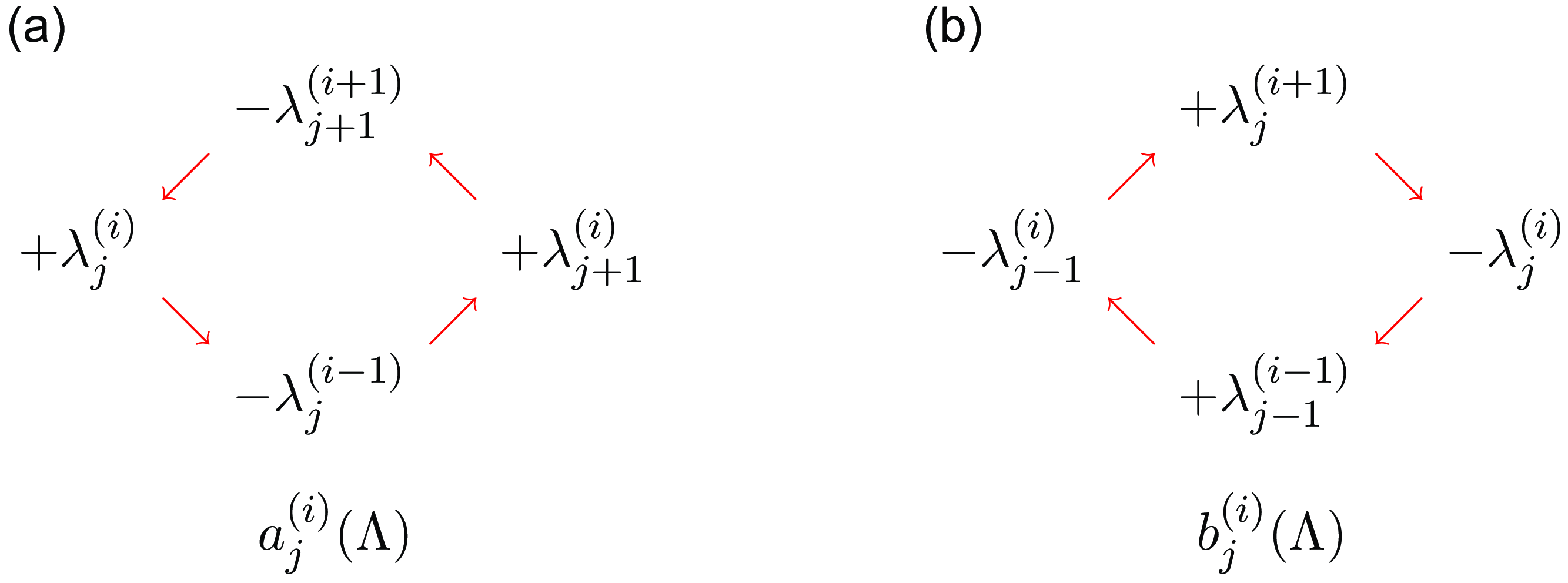
Computing diamond numbers in Gelfand–Tsetlin patterns.

We introduce the following diamond numbers (see Figures1 and 2), which are alternating sums around a diamond shape in
 $\Lambda$
starting at
 $\lambda ^{(i)}_j$
:
 \begin{align} a^{(i)}_j(\Lambda ) &\,:\!= \lambda ^{(i)}_j - \lambda ^{(i-1)}_j + \lambda ^{(i)}_{j+1} - \lambda ^{(i+1)}_{j+1}, \quad 0\le j\le i, \end{align}
 \begin{align} b^{(i)}_j(\Lambda ) &\,:\!= - \lambda ^{(i)}_j + \lambda ^{(i-1)}_{j-1} - \lambda ^{(i)}_{j-1} + \lambda ^{(i+1)}_j, \quad 1\le j\le i+1, \\[9pt]\nonumber\end{align}
where by convention
 $\lambda ^{(i)}_j=0$
if not
 $1\le j\le i$
. Note that,
 \begin{equation} b_j^{(i)}(\Lambda )=-a_{j-1}^{(i)}(\Lambda ),\quad 1\le j\le i+1, \end{equation}
and, by the interleaving conditions,
 \begin{equation} a_0^{(i)}(\Lambda )\le 0,\quad b^{(i)}_{i+1}(\Lambda )\le 0. \end{equation}
For notational convenience, we put
 \begin{equation} a_j^{(i)}(\Lambda )=0 \;\; \forall j\gt i, \qquad b_j^{(i)}(\Lambda )=0 \;\; \forall j\gt i+1. \end{equation}
Remark 3.1. There is a concrete interpretation of the diamond numbers of a pattern in terms of the corresponding SSYT, see Lemma 4.1.
Next, define these diamond-sums:
 \begin{align} A^{(i)}_j(\Lambda )\, &:\!= \sum _{k=j}^{i} a_k^{(i)}(\Lambda ),\quad 0\le j\le i, \qquad A_{i+1}^{(i)}=0, \end{align}
 \begin{align} B^{(i)}_j(\Lambda ) \,&:\!= \sum _{k=1}^j b_k^{(i)}(\Lambda ), \quad 1\le j\le i+1, \qquad B_0^{(i)}=0. \\[9pt]\nonumber\end{align}
Note that equation (3.3) imply
 \begin{equation} A_0^{(i)}(\Lambda )\le A_1^{(i)}(\Lambda ),\quad B_{i+1}^{(i)}(\Lambda )\le B^{(i)}_i(\Lambda ). \end{equation}
The following relation will be useful:
 \begin{equation} A_0^{(i)}(\Lambda )=A_j^{(i)}(\Lambda )-B_j^{(i)}(\Lambda )=-B_{i+1}^{(i)}(\Lambda )\qquad \forall j\in \{0,1,\ldots, i+1\}. \end{equation}
Remark 3.2. In [Reference Watanabe and Yamamura15], the authors give the formula for the
 $\mathbf {i}_A$
-string datum, where
 $\mathbf {i}_A$
is the reduced long word
 $(1,2,1,3,2,1,\ldots, n-1,n-2,\ldots, 1)$
. Converting their notation (their
 $a_{ij}$
is our
 $\lambda ^{(n+i-j)}_i$
) gives the formula
 $d_{i,j}(\Lambda )=\sum _{m=1}^{j-i}(\lambda ^{(j)}_m-\lambda ^{(j-1)}_m),\qquad 1\le i\lt j\le n$
.
If
 $\Lambda \in \mathrm {GTP}(n,\lambda )$
, let
 $\Lambda \pm \Delta ^{(i)}_j$
denote the array of integers obtained from
 $\Lambda$
by replacing
 $\lambda ^{(i)}_j$
by
 $\lambda ^{(i)}_j\pm 1$
. (In general, the resulting array is not a valid GTP.)
Definition 3.3. Let
 $P$
be the weight lattice of type
 $A_{n-1}$
. Put
 $\omega _i=\sum _{j=1}^i\boldsymbol {e}_j$
. Define for any
 $\Lambda \in \mathrm {GTP}(n, \lambda )$
and
 $i\in \{1,2,\ldots, n-1\}$
:
 \begin{align} \mathrm {wt}(\Lambda ) &=\sum _{j=1}^n \big (\sum _{k=1}^j \lambda ^{(j)}_k - \sum _{k=1}^{j-1} \lambda ^{(j-1)}_k\big )\boldsymbol {e}_j \\ &=A_0^{(1)}(\Lambda )\omega _1+A_0^{(2)}(\Lambda )\omega _2+\cdots +A_0^{(n)}(\Lambda )\omega _n \nonumber\\ \nonumber &=-\big (B_{2}^{(1)}(\Lambda )\omega _1+B_{3}^{(2)}(\Lambda )\omega _2+\cdots +B_{n+1}^{(n)}(\Lambda )\omega _n\big ); \nonumber \end{align}
 \begin{align} \varphi _i(\Lambda ) &= \max \big \{ A_1^{(i)}(\Lambda ), A_2^{(i)}(\Lambda ),\ldots, A_i^{(i)}(\Lambda ) \big \}; \end{align}
 \begin{align} \varepsilon _i(\Lambda ) &= \max \big \{ B_1^{(i)}(\Lambda ), B_2^{(i)}(\Lambda ), \ldots, B_i^{(i)}(\Lambda ) \big \}; \end{align}
 \begin{align} \widetilde {f}_i (\Lambda ) &= {\begin{cases} \Lambda - \Delta ^{(i)}_\ell, &\mathrm{if} \ \varphi _i(\Lambda )\gt 0, \\ 0, &\mathrm{if}\ \varphi _i(\Lambda )=0, \end{cases}} \\[8pt]\nonumber\end{align}
where
 $\ell = \max \big \{j\in \{1,2,\ldots, i\}\mid A^{(i)}_j(\Lambda )=\varphi _i(\Lambda ) \big \}$
;
 \begin{align} \widetilde {e}_i (\Lambda ) &\,= {\begin{cases} \Lambda + \Delta ^{(i)}_\ell, &\text {if} \ \varepsilon _i(\Lambda )\gt 0,\\ 0, &\text {if} \ \varepsilon _i(\Lambda )=0, \end{cases}} \end{align}
where
 $\ell = \min \big \{j\in \{1,2,\ldots, i\}\mid B^{(i)}_j(\Lambda )=\varepsilon _i(\Lambda ) \big \}.$
Theorem 3.4.
Let
 $n$
be any positive integer and
 $\lambda$
be a partition with
 $n$
or fewer parts. Then the set
 $\mathrm {GTP}(n,\lambda )$
of all GTPs with
 $n$
rows and top row
 $\lambda$
, equipped with the crystal data
 $\mathrm {wt},\ \tilde {f}_i,\tilde {e}_i,\varphi _i,\varepsilon _i$
as in Definition
3.3
, is a crystal of type
 $A_{n-1}$
.
Proof.
Let
 $i\in \{1,2,\ldots, n-1\}$
be arbitrary. First, we show that if
 $\Lambda \in \mathrm {GTP}(n,\lambda )$
is such that
 $\varphi _i(\Lambda )\gt 0$
, then
 $\tilde {f}_i(\Lambda )$
is a valid GTP. Let
 $\ell =\max \{j\in \{1,2,\ldots, i\}\mid A_j^{(i)}=\varphi _i(\Lambda )\}$
. Then, by definition,
 $\tilde {f}_i(\Lambda )=\Lambda -\Delta ^{(i)}_\ell$
, which has integer entries, the top row still equals
 $\lambda$
(since
 $i\lt n$
), and the interleaving conditions hold everywhere except possibly near the
 $\lambda _\ell ^{(i)}$
entry. More precisely, we must show the following inequalities hold:

We have that
 $\varphi _i(\Lambda )=A_\ell ^{(i)}(\Lambda ) = a_{\ell }^{(i)}(\Lambda )+a_{\ell +1}^{(i)}(\Lambda )+\cdots +a_i^{(i)}(\Lambda )$
. Note that
 $a_\ell ^{(i)}(\Lambda )\gt 0$
, otherwise
 $j=\ell +1$
would satisfy
 $A_j^{(i)}(\Lambda )=\varphi _i(\Lambda )$
(we can’t have
 $A_{\ell +1}^{(i)}(\Lambda )\gt \varphi _i(\Lambda )$
by the definitions of
 $\varphi _i$
and
 $\ell$
) contradicting maximality of
 $\ell$
. Now,
 $a_\ell ^{(i)}\gt 0$
is equivalent to
 \begin{equation} \lambda _\ell ^{(i)}-\lambda _\ell ^{(i-1)}+\lambda _{\ell +1}^{(i)}-\lambda _{\ell +1}^{(i+1)}\gt 0 \end{equation}
by definition of
 $a_\ell ^{(i)}$
. Since all entries of
 $\Lambda$
are integers, equation (3.16) implies that
 \begin{equation} \lambda _\ell ^{(i)}-1 \ge \lambda _\ell ^{(i-1)}+\lambda _{\ell +1}^{(i+1)}-\lambda _{\ell +1}^{(i)}. \end{equation}
By the interleaving condition for
 $\Lambda$
,
 \begin{equation} \lambda _{\ell +1}^{(i+1)}\ge \lambda _{\ell +1}^{(i)}, \quad \text { and }\quad \lambda _{\ell }^{(i-1)}\ge \lambda _{\ell +1}^{(i)}. \end{equation}
Combining equation (3.17) and equation (3.18), we obtain
 \begin{equation} \lambda _{\ell }^{(i)}-1\ge \lambda _\ell ^{(i-1)}\quad \text {and}\quad \lambda _\ell ^{(i)}-1\ge \lambda _{\ell +1}^{(i+1)} \end{equation}
which are the two rightmost inequalities in equation (3.15). The two leftmost inequalities in equation (3.15) are trivial since
 $\lambda _\ell ^{(i+1)}\ge \lambda ^{(i)}$
and
 $\lambda _{\ell -1}^{(i-1)}\ge \lambda _\ell ^{(i)}$
by the interleaving conditions for
 $\Lambda$
. This shows that if
 $\varphi _i(\Lambda )\gt 0$
, then
 $\tilde {f}_i(\Lambda )\in \mathrm {GTP}(n,\lambda )$
.
Next, suppose that
 ${\varepsilon }_i(\Lambda )\gt 0$
. We must show that
 $\tilde {e}_i(\Lambda )\in \mathrm {GTP}(n,\lambda )$
. We have
 ${\varepsilon }_i(\Lambda )=\max \{B_1^{(i)}(\Lambda ),\ldots, B_i^{(i)}(\Lambda )\}$
. Let
 $\ell =\min \{j\in \{1,2,\ldots, i\}\mid B_j^{(i)}(\Lambda )={\varepsilon }_i(\Lambda )\}$
. Then
 ${\varepsilon }_i(\Lambda )=B_{\ell }^{(i)}=b_1^{(i)}(\Lambda )+b_2^{(i)}(\Lambda )+\cdots +b_\ell ^{(i)}(\Lambda )$
. As before,
 $b_\ell ^{(i)}(\Lambda )\gt 0$
by the minimality of
 $\ell$
. So
 \begin{equation} -\lambda _{\ell -1}^{(i)}+\lambda _{\ell -1}^{(i-1)}-\lambda _{\ell }^{(i)}+\lambda _{\ell }^{(i+1)}\gt 0. \end{equation}
We have
 $\tilde {e}_i(\Lambda )=\Lambda +\Delta ^{(i)}_\ell$
and hence we must show that

Analogously to the previous case, the rightmost two inequalities
 $\lambda _\ell ^{(i)}+1\ge \lambda _{\ell +1}^{(i+1)}$
and
 $\lambda _\ell ^{(i)}+1\ge \lambda _{\ell +1}^{(i-1)}$
hold trivially by the interleaving conditions for
 $\Lambda$
. By equation (3.20), we have
 \begin{equation} \lambda _\ell ^{(i)}+1\le -\lambda _{\ell -1}^{(i)}+\lambda _{\ell -1}^{(i-1)}+\lambda _{\ell }^{(i+1)} \end{equation}
which together with
 $\lambda _{\ell -1}^{(i)}\ge \lambda _{\ell -1}^{(i-1)}$
and
 $\lambda _{\ell -1}^{(i)}\ge \lambda _{\ell }^{(i+1)}$
which hold by the interleaving condition for
 $\Lambda$
, yields the leftmost two inequalities in equation (3.21). This shows that if
 ${\varepsilon }_i(\Lambda )\gt 0$
, then
 $\tilde {e}_i(\Lambda )\in \mathrm {GTP}(n,\lambda )$
.
Next, we show that property (i) in the definition of crystal holds. First, we show that
 $\tilde {f}_i(\Lambda )=\Lambda '$
if
 $\tilde {e}_i(\Lambda ')=\Lambda$
. Suppose
 $\tilde {f}_i(\Lambda )=\Lambda '$
. In particular,
 $\varphi _i(\Lambda )\gt 0$
. Then we need to prove
 $\tilde {e}_i(\Lambda ')=\Lambda$
. We have
 $\Lambda '=\Lambda -\Delta ^{(i)}_\ell$
, where
 $\ell$
is defined by
 \begin{equation} \ell =\max \{j\in \{1,2,\ldots, i\}\mid A^{(i)}_j(\Lambda )=\varphi _i(\Lambda )\}. \end{equation}
First, we show that
 ${\varepsilon }_i(\Lambda ')\gt 0$
. By definition,
 ${\varepsilon }_i(\Lambda ')=\max \{B_1^{(i)}(\Lambda '),B_2^{(i)}(\Lambda '),\ldots, B_i^{(i)}(\Lambda ')\}$
. So it suffices to show that
 $B_j^{(i)}(\Lambda ')\gt 0$
for some
 $j$
. For
 $j=\ell$
, we have:
 \begin{equation} B_\ell ^{(i)}(\Lambda ')=b_1^{(i)}(\Lambda ')+b_2^{(i)}(\Lambda ')+\cdots +b_\ell ^{(i)}(\Lambda ')=B^{(i)}_\ell (\Lambda )+1 \end{equation}
since
 $b_j^{(i)}(\Lambda ')=b_j^{(i)}(\Lambda )$
for
 $j=1,\ldots, i-1$
while
 $b_{\ell }^{(i)}(\Lambda ')=b_{\ell }^{(i)}(\Lambda )+1$
by definition of
 $b_j^{(i)}(\Lambda )$
. By equation (3.8),
 \begin{equation} B_\ell ^{(i)}(\Lambda )+1 = A_\ell ^{(i)}(\Lambda )-A_0^{(i)}(\Lambda )+1 = \varphi _i(\Lambda )-A_0^{(i)}(\Lambda )+1 \end{equation}
By definition of
 $\varphi _i$
, we have
 \begin{equation} \varphi _i(\Lambda )-A_0^{(i)}(\Lambda )\ge 0. \end{equation}
Now, equations (3.24)–(3.26) imply
 $B_\ell ^{(i)}(\Lambda ')\gt 0$
, hence
 ${\varepsilon }_i(\Lambda ')\gt 0$
. It remains to be shown that
 $\tilde {e}_i(\Lambda ')=\Lambda$
. Since
 $\Lambda =\Lambda '+\Delta ^{(i)}_\ell$
, we have to show that
 \begin{equation} \ell =\min \{j\in \{1,2,\ldots, i\}\mid B_j^{(i)}(\Lambda ')={\varepsilon }_i(\Lambda ')\}. \end{equation}
For
 $1\le j\lt \ell$
, we saw that
 $B_j^{(i)}(\Lambda ')=B_j^{(i)}(\Lambda )$
and equation (3.8) implies that
 $B_j^{(i)}(\Lambda )\lt B_\ell ^{(i)}(\Lambda )$
, while
 $B_\ell ^{(i)}(\Lambda ')=1+B_\ell ^{(i)}(\Lambda )$
. So
 ${\varepsilon }_i(\Lambda ')\ge B_\ell ^{(i)}(\Lambda ')$
and we will show equality. For
 $\ell \lt j\le i$
, we have, by definition of
 $b_j^{(i)}(\Lambda )$
,
 \begin{equation} B_j^{(i)}(\Lambda ')=2+B_j^{(i)}(\Lambda ), \end{equation}
and by equation (3.8),
 \begin{equation} B_j^{(i)}(\Lambda )=A_j^{(i)}(\Lambda )-A_0^{(i)}(\Lambda ), \end{equation}
while by definition of
 $\ell$
, (3.23), we have
 \begin{equation} A_j^{(i)}(\Lambda )-A_0^{(i)}(\Lambda ) \lt A_\ell ^{(i)}(\Lambda )-A_0^{(i)}(\Lambda ). \end{equation}
Thus, equations (3.28)–(3.30) imply that
 \begin{equation} B_j^{(i)}(\Lambda ')\le 1+B_\ell ^{(i)}(\Lambda )=B_\ell ^{(i)}(\Lambda '). \end{equation}
Therefore,
 ${\varepsilon }_i(\Lambda ')=B_{\ell }^{(i)}(\Lambda ')$
and equation (3.27) holds.
The converse is analogous but we provide some details for the sake of completeness. Suppose that
 $\tilde {e}_i(\Lambda ')=\Lambda$
. We need to show that
 $\tilde {f}_i(\Lambda )=\Lambda '$
. We have
 ${\varepsilon }_i(\Lambda ')\gt 0$
and
 $\Lambda =\Lambda '+\Delta _{\ell }^{(i)}$
where
 $\ell =\min \{j\in \{1,2,\ldots, i\}\mid B_j^{(i)}(\Lambda ')={\varepsilon }_i(\Lambda ')\}$
. First, we show
 $\varphi _i(\Lambda )\gt 0$
by showing
 $A_\ell ^{(i)}(\Lambda )\gt 0$
. We have
 $A_\ell ^{(i)}(\Lambda )=A_\ell ^{(i)}(\Lambda ')+1$
and
 $A_\ell ^{(i)}(\Lambda ')={\varepsilon }_i(\Lambda ')-B_{i+1}^{(i)}(\Lambda ')\ge 0$
by equation (3.8). It remains to show
 $\tilde {f}_i(\Lambda )=\Lambda '$
. Since
 $\Lambda '=\Lambda -\Delta _\ell ^{(i)}$
, this is equivalent to showing that
 $\ell =\max \{j\in \{1,2,\ldots, i\}\mid A_j^{(i)}(\Lambda )=\varphi _i(\Lambda )\}$
. For
 $\ell \lt j\le i$
, we have
 $A_j^{(i)}(\Lambda )=A_j^{(i)}(\Lambda ')=B_j^{(i)}(\Lambda ')-B_{i+1}^{(i)}(\Lambda ')\le B_{\ell }^{(i)}(\Lambda ')-B_{i+1}^{(i)}(\Lambda ')=A_\ell ^{(i)}(\Lambda ')=A_\ell ^{(i)}(\Lambda )-1\lt A_\ell ^{(i)}(\Lambda )$
. So
 $\ell \le \max \{j\in \{1,2,\ldots, i\}\mid A_j^{(i)}(\Lambda )=\varphi _i(\Lambda )\}$
. For
 $1\le j\lt \ell$
, we have
 $A_j^{(i)}=2+A_j^{(i)}(\Lambda ')=2+B_j^{(i)}(\Lambda ')-B_{i+1}^{(i)}(\Lambda ')\le 1+B_\ell ^{(i)}-B_{i+1}^{(i)}(\Lambda ')=1+A_\ell ^{(i)}(\Lambda ')=A_\ell ^{(i)}(\Lambda )$
. This proves the desired equality.
Suppose now that
 $\tilde {f}_i(\Lambda )=\Lambda '$
and
 $\tilde {e}_i(\Lambda ')=\Lambda$
hold. In this case, all the entries of
 $\Lambda '$
equal those of
 $\Lambda$
, except for one entry
 $\lambda ^{'(i)}_\ell$
in the
 $i$
th row, which equals
 $\lambda ^{(i)}_\ell -1$
. Therefore,
 \begin{align*} \mathrm {wt}(\Lambda ') &=\sum _{j=1}^n \big (\sum _{k=1}^j \lambda ^{'(j)}_k - \sum _{k=1}^{j-1} \lambda ^{'(j-1)}_k\big )\boldsymbol {e}_j \\ &=-\boldsymbol {e}_i+\boldsymbol {e}_{i+1}+ \sum _{j=1}^n \big (\sum _{k=1}^j \lambda ^{(j)}_k - \sum _{k=1}^{j-1} \lambda ^{(j-1)}_k\big )\boldsymbol {e}_j \\ &=\mathrm {wt}(\Lambda )-\alpha _i \end{align*}
which is equivalent to
 $\mathrm {wt}(\Lambda ')=\mathrm {wt}(\Lambda )+\alpha _i$
.
To conclude the proof of (i), we need to show
 $\varepsilon _i(\Lambda ')=\varepsilon _i(\Lambda )+1$
and
 $\varphi _i(\Lambda ')=\varphi _i(\Lambda )-1$
. For
 $1\le j,\ell \le i$
and any
 $\Lambda \in \mathrm {GTP}(n,\lambda )$
, we have
 \begin{equation*} A^{(i)}_j(\Lambda -\Delta _\ell ^{(i)}) = {\begin{cases} A_j^{(i)}(\Lambda ), & 0\le j\lt \ell, \\ A_j^{(i)}(\Lambda )-1, & j=\ell, \\ A_j^{(i)}(\Lambda )-2, & \ell \lt j\le i. \end{cases}} \end{equation*}
Suppose
 $\varphi _i(\Lambda )\gt 0$
and let
 $\ell =\max \{j\in \{1,2,\ldots, i\}\mid A_j^{(i)}=\varphi _i(\Lambda )\}$
. Then for all
 $1\le j\le i$
.
 $A_j^{(i)}(\Lambda -\Delta _\ell ^{(i)})\le \varphi _i(\Lambda )-1$
with equality for
 $j=\ell$
. Therefore,
 $\varphi _i(\tilde {f}_i(\Lambda ))=\varphi _i(\Lambda )-1$
.
Let
 $1\le j,\ell \le i$
. Then for any
 $\Lambda \in \mathrm {GTP}(n,\lambda )$
, we have
 \begin{equation*} B^{(i)}_j(\Lambda +\Delta _\ell ^{(i)})= {\begin{cases} B_j^{(i)}(\Lambda ) & 1\le j \lt \ell, \\ B_j^{(i)}(\Lambda )-1 & j=\ell, \\ B_j^{(i)}(\Lambda )-2 & \ell \lt j \le i. \end{cases}} \end{equation*}
Suppose
 ${\varepsilon }_i(\Lambda )\gt 0$
and let
 $\ell =\min \{j\in \{1,2,\ldots, i\}\mid B_j^{(i)}(\Lambda )={\varepsilon }_i(\Lambda ) \}$
. Then
 $B_j^{(i)}(\Lambda +\Delta _\ell ^{(i)})\le {\varepsilon }_i(\Lambda )-1$
with equality for
 $j=\ell$
. Thus,
 ${\varepsilon }_i(\tilde {e}_i(\Lambda ))={\varepsilon }_i(\Lambda )-1$
.
For property (ii), we verify that for all
 $\Lambda \in \mathrm {GTP}(n,\lambda )$
, we have
 \begin{equation*}\varphi _i(\Lambda )-\varepsilon _i(\Lambda ) = \langle \mathrm {wt}(\Lambda ), \alpha _i^\vee \rangle .\end{equation*}
We have
 $\varphi _i(\Lambda )=\max \{A_1^{(i)},A_2^{(i)},\ldots, A_i^{(i)}\}$
and
 $\varepsilon _i(\Lambda )=\max \{B_1^{(i)},B_2^{(i)},\ldots, B_i^{(i)}\}$
. We will use relation equation (3.8). Writing
 $A^{(i)}_k=A_k^{(i)}(\Lambda )$
for brevity, we have
 \begin{align*} \varphi _i(\Lambda )-\varepsilon _i(\Lambda ) &= \max \{A^{(i)}_1,A^{(i)}_2,\ldots, A^{(i)}_i\}- \max \{ A^{(i)}_1-A^{(i)}_0, A^{(i)}_2-A^{(i)}_0,\ldots, A^{(i)}_i-A^{(i)}_0\} \\ &=\max \{A^{(i)}_1,A^{(i)}_2,\ldots, A^{(i)}_i\}- \max \{ A^{(i)}_1, A^{(i)}_2,\ldots, A^{(i)}_i\} + A^{(i)}_0 \\ &=A^{(i)}_0 \\ &=\sum _{k=0}^i (\lambda ^{(i)}_k+\lambda ^{(i)}_{k+1}-\lambda ^{(i-1)}_k-\lambda ^{(i+1)}_{k+1}) \\ &=2\sum _{k=1}^i \lambda ^{(i)}_k-\sum _{k=1}^{i-1}\lambda ^{(i-1)}_k - \sum _{k=1}^{i+1}\lambda ^{(i+1)}_k. \end{align*}
On the other hand, using the first expression for the weight function, we have
 \begin{equation*} \mathrm {wt}(\Lambda )=\sum _{j=1}^n \big (\sum _{k=1}^j \lambda ^{(j)}_k - \sum _{k=1}^{j-1} \lambda ^{(j-1)}_k\big )\boldsymbol {e}_j \end{equation*}
so using
 \begin{equation*} \langle \boldsymbol {e}_j, \alpha _i^\vee \rangle = \langle \omega _j-\omega _{j-1}, \alpha _i^\vee \rangle = \delta _{ji}-\delta _{j-1,i} \end{equation*}
we get
 \begin{align*} \langle \mathrm {wt}(\Lambda ), \alpha _i^\vee \rangle &= \langle \sum _{j=1}^n \big (\sum _{k=1}^j \lambda ^{(j)}_k - \sum _{k=1}^{j-1} \lambda ^{(j-1)}_k\big )\boldsymbol {e}_j, \alpha _i^\vee \rangle \\ &= \sum _{j=1}^n \big (\sum _{k=1}^j \lambda ^{(j)}_k -\sum _{k=1}^{j-1} \lambda ^{(j-1)}_k \big )(\delta _{ji}-\delta _{j-1,i}) \\ &=2\sum _{k=1}^i \lambda ^{(i)}_k - \sum _{k=1}^{i-1} \lambda ^{(i-1)}_k -\sum _{k=1}^{i+1} \lambda ^{(i+1)}_k \end{align*}
This shows that
 $\varphi _i(\Lambda )-\varepsilon _i(\Lambda ) = \langle \mathrm {wt}(\Lambda ), \alpha _i^\vee \rangle$
, which also equals the coefficient of
 $\omega _i$
in
 $\mathrm {wt}(\Lambda )$
, proving the second and third equality in equation (3.9).
Lastly, since
 $\varphi _i(\Lambda )$
and
 ${\varepsilon }silon_i(\Lambda )$
are never
 $-\infty$
, condition (iii) in the definition of a crystal is void.
4. Crystal isomorphism
In this section, we prove our second main result which says that the natural bijection
 $\mathcal {T}$
from
 $\mathrm {SSYT}(n,\lambda )$
to
 $\mathrm {GTP}(n,\lambda )$
described in Section 2.5 is an isomorphism of crystals.
We will let
 $T_i$
denote the
 $i$
th row of a SSYT
 $T$
, and
 $T_{\ge \ell }$
the subtableau obtained by deleting the first
 $\ell -1$
rows, and similarly for
 $T_{\le \ell }$
:
 \begin{equation*} T = \begin{matrix} T_1 \\ T_2 \\ \vdots \\ T_n \end{matrix} \qquad \qquad T_{\ge \ell } = \begin{matrix} T_\ell \\ T_{\ell +1} \\ \vdots \\ T_n \end{matrix} \qquad \qquad T_{\le \ell } = \begin{matrix} T_1 \\ T_{2} \\ \vdots \\ T_\ell \end{matrix} \end{equation*}
The following counting lemma will be useful.
Lemma 4.1.
Let
 $\Lambda \in \mathrm {GTP}(n,\lambda )$
and
 $T=\mathcal {T}(\Lambda )$
.
-
(a) For all integers
$k$
with
$1\le k\le n$
, the number of letters
$i$
in
$T_k$
is equal to
$\lambda ^{(i)}_k - \lambda ^{(i-1)}_k$
. -
(b)
$a^{(i)}_j(\Lambda )$
counts the number of
$i$
’s in
$T_j$
minus the number of
$(i+1)$
’s in
$T_{j+1}$
. -
(c)
$b^{(i)}_j(\Lambda )$
counts the number of
$(i+1)$
’s in
$T_j$
minus the number of
$i$
’s in
$T_{j-1}$
. -
(d)
$A^{(i)}_\ell (\Lambda )$
counts the number of
$i$
’s in
$T_{\ge \ell }$
minus the number of
$(i+1)$
’s in
$T_{\ge \ell +1}$
. -
(e)
$B_{\ell }^{(i)}(\Lambda )$
counts the number of
$(i+1)$
’s in
$T_{\le \ell }$
minus the number of
$i$
’s in
$T_{\le \ell -1}$
.


Proof.
(a) The number of boxes in
 $T_k$
containing a letter from
 $\{ 1, 2, \ldots, i \}$
is
 $\lambda ^{(i)}_k$
. Then (b) and (c) are immediate by part (a) and the definitions, (3.1), of the diamond numbers. Now (d) and (e) follow from parts (b) and (c).
Theorem 4.2.
Let
 $n$
be a positive integer and
 $\lambda$
a partition with
 $n$
or fewer parts. The bijection
 $\mathcal {T}$
from
 $\mathrm {GTP}(n,\lambda )$
to
 $\mathrm {SSYT}(n,\lambda )$
given in Section
2.5
is an isomorphism of crystals.
Proof.
Let
 $\Lambda \in \mathrm {GTP}(n,\lambda )$
, and let
 $T=\mathcal {T}(\Lambda )$
.
 $\mathrm {wt}(\Lambda )=\mathrm {wt}(T)$
: For each
 $i\in \{1,2,\ldots, n-1\}$
, by Lemma 4.1(a),
 $\sum _{j=1}^i \lambda ^{(i)}_j-\sum _{j=1}^{(i-1)} \lambda ^{(i-1)}_j$
equals
 $N_i(T)$
, since the letter
 $i$
cannot occur below the
 $i$
th row in an SSYT.
Let
 $i\in \{1,2,\ldots, n-1\}$
be arbitrary. In the rest of the proof, “bracketing” refers to
 $i$
-bracketing. Put
 $A^{(i)}_k=A_k^{(i)}(\Lambda )$
and
 $B^{(i)}_k=B^{(i)}_k(\Lambda )$
for brevity.
 $\varphi _i(\Lambda )=\varphi _i(T)$
: By definition,
 $\varphi _i(T)$
is the number of unbracketed
 $i$
’s in
 $T$
. So
 $\varphi _i(T)\ge \varphi _i(T_{\ge j})$
for any
 $j\in \{1,2\ldots, i\}$
. Let
 $j_1\ge j_2\ge \cdots \ge j_k$
be all the rows of
 $T$
containing at least one unbracketed
 $i$
. Then
 $\varphi _i(T_\ge {j_1}) = A_{j_1}^{(i)}$
by Lemma 4.1(d). Furthermore,
 $A_{j_1}^{(i)}\gt A_{k}^{(i)}$
for
 $k=i, i-1, \ldots, j_1+1$
. Next,
 $\varphi _i(T_{\ge j_2}) = \varphi _i(T_{\ge {j_1}})+\varphi _i(T_{\ge {j_2}}/T_{\ge {j_1}}) = A_{j_1}^{(i)}+(A_{j_2}^{(i)}-A_{j_1}^{(i)})=A_{j_2}^{(i)}$
. (Here,
 $T_{\ge {j_2}}/T_{\ge {j_1}}$
denotes the subtableau of
 $T$
consisting of row
 $j_2$
through row
 $j_1-1$
.) And
 $A_{j_2}^{(i)}\gt A_k^{(i)}$
for
 $k=j_1, j_1-1,\ldots, j_2+1$
. Continuing recursively, we eventually obtain that
 $\varphi _i(T)=\varphi _i(T_{\ge {j_k}}) = A_{j_k}^{(i)}\gt A_{j}^{(i)}$
for
 $j\gt j_k$
. It remains to be shown that
 $A^{(i)}_j\le A^{(i)}_{j_k}$
for
 $i=j_k-1,j_k-2,\ldots, 1$
. Since
 $j_k$
is the top row having unbracketed
 $i$
’s, we have
 $A_j^{(i)}(\Lambda _{\le j_k-1}) \le 0$
for
 $j=j_k-1, j_k-2,\ldots, 1$
, where
 $\Lambda _{\le r}$
is defined to be
 $\mathcal {T}^{-1}(T_{\le r})$
for all
 $r$
. Since
 $A_j^{(i)}(\Lambda ) - A_{j_k}^{(i)}(\Lambda ) = A_j^{(i)}(\Lambda _{\le j_k-1})$
, this shows the required inequality.
 $\varepsilon _i(\Lambda )=\varepsilon _i(T)$
: This part can be proved completely analogously to the case of
 $\varphi _i$
. But it also follows from the case of
 $\varphi _i$
and the fact that we already know that
 $\mathrm {GTP}(n,\lambda )$
and
 $\mathrm {SSYT}(n,\lambda )$
are crystals, and hence by property (ii) in the definition of crystal and that
 $\mathrm {wt}(\Lambda )=\mathrm {wt}(T)$
,
 \begin{equation*} {\varepsilon }_i(\Lambda ) = \varphi _i(\Lambda )-\langle \mathrm {wt}(\Lambda ),\alpha _i^\vee \rangle = \varphi _i(T)-\langle \mathrm {wt}(T),\alpha _i^\vee \rangle = {\varepsilon }_i(T). \end{equation*}
 $\mathcal {T}\big (\tilde {f}_i(\Lambda )\big )=\tilde {f}_i\big (\mathcal {T}(\Lambda )\big )$
: We have seen already that
 $\varphi _i(\Lambda )=\varphi _i(T)$
. Thus,
 $\tilde {f}_i(\Lambda )\neq 0$
if
 $\tilde {f}_i(T)\neq 0$
. Suppose
 $\tilde {f}_i(\Lambda )\neq 0$
. Put
 $\Lambda '=\tilde {f}_i(\Lambda )=\Lambda -\Delta ^{(i)}_\ell$
, where
 $\ell =\max \{i\in \{1,2,\ldots, i\}\mid A_j^{(i)}(\Lambda )=\varphi _i(\Lambda )\}$
. By definition of the bijection
 $\mathcal {T}$
, the SSYT
 $\mathcal {T}(\Lambda ')$
is obtained from
 $T$
by changing the rightmost
 $i$
in row
 $\ell$
to
 $i+1$
. On the other hand,
 $\tilde {f}_i(T)$
is obtained by changing the rightmost unbracketed
 $i$
in
 $T$
to
 $i+1$
. So we must show that
 $\ell$
equals the row index of the rightmost unbracketed
 $i$
in
 $T$
. First, we show that there is an unbracketed
 $i$
in row
 $\ell$
of
 $T$
. To do this, we derive a series of equivalences. Let
 $j\in \{1,2,\ldots, i\}$
be arbitrary. Then:
 \begin{align*} &T \ \text {has an unbracketed} \ i\ \text {in row}\ j\\ \Leftrightarrow \; & \varphi _i(T_{\ge j})\gt \varphi _i(T_{\ge j+1}) \\ \Leftrightarrow \; & \varphi _i(\Lambda _{\ge j})\gt \varphi _i(\Lambda _{\ge j+1}) \quad \text {where}\, \Lambda _{\ge k}\,:\!=\mathcal {T}^{-1}(T_{\ge k}) \\ \Leftrightarrow \; & \max \{A^{(i)}_k(\Lambda _{\ge j})\mid k=1,2,\ldots, i\} \gt \max \{A^{(i)}_k(\Lambda _{\ge j+1})\mid k=1,2,\ldots, i\} \\ \Leftrightarrow \; & \max \{A^{(i)}_k(\Lambda )\mid k=j,j+1,\ldots, i\} \gt \max \{A^{(i)}_k(\Lambda )\mid k=j+1,j+2,\ldots, i\} \\ \Leftrightarrow \; & A^{(i)}_j(\Lambda )\gt A^{(i)}_k(\Lambda ) \quad \text { for all}\, k\in \{j+1,\, j+2,\,\ldots, \, i\}. \end{align*}
The penultimate equivalence holds by the counting lemma, Lemma 4.1(d), and that the first row of
 $T_{\ge j}$
is the
 $j$
th row of
 $T$
and so on. Now, by definition of
 $\ell$
, we do indeed have
 \begin{equation*}A^{(i)}_\ell (\Lambda )\gt A^{(i)}_k(\Lambda )\quad \text {for all $k\in \{\ell +1,\, \ell +2,\, \ldots, \, i\}$}\end{equation*}
and therefore by the above series of equivalences, there is at least one unbracketed
 $i$
in row
 $\ell$
of
 $T$
.
It remains to show that
 $\ell$
is the row of the rightmost unbracketed
 $i$
in
 $T$
. Since any
 $i$
directly to the right of an unbracketed
 $i$
is itself unbracketed, any unbracketed
 $i$
further to the right would have to occur among the top
 $\ell -1$
rows of
 $T$
. Any unbracketed
 $i$
among the top
 $\ell -1$
rows of
 $T$
would remain unbracketed when considered as an entry of the truncated tableau
 $T_{\le \ell -1}$
. So it suffices to show that
 $T_{\le \ell -1}$
has no unbracketed
 $i$
’s, or equivalently, that
 $\varphi _i(T_{\le \ell -1})=0$
. Let
 $\Lambda _{\le \ell -1}=\mathcal {T}^{-1}(T_{\le \ell -1})$
. As previously shown,
 $\varphi _i(T_{\le \ell -1})=\varphi _i(\Lambda _{\le \ell -1})$
. By Lemma 4.1(d), for all
 $1\le j\le i$
:
 \begin{equation*} A^{(i)}_j(\Lambda _{\le \ell -1}) = A^{(i)}_j(\Lambda )-A^{(i)}_\ell (\Lambda ) \end{equation*}
which is less than or equal to zero by definition of
 $\ell$
. Hence
 $\varphi _i(\Lambda _{\le \ell -1})=0$
.
 $\mathcal {T}\big (\tilde {e}_i(\Lambda )\big )=\tilde {e}_i\big (\mathcal {T}(\Lambda )\big )$
: We know that
 ${\varepsilon }_i(\Lambda )={\varepsilon }_i(T)$
. Thus,
 $\tilde {e}_i(\Lambda )=0$
if
 $\tilde {e}_i(T)=0$
. Suppose that
 $\tilde {e}_i(\Lambda )\neq 0$
. Put
 $\Lambda '=\tilde {e}_i(\Lambda )=\Lambda +\Delta ^{(i)}_\ell$
, where
 \begin{equation*}\ell =\min \big \{j\in \{1,2,\ldots, i\}\mid B^{(i)}_j(\Lambda )={\varepsilon }_i(\Lambda )\big \}.\end{equation*}
Also, recall that
 \begin{equation*}{\varepsilon }_i(\Lambda )=\max \{B^{(i)}_1(\Lambda ),\, B^{(i)}_2(\Lambda ),\, \ldots, \, B^{(i)}_i(\Lambda )\}.\end{equation*}
By definiton of the bijection
 $\mathcal {T}$
, the SSYT
 $\mathcal {T}(\Lambda ')$
is obtained from
 $T$
by changing the leftmost
 $i+1$
in row
 $\ell$
of
 $T$
to
 $i$
. On the other hand,
 $\tilde {e}_i(T)$
is the SSYT obtained from
 $T$
by changing the leftmost unbracketed
 $i+1$
to
 $i$
. So we must show that
 $\ell$
equals the row index of the row in
 $T$
which contains the leftmost unbracketed
 $i+1$
.
First, we show that row
 $\ell$
of
 $T$
contains an unbracketed
 $i+1$
. For this, we derive an equivalent condition. For all
 $j\in \{1,2,\ldots, i\}$
, we have:
 \begin{align*} &T \ \text {contains an unbracketed}\ i+1\ \text {in row}\ j+1\\ \Leftrightarrow \; & {\varepsilon }_i(T_{\le j+1}) \gt {\varepsilon }_i(T_{\le j}) \\ \Leftrightarrow \; & {\varepsilon }_i(\Lambda _{\le j+1}) \gt {\varepsilon }_i(\Lambda _{\le j}) \quad \text {where}\ \Lambda _{\le k}\,:\!=\mathcal {T}^{-1}(T_{\le k})\\ \Leftrightarrow \; & \max \{B^{(i)}_k(\Lambda _{\le j+1})\mid k=1,2,\ldots, i\}\gt \max \{B^{(i)}_k(\Lambda _{\le j})\mid k=1,2,\ldots, i\}\\ \Leftrightarrow \; & B^{(i)}_{j+1}\gt B^{(i)}_k\quad \text {for all}\ k\in \{1,2,\ldots, j\} \end{align*}
This condition holds for
 $j+1=\ell$
by definition of
 $\ell$
. Thus,
 $T$
contains an unbracketed
 $i+1$
in row
 $\ell$
.
Next, we show that no row of
 $T$
contains an unbracketed
 $i+1$
further to the left. Such a row
 $j$
would have to be below
 $\ell$
, that is
 $j\ge i+1$
. By the above equivalences, we would get
 \begin{equation*}B^{(i)}_j(\Lambda )\gt B^{(i)}_k(\Lambda )\quad \text {for all $k\in \{1,2,\ldots, j-1\}$}.\end{equation*}
In particular,
 $B^{(i)}_j(\Lambda )\gt B^{(i)}_\ell (\Lambda )$
, which contradicts the definition of
 $\ell$
. This finishes the proof that
 $\mathcal {T}(\tilde {e}_i(\Lambda ))=\tilde {e}_i(\mathcal {T}(\Lambda ))$
.
Alternative proof that
 $\mathcal {T}\big (\tilde {e}_i(\Lambda )\big )=\tilde {e}_i\big (\mathcal {T}(\Lambda )\big )$
: As is well-known, if a function between crystals preserves the string length functions and intertwines the
 $\tilde {f}_i$
crystal operators, then it automatically intertwines the
 $\tilde {e}_i$
crystal operators. We illustrate this for the convenience of the reader. We know that
 ${\varepsilon }_i(\Lambda )={\varepsilon }_i(T)$
. Thus,
 $\tilde {e}_i(\Lambda )=0$
if
 $\tilde {e}_i(T)=0$
. Suppose that
 $\tilde {e}_i(\Lambda )\neq 0$
. Since
 $\varphi _i(\mathcal {T}(\tilde {e}_i(\Lambda ))=\varphi _i(\tilde {e}_i(\Lambda ))\ge 1$
. Thus we have
 \begin{align*} \mathcal {T}\big (\tilde {e}_i(\Lambda )\big ) &= \tilde {e}_i\tilde {f}_i\big (\mathcal {T}(\tilde {e}_i(\Lambda ))\big )\\ &=\tilde {e}_i\mathcal {T}\big (\tilde {f}_i\tilde {e}_i(\Lambda )\big ) \quad \text {by $\mathcal {T}\tilde {f}_i=\tilde {f}_i\mathcal {T}$}\\ &=\tilde {e}_i\big (\mathcal {T}(\Lambda )\big ). \end{align*}
5. Example
Isomorphic crystal graphs of type
 $A_2$
.

Figure 3 shows the respective crystal graphs of two isomorphic crystals of type
 $A_2$
. To illustrate, consider the GTP
 \begin{equation*} \Lambda = \left \{\begin{array}{*{5}c} \lambda ^{(3)}_1 & & \lambda ^{(3)}_2 & & \lambda ^{(3)}_3 \\ & \lambda ^{(2)}_1 & & \lambda ^{(2)}_2 & \\ & & \lambda ^{(1)}_1 & & \end{array}\right \} = \left \{\begin{array}{*{5}c} 3 & & 1 & & 0 \\ & 3 & & 1 & \\ & & 2 & & \end{array}\right \} \end{equation*}
in the crystal
 $\mathrm {GTP}(3,(3,1,0))$
(in Figure 3, it is in the second vertex row from the top). Let us compute
 $\widetilde f_1(\Lambda )$
. First, we need
 $\varphi _1(\Lambda )$
. The relevant diamond sum (see equation 3.5) for
 $\Lambda$
is (recall that entries outside the array are zero by convention)
 \begin{equation*} A_1^{(1)}(\Lambda ) = a_1^{(1)}(\Lambda ) = \lambda _1^{(1)} - \lambda _1^{(0)} + \lambda _2^{(1)} - \lambda _2^{(2)} = 2 - 0 + 0 - 1 = 1, \end{equation*}
which gives
 \begin{equation*} \varphi _1(\Lambda ) = \max \big \{ A_1^{(1)}(\Lambda )\big \} = 1. \end{equation*}
By Definition3.3, the only value for
 $\ell$
here is
 $\ell =1$
, hence applying
 $\tilde {f}_1$
on
 $\Lambda$
has the effect of decrementing the entry
 $\lambda ^{(1)}_1$
:
 \begin{equation*} \widetilde {f}_1(\Lambda ) = \Lambda -\Delta ^{(1)}_1= \left \{\begin{array}{*{5}c} 3 & & 1 & & 0 \\ & 3 & & 1 & \\ & & 1 & & \end{array}\right \} \end{equation*}
as is visible in Figure 3. Let us also compute
 $\tilde {f}_2(\Lambda )$
. The diamond sums we need are
 \begin{align*} A_1^{(2)}(\Lambda ) &\,= a_1^{(2)}(\Lambda ) + a_2^{(2)}(\Lambda ) = (3 - 2 + 1 - 1) + (1 - 0 + 0 - 0) = 1 + 1 = 2 \\ A_2^{(2)}(\Lambda ) &\,= a_2^{(2)}(\Lambda ) = 1 - 0 + 0 - 0 = 1, \end{align*}
which gives
 \begin{equation*} \varphi _2(\Lambda ) = \max \big \{ A_1^{(2)}(\Lambda ), A_2^{(2)}(\Lambda ) \big \} = \max \big \{ 2, 1 \big \} = 2. \end{equation*}
Here, the largest index
 $\ell \in \{1,2\}$
for which
 $A^{(2)}_\ell =\varphi _2(\Lambda )$
is
 $\ell =1$
. Therefore, applying
 $\tilde {f}_2$
on
 $\Lambda$
has the effect of decrementing the entry
 $\lambda ^{(2)}_1$
:
 \begin{equation*} \widetilde {f}_2(\Lambda ) = \Lambda -\Delta ^{(2)}_1= \left \{\begin{array}{*{5}c} 3 & & 1 & & 0 \\ & 2 & & 1 & \\ & & 2 & & \end{array}\right \} \end{equation*}
as can be seen in Figure 3. The remaining crystal structure can be worked out in a similar fashion.
Acknowledgments
The first author gratefully acknowledges support from Simons Collaboration Grant for Mathematicians, award number 637600, and the Army Research Office grant W911NF-24-1-0058. This work was inspired by a question of G. Benkart.