Introduction
Almost twenty years ago, Roy Church observed in a survey of products, firms, marketing, and consumers since the mid-nineteenth century that historians should give more attention to such elementary factors as “what firms produce and for whom.” He asked, “How did entrepreneurs and managers gain information about consumers, how was it employed, and with what effects on products made, in terms of prices, quality, design or style?”Footnote 1 As he correctly observed, these issues could only be addressed through labor-intensive empirical studies; they also require the survival of the sort of evidence that allows conclusions to be drawn about consumers and how they shape business behavior. The Church call was recently developed for quality textiles, perhaps the greatest of the consumer-driven commodities, past and present, during a period of decline in the sector and when evidence is readily available. Clayton’s study of the mid-twentieth-century British cotton industry exploits modern marketing campaigns in an age when market research and advertising techniques were well developed, and the government-founded Cotton Board took a direct role in promoting sales of printed cottons at home.Footnote 2 What, though, of cotton selling a hundred years before that, when it was still a leading manufacturing sector in Britain with an international sales profile, but before the effective formulation and theorizing of mass-marketing techniques such as consumer research or product strategy and branding?Footnote 3
This article is about British-made cotton textiles that were sold in India and the market and sales information gathered mid-nineteenth century by commission agents in Bombay and by personal observations of John Matheson, a Glasgow-based cotton entrepreneur. It looks at the use of this information for the product development of high-quality Turkey red-dyed and printed cottons manufactured by one of the three major Scottish firms whose main market was India: William Stirling & Sons. In 1898 it merged with John Orr Ewing & Co. and Archibald Orr Ewing & Co. to form the United Turkey Red Company Ltd.Footnote 4 The study draws on two exceptional sources. The first is a pattern book from 1853 to 1869 that combines written commentary from a number of agents in India on their printed cotton sales along with textiles samples sent from Bombay to the Stirling offices in Glasgow.Footnote 5 The second is a published tour account by John Matheson (1817–1878), Stirling’s managing partner, who visited India in the early 1860s to see the system of retail distribution for himself and to gather information on consumers, market segmentation, and more generally the Indian economy.Footnote 6 These sources are enhanced by a commentary of the same decade from David Bremner, an early commercial journalist, who published a lengthy description of Stirling’s print and dye works in the Scotsman newspaper in 1869 as part of a series on the industries of Scotland.Footnote 7
The British cotton industry has been a major field of economic and business history for decades, and has also engaged the interests of historians of material culture and globalization. Technology and innovation have formed the focus of one area of inquiry, along with the parallel preoccupation with why the industry ultimately failed.Footnote 8 An array of studies is concerned with the social and cultural impacts of international cotton production on British consumers.Footnote 9 Another body of literature looks at global markets and international design exchange from Asia to Europe, particularly in the eighteenth century.Footnote 10 Most of the discussion of the nineteenth century is focused on standardized products such as gray cloths and shirtings. Though a smaller sector, it is widely accepted that the cotton finishing industry making prints for fashionable clothing or domestic furnishings was more generally successful than standardized production. It employed large numbers of skilled workers, generated healthy profits for the owners, and performed well in the face of rising overseas competition.Footnote 11 Studies of printed cottons tend to focus on the economic dynamics of competing European or Indian manufacturers or on the mechanism of the trade through the activities and organizational structures of merchants, shippers, and commission agents.Footnote 12 There is limited engagement with design relative to the cultural characteristics of market creation, particularly in the mid- and late nineteenth century. Little is known about how entrepreneurs sought to understand and shape their sales profiles, even among British consumers. There are also few accounts of how British-made higher-end prints entered and performed in their principal market, which—like plain cottons—was India. This article seeks to fill some of these gaps and cast light on why it was so hard to successfully enter the India market for what was usually called “fancy” cottons.
Below I first give a short account of the rise and demise of Turkey red cotton printing in Scotland. In the next section, which is focused on India agent commentaries, I consider the variety of piece sizes, patterns, colors, and packaging that was necessary for successful sales of printed cotton in India. It shows that despite much continuity in traditional patterns and color preferences, there were also seasonal changes and an appetite for novelty patterns. In the third section, I develop these themes and interrogate what John Matheson, his contemporaries, and his agents understood about Indian markets, bazaar-based market intermediaries, and consumers. I also consider the limits of Western businesses to shape Indian consumer tastes. The article concludes that there was relevant information conveyed from India and evidence it was used to inform production for the India market. Nevertheless, there was also a blindness to the realities of India’s complex evolving dress cultures, which had implications for product development in Britain. A constant emphasis on the quality of products, ever-increasing varieties of piece sizes and patterns, and the use of elaborate and expensive packaging for retail sales were not enough to sustain saturated markets.
Inevitably, failure to maintain a presence in the India market was rooted in the complex social, cultural, and economic contexts in India in which British producers and agents were placed. A modernizing dynamic largely under Indian control coexisted with an evolving attachment to ideas of tradition in Indian business and bazaar practices that outside commentators imperfectly understood. This becomes apparent in some of the written observations of John Matheson in the 1860s. As the century advanced, the Indian taste for its own manufactures, including red-dyed and printed cottons, was served by new and easily available synthetic dyes and machine production of cheap and fashionable goods.Footnote 13 Design schools in India, which were founded by colonial officials, many of them Scots, generated local designers with a better appreciation of Indian consumer tastes than designers in Glasgow, however well informed.Footnote 14 Far from being left behind, Indian artisans evolved with changing demand, and were themselves the originators of new and original designs that easily matched those coming from Glasgow or Manchester.Footnote 15 Indian bazaar marketing, seen as fossilized by outsiders, operated according to its own evolving values and norms, and happily embraced a changing pattern of supplies from British manufacturers as well as local factories or sources elsewhere in the world.Footnote 16 The economic or cultural evolution of the textile industry in India was not entirely divorced from that of Britain. Of course, many British industrialists, including some of the Scottish Turkey red entrepreneurs, had an interest in manufacturing in India, but the ultimate fate of Scottish Turkey red in India was shaped by both global and local conditions.
Scottish Turkey Red
There were many types of dyed and printed cottons in the nineteenth century. The relative cost of the natural dyes involved and the complexity of the dyeing and printing processes gave rise to a high added value for the commodities produced.Footnote 17 The term “Turkey red” refers to a dyeing process that was used to create a bright and fast red that withstood strong sunshine and frequent washing without fading. The process was expensive and only fully perfected in the 1830s, but the end product, either plain red or over printed using a variety of print techniques, enjoyed wide popularity. It was reputed to be the most profitable of all the cotton finishing sectors in the nineteenth century.Footnote 18 Outside of Britain, the main market was India, but there were also sales in South America, the Middle East, Indonesia, China, and Japan. In the middle decades of the nineteenth century, Turkey red cotton was produced in a remarkable variety of prints; finishes; and sizes of cloth, including printed bandannas and “dress” pieces for saris and sarongs.Footnote 19 Some of these were still made on handlooms, and the finest dress pieces—such as saris with complex patterned ends and borders—were printed using craft techniques.Footnote 20 As with many higher-end cotton printers, all of the Scottish Turkey red firms managed their own marketing at home and abroad rather than rely on merchant intermediaries and shipping houses, the latter being usual among lower-end producers.Footnote 21
Several Scottish firms were noted manufacturers of Turkey red cottons. One of the earliest was William Stirling & Sons, which was founded in Glasgow in the mid-eighteenth century by a merchant for London-printed cottons. Production moved to the Vale of Leven in Dunbartonshire in the 1770s to take advantage of plentiful water and space for bleach fields.Footnote 22 By mid-century, Stirling was the largest firm of its type in Scotland and occupied two distinct manufacturing sites: the Cordale Printworks and the Dalquhurn Dyeworks. Stirling employed nearly 1,500 workers in 1868, with many practicing hand-printing techniques to achieve a high-quality output alongside machine printing. Designers for the industry were based in Glasgow.Footnote 23 Stirling’s annual output, mostly for export, was almost 19 million yards of cloth in 1868, about half of this patterned, along with 800,000 pounds of dyed yarn. They also printed large quantities of patterned bandanna handkerchiefs, used as scarves and head coverings, produced at a rate of 4,000 a day according to order.Footnote 24 Stirling’s commercial affairs were conducted from premises in central Glasgow, which were extended in the late 1850s with the building of a new complex of warehouse, salesroom, and offices at 138-140 West George Street.Footnote 25 In the mid-1860s, immediate neighbors listed in Post Office-published street directories, included the offices of the London-based dye manufacturers Simpson, Maule & Nicholson, which had invented magenta-based dyes. Other neighbors included various commission agents, some of whose names appear in Stirling’s business records.Footnote 26
John Matheson, Stirling’s senior managing partner, commissioned the West George Street complex. He had entered the business in 1846, previously working as a clerk for a Glasgow cotton-broker. He started in charge of Stirling’s Glasgow salesroom and then moved to the Vale of Leven works, where he made many technical innovations and expanded output. He was interested in the commercial life of Glasgow, active as a director of the Glasgow Chamber of Commerce, and appointed president of the chamber in 1872.Footnote 27 He wrote papers on commercial and financial subjects for bodies such as the Social Science Association and British Association. He also took a detailed interest in the marketing of Stirling’s printed cottons sufficient to take a trip to India via the overland route in 1861–1862, just before the opening of the Suez Canal. In 1870 he published his travel account with his observations on the manners of the people and the conduct of business.Footnote 28 Matheson traveled with his wife, his Glasgow friend and seasoned India traveler William Mackinnon, and Mackinnon’s wife. Mackinnon was a shipping entrepreneur and a West George Street neighbor. Mackinnon’s aim was to petition government officials for contracts for a new shipping line from Bombay to Calcutta.Footnote 29 Other Glasgow businessmen who were frequent India visitors included John Muir, of the old cotton firm of James Findlay & Co., who visited seven times in the 1870s and 1880s.Footnote 30 Matheson made a second India trip in 1875. Matheson’s book, England to Delhi, describes his first trip and gives a vivid account of India in the early 1860s, just a few years after the East India Company had ceased operations. His journey was largely commercial in its purpose: to better know a country “through the medium of close mercantile connections.”Footnote 31
The 1860s marked a high point in his optimistic engagement with the India market. Matheson was convinced a bright future was ahead for a modernizing economy, with increasingly westernized consumers rising “above the shadows of ignorance and mysticism into the light and liberty of day,” with growth in fine exports to India for firms like his own. He wrote, “It is evident that in these and the other statistics of trade to which I have alluded at intervals, we perceive the source alike of past prosperity and future hope … so noble is the vocation allotted to commerce in the economy of national life.”Footnote 32 However, this optimism was not sustained. By the mid-1870s, the Scottish Turkey red firms struggled for market share and moved away from design innovation and multiple lines of “fancy” textiles toward a standardized output of mostly traditional prints and plain red cloth along with red yarn for weaving in India.Footnote 33 The reasons for this are complex, and include increased overseas and particularly Asian production, and the widespread adoption of German synthetic dyes that were cheaper than natural Turkey red. More important were the structural changes in the organization of the trade. After founding partners retired, their successors mutated the local agency houses into bigger international corporations with limited interest in niche textile markets and increased international shipping and related investments.Footnote 34 The agency houses that survived in India became subsidiaries of firms focused on the provision of transport infrastructure and backward investment in the Indian and South East Asian economy in areas such as jute, tea, wood products, and mining.Footnote 35 Subsidiaries communicated market information through swiftly published market reports that encouraged simplification in textile products and development of new financial arrangements with the firms for whom they acted. These subsidiaries often required a monopoly agreement for either the markets served or classes of goods supplied. They were not interested in innovative design or chasing after specialist markets. Some invested in factory-based synthetic Turkey red cotton printing in India to the detriment of their British clients.Footnote 36
The Turkey red entrepreneurs were willing participants in many of the new developments and made spectacular fortunes on their own account, but their firms were less fortunate. By the close of the nineteenth century, the industry was faltering. With the defensive merger of the three great Scottish firms in 1898,37 many pattern lines and printing techniques were abandoned and there was a great loss of skilled labor in the printing shops. The industry remained vulnerable to sudden shifts of fortune arising from the affairs of the merchants with whom firms conducted business. This was highlighted during a routine board of directors’ meeting in Glasgow on Wednesday, July 15, 1903, as recorded in the minutes.
A telegram received during the course of the meeting indicated that Ewing & Co. Calcutta had suspended payment. Examination of the position revealed that they had Stocks in the value of about £23,000. … Expression was given to the hope that the firm of Ewing & Co. would be able to resume business and the position be such as would admit of the Company supporting them.Footnote 38
Ewing & Co., once a major trading consortium, was declared bankrupt a short while later, creating great losses for the United Turkey Red Co. Ltd.Footnote 39 Government contracts kept the ailing industry afloat during two world wars before Scottish Turkey red production finally ceased in the early 1950s.
From this perspective, there is an almost inexorable character to the narrative sketched above. For John Matheson in the 1860s, reading his agent’s recommendations, actively liaising between the printing shop and warehouses, commissioning new designs, and even visiting India himself, there were several decades that seemed to prove India could be a viable long-term market for “fancy” cottons. For a while, there was a great commercial commitment to this end. It is therefore worth looking in detail at the business of selling printed cotton in India through both his eyes and his information sources.
Pieces, Patterns, Pricing, and Packaging
Textile printing and fancy weaving companies, in addition to their ledgers and letter books, kept another type of business record: “pattern books” that contained small samples of fabrics and designs, sometimes annotated with numbers or brief text, though only rarely with much information on the patterns themselves.Footnote 40 With only modest survival of such records to the present, meaning is often hard to interpret, so these books are little used by business historians.Footnote 41 Most pattern books, including those in the Scottish Turkey red collection now held in the National Museums Scotland, were tools that documented different printing techniques and colors for numbered patterns for use on the factory floor.Footnote 42 The Turkey red collection also includes a few “show books” for the Glasgow warerooms or for use by traveling salesmen. Some are books of designs that were registered for copyright, and there are a few order and consignment books containing samples of textiles that were sent to customers. There is one unusual volume in the Turkey red collection, the so-called Bombay Pattern Book (BPB). It comprises textile samples attached to letters, mostly from commission agents in Bombay, sent to William Stirling & Sons in their Glasgow offices between 1853 and 1869. The letters provide detailed commentaries on samples and their design characteristics, color combinations, and fabric quality and sizes, along with observations on prices, market demand, and conditions. Some make suggestions for consignments to be dispatched that were most likely to sell in the season immediately ahead or in particular places in India. All of the samples were for textiles used for clothing worn by Indians above the rank of peasant. Many of the letters include patterns produced by rival firms along with market information on the firms in question, with recommendations for copying, which was a widespread practice in Britain and Europe from the eighteenth century.Footnote 43 Though design copyright existed in Britain by the early nineteenth century, and Turkey red manufacturers registered some of their designs, it was notoriously hard to enforce; additionally, copyright protection for design in India was impossible given the common use of traditional motifs such as the “paisley” pattern.Footnote 44
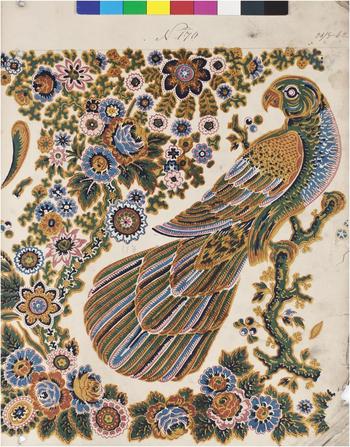
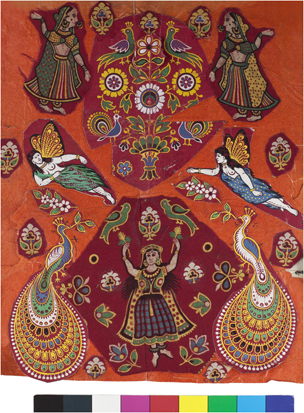
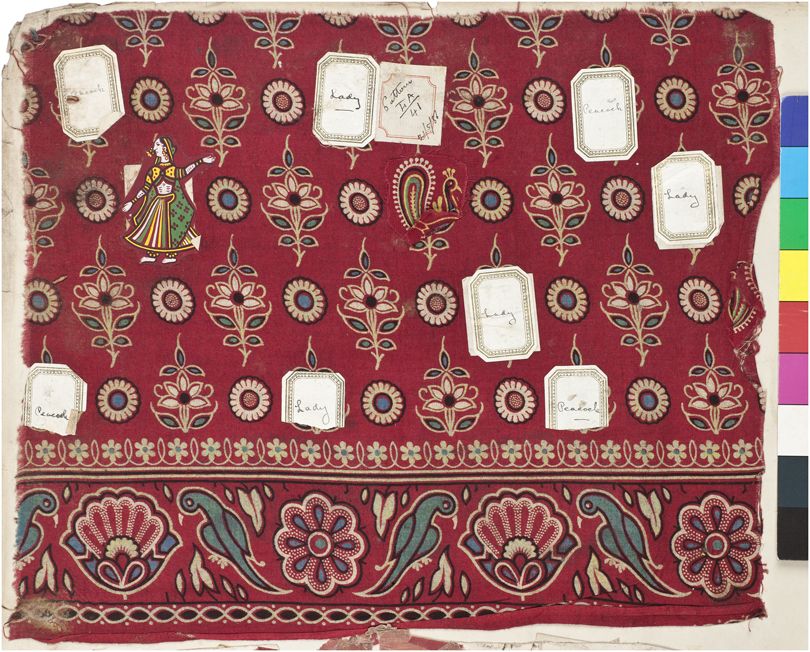
Although not foregrounded in this article, the gathering of information in India on pattern or color preferences and sales performance was an essential underpinning to a complex textile design process at home.Footnote 45 Edmund Potter (1802–1883), the Manchester-born calico printer and politician, estimated that in the 1850s there were approximately 600 textile pattern designers and sketch makers enjoying “constant employment”: in Britain, most of them trained locally through the design schools that were founded from the 1830s.Footnote 46 An estimated 200 of these were based in Scotland. A minority were independent designers who worked across different textile fields, including design for fine weaving, which was prominently in Scotland in the damask linen industry. It was a more specialist and lucrative area of work than design for prints. Calico printing and Turkey red firms usually employed their own in-house designers, often advertising for such personnel. For example, in 1855 Alexander Orr Ewing & Co., in the pages of the Glasgow Herald, announced: “WANTED, a DESIGNER of first rate taste and ability practically acquainted with the working of Turkey Red Printed Goods. To a thoroughly competent party liberal encouragement will be offered. To be employed in Town.”Footnote 47 These designers, as suggested here, were based in offices and warehouse premises in central Glasgow, where they took instruction from the clerks and business managers who dealt with overseas correspondents and made the decisions about which patterns to go into or out of production. The names of these individuals were mostly unrecorded. One exception was Dunbartonshire-born John Buchanan (1819–1898), who later found modest celebrity as a botanical artist. He was foreman in the 1840s in the drawing shop of Glasgow’s longest surviving Turkey red firm, Henry Monteith & Co., a famous bandanna manufacturer. Buchanan had been apprenticed as a pattern drawer in the Vale of Leven and later worked for a Manchester firm before settling in Glasgow.Footnote 48 Pattern designers created new designs and also engaged in the competitive process of design registration for copyright, which required fine drawings on paper.Footnote 49 Some of the original designs were intended for the India market (Figure 1). In the Glasgow offices, the pattern drawers (also called sketch makers) were as equally important as the designers. The pattern drawers worked alongside the engravers, block cutters, and printers in the factories, which, in the case of the Turkey red firms, were twenty-five miles away in rural Dunbartonshire. Under instruction from Glasgow, they made practical drawings from original designs for translation into blocks or plates, and they copied designs from the patterns of rival firms or from traditional Indian prints as supplied by agents. They and the designers invented “new” designs from motifs already in production through a cut-and-paste system of pattern creation (Figure 2). The pattern pieces were mounted as a collage in an original configuration destined for India. There was also a simpler system of pattern design that involved a sample of printed cotton with a border and infill made up of flowers, which were replaced with a dancing woman or a peacock at regular intervals. Written labels indicated where the motifs should go (Figure 3).
Textile design on paper, c.1862–1868.
Source: A.1962.1266.31.8.170, the Drawer’s Book, Turkey Red Pattern Book Collection. Used with permission from the National Museums Scotland.

Design for cylinder printed cotton comprising a collage of paper and fabric pieces mounted on paper, c.1880s.
Source: A.1962.1266.9.5.6687, Turkey Red Pattern Book Collection. Used with permission from the National Museums Scotland.

Textile sample with cut-out textile motifs and paper labels attached to show design changes for printing, c.1880s.
Source: A. 1962.1266.28.1, Labels, Turkey Red Pattern Book Collection. Used with permission from the National Museums Scotland.

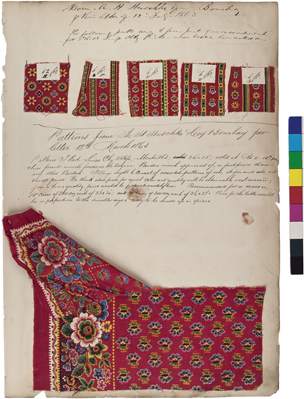
Like all British cotton printing firms, Scottish manufacturers purchased some of their finest patterns from agents in Paris who had access to specialist French or Swiss designers, though these prestige acquisitions were mostly for the upper end of the British fashion market.Footnote 50 For the India market, however, it was a combination of copying and original input based largely on information and patterns supplied by the agents abroad that dominated the design process. An illustration comprising a page from the BPB with a commentary and samples from 1863 by the agent from A. H. Huschke & Co. includes a large portion of a fine handkerchief or bandanna with a flowery border produced by Glasgow rival Henry Monteith & Co. It is described in the commentary as having “found much favour in the bazaar … in fact more than any other border.” It was recommended for copying, with infilling patterns of “sets, stripes and sets, and small pines”Footnote 51 (Figure 4). Hence, the BPB was more than just a commentary on market conditions in India or a primitive form of market research. It also offered insights to the operation of a team-based and pragmatic design process.
Textile samples with written commentary on patterns, colors, prices, and sales from India agent A. H. Huschke & Co., February 12, 1863.
Source: A.1962.1266.31.6, Bombay Pattern Book, 77, Turkey Red Pattern Book Collection. Used with permission from the National Museums Scotland.

The first entry in the BPB is a letter dated March 1853, and attached to it is a page of miscellaneous textile samples from India, one bearing a label that states “to show texture of cloth for sarees,” followed by sketches for a scarf with fringe that is described as “suitable for Bombay.” The attention given to the latter is telling, for the market for scarves in India was vast and growing. As Matheson observed, there was “an increasing variety of styles and pattern … bright colouring being greatly prized, more especially the celebrated Turkey red ground, illuminated with yellow and green, or full chintz flowers and figures, with large objects in the form of pines and peacocks at either end.”Footnote 52 The last BPB entry, which shows the trade of a rival company, was a collection of “samples of prints sold [in India] by Graham & Co” (a Manchester company), with prices achieved, sent to Stirling on January 20, 1869. Covering nearly sixteen years—including the year of Matheson’s first India trip and ending just as his account of the journey was going to press—the BPB contains 124 separate communications with samples from nineteen mainly Bombay-based agency houses.
The market information contained in the BPB is mainly details on prices predicted or achieved and illustrations with textile samples. These had been sent by agents or their clerks, who, being based in city-center warehouses, had gained insights to fluctuating demand through their daily interactions with Indian merchants and bazaar retailers. This system of information-gathering was described by Matheson, who studied the agents and their offices, the brokers who operated the auctions for cut-price damaged goods, and the local retailers seated cross-legged outside their shops.Footnote 53 Basic market information on India cottons was available through newspaper sources, and some big trading houses produced printed monthly market reports starting in the 1850s.Footnote 54 While offering useful insights for standardized textile goods, such as gray cloths, these offered little of value in the “fancy” cotton trades. For example, the following from the August 1853 market report given in the Straits Times is a typical statement: “Handkerchiefs—we have no change to report in the demand, price, or stocks of these goods. None but favourite patterns can be placed.” This gives no indication of what comprises the “favourite patterns.”Footnote 55 Compare this with a typical “memo of musters” from February 25, 1857, for Grey & Co. in Bombay. It supplied patterned samples (with prices) for copying, with instructions that Stirling send 150 cases (eighteen dozen pieces per case) containing “an assortment of Turkey red pink handkerchiefs” with secondary color-ways in green and blue, and a request that these be produced in twenty-five-inch squares rather than the usual twenty-three by twenty-eight inches.Footnote 56 Moreover, the price data supplied by agents was almost always shaped and contextualized with written commentaries on patterns and weave; product presentation; the quantities of similar products already on sale through rival houses; and issues of seasonality of sale or market niches for different prints according to ethnic, religious, or regional sales patterns. Throughout the period, the agents dealt with pressures of oversupply from Britain coupled with lumpy and sometimes unpredictable demand, and they stressed as a matter of routine that product appearance and fabric quality provided keys to competitive edge.
The first criteria that was usually noted in market reports was the actual patterns required at the time, illustrated through the provision of samples of successful goods to be reproduced or copied, or sometimes of unsuccessful goods to be discontinued. The samples contained in the BPB included designs by Stirling, rival British companies, and locally based Indian craftsmen using hand techniques. Design practices in the British Turkey red and printed calico industry were heavily biased toward copying, including outright copyright theft, along with the reproduction of traditional designs with few adaptations. However, innovative and novelty designs also clearly sold well.Footnote 57 Over the sixteen years covered by BPB, there was much continuity in the designs requested or highlighted for copying with a focus on what were routinely called “Swiss chintz” patterns: small florals or paisleys used on women’s garments and for the filling patterns on sari dress pieces. Stripes and zigzags were also in continuous demand, particularly for men’s turbans. Of newer styles of patterns coming into vogue over the course of the 1860s, the most prominent—normally found on handkerchiefs (see Figure 4)—were large floral motifs of a type that also sold well in Britain. Although there was constant demand for certain patterns, there were also seasonal changes in the colors that were popular in the market, and samples were commonly sent for copying in different color-ways. In an order for zigzag patterns in November 1866, the following detail was attached to the numbered samples: “No. 46-58. T[urkey] red prints all suitable assortments. 5 cases of each assortment at a time—of no. 46 only one sample sent, but the contents of the case to be as follows, 25 pieces as per sample; 5 pieces all white stripes; 20 pieces all yellow stripes. 50 pieces in a case.”Footnote 58 The original sample was red with yellow and white zigzag stripes, the pattern achieved through discharge printing that could generate either white or yellow depending on the discharge process employed.
As in any modern retail fashion market, color was as important in Indian textiles as it was in Europe, though the European palette favored more muted tones.Footnote 59 Certain colors had traditional associations or were linked to particular religions—green was popular among Muslim customers and orange among Hindus—but demand also shifted with the seasons and fashions. Many samples sent for copying were in the previous season’s colors with a request that a different color combination be tried for the coming season. A typical instruction, this one from Huschke & Co, was “if this pattern [zigzag] can be sent in fast colours the broad stripe should be sky blue where it is green and T[urkey] red where there is pink.”Footnote 60 The recommendation for Swiss chintz prints from Herman, Lucius & Co. was: “If in pattern no 6 [paisley] yellow were substituted for black it would be an improvement. 40–50 cases could easily be sold during the season.”Footnote 61 Even the exact shade would be specified: “This is the shade of green that we want [sample attached] and this is what we object to [sample attached].”Footnote 62 The agents were familiar with the printing techniques that achieved the colors in the fabrics they sold, as a commentary from Grey & Co. on green reveals: “No. 868 Not at all liked. The green colour, from being printed over the red loses its effect entirely and shows as a very dull brown. If you could produce a bright green like this [sample attached] they might succeed.”Footnote 63
Both the color and the brightness of the red that was sent to Bombay, along with the quality and weight of the fabric, formed a constant focus for agents’ advice and information. One agent from Sir Charles Forbes & Co. noted:
A very careful attention should be paid to the colour and cloth of the samples forwarded. The colour should be of best Turkey red, the cloth to be thick and the weight must be equal to that mentioned against some numbers in the list. Slight differences in colour or cloth make a large difference in price here, careful attention should therefore be paid to the remnants added to each number.Footnote 64
The last comment in this communication highlights one of the constant challenges that faced the Turkey red manufacturers that used natural dyeing methods based on extract of madder root, which was a complex process with variable results. Sea damage to stock was another source of concern that was commonly reported and a frequent subject of newspaper reports. A letter from Huschke & Co. dated February 1866 contains a “muster of our own goods” and three samples of “our own printed mulls” sent to show “condition as regards colour, cloth and style.” The goods, shipped on the Cameronian and the Anne Dorothea, had been damaged in transit by sea water, causing discoloration and rendering the muster only suitable for disposal through auction. This occurred in India as well as in Britain on damaged stock.Footnote 65 Fungal damage from poor storage in transit was also a problem that impacted prices, with samples frequently returned. For example, in September 1865, a letter from Nicol & Co. to Stirling enclosed a “bit of velvet out of [consignment] 37/40 sent to show mildew an allowance of Rs275 had to be made on the four cases.”Footnote 66
The size of textile pieces was closely specified in the agents’ reports, which proves that Turkey red manufacturers produced printed goods in a great variety of sizes. These were supplied by weavers in Glasgow or Manchester, many working on handlooms, which was good for achieving variety in piece size but not always to a consistency in weight or weave. Handkerchiefs ranged from 23- to 30-inches square, with oblongs also sold. Standard textile lengths were 39-inches wide and 20-yards long, but goods were also manufactured in pieces measuring 32 inches by 28 yards. Ewart Latham & Co. in 1867 sent a sample for copying that had been sold by Bombay dealer B & A Harmusjee; it was just 24 inches by 28 yards, which would have been locally produced using craft techniques.Footnote 67 Turban twills were 12- to 14-inches wide. The edges on fabrics were sometimes specified, as in January 1858 when Huschke & Co. reported that a plain red cotton velvet was selling well because it was the only one on the market, but that in the future it was to have two selvage edges, not a cut edge as supplied.Footnote 68 Saris and scarves with borders and end designs were typically up to 60-inches wide and 3- to 4-yards long, and the design composition and size of the borders and ends were carefully specified for execution by hand. This was observed by David Bremner in his newspaper report on the Stirling print works in 1869: “The dress pieces are short, being only from 11/2 to 8 yards in length; and owing to that and other technical causes, it would be unprofitable to print them on a cylinder machine, so they are done by the block method.”Footnote 69
The Bombay commission agents communicated daily with their local dealers, who in turn provided useful information on retail sales and conditions. One issue frequently highlighted was product presentation and packaging. A memorandum from Bombay in June 1857 requested “bright colours stout cloth” and also advised that “pieces when folded ought to be tied at both ends with orange coloured thread instead of black the latter being objectionable.”Footnote 70 Another order requested bundles of five pieces, each “to be tied with green silk tape.”Footnote 71 Instructions for “well starched and folded up” and wrapped in high-quality decorated paper were routinely specified, with many details on the folding. For example, Grey & Co. directed the following in an October 1854 order for turban pieces: “No 202 Turkey R twills 15 inch twenty yards much admired. Care to be observed in folding which should be exactly 15 by 20 inches … in bundles of 10 pieces each in paper. 100 pieces in a case and 4 cases by a ship.”Footnote 72 In all instances, as here, the individual dress pieces were wrapped and tied in decorative packaging presumably for show in a bazaar display. This suggests that Indian retail consumers purchased the item still wrapped and put high store in this sort of presentation. This was not seen in Britain, where textiles were sold by the yard from a roll or folded bolt and premade garments were sold unwrapped from racks or shelves.
The labeling, or “ticketing,” of bundles was also carefully specified because the trademark labels included complex imagery that identified the brand and quality; these were important sources of product information for local dealers and retail customers unfamiliar with English.Footnote 73 Both the labels for the bundles—which were the size of a modern postcard and commonly decorated with gold—and the decorative paper in which the bundles were wrapped were areas of specialist manufacture that emerged alongside the textile industry in Glasgow and Manchester (these labels are discussed in full below).Footnote 74 Used in packaging, they were an expensive but necessary indicator of quality designed to catch the eye in competitive markets with a sophisticated consumer demand. The cost, moreover, was in addition to the expensive protective packaging for sea-based transport.Footnote 75 By the early twentieth century, at a time when cotton print sales in India were increasingly standardized for the low-end market, tickets were still used on high-quality textiles as an “additional decorative element.”Footnote 76 In a context where it was impossible to protect the copyright on patterns, product fraud in India was often focused on the use of pirated labels attached to bundles of inferior manufactures and was prosecuted through the courts.Footnote 77 Product labels and tickets were of value in India because they facilitated the transfer of accurate market information from India back to Britain, as seen in the BPB. Agents could supply labeled samples that had sold in Bombay, which allowed firms in Britain to get an accurate insight to the business of their rivals.
Agents supplied information on prices both achieved and anticipated in light of shifting market supply and seasonal demand. In a commentary on one sample, Grey & Co. in February 1857 stated: “The patterns are said to be good and well liked at present, but we fear they are rather extensive and are in but small consumption here. First arrival may realise a high price.” The same letter requested “a beautiful assortment of printed woolen dresses 28 inches wide and 11 yards long, each piece folded in paper with a ticket as usual. 150 pieces to a case and 2 or 3 cases by a ship and 10 cases for the whole year. These goods ought always to arrive here before the setting in of the cold season.”Footnote 78 Comparative prices were indicated, as in a December 1865 letter from Nicol & Co., which included samples sent “with reference to their recommendations for next season’s supplies,” including “Swiss chintz prints, German dyes, sold by J. Sigg & Co at Rs 10 per piece.” This was a high price for the finest-quality goods. The letter also contained a “cutting of A. Orr Ewing & Co dyes which has sold by B. & A. Harmanjee at Rs 6/15 per piece … [and a] cutting of A. Collie & Co. [Manchester] dyes which is now showing in the Bazaar. Some of the goods were sold by Ewart, Latham & Co at Rs 5/8 and subsequently a further quantity was placed at Rs5/7.”Footnote 79
The India market was always competitive and long-run market saturation was frequently indicated, as in a September 1866 order for Turkey red sarees in Hindu and Mohammedan patterns.Footnote 80 Though most goods dispatched to Bombay were for local sale, expansion into more distant markets was constantly under review. Some consignments were for onward transmission to other regions, with proposed patterns indicated, as in a communication from Nicol & Co. in November 1863. It included a set of samples sent for market testing that had been returned with the cryptic comment: “Madras patterns not very suitable [for Bombay].”Footnote 81 One extensive May 1860 letter comprised a speculative consignment for the Karachi market, organized from Glasgow by James Paul, the principal partner of John Fleming & Co. Paul was connected with Nicol & Co. of Bombay and also had links with William McKinnon, the shipping entrepreneur who was seeking to develop a Bombay-to-Karachi shipping service at the time: “Referring to our conversation yesterday regarding shipment to my friends Fleming & Co. Karachi I have now pleasure in handing you the following memo for your guidance, in respect to an experimental mission direct to the port in question.” This was followed by a large order for Turkey red cambrics, twills, dimities, broads, mulls, and jaconets, along with handkerchiefs in the “ordinary Bombay style” and “saree and hoodries—of all sizes and of the ordinary Bombay assortment.” The consignment was recommended for the Victoria and Albert, which was due to sail from the River Clyde on June 10.Footnote 82 Whether the experiment was a success is not recorded, but there was no repeat order from this source.
Understanding and Shaping the India Market
As the BPB letters illuminate, as the numbers of brokers and auctioneers attest, and as evident from John Matheson’s two lengthy visits, India represented a vast market for British cotton, which expanded rapidly in the early and mid-nineteenth century. The colonial state worked hard to block alternative supplies from elsewhere in Europe and to repress indigenous manufactures that might threaten British firms.Footnote 83 This, however, was not always easy when it came to high-end textiles, with fine chintzes from mainland Europe easily available at reasonable prices and where there was a well-developed taste for quality local hand-made weaves and prints. Attempts to address the latter can be seen in formal initiatives to educate the British industry on Indian consumer taste. From mid-century, imported textiles were displayed in museum collections and at great exhibitions with the interests of textile manufacturers and designers in mind.Footnote 84 The most famous government initiative for raising awareness of Indian textiles took the form of volumes of textile samples with accompanying descriptions, which were circulated to manufacturing centers in the late 1860s and 1870s by John Forbes Watson, Reporter on the Products of India.Footnote 85 Forbes Watson’s collection was described in the Glasgow Herald, on the occasion of a set of volumes being offered to the Glasgow Chamber of Commerce, as containing “700 working samples of cotton, silk, and woolen textiles of native manufacture, obtained from various places in India.” Every sample in this mix of woven and printed goods was numbered, with identical numbers in each set of volumes, and “all are accompanied by details respecting the length, breadth, and weight etc of the pieces of which they originally formed a part.” Twenty sets, comprising eighteen volumes each, were distributed in Britain and seven remained in India. This was because:
The opportunity which will thereby be afforded to the agent in India of directing the attention of his correspondent here [in Britain] to the articles suited to the requirements of his constituents. … The agent in India may call his home correspondent’s attention to a certain number in a certain volume and ask him to send out something as like it as possible, or with such alteration as he may see fit to suggest.Footnote 86
One of the problems with the Forbes Watson volumes, however, was the absence of information on price, which is not surprising given that prices changed rapidly according to the season, local demand, and market saturation. Moreover, the sets of volumes and the accompanying India Office publication of The Textile Manufactures and the Costumes of the People of India were predicated on a Western belief, an aesthetic fallacy of sorts, that the Indian high-end consumer market was for “traditional” weaves and prints with designs marked by a simplicity that met with elite European approval. The samples selected were mostly of pure and austere types defined regionally and in marked contrast to the bright and stylistically hybrid prints that were sold successfully by British manufacturers trading in India. Even though it received much contemporaneous recognition, nineteenth-century manufacturers almost certainly paid little real attention to these India Office sample collections.Footnote 87 Instead, entrepreneurs like Matheson relied on their own market information, sometimes undertaken through fieldwork on the ground but mainly drawing on a network of local agents who sent samples of patterns with commentaries on how they could be bettered.
The 1860s were a boom time for Bombay traders when restrictions in American cotton supplies arising from the Civil War gave a premium to Indian cotton. Consignments of printed goods from Britain paralleled India’s trade in raw cotton. Although normal business resumed at the end of the war, cotton exports still generated vast profits for some of Matheson’s trading partners, such as brothers John and James Nicol Fleming, his Bombay hosts. This marked the start of a swift rise in the importance of India, and particularly of Bombay, in the trade of Glasgow, which from 1866 until the end of the century was the leading destination for tonnage exports from the River Clyde.Footnote 88 Bombay’s prominence was a function of geography, giving it natural advantages in onward trade with the Middle East and Africa. It was also the first point of contact for Europeans traveling overland from the Mediterranean via Alexandria and Aden (such as Matheson and his party in 1861) or later via the Suez Canal. It was a focus for internal migration mainly from northern India, which gave rise to a four-fold increase in the city’s population, increasing to 800,000 people between 1818 and 1864.Footnote 89 It had a complex British-owned commercial infrastructure that evolved during East India Company rule and a system of agency houses to repatriate the wealth of British returnees.Footnote 90 Bombay’s growth in the 1850s and 1860s was also a function of the ethnic mix in the local trading population, which included large numbers of Parsee businessmen. They were widely respected in European merchant networks and in some instances formed partnerships with British trading houses, which generated admiring comments from Matheson, among others: “The Parsee broker of Bombay is a man of mark in the mercantile system … a highly capable man of business; affable, sober, punctual, vigilant.”Footnote 91 One of those who traded with Stirling for several decades was Framji Patel, a partner in the company Frith & Co., which was renamed Wallace & Co. in 1848 and evolved into a worldwide trading, banking, and agency business.Footnote 92 Although Calcutta was equal in size and had a similar structure of banks and joint stock companies as Bombay, the latter had a more integrated business community. This can be seen in the founding of a chamber of commerce in 1836, two years after the same body in Calcutta but representing local as well as European businesses.Footnote 93 Bombay’s Parsee businesses were well connected in India; and their businessmen traveled to Europe, including Glasgow, to take part in exhibitions of Indian goods and establish retail outlets in elite thoroughfares such as London’s Regent Street.Footnote 94 The centrality of migrant traders was signaled in market information provided to Stirling by Bombay agents Grey & Co. in February 1857, when they reported with reference to a recommendation for Turkey red printed mulls: “These goods are in large consumption among the Marrawarree people especially.” They were a subgroup of Hindu Jains, originating in Rajasthan, who were important money lenders and dominated many inland business networks.Footnote 95
The vibrancy, openness, and commercial opportunity in Bombay was due to its cosmopolitan mix and good trading routes along the coast and into inland areas facilitated by the chamber of commerce. The chamber lobbied for improved transport infrastructures, modern roads, and early developments in railway and steam shipping services.Footnote 96 Though not illustrated in the BPB, a sample elsewhere in the Scottish Turkey Red Pattern Book Collection—probably from John Orr Ewing & Co. in the 1860s—shows a sari end piece with an elaborate traditional peacock design framing a stylized steam train motif, the latter a recent introduction to India.Footnote 97 Indeed, the design may have been timed to commemorate the 1864 opening of the Bombay-to-Surat railway line, the first long-distance intercity route in India. There was clearly a market for such novelties in Bombay, and British firms employed designers at home to come up with new ideas, though certain pattern trials in the BPB, including one showing milkmaids and cowherds in Indian dress, were returned by agents with an emphatic “not suitable” label attached; the reason for this particular rejection was not given, but it was most likely connected with religious sensibilities concerning men and women depicted together.Footnote 98
The Indian market as represented by Bombay was perceived to be vast. However, extending beyond that great city into other cities and regions was a challenge because the subcontinent was shaped by a multitude of religious and local tastes. Attempts to take consignments elsewhere were not always met with success, as Matheson found in Madras.
The piece-goods dealers, with whom I spent the mid-day period, divided between the warehouse and the bazaar, differed from those of Bombay not only … in the absence of style both as regards dress and manner, but in the exercise of what may be termed a fossilised conservatism of taste as to pattern or colouring, which excludes even a shadow of variation.Footnote 99
Moreover, issues of “taste” were compounded by local and, for outsiders, unpredictable idiosyncrasies in demand, which Indian craftsmen were better able to accommodate.Footnote 100 Matheson gained a personal insight to such difficulties during his India tour:
In the present year [1861] Glasgow shippers of certain fancy goods were advised by their correspondents in Calcutta that such fabrics would be unsaleable for a time, the cause not being one of those which regulate the laws of supply and demand as indicated by Adam Smith or any similar economists, but being due solely to the fact that March and April were held to be unlucky months for marriages, as predicted by the priesthood of Benarez. Indian lovers, thus forewarned, prudently declined being united till the ill fated period had run its course, and so the calico chintz flowers and bright coloured peacocks intended to adorn them on the occasion must needs be regarded in the interval as useless stock.Footnote 101
The only way to navigate the cultural minefield that the Indian market represented was to employ the best-informed local agents. In most years, Stirling’s Bombay business was transacted by two or three agents, with a handful dominating over many years. Not surprisingly, the majority of the correspondents were Scots-owned firms, which made sense because of both the personal connections they provided—with many having managing partners who were Matheson’s friends—and because of their dominant role in the Bombay Chamber of Commerce.Footnote 102 Typical here was W. Nicol & Co., a Scottish-owned major commercial force in India. Nicol’s agency business, which was part of a larger concern, generated 24 percent of communications in the BPB. Nicols undertook working with Stirling as a personal favor to Matheson and focused on midmarket prints.Footnote 103 Also typical was the firm Grey & Co., the third-ranked of Stirling’s Bombay agents, with 10 percent of BPB communications. Grey had strong Glasgow connections through its principal partner Gavin Steel, who was Matheson’s boyhood friend. Despite the importance of established Scottish business networks and personal connections, the most important by volume of BPB correspondence was A. H. Huschke & Co., which accounted for 37 percent of all letters and orders; the company were not Scottish at all.
Huschke was part of a long-established Swiss–Indian connection that began in the eighteenth century when Swiss manufacturers of fine cotton prints for European consumption began exploiting Indian imported textiles for design inspiration. This gave rise to what were known as Swiss chintzes, which were characterized by small print motifs that were mostly floral. This fabric, along with other European luxuries such as watches and clocks, were exported to India through specialist India-based Swiss agents for an elite market that placed a high premium on Western-made consumer goods.Footnote 104 Huschke, a moderate exporter of raw cotton during the cotton boom, was mostly active as a specialist importer of quality goods for the fashion market.Footnote 105 Mindful of its reputation for luxury cottons, as an agency Huschke was party to one of the first trademark protection court cases in India in 1865. It sought, successfully, to preserve the exclusivity of its brand of wares made by Egg, Zeilger, Greuter & Co. (in Winterthur, Switzerland), manufacturers of finest-quality Turkey red Swiss chintz prints. As described in the Times of India, “from their superior manufacture, they acquired a high reputation, were in great demand, and sold at a higher price than goods of a similar make.”Footnote 106 Founder August Henry Huschke was of Swiss-German descent; was a long-time resident in Bombay; was married there in 1841 to the daughter of a Hamburg-based Swiss merchant;Footnote 107 and was of a generation of Swiss merchants and textile manufacturers who pioneered the practices of market information-gathering.Footnote 108 His firm, with offices in Manchester and later in London, was sold when he died in 1866, passing to John Tebbut Bell, a former junior partner.Footnote 109
Stirling’s reliance on Huschke & Co., coupled with analyses of the firm’s product lines, signals an intention to engage with a high-quality and dynamic market where elements of changing tastes could be informed by Western fashions. Moreover, Matheson’s visit and published thoughts on the manufacturing economy of India underlined his interest in such sales. He was thorough in his approach to market research. For example, in a chapter titled “Indigenous Industries,” he offered descriptions of and commentary on what he saw by way of native enterprises. He also included extended case studies based on personal interviews, quoted at length, with named Indian artisans and entrepreneurs engaged in all areas of textile production.Footnote 110 He charted the increase in machine production in India, particularly in Bombay; and noted the large manufacturing establishments that were coming into existence, some with as many as 1,600 employees. He was convinced that this would only produce “certain stout and bulky fabrics” of little threat to British-made finer cloths.Footnote 111 Indeed, he perceived these limitations as operating across the industrial spectrum:
Such establishments as rum distilleries, biscuit manufactories, engineering, tanning, rope-spinning, shawl and carpet weaving, calico printing and dyeing works, exist to some extent in great communities, or scattered at intervals throughout the rural districts [but] they are, with scarcely an exception, conducted in a rough fashion and on a small scale.Footnote 112
He was confident that the British command of the Indian textile market “is becoming more and more our own,” which would lead to the “gradual extinction of the hand-loom, and those other rough old modes of native manufactures which still hold their ground in the more retired rural districts.”Footnote 113 He was, of course, wrong. Indeed, in India, as in other parts of the world such as South America, native artisans using hand techniques continued to thrive despite the availability of modern textile goods imported from Britain and Europe.Footnote 114 Matheson knew full well that the quality of the high-end local craft production was outstanding, though expensive and exclusive to the elite. What he could not see, however, even though it was presaged in the evolving sales profile of his own firm in the 1860s, was the degree to which the market for printed cotton in India was met by craftsmen in Indian workshops using hand techniques to discharge and print their own designs onto British-produced plain red cloth. This generated a hybrid product—part machine-made in Britain and part hand-made in India—where the added value remained in India. The reasons for this relate to Indian consumer preferences in the last three decades of the nineteenth century, which were shaped by westernized sensibilities linked to a celebration of localized cultural norms.
The 1850s through the early 1870s represented a period of unprecedented opportunity for British Turkey red prints in India, facilitated by advances in the transport infrastructure, much of it led by Scottish entrepreneurs like Matheson’s friend William McKinnon. However, the same transport links allowed Indian visits to Europe, with complex cultural exchanges resulting.Footnote 115 The mid-nineteenth century saw changes in Western consumer culture through industrial exhibitions, new department stores, and elements of consumer culture that were also evident in India. By the 1870s, ready-made clothing such as tailored Indian-style men’s coats for the local market were commonly advertised by Bombay department stores.Footnote 116 Additionally, newspaper reports hinted at the ways in which some young Indian women expressed their Western-influenced fashionable flair. In the early 1880s, for instance, an extensive Times of India article titled “The Parsee Girl of the Period,” by social commentator N. S. Ginwalla, provided a parallel to a similarly named English commentary, “The Girl of the Period.” The former reflected on the changing manners, abandoned traditions, and emulative costume of women in the wealthy, cosmopolitan business class:Footnote 117 “It is her ambition to look and act every bit the English lady; she dresses in a semi-English fashion, in English shoes and stockings,” though he also concedes that “her bright saree are still native.” Moreover, though this was a conventional satirical attack on perceived female excess that generated a lively letter correspondence to the newspaper thereafter, “the worst of it all is that the Parsee Young Lady’s love of luxury is shared by the Parsee Young Gentleman.” Changes such as these were much in line with what Matheson and others expected and doubtless had implications for some areas of British manufacturing.Footnote 118 Running parallel with such trends, though, were other equally important cultural shifts that would have significant implications for British textile sales, including a growing resentment of the imposition of Western dress norms. This antipathy, seen in the pejorative account of “the Parsee girl,” was signaled again through the pages of the Times of India. In 1875 a letter signed by one B. C. C. Bandoopwalla called on the British governing class to stop insisting on Western dress for Indian male participants at formal state occasions: “As rational beings, we should be allowed our own choice in all matters of taste, especially in the common taste of dressing as we please.”Footnote 119 A movement was gaining pace, of a sort also seen in Europe, Scotland, and Ireland, that linked textiles and dress to national identity. Although it was some decades before this became a mass political force in India, there were signs of the harnessing of clothing cultures to calls for Indian autonomy.Footnote 120
Matheson failed to fully understand the Indian consumer, but the situation was more complex than a simple choice between local products with high politico-cultural value and Western imports with their modern associations. As historians and anthropologists have subsequently shown, there was—in addition to a tension between European and Indian dress cultures—a shifting pattern of consumption among the Hindu population from the norm of unsewn garments (the sari, dhoti, and turban made from a single piece draped and pinned on the body) toward sewn garments such as trousers, jackets, and blouses conventionally associated with Muslim dress culture and favored in Anglo-Indian circles and in towns as workwear. This was not just a case of some Indians dressing in or rejecting Western fashions, though that dynamic was in play. Rather, it was the colonial project itself in favoring one style of Indian clothing over another, with implications largely unseen at the time, that shifted the pattern away from Turkey red piece-goods manufacturers who specialized in unsewn garments.Footnote 121 Add to this that Indian clothing consumption was not dictated by individual consumer preferences alone but was commonly tied to gifting and ceremonial or ritual events. It is then not surprising that Matheson and other cotton entrepreneurs had only a partial understanding of their customers’ motives despite their extensive research.
Another critical issue that is indicated in Matheson’s observations in particular and in the BPB more generally is the absence of any capacity to shape sales in India through active marketing. The BPB letters reveal how consumer information was channeled through agents on the ground, who in turn relied on their own local informants: the Indian bazaar merchants who purchased most of the products. Many of the bazaar merchants sold in bulk for onward trade within and beyond Bombay and did so simultaneously with their trade in locally manufactured and hand-crafted goods. These multiple layers of British and Indian businessmen generated a vast gulf between the original producer and the consumer, whether the latter lived in an urban area—which most of them probably did—or rural. India’s complex market embraced demand for print novelties, giving rise, as I have shown, to design innovation and market trials, alongside demand for more traditional prints, and seasonal changes in popular colors. Marketing from producer to consumer was impossible. There were no Indian fashion magazines or newspaper commentaries for the female reader, as in Britain and Europe. Although department stores existed in India by the 1860s, they advertised to European customers (who did not regard Turkey red as a fashionable dress color) and to Indian customers for sewn garments that were not made in Turkey red. The advertiser’s language of “latest fashions” or “new season” were used by Indian retailers in Bombay starting in the 1830s, but only where the intended customer was European.Footnote 122
This is not to say that contemporaneous observers in India were not keen to develop some of the same marketing strategies as in Britain. The following Times of India account of the Manchester Calico Ball attests to this:
The dressmakers of Bombay, as elsewhere, display their most tempting wares upon very elegant lay figures, but it has remained for the calico printers of Manchester to press into their service 1,200 young handsome ladies as a still more attractive advertisement for their goods. On the 25th ultimo a grand annual ball was given at the Manchester Town Hall, with the object of showing the variety and perfection to which the art of calico has arrived. The rule laid down by the Ball Committee, all eminent British calico printers, was that the ladies who graced the ball with their presence should, without exception, consent to wear costumes of English calico, printed within Manchester or Glasgow.
The Times article continued:
All the ladies’ dresses were made of British printed cotton, the latest designs of the trade, and even some which are not yet in the market, had been made into ordinary ball dresses. Many very handsome costumes were worn, and the display showed that these cottons can be as effectively treated as more fashionable materials. There is an odd mixture of gallantry and business in this enterprising undertaking that should commend it to many in Bombay. But it is difficult to see how the same principle can be applied during our present festive season here, where the buyers, being natives are not dancing men.Footnote 123
The event, widely reported in the press, included extensive details of patterns, colors, and dress designs in the manner of contemporaneous fashion journalism. The final sentence, though, hits the heart of the matter in India: for the “buyers,” the Indian bazaar dealers were not “dancing men.” Additionally, the Indian women who ultimately consumed most of the imported printed cottons led very different lives than women in Britain, and they were not in the same market position to make choices through information gained from advertising and browsing in stores.Footnote 124 Indeed, as studies of Asian dress fashions elsewhere have shown, it is only when women as independent consumers were empowered to make their own retail choices, which mostly started in the early twentieth century, that distinctive national fashion cultures fueled by advertising and modern marketing emerged.Footnote 125
The only form of advertising employed by the Turkey red manufacturers was their elaborate tickets, as described earlier. Many of the highly colored, and gilded labels survive in archive collections.Footnote 126 Their iconography is mostly evocative of traditional high-status Indian themes, including princely processions of bedecked horses or elephants, exotic birds and animals (such as peacocks, parrots, and tigers), and images of Indian deities or beautiful women in secluded gardens. The audience for these labels, which reinforced certain Indian cultural tropes and values that were in opposition to a modernizing Western agenda, was both the eventual retail consumer and the local merchant intermediaries in the bazaars. The latter were described in a striking visual illustration, titled “Piece-Goods Merchants,” in Matheson’s England to Delhi. In it, they are shown with samples and folded dress pieces decorated with labels.Footnote 127 The former, that is the retail customers who purchased from the bazaar merchants, were not directly interrogated by Matheson or his agents.
Bazaar commercial practices and culture, and how they related to local demand and consumption, were fluid, mutable, and barely understood by outsiders. Even today, historians of Indian business struggle to reconcile a narrative informed by “hegemonic Western knowledge” and big business interests with local realities and knowledge that have been shaped by the long evolution of bazaar trade.Footnote 128 As recent commentary has revealed, the bazaar appeared chaotic and inefficient to nineteenth-century Western business observers, but “it commanded its own complex and sophisticated form of organization finely adjusted over centuries,” based on ethnic communities and trading families, and mediated by distinctive notions of trust and honorable business practice.Footnote 129 It was neither static nor backward-referencing but contained within it its own modernizing dynamic in response to colonialization.Footnote 130 These characteristics—and multiple layers of middle men, highly decentralized markets, and price variations—limited the Western capacity to understand the Indian market or effect any form of coherent shaping of consumer demand, despite advances in transport infrastructure such as railway and steam ship services.Footnote 131 This inability was compounded by frustration with some of the known behaviors of bazaar traders, such as a willingness to operate with much lower profit margins than was acceptable to Western businesses. Behaviors also included habits of personal attire and presentation that were confounding for observers such as Matheson: “Between the considerable trader ensconced among his high piles of piece goods, or store of bales and boxes, and the vendor of a paltry handkerchief in the crowd, there may be no difference in appearance.”Footnote 132
Conclusion
What does this interrogation of agents’ letters, pattern samples, Matheson’s written account of his India tour, and newspaper commentaries allow me to conclude on approaches to selling printed cottons in India?
The first is that Matheson and others had access to a great deal of information about their markets through their own business practices, correspondents on the ground, and published sources. They understood pricing variations and the stress on quality and packaging, and were keenly aware of the tension between periodic shortages and oversupply. They knew there was a fashion dynamic in some elements of the printed cotton market, with seasonal changes in color preferences and some demand for novelty designs sufficient for regular trials of new patterns. Over the sixteen years covered in the BPB, there were changes in the types of designs sent to India, with a growing stress on large floral motifs that also sold well in Europe. Moreover, there was no shortage of understanding of what the Indian consumer conventionally did with the textiles that they purchased, since British-produced guides to Indian dress gave details. Foremost was Forbes Watson’s Textile Manufacturers and Costumes of the People of India, published in 1866 to accompany the “mobile museum.” Forbes Watson stressed the importance to British textile manufacturers of their knowing how Indian garments were worn, and he provided copious information on the different sizes and types of cloth and the decorations that matched well with the range indicated in the BPB. Among the myriad textiles produced in India was the printed cotton dress piece, used mainly as an unsewn garment such as for saris. These, he suggested, were the best markets for British manufacturers; this again corresponds with the agents’ reports and practices in Scottish factories, which maintained expensive hand-printing for such dress pieces.Footnote 133 Nevertheless, Forbes Watson, the BPB agents, and Matheson himself did not fully comprehend the degree to which clothing cultures in colonial India were dynamic and contested. Matheson saw and welcomed westernization but did not understand the reasons why some in India chose to value traditional textiles, which he dismissed as mere conservatism, or why some consumers replaced unsewn dress pieces with ready-made sewn garments.
Matheson knew that the India market was heavily segmented by region and ethnicity, and that his markets were often glutted. The period covered by the BPB and Matheson’s India visits were high points in market optimism based on the situation in Bombay, but contemporaneous records also reveal the frailties. The BPB letters represent a system of market information-gathering that was both reactive and speculative yet incorporated almost no capacity for active marketing through advertising. Its narrative is one of fluctuating and sometimes saturated markets, attempts to predict what might happen based on limited information, occasional suggestions at innovation by way of an experiment, and demand for endless variety. The only constant was that quality products of consistent weight and appearance with attractive presentation had the best chance of succeeding, but even that was not enough. One of the most telling comments in the BPB was, as detailed above, the need for two salvage edges on a piece of velvet that had been split along its length. This had nothing to do with color or print but with the size of the original textile piece. It was a recommendation that, in order to sell it in India in the future, the material had to be woven to narrower dimensions. Whether or not that narrower velvet piece was ever produced is not revealed. Manufacturing pressures toward increasingly exacting standards and an ever-greater variety of piece sizes to meet a myriad of consumer demands recognized, but imperfectly understood, was not sustainable. As noted above, there was also no capacity to shape the market through advertising. It is not surprising, therefore, that these forces—in conjunction with changes in the way the trade was organized and the triumph of synthetic dyes over expensive natural Turkey red—gave rise to the eventual rationalization that lower-quality, standardized products were cheaper to produce at home and easier to sell abroad.
John Matheson died in 1878 and did not see any of this ahead. As late nineteenth-century Glasgow court cases over copyright infringement reveal,Footnote 134 textile samples for copying were still sent by agents in India. However, the larger multinational operations, mostly directed by layers of merchant intermediaries in Britain, had neither the willingness nor the insight to provide their manufacturing clients with such minutely detailed business reports on the vagaries of India’s markets, unlike in the 1850s and 1860s as recorded in the BPB. Moreover, local production in India was tenacious. In the late nineteenth century, India’s own design innovation was cultivated through art colleges, exhibitions, and competitions. Factory output evolved.Footnote 135 As reported in 1883 by Indian journalist F. H. C. on attending the Punjab Calcutta Exhibition: “Possibly the most interesting of all the Punjab exhibits is the splendid collection of cotton printed goods, which proves that the cotton printing of the Punjab still survives and defies Manchester and Glasgow to extinguish it.”Footnote 136