Introduction
Anxiety and depression are common in elderly people diagnosed with Alzheimer's disease (AD), occurring in about 25% to 70% of patients (Teri et al., Reference Teri1999; Ferretti et al., Reference Ferretti, McCurry, Logsdon, Gibbons and Teri2001; Porter et al., Reference Porter2003; Holtzer et al., Reference Holtzer2005). Anxiety and depression are known to have an influence on cognition in elderly people without dementia (Bierman et al., Reference Bierman, Comijs, Jonker and Beekman2005). Generally, studies on depression show a negative effect on cognitive decline (Bassuk et al., Reference Bassuk, Berkman and Wypij1998; Comijs et al., Reference Comijs, Jonker, Beekman and Deeg2001; Wetherell et al., Reference Wetherell, Reynolds, Gatz and Pedersen2002). Some studies on the association between anxiety symptoms and cognition also found this negative effect (Wetherell et al., Reference Wetherell, Reynolds, Gatz and Pedersen2002). However, previous research in a population-based cohort of elderly people showed that mild anxiety symptoms enhanced cognitive abilities while severe anxiety symptoms were associated with a decline in cognitive abilities (Bierman et al., Reference Bierman, Comijs, Jonker and Beekman2005). A possible theoretical framework for the association between anxiety and depression on one side and cognitive decline one the other is based on the glucocorticoïd cascade hypothesis (Sapolsky, Reference Sapolsky1996; Reference Sapolsky2000). This hypothesis indicates that psychological distress may lead to excessive levels of glucocorticoids (Jorm, Reference Jorm2000). In particular, the hippocampus is highly sensitive to these stress hormones, and plays a critical role in learning and memory. Therefore, exposure to long-term high levels of the stress hormones might cause impairment of memory function (de Kloet, Reference de Kloet2002; Magri et al., Reference Magri2006). In patients with AD the hippocampus is already atrophied, and psychological stress such as anxiety and depression might cause further hippocampal damage (Jorm, Reference Jorm2000). This might lead to an accelerated decline of memory function in AD patients. Because variation and decline of memory function can be measured in patients with early stage AD, an influence of anxiety and depression on memory function is most likely to be detected in patients at this stage of AD. Therefore the present study investigated whether symptoms of anxiety and depression influence decline of memory function in elderly people diagnosed with early stage AD.
Methods
Sample
A study sample of patients with early stage AD was recruited from several general hospitals and mental health care institutes in the Netherlands. Inclusion criteria were a recent diagnosis of AD by a clinician, and a score of 1 on the Clinical Dementia Rating (CDR; Hughes et al., Reference Hughes, Berg, Danziger, Coben and Martin1982). A first-degree relative or caregiver in close contact with the patient had to be available to provide information about the patient.
The patients were examined with an interval of 12 months: in 2003 (baseline) and in 2004 (follow-up). This resulted in a study sample of 44 elderly people diagnosed with AD, with information on decline of memory function and anxiety and depression taken at two measurements. Drop-out was not related to depression, any of the confounding variables or the cognitive performance tests. However, patients who dropped out of the study did report fewer anxiety symptoms than patients who participated in both measurements.
All interviews were conducted in the patient's home by specifically trained and intensively supervised interviewers. Written informed consent was obtained from each patient, according to prevailing legal requirements. The Medical Ethics Committee of the VU Medical Center, Amsterdam approved the study.
Measures
General cognitive functioning was measured by means of the Mini-mental State Examination (MMSE; Folstein et al., Reference Folstein, Folstein and McHugh1975) a frequently used screening instrument for global cognitive functioning. Scores range from 0 to 30 with a higher score indicating better cognitive functioning.
Episodic memory was measured with a modified Dutch version of the Auditory Verbal Learning Test (AVLT; Deelman et al., Reference Deelman, Jennekens-Schinkel, Diamant and Diesfeldt1980; Rey, Reference Rey1964). This test originally consisted of 15 words, but because of the limited cognitive abilities of the patients, the number of words was reduced to eight, which have to be learned during five trials. The total number of words the patient has learned during the trials is the learning score, which ranges from 0 to 40. The number of words reproduced after 20 minutes is the recall score, ranging from 0 to 8. Higher scores on both variables indicate better memory functioning.
Anxiety symptoms were measured with the Hospital Anxiety and Depression Scale-Anxiety sub-scale (HADS-A; Zigmund and Snaith Reference Zigmund and Snaith1993). This subscale consists of seven items with a timeframe of four weeks. The items are self-rated on a 4-point scale by the patients. Scores of 7 and higher indicate clinically relevant anxiety symptoms (Zigmund and Snaith Reference Zigmund and Snaith1993; Snaith, Reference Snaith2003).
Anxiety disorders, according to the DSM-IV criteria (American Psychiatric Association, 1994), were diagnosed by means of the Composite International Diagnostic Interview (CIDI; Wittchen Reference Wittchen1994). The six-month prevalence rates for specific phobia, social phobia, agoraphobia without panic, panic disorder without agoraphobia, panic disorder with agoraphobia, and generalized anxiety disorder (GAD) were included in the present study.
Depressive symptoms were measured by means of the Center for Epidemiologic Studies Depression Scale (CES-D; Radloff, Reference Radloff1997; Beekman et al., Reference Beekman, Deeg, van Limbeek, Braam, de Vries and van Tilburg1997). The CES-D is a self-report scale, consisting of 20 items asking about symptoms in the past week. Each answer is rated on a 4-point scale. Higher scores indicate more depressive symptoms with scores of 16 and higher being indicative of clinically relevant depressive symptoms.
Depressive disorders according to DSM-IV criteria (American Psychiatric Association, 1994), were diagnosed using the National Institute of Mental Health Diagnostic Interview Schedule (DIS; Robins et al., Reference Robins, Helzer, Croughan and Ratcliff1981). For this study, six-month prevalence rate of major depression were included.
Confounders
Possible confounding variables that may be associated with both cognitive decline and anxiety and depression include sociodemographic characteristics, alcohol consumption, cardiovascular disease, diabetes mellitus and the use of medication. All information was cross-checked with information provided by the relative or care-giver of the patient.
The sociodemographic characteristics that were included were age and level of education. Level of education was classified into three categories: low level (uncompleted elementary education or lower vocational education), medium level (general intermediate education, intermediate vocational education, general secondary education), and high level of education (higher vocational education, college education and university education).
Alcohol consumption was assessed with a questionnaire developed by the Dutch Central Office of Statistics (Central Bureau of Statistics, 1989) and classified, according to Garretsen's Indication of Present Alcohol Use (Garretsen, Reference Garretsen1983), into five categories of present alcohol use: non-drinker, light, moderate, severe and excessive drinker. Because very few patients were severe or excessive drinkers, these two categories were collapsed into one category in analyses.
Cardiovascular disease and diabetes mellitus were assessed by asking the patients if they had any of the following: cardiac disease, stroke, high blood pressure or diabetes mellitus.
Finally, the use of medication was assessed by asking the patients to name any medications they had taken in the two weeks prior to the examination. This information was compared with the information on the drug containers provided by the patients. Drug use was classified into categories according to the Anatomic Therapeutic Chemical (ATC) classification. For the present study, separate variables were computed for (a) benzodiazepine use, antidepressive medication use and anti-psychotic use, and (b) dementia medication use (both coded as “yes” or “no”).
Statistical analyses
The characteristics of the study population were established at baseline and at the follow-up measurement. Scores of difference indicating decline in memory function over the period of a year were calculated for the memory test by subtracting the score on the memory test from the follow-up measurement from the baseline measurement. We investigated the correlation between anxiety and depression and memory at baseline and investigated whether changes in memory performance over the one-year follow-up period were associated with changes in anxiety or depression over that same period. Linear regression analyses were performed to determine any significant association between anxiety and depression and subsequent decline of memory function. Corrections were made for memory function at baseline and for the confounding variables measured at baseline. In analyses, p values lower than 0.05 were regarded as statistically significant. Statistical analyses were performed using SPSS, version 12.0.1.
Results
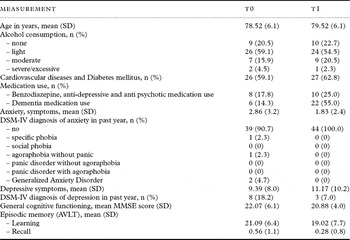
The characteristics of the participants are presented in Table 1. Just over half (54.5%) of the respondents were male and the level of education was normally distributed (low level of education 27%, medium level of education 45.5% and high level of education 27.3%). Respondents scored an average of 22 points on the MMSE at the first measurement and an average score of almost 21 points at the second measurement.
Characteristics of the study sample (N = 44) at baseline (T0) and one-year follow-up (T1)

MMSE = Mini-mental State Examination, AVLT = Auditory Verbal Learning Test.
Patients reported few anxiety symptoms (2.86 at baseline and 1.83 at follow up) and depressive symptoms (9.39 at baseline and 11.17 at follow-up). The reported decline in anxiety symptoms reached the level of significance (p = 0.02). Depressive symptoms, however, did not change significantly (p = 0.24). Anxiety disorders are reported in 9% of patients at baseline, whereas none of the patients report an anxiety disorder at follow-up. Depression disorders are reported by 18% at baseline and by 7% of patients at follow-up. With respect to memory function; the mean learning score declined between the two measurements (p = 0.04), but no significant decline was found on the recall score (p = 0.15).
No significant correlations between anxiety and depression and memory function at baseline were found, nor between changes in memory performance over the one-year follow-up period and changes in anxiety or depression over that same period.
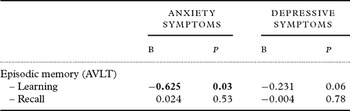
Regression analyses were performed to investigate the effect of anxiety and depression symptoms on decline in memory function (Table 2). Analyses showed that having more anxiety symptoms at baseline was associated with a slower decline in learning on the AVLT. After correcting for confounding variables the association was still significant (B = −0.657, p = 0.02). Anxiety symptoms did not seem to influence the decline on the recall of the AVLT. Furthermore, no significant association was found between the depressive symptoms and decline in memory function on both the learning and the recall of the AVLT.
The association between cognitive decline and anxiety and depressive symptoms measured at T0

AVLT = Auditory Verbal Learning Test.
We found no association between depressive disorders and decline in memory function (results not shown), and we were unable to establish a possible association between anxiety disorders and decline in memory function due to the low prevalence of anxiety disorders.
Discussion
The present study investigated whether psychological distress such as anxiety and depressive symptoms would result in an accelerated decline of memory function in AD patients. Contrary to our expectations, we found that higher levels of anxiety symptoms were associated with less decline in memory function, specifically the learning phase, over a one-year period, whereas depressive symptoms were less strongly related to decline of memory function. In our sample of early stage AD patients, levels of anxiety and depressive symptoms were low. These mild levels of anxiety and depressive symptoms might not have caused the distress we assumed and therefore the hypothesized damaging effect of hypersecretion of stress hormones could not be established. The nature of the anxiety and depressive symptoms might also be different in AD patients and therefore be less influential on cognitive performance. Nevertheless, our findings are interesting and fit previous cross-sectional research in a population-based sample of elderly persons (Bierman et al., Reference Bierman, Comijs, Jonker and Beekman2005), which also showed that sub-clinical levels of anxiety symptoms enhance cognitive performance, while severe anxiety symptoms were associated with reduced cognitive abilities. The enhanced memory function as a consequence of mild anxiety symptoms is probably caused by an arousing function that improves performance (Eysenck and Calvo, Reference Eysenck and Calvo1992). According to our results, this mechanism is also applicable to elderly people diagnosed with AD, which is remarkable in the light of previous research by Berger et al. (Reference Berger, Fratiglioni, Winblad and Backman2005). Berger et al. indicated that the influence of individual difference variables, such as depressive symptoms, on cognitive performance is overshadowed by the dementing process itself.
The measurements of anxiety (HADS-A) and depressive symptoms (CES-D) were both developed for measuring anxiety and depression in the cognitively healthy, general population. The present study population is cognitively impaired and questions might arise about their abilities to report correctly on anxiety and depression over a previous time period. Research by Harper et al. (Reference Harper, Kotik-Harper and Kirby1990) and Lichtenberg et al. (Reference Lichtenberg, Marcopulos, Steiner and Tabscott1992) however, showed that only the most severely impaired dementia patients are incapable of accurately reporting their mood. Our study sample of elderly people in an early phase of dementia is therefore considered capable of correctly reporting their own anxiety and depression.
The findings have to be placed in the context of the strengths and limitations of this study. Strengths of the current study are that elderly people diagnosed with early stage AD were followed over a period of one year to provide data on decline in memory function and on anxiety and depressive symptoms and confounding variables. However there are also limitations. First, studying sufficient AD patients with serious distress will require a much larger study population. The second limitation is that the performance on the recall of the AVLT might have suffered from a “floor effect” causing the lack of association between anxiety or depression and decline of memory performance on this component. The patients scored on average 0.56 at baseline and 0.28 at the follow up measurement even though the scale ranges from 0 to 8. This small amount of deterioration might be due to the mild severity of AD in the sample population as MMSE scores also showed a modest decline. Furthermore, test/retest effects of the memory scale might have played a role. The small decline in memory performance could have also been caused by the fact that a greater percentage of subjects were taking anti-dementia medications at follow-up. These medications might have enhanced cognitive performance at follow-up.
In conclusion, symptoms of anxiety and depression generally seem to be mild in early AD patients, and do not seem to affect decline of memory function in patients diagnosed with AD. In this study we found that anxiety symptoms were associated with a slower decline in memory function.
Conflict of interest
None.
Description of authors' roles
E. J. M. Bierman designed the study, collected and analyzed the data, and wrote the article. H. C. Comijs designed the study, supervised the data collection and assisted in the statistical analysis and helped write the article. C. Jonker helped design the study and write the article. P. Scheltens played a major role in the data collection and helped with writing the article. A. T. F. Beekman designed the study and helped with writing the article.