


1. Introduction
This paper was originally motivated by the following question of Hee Oh, mentioned during the lecture in the conference “Visions in Arithmetic and Beyond: Celebrating Peter Sarnak’s Work and Impact”:
Is there a Schottky group whose limit set contains no four points lying in a circle?
We briefly give some context for the question. Given a finitely generated torsion free Kleinian group
 $\Gamma \lt PSL_2(\mathbb{C})$
, one wants to determine criterion for when a discrete faithful representation
 $\rho\;:\;\Gamma\rightarrow PSL_2(\mathbb{C})$
must be a Mobius conjugation. Earlier work on rigidity theory, for example by Mostow [
Reference Mostow2, Reference Mostow3
], and later Sullivan [
Reference Sullivan6
], deals with
 $\Gamma$
whose limit set
 $\Lambda_\Gamma$
is all of
 $S^2=\partial_\infty \mathbb{H}^3$
.
Kim and Oh provide the first results for Kleinian groups of the second kind [
Reference Kim and Oh4
]. They show when
 $\Gamma$
is a Zariski dense finitely generated Kleinian group with disconnected domain of discontinuity, and
 $\rho\;:\;\Gamma \rightarrow PSL_2(\mathbb{C})$
is a discrete, faithful, Zariski dense representation with
 $\rho$
equivariant boundary map
 $f\;:\;\Lambda_\Gamma \rightarrow S^2$
, if f maps “circular slices” of
 $\Lambda_\Gamma$
into circles, then
 $\rho$
is a Mobius conjugation.
Their work is a major advance in rigidity theory for being able to address Kleinian groups of the second kind. But for
 $\Gamma$
with a connected domain of discontinuity, not much is known about their rigidity properties and it is difficult to know what to expect. Schottky groups are discrete subgroups whose limit sets are homeomorphic to Cantor sets, and hence have a connected domain of discontinuity (more precise definitions will be given in later sections). They are classical objects and among the first examples of discrete subgroups of
 $PSL_2(\mathbb{C})$
, so this is a natural class of examples to consider if one wishes to push the theory farther. An affirmative answer to the above question would mean there can be no analogue of the Theorem of Kim and Oh for Kleinian groups with connected domain of discontinuity.
In this paper we provide evidence that such a Schottky group exists. In what follows, G is a free group of rank
 $n\gt1$
and S(G) is Schottky space. The Theorem colloquially states that for “most”
 $PSL_2(\mathbb{C})$
Schottky embeddings of G, the resulting groups have no pair of distinct translation axes that lie on a common plane
 $\mathbb{H}^2$
.
Theorem 1·1. There exists a subset
 $R\subset S(G)$
such that
 $int(R)=\emptyset$
and for all
 $\sigma\in S(G)\setminus R$
and any pair of non-commuting words
 $w_1,w_2\in G$
,
 $Fix(\sigma(w_1))\cup Fix(\sigma(w_2))$
is not contained in a circle.
Before proceeding, we give an outline of the argument.
-
(i) By Bers’ theorem, the moduli space of Schottky representations of the rank n free group G, namely Schottky space, can be identified with an open subset
 $S(G)\subset \mathbb{C}^{3n-3}$
with explicit
$3n-3$
coordinate functions.
-
(ii) For each pair of non-commuting words
$w_1,w_2\in G$
, we consider a function
$\chi_{w_1,w_2}\;:\;S(G)\rightarrow \mathbb{C}$
that maps
$[\sigma]\in S(G)$
to the cross ratio of
$\sigma(w_1)^\pm$
and
$\sigma(w_2)^\pm$
, where
$\sigma(w_i)^\pm$
are the attracting and repelling fixed points of the loxodromic
$\sigma(w_i)$
. -
(iii) Our aim is to show that the following set
is non-empty.
\[ {}S(G)\setminus \bigcup_{w_1w_2 \neq w_2w_1} \chi_{w_1,w_2}^{-1}(\mathbb{R}) {}\]
-
(iv) Each
$\chi_{w_1,w_2}$
is holomorphic on simply connected open subsets of S(G), so the open mapping theorem can be used to show that if
$\chi_{w_1,w_2}$
is non-constant, then
$\chi_{w_1,w_2}^{-1}(\mathbb{R})$
has empty interior. This means if we can show
$\chi_{w_1,w_2}$
is non-constant for all pairs of non-commuting words
$w_1,w_2\in G$
, then the Baire category theorem implies the set in step (iii) is non-empty.





The main technical obstacle surmounted in this note is showing that
 $\chi_{w_1,w_2}$
is indeed non-constant for all pairs of non-commuting words.
In Sections 2 and 3, we review some basics about Schottky groups and Schottky space. Then in Section 4 we classify pairs of words in the free group based on a geometric criterion. Finally, we prove the main theorem in Section 5.
2. Schottky groups
Let
 $D^-$
and
 $D^+$
be the closure of two disjoint simply connected domains in
 $\hat{\mathbb{C}}$
, where
 $\partial D^\pm$
is a Jordan curve. A loxodromic
 $\gamma \in PSL_2(\mathbb{C})$
pairs
 $D^-$
to
 $D^+$
if the following two conditions hold:
-
(1)
$\gamma(\partial D^-) = \partial D^+$
; -
(2)
$\gamma(int(D^-)) = \hat{\mathbb{C}} \setminus D^+$


If
 $\{D_i^\pm\}_{i=1}^n$
is a collection of closures of mutually disjoint simply connected domains, and
 $\gamma_i$
is a loxodromic that pairs
 $D_i^-$
to
 $D_i^+$
, then
 $\langle \gamma_1,\ldots \gamma_n \rangle$
is a Schottky group. If each
 $D_i^\pm$
in the previous sentence is a geometric disk, then
 $\langle \gamma_1,\ldots ,\gamma_n \rangle$
is a classical Schottky group.
It is a simple matter to construct classical Schottky groups. If
 $D^-$
and
 $D^+$
are disks with centers
 $d^-$
and
 $d^+$
, and radii r and s, then
 \[ {}z\mapsto \frac{rs}{z-d^-} + d^+ {}\]
is a Mobius transformation taking
 $\partial D^-$
to
 $\partial D^+$
and mapping
 $int(D^-)$
onto
 $\hat{\mathbb{C}}\setminus D^+$
. Then
 \[ {}\frac{-1}{\sqrt{rs}}\begin{pmatrix} {}d^+ & rs-d^-d^+\\ {}1 & -d^-\end{pmatrix}\in PSL_2(\mathbb{C}) {}\]
will be a loxodromic pairing
 $D^-$
to
 $D^+$
when
 $|d^- - d^+|\gt2\sqrt{rs}$
. So if
 $\{D_i^\pm\}_{i=1}^n$
is any collection of pairwise disjoint disks in
 $\mathbb{C}$
such that the distance between the centers is much larger than their respective radii, then there exists a classical Schottky group
 $\langle \gamma_1,\ldots \gamma_n \rangle$
where
 $\gamma_i$
pairs
 $D_i^-$
to
 $D_i^+$
. In particular, for all
 $n\in \mathbb{N}$
, there are classical Schottky groups whose generators pair disks with radii less than
 $1/n$
.
Schottky groups are free, discrete, and purely loxodromic. For any loxodromic
 $\gamma$
, let
 $\gamma^+$
and
 $\gamma^-$
denote the attracting a repelling fixed points of
 $\gamma$
and let
 $Fix(\gamma)\;:\!=\;\{ \gamma^\pm \}$
. From the definitions it is clear that if
 $\gamma$
pairs
 $D^-$
to
 $D^+$
, then
 $\gamma\pm \in D^\pm$
. In later arguments, for words
 $\omega$
in a Schottky group
 $\langle \gamma_1,\ldots \gamma_n \rangle$
where
 $\gamma_i$
pairs
 $D_i^-$
to
 $D_i^+$
, we will need to specify which disk in the collection
 $\{D_i^\pm\}_{i=1}^n$
contains
 $\omega^+$
and
 $\omega^-$
. For this reason, we introduced the following notation.
Let
 $\Gamma = \langle \gamma_1,\ldots, \gamma_n \rangle$
be a Schottky group where
 $\gamma_i$
pairs
 $D_i^-$
to
 $D_i^+$
. We let
 $D^\pm (\gamma_i)\;:\!=\; D_i^\pm$
. Put
 $D^+(\gamma_i^{-1})\;:\!=\; D^-(\gamma_i)$
and
 $D^-(\gamma_i^{-1})\;:\!=\; D^+(\gamma_i)$
. The collection
 $\{D_i\}_{i=1}^n$
is not unique to
 $\Gamma$
. So
 $D^\pm(\gamma_i)$
just refers to any collection of disks paired by the Schottky generators.
Since the attracting/repelling fixed point of
 $\gamma$
is the repelling/attracting fixed point of
 $\gamma^{-1}$
, one can verify via induction the following basic but crucial observation:
Lemma 2·1. Let
 $\omega = \gamma_{i_1}^{m_1} \ldots \gamma_{i_k}^{m_k}\in \Gamma$
, with
 $m_i \in \mathbb{Z}\setminus \{0\}$
, be a freely reduced word. Let
 $sgn(m) = +1$
if
 $m\gt0$
and
 $sgn(m)=-1$
if
 $m\lt0$
. Then we have
 $\omega^+ \in D^+(\gamma_{i_1}^{sgn(m_1)})$
and
 $\omega^- \in D^+(\gamma_{i_k}^{-sgn(m_k)})$
.
While there is no canonical choice of disks for
 $\Gamma$
, all statements and arguments referring to
 $D^\pm(\gamma_{i_k})$
will hold for any collection of disks satisfying the Schottky definition, and will not require choices.
3. Schottky space
From now on, let
 $G=\langle g_1,\ldots , g_n \rangle$
denote a fixed rank n free group with
 $\{g_1, \ldots , g_n\}$
a fixed ordered set of generators. Schottky space, denoted S(G), is the set of all
 $PSL_2(\mathbb{C})$
conjugacy classes of embeddings
 $\sigma\;:\;G \rightarrow PSL_2(\mathbb{C})$
such that its image
 $\sigma(G)=\langle \sigma(g_1),\ldots ,\sigma(g_n) \rangle$
is a Schottky group. It is a classical result of Bers [
Reference Bers1
] that Schottky space can be identified with a connected open subset of
 $\mathbb{C}^{3n-3}$
. We review some details of this identification.
For any point
 $[\sigma]$
in Schottky space, we can take a representative
 $\sigma$
where
 $\sigma(g_1)^+ = -1$
,
 $\sigma(g_2)^- = 0$
, and
 $\sigma(g_2)^+ = 1$
. Then
 $\sigma$
is determined by the squared traces of the generators, and the remaining fixed points of the generators which have yet to be specified. Then the following embedding identifies Schottky space with a domain in
 $\mathbb{C}^{3n-3}$
:
 \[ {}[\sigma] \mapsto (tr^2(\sigma(g_1)), tr^2(\sigma(g_2)), \sigma(g_2)^-,\ldots , tr^2(\sigma(g_n)), \sigma(g_n)^+, \sigma(g_n)^-) {} {} {}. {}\]
From this point forward, we identify Schottky space S(G) with a domain in
 $\mathbb{C}^{3n-3}$
as described above. We abuse notation so that
 $\sigma \in S(G)$
refers to both a point in Schottky space under this identification, and an embedding
 $\sigma \rightarrow PSL_2(\mathbb{C})$
such that
 $\langle \sigma(g_1), \ldots , \sigma(g_n) \rangle$
is a Schottky group with
 $\sigma(g_1)^+ = -1$
,
 $\sigma(g_1)^- = 0$
, and
 $\sigma(g_2)^+ = 1$
.
We conclude this section with some remarks on holomorphic functions defined on simply connected open subsets of S(G). As a warm-up, recall that for any simply connected domain
 $\Omega\subset \mathbb{C}^k$
, if
 $f\;:\;\Omega \rightarrow \mathbb{C}$
is holomorphic and non-vanishing, then
 $\ln f$
is also holomorphic. For such f,
 $e^{\ln f/m}$
will also be holomorphic, so that f has holomorphic mth roots for all m. In particular,
 $\sqrt{f}$
is a holomorphic function on
 $\Omega$
.
Now suppose
 $\Omega \subset S(G)$
is a simply connected open subset of S(G) (note that Schottky space itself is not simply connected [
Reference Takashi and Yoshida7
]). Let
 $g_i$
be one of the fixed generators of G. The entries of
 $\sigma(g_i)$
can be written as rational functions in
 $\sigma^\pm (g_i)$
and
 $\sqrt{tr^2\sigma(g_i)}$
. Notice that for all
 $\sigma \in S(G)$
, the quantities
 $(\sigma(g_i)^+-\sigma(g_i)^-)$
,
 $tr\sigma(g_i)$
, and
 $tr^2\sigma(g_i) - 4$
are never 0 because
 $\sigma(G)$
is purely loxodromic and discrete.
For any non-identity element
 $w\in G$
, we conclude
 $ \sigma \mapsto \sigma^+(w) - \sigma^-(w)$
defines a (necessarily non-vanishing) holomorphic function on
 $\Omega$
, as the entries of
 $\sigma(w)$
are
 $\mathbb{Z}$
-polynomials in the entries of the generators
 $\sigma(g_i)$
, and the fixed points of any
 \[ {}\begin{pmatrix} {}a & b\\ {}c & d\end{pmatrix} \in PSL_2(\mathbb{C}) {}\]
are given by
 \[ {}\frac{a-d \pm \sqrt{(a+d)^2-4}}{2c}. {}\]
Later, for fixed pairs of non-commuting words
 $w_1,w_2\in G$
, we will define functions mapping
 $\sigma \in \Omega$
to the cross ratio of the fixed points of
 $\sigma(w_1),\sigma(w_2)$
. By this discussion, such functions are holomorphic. See [
Reference Yamamoto and Taniguchi8
] for more details on how fixed point cross ratios have been used to study Schottky space.
4. Classifying pairs of words
Given a
 $\sigma \in S(G)$
and two freely reduced non-commuting words
 $w_i,w_j\in G$
, we will need to know which
 $D^\pm (g_k)$
contains which fixed points of
 $\sigma(w_i)$
and
 $\sigma(w_j)$
, and whether or not some
 $D^\pm (g_k)$
contains multiple points in
 $Fix(\sigma(w_i))\cup Fix(\sigma(w_j))$
. By Lemma 2·1, this depends only on what the left-most and right-most letters of the words are. We now classify pairs of freely reduced non-commuting words in G with this goal in mind. Afterwards, we explain more explicitly the geometric intuition behind the classification. Recall that a word is cyclically reduced if its left-most and right-most letters are not inverses of each other.
Definition 4·1. Let
 $w_i,w_j\in G$
be two freely reduced non-commuting words.
-
(1) Say
$w_i,w_j$
is a type 1 pair if both words are cyclically reduced and both
$w_i$
and
$w_i^{-1}$
have different left-most letters with
$w_j$
and
$w_j^{-1}$
. -
(2) Say
$w_i,w_j$
is a type 2 pair if either of the following occurs:-
(a)
$w_i$
is not cyclically reduced and has a different left-most letter from
$w_j$
and
$w_j^{-1}$
. -
(b)
$w_i$
and
$w_j$
are both cyclically reduced and the pair is not of type 1.
-
-
(3) Say
$w_i,w_j$
is a type 3 pair if
$w_i$
is not cyclically reduced,
$w_j$
is cyclically reduced, and
$w_i$
has the same left-most letter as
$w_j$
or
$w_j^{-1}$
(but not both). -
(4) Say
$w_i,w_j$
is a type 4 pair if neither word is cyclically reduced and
$w_i$
has the same left-most (and hence same right-most letters) with either
$w_j$
or
$w_j^{-1}$
.


We now explain the geometric intuition behind the classification. Let
 $\sigma \in S(G)$
. Say
 $w_1,w_2\in G$
is a pair of freely reduced non-commuting words. If
 $w_1,w_2$
is a
-
(1) type 1 pair, then each
$D^\pm(\sigma(g_i))$
contains at most one point in
$Fix(\sigma(w_1))\cup Fix(\sigma(w_2))$
. -
(2) type 2 pair, then some
$D^\pm(\sigma(g_k))$
contains exactly two points in
$Fix(\sigma(w_1))\cup Fix(\sigma(w_2))$
. -
(3) type 3 pair, then some
$D^\pm(\sigma(g_k))$
contains exactly three points in
$Fix(\sigma(w_1))\cup Fix(\sigma(w_2))$
. -
(4) type 4 pair, then some
$D^\pm(\sigma(g_k))$
contains
$Fix(\sigma(w_1))\cup Fix(\sigma(w_2))$
.






While the disks
 $D^\pm(\sigma(g_k))$
are not unique to each
 $\sigma(G)$
, any collection of disks satisfying the Schottky group definition will also satisfy the containment properties listed above. Moreover, for type 2 pairs, when
 $D^\pm(\sigma(g_k))$
contains two points in
 $Fix(\sigma(w_1))\cup Fix(\sigma(w_2))$
it will contain the same 2 fixed points for all
 $\sigma \in S(G)$
. For example, if
 $w_1,w_2$
is a type 2 pair and (say) for some
 $\sigma_0 \in S(G)$
we have
 $\{\sigma_0(w_1)^+,\sigma_0(w_2)^+\} = (Fix(\sigma_0(w_1))\cup Fix(\sigma_0(w_2)))\cap D^+(\sigma_0(g_1))$
, then for all
 $\sigma \in S(G)$
we will have
 $\{\sigma(w_1)^+,\sigma(w_2)^+\} = (Fix(\sigma(w_1))\cup Fix(\sigma(w_2)))\cap D^+(\sigma(g_1))$
.
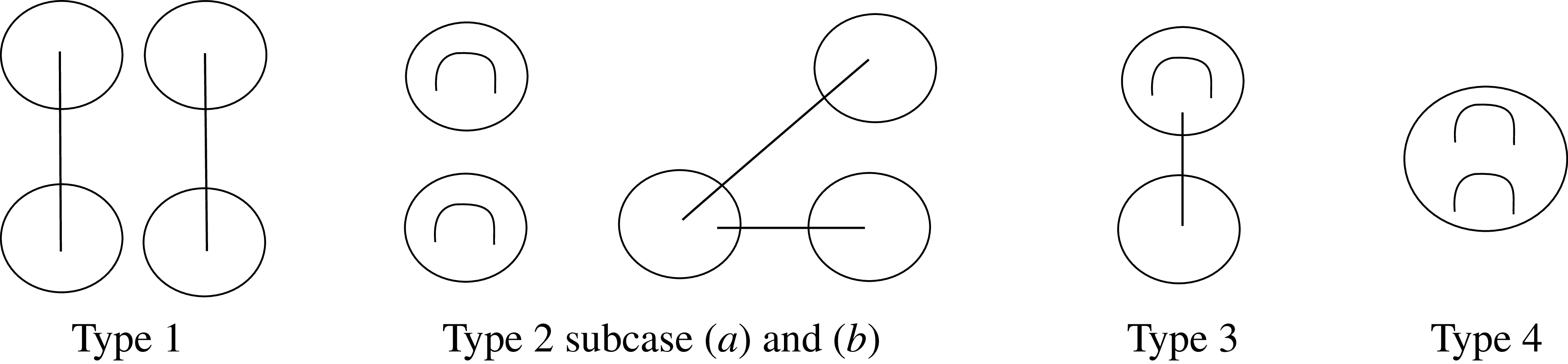
This geometric picture helps one see that all pairs of non-commuting freely reduced words are indeed of one of the types listed above, since under a Schottky embedding the fixed points of any word must be in one of the Schottky disks. The four types account for all possible ways the 4 fixed points
 $Fix(\sigma(w_1))\cup Fix(\sigma(w_2))$
can be distributed among the disks
 $\{D^\pm(\sigma(g_i))\}$
. See Figure 1 for some diagrams of how the translation axes of
 $\sigma(w_1)$
and
 $\sigma(w_2)$
can be positioned relative to disks paired by generators of
 $\sigma(G)$
, depending on what type of pair
 $w_1,w_2$
is.
This figure gives examples of how the endpoints of the translation axes of
 $\sigma(w_1)$
and
 $\sigma(w_2)$
can be distributed among the disks
 $\{D^\pm(\sigma(g_i))\}$
being paired by the generators of
 $\sigma(G)$
, based on what type of pair
 $w_1,w_2$
is. The circles represent the
 $D^\pm(\sigma(g_k))$
containing
 $\sigma^\pm(w_i)$
.

5. Proofs
Let
 $w_1,w_2\in G$
be a pair of freely reduced non-commuting words. We will show there exists
 $\sigma\in S(G)$
such that
 $Fix(\sigma(w_1))\cup Fix(\sigma(w_2))$
is not contained in a line. Our argument will be divided into cases based on what type of pair
 $w_1,w_2$
is. The next lemma will help us reduce the argument to word pairs of type 1 and 2.
Lemma 5·1. If
 $w_1,w_2\in G$
is a pair of type 3 or 4, then there exists
 $g\in G$
such that
 $gw_1g^{-1},gw_2g^{-1}$
is a pair of type 1 or 2 after free reduction.
Proof. First suppose the pair is of type 3. Say
 $w_1$
is not cyclically reduced, so
 $w_1=gw_1'g^{-1}$
for some
 $g, w_1'\in G$
, where
 $gw_1'g^{-1}$
is freely reduced and
 $w_1'$
is cyclically reduced. Then
 $w_2$
is cyclically reduced. Without loss of generality we suppose
 $w_1$
and
 $w_2$
have the same left-most letter.
Write
 $g=g_{i_1}^{m_1}\cdots g_{i_r}^{m_r}$
,
 $m_j\in \mathbb{Z}\setminus \{0\}$
. Let
 $sgn(m_j)=+1$
if
 $m_j\gt0$
and
 $sgn(m_j)=-1$
if
 $m_j\lt0$
. We claim that after free reduction of
 $g^{-1}w_2g$
, the pair
 $w_1',g^{-1}w_2g$
is of type 1 or 2. It cannot be a type 4 pair because
 $w_1'$
is cyclically reduced, so it suffices to show the pair is not of type 3.
Suppose for contradiction that
 $w_1',g^{-1}w_2g$
is a type 3 pair. Since
 $w_1'$
is cyclically reduced and the pair is of type 3, then after free reduction
 $g^{-1}w_2g$
is not a cyclically reduced word, and it has either the same left-most letter as
 $w_1'$
, or the same right-most letter as
 $w_1'$
. We start by arguing the pair does not have the same right-most letter.
Recall that
 $w_2$
is cyclically reduced. Also
 $w_1=gw_1'g^{-1}$
and
 $w_2$
share the same left-most letter, which is
 $g_{i_1}^{sgn(m_1)}$
. This means
 $g_{i_1}^{-sgn(m_1)}$
cannot be the right-most letter of
 $w_2$
. Hence the word
 \[ {}w_2g=w_2g_{i_1}^{m_1}\cdots g_{i_r}^{m_r} {}\]
is freely reduced. But the right-most letter of
 $w_1'$
is not
 $g_{i_r}^{sgn(m_r)}$
because
 $w_1=gw_1'g^{-1}$
is freely reduced.
Therefore,
 $w_1'$
and
 $g^{-1}w_2g$
must share the same left-most letter after free reduction of
 $g^{-1}w_2g$
. But the left-most letter of
 $w_1'$
is not
 $g_{i_r}^{-sgn(m_r)}$
because
 $w_1=gw_1'g^{-1}$
is freely reduced. This means after free reduction of
 $g^{-1}w_2g$
, the entire
 $g^{-1}$
word must have been eliminated. That is, after free reduction we have
 $g^{-1}w_2g=w_2'g$
for some freely reduced word
 $w_2'$
. As argued in the previous paragraph,
 $w_2'g$
is freely reduced. By assumption,
 $w_2'g$
is not cyclically reduced, so the left-most letter of
 $w_2'g$
is
 $g_{i_r}^{-sgn(m_r)}$
. But again, the left-most letter of
 $w_1'$
cannot be
 $g_{i_r}^{-sgn(m_r)}$
. This gives the desired contradiction.
Finally, if the pair is of type 4, we can let
 $g\in G$
be such that
 $gw_1g^{-1}$
is cyclically reduced after free reduction. This means
 $gw_1g^{-1},gw_2g^{-1}$
is not a type 4 pair after free reduction. If it is type 1 or 2, then we are done. If it is of type 3, then we conjugate further as in the previous case.
For
 $w_1,w_2$
a pair of freely reduced non-commuting words in G, put
 \[R(w_1,w_2): = \{ {}\sigma \in S(G) : Fix(\sigma(w_1))\cup Fix(\sigma(w_2)) \text{ is contained in a circle} {}\}. {}\]
Our next task is to show
 $R(w_1,w_2)$
has empty interior. To do this, we will need to exhibit two Schottky embeddings
 $\sigma',\sigma''\in S(G)$
where the cross ratio of the fixed points of
 $\sigma'(w_1),\sigma'(w_2)$
is different from the cross ratio of the fixed points of
 $\sigma''(w_1),\sigma''(w_2)$
. The candidate Schottky embeddings we will consider will be a sequence of classical Schottky groups whose generators pair disks with successively smaller diameter, shrinking to zero.
To construct this sequence, fix 2n distinct points
 $\{d_i^\pm\}_{i=1}^{2n}$
in
 $\mathbb{C}$
which are pairwise distance (say) at least 100 apart. For
 $t\in \mathbb{N}$
, let
 $D_i^\pm[t]$
be a disk centered at
 $d_i^\pm$
with diameter less than
 $1/t$
. Let
 $\sigma_t\;:\;G \rightarrow PSL_2(\mathbb{C})$
be an embedding such that
 $\sigma_t(G)$
is a classical Schottky group where
 $\sigma_t(g_i)$
pairs
 $D_i^-[t]$
to
 $D_i^+[t]$
. Put
 $D_t^\pm(\sigma_t(g_i))\;:\!=\;D_i^\pm[t]$
and
 $D_t^\pm(\sigma_t(g_i^{-1}))\;:\!=\; D_i^\mp[t]$
. The representations
 $\sigma_t$
are not yet points in our model of Schottky space S(G) because the fixed points of
 $\sigma_t(g_1)$
and
 $\sigma_t(g_2)$
have not yet been normalized, but as will be clear later on, we can conjugate the representations to get the desired points in S(G). We summarize the properties about
 $\{\sigma_t\}_{t=1}^\infty$
that we need for future arguments in the following Lemma. The absolute value refers to the standard Euclidean distance as points in
 $\mathbb{C}$
.
Lemma 5·2. The sequence
 $\{\sigma_t(G)\}$
of classical Schottky groups satisfies the following two properties:
-
(i) there are universal constants
$c_1,c_2\in (0,\infty)$
such that if
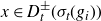
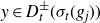
$x\in D_t^\pm(\sigma_t(g_i))$
,
$y\in D_t^\pm(\sigma_t(g_j))$
, and
$D_t^\pm(\sigma_t(g_i))\neq D_t^\pm(\sigma_t(g_j))$
, then
$c_1\lt|x-y|\lt c_2$
; -
(ii) for all generators
$g_i$
, we have
$\lim\limits_{t\rightarrow \infty} Diam(D_t^\pm(\sigma_t(g_i)))=0$



The first property of Lemma 5·2 comes from the fact the centers are fixed during the construction of
 $\{\sigma_t\}_{t=1}^\infty$
.
Proposition 5·3. For any pair of freely reduced non-commuting words
 $w_1,w_2\in G$
,
 $R(w_1,w_2)$
has empty interior in S(G).
Proof. By Lemma 5·1, pairs of type 3 or 4 are conjugate in G to a pair of type 1 or 2. For any
 $w,g\in G$
and
 $\sigma \in S(G)$
, we have
 $Fix(\sigma(gwg^{-1})) = \sigma(g)Fix(\sigma(w))$
, so it suffices to consider pairs of type 1 or 2. We consider cases based on the pair type.
Case 1: Say
 $w_1,w_2$
is a type 2 pair where (say)
 $w_1$
is not cyclically reduced. For any
 $\sigma\;:\;G \rightarrow PSL_2(\mathbb{C})$
where
 $\langle \sigma(g_1),\ldots , \sigma(g_n)\rangle$
is a Schottky group, put
 \begin{align*} {} {}\chi_{w_1,w_2}(\sigma) &\;:\!=\; [\sigma^+(w_1), \sigma^+(w_2), \sigma^-(w_1), \sigma^-(w_2)] \\ {} {}&= \frac{(\sigma^-(w_1) - \sigma^+(w_1))}{(\sigma^-(w_1)-\sigma^+(w_2))} \frac{(\sigma^-(w_2)-\sigma^+(w_2))}{(\sigma^-(w_2)-\sigma^+(w_1))}. {}\end{align*}
That is,
 $\chi_{w_1,w_2}(\sigma)$
is the cross ratio of the fixed points of
 $\sigma(w_1),\sigma(w_2)$
. We will now show there exists
 $\sigma',\sigma'' \in S(G)$
such that
 $\chi_{w_1,w_2}(\sigma')\neq \chi_{w_1,w_2}(\sigma'')$
.
Let
 $\{\sigma_t\}_{t=1}^\infty$
be the sequence of Schottky embeddings as in Lemma 5·2. Since
 $w_1,w_2$
is a type 2 pair with
 $w_1$
not cyclically reduced, there is a
 $g_j$
in the fixed set of generators
 $\{g_1,\ldots g_n \}$
of G, and
 $s\in \{\pm 1\}$
, such that
 $\sigma_t^\pm (w_1)\in D_t^+(\sigma_t(g_j^{s}))$
for all t. Moreover,
 $\sigma^\pm(w_2) \not\in D_t^+(\sigma_t(g_j^{s}))$
. Hence, property (ii) of the sequence
 $\{\sigma_t\}_{t=1}^\infty$
implies
 \[\lim\limits_{t\rightarrow \infty} |\sigma_t^-(w_1) - \sigma_t^+(w_1)| = 0. \]
The term
 $|\sigma_t^-(w_2)-\sigma_t^+(w_2)|$
either converges to 0 or remains bounded above as
 $t\rightarrow \infty$
, depending on whether or not
 $w_2$
is also cyclically reduced. Meanwhile, by property (i) of the sequence
 $\{\sigma_t\}_{t=1}^\infty$
, there are constants
 $c_1,c_2 \in (0,\infty)$
such that
 \[c_1 \lt |\sigma_t^-(w_1)-\sigma_t^+(w_2)|,|\sigma_t^-(w_2)-\sigma_t^+(w_1)| \lt c_2\]
for all t. We conclude
 \[ {}\lim\limits_{t\rightarrow \infty}|\chi_{w_1,w_2}(\sigma_t)|=0 {}\]
so there must be
 $\sigma_{t'},\sigma_{t''}$
in
 $\{\sigma_t\}_{t=1}^\infty$
with
 $\chi_{w_1,w_2}(\sigma_{t'})\neq \chi_{w_1,w_2}(\sigma_{t''})$
. There exists
 $\gamma\in PSL_2(\mathbb{C})$
such that
 $\gamma\sigma_{t'}(g_1)^+\gamma^{-1}=-1$
,
 $\gamma\sigma_{t'}(g_1)^-\gamma^{-1}=0$
, and
 $\gamma\sigma_{t'}(g_2)^+\gamma^{-1}=1$
. Let
 $\sigma'\in S(G)$
be such that
 $\sigma'(w)= \gamma\sigma_{t'}(w)\gamma^{-1}$
for all
 $w\in G$
. Cross ratios are invariant under Mobius transformations, and
 $(\gamma\sigma_{t'}(w)\gamma^{-1})^\pm = \gamma(\sigma_{t'}(w))^\pm$
, so we have
 \[ {}\chi_{w_1,w_2}(\sigma')= [\gamma \sigma_{t'}^+(w_1), \gamma \sigma_{t'}^+(w_2), \gamma \sigma_{t'}^-(w_1), \gamma \sigma_{t'}^-(w_2)] = \chi_{w_1,w_2}(\sigma_{t'}). {}\]
Obtain
 $\sigma''$
from a
 $PSL_2(\mathbb{C})$
conjugation of
 $\sigma_{t''}$
in the same way. Then
 $\sigma',\sigma''$
are points in S(G) such that
 $\chi_{w_1,w_2}(\sigma')\neq \chi_{w_1,w_2}(\sigma'')$
, as desired.
Now for any
 $\sigma \in S(G)$
, since S(G) is a connected open subset of
 $\mathbb{C}^{3n-3}$
, there exists a smoothly embedded arc joining
 $\sigma,\sigma'$
and
 $\sigma''$
. Let
 $\Omega_\sigma$
be a tubular neighbourhood of such an arc. Then we see
 $\{\Omega_\sigma\}_{\sigma\in S(G)}$
is an open cover of S(G) by simply connected subsets, each of which contains
 $\sigma'$
and
 $\sigma''$
. Manifolds are Lindelof so we can pass to a countable sub-cover, which we denoted by
 $\{\Omega_m\}^\infty_{m=1}$
.
On each
 $\Omega_m$
, define
 $\chi_{w_1,w_2}|_{\Omega_m}\;:\;\Omega_m \rightarrow \mathbb{C}$
by
 $\chi_{w_1,w_2}|_{\Omega_m}(\sigma)\;:\!=\; \chi_{w_1,w_2}(\sigma)$
. Then
 $\chi_{w_1,w_2}|_{\Omega_m}$
is a non-constant holomorphic function. By the open mapping theorem for several complex variables (see [
Reference Korevaar and Wiegerinck5
]),
 $\chi_{w_1,w_2}|_{\Omega_m}^{-1}(\mathbb{R})$
has empty interior. Since the cross ratio of four points is real if and only if they lie on a circle, we have that for all
 $\sigma \in \Omega_m \setminus \chi_{w_1,w_2}|_{\Omega_m}^{-1}(\mathbb{R})$
,
 $Fix(\sigma(w_1))\cup Fix(\sigma(w_2))$
does not lie on a circle. That is,
 \[R(w_1,w_2)= \bigcup_{m=1}^\infty \chi_{w_1,w_2}|_{\Omega_m}^{-1}(\mathbb{R}),\]
and since each
 $\chi_{w_1,w_2}|_{\Omega_m}^{-1}(\mathbb{R})$
is closed and has empty interior, the Baire category theorem (for locally compact Hausdorff spaces) implies
 $R(w_1,w_2)$
has empty interior as desired.
Case 2: Now suppose
 $w_1,w_2$
is a type 2 pair with both words cyclically reduced. Furthermore, replacing either word with their inverses if necessary, we assume they have the same left-most letter. Put
 \begin{align*} {} {}\chi_{w_1,w_2}(\sigma) &\;:\!=\; [\sigma^+(w_1), \sigma^-(w_1), \sigma^+(w_2), \sigma^-(w_2)] \\ {} {}&= \frac{(\sigma^+(w_2) - \sigma^+(w_1))}{(\sigma^+(w_2)-\sigma^-(w_1))} \frac{(\sigma^-(w_2)-\sigma^-(w_1))}{(\sigma^-(w_2)-\sigma^+(w_1))}. {}\end{align*}
Let
 $\sigma_t$
denote the same sequence of representations from Lemma 5·2 as in case 1. We will show there exists
 $\sigma_{t'},\sigma_{t''}\in \{\sigma_t\}_{t=1}^\infty$
such that
 $\chi_{w_1,w_2}(\sigma_{t'})\neq \chi_{w_1,w_2}(\sigma_{t''})$
. This suffices to give the desired result because the same reasoning as in case 1, in the part after
 $\sigma_{t'}$
and
 $\sigma_{t''}$
were found, applies verbatim.
Under the current assumptions of this case, there is a
 $g_l$
in the fixed set of generators
 $\{g_1,\ldots,g_n \}$
for G and
 $s\in \{\pm 1 \}$
such that
 $\sigma_t^+(w_1),\sigma_t^+(w_2)\in D_t^+(g_l^s)$
for all t. This means
 \[\lim\limits_{t\rightarrow \infty} |\sigma_t^+(w_2) - \sigma_t^+(w_1)| = 0, \]
while
 $|\sigma_t^-(w_2) - \sigma_t^-(w_1)|$
either remains bounded above or decays to 0 as
 $t\rightarrow \infty$
. Neither
 $\{\sigma^+(w_2),\sigma^-(w_1) \}$
nor
 $\{\sigma^-(w_2),\sigma^+(w_1)\}$
can be contained in a single
 $D_t^\pm(\sigma_t(g_i))$
for any
 $\sigma_t$
or generator
 $g_i$
because
 $w_1,w_2$
is a type 2 pair and
 $\{\sigma^+(w_2)),\sigma^+(w_1) \}$
always lies in
 $D_t^+(g_l^s)$
for all t all
 $\sigma_t$
. Hence the terms
 $|\sigma^+(w_2))-\sigma^-(w_1)|$
and
 $|\sigma^-(w_2)-\sigma^+(w_1)|$
must be bounded below strictly away from 0 for all t. From this we conclude
 \[ {}\lim\limits_{t\rightarrow \infty}|\chi_{w_1,w_2}(\sigma_t)|=0, {}\]
so there must be
 $\sigma',\sigma''\in S(G)$
with
 $\chi_{w_1,w_2}(\sigma')\neq \chi_{w_1,w_2}(\sigma'')$
.
Case 3: Finally, suppose
 $w_1,w_2$
is a type 1 pair. Put
 \begin{align*} {} {}\chi_{w_1,w_2}(\sigma) &\;:\!=\; [\sigma^+(w_1), \sigma^-(w_1), \sigma^+(w_2), \sigma^-(w_2)] \\ {} {}&= \frac{(\sigma^+(w_2) - \sigma^+(w_1))}{(\sigma^+(w_2))-\sigma^-(w_1))} \frac{(\sigma^-(w_2)-\sigma^-(w_1))}{(\sigma^-(w_2)-\sigma^+(w_1))}. {}\end{align*}
As before, it suffices to find
 $\sigma',\sigma''\in S(G)$
such that
 $\chi_{w_1,w_2}(\sigma')\neq \chi_{w_1,w_2}(\sigma'')$
. Observe that if
 $\sigma\in S(G)$
is such that
 $\sigma(G)$
is Fuchsian, then
 $\chi_{w_1,w_2}(\sigma)\in \mathbb{R}$
and
 $\chi_{w_1,w_2}(\sigma)\in (-\infty,0)$
if and only if
 $Fix(\sigma(w_1))$
separates
 $Fix(\sigma(w_2))$
i.e. if and only if the translation axes of
 $\sigma(w_1)$
has non-empty intersection with the translation axes of
 $\sigma(w_2)$
.
Since
 $w_1,w_2$
is a type 1 pair, for all
 $\sigma \in S(G)$
, each point in
 $Fix(\sigma(w_1))\cup Fix(\sigma(w_2))$
always lies in a different Schottky disk of
 $\sigma(G)$
. Then it is easy to use a Ping Pong argument to obtain
 $\sigma',\sigma''\in S(G)$
where
 $\chi_{w_1,w_2}(\sigma') \in (-\infty,0)$
and
 $\chi_{w_1,w_2}(\sigma'')\in (0,\infty)$
.
Now we restate and prove the main Theorem.
Theorem 1·1. There exists a subset
 $R\subset S(G)$
such that
 $int(R)=\emptyset$
and for all
 $\sigma\in S(G)\setminus R$
and any pair of non-commuting words
 $w_1,w_2\in G$
,
 $Fix(\sigma(w_1))\cup Fix(\sigma(w_2))$
is not contained in a circle.
Proof. Let
 \[ {}R \;:\!=\; \bigcup_{w_1w_2 \neq w_2w_1} R(w_1,w_2), {}\]
where
 $R(w_1,w_2)$
is defined as in Proposition 5·3 and the union is over all pairs of non-commuting words in G. This is a countable union. It is clear each
 $R(w_1,w_2)$
is closed, and each
 $R(w_1,w_2)$
has empty interior by Proposition 5·3, so R also has empty interior by the Baire category theorem for locally compact Hausdorff spaces. For any
 $\sigma \in S(G)\setminus R$
,
 $Fix(\sigma(w_1))\cup Fix(\sigma(w_2))$
is not contained in a line for any pair of non-commuting words
 $w_1,w_2\in G$
, by construction of R.
Acknowledgements
The author would like to thank Darren Long for many helpful conversations and being an invaluable sounding board as these ideas took shape. We also thank Ara Basmajian for many enjoyable conversations on related topics. And we thank the referee for advice improving the exposition of this paper.
 σ(w1)
 σ(w2)
 {D±(σ(gi))}
 σ(G)
 w1,w2
 D±(σ(gk))
 σ±(wi)

 Open access

