Introduction
The main Tethyan sedimentary belt of the Himalaya lies between the Indus-Tsangpo Suture Zone to the north and the Higher Himalayan Crystallines to the south. The Precambrian–Eocene sedimentary succession of the Tethyan Basin is resting on the Central Crystallines (Heim and Gansser, Reference Heim and Gansser1939; Gansser, Reference Gansser1964; Valdiya, Reference Valdiya1987; Gaetani and Garzanti, Reference Gaetani and Garzanti1991; Valdiya and Pande, Reference Valdiya and Pande2009) and separated by the South Tibetan Detachment Fault.
The Ordovician Tethyan sedimentary succession of the Kumaun Higher Himalaya has been classified into the Ralam, Garbyang, Shiala, and Yong Limestone formations in ascending order. The placement of the Ordovician–Silurian boundary is still a matter of dispute. Some have marked it within the Shiala Formation (Sinha et al., Reference Sinha, Prasad and Srivastava1998) whereas others have placed it in the Yong Limestone Formation (Shah and Sinha, Reference Shah and Sinha1974a; Khanna et al., Reference Khanna, Sinha and Sah1985; Bhargava, Reference Bhargava2011). The Ordovician Shiala Formation consists of limestone with subordinate shale, arenite, and thin bands of biostromal limestone containing a diverse fauna (corals, crinoids, and brachiopods) indicating widespread inundation of the northern Indian plate margin and development of a new marine community. The appearance of nodular limestone, overlying Shiala Formation, marks the presence of Yong Limestone Formation with a sharp contact.
This paper describes cryptostome bryozoans collected from the lower part of the Yong Limestone Formation. The Ordovician bryozoan faunas from India are scarcely known, other than from a few older publications (e.g., Reed, Reference Reed1912, Reference Reed1936); only one recent study has been conducted on the Ordovician bryozoans of India (Suttner and Ernst, Reference Suttner and Ernst2007).
Geologic setting and age
The Shiala Formation consists of pink arenite with small to mega-scale ripples, slate, and thin bands of limestone. It has been classified into four biozones in the Girthi valley, Kumaun Himalaya—Orthis (Dalmanella) testidunaria, Rafinesquina aranea, Monotyrpa, and Rafinesquina alternata zones—which suggests a Middle to Late Ordovician age (Sinha, Reference Sinha1980). The Shiala Formation is succeeded upward by grayish-green, nodular, fragmentary, fossiliferous, algal, and biohermal limestone of the Yong Limestone Formation (Shah and Sinha, Reference Shah and Sinha1974a, Reference Shah and Sinhab; Sinha, Reference Sinha1980). It extends from Dhauli Ganga valley in the northeast to Kali valley, Nepal, in the southeast. The chitinozoan association from the Yong Limestone Formation suggests a Late Ordovician–Early Silurian, probably Caradocian to Llandoverian age, which implies that the Ordovician–Silurian boundary lies in the lower half of this stratigraphic horizon (Khanna et al., Reference Khanna, Sinha and Sah1985). The limestone is exposed as a domal structure; it becomes nodular toward the margin of the basin and is fossiliferous (bryozoans, crinoids, corals). The exposed thickness of the Yong Limestone Formation is ~45 m, and it has been recorded in Yong Gad, Kio Gad, and Niti valley. The Yong Limestone Formation is succeeded upward by Variegated Silurian limestone, shale, and quartz arenite (Kumar et al., Reference Kumar, Mehdi and Prakash1972; Shah and Sinha, Reference Shah and Sinha1974b; Sinha, Reference Sinha1980; Khanna et al., Reference Khanna, Sinha and Sah1985).
The placement of the Ordovician–Silurian boundary in Kumaun Himalaya is still a matter of debate. The greenish-grey silty shale of the lower part of the Shiala succession has yielded well-preserved chitinozoans, melanosclerites, and acritarchs, which suggest Middle to Late Ordovician age whereas, based on calcareous algae, the upper age limit extends into the Middle Silurian. Hence, the Ordovician–Silurian boundary lies within the Shiala Formation (Sinha et al., Reference Sinha, Prasad and Srivastava1998, Reference Sinha, Vandenbroucke and Verniers2011; Sinha and Trampisch, Reference Sinha and Trampisch2013; Sinha and Verniers, Reference Sinha and Verniers2016). On the other hand, Khanna et al. (Reference Khanna, Sinha and Sah1985) and Bhargava (Reference Bhargava2008, Reference Bhargava2011) assigned a Late Ordovician age to the Yong limestone and placed the Ordovician-Silurian boundary within the Yong Limestone Formation. The present study describes bryozoans collected from the Niti valley, Kumaun Himalaya, Uttarakhand, India, and supports the Late Ordovician age for the lower part of the Yong Limestone Formation. The study also helps to establish the placement of the Ordovician–Silurian boundary at least in the Yong Limestone Formation or in the overlying Variegated Formation and certainly not in the underlying Shiala Formation.
Suttner and Ernst (Reference Suttner and Ernst2007) recorded bryozoans from the Upper Ordovician–Lower Silurian Tethyan sequence of the Pin Formation, Spiti Valley, Himachal Higher Himalaya, and suggested subtropical shallow water conditions. Late Ordovician bryozoans have been recorded from the United States, Northeast Spain, Morocco, Norway, Mongolia, Argentina, Estonia, and Canada (e.g., Nickles and Bassler, Reference Nickles and Bassler1900; Bassler, Reference Bassler1911, Reference Bassler1928; Modzalevskaya, Reference Modzalevskaya1953; Ernst and Carrera, Reference Ernst and Carrera2008; Ariunchimeg, Reference Ariunchimeg2009; Sanchez, Reference Sanchez2009; Ernst and Nakrem, Reference Ernst and Nakrem2012; Sanchez et al., Reference Sanchez, Ernst, Vennin and Villas2016).
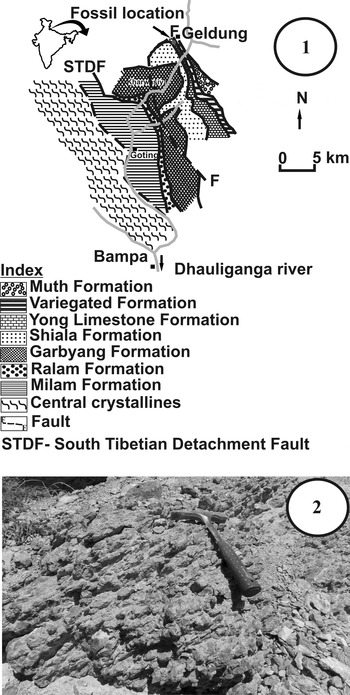
Cryptostome bryozoans belonging to the genus Ptilotrypa Ulrich, Reference Ulrich1890, have been recorded for the first time from the Ordovician sequence of the Yong Limestone Formation, Niti valley, Kumaun Himalaya (Fig. 1.1). In total, six bryozoan specimens were recovered from the limestone horizon occurring at an elevation of 4,565 m, southwest of the Geldung, Chamoli district, Uttarakhand (Fig. 1.2).
Location of the fossil specimens. (1) Geologic map showing location of specimens of Niti valley, Kumaun Tethys Himalaya, Uttarakhand, after Shah and Sinha (Reference Shah and Sinha1974b). (2) Field photograph of limestone band of the Yong Limestone Formation, which yielded the fossil specimens (rock hammer is 27.9 cm long).

Materials and methods
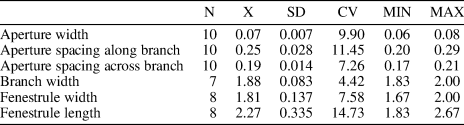
This study is based on six specimens preserved in situ. The two best specimens were selected for the detailed study. The samples were cleaned, and transverse and longitudinal thin sections were prepared for identification. A number of measurements were taken for the identification of specimens (Table 1). All the material described herein was recovered from beds situated ~10 m above the base of the Yong Limestone Formation.
Summary descriptive statistics for Ptilotrypa bajpaii n. sp. N = number of measurements; X = mean; SD = sample standard deviation; CV = coefficient of variation; MIN = minimal value; MAX = maximal value; units = mm.

Repository and institutional abbreviation
The original samples are kept in the repository of the Geological Survey of India (GSI), Northern Region, Lucknow, India.
Systematic paleontology
Phylum Bryozoa Ehrenberg, Reference Ehrenberg1831
Class Stenolaemata Borg, Reference Borg1926
Superorder Palaeostomata Ma et al., Reference Ma, Buttler, Taylor, Rosso, Wyse Jackson and Porter2014
Order Cryptostomata Vine, Reference Vine1884
Suborder Ptilodictyina Astrova and Morozova, Reference Astrova and Morozova1956
Family uncertain
Ptilotrypa Ulrich in Miller, Reference Miller1889
Type species
Ptilotrypa obliquata Ulrich, Reference Ulrich1890. Upper Ordovician (Katian); Illinois and Tennessee, USA.
Diagnosis (modified after Karklins, Reference Karklins and Robison1983)
Colonies branched or reticulate (anastomosing), consisting of bifoliate branches. Branches lens-shaped in transverse section. Mesotheca thin, irregularly crenulated, without median rods. Autozooecia straight, tubular, long, subrectangular to subelliptical in transverse section at mesotheca, oriented at angles of 40°–50° to mesotheca, arranged in horizontal series in transverse section. Autozooecial apertures oval, arranged in an indistinct rhombic pattern. Diaphragms present; hemisepta absent; cystiphragms present. Autozooecial walls U-shaped, laminated; autozooecial boundaries distinct, dark, narrowly to broadly serrated. Metazooecia rare to common, small, short. Styles absent. Monticules rare to common, flat, consisting of extrazooecial material and enlarged zooecia.
Occurrence
Upper Ordovician (Katian); North America, India.
Remarks
Ptilotrypa Ulrich in Miller, Reference Miller1889 differs from Ptilodictya Lonsdale, Reference Lonsdale and Murchison1839 in having autozooecial walls with distinct boundaries versus those with fused (amalgamated) microstructure in the latter genus. Ptilotrypa differs from Stictoporella Ulrich, Reference Ulrich1882 in the shape of autozooecia—straight tubular, budding at relatively high angles from the mesotheca—whereas the autozooecia in Stictoporella grow for a longer distance along the mesotheca and then bend more sharply toward the colony surface.
The species Ptilotrypa secunda Lavrentjeva in Gorjunova and Lavrentjeva, Reference Gorjunova and Lavrentjeva1993 and P. prima Lavrentjeva in Gorjunova and Lavrentjeva, Reference Gorjunova and Lavrentjeva1993 from the Katian of Estonia do not belong to this genus because they possess autozooecia with a sharper bend into the exozone and superior hemisepta as well as spherules in the autozooecial walls. These features make them rather similar to Astrovidictya Gorjunova and Lavrentjeva, Reference Gorjunova and Lavrentjeva1993.
Ptilotrypa bajpaii new species
(Figures 2–4)
Holotype
NRF-2/468 (slide no. NRF-2/474, NRF-2/475, NRF-2/476).
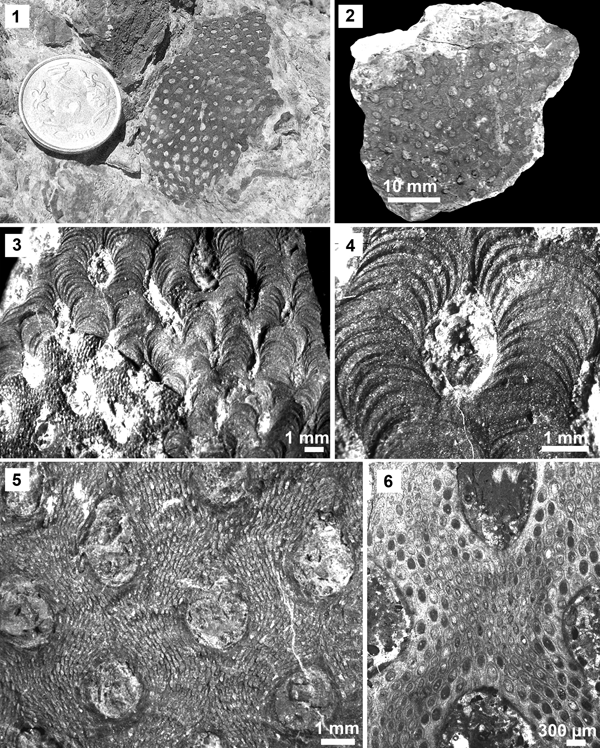
Photographs of Ptilotrypa bajpaii n. sp. (1) Field photograph showing bryozoans embedded in the limestone (paratype no. NRF-2/469). Diameter of coin = 2.5 cm. (2) Reticulate colony shape with anastomosing branches (holotype no. NRF-2/468). (3) Anastomosing branches rounded to elliptical fenestrules along with reverse and obverse surface (holotype no. NRF-2/468). (4) Semicircular ornamentation of reverse surface with fenestrule (holotype no. NRF-2/468). (5) Autozooecia arranged in 8–12 alternating rows on the obverse surface (paratype no. NRF-2/470). (6) Microphotograph showing tubular, straight, long, subrectangular shape of autozooecia (holotype no. NRF-2/468; slide no. NRF-2/474).

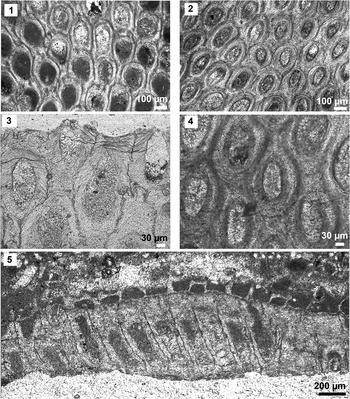
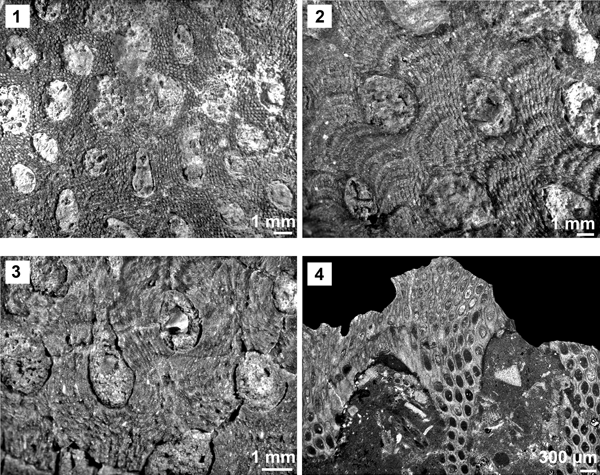
Microphotographs of Ptilotrypa bajpaii n. sp. (1–3) Tangential section showing autozooecial apertures and walls with distinct zooecial boundaries (holotype no. NRF-2/468; slide no. NRF-2/475). (4) Tangential section showing autozooecial apertures and walls (paratype no. NRF-2/471; slide no. NRF-2/477). (5) Branch longitudinal section showing autozooecial shape (holotype no. NRF-2/468; slide no. NRF-2/476).

Photographs of Ptilotrypa bajpaii n. sp. (1) Alternate rows of autozooecia arranged on the obverse surface (paratype no. NRF-2/472). (2) Anastomosing branches, rounded to elliptical fenestrules, along with semicircular ornamentation (paratype no. NRF-2/473). (3) Autozooecia and rounded to elliptical fenestrules (paratype no. NRF-2/471). (4) Tangential section showing autozooecial apertures and walls (paratype no. NRF-2/471; slide no. NRF-2/478).

Paratypes
NRF-2/469, NRF-2/470, NRF-2/471 (slide no. NRF-2/477, NRF-2/478), NRF-2/472, NRF-2/473 (Fig. 4.1–4.4).
Diagnosis
Reticulate colonies consisting of anastomosing branches; fenestrules rounded to elliptical, almost as wide as branches; autozooecia arranged in 8–12 alternating rows; metazooecia few, small; monticules absent.
Occurrence
Upper Ordovician, Yong Limestone Formation, Kumaun Tethys Himalaya, Niti valley, southwest of the Geldung, Chamoli district, Uttarakhand, India.
Description
Reticulate colonies consisting of anastomosing branches (Fig. 2.1–2.3). Branches 1.83–2.00 mm wide. Branch thickness unknown because colonies are split in the plane of mesotheca. Mesotheca could not be observed. Fenestrules round to elliptical (Fig. 2.3), 1.67–2.00 mm wide and 1.83–2.67 mm long, semicircular ornamentation on the reverse surface (Fig. 2.4). Autozooecia arranged in 8–12 alternating rows on branches, tubular, straight, long, subrectangular in endozone and subelliptical in exozone (Fig. 2.5, 2.6). Autozooecial diaphragms and cystiphragms absent. Autozooecial walls U-shaped laminated, 0.072–0.127 mm thick; autozooecial boundaries distinct, dark, narrowly to broadly serrated (Fig. 3.1–3.5). Metazooecia few, tubular, 0.02–0.03 mm in diameter. Styles absent. Monticules absent.
Etymology
The species is named after Prof. Sunil Bajpai, a well-known Himalayan paleontologist and director of the Birbal Sahni Institute of Paleosciences, Lucknow, India.
Remarks
Ptilotrypa bajpaii n. sp. differs from P. oblicuata Ulrich, Reference Ulrich1890 in having reticulate (anastomosing) colonies and smaller autozooecial apertures (aperture width range 0.06–0.08 mm versus mean width of 0.16 mm in P. oblicuata) as well as in lacking cystiphragms, diaphragms, and monticules.
Results
Ptilotrypa obliquata Ulrich, Reference Ulrich1890, the type species of the genus Ptilotrypa Ulrich in Miller, Reference Miller1889, was reported from the Upper Ordovician (Katian) of the United States. Ulrich (Reference Ulrich1890) placed this genus originally in the family Ptilodictyonidae Zittel, Reference Zittel1880. Karklins (Reference Karklins and Robison1983, p. 522) placed this genus as family uncertain, and this opinion has been followed in the present paper. Gorjunova and Lavrentjeva (Reference Gorjunova and Lavrentjeva1993, p. 80) placed Ptilotrypa in the family Stictoporellidae Nickles and Bassler, Reference Nickles and Bassler1900. However, Ptilotrypa does not fit in either the Ptilodictynidae or the Stictoporellidae. It differs from ptilodictyionids in the wall structure with serrated zooecial boundaries, and from stictoporellinids in the shape of autozooecia, which do not bend in the exozone. So far, the taxonomic assignment of this genus remains uncertain.
The type species of Ptilotrypa possesses a colony composed of dichotomous branches, whereas P. bajpaii n. sp. possesses a reticulate colony, in which branches are fused (anastomosing). The internal morphology of this species corresponds to that of the type species, so the colony shape appears to be of secondary importance for establishing a new genus. The two species placed earlier in the genus Ptilotrypa (see Remarks) have strong morphological differences from the type species, and they are herein removed from this genus (and probably are best placed in Astrovidictya).
With the report of this species from India, only two species of Ptilotrypa are known, both restricted to the Katian in their temporal distribution. Ptilotrypa obliquata is known from the Cincinnatian Series of Illinois and Tennessee in the United States. This connection is partly confirmed by the presence of two taxa in bryozoans of the Pin Formation (Suttner and Ernst, Reference Suttner and Ernst2007) that were also reported in the Cincinnatian of North America: Calloporella harrisi Ulrich, Reference Ulrich1882 and Dekayia gregaria (Ulrich, Reference Ulrich1883). Stratigraphically these are found in the Amorphognathus ordovicicus Zone of the Pin Formation.
The reticulate colony of Ptilotrypa bajpaii n. sp. may represent an evolutionary innovation improving filtering feeding capacity of this bryozoan compared to the branched colony of the type species. Reticulate colonies in bryozoans act as effective filtering architectures in which water currents go through fenestrules (Cowen and Rider, Reference Cowen and Rider1972; Cook, Reference Cook1977; Suárez Andrés and Wyse Jackson, Reference Suárez Andrés and Wyse Jackson2015). Observations in the field indicate an abundance of large colonies of Ptilotrypa bajpaii n. sp. The development of the biohermal and nodular Yong Limestone Formation, along with corals, bryozoans, and crinoids, indicates warm shallow marine condition (Sinha et al., Reference Sinha, Srivastava and Peters2005). The Yong limestone comprises a series of reef structures with dips in all directions and interconnected with one another by bedded reefal debris (Shah and Sinha, Reference Shah and Sinha1974b; Sinha, Reference Sinha1980). The presence of this new species of a cryptostome bryozoan species indicates an Upper Ordovician age for the lower part of the Yong Limestone Formation and thus constrains the Ordovician–Silurian boundary at least in the Yong Limestone Formation or in the overlying Variegated Formation instead of in the underlying Shiala Formation.
Acknowledgments
The authors are grateful to Additional Director General and HoD, Geological Survey of India, Northern Region, Lucknow, India, for providing an opportunity to work in this area. Thanks are also due to S. Shome (GSI, Kolkata, India), P.D. Taylor (Natural History Museum, London, UK), M. Sonar (Aurangabad, India), G. Srivastava (BSIP, Lucknow, India), S.R. Mishra, R. Negi, and V. Singh (GSI, Lucknow, India) for technical support during the preparation of the manuscript. We are also grateful to H.A. Nakrem (University of Oslo) and M.M. Key (Dickinson College, Carlisle, USA) for their helpful and constructive reviews.