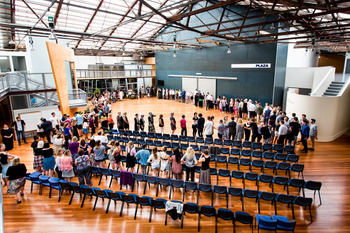
On a late summer morning in 2019, seventy-five incoming students arrived at New Zealand's national drama school to be welcomed through a pōwhiri, a Māori practice for ceremoniously receiving visitors. Best known as Toi Whakaari (Toi), the school balances Western and indigenous traditions, within which the pōwhiri is an essential exercise.Footnote 1 A Toi staff member briefed the new arrivals prior to their entering the building's main plaza, where a woman from the local iwi (tribe) – Te Āti Awa – summoned the visitors through a refrain (karanga), before instructing them to fill two rows of chairs across from their hosts.Footnote 2 Once everyone was seated, a representative from the incoming cohort gave a speech requesting that his group be welcomed into Toi's community. Called a whaikōrero, the speech was delivered by a recently appointed staff member and alumnus who is Māori and familiar with how a pōwhiri works.Footnote 3 Toi's director (Tanea Heke) and several of her staff and students reciprocated with whaikōrero communicating the school's constituting values, namely the significance of ancestry (whakapapa), embracing difference and the practice of shared respect (whakaute).Footnote 4 Both the visitors and their hosts then gifted songs (waiata) and feasted on kai (food) towards ‘settling’ the former and commencing the semester.
Pōwhiri to welcome incoming staff and students (February 2019). Image courtesy of Toi Whakaari, Wellington, New Zealand.

Research methods, questions and positionality
The pōwhiri is one of many ways that Tikanga Māori constitutes Toi's learning environment, the very subject of this essay, which intersects actor training with culture and identity.Footnote 5 My ethnographic methodology comes from fieldwork as a Fulbright scholar between January and July 2019, when I had access to the school's activities and personnel. I conducted numerous interviews with students and staff, observed teaching and learning, was privy to faculty meetings, and participated in Toi's annual retreat to a marae. An extraordinary experience that was as inspiringly received as it was responsibly rendered, Noho Marae perhaps best represents the school's integration of Tikanga Māori and is one of many attributes distinguishing Toi from other conservatoires.Footnote 6
This article is positioned towards acting teachers and performance scholars and can be read in relation to a number of recent and important contributions to the field. In researching Toi, I investigate its use of indigeneity in the context of a bicultural pedagogy. My methodology is therefore distinct from the ‘inter-’, ‘cross-’, and ‘multicultural’ investigations of Zarrilli, Tatinge Nascimento, Barba and others in that I specifically address Toi's synthesis of Māori and Western practices towards rethinking training.Footnote 7 A bicultural paradigm, it naturally raises concerns about a binary between indigenous and colonialist approaches, thereby causing me to frame my research according to the following questions: is Toi's pedagogy delivered with a commitment to the sanctity of Māori beliefs or does it appropriate them? Is the school equitable and inclusive in its delivery of curriculum? How is Toi's bicultural praxis implemented and what is the response of its Māori stakeholders? Does Toi provide insights for training actors in the twenty-first century?
I address these questions by first overviewing the school's history (whakapapa), before examining its implementation of Tikanga Māori. In ethnographically documenting my six-month residency, I explore events and practices such as Noho Marae and Toi's bicultural curriculum. While acknowledging imperfections, I argue that the school's deployment of indigeneity is responsible, its pedagogy is impressively inclusive, and its training is a model to behold. The dedicated and thoughtful work of staff and students, as well as the recent appointment of Tanea Heke as director, prove as much. Thus I contend that Toi Whakaari is very much in the process of meeting its long-time goal of exploring ‘indigenous and immigrant cultures in partnership’, thereby reflecting the idealized values of greater Aotearoa.Footnote 8
My findings are offered from the perspective of a white outsider, a tauiwi, whose privilege therein contextualizes this research. My whakapapa as an American of European descent frames how I perceive practices and traditions quite distinct from my own. I therefore meet this project with humbleness while recognizing the limitations of my position as a Pākehā.Footnote 9 Yet I respectfully suggest that an outsider's viewpoint has certain advantages, insofar as presenting what I learn from a fresh perspective devoid of institutional bias. In doing so, however, it is imperative to maintain my integrity as a researcher who is sensitive to his cultural orientation relative to that of his Māori counterparts. As Edward Said asserts, an author undertaking a sociocultural analysis such as this one must foreground their positionality and audience in relation to the subject matter: ‘Who writes? For whom is the writing being done? [And] in what circumstances?’Footnote 10
My colleagues at Toi as well as their students and alumni were welcoming throughout my fieldwork and thereafter. They reviewed and shared in my research as part of a process marked by robust exchange, mutual respect and reciprocal discoveries. As such, my residency personifies ea, when hosts and their guests forge a relational ‘balance’ steeped in trust and openness.Footnote 11 This reciprocity grounded my research and informed my writing. After my residency, for instance, I had ongoing correspondence with Toi's director of actor training (Heather Timms) and Teina Moetara, a former staff member who now liaises with the school as a consultant. Along with others, they have thoughtfully vetted and supported my research and findings.
While my project investigates Toi's use of indigeneity, I do not claim to be expert in Māori culture, nor do I make a moral judgement about its application to actor training. I acknowledge the long and painful history of Eurocentric research that has been imposed upon indigenous communities, spaces and societies. Discourses of culture are contingent on the epistemological frameworks within which they sit. To borrow from Stuart Hall, the formation of knowledge ‘shapes perceptions and practice … [and] has consequences for both those who employ it and those who are subjected to it’.Footnote 12 I am aware of the complex aim of this study and take care to self-identify as an outsider respecting Tikanga Māori while investigating it from the standpoint of an actor trainer. In doing so, I subscribe to Linda Tuhiwai Smith's guide for conducting fieldwork in a post-colonial context. To the extent I address Māori customs and practices, I will refrain from ‘disconnecting them from their histories, their landscapes, their social relations, and their ways of thinking, feeling, and interacting with the world’, while focusing on what an outsider's perspective can offer, which in this instance pertains to actor training.Footnote 13
Toi Whakaari has also wrestled with these discourses of culture. Taking its lead from New Zealand's Treaty of Waitangi, the school champions ‘partnership’ and ‘protection’ as constituting values.Footnote 14 Established in 1840, the treaty remains the basis for New Zealand's bicultural society. Representatives of the British Crown came to terms with indigenous leaders to commence English settlements in exchange for protecting the Māori from foreign invasion, most notably the French, who at the time posed a threat. What transpired over the next 130 years was a colonial enterprise that disenfranchised the Māori and their way of life. Despite the treaty's assurance that Māori could claim ownership of their lands and maintain a degree of autonomy, they were subjected to an ‘overriding intent to establish British sovereignty’.Footnote 15 The so-called New Zealand Wars occurred between 1845 and 1872, during which time the Crown thwarted the resistance of iwi throughout the ‘country’.Footnote 16 It was not until 1975, with the ratification of the Treaty of Waitangi Act and its corresponding ‘tribunal’, that breaches of the original agreement were addressed, due process for Māori grievances ensured, and reparations for past oppression enacted.Footnote 17
Since the 1970s, Māori interests and values have been measurably implemented in New Zealand–Aotearoa. In addition to monetary reparations, the state has redistributed land to iwi in ‘concrete and meaningful’ ways.Footnote 18 Alongside English, Te Reo is recognized as the nation's official language and state agencies have been reformed to reflect a bicultural agenda. Māori traditions are taught in schools, represented in the public sphere, and acknowledged throughout society.Footnote 19 The best of intentions to be inclusive, however, can be reductive and offend the very population one seeks to respect. It is difficult to sustain a bicultural ethos between disparate identities that share a history steeped in colonialism. Despite perceptions that New Zealand is a progressive nation that has successfully repositioned settler–indigenous relations, Māori continue to be underrepresented and marginalized in sectors that range from the government and judicial system to education and business. The country has yet, for example, to elect a Māori prime minister. This disenfranchisement has been well documented by New Zealand historians such as Anne Salmond, Dora Alves and Katherine Smits.Footnote 20
Toi Whakaari in some ways reflects New Zealand's bicultural dialectic. While it subscribes to an inclusive agenda, the school continually negotiates how this ethos becomes manifest. The concept and practice of biculturalism are complicated. Merging two disparate identities within a collective community invites discomfort while necessitating a thoughtful embrace of difference and its inherent challenges. One must remain connected and committed to one's positionality and whakapapa as they respect and engage the same in others. An effort to be inclusive can inadvertently devolve into hollow vagueness and misplaced interpretations of identities different from our own. Responsibly practising biculturalism requires meeting ‘difference’ with humbleness, empathy, patience and listening. In the latter, for example, Toi's actors are taught to ‘read and respond’ to others in an open, active and grounded way. As the school's tikanga consultant, Teina Moetara, claims,
I love the idea of biculturalism: it is my culture and your culture. When I meet you, I have to understand who I am first. When an actor goes into an audition or a rehearsal, they should be able to read the room and bring their own identity to meet the moment. It is not about being multicultural, which is like a smoothie. Owning who we are and being responsible for how we engage difference is essential to understanding the power of being bicultural.Footnote 21
As Moetara suggests, biculturalism is not a fixed exercise of cataloging groups and individuals according to stereotypical criteria. Rather, it necessitates a nuanced understanding and deep respect for others in relationship to one's own identity and history. A dynamic practice that requires rigour, Toi's bicultural approach offers performance trainers and scholars a welcome example of negotiating difference, empowering marginalized voices, and engaging forward-facing pedagogies.
Historical background: from a UK-inspired conservatoire to an Aotearoan model
Toi Whakaari was founded in 1970 with funding from the Queen Elizabeth II Arts Council. In what began as a one-year experiment, the school operated under the leadership of Nola Millar, a Wellington-based stage director who believed that New Zealand needed a national drama school to contribute to its developing professional theatre scene.Footnote 22 With support from the Arts Council, she spent much of 1967 visiting acting programmes throughout Western Europe and North America, a sojourn that informed, if not defined, her founding of Toi. While recognizing the significance of borrowing techniques and methodologies from the likes of LAMDA and HB Studio,Footnote 23 Millar wanted New Zealand's drama school to ‘foster the growth of a native professional theatre’.Footnote 24
Millar's commitment to indigeneity – loosely understood as it may have been at the time – remains a core principle at Toi. Officially named for the Te Reo term meaning performing arts, Toi Whakaari practises a bicultural pedagogy that can be seen as a ‘gift shifting New Zealand's perceptions of what is possible’.Footnote 25 In making this proud claim, Christian Penny – Toi's director from 2011 to 2018 – echoes the Māori tradition of reciprocity and presents Toi's engagement of difference as an exemplar for societal advancement. Toi's staff and students ‘understand difference as something with potential as opposed to something to be managed’, thereby creating a community where cross-cultural, interdisciplinary and entrepreneurial learning abounds, a progressive and inclusive approach worthy of consideration worldwide.Footnote 26
The school has not always been a proponent of pedagogical progress. Despite Millar's hope for an institution that values indigeneity, much of its history was steeped in an English model trafficking in assimilation. It was not until 1988 and the concurrent retirement of George Webby as director – a post he held for fourteen years – that the school began to ‘explore a more bicultural way of working’.Footnote 27 It underwent growing pains during the 1990s while trying to honor Millar's vision. For instance, the Māori film producer Whetu Fala taught indigenous theatre in 1992–3, before abruptly leaving because Toi was not living up to its standards of inclusivity:
You had things like white teachers (Pākehā) taking over the instruction of the Māori performing arts. This is an extension of colonialism. Colonization and racism occur when we are made to believe that our knowledge of ourselves is of no worth. It gets to a point where ‘the normal’ is not indigenous values, but Pākehā interpretation of Māori values.Footnote 28
Fala's comments go to the heart of one of this essay's questions: to what extent is Toi's bicultural ethos equitable and inclusive? The intentions of staff and administrators throughout the school's history have been well meant. Bill Guest makes this claim apparent in his book Transitions, which traces Toi's development as a bicultural institution from its inception to 2010.Footnote 29 Advancements clearly have been made towards a more egalitarian and diverse learning community since Fala's tenure – she was justifiably concerned by the lack of Māori representation on the faculty, as indigenous practices and values are best conveyed by those who are Māori. If a school assigns non-representative staff to instruct in subject areas that pertain to marginalized peoples and communities, it potentially disenfranchises the very group that it purports to include. While the 1990s began a period of well-intended progress, Toi was still trying to find its way in negotiating European and Māori identities, an assertion made apparent by Annie Ruth, Toi's director from 1997 to 2012, who described the institutional culture at the point of her arrival as a ‘time for the entire school to learn together in the frame of Māori principles’.Footnote 30
Significant administrative and structural changes defined the 1990s at Toi. In accordance with the Education Amendment Act, the school was no longer funded by the Arts Council and instead became underwritten by the government as an ‘accredited private training establishment’.Footnote 31 This change was important because it gave Toi greater autonomy, as the state jointly underwrote and recognized it as New Zealand's national drama school. Other developments throughout the decade were the implementation of a Bachelor of Performing Arts degree, relocating the school to its current home in Wellington's Newtown district, and the appointment of Robin Payne as director; she is rightfully credited with moving Toi closer to its bicultural commitment.Footnote 32 Noho Marae started during her tenure and the learning environment became more inclusive than in previous years. Nevertheless, Toi continued its strict adherence to English techniques until the early twenty-first century, when the training transitioned to a more balanced paradigm under Ruth's leadership.
Ruth brought Toi into the new millennium by focusing on its Māori initiative. Building upon Payne's groundwork, the school's biculturalism ‘took off’ under her leadership, as indigenous staff increased and Tikanga Māori was integrated towards ‘transcending appearances of tokenism’.Footnote 33 Her first appointee was an indigenous teacher, Rawiri Paratene, who undertook both acting and tikanga courses.Footnote 34 Two other key hires arriving in 2007 were Teina Moetara and Jade Erickson, who respectively led the Taha Māori and Theatre History initiatives.Footnote 35 When Heather Timms joined the staff in 2008, the three founded the pedagogy Tūrangawaewae, which has shaped the Acting Program ever since.
A compound word meaning a ‘unique place to stand’, Tūrangawaewae is foundational to Toi's actors.Footnote 36 Tū is the Te Reo term for one's position or ‘stand’ and is the guiding principle throughout the first year of training. Each actor locates their artistic identity while developing their individuality. Embodied learning manifests in skills classes such as voice and movement, which support activities like independent practice and a solo project. The latter culminates with a twenty-minute piece in which students ‘speak to who they are and what they want to say to the world’.Footnote 37
Raranga signifies ‘to weave’ in Te Reo and encapsulates the program's second year through embodied practice, deep listening and collaborating with others. The collectivist values of Māori are especially pronounced, as actors deepen their artistic and personal core through group activities like screen lab and a Shakespeare project, wherein the principles of Tū and Raranga guide them. In addition to honing their craft, students develop soft skills such as accountability, initiative, self-creation, interpersonal communication and adaptability. They become as deft at reading a room and negotiating difference as they are at executing a close-up or speaking blank verse. In the spirit of Tikanga Māori, Years One and Two thus ‘weave’ a range of pedagogical outcomes through establishing ‘a unique place to stand as a person, an actor, and an artist’.Footnote 38
The third year of training is identified by waewae – ‘legs’ in Te Reo – and focuses on the actor as an independent artist whose skill set and life goals are individualized. This approach can be seen as entrepreneurial, insofar as students engage their Tū and Raranga to create career paths through completing short films, theatrical productions and independent projects. Most become professional actors, but others find success in related métiers such as writing, directing, teaching, arts management or social services. For example, 2012 alumna Alice Canton makes her living as a creative consultant for New Zealand's Department of Corrections, where she empowers and instructs imprisoned women to re-enter society. Canton credits her training, especially its Māori components, in describing a ‘weird intersection between [her] theatre work and her day job’. She further states,
In many ways the two are indistinguishable. Whether acting or counseling, I must engage empathically, listen to a person's story, and document it as part of a shared practice. Understanding triggers of conflict, appreciating and respecting difference, and knowing how to mediate these differences were skills I took from both Christian and Heather.Footnote 39
Penny replaced Ruth in 2012 and served as Toi's director until 2018. Leveraging Ruth's work, he led Toi during a period of pedagogical progress consistent with its bicultural mission. In addition to extending Noho Marae from a one-day affair into a week-long retreat, Penny helped the school reconcile the inherent tension that arises from differing cultural positions. With ample support from colleagues like Timms and Moetara, he introduced the concept and practice of ‘responding to context’ by accessing a ‘shared way of working through a shared language’.Footnote 40 Western and Māori approaches to teaching and learning framed an educational environment that dialectically positioned methodologies commensurate with both cultural perspectives. Students became as adept at viewpoints and Stanislavski as they were capable of reading a room, contributing to ensembles and claiming ownership of their artistic voice, all feats facilitated directly and indirectly through Tikanga Māori.
Toi's Māori frameworks: an empowering pedagogy or tokenism?
Penny left Toi in 2018 and Heke assumed the directorship thereafter. She too has built upon the work of her predecessors. Annie Ruth responded to Heke's appointment by stating, ‘I cannot tell you how happy I am to see Tanea as director’, as well as ‘seeing new faces like Grace’.Footnote 41 With respect to the latter, Ruth is acknowledging the Arts Management tutor, Grace Hoet, who joined Toi in 2019 and – like Heke – is Māori and an Acting Program graduate.Footnote 42 Hoet echoes Ruth's praise of her fellow alumna in claiming, ‘I think the [Māori] frameworks are being held with care [with] Tanea at the helm’.Footnote 43 Fluent in Te Reo, Heke brings two decades of experience as a theatre producer and professional actor to Toi. A leader with keen interpersonal communication skills, her directorship should deepen the tikanga, especially as it applies to working across all departments. She states, ‘I want to see much more cross-disciplinary engagement throughout the school because this is what is happening in the profession. We need to work together as a whānau.’Footnote 44 Heke spent her first five months listening to the concerns and perspectives of staff and students. Given her understanding of Māori traditions, she focused on the school's use of koiwitanga, which is best described as a ‘tool, a practice, a philosophy’ capturing the essence of Tikanga Māori. Koiwi means ‘skeleton’ in Te Reo, and, as the story goes, in the 2000s a student discovered a box on the premises that contained the bones of an indigenous person. He then brought it to Moetara, thereby prompting the term koiwi to become a beacon of sorts for the school's tikanga.Footnote 45 In effect, it contextualizes the pedagogy across Toi's departments and sustains a culture where students and staff uphold their mana – their spiritual power – while inviting difference. Participants embrace their position – their Tū – while making space for others to do so. As Moetara indicates, koiwi is not intended to be a ‘kumbaya-like experience’, but to cause students and staff to become ‘clear in their identity and ethos’ and accordingly ‘put [these attributes] into the world’. He further describes the process in metaphorical terms by citing the three poles that structurally support a Māori meeting house (wharenui), with the rear pole signifying ‘identity’ and the middle and front representing one's ‘ethos’ and ‘practice’. The individual is thus grounded in their personhood and artistry, thereby positioning themselves to meet a given moment with the ‘fundamental values’ constituting who they are.Footnote 46
This practice is particularly important for actors because they must stay grounded when encountering the industry's objectifying and commodified demands. Thus Toi's Acting alumni assume authority over their lives and careers. Such is the case with Richard Te Are and Acacia O'Connor, both of whom graduated in 2017 and have been successful in different ways. Te Are landed a part in a feature film during his third year at Toi and has since played a recurring role on one series and a lead on another. He is represented by one of Auckland's most respected talent agents and auditions regularly. He is gainfully employed as an actor, a feat for which ‘he keeps going back to what [he] learned at Toi’. Indeed, Te Are credits his training not only for his acting chops, but also for the life lessons gleaned from koiwi:
Every day, I call on every project and class that I did at school: screen lab, context and practice, scene study, and koiwi. In its essence, koiwi is a space where we ask and brave questions without necessarily having to come up with final answers. We learn to sit with what is uncomfortable. We are constantly trying to figure out how to work as a group. For me, it was always important to create a space for many voices to be heard.Footnote 47
For her part, O'Connor has had success as a solo performer. In 2018, she premiered a piece called A Few Things I've Learned about Dating and Death at Auckland's prestigious Basement Theatre; one reviewer commended her show as ‘a great example of the power relationship between a performer and an audience’.Footnote 48 Like Te Are, she credits Toi for her accomplishments, a point evidenced by A Few Things, given that she developed it as part of Toi's independent practice. In many respects O'Connor typifies the balance of artistic craft and personal empowerment that comprises the Acting Program. In describing her strategy for approaching the industry, she states,
There is a perception that the arts are really hard. That is true to a point, but it is not as hard as people think because we can make our own opportunities. It is getting easier to get work seen and I am personally stoked that there is a role out there for everyone.Footnote 49
The role O'Connor references is not necessarily a part in a production, but can be understood in a broader context to include entrepreneurism and self-generating artistic opportunities. A pair of graduates from the class of 2012, Holly Chappell and Tom Eason, prove as much.Footnote 50 Arriving at Toi as a couple, Chappell and Eason got married in 2013 and eventually returned to their home town of Christchurch to start a theatre company dedicated to ‘innovative’ work that helps the local community ‘develop its own cultural voice’.Footnote 51 Before commencing their company, Two Productions, Chappell and Eason spent time in Auckland honing their craft while interning at the Red Leap Theatre, one of Auckland's most ‘visually innovative’ performance organizations.Footnote 52 They credit their training as ‘fundamental’ to their ‘lives and development as artists’, which has resulted in being gainfully employed. Eason states,
We have never had to get a café job. We were always finding work in the industry and working for a range of professional companies as well as making shows with Two Productions … Our training has helped us realize our ambitions and has given us the hard and soft skills to have a wide-ranging career.Footnote 53
In addition to acting, they learned how to make offers and lead a group while entrepreneurially engaging the industry. They have found employment in professional theatres and television as well as in teaching and performance making. Like O'Connor and Te Are, they are multifaceted actors who are particularly grateful for their experience studying koiwitanga, acknowledging how it informed their training:
I loved koiwi and participated as actively as I could. It afforded me the opportunity to collaborate with as many students as possible across the school. Koiwi strengthened my acting by teaching me how to be an artistic leader who knows how to work with others, to shift the conversation to the group's advantage, and to maintain a safe and positive work environment (Chappell).Footnote 54
I learned through Holly and others. I remember thinking koiwi could either be a waste of time or the most important part of our training. I eventually realized its significance and continue to use the principles that I learned every day in my life (Eason).Footnote 55
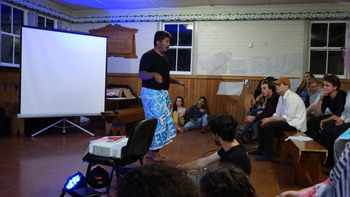
Koiwi occurs in ninety-minute sessions on Monday and Friday mornings, during which time work is shared, conversations are forged, waiata are taught, lectures are rendered and karakia (prayers) are chanted. It challenges participants to take ownership of Toi's training while simultaneously framing the working week, contextualizing the curriculum and defining the institution's culture. Māori principles ranging from the significance of one's whakapapa and tapu (that which is sacred) to the practice of karanga are taught and learned. Students and staff rotate to lead each session and the entire school is encouraged to participate. As such, koiwi invites obvious challenges regarding a person's ancestry and identity. If a Māori student leads a haka or waiata, for example, is it their own volition to do so or are they somehow being pressured? Likewise, what are the cultural signals and ramifications of Pākehā undertaking such a role? In responding to these questions, Moetara describes koiwi as an intersectional practice that paradoxically preserves inherent differences and tensions while creating a space for diversity and inclusion:
Jade and I looked at the timetable and decided to allow ninety minutes at the beginning and end of the week to involve the entire school in exploring everyone's respective culture. It took a lot of time to openly address culture in the room, which was not the way of the school at the time. We were challenging Eurocentric principles, but we were also challenging Māoridom.Footnote 56
Koiwi's focus is on understanding and respecting difference through acknowledging and exploring cultural distinctions towards empowering each individual's personal and artistic voice. Moetara is no more interested in dismissing European influences than he is in privileging those of Māori. In fact, he is thoughtfully critical of the widely held belief among indigenous peoples that ‘everything must be by Māori, for Māori, with Māori’. While an indigenous participant can perhaps best introduce a given practice, according to Moetara, nurturing an equitable and inclusive community requires shared leadership among Māori and Pākehā. Thus the frameworks imbedded in Toi's curriculum are designed for everyone accessing ‘their power source: their deep connection to who they are in the deepest sense’.Footnote 57 Testimonials from current students and alumni corroborate his contention. In addition to Pākehā like Chappell and Eason, both of whom were leaders of koiwi during their time at Toi, Māori students such as Te Are likewise affirm the care and responsibility with which the biweekly practice operates.
Actor Lance Ainofo sharing work in a koiwi session. Image courtesy of Toi Whakaari, Wellington, New Zealand.

Addressing issues outside one's comfort zone while negotiating difference is precisely the point to koiwi. Students and staff nurture their respective identities as individuals, artists, teachers and learners. Naturally, this process invites criticism, the most significant of which has come from Heke. Appointed in 2019, she is still studying Toi's pedagogy and the ways in which koiwi functions within and around it. While acknowledging its potential in serving the school's bicultural mission, her initial observation is one of measured reserve: ‘everything sort of sits as something onto itself, which is a Pākehā – a European – practice … We need to do better as a whānau’.Footnote 58 Heke is legitimately concerned that Tikanga Māori can be misrepresented due to a lack of understanding of its traditions and meanings. She prefers that only indigenous Aotearoans lead koiwi, insofar as she deems them the most qualified intellectually and ontologically to do so – ‘it is their whakapapa, their ancestry’.Footnote 59 Grace Hoet agrees: ‘we must have the right people (indigenous) leading and maintaining the tikanga’. Yet both Heke and she are keen to embrace Moetara's perspective and how it becomes manifest through koiwi. Hoet claims, ‘Teina has the mātauranga [knowledge] to balance the school's Māori and Pākehā representation’Footnote 60 and Heke credits his work at Toi's Noho Marae:
I have seen the frameworks explained very clearly from Teina at Manutuke, but I do not see them playing out every day at school. If we want to work with these practices, how can we make it happen in the school? It is one thing to talk about Tikanga Māori, but how do we walk the walk?Footnote 61
Heke's words are strong and impressive in addressing whether or not the school's inclusion of Māori principles is tokenistic. While her observation and sagacity are much respected, koiwi appears to be effectively training students to become self-reliant, entrepreneurial and grounded in their craft and career. As Moetara states, ‘We want to meet difference to activate our diversity as individuals and as a learning community while recognizing our blind spots and avoiding a one-size-fits all perspective’.Footnote 62 The intent is to empower everyone's artistic and personal identity, a key criterion that is contingent on not positioning someone as a guru, a point on which Moetara self-reflects: ‘In delivering the Māori frameworks, I discovered if I speak too much people look to me as an expert instead of using their own voices’.Footnote 63 Thus he balances his authorial voice on Māoridom and koiwi with guiding others to lead the work towards a sustainable and shared outcome.
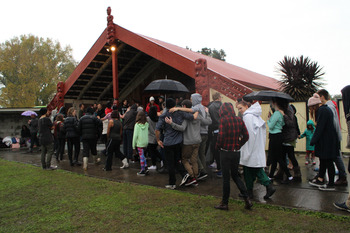
Moetara's approach is perhaps best represented at Noho Marae.Footnote 64 Held annually some 530 kilometres north of Wellington, the school's staff and students embark upon a five-day retreat to develop work, live communally and deepen their mātauranga. Upon arriving for the 2019 Noho Marae, members of the Rongowhakaata iwi greeted the Toi contingent at the wharenui to commence a pōwhiri, before inviting their guests inside to share kai. Moetara was among the hosts and offered the first of his five lectures on Tikanga Māori, a session that underscored the sacredness of his clan's marae and whakapapa:
The home/meeting house is where we gather to identify, engage, and confirm our iwi's values. When we are inside the whare it is not about being Māori, but about having an identity, a personal compass, a position rooted in history.Footnote 65
The next four days tethered Māori frameworks to artistic practice: Moetara offered talks, actors rehearsed projects, designers developed ideas, managers planned schedules, the staff held meetings (hui), and the students presented work. The third-year actors shared segments of their independent projects in what were termed ‘art talks’ ranging from solo performances and comedy acts to webisodes, short films and music videos. To cite a few examples, one student offered her vision for an artistic collective, another performed his stand-up routine, whereas a third read excerpts from a play he was writing. Rigorous feedback followed each talk, when ideas were exchanged within a supportive learning environment, thereby empowering students to bolster their Tū while forging future collaborations. The art talks emblematize the Acting Program's commitment to independent and shared practice in the context of entrepreneurism, a point underscored by 2015 alumnus Jack Barry:
The art talks are something you need to do every day in the profession. Whether you are pitching a project to a producer or auditioning for an acting job, the industry is a constant space for selling your work and building a sustainable career.Footnote 66
Such a visionary ethos abounds among Toi's actors, all of whom are provided the skills and knowledge to have careers both in and outside the industry. They are taught to develop and produce work with confidence and fearlessness, attributes drawn from Tikanga Māori in conjunction with koiwi. Entrepreneurism is not undertaken in the blithely capitalist use of the word; rather, it is a by-product of each student's Tū and corresponding connection to their mana, the spiritual power and authority to engage others in service of oneself and the collective.
Toi Whakaari students and staff arriving for Noho Marae 2019. Image courtesy of Toi Whakaari, Wellington, New Zealand.

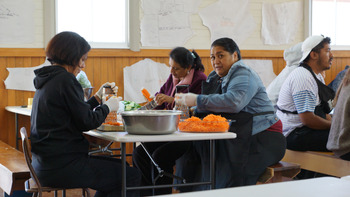
Māori beliefs and principles permeated the 2019 Noho Marae. From Moetara's lectures and ad hoc discussions to practising waiata and rehearsing the school's haka, staff and students engaged in a pedagogical experience that was as communal as it was personal. Each individual reflected on their growth as the group's dynamic deepened throughout the week. Sleeping thirty to a room, sharing kai and clean-up and living as a collective were as integral to the teaching and learning as was the presenting of work. On the final night of the retreat, Toi students and staff joined their hosts in a farewell dinner prepared from an earth oven (hāngī), a traditional method of cooking among Māori. Afterwards, everyone contributed to restoring the wharenui to its state at the outset of Noho Marae, thereby creating a space for the Toi and Rongowhakaata contingencies to honour what had transpired over the week and acknowledge ‘what work remained to be done’.Footnote 67
Just as Noho Marae commenced with a pōwhiri, it also ended in ceremonial protocol. In what Māori call a poroporoaki – signifying farewell – representatives from Toi (one a student, the other a staff member) expressed gratitude to the Rongowhakaata. Thereafter, they led the Toi contingent in a pair of waiata in Te Reo as a sign of respect to their hosts, who reciprocated with whaikōreo (speeches) and songs of their own; as such, one of the speakers urged the students and staff ‘to trust their mana and embrace their Tū.’Footnote 68 With words that were as provocative as they were reassuring, the speaker exemplified the Māori distinction between ‘farewell’ and ‘goodbye’. Whereas the latter connotes finality, to bid an individual or a group to ‘go well’ as they ‘take their leave’ is eternal. And with that parting message fresh in everyone's mind, the hosts and guests formed a hongi line to bring the proceedings to a close. What began and ended with ten-hour bus journeys was an experience filled with challenges and responses, accomplishments and setbacks, and a prevailing sense of rigour and joy.
Tanea Heke (left), Grace Hoet (front right) and Prabha Ravi (Toi's director of engagement) prepare kai as part of the 2019 Noho Marae. Image courtesy of Toi Whakaari, Wellington, New Zealand.

Conclusion
Noho Marae is a rich and rewarding part of Toi's training and represents the school's commitment to biculturalism. In addition to providing a unique opportunity to foster projects and artistic collaborations, the experience reinforces and deepens Toi's exploration and integration of Tikanga Māori. As acknowledged by Heke, however, the tikanga is difficult to sustain throughout the academic year. Yet based on five months of fieldwork, I would argue that the school is making demonstrative progress in upholding its bicultural mission. Koiwi's overarching influence on the pedagogy fortifies the tikanga, as do intradisciplinary courses like Context and Practice and Toi's Festival of Work-in-Development. The latter is an exploration of original pieces involving students from across the curriculum that culminates at the end of the academic year with a public performance. Context and Practice is compulsory for all first-year students and teaches them how to read work. Another outstanding example of Toi's cross-disciplinarity is a class entitled Mise en Scène, which is team-taught and involves a plurality of programmes in creating a film project. Participants from Design, Sets/Props, Acting, and Technical Management partake in a five-week endeavour that underscores the school's communitas while empowering students to locate and deepen their artistic voice. Vaughan Slinn, a senior tutor in the Acting Program, acknowledges as much in stating, ‘Mise en Scène allows for actors and designers to be content creators, which are in high demand in the industry; so it is an opportunity for our students to be creative entrepreneurs in the screen space’.Footnote 69 Such entrepreneurism flourishes precisely because of the school's indigenous frameworks.
Toi Whakaari in general, and its Acting Program specifically, are a unique training environment from which other drama schools and arts institutions could learn. Its embrace of cultural difference, coupled with its integration of Māori frameworks, allows students and staff to grow in their craft while reflecting New Zealand's bicultural agenda. The curriculum's entrepreneurism prepares the former to be content creators who generate their own professional opportunities. The tūrangawaewae pedagogy trains actors who are grounded in their artistic and personal identity, a powerful position from which to collaborate. In brief, Toi is a very special place.
Since its inception Toi Whakaari has become increasingly inclusive in building a learning environment that represents Māori values. In what can be described as an evolving process, its staff and students develop their tikanga through koiwi and other practices. Sharing work, exchanging ideas, making announcements (pānui) and learning waiata constitute the biweekly sessions as part of an overarching investigation of indigenous culture within which students ‘encounter and engage’ each other towards becoming ‘responsive and conscious’ individuals and artists.Footnote 70 As such, the school has begun hiring specialists in Tikanga Māori who assist in the integration of these frameworks and Moetara continues to be significant in guiding the process. During the 2019 semester break, for example, the staff partook in Noho Marae under his leadership. Heather Timms encapsulated the experience by stating, ‘The Marae was VERY rich. What became clear for all (Maori and non-Maori alike) is that the work is challenging because it requires constant investment and engagement of the group.’Footnote 71 These positive and productive developments bode well for Toi Whakaari's bicultural mission. Heke's appointment ensures that the school will be led by someone who identifies as Māori and brings an impressive range of professional experience to the position. A proactive leader with first-hand knowledge of indigeneity, she has a clear strategy for building a learning environment that is sustainable. And in collaboration with Moetara, Timms and others there is an ‘understanding of how what everyone does falls within the overall picture’ of Toi's community.Footnote 72 Indeed, the collectivism that defines Māori culture aligns well with the work of theatre artists. The former's reverential regard for the marae demonstrates as much. A sacred meeting place where the past informs the present, the marae constitutes a space within which a community's members locate their mana towards engaging difference and realizing their goals. It is through the collective that the individual nourishes their Tū alongside their personal and artistic growth. This practice is at the heart of Toi's training, and under Heke's leadership, combined with the commitment of staff and students, it is a model from which to learn and behold – tauira hei mātakitaki.