Introduction
Initiatives and referenda routinely require the average voter to make complicated policy decisions. Indeed, direct democracy often asks voters to ratify laws or constitutional amendments on the key political issues of the day, such as taxes, debt, immigration, abortion and same-sex marriage. Increasingly, ballot measures have focused on civil liberties.Footnote 1 On California's 2008 general election ballot, voters defined marriage as requiring opposite-sex partners and decided that physicians should not be required to notify a minor's parents before providing an abortion. These two examples are hardly alone. Over the past few decades, voters who reside in states with direct democracy have altered their state's constitution to limit or increase the rights available to the citizens of that state (for same-sex marriage, see Lupia et al. Reference Lupia, Krupnikov, Levine, Piston and Hagen-Jamar2010). Indeed, direct democracy has been an important weapon on the frontline of the “culture war.”
In many elections, the demands of direct democracy may be overwhelming. Again, consider the 2008 California general election: residents of Los Angeles County voted on 12 statewide propositions and an additional 48 local and countywide measures. Citizens within the city limits of Los Angeles considered at least 12, and in some districts more than 20, abstruse policy proposals in addition to selecting a president, a senator and representatives for federal, state, county, city and other local offices. The presence of multiple ballot measures in any given election is commonplace in California, and California is not the only state in which ballots resemble telephone directories. Asking voters to evaluate complicated constitutional questions – especially ones that define civil liberties – may be demanding too much from election-fatigued voters.
As a policy maker, the average voter is inexperienced and under-informed at best. Direct democracy thus poses a troubling dilemma: are voters equipped to evaluate complicated ballot measures? Surveys that highlight the dismal amount of knowledge that voters possess about politics (e.g. Delli Carpini and Keeter Reference Delli Carpini and Keeter1996) suggest the answer is a resounding “no”. The answer to whether voters are competent policymakers at the ballot box, however, is far from clear, in part because the bulk of scholarship on ballot measures focuses on questions such as these:
-
• How does direct democracy work as an institution (see, e.g., Lowenstein Reference Lowenstein1982, Reference Lowenstein1983; Kousser and McCubbins Reference Kousser and McCubbins2005; Garrett and McCubbins Reference Garrett and McCubbins2008; Kousser et al. Reference Kousser, McCubbins and Moule2008a, Reference Kousser, McCubbins and Rozga2008b)?
-
• How is spending regulated in direct democracy campaigns (Lowenstein and Stern Reference Lowenstein and Stern1989; Garrett Reference Garrett1999; Garrett and Smith Reference Garrett and Smith2005)?
-
• Does campaign spending affect voters’ awareness of ballot measures (e.g. Bowler and Donovan Reference Bowler and Donovan1998; Nicholson Reference Nicholson2003)?
By contrast, few studies (e.g. Lupia Reference Lupia1994; Bowler and Donovan Reference Bowler and Donovan1998; Karp Reference Karp1998; Burnett et al. Reference Burnett, Garrett and McCubbins2010; Burnett and McCubbins Reference Burnett and McCubbins2013) use individual-level data to consider whether voters who make these policy decisions are casting competent votes – a fundamental requisite for direct democracy to “work” (see also, Gerber and Lupia Reference Gerber and Lupia1999). The question of whether individuals can cast competent votes on ballot measures is especially critical when a substantial amount of proposals aim to amend a state's constitution. Indeed, the empirical evidence examining how voters make decisions on ballot measures that define civil liberties at the individual level is even scarcer.
Citing Lupia's (Reference Lupia1994) seminal work on voters in direct democracy, many scholars now assume that individuals can make competent choices without “encyclopedic” information of the issues. Research on endorsements, however, often ignores the importance of source effects.Footnote 2 Noting that researchers need to take into account the credibility of the cue-giver, Lupia and McCubbins (Reference Lupia and McCubbins1998) use experimental evidence to demonstrate that individuals can make expert-level decisions when an individual perceives a third-party cue-giver to be knowledgeable and trustworthy. While Lupia (Reference Lupia1994) has shown that voters can make informed decisions despite their information deficiencies, Lupia and McCubbins (Reference Lupia and McCubbins1998) demonstrate that receiving the cue-givers message is contingent on trusting the source. Here, we focus on a real-world empirical test of the Lupia and McCubbins experimentally-derived hypothesis that voters will only receive the signal (i.e. the endorsement) when the source (i.e. the cue-giver) is credible – that is, the voter perceives the cue-giver to be knowledgeable and trustworthy.
In a recent article, Burnett et al. (Reference Burnett, Garrett and McCubbins2010) found no evidence that familiarity with the core facts behind a ballot measure or knowledge of the position of prominent cue-giver caused voters to vote differently compared to those who possessed neither kinds of information. This evidence stands in stark contrast to the existing literature's assumption that voters routinely use information – including cues – to make decisions. We expand upon the existing research in three important ways. First, our survey data and analysis provide insight into how voters decided two important social issues that often appear on the ballot: abortion law and same-sex marriage. Despite the importance of these two policies in American political discourse, empirical evidence exploring how individuals cast votes on these issues when they appear on the ballot is paltry. Second, we show that cue-givers succeed in influencing only a subset of voters in any given election. In particular, we demonstrate that voters’ use of cues is highly conditional on whether a voter finds the cue-giver to be credible. Our core finding is that cues are helpful only sometimes for some people, but when they work, the outcome is contingent on the individual trusting the cue's source. This finding waves a caution flag for scholars who assume that voters’ use of cues is widespread. Third, we find that having specific “encyclopedic” knowledge about a ballot measure affects only some voters compared with the relevant baseline. This result is somewhat surprising given that previous research (Bartels Reference Bartels1996; Lau and Redlawsk Reference Lau and Redlawsk1997) reveals factual knowledge can have a strong effect on voters’ decisions. While our results are suggestive, additional studies are necessary to move towards a general understanding of what voters know about ballot measures and when knowledge of facts and elite endorsements will influence voters in direct democracy.
Voters and competent decisions in direct democracy
Scholars have routinely observed that voters know very little about politics and have a limited (and often non-existent) understanding about the structure of the political world (e.g. Converse Reference Converse1964; for a review of what voters know, see Delli Carpini and Keeter Reference Delli Carpini and Keeter1996). In response to Converse's finding that voters did not organise their political beliefs according to an academic ideal, Brady and Sniderman (Reference Brady and Sniderman1985) and Sniderman et al. (Reference Sniderman, Brody and Tetlock1991) hypothesise that voters assess political choices by relying on their evaluations of groups. They argue that individuals employ “likability heuristics” – simple affective evaluations of groups such as liberals and conservatives – to arrive at reasonably informed decisions. In essence, voters are able to overcome some (but not all) of their informational deficiencies by using these simple affective assessments to inform their own choices about candidates and issues of the day. Since Brady and Sniderman's (Reference Brady and Sniderman1985) original argument, the belief that voters can make reasonable choices on political matters has gained substantial support in the political behaviour literature (e.g. Carmines and Kuklinski Reference Carmines and Kuklinski1990; Mondak Reference Mondak1993; Lupia Reference Lupia1994; Popkin Reference Popkin1994; Mutz Reference Mutz1998; Lupia et al. Reference Lupia, McCubbins and Popkin2000; Nicholson Reference Nicholson2011).
While much of the above research explores ways in which voters can use heuristics, the agency-theory framework that Lupia and McCubbins (Reference Lupia and McCubbins1998, Chapters 2–5) discusses advances a set of standards against which we can evaluate when and under what conditions heuristics will influence an individual's decisions. In particular, Lupia and McCubbins argue that voters (whom they call “principals”) can use information from cue-givers (whom they call “speakers”) when the cue-giver meets the following common-knowledge conditions: (1) the voter believes that the cue-giver shares a common interest over policy outcomes, or, lacking that, the cue-giver must undertake an observable and costly action to communicate a voting cue to the voter, or some external force or forces are strong enough to substitute for common interest (there is a penalty for lying or a threat of verification, thereby making the cue-giver trustworthy); and (2) the voter perceives the cue-giver to be knowledgeable about the subject matter (thus, the cue-giver is believed to have the knowledge the voter desires).Footnote 3 In other words, Lupia and McCubbins move beyond the blanket assumption that individuals can use information shortcuts freely, and instead propose that the individual's assessment of the cue-giver's credibility will determine whether the individual will incorporate the cue-giver's advice into a decision.
While information shortcuts have great potential to help voters make decisions, the realities of political campaigns place limits the ability of cue-givers to persuade voters. For instance, Garrett and McCubbins (Reference Garrett and McCubbins2008) find that many information shortcuts fail to meet the two basic conditions set forth by Lupia and McCubbins, with or without the existence of external persuasive forces, and are therefore not useful. On the other hand, Boudreau (Reference Boudreau2009a), in work that parallels the work of Lupia and McCubbins (Reference Lupia and McCubbins1998), Gigerenzer (Reference Gigerenzer2000, Reference Gigerenzer2007, Reference Gigerenzer2008), Gigerenzer and Selten (Reference Gigerenzer and Selten2001) and Gigerenzer et al. (Reference Gigerenzer and Todd1999), uses experimental evidence to show that unsophisticated voters can use cues so successfully that they can, in some instances, outperform more knowledgeable (sophisticated) voters. In a related study, Boudreau (Reference Boudreau2009b) validates the Lupia and McCubbins (Reference Lupia and McCubbins1998, 55) hypothesis that an individual may ignore credible cues if she thinks she is capable of making an independent decision (see also, Zaller Reference Zaller1992). Boudreau et al. (Reference Boudreau, McCubbins, Rodriguez and Weller2010) show that for individuals to become informed, cues must be cheap to acquire and, the problems have to be easy enough for individuals to understand, thereby allowing individuals to use their knowledge of cues to make an informed decision. In sum, information shortcuts can work, but it is unclear how often elections meet the conditions for voter persuasion.
Many scholars now incorporate information shortcuts as an essential component of vote choice models. These models assume that voters successfully and routinely overcome their information deficiencies by relying on simple cues (cf. Popkin Reference Popkin1994). In some instances, assuming voters’ widespread use of cues is plausible. Countless empirical studies have shown that party labels – the most pervasive cue in politics that happens to mirror how individuals organise and understand the political landscape (Green et al. Reference Green, Palmquist and Schickler2002) – are extraordinarily effective at informing voters about the positions of candidates. For partisan candidate contests, the cue of party identification works well, because it establishes common interest with voters (Downs Reference Downs1957, Chapter 8). Moreover, these labels are available on the printed ballot for candidate contests, which reduces the transaction costs for voters to access these cues. In other words, party labels are the easiest cue to understand and acquire for voters, and they are credible signals of the candidates’ positions. It comes as no surprise that voters often select their fellow partisan on the ballot at rates that often eclipse 90 per cent in congressional elections (e.g. Jacobson Reference Jacobson2008). Moreover, even for non-partisan elections, other aspects of the candidates – such as gender and occupation (McDermott Reference McDermott1997, Reference McDermott1998, Reference McDermott2006) – can substitute for partisanship, which is in line with what Brady and Sniderman (Reference Brady and Sniderman1985) theorise.
It is problematic to assume that voters’ use of cues in initiative and referendum elections is widespread, however. Unlike candidate contests, ballot measures do not come with the typical voting cues printed on the ballot. What is often available for voters is a short description of the initiative or referendum. California, for example, limits the description to 100 words. These brief descriptions may not be detailed enough for voters to make an informed decision (Burnett et al. Reference Burnett, Garrett and McCubbins2010, 319), or, perhaps worse, the text may be subject to elite manipulation (Burnett and Kogan Reference Burnett and Kogan2010). In other cases, the text that describes ballot measures appears in the form of a question, often providing little information about the actual substance of the legislation. The limited ballot text, predisposition of voters to spend very little effort to learn about politics and the direct impact that ballot measures have on policy heighten the importance of endorsements in direct democracy.
Complicating matters, the cognitive costs associated with using cues are much higher for voters in direct democracy when compared with candidate contests. In order for voters to use cues to make informed choices with respect to ballot measures, the following must be true: (1) the source of the cue and the communication environment satisfies both of Lupia and McCubbins’ conditions for persuasion, (2) voters must have learned about the voting cue before they vote and (3) voters recall the voting cue when they make their choice. Our expectation, then, is that voters will rely on information shortcuts to inform their votes on ballot measures far less often than they rely on information shortcuts to inform their decisions for national or statewide candidates for two reasons. First, voters may not learn of the relevant endorsements, or they may simply forget them. Second, many voters will not perceive the source of the endorsement to be credible (the endorsements will therefore not satisfy the two conditions necessary for persuasion).
For direct democracy, Lupia (Reference Lupia1994) is the first to offer empirical support showing that voters can use information shortcuts to approximate a fully informed vote on ballot measures. Lupia conducted an exit survey of Los Angeles voters during the 1988 general election in California to measure the electorate's awareness of prominent endorsers and opponents of five related ballot measures. In his survey, Lupia finds that voters who knew the information shortcuts (cues presented by endorsers) were able to use the cues to arrive at informed decisions on the five initiatives he surveyed (all of the measures dealt with automobile insurance reform). As Lupia and Matsusaka note about the seminal work, “Such evidence supports the claim that voters with apparently low levels of political information can use information shortcuts to emulate the voting behaviour they would have exhibited if they were as informed as the best-informed persons in the survey” (Lupia and Matsusaka, Reference Lupia and Matsusaka2004, 468).
As Bartels (Reference Bartels1996) observes and Lupia and Matsusaka (Reference Lupia and Matsusaka2004) confirm, however, very little empirical evidence examines whether voters, in practice, actually substitute information shortcuts for extensive factual knowledge. Despite the dearth of empirical evidence, scholars have prematurely designated Lupia's findings the conventional wisdom in the study of direct democracy. Recent empirical work on the topic, however, has begun to challenge the assumption that voters’ use of endorsements is widespread (Burnett et al. Reference Burnett, Garrett and McCubbins2010; Burnett and Parry Reference Burnett and Parry2012; Burnett and McCubbins Reference Burnett and McCubbins2013). This research aims to provide additional evidence concerning whether and how often voters use endorsements and their knowledge of specific facts to evaluate ballot measures. In particular, we establish that the effectiveness of endorsements is conditional on whether voters perceive the source of the endorsement to be credible.
Below, we test whether voters use voting cues to compensate for their lack of factual knowledge about ballot measures for two controversial initiatives that proposed broad policy changes that would affect millions of citizens in California. Using empirical data from an actual election, we test the hypothesis proposed by Lupia and McCubbins (Reference Lupia and McCubbins1998):
Hypothesis 1: Voters will use a cue-giver's endorsement to inform their decisions on ballot measures if they perceive the cue-giver to be credible.
In essence, our first hypothesis states that we expect voters who have knowledge of a cue and perceive the cue-giver to be knowledgeable and trustworthy to vote differently when compared with voters who lack such knowledge. In our research design, which we outline below, we expect that a voter's ideology will allow the voter to discern the credibility of the source. For these voters, knowledge of an endorsement will significantly influence their decisions.
In addition, we examine the effects of factual knowledge on vote choice. Similar to Lupia (Reference Lupia1994), we expect that knowledge of a cue is as effective at informing voters' decisions as factual knowledge. In particular, our expectation is that knowledge of a fact will lead voters to decisions that are aligned with their preferences (e.g. Bartels Reference Bartels1996):
Hypothesis 2: Voters who have specific knowledge about a ballot measure will use that knowledge to arrive at a decision that matches their preferences more often when compared with voters who do not have such knowledge.
Similar to our first hypothesis, we anticipate that the ideological orientation of voters will affect how voters use factual information to arrive at a decision. We discuss these expectations fully in the research design and methods section.
Data
We use data collected during California's general election on 4 November 2008 to test our hypotheses. During this election, we assessed voters’ knowledge about two contentious propositions on the ballot, including their knowledge of endorsements from prominent cue-givers. We also asked respondents to report their vote choices and demographic information (e.g. party identification, income, education). We trained student volunteers to take interviews from voters as they exited the polling both. We surveyed 13 polling locations that covered 19 precincts. Our student volunteers collected 1,002 complete interviews and received 1,051 refusals, yielding a cooperation rate of 49 per cent. We instructed our student volunteers to ask every other exiting voter for an interview to randomise our sample.
We asked respondents about two initiatives that would have amended the California state constitution. Proposition 4 was an initiative that required medical officials to notify the parent(s) or legal guardian(s) at least 48 hours before performing an abortion on an unemancipated minor. Proposition 4 did not require parental or guardian consent. The initiative allowed for a number of exceptions: when the minor showed convincing evidence of maturity; when a court deemed that forgoing notification is in the best interest of the minor; when the parent(s) or guardian(s) had given previous consent; or in the case of a medical emergency. Additionally, Proposition 4 would have instituted mandatory reporting requirements and penalties for non-compliance for physicians.
Proposition 4 was a controversial initiative that had many proponents and opponents. Governor Schwarzenegger offered his support of the initiative on “Meet the Press” the June before the election. Despite this, he was a quiet supporter throughout the remainder of the campaign. The most vocal opponent of Proposition 4 was Planned Parenthood. Planned Parenthood's position satisfied the trustworthiness and knowledgeability conditions, because the group is a well-known and outspoken supporter of pro-choice policies. Thus, many voters shared a common interest with Planned Parenthood, and many others had conflicting interests. Both those who favoured and those who opposed pro-choice policies, therefore, could draw inferences about Proposition 4's policy impact from Planned Parenthood's position. Planned Parenthood also satisfied the knowledgeability condition, because the group presumably has expertise about the effects of abortion regulation. Accordingly, we asked voters the following question about Planned Parenthood's endorsement:
1) Do you happen to know if Planned Parenthood supported, opposed or took no position on Proposition 4 (the one about parental notification for an abortion)? (The correct answer is “opposed”)
Proposition 8, the second measure we asked about, was an initiative to amend California's constitution to limit the definition of marriage to be between one man and one woman. Proposition 8 offered California voters the opportunity to overrule a decision by the California Supreme Court that had struck down Proposition 22 – an earlier, statutory initiative that limited marriage to be between one man and one woman – as unconstitutional. The court's written decision on Proposition 22 also interpreted the California Constitution to mean that same-sex couples had a legal right to marry.
Proposition 8 attracted wealthy and organised proponents and opponents. Both sides spent an incredible amount of money on their campaigns, totalling more than $108 million. The California Republican Party and Democratic Party took opposite positions on Proposition 8 (with the Republican Party in favour and the Democratic Party against the initiative). Both parties broadcasted their endorsements as part of a slate mailer. Voters often use political party endorsements as a cue on how to vote, because their long-established and well-known ideological positions make them trustworthy (relying on a pre-existing common interest with their members) and knowledgeable (political parties are experts on public policy). Thus, we measure our respondents’ use of the parties’ endorsements with the following questions:
2) Do you happen to know if the Democratic Party supported, opposed or took no position on Proposition 8 (the one about same-sex marriage)? (The correct answer is “opposed”)
3) Do you happen to know if the Republican Party supported, opposed or took no position on Proposition 8 (the one about same-sex marriage)? (The correct answer is “supported”)
For each ballot measure, we asked a factual knowledge question that requested respondents to recall details about the ballot measures, what Lupia (Reference Lupia1994) calls encyclopedic knowledge. For Proposition 4, we asked:
4) True or False: Proposition 4 requires minors to get consent of a parent before having an abortion. (The correct answer is “false”)
This question assessed whether voters knew that Proposition 4 only required parental notification and not parental consent for a minor to receive an abortion. Voters who had followed the campaign or had paid close attention to the campaign materials should have learned the correct answer to this question.
For Proposition 8, we assessed whether voters understood that constitutional amendments via the initiative process only require a simple majority to pass. Specifically, we asked:
(5) As a constitutional amendment, what percent of the vote is required to pass Proposition 8, eliminating same-sex marriage? (The correct answer is a “majority” of voters)
Perhaps an attempt to mobilise their supporters, the opposition campaign emphasised how easy it was to change the constitution throughout their campaign. Astute readers will note that this factual knowledge question is not specific to Proposition 8 and applies to any constitutional amendment proposed via the initiative or referendum process. Given the straightforward nature of Proposition 8, however, there were few factual knowledge questions we could ask voters about. Moreover, the opposing campaign focused on this piece of information, making knowledge of this fact particularly relevant to Proposition 8. Indeed, we expect that voters who knew this fact were likely to have learned it from the broader informational environment created by the campaigns. Thus, voters who followed the campaigns or were familiar with California's laws regarding the initiative process should have learned the correct answer to this question.
We asked two additional factual knowledge questions that we omit from the analysis below. For Proposition 4, we asked “Under Proposition 4, do you know the number of hours before their child receives an abortion that a parent must be notified”? The correct answer is “48 hours”. This measure, however, was never significant in any regression, and we therefore dropped it from the analysis for simplicity. For Proposition 8, we asked voters, “True or False: Proposition 8 would limit marriage, overturning a recent California Supreme Court decision”. The correct answer is “true”. Over 90 per cent of our respondents answered this question correctly. As a result, it did not provide any predictive power in our regression and we dropped it from the analysis.
By asking factual knowledge questions, we can separate voters who have relatively deep knowledge of a ballot measure from voters who only have knowledge of the information shortcut we asked about. Similar to Lupia before us, including these questions allows us to estimate whether factual knowledge or knowledge of a cue had any effect on vote choice. We provide the ballot summary of each proposition in Appendix.
Research design and methods
We use a post-test-only non-equivalent dependent variable design to test our hypothesis. Our design uses responses to the factual knowledge and information shortcut questions to create variables that estimate the effect of information on vote choice. Unlike Lupia (Reference Lupia1994), who assumes that voters perceived the relevant cue-givers to be credible – in particular, he assumes that voters disliked lawyers and insurance companies but trusted a Ralph Nader-led consumer group, and knowledge of these cues would lead to a vote for or against their respective measures – we must define what an informed choice is by adding an expected effect of our information variables (e.g. Rabinowitz and MacDonald Reference Rabinowitz and MacDonald1989). In particular, we anticipate that information – especially elite endorsements – will affect subgroups of voters differently. Indeed, Lupia and McCubbins (Reference Lupia and McCubbins1998) demonstrate that the ability of information to influence decisions is contingent on the perceived credibility of the source.
Our ballot measures deal with abortion (Proposition 4) and same-sex marriage (Proposition 8), two quintessential ideological issues. As such, we predict that voters who are liberal will view the endorsements from Planned Parenthood, the Democratic Party and the Republican Party differently when compared with conservative voters. Put another way, the effect of the endorsements provided by these groups will be conditional on an individual's stated ideology. Therefore, we add a “direction” to our information variables by interacting them with our respondents’ self-reported ideology. Our approach matches the theoretical framework of Lupia and McCubbins (Reference Lupia and McCubbins1998) and the empirical research of Karp (Reference Karp1998) who adds a direction to his cue variable by interacting it with a thermometer score his respondents gave regarding the cue-giver. In essence, we anticipate that information should help liberal voters oppose these two measures and conservative voters support these two measures.
We employ a quasi-experimental test of our hypotheses by matching respondents in the treatment group (knowledge of a cue) to respondents in the control group (no knowledge of a cue) for both ballot measures. We use a simple matching equation where we predict the propensity of receiving the treatment with common demographic variables (age, income, education and gender) and related knowledge variables (factual knowledge of the proposition and general political knowledge). To implement our matching equation, we use the GenMatch package for R (see Diamond and Sekhon Reference Diamond and Sekhon2005) as implemented by the MatchIt package for R (Ho et al. Reference Ho, Imai, King and Stuart2007).
Why use matching in this research? By using matching, we can be confident that our findings are not the result of some covariate imbalance between our groups (those who knew the cue and those who did not). Matching, then, ensures (1) that we have covariate balance between our treatment and control conditions and (2) that the propensity to receive the treatment is about equal between the treatment and control groups. In order to construct a quasi-experimental test of our hypotheses, we must make the two groups comparable. In an experiment, researchers can administer the treatment to one group and establish a control group that does not receive the treatment. In observational studies, such as ours, we cannot and should not assume that the treatment (knowledge of a cue) was randomly assigned among the population. Indeed, voters’ level of interest in elections is not equally distributed among the population. As such, we expect that certain types of individuals in our sample will be predisposed to receive the treatment; that is, their propensity to receive the treatment is higher than other individuals. Genetic matching, then, balances the propensity to receive the treatment across both the treatment (knew a cue) and control (did not know a cue) groups. By balancing the propensity to receive the treatment across treatment and control groups, we can compare the two groups directly, thereby satisfying the requirements of a quasi-experimental test.Footnote 4
After matching our respondents, we use the following logit regression equation to model each respondent's vote choice on Propositions 4 and 8:
 $$Pr({{y}_{iz}}\, = \,1)\, = \,1/(1\, + \,{{e}^{ - {{n}_{iz}}}} )$$
where
 $$no{ {{n}_{iz}}\, = \,{{\beta }_{\rm{0}}}\, + \,{{\beta }_{\rm{1}}}LIBERA{{L}_{iz}}\, + \,{{\beta }_{\rm{2}}}LIBERA{{L}_{iz}}\,\times \,CU{{E}_{iz}}\, \cr & \quad+ \, {{\beta }_{\rm{3}}}LIBERA{{L}_{iz}}\,\times \,FAC{{T}_{iz}}\, + \,{{\beta }_{\rm{4}}}LIBERA{{L}_{iz}}\,\times \,CU{{E}_{iz}}\,\times \,FAC{{T}_{iz}}\, \cr & \quad+ \, {{\beta }_{\rm{5}}}CONSERVATIV{{E}_{iz}}\, + \,{{\beta }_{\rm{6}}}CONSERVATIV{{E}_{iz}}\,\times \,CU{{E}_{iz}}\, \cr & \quad + \, {{\beta }_{\rm{7}}}CONSERVATIV{{E}_{iz}}\,\times \,FAC{{T}_{iz}}\, + \,{{\beta }_{\rm{8}}}CONSERVATIV{{E}_{iz}}\, \cr & \quad\times \, CU{{E}_{iz}}\,\times \,FAC{{T}_{iz}}\, + \,{{\beta }_{\rm{9}}}CU{{E}_{iz}}\, + \,{{\beta }_{_{{{\rm{10}}}} }}FAC{{T}_{iz}}\, \cr & \quad+ \, {{\beta }_{_{{{\rm{11}}}} }}CU{{E}_{iz}}\,\times \,FAC{{T}_{iz}}\, + \,{{\beta }_{_{{{\rm{12}}}} }}{{X}_{iz}} $$
In Equation (1), Pr(yiz = 1) is respondent i's estimated probability of voting in favour (where “1” indicates a “yes” vote and “0” represents a “no” vote) of Proposition z. The term niz defines the model that estimates Pr(yiz = 1). In the model, LIBERALiz is a dichotomous measure of whether respondent i classifies oneself as a liberal (coded as a “1”) or not (coded as a “0”). CUEiz is a dichotomous measure of respondent i's knowledge of an elite endorsement for Proposition z. For Proposition 4, CUEiz measures whether a voter knew Planned Parenthood's position, where respondent i receives a “1” if they know the correct answer and a “0” otherwise. For Proposition 8, CUEiz indicates whether respondent i was able to identify at least one of the political parties’ positions. Respondent i receives a “1” if they knew either that the Democratic Party of California opposed the measure or the Republican Party of California supported the measure; voters who knew both cues also received a “1”. Voters who did not know either endorsement received a “0”. FACTiz indicates whether respondent i gave a correct answer to the factual knowledge questions we asked for Proposition z.
For Proposition 4, FACTiz indicates whether respondent i gave a correct answer to Question (4), which asked respondents recall whether Proposition 4 required parental consent (it did not). For Proposition 8, FACTiz estimates the effect of respondent i's knowledge of the vote percentage required to pass Proposition 8, where a “1” indicates a correct answer and a “0” represents an incorrect answer. CONSERVATIVEiz measures whether respondent i self-identifies as a conservative (coded as “1”) or not (coded as “0”). The final term, X iz , is a matrix of covariates that control for Age, Education, Income and general Political Knowledge,Footnote 5 factors that have been previously shown to affect vote choice.
Results
We discuss our results in four steps. First, we present summary statistics to assess how much voters knew about the propositions on the ballot; we also consider source credibility (Iyengar and Valentino Reference Iyengar and Valentino2000; Druckman Reference Druckman2001a, Reference Druckman2001b) and whether the cues we surveyed satisfy the Lupia and McCubbins (Reference Lupia and McCubbins1998) conditions necessary for persuasion. Second, we examine the covariate balance of our sample between groups before and after using genetic matching (Diamond and Sekhon Reference Diamond and Sekhon2005). Third, we present the regression results using the matched sample as a strict quasi-experimental test of Lupia's theory. Fourth, we calculate some marginal effects of information on vote choice.
To begin, we consider how much people knew about the propositions on the ballot. For Proposition 4, 47.3 per cent of our respondents could identify the cue that Planned Parenthood opposed Proposition 4, while 8.3 per cent thought Planned Parenthood supported the measure. An additional 2.2 per cent believed Planned Parenthood took no position and 42.2 per cent reported that they did not know what (if any) position Planned Parenthood advocated. For our factual knowledge question, only 27.1 per cent of our sample appeared to know that Proposition 4 did not require parental consent and a surprising 67.8 per cent believed the measure required consent. The remaining respondents (5.2 per cent) reported that they did not know the correct answer.
Many voters did not recognise Planned Parenthood's position. Yet, the organisation may have been a viable information shortcut for those voters who could identify its position. For instance, some voters might have viewed Planned Parenthood as a credible source of information about Proposition 4, since it is an organisation that provides health services, including abortions, at little to no cost. Moreover, Planned Parenthood takes a consistent pro-choice position. It is therefore reasonable that a voter could infer they own preference about a ballot measure based on Planned Parenthood's recommendation.
There is a mild correlation between having general political knowledge and identifying Planned Parenthood's position (0.3). Thus, being able to identify the cue's recommendation is not a byproduct of being politically informed. Finally, there appears to be no correlation between knowing Planned Parenthood's position and knowing that the initiative did not require consent (0.08). While knowledge of the group's position was not widespread among our sample, voters who did recognise Planned Parenthood's voting recommendation could have used this information shortcut to make an informed choice.
We uncover similar numbers for Proposition 8. Many voters did not know that the Democratic Party of California opposed (53.5 per cent correct) and that the Republican Party of California supported (51.3 per cent correct) the measure. An additional 19.3 and 22.7 per cent provided an incorrect answer and 27.2 and 26 per cent said they did not know the correct endorsement provided by the Democratic Party of California and Republican Party of California, respectively. For the factual knowledge question we asked concerning Proposition 8, only 47.8 per cent of the respondents knew that the initiative, as a constitutional amendment, required a simple majority of votes to pass. The remaining respondents believed that Proposition 8 required a two-thirds majority (11.9 per cent) or some other percentage to pass (4.6 per cent); a substantial minority simply did not know (35.7 per cent).
Around 50 per cent of our voters knew the positions of the Democratic and Republican Parties. Political parties provide trustworthy cues, as they share a common interest with their members (non-members can also infer information from the parties’ positions). Further, political parties send out information to guide voters in their choices for upcoming elections via slate mailers. Parties also provide information about their positions on their websites and in the voter information guide. Moreover, political parties are policy experts and therefore satisfy the knowledgeability condition. While limited, these information shortcuts may be useful for the voters who recognised the parties’ positions.
Knowledge of Proposition 8's cues appeared to be unrelated to general political knowledge and factual knowledge of the initiative. There is a weak correlation between knowledge of the parties’ positions and general political knowledge (for the Democratic Party it was 0.2; for the Republican Party it was 0.08). This suggests that knowledge of a cue is independent of general political knowledge. Voters’ factual knowledge of Proposition 8 and knowledge of the parties’ positions are also unrelated. Knowing that Proposition 8 required a majority of votes to pass correlates with knowing the Democratic Party's position and the Republican Party's position at 0.14 and 0.06, respectively.
While political parties satisfy the Lupia and McCubbins conditions for persuasion, their usefulness may be of limited effect. The $108 million campaign surrounding Proposition 8 led to a saturated information environment. Despite the campaigns’ best efforts, however, only 50 per cent of our respondents learned much about Proposition 8, including the parties’ endorsements.
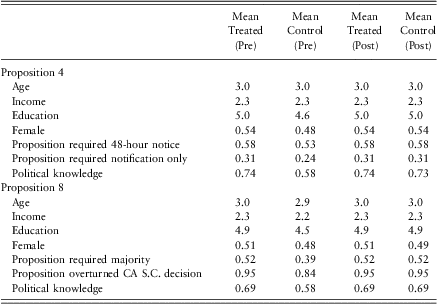
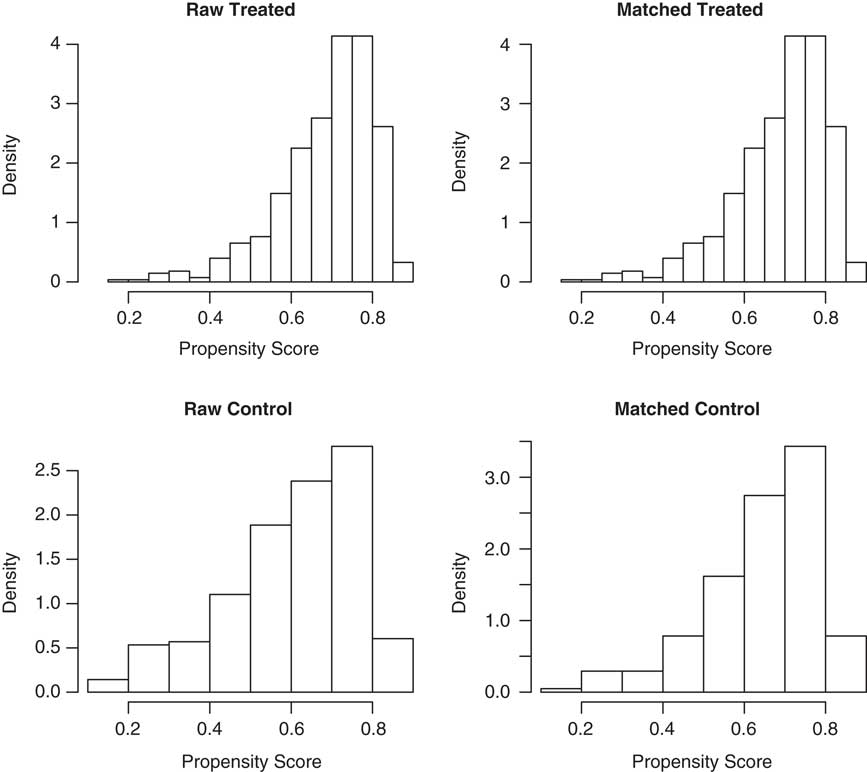
We turn now to examine the covariate balance between our treatment (knew the cue) and control groups (did not know the cue). As Table 1 shows, we had reasonable covariate balance between our treatment and control groups for Proposition 4 before matching. After matching, however, we achieve near-perfect covariate balance between the two groups. For Proposition 4, the genetic matching algorithm matched 393 treated observations to 225 control cases, and 207 control cases went unmatched. Concerning Proposition 8, also shown in Table 1, the difference in covariate distribution between groups was somewhat larger before matching, though the two groups were still similar. Again, after matching, we achieve near-perfect covariate balance between the groups. For this measure, the algorithm matched 551 treatment cases to 214 control cases, and 67 control cases went unmatched.
Covariate balance improvement from genetic matching

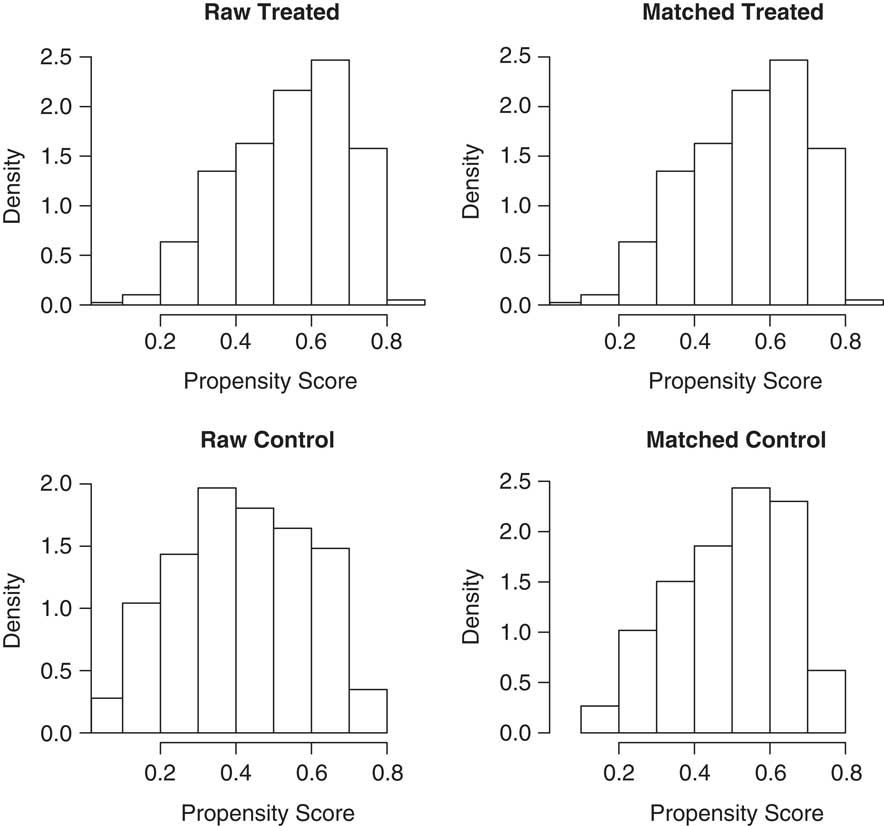
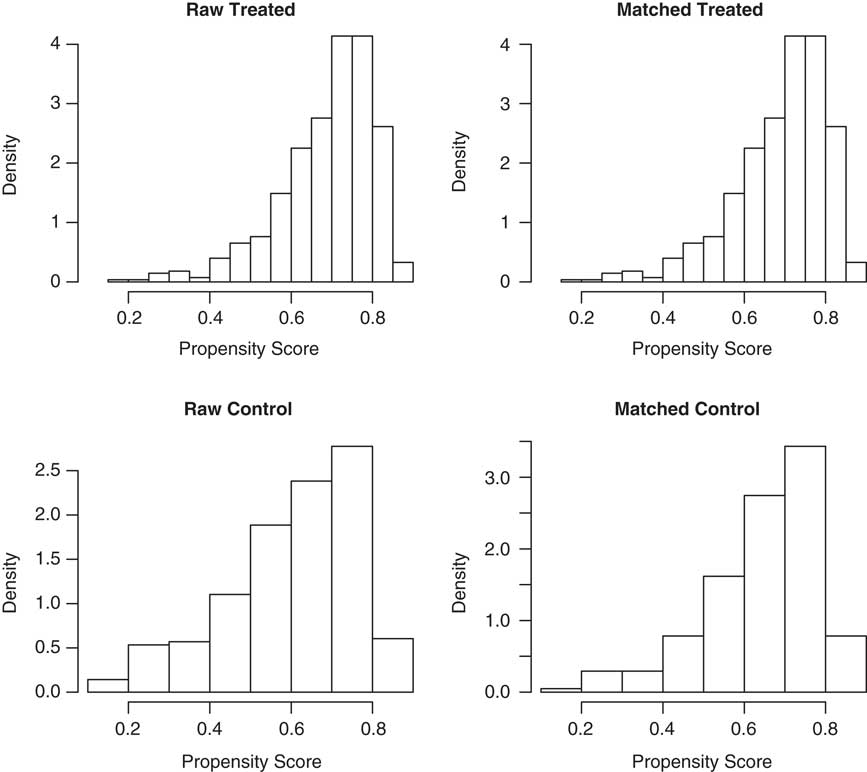
In addition to covariate balance, a quasi-experimental test requires similar distributions in the propensity to receive the treatment across the treatment and control groups; when propensity scores are equivalent, we are ensuring that we are comparing similar groups. Figures 1 and 2 present the distributions of the propensity to receive the treatment for the treatment and control groups both before and after matching for Propositions 4 and 8, respectively. As the figures indicate, the distribution of the control group is remarkably similar to the treatments group for both measures after matching. Figures 1 and 2, coupled with Table 1, assure us that our matching algorithm succeeded and that our treatment and control groups are comparable. In other words, we have established the balance between the two groups to satisfy the conditions necessary for a quasi-experimental test of our hypotheses.
Distribution of propensity scores, Proposition 4.
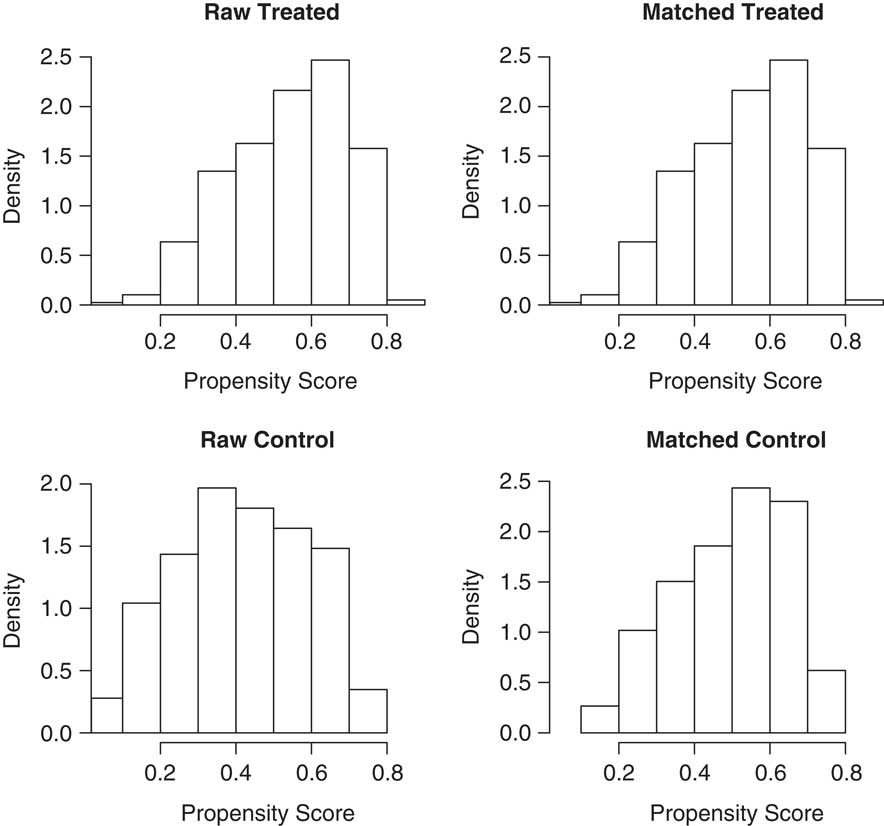
Distribution of propensity scores, Proposition 8.
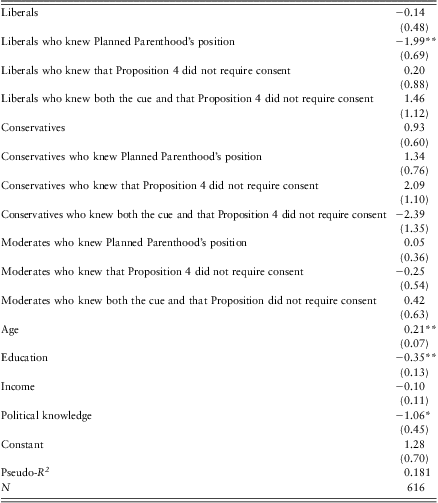
Having established covariate and propensity score balance, we turn now to present the results of our regressions. Table 2 presents the logit regression results for Proposition 4 based on Equation (1), using our matched sample.Footnote 6 The regression produces only one significant finding: liberals who knew that Planned Parenthood opposed the measure were significantly less likely to vote for the measure. Knowledge of the cue, however, did not have a significant effect on either moderates or conservatives. We anticipated that moderates would not be significantly affected by the cue, given that moderates are a heterogeneous group and will therefore have differing opinions on abortion. Whereas liberals and conservatives will be relatively homogeneous with regards to their views on abortion rights, moderates will vary significantly. Thus, it is unsurprising that Planned Parenthood's endorsement would have a significant effect on liberals, but it is surprising that conservatives are not significantly affected by Planned Parenthood's endorsement (though the sign is in the right direction). Other demographic variables that tend to correlate with an ideology are also significant in this regression. In particular, age is positive and significant, and education and general political knowledge are both negative and significant. These findings match the expectations provided by previous survey research that shows education and political knowledge are slightly correlated with identification as a liberal in California politics. This regression result provides limited support for the Lupia and McCubbins hypothesis that source credibility will influence the effectiveness of endorsements: while the interaction of knowledge of the cue with liberal voters is significant, the interaction with conservative voters is not significant. By contrast, the regression results for Proposition 4 provide no support for our second hypothesis.
Proposition 4, 48-hour notification of abortion for minors, matched sample
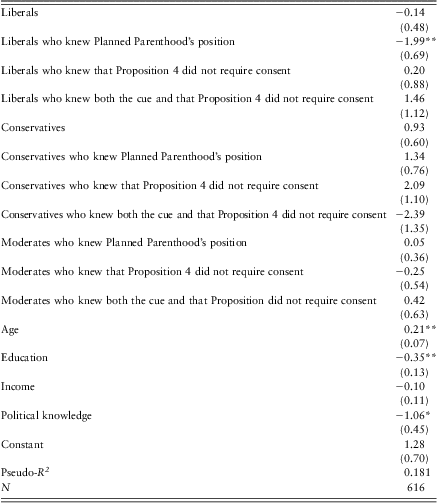
Note: Logit regression of vote choice (0 = vote against proposition, 1 = vote for proposition).
Standard errors are in parentheses. Omitted category is voters who identify themselves as moderates and do not know the cue or the factual knowledge question.
*p < 0.05, **p < 0.01.
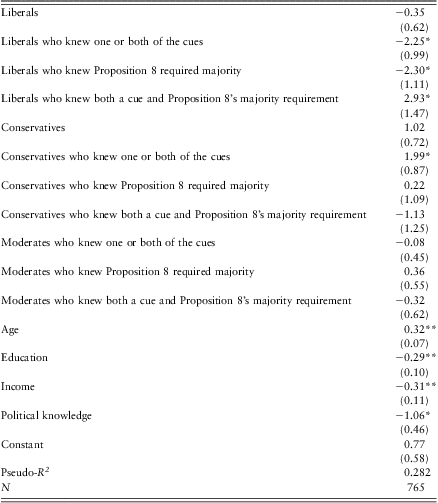
Three findings emerge from the regression results for Proposition 8 in Table 3. First, as above, cues matter, but their effect is not absolute. Liberals are more likely to vote against the measure when they know one of the parties’ endorsements. Likewise, conservatives are more likely to vote for the measure when they know an endorsement. These two findings strongly support the Lupia and McCubbins’ hypothesis that the effect of cues depends on source credibility. For moderates, however, knowledge of the cue has no discernable effect, which supports our main conclusion that cues are useful for only some voters. Second, knowing that Proposition 8 required a simple majority to pass only affected liberals, who were less likely to support the measure, providing limited support for our second hypothesis. Notably, age is significant and positive. This result is expected given the broad generational gap in attitudes towards same-sex marriage observed by numerous surveys over the past decade. Likewise, education, income and general political knowledge are all negative and significant. This matches previous research that notes the relationship between education and knowledge and support for same-sex marriage.
Proposition 8 – initiative to limit marriage, matched sample

Note: Logit regression of vote choice (0 = vote against proposition, 1 = vote for proposition).
Standard errors are in parentheses. Omitted category is voters who identify themselves as moderates and do not know the cue or the factual knowledge question.
*p < 0.05, **p < 0.01.
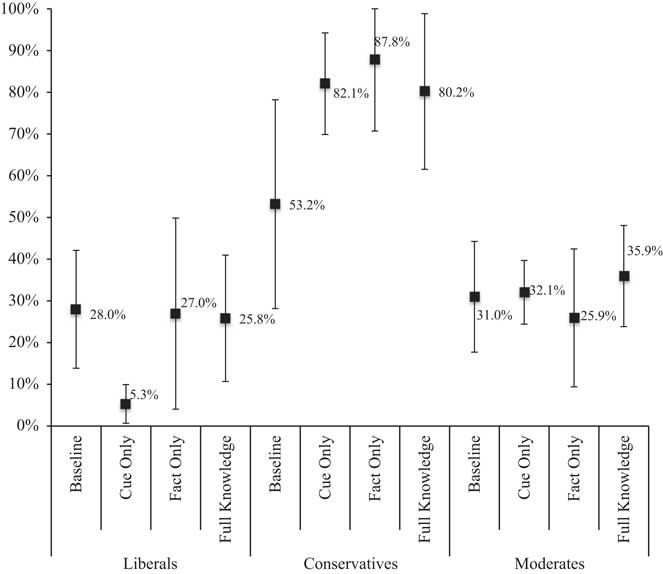
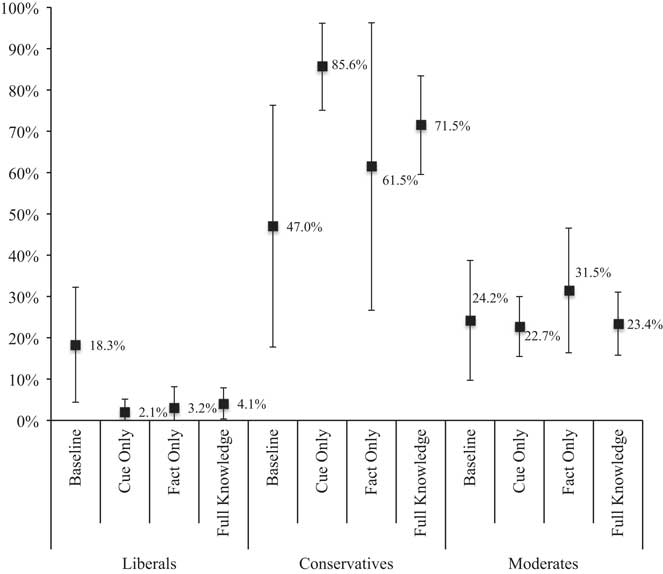
To provide context to our regression results, we calculate the predicted probabilities of voting in favour of Propositions 4 and 8. These predicted probabilities are calculated using Long and Freese's SPost program in Stata (Long and Freese Reference Long and Freese2005). We estimate the voting probabilities by varying the effects of ideology and knowledge; we set the covariates (age, education, income and political knowledge) to their mean value. For liberals, conservatives and moderates, we calculate the baseline voting probability (without any knowledge effects), the effect of knowing a cue by itself, knowing the correct answer to the factual question, and knowing both the cue and having factual knowledge.
Figure 3 presents the predicted voting probabilities for Proposition 4. For liberals, the effect of knowing the cue was quite large: voters who knew that Planned Parenthood opposed the measure had only a 5.3 percentage probability of voting for the initiative, a 22.7 percentage point decrease in probability compared with the baseline liberal voter. For conservatives, voters who knew that Planned Parenthood opposed the measure or that the initiative did not require consent were more likely to vote in favour of the measure – a 28.9 percentage point and 34.6 percentage point increase, respectively. While this difference is not significantly different from the baseline conservative, the substantive difference is quite large. Conservatives who had full knowledge were also substantially (if not significantly) more likely to vote in favour of the measure when compared with the baseline conservative voter (a 27 percentage point increase). By contrast, knowledge of the cue or factual knowledge did not appear to have any substantive or significant effect on moderates.Footnote 7
Predicted probabilities of voting in favour of Proposition 4.
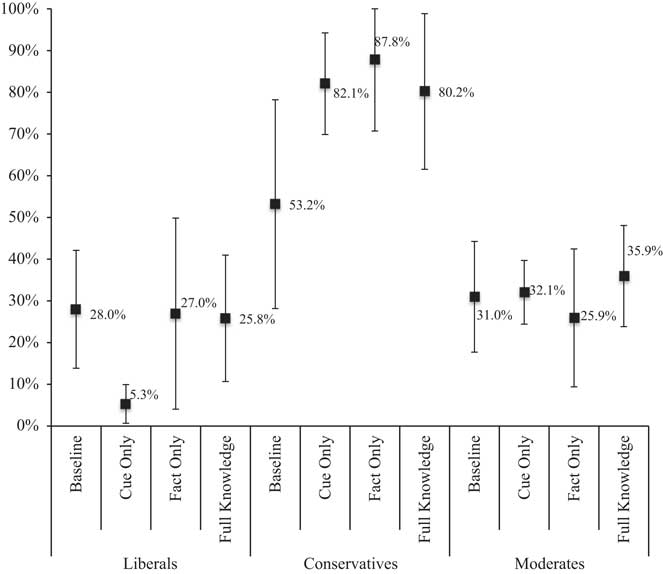
To summarise our results for Proposition 4, we show that cues affected voters, but in a nuanced way. The regression results for Proposition 4 (Table 2) show that only liberals who knew Planned Parenthood's opposition to the initiative seemed to vote differently than the baseline (moderates who lacked both factual knowledge and knowledge of Planned Parenthood's endorsement). When we calculate the predicted probabilities based on our regression results for Proposition 4 (Figure 3), we find that, again, only liberals with knowledge of the endorsement vote differently than both the liberal and moderate baseline voter. Conservative voters are statistically indistinguishable from one another across information levels (though conservatives with knowledge of a fact or cue are distinguishable from moderates). For moderates, however, information seems to have no noticeable effect on their voting behaviour. Overall, we find limited support for our first hypothesis and no support for our second hypothesis.
We provide the predicted voting probabilities for Proposition 8 in Figure 4.Footnote 8 For liberals, knowing either of the cues or that the initiative required a simple majority to pass had a limited but substantively interesting effect on votes when compared to the baseline liberal voter. Indeed, knowledge of one of the political parties’ endorsements led to a 16.2 percentage point decline in support for the measure among liberal voters. Likewise, knowing that Proposition 8 required a simple majority to pass precipitated a 15.2 percentage point decrease in support among liberals. These differences, however, are not statistically significant from the liberal baseline (though these differences are significant when compared with moderate voters, as the regression results indicate). The effect of knowing the Democratic Party's or Republican Party's endorsement for conservative voters was substantively larger than liberals. Support for Proposition 8 increased by 38.6 percentage points among conservatives who knew one of these endorsements when compared with the baseline conservative voter. Knowing that Proposition 8 required only a simple majority to pass led to a 14.5 percentage point increase in support for the measure among conservatives, but this difference was not significant. Similar to Proposition 4, the effect of knowledge on moderates did not produce any substantively interesting results. In fact, voting patterns are remarkably similar among moderates for all levels of knowledge.
Predicted probabilities of voting in favour of Proposition 8.
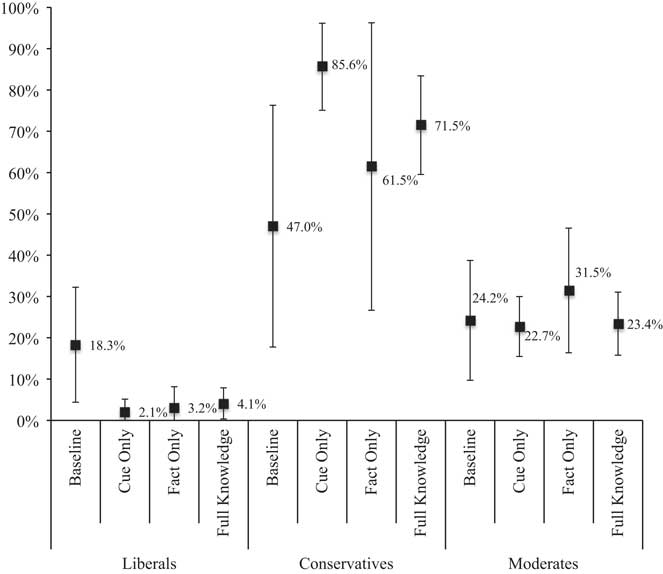
To summarise our results for Proposition 8, we again find that the effect of cues on voters’ decisions is not absolute. Our regression results (Table 3) indicate that knowledge of a cue affected the voting behaviour of both liberals and conservatives compared with the baseline (moderates who lacked knowledge). When we calculated the predicted probabilities (Figure 4), however, it became clear that knowledgeable liberals and conservatives did not vote differently when compared with their respective ideological baseline group. As was the case with Proposition 4, knowledge did not have any discernable effect on moderate voters’ evaluation of Proposition 8. Overall, we find strong support for our first hypothesis and limited support for our second hypothesis. We turn now to consider the implications of our findings.
Discussion
Our results show that some voters do use their knowledge of facts and cues to make decisions on important constitution-changing measures such as abortion law and same-sex marriage, but usage is far from universal. For Proposition 4, we found that Planned Parenthood's endorsement influenced liberals’ decisions far more than conservatives; knowledge of the endorsement had no discernable effect on moderates. For Proposition 8, we showed that knowledge of one or both of the parties’ cues influenced both conservatives and liberals. Again, we did not find any significant effects for moderates (upon whose ballots policy usually swings). The relative effectiveness of factual knowledge in altering voting probabilities also varied by group. For Proposition 4, knowing that the initiative did not require parental consent (only notification) had no noticeable effect on any ideological voting group. Substantively speaking, knowledge of this fact had the strongest effect on conservatives. By contrast, knowing that Proposition 8 required just a simple majority to pass and modify the state's constitution had a significant effect on liberal voters. Taken together, our findings reveal that information – including knowledge of both endorsements and facts – has a very nuanced effect on voters’ decisions in direct democracy. Indeed, our results indicate that these effects may vary by voter and ballot measure. With respect to the value of information shortcuts, we show that they can be quite powerful, but their effects are far from widespread. In fact, our findings serve to confirm, by and large, the Lupia and McCubbins’ (Reference Lupia and McCubbins1998) hypothesis (our first hypothesis) that use of information is conditional on finding the source credible. As they predict, we find that when voters use cues, it is only when we interact their self-reported ideology with knowledge of the cue. While this result is encouraging, our results clearly indicate that cues are effective only some of the time for only some people, and scholars should not assume that information shortcuts are a panacea for the informational deficiencies of voters.
When compared with the uninformed moderate voter baseline, our findings show that voters who self-identify with the liberal or conservative ideology are likely to use cues on same-sex marriage (a very easy issue where the ballot language was short and straightforward) and liberals used a cue on a measure concerning abortion (a somewhat easy issue where the ballot language was more complicated, as our factual knowledge question reveals). Indeed, because these issues are prototypical “easy issues” (Carmines and Stimson Reference Carmines and Stimson1980), we expect that self-identified ideological voters will be able to arrive at a value-consistent decision for these ballot measures without much effort. That is, information such as endorsements or facts is likely to have a limited effect on ideological voters’ decisions when compared with like-minded ideological voters. We cannot, however, account for whether and if information affected moderates’ decisions on either measure. Importantly, future research should forge a path forward to understand how all voters interact with their informational environment. While moderates are a heterogeneous group, and it is difficult to predict how they would use cues or factual information, these are the voters deciding the outcome of most elections and thus are making important and far-reaching policy decisions through ballot propositions.
We return now to the question at the heart of our research: are voters able to make competent decisions concerning important policy choices that often change their state's constitution? A substantial percentage of voters seem to learn facts about the proposed policies and the endorsements from trustworthy elites; indeed, many seem to use what they know to inform their decisions as well. In particular, voters who self-identify with one ideology or another appear to use elite endorsements somewhat often, even though the issues we examined here are “easy”. For these voters, we can be relatively confident in their ability to make an informed choice when the issue is ideological. Most ballot measures – for example, those that deal with issuing bonds or altering gasoline tax policy – are not inherently ideological, however. We suspect that interest groups and elites will have an easier time establishing trust when a ballot measure is ideological (and therefore the issue is easier for voters to understand). By contrast, we expect that interest groups and elites will have a difficult time influencing voters when the issue is non-ideological – a result shown in our analysis of Proposition 7 (Burnett et al. Reference Burnett, Garrett and McCubbins2010), a non-ideological issue on the same ballot. Our research combined with our previous study suggests that usage of cues is conditional (and circumstantial) even for ideological voters.
Understanding how moderates make decisions remains an important and significant challenge. Indeed, the moderate's voting calculus with regards to ballot measures, in particular, is a mystery: we cannot predict the direction of their vote on most ballot measures, because moderates vary in their support for most issues. In other words, we know very little about how this heterogeneous group of voters is, in essence, deciding the outcomes of important constitutional questions. While we may not expect moderates to use elite endorsements at a high rate (typically, they are the least informed about politics), we cannot test this proposition without new data and a revised voting model.
One of the underlying questions of our research is, do voters incorporate information into their decisions on ballot measures? Scholars should be especially interested in this question, because the choices voters make through the initiative and referendum process have the power to alter the political and policy landscape fundamentally, ranging from raising taxes to defining civil liberties. An alarming fact that our data revealed is that a significant number of voters did not know much about the constitutional amendments that lay before them. Almost 50 per cent of the voters we surveyed were unaware of the relevant endorsements for Proposition 8 even when the supporting and opposing campaigns spent over $108 million in an effort to educate the electorate (albeit selectively). For these voters, it is unclear how they are assessing ballot measures. It may be the case that these voters are using their standing assessments of groups (e.g. how they feel about homosexuals) to make decisions (e.g. Brady and Sniderman Reference Brady and Sniderman1985; Sniderman et al. Reference Sniderman, Brody and Tetlock1991; Nicholson Reference Nicholson2011), but our data do not provide leverage on this question.
Our results clearly show that scholars cannot simply assume widespread knowledge of cues and that all voters routinely use cues to overcome their informational deficiencies when evaluating ballot measures without qualifications (e.g. establishing source credibility). Conversely, we also find that many voters do indeed incorporate cues into their decisions. These voters are precisely who Lupia and McCubbins (Reference Lupia and McCubbins1998) predict will use cues: individuals who can establish a common interest with the cue-giver, thereby making the source credible. As our results show, ideological voters appear to cast ballots that match their ideological predispositions at a high rate, a rate that often increases with information such as cues. For non-ideological voters, the results are unclear.
While some readers may interpret our analysis as suggesting that cues and knowledge of facts are not useful for voters in direct democracy, our opinion is that the opposite is true. We concur with the previous research that shows that information shortcuts are extremely valuable and useful for voters, especially in direct democracy (e.g. Lupia Reference Lupia1994; Karp Reference Karp1998; Lupia and McCubbins Reference Lupia and McCubbins1998). For us, the question becomes, how can policymakers increase voters’ use of these valuable and trustworthy cues when evaluating initiatives and referenda? The answer, we argue, is a simple policy change: make direct democracy elections more similar to candidate elections by institutionalising cues and including information about a proposition's prominent endorsers and opponents on the ballot itself. We argue that adopting this policy would be analogous to having party identification and incumbency labels that appear on the ballot for many elected offices. By providing a candidate's party label and incumbency status, voters can make inferences about a candidate based on their own evaluations of that candidate's political party and past job performance (see, e.g., Fiorina Reference Fiorina1981; MacKuen et al. Reference MacKuen, Erikson and Stimson1989). Voters can perform these evaluations, because they have the information shortcuts available to them on the ballot when they make their choice. Including elite endorsements on the ballot itself would also help establish trust between the cue-giver and the voter because, similar to a candidate's reported party identification, the information shortcuts on the ballot will have the credibility of an official announcement from the state.
Political parties are the obvious choice for potential endorsers to include on the ballot. If both parties take a position on a ballot measure – as was the case with Proposition 8 – those positions should be printed on the ballot. If the parties take no position on a proposition, that information should be made available as well. Endorsements, however, need not be limited to the two major parties: a number of trustworthy and knowledgeable cue-givers are available (e.g. prominent interest groups, well-known political figures). Including relevant endorsers and opponents on the ballot for initiatives and referenda would allow voters to use their evaluations of those cue-providers to make more informed choices at the point of decision.
Why include cues on the ballot itself? Ballot titles and summaries may not be providing voters with enough information. In California, for instance, ballot titles and summaries provided on the ballot are somewhat meagre, as they cannot exceed 100 words. The goal of the title and summary, according to California law, is to describe the core of the initiative or referendum (for a summary of the California case, see Burnett et al. Reference Burnett, Garrett and McCubbins2010). The Legislative Analyst also includes a short fiscal impact statement, which often indicates a large degree of uncertainty. While the fiscal impact statements may be somewhat useful, the summaries, we suspect, may not provide enough information to voters. If, for example, voters had not read or heard anything about the measure before casting their ballot as Matsusaka (Reference Matsusaka2005) believes, they must rely on a short summary to inform them about an often complex and lengthy policy proposal. Placing elite endorsements on the ballot would supply voters with vital and potentially decision-improving information that is readily available. In sum, including cues on the ballot for every proposition would increase awareness of the relevant endorsers and opponents for individuals who were not aware of them before Election Day, and it would remind knowledgeable voters who were already aware of the cues to consider these information shortcuts when they mark their choice. Together, this should increase the likelihood that voters would use information shortcuts to make informed decisions.
Acknowledgements
We wish to thank the nearly 140 volunteers who helped collect the data for this paper. We also thank Anthony Bertelli, Daniel Enemark, Elizabeth Garrett, Vladimir Kogan, Colin McCubbins, Ellen Seljan and three anonymous reviewers for valuable comments.
Appendix: Ballot Text of Propositions
Proposition 4
Waiting Period and Parental Notification before Termination of Minor's Pregnancy Initiative Constitutional Amendment.
Changes California Constitution, prohibiting abortion for unemancipated minor until 48 hours after physician notifies minor's parent, legal guardian, or, in limited cases, substitute adult relative. Provides an exception for medical emergency or parental waiver.
Proposition 8
Eliminates Right of Same-Sex Couples to Marry.
Initiative Constitutional Amendment.
Changes California Constitution to eliminate the right of same-sex couples to marry. Provides that only marriage between a man and a woman is valid or recognised in California.