In experimental psychology, letter-detection tasks have been used to study attention and awareness for many years. Recently, the missing-letter effect (MLE; Corcoran, Reference Corcoran1966; Healy, Reference Healy1976) has been gaining considerable attention in research on the reading process. Participants are typically asked to read a given text at normal speed while crossing off a specific letter (target letter) whenever encountered. They are also instructed to not turn back to cross off letters that they think they might have forgotten.
Research shows that readers fail to detect a certain number of target letters, and that the distribution of these omissions is not random, but rather appears to be governed by certain rules. Along these lines, Healy's work has consistently revealed statistically significant elevated rates of letter omission in English high-frequency words such as and, the, or for. To explain these results, the researcher and her colleagues developed the unitization model, a framework in which the reader simultaneously processes text on several levels. These processes are based on visual feature, letter, syllable, and word stimuli (Healy, Reference Healy1976, Reference Healy1994; Healy & Drewnowski, Reference Healy and Drewnowski1983). Once the reader identifies a unit through one of these analyses, the other analyses are stopped even if they have not been carried out to completion. In the most general terms, the unitization model is a multicued process, with word frequency as one cue; the omission of letters is interpreted by Healy as the result of rapid, global recognition of a word because of its frequency (Drewnowski & Healy, Reference Drewnowski and Healy1982).
Research conducted by Greenberg and Koriat has resulted in the creation of an entirely different explanatory framework for the MLE (Greenberg, Koriat, & Shapiro, Reference Greenberg, Koriat and Shapiro1992; Koriat & Greenberg, Reference Koriat and Greenberg1991, Reference Koriat and Greenberg1993, Reference Koriat and Greenberg1994, Reference Koriat and Greenberg1996; Koriat, Greenberg, & Goldshmid, Reference Koriat, Greenberg and Goldshmid1991). Recognizing that the most frequent words are often grammatical or function words, the authors claimed that it is actually their structuring nature that induces the MLE. Their position resulted in the creation of what is known as the structural account of the reading process, which is based on the assumption that differences in letter omissions are because of the syntactic role that certain words play in the organizational structure of sentences rather than their frequency. According to this model, the reader processes prominent function words, such as prepositions, articles, and conjunctions in order to establish a temporary skeletal frame for a given phrase or sentence onto which meaning derived from content words are subsequently integrated. These functional words then recede into the background as the integration of meaning unfolds within the preestablished structure.
However, these two models are not mutually exclusive. In 2004, an article was published in which Greenberg, Healy, Koriat, and Kreiner incorporated certain aspects of their respective models into a larger model capable of integrating all the seemingly divergent observations made in previous studies. This model, the guidance–organization (GO) model, is based on the assumption that highly frequent function words are identified through both parafoveal vision and the processes originally laid out by Healy in her unitization model. These words are then used as pivots around which a reader organizes the syntax of a given sentence. This syntactic organization then guides the reader's attention to the content words, thus allowing for the analysis of the semantic information of the sentence and its integration into the structural frame established by the reader (Greenberg et al., Reference Greenberg, Healy, Koriat and Kreiner2004).
Integrating relevant elements such as bottom-up processes derived from the unitization account (the unitization assumption and the parafoveal processing assumption) and top-down processes derived from the structural account (the structural precedence assumption and the guidance assumption), the GO model allows for a more detailed analysis of the reading process. The last assumption, the guidance assumption, lies at the crux between bottom-up and top-down processes and explains how the MLE is attributed to the predictability of the word in a text, this predictability being a function of the contextual constraints that allow for anticipation of sentential slots where the syntactic organizing units are likely to be positioned.
One of the strengths of the GO model is its capacity to be experimentally tested. In an effort to find results congruent with the GO model, Roy-Charland and Saint-Aubin (Reference Roy-Charland and Saint-Aubin2006) investigated the interaction (in both French and English) between word class and frequency in the MLE. Using a new experimental procedure, Foucambert (Reference Foucambert2008) confirmed the importance of parafoveal information in the construction of syntactic structures, shedding new light on the contextual constraint assumption. Finally, Greenberg et al. (Reference Greenberg, Healy, Koriat and Kreiner2004) found several similarities between eye-movement experiments and GO model predictions, thus calling for more research along the same lines. Recently, Roy-Charland, Saint-Aubin, Klein, and Lawrence (Reference Roy-Charland, Saint-Aubin, Klein and Lawrence2007) published a particularly important article in which they carried out a systematic study of GO model predictions on eye movement. Although their results were congruent with certain GO model predictions, it is important to note that predictions bearing on response times were not. Contrary to GO model predictions, the authors observe shorter fixation durations on lexical words than on functional words. From these observations, Roy-Charland et al. (Reference Roy-Charland, Saint-Aubin, Klein and Lawrence2007) elaborated a new explanatory model for the missing letter effect: the attentional–disengagement (AD) model. Inspired by information processing models, the AD model posits that “the missing-letter effect reflects the allocation of attention during reading” (Saint-Aubin & Klein, Reference Saint-Aubin and Klein2008, p. 133). Letter omissions occur when readers disengage their attention from a word, which happens more often with frequent words than rare words, thus more often with function words than lexical words.
Nonetheless, the development of these word- and morpheme-processing skills on the basis of the syntactic role of words or their frequency of appearance in the written language remains largely incomplete (Koriat & Greenberg, Reference Koriat and Greenberg1991). Some studies have attempted to link the MLE with the reader's age; most notably, Greenberg, Koriat, and Vellutino (Reference Greenberg, Koriat and Vellutino1998) showed that the more readers advance in age the more letter omission responds to certain categories of words (function vs. content). For these authors, this trend reflects a growing awareness of the sentence structure and the role that certain categories of words play within that structure. However, although their study compares students from a relatively wide age range (7 to 13 years old), it does not answer the question of when this sensitivity to the role and nature of words in sentence construction develops. Saint-Aubin and Klein (Reference Saint-Aubin and Klein2008) wrote a critical review of the work examining the MLE among young readers. In general terms, the MLE becomes progressively more prominent with age (Cunningham, Healy, Kanengiser, Chizzick, & Willitts, Reference Cunningham, Healy, Kanengiser, Chizzick and Willitts1988; Drewnowski, Reference Drewnowski1978, Reference Drewnowski1981; Saint-Aubin, Klein, & Landry, Reference Saint-Aubin, Klein and Landry2005). However, the results in the literature reviewed by Saint-Aubin and Klein (Reference Saint-Aubin and Klein2008) are difficult to interpret because of some uncertainties generated by the experimental designs of the reported studies, for example, the uncontrolled position of the letter in the word the versus mother in Drewnowski (Reference Drewnowski1978) or the repetition of a task using the same textual material (Drewnowski, Reference Drewnowski1978, Reference Drewnowski1981), a condition that is known to either reduce the MLE (Healy, Oliver, & McNamara, Reference Healy, Oliver and McNamara1987) or make it disappear altogether (Saint-Aubin, Roy-Charland, & Klein, Reference Saint-Aubin, Roy-Charland and Klein2007).
Two recent studies have revisited this question around the relationship of the factors that accompany the emergence of the MLE: the age and skill level of young readers. First, the results reported by Saint-Aubin et al. (Reference Saint-Aubin, Klein and Landry2005) shed light on questions concerning the relationship between selective letter omission and learners' introduction to explicit reading instruction. In their experiments, they observed an evolution of the MLE in the frequency and class of the word in which the letters appear among children from first to seventh grades. Their main conclusion suggests that if a missing-letter differential is observed starting at the end of kindergarten, it cannot be attributed to the syntactic or lexical role of the word before the end of fourth grade. Second, Saint-Aubin and Klein (Reference Saint-Aubin and Klein2008, p. 135) published an article with the objective of being “the first comprehensive examination of the relationship between the missing-letter effect and degree of acquisition of reading skills.” Evaluating the young readers using the Wide Range Achievement Text—Third Edition test, they demonstrated that from first to fourth grade the MLE is positively correlated to the students' reading skill level. However, for the older students (Grade 5), the difference between good and poor readers only solidifies, in terms of the MLE, with the function word the. In light of these results, the authors conclude that the distinction between good and poor readers lies in the capacity of the former to organize the structure of a sentence being read, such a conclusion concurring with the structural side of both the GO (Greenberg et al., Reference Greenberg, Healy, Koriat and Kreiner2004) and the AD (Roy-Charland et al., Reference Roy-Charland, Saint-Aubin, Klein and Lawrence2007) models. However, this skill only emerges in the fifth grade. Moreover, this result is congruent with the preliminary results from Saint-Aubin et al. (Reference Saint-Aubin, Klein and Landry2005), which demonstrate that the role of word class does not emerge before the fourth grade in the explanation of the MLE.
The present study aims to build on previous work done by Saint-Aubin et al. (Reference Saint-Aubin, Klein and Landry2005), adding two distinguishing elements. First, we wanted to run an initial evaluation before the onset of explicit reading instruction, then we wanted to verify the same hypotheses using authentic reading material (a children's book). Concerning the first point, Saint-Aubin et al. (Reference Saint-Aubin, Klein and Landry2005) administered their tests at the end of the academic year, 9 months after the beginning of explicit reading instruction, which eliminates the possibility of comparing postresults with the results of the students' performance prior to explicit reading instruction. Before even entering the first grade, children have already been more or less involved in the discovery of writing, mainly through the readings done by their teachers in the lower grades and by the practice of reading at home within the children's families. Two studies (Baker, Fernandez-Fein, Scher, & Williams, Reference Baker, Fernandez-Fein, Scher, Williams, Metsala and Ehri1998; Bus, van IJzendoorn, & Pellegrini, Reference Bus, IJzendoorn and Pellegrini1995) have revealed an important link between numerous aspects of children's knowledge of written language and culture, including a better understanding of the alphabet, and the role of writing and vocabulary. Under these conditions, the influence of word frequency on the MLE could be observed even before the start of explicit reading instruction. Second, when using an authentic text to measure the MLE, it seemed important to replicate these measures in the most authentic of conditions, especially with young children. However, compared to the more classic studies on the MLE, the experimental material runs the risk of losing internal validity as a result of a lack of control of certain elements that would normally be considered in other studies. This is why, in the present study, the characteristics related to word size, and especially letter position within words, were integrated into statistical models as control variables to the extent that many studies have established a link between letter detection and the visual configuration of the words which contain them (Nazir, Jacobs, & O'Regan, Reference Nazir, Jacobs and O'Regan1998; White, Rayner, & Liversedge, Reference White, Rayner and Liversedge2005). Moreover, considering the linguistic material, and the extent to which students are in the process of consolidating their control over grapheme–phoneme correspondences, it would be interesting to introduce this dimension into the analysis of analyzed material (Gross, Treiman, & Inman, Reference Gross, Treiman and Inman2000).
The objective of the present study is to analyze the results of a letter-detection task among younger students (ages 5 to 8) in an attempt to answer the following question: when does sensitivity to content/function word distinction emerge? It would be reasonable to claim that a lack of knowledge of written language could produce a randomizing effect on the MLE for the youngest of kindergarten students. In other words, the MLE would play a less important role on letter recognition, rendering the pattern of omitted letters more random. In contrast, the relative familiarity that older students (first and second grades) have with words and sentences should progressively produce a more regular pattern in the MLE in terms of the influence exerted by the syntactic and semantic role of the observed words.
METHOD
Participants
A total of 886 students from 45 different classes participated in this series of experiments. The participant sample consisted of 116 kindergarten students (mean age = 6.1 years, σ = 33 weeks), 420 first-grade students (mean age = 7 years, σ = 24 weeks), and 350 second-grade students (mean age = 8.1 years, σ = 25 weeks).Footnote 1 This distribution is normal and is typical of the population distribution in French schools.
Materials
A two-page booklet was distributed to the students. A very short text was given on the first page, allowing them to become familiar with the task, but using a different target letter. The second page contained a 116-word text, Les baisers du Loup (Solotareff, Reference Solotareff2001), which served as the base for the experiment. The texts (see Appendices A and B) were printed in 24-point Garamond type with single-line spacing. The target letter u appeared 36 times in the text (without counting the first and last sentences of the text). However, to be more closely aligned with the normal conditions of the task, 7 occurrences were deleted because the letter u was capitalized (Une, Un) or because it appeared at the beginning or the end of the line (leur and plume) or sentence (poulailler, cour, loup). In the end, 29 occurrences were observed.
Procedure
The experiment was conducted in class at the end of the school year in June. The teachers did not read or present any part of the two texts. The following is a copy of the instructions provided to the students: “With a pen, and while browsing the text, while reading it, to the best of your ability, and at your own speed, without going back, you are going to cross off the letter u (the letter is written on the board) whenever you encounter it.”Footnote 2 These instructions were repeated before starting the test on the second text.
Measurements
For every word in which the target letter is found, we established several variables characterizing it.
• Word size: This variable was introduced into the model to control for the well-documented effects of word length extraction from parafoveal information (Kennedy, Reference Kennedy2000; White et al., Reference White, Rayner and Liversedge2005) and the relatively frequent skipping of short words by the reader (Rayner, Reference Rayner1998). Previous studies on eye movement have shown that function words (articles, conjunction, prepositions) are omitted from eye fixations during reading (Carpenter, Just, & Rayner, Reference Carpenter, Just, Rayner and Raynor1983), as well as that three-letter words are skipped more often when they are functional (the) than when they are verbs (O'Regan, Reference O'Regan1979). Consequently, frequent words, as is the case with small words, would often be identified in the parafoveal vision (by the peripheral zone of the retina) during fixation on a preceding word, whereas the less common words would be processed by the foveal zone of the eye (Rayner, Pollatsek, & Coltheart, Reference Rayner, Pollatsek, Coltheart and Coltheart1987).
• The position of the letter in the word: To represent this value, we calculated the ratio between the position of the letter and the size of the word. The closer this value is to 1, the closer the letter is to the end of the word. Prior studies have shown that the eye frequently positions itself toward the end of the first third of the word (O'Regan & Jacobs, Reference O'Regan and Jacobs1992; Vitu, Reference Vitu1991; Vitu, O'Regan, Inhoff, & Topolski, Reference Vitu, O'Regan, Inhoff and Topolski1995).
• The frequency of the word in which the letter appears: This frequency is derived from the database FRANTEXT,Footnote 3 which provides information on contemporary French words from 1950 to 2000 (New, Pallier, Ferrand, & Matos, Reference New, Pallier, Ferrand and Matos2001). In order to normalize the distribution of this variable (that ranged from 0.3 to 11,469 per million) in the following analyses, we use the normal logarithm of the different values.
Whether the letter u studied represents the phoneme [y] in the word (pur vs. jour).
• The type of word in which the letter is present (function vs. content): This variable was based on word categories. Nouns, personal pronouns, verbs, adjectives, and adverbs are considered content words in that they carry information about a character or an action in the text. Their printed frequencies ranged from 57.8 to 11,468.6 per million (M = 5,329.3, SD = 4,274.6). Function words, on the other hand, organize the structure of content words and carry little or no semantic information. Conjunctions, articles, relative pronouns, and prepositions are examples of function words. Their printed frequencies ranged from 0.3 to 4,519.8 per million (M = 867.8, SD = 1,448.9).
RESULTS
The results were analyzed from two angles. We intended to determine whether the analyzed data would reveal a difference according to the length of formal exposure to written text in school (operationalized by grade level) and whether they would indicate, within the same grade level, which of the five variables best explains the MLE.
Analysis 1
For an initial examination by item, a 2×2×3 mixed-design analysis of covariance was conducted with phonemic representation and word class as between-item factors; grade level as a within-item factor; and frequency, letter position, and word length as covariants. We also introduced into the model the interaction between grade level and all of the other variables of the model.
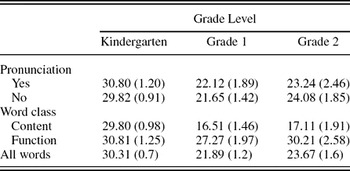
The results presented in Table 1 demonstrate a significantly higher letter-omission rate among kindergarten students (30%), in comparison with the two other levels (21% and 23%), F (2, 46) = 3.61, p < .04, η2 = 0.14. The post hoc tests specify that only the difference between kindergarten and the two other grades is significant (unequal N honestly significant difference [HSD]: p < .0002 for the other two grades).
Means (standard errors) for percentages of omissions according to grade level, pronunciation, and word class

This analysis of covariance yielded no effect for word length, F (1, 23) = 2.79, p < .11, for the phonetic presence of the sound [y], F (2, 23) = 0.01, ns, or for letter position, F (1, 23) = 0.21, ns. However, we observed a significant word class effect for the entire population, F (1, 23) = 19.73, p < .001, η2 = 0.46, with an average omission rate of 29.4% for function words in comparison to 21.1% for content words and a significant word frequency effect, F (1, 23) = 11.26, p < .003, η2 = 0.33, with an increase of omissions for more frequent words.
We calculated several essential interactions that shed light on the activation of these different elements throughout the students' progression from kindergarten to second grade. We initially noticed that interaction between the phonetic presence of [y] and grade level does not have an effect on the MLE, F (2, 46) = 0.19, ns. There was also a lack of effect with the interaction between grade level and word frequency, F (2, 46) = 2.04, p < .15, which illustrated the constant influence of frequency in the MLE. In addition, neither interaction between grade level and word length, F (2, 46) = 0.8, ns, nor interaction between grade level and letter position, F (2, 46) = 0.35, ns, were significant. The role of word class, however, evolves significantly throughout the cycle from kindergarten to second grade, F (2, 46) = 7.91, p < .002, η2 = 0.25. The post hoc comparisons (Tukey HSD for unequal N) show that at the end of kindergarten the omission patterns in content words are similar to that in function word (p < .99) and that the omission patterns begin to differentiate significantly depending on word class starting from the students' initial exposure to writing (all ps < .02).
Analysis 2
To enhance our investigation, a 3×2 mixed-design analysis of variance was conducted with grade level as the between-subjects factor and the percentage of letter omissions in content and function words as the repeated factor. Corroborating the item analysis, the results show a word class effect, F (1, 883) = 240.76, p < .0001, η2 = 0.21, and a grade level effect, F (2, 883) = 28.97, p < .0001, η2 = 0.06. Finally, the interaction between grade level and word class is significant as well, F (2, 883) = 56.62, p < .0001, η2 = 0.11.
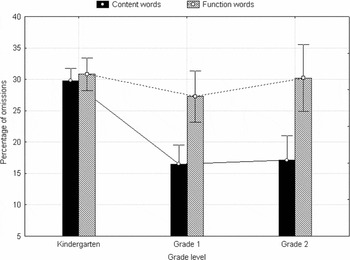
Figure 1 illustrates the change in the role of word class throughout the 3 years of schooling. Note that the post hoc tests (Tukey HSD for unequal N) reveal that variation according to word class is insignificant in preschool. Significance emerges in the first grade (p < .04), only to become stronger by the end of the second grade (p < .02).
Mean percentages of omissions according to word class and grade level. The error bar represents the 95% confidence intervals.

Analysis 3
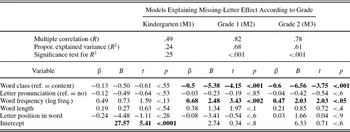
These analyses allow us to have a clearer understanding of what is constructed throughout the progression from kindergarten to second grade. However, they do not allow us to evaluate the respective weight of the various factors introduced into the explanatory model. In order to find a response to this question, we conducted three (M1, M2, M3) multiple regression analyses (complete models), each one using percentages of letter omission in the three grade levels as a dependent variable. The independent variables remain the same as in the preceding analysis, with the exception of grade level. If Model M1 shows that the MLE is not significant in kindergarten (see Table 2), the portion of the variance explained by the independent variable (note that >60% of this phenomenon is explained by Models M2 and M3) and the multiple correlation coefficient (R M2 = .82 and R M3 = .78) justifies an in-depth investigation of the contribution of these variables to the MLE.
Explanatory models for percentages of omissions according to grade level

Note: All of the effects described in the table are “pure”; that is, all of the other variables are controlled. For example, in the coefficient column of the Grade 1 model (M2), we see that because the target letter is present in a content word (qualitative variable) it “contributes” to the decrease in the percentage of omissions from 5.38 points and that (quantitative variable) each additional letter in the word that contains the target letter increases the proportion of omissions from 1.34%. The values in bold indicate statistically significant coefficients of regression (p < .05).
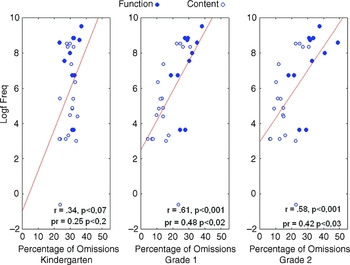
Table 2 presents the regression coefficients, standardized coefficients, t tests, and level of significance of these coefficients for the variables or modalities introduced into the explanatory models. It confirms the previous analyses. Both significant models present two highly correlated variables, if all other things are equal, in the MLE in words. The role of the first variable, the type of word in which the letter appears, is nonexistent in kindergarten (βM1 = −0.13, p < .6) but emerges robustly in the first grade (βM2 = −0.5, p < .001) and becomes an even stronger force in the second grade (βM3 = −0.6, p < .001). Word frequency follows a similar evolution because its significant contribution to the MLE emerges in first grade (βM2 = 0.68, p < .002) and continues into second grade (βM3 = 0.47, p < .05). This evolution can also be observed within the three sample groups in Figure 2, which presents the correlations and the partial correlations between log frequency and the percentage of omissions contingent on word type.
Mean percentages of omissions as a function of the log frequency. The partial correlations controlled for the influence of word class. [A color version of this figure can be viewed online at journals.cambridge.org/aps]

In terms of the respective weight of the two variables, we observe a crossing of their influence between the end of first grade and the end of second grade: although frequency is the most influential variable at the end of first grade (βM2-word class = −0.5 vs. βM2-freq. = 0.68; z = −5.13, p < .001),Footnote 4 word class is the most dominant variable by second grade with the greatest causal power in explaining letter omissions (βM3-word class = −0.6 vs. βM3-freq. = 0.47; z = −4.02; p < .001).
DISCUSSION
In an attempt to refine the reports from Saint-Aubin et al. (Reference Saint-Aubin, Klein and Landry2005), the present study was designed to investigate elements necessary to help us determine the moment when students begin to omit letters in letter-detection tasks in a nonrandom manner. Our experimental plan differed from those of the majority of studies on the observation of the MLE in that we chose to use an authentic text from French children's literature. This approach required us to statistically control à posteriori certain factors that influence letter omission. If this decision resulted in the loss of a certain level of rigor in comparison with specifically constructed experimental material, it brought about a more authentic situation and quite likely more interesting texts, especially with younger participants, from which it is important to observe whether the obtained results follow the same patterns as more classic studies. Among the results of this study, we find a certain quantity of classic data from the letter-detection tasks corroborating the principal models used to explain this phenomenon.
In kindergarten, we observed that letter omission is equivalent in frequent function words and in more rare lexical words and that this omission is 30% higher than in the two other grades. In contrast, starting at the end of first grade and increasingly important throughout second grade we observe a considerable presence of the MLE significantly associated to frequency and word class. These results agree with the hypotheses developed by the two most prominent models explaining the MLE. The GO model developed by Greenberg et al. (Reference Greenberg, Healy, Koriat and Kreiner2004) as well as the AD model developed by Roy-Charland et al. (Reference Roy-Charland, Saint-Aubin, Klein and Lawrence2007) predict both a word frequency and a word class effect. For the AD model, the omissions are the result of a decrease in attention paid to easily anticipated high-frequency words and functional words carrying a light semantic load (Roy-Charland et al., Reference Roy-Charland, Saint-Aubin, Klein and Lawrence2007). In terms of the GO model, it unites the two older models in that the structural model explains letter omission according to the role of a given word in the very rapid construction of a syntactic skeleton and the unitization account attributed letter omission to the effects of the lexical proximity between the reader and the syntagm (frequency and familiarity).
If the results of the present study do not allow for a clear choice between these two explanatory models, it does allow us to characterize the emergence of letter omission. In the first place, the results confirm the early emerging role of word frequency in terms of explaining the MLE because we see its effect emerge at the end of the first year of explicit reading instruction. In this sense, they point in the same direction as the overall results of work exploring the development of the MLE (Cunningham et al., Reference Cunningham, Healy, Kanengiser, Chizzick and Willitts1988; Drewnowski, Reference Drewnowski1978, Reference Drewnowski1981; Greenberg et al., Reference Greenberg, Koriat and Vellutino1998; Saint-Aubin et al., Reference Saint-Aubin, Klein and Landry2005).
We aimed to test the level of engagement of the structural model throughout the process of learning to read. This model claims that the reader conducts two operations while reading: the reader extracts the grammatical skeleton of the sentence, then fills it in with the meaning obtained from the semantic information of the individual words in the sentence. In this sense, the words responsible for organizing the structure of the sentence are relegated to a background position, and the reader's attention, as a consequence, is predominantly focused on the content words. The findings of this present study appear to support this model. Many of our results reveal that initiation to written language is accompanied by the emergence of simultaneous attention to the effects of the role that words play in a given sentence. Our first analysis (cf. Figures 1 and 2) shows that as soon as children begin to master reading techniques (i.e., at the end of first grade) the distribution of letter omissions is no longer random and the difference between function and content words becomes very sensitive. The most striking observation was the decrease of letter omissions in content words, compared to kindergarten students (Figure 1). This observation illustrates the greater availability of semantic information provided by these words as the eye moves across the sentence (Koriat & Greenberg, Reference Koriat and Greenberg1996). Consequently, this significant decrease in the percentage of missing letters in content words starting from the earliest stages of the reading learning process reflects the early development of a set of skills that young readers use to establish syntactic structural frames (skeletons) into which they integrate semantic information. In contrast, our third analysis reveals the developing importance of word class in the MLE, which exerts a less important influence than frequency in first grade and supplants it at the end of the second grade.
These results are noticeably different than those from previous studies. The data from Greenberg et al. (Reference Greenberg, Koriat and Vellutino1998) show an effect of word class starting only in the fourth grade. This is similar to the results from Saint-Aubin et al. (Reference Saint-Aubin, Klein and Landry2005) and Cunningham et al. (1998), who did not find a difference in omissions for the letter a before the third grade when it appeared as its own entity (as an article) or when it was embedded in familiar content words. Our results on the strong decrease in the percentage of letter omissions in content words between children in kindergarten and those in the first grade illustrate skills developed by young readers that enable them to establish syntactic structural frames onto which they integrate semantic information. Moreover, it is striking to note that from the end of the second grade it is word class that becomes more important, indicating that the capacity to construct the syntactic skeleton that is acquired very early seems to develop with age whereas the influence of frequency remains relatively constant in letter omission. What differentiates our results from previous work in the field is not the general profile of the factors influencing letter omissions; it is the shift in the time of emergence of syntactic sensitivity at the end of the first year of reading instruction. However, only one single prior developmental study used French as the support language. Nevertheless, our results indicate once again an earlier emergence of the role of word class in the MLE. One possible explanation for these results among young readers may lie in the differences in teaching approaches between the two school districts from which our populations come: the young readers observed in Saint-Aubin et al. (Reference Saint-Aubin, Klein and Landry2005) learned to read in New Brunswick, Canada, whereas ours were educated in the French system. There are at least two explanations for this situation. First, this variance could be attributable to differences in reading skill levels between the New Brunswick and the French students. International evaluation tools such as the PISA (OCDE, 2000, 2001) show that the French-speaking children in New Brunswick are weaker in reading that their French homologues: the young French-speaking New Brunswickers obtained an average score of 478 (513 for the English speakers), whereas the young French students obtained an average of 505 points (general average = 500, standard deviation = 100). Second, given these conditions, there may be a significant difference in skill levels between the students tested by Saint-Aubin et al. (Reference Saint-Aubin, Klein and Landry2005) and ours. In this case, our results, which were obtained with a different protocol and a larger sample population, tend to be more in line with those obtained by Saint-Aubin and Klein (Reference Saint-Aubin and Klein2008) insofar as our students would be among the strongest whereas the young French-speaking New Brunswickers would be positioned on the side of the weakest readers. However, given the discrepancy between the age of our students and those tested by the PISA, this is not the only plausible explanation. This is why this simple difference raises questions about the role of teaching practices in the observation of reading skills among young children.
Future studies should explicitly take into consideration teaching methods and pedagogical practices in order to better understand how specific reading skills are developed, because, independent of observations at the moment when this syntactic skill can begin to be observed, the problem of its teaching and development remains unsolved. Grammar instruction, which starts more or less early according to individual curricula, is characterized by two opposing tendencies: one is largely based on syntactic criteria, whereas the other is based on uniquely semantic criteria. One can teach students to recognize a noun either because it can be preceded by a determiner or because it designates a thing. Furthermore, certain curriculums, or certain teachers, consider that the automatic recognition of the most frequent words is an important precondition for the mastery of reading skills; thus, they tend to favor explicit teaching of the most frequent words of the French language, of which many are function words. Articulation of these two elements is probably not possible without considering the relationship to the observations that we can make of the MLE within the youngest of children. For example, the data presented here imply that the ability to create a syntactic framework is developed from one's first contact with written language, but they do not indicate whether this development is simply the result of exposure to written language or whether it deserves to be supported by specific pedagogical interventions. If the answer to this question proves to be positive, it would need to be taken into account in the daily life of schools.
APPENDIX A
The letters in italic below were not included in the analysis because the letter u was capitalized or because it was in a word that begins or ends a sentence or a line. In addition, the first and last lines are not considered.
Les baisers du loup
Un loup voulait se marier.
Il choisit la plus adorable, la plus blanche des oies d’un poulailler. Il lui fit la cour. Elle fit d'abord des manières mais accepta assez rapidement de le suivre pour l'épouser, ne sachant pas ce que fait le loup aux oies.
Après être passes devant le maire puis à l'église du village, les deux mariés, impatients de se retrouver seuls, dansèrent peu et mangèrent à peine, puis s'engouffrèrent dans leur nouvelle petite voiture électrique et filèrent dans les bois, droit au repaire du loup. Une fois chez lui, le loup, emporté par ses baisers, mangea l'oie jusqu'à la dernière plume.
Évidemment.
Pas étonnant qu’on dise: bête comme une oie.
APPENDIX B
Frequency, word class, and omission rates by grade for the studied words

ACKNOWLEDGMENTS
The authors thank Michael Zuniga for his assistance in this work and three reviewers for their comments on an earlier version of this paper.