1 Introduction
Automated Planning (AP) can solve complex deliberative tasks in highly structured environments by exploiting models of the agents and their environment (Ghallab et al., Reference Ghallab, Nau and Traverso2004; Geffner and Bonet, Reference Geffner and Bonet2013). Traditionally the solutions generated by automated planners are tied to a particular planning instance and hence, do not generalize.
Generalized planning goes one step further and studies the computation of planning solutions that generalize over a set of planning instances. In the worst case, each instance in the set may require a different solution. In many cases, however, it is possible to compute a single compact solution that exploits some common structure of multiple planning instances.
A generalized plan is an algorithm-like solution that is valid for a given set of planning instances. An illustrative example is the following generalized plan for the well-known blocksworld domain (Slaney and Thiébaux, Reference Slaney and Thiébaux2001), where the goal is to stack the blocks on each other in a given pattern. This generalized plan solves any instance in the domain, regardless of the number of blocks and the names of the blocks.
(1) Put all the blocks on the table.
(2) Move a block X on top of a block Y whenever (1) X and Y are clear; (2) X is supposed to be on Y in its goal position; and (3) Y is already at its goal position.
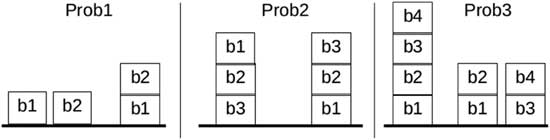
Figure 1 depicts three different blocksworld instances (named Prob1, Prob2 and Prob3 with two, three and four blocks, respectively) that are solvable by the previous generalized plan. For each instance, the figure shows the blocks configuration for the initial state (left side) and the corresponding goal state (right side).
Three different example instances from blocksworld. Each instance shows the blocks configuration for the initial state (left side) and goal state (right side).

The problem of computing general solutions for complex decision-making tasks has been studied since the early days of AI (Newell et al., Reference Newell, Shaw and Simon1959). In recent years we are experiencing a renewed interest caused by the appearance of novel formalisms for representing families of planning solutions, as well as new algorithms to compute such solutions. These advances reveal the potential of techniques from generalized planning and encourage the application of planning to diverse areas of computer science such as program synthesis, autonomous control, data wrangling or form recognition (Torlak and Bodik, Reference Torlak and Bodik2013; Alur et al., Reference Alur, Bodik, Juniwal, Martin, Raghothaman, Seshia, Singh, Solar-Lezama, Torlak and Udupa2015; Gulwani et al., Reference Gulwani, Hernandez-Orallo, Kitzelmann, Muggleton, Schmid and Zorn2015).
This paper reviews these recent advances in generalized planning and relates them to existing formalisms that also aim at generality within AP, such as planning with domain control knowledge and different approaches for planning under uncertainty. First, the paper provides a background on AP, formalizes the generalized planning task, and introduces our criteria for reviewing the work on generalized planning. Second, the paper discusses different approaches for specifying sets of planning tasks. Third, the paper surveys diverse representation formalisms for generalized plans analyzing their strengths and weaknesses. Fourth, current algorithms for computing generalized plans are examined. Finally the paper ends discussing different implementations and identifying open research questions to encourage future research.
2 Background
This section introduces classical planning (the vanilla model for AP), proposes a formal model for generalized planning based on classical planning, and defines the framework we use to analyze the existing work on generalized planning.
2.1 Classical planning
The classical planning model is the most common model for AP, and is based on the following assumptions:
1. The planning task to solve has a finite and fully observable state space.
2. Actions are deterministic and cause instantaneous state transitions.
3. Goals are conditions referred to the last state reached by a solution plan.
Therefore, a solution to a classical planning instance is a sequence of applicable actions that transforms a given initial state into a goal state, that is, a state that satisfies a previously specified set of goal conditions (Geffner and Bonet, Reference Geffner and Bonet2013).
Formally we use F to denote a set of propositional variables or fluents that together describe a state. A literal l is a valuation of a fluent f∈F, that is, l=f or l=¬f. A set of literals L on F is well-defined if there does not exist a fluent f∈F such that f∈L and ¬f∈L. Hence a well-defined literal set L assigns at most one value to each fluent in F, effectively representing a partial assignment of values to fluents. We use
 $${\cal L}(F)$$
to denote the set of all well-defined literal sets on F. Given L, let ¬L={¬l:l∈L} be its complement.
A state s is a literal set in
 $${\cal L}(F)$$
such that |s|=|F|, that is, a total assignment of values to fluents. Explicitly including negative literals in states simplifies subsequent definitions, but we often abuse notation by defining a state s only in terms of the fluents that are true in s, as is common in Strips planning.
A classical planning frame is a tuple Φ=〈F, A〉, where F is a set of fluents and A is a set of actions. Each action a∈A has a precondition
 $${\rm pre}(a)\in{\cal L}(F)$$
and a set of effects
 $${\rm eff}(a)\in{\cal L}(F)$$
. An action a∈A is applicable in a given state s iff pre(a)⊆s, that is, if its precondition holds in s. The result of executing an applicable action a∈A in a state s is a new state θ(s, a)=(s\¬eff(a))∪eff(a). Subtracting the complement of eff(a) from s ensures that θ(s, a) remains a well-defined state.
Given a frame Φ=〈F, A〉, a classical planning instance is a tuple P=〈F, A, I, G〉, where
 $$I\in{\cal L}(F)$$
is an initial state (i.e. |I|=|F|) and
 $$G\in{\cal L}(F)$$
is a goal condition. A plan for P is an action sequence π=〈a
1, … , a
n
〉 that induces a state sequence 〈s
0, s
1, … , s
n
〉 such that s
0=I and, for each i such that 1≤i≤n, a
i
is applicable in s
i−1 and generates the successor state s
i
=θ (s
i−1, a
i
). The plan π solves P if and only if G⊆s
n
, that is, if the goal condition is satisfied in the last state that is reached following the application of π in I.
The Planning Domain Definition Language (PDDL) (McDermott et al., Reference McDermott, Ghallab, Howe, Knoblock, Ram, Veloso, Weld and Wilkins1998) is the input language for the International Planning Competition (IPC) (Vallati et al., Reference Vallati, Chrpa, Grzes, McCluskey, Roberts and Sanner2015) and the de facto standard for representing classical planning instances. Besides classical planning, PDDL can represent more expressive planning models such as temporal planning or planning with path constraints and preferences (Fox and Long, Reference Fox and Long2003; Gerevini and Long, Reference Gerevini and Long2005).
PDDL separates the representation of a given planning instance into two parts, the domain and the problem:
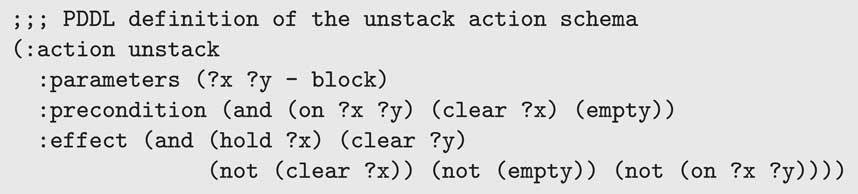
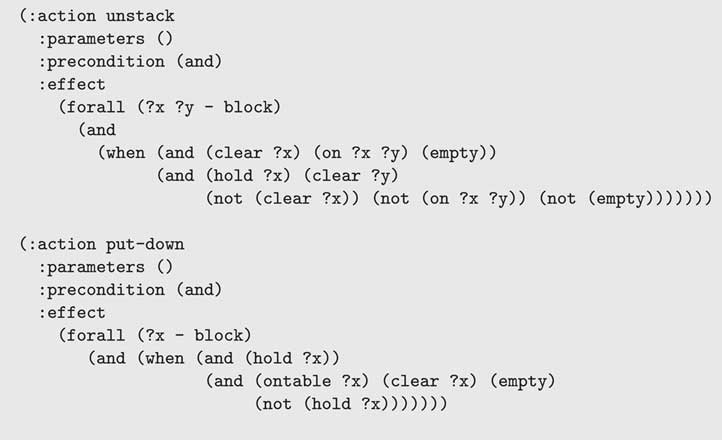
∙ A PDDL domain defines predicates and action schemas, whose parameters are instantiated on objects to respectively form fluents and ground actions. Figure 2 shows the PDDL action schema unstack from blocksworld, whose effect is to unstack the top block from a tower of blocks (in PDDL a question mark denotes the start of a variable name and a semicolon denotes the start of a comment). Apart from unstack, the PDDL definition of the blocksworld domain includes three other action schemas: stack for stacking a block onto a tower of blocks and pick-up and put-down, for picking up a block from the table or putting a block down the table.
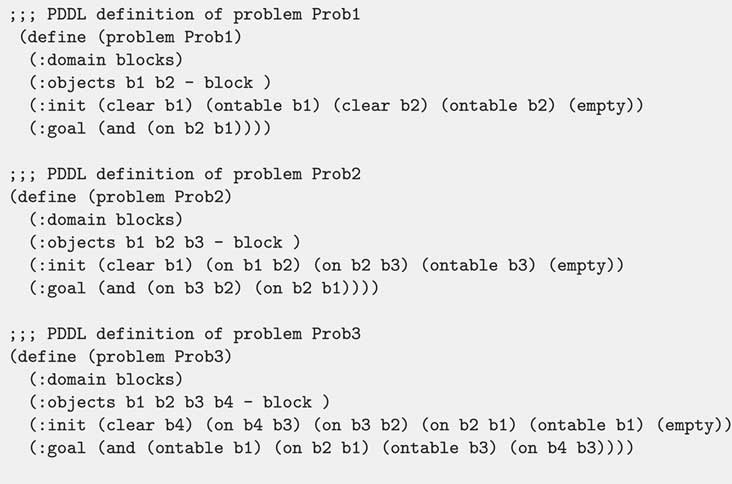
∙ A PDDL problem defines the objects of the planning instance, the initial state of these objects, and their goal conditions. Figure 3 shows the PDDL representation of the three classical planning instances illustrated in Figure 1.
Action schema unstack from the blocksworld coded in Planning Domain Definition Language (PDDL).

Three planning problems from the blocksworld domain coded in Planning Domain Definition Language (PDDL).

Both the fluent set F and the action set A of a given planning problem are instantiated by assigning objects, from the PDDL problem, to the parameters of the predicates and action schemas (defined in the PDDL domain). For example, if the unstack action schema is instantiated with parameters ?x=b1 and ?y=b2, then pre(unstack (b1, b2))= {(on b1 b2), (clear b1), (empty)}.
PDDL assumes that different instances belonging to the same domain share the same actions schemas, but this does not mean they share the same planning frame. For example, the three blocksworld instances shown in Figures 1 and 3 have different sets of objects, which induce different fluent and action sets.
2.2 Generalized planning
Generalized planning is often used as an umbrella term that refers to more general notions of planning, like the computation of plans with control flow structures, planning with domain control knowledge or diverse models for planning under uncertainty (such as conformant, contingent, Markov decision process (MDP) or partially observable Markov decision process (POMDP) planning (Geffner and Bonet, Reference Geffner and Bonet2013)). This paper is a review of the work on generalized planning under the assumptions of full state observability and deterministic actions.
Definition 1.
A generalized planning instance is a finite set of classical planning instances
 $${\cal P}{\equals}\{ P_{1} ,\,\ldots\,,P_{T} \} $$
that share some common structure.
Previous approaches to compute general knowledge for AP, such as macro-actions (Fikes et al., Reference Fikes, Hart and Nilsson1972), case-based planners (Borrajo et al., Reference Borrajo, Roubickova and Serina2015) or even the learning track of the IPC (Fern et al., Reference Fern, Khardon and Tadepalli2011), assumed that the given set of classical planning instances shares the same predicates and action schemes.
More recent work imposes a stronger constraint on the classical planning instances in a given generalized planning task, they must share the set of fluents and the set of actions. Formally, the {P
1, … , P
T
} instances in
 $${\cal P}$$
belong to the same planning frame Φ and hence, P
1=〈F, A, I
1, G
1〉, … , P
T
=〈F, A, I
T
, G
T
〉 share the same set of fluents and actions and differ only in the initial state and goals. This constraint forces the set of planning instances in a generalized planning task to share the same state space. Note that this definition of generalized planning still makes it possible to encode instances
 $$P\in{\cal P}$$
with different number of objects fixing their irrelevant fluents to False. For instance, when defining the two-block planning task illustrated in Figure 1, any fluent referred to blocks b3 and b4 is set to False.
A generalized plan can be viewed as a procedural representation of the instances in a generalized planning task. Generalized plans are then generative models that may have diverse forms. Each form with its own expressiveness capacity and own computation and validation complexity. Generalized plans range from programs (Winner and Veloso, Reference Winner and Veloso2003; Segovia-Aguas et al., Reference Segovia-Aguas, Jiménez and Jonsson2016a) and generalized polices (Martn and Geffner, Reference Martn and Geffner2004) to Finite State Controllers (FSCs) (Bonet et al., Reference Bonet, Palacios and Geffner2010; Segovia-Aguas et al., Reference Segovia-Aguas, Jiménez and Jonsson2016b), AND/OR graphs, formal grammars (Ramirez and Geffner, Reference Ramirez and Geffner2016) or hierarchical task networks (HTNs) (Nau et al., Reference Nau, Au, Ilghami, Kuter, Murdock, Wu and Yaman2003). We can classify generalized plans according to their specification of the action to apply next:
∙ Fully specified solutions, that unambiguously specify the action to apply next, for solving every instance in a given generalized planning task. Programs, generalized policies or deterministic FSCs belong to this class. Conformant, contingent or POMDP plans belong also to this class (if we consider that the possible initial states represent different classical planning instances all sharing the same state variables, actions and goals (Hu and Giacomo, Reference Hu and Giacomo2011)).
∙ Non specified. In this case the action to apply next is not explicitly specified. For instance, a classical planner provided with a domain model is a non-specified generalized plan. Such a plan is very general (covers any instance representable in the classical planner’s input language) but has an inefficient execution mechanism (running the classical planner to produce a fully specified solution for every instance in the generalized planning task).
∙ Partially specified. Between these two extremes we find generalized plans that share elements of both:
1. A planner is still required to produce a fully specified solution for a particular instance.
2. Some general knowledge is exploited to constrain the possible solutions.
The different approaches for planning with domain-specific control knowledge (DCK) belong to this class. This class includes planning with partially specified programs, non-deterministic FSCs, formal grammars, AND/OR graphs or HTNs that do not exactly capture the action to apply next.
Despite the different forms of generalized plans, we can define the conditions under which a generalized plan is considered a solution to a given generalized planning task.
Definition 2. The execution of a generalized plan ∏ in a classical planning instance P=〈F, A, I, G〉 is a classical plan, denoted as exec(∏, P)=〈a 1, … , a n 〉, that induces a state sequence 〈s 0, s 1, … , s n 〉 such that s 0=I and, for each 1≤i≤n, a i is applicable in s i−1 and generates the successor state s i =θ(s i−1, a i ).
Definition 3. A generalized plan ∏ is a solution to a given generalized planning instance
 $${\cal P}{\equals}\{ P_{1} ,\,\ldots\,,P_{T} \} $$
iff the execution of ∏ on every classical planning instance P
t
, 1≤t≤T produces a classical plan that solves P
t
.
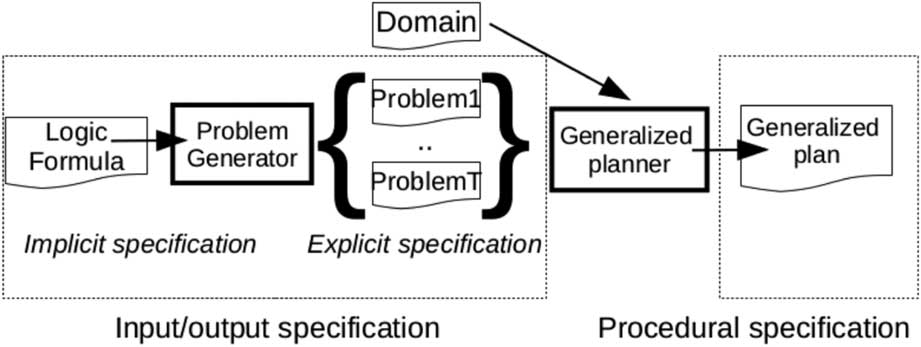
In the remainder of the paper we analyze, criticize and compare different approaches to generalized planning following the abstract framework shown in Figure 4:
∙ The problem generator box refers to a generative model of the instances in the generalized planning task. A generalized planning task comprises a set of individual planning tasks to be solved. This set of planning tasks can either be finite or infinite. Likewise it can be specified in different ways, for example, an explicit enumeration of classical planning instances or implicitly by using logic formulae, a probabilistic distribution, a problem generation program, etc. Problem generation is skipped when an explicit specification of the planning tasks is provided.
∙ The generalized planner box refers to an algorithm fed with an input-output specification of the instances to solve and that generates a solution to these instances. The algorithms for generalized planning range from pure top-down approaches, that search in the space of generalized plans a solution that covers all the input instances, to bottom-up approaches, that compute a solution to a single instance, generalizing it and merging it with previously found solutions to widen the coverage of the generalized plan.
Abstract framework for generalized planning.

To illustrate our use of this abstract framework, we follow it here to look at classical planning as if it were a generalized planning approach.
1. In classical planning the planner only receives as input a single and ground planning instance.
2. The state-of-the-art algorithms for classical planning are heuristic search in the state space (Helmert, Reference Helmert2006; Frances et al., Reference Frances, Ramrez, Lipovetzky and Geffner2017) or compilation to other forms of problem solving such as SAT (Rintanen, Reference Rintanen2012).
3. A classical plan is a sequence of actions and both the execution and validation of a classical plan are linear in the length of the plan. Nevertheless actions with conditional effects, variables and control-flow structures can be used to compactly represent solutions to classical planning tasks (Hector, Reference Hector2005; Scala et al., Reference Scala, Ramirez, Haslum and Thiebaux2016).
3 Representing sets of planning tasks
This section analyzes different formalisms for representing sets of planning tasks within generalized planning.
3.1 Representing actions
Compact and general task representations usually require an action model where different effects can occur depending on the current state of the world. An example is the agent-centered action model of the ATARI video-game (Mnih et al., Reference Mnih, Kavukcuoglu, Silver, Rusu, Veness, Bellemare, Graves, Riedmiller, Fidjeland, Ostrovski and Petersen2015), where the 18 possible actions have different effects according to the current state of the video-game. Here, we review extensions to the classical planning action model that aim more compact and general representations of the planning tasks and the planning solutions.
3.1.1 Conditional effects
The model of classical planning with conditional effects is more expressive than the basic classical planning model. Conditional effects cannot be compiled away if plan size should grow only linearly (Bernhard, Reference Bernhard2000). A classical planning task with conditional effects is a tuple P=〈F, A, I, G〉, as defined for classical planning, except for the set of actions A. Now, each action a∈A with conditional effects is defined as:
∙ The preconditions, a set of literals
 $${\rm pre}(a)\,\subseteq\,{\cal L}(F)$$
.
∙ The set of conditional effects, cond(a). Each conditional effect
$$C \triangleright E\in{\rm cond}(a)$$
is composed of two sets of literals,
$$C\,\subseteq\,{\cal L}(F)$$
(the condition) and
$$E\,\subseteq\,{\cal L}(F)$$
(the effect).


An action a∈A with conditional effects is applicable in a state s if and only if pre(a)⊆s, and the resulting set of triggered effects is,
 $${\rm eff}(s,a){\equals}\bigcup\limits_{C \triangleright E\in{\rm cond}(a),C\,\subseteq\,s} E$$
that is, effects whose conditions hold in s. The result of applying a in s is a new state θ(s, a)=(s\¬eff (s, a)) ∪ eff (s, a). The definition of a plan, and a solution plan, is analogous to that for planning problems without conditional effects.
PDDL supports the definition of conditional effects with the when keyword. In PDDL the condition of a given conditional effect has the same expressiveness as action preconditions and goals, so it can either be a negation, a conjunction, a disjunction or a quantified formula, as defined in the action description language formalism (Pednault, Reference Pednault1989; Fox and Long, Reference Fox and Long2003). Many classical planners natively cope with conditional effects without compiling them away. In fact since 2014, the support of PDDL conditional effects is a requirement for participating at IPC (Vallati et al., Reference Vallati, Chrpa, Grzes, McCluskey, Roberts and Sanner2015).
The model of classical planning with conditional effects makes it possible to repeatedly refer to the same action while the precise effects of the action are determined by the state where the action is applied. For instance, the execution of the six-action sequence (unstack, put-down, unstack, put-down, unstack, put-down) can unstack a single tower of either four, three or two blocks if unstack and put-down are actions with conditional effects as defined in Figure 5. The effects of these actions are defined using the universally quantified variables ?x and ?y of type block. Quantified variables do not increase the expressiveness of the actions but allow a more succinct representation. Note that these actions are defined with a single tower of blocks otherwise, if there is more than one tower, these actions would represent the unstacking of multiple blocks at the same time.
Planning Domain Definition Language (PDDL) actions from a blocksworld version to unstack a single tower of blocks using conditional effects and universally quantified variables.

3.1.2 Update formulas and high-level state features
The series of work by Srivastava et al. (Reference Srivastava, Immerman and Zilberstein2011a) on generalized planning encodes the effects of actions with update formulas. An update formula is an arbitrary first-order logic (FOL) formulae, that includes transitive closure, defining the new value of a given predicate after an action application. The transitive closure allows compact representation of connectivity properties such as the above concept in blocksworld.
In more detail, a particular update formula for a predicate p has the form
 $$p'\,\equiv\,[\neg p\wedge\Delta _{{p,a}}^{{\plus}} ]\vee[p\wedge\neg \Delta _{{p,a}}^{{\minus}} ]$$
where:
∙ p′ denotes the value of the predicate p after the application of action a.
∙
$$\Delta _{{p,a}}^{{\plus}} $$
denotes the conditions under which p is changed to true by action a.∙
$$\Delta _{{p,a}}^{{\minus}} $$
denotes the conditions under which p is changed to false by action a.


While this model for the action effects encodes more expressive state transitions than simple conditional effects, it is not supported by off-the-shelf PDDL classical planners.
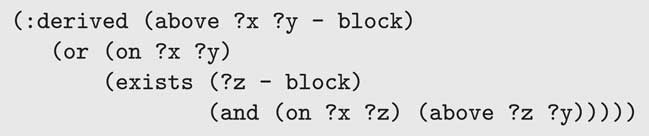
Arbitrary FOL formulae, that include transitive closure, can be represented in PDDL using derived predicates. Derived predicates can later be included in action preconditions, conditional effects and goals. Figure 6 shows how PDDL defines the above derived predicate that models whether a block ?x is above another block ?y in a blocksworld tower.
Planning Domain Definition Language derived predicate with one existentially quantified variable ?z that leverages recursion to capture when a block ?x is above another block ?y.

Derived predicates can represent expressive state queries including hierarchies over the state variables and recursion (Thiébaux et al., Reference Thiébaux, Hoffmann and Nebel2005). This has proven useful for compactly representing planning tasks and also for more effective planning (Ivankovic and Haslum, Reference Ivankovic and Haslum2015). Figure 7 shows a PDDL derived predicate, with a quantified variable ?b, that represents the set of blocksworld states where all blocks are on the table. Apart from derived predicates, diverse formalisms have been used to represent state queries in planning, ranging from first order clauses (Veloso et al., Reference Veloso, Carbonell, Perez, Borrajo, Fink and Blythe1995) to description logic formulae (Martn and Geffner, Reference Martn and Geffner2004), or even linear temporal logic formulae to define queries about sequence of states (Cresswell and Alexandra, Reference Cresswell and Alexandra2004).
Example of a Planning Domain Definition Language derived predicate, with one universally quantified variable ?b, that captures when all the blocks are on the table.

3.1.3 Sensing and non-deterministic actions
When states are fully observable, explicit sensing actions are not necessary given that any state information is obtained via state queries. Sensing actions are then suitable for planning under partial observability and they do not model state transitions, but the observation of some piece of information from the current state that is unknown. Planners apply sensing actions when the lack of information about the current state prevents them from generating a plan that achieves the goals with certainty.
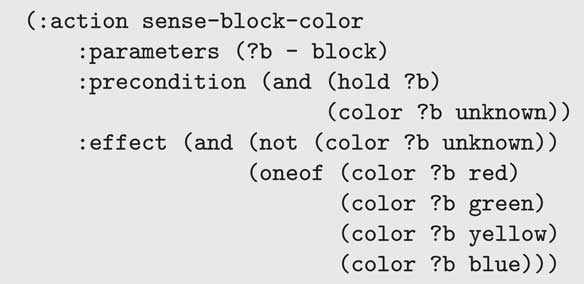
If we assume that uncertainty about the current state decreases monotonically (i.e. once the value of a state variable is known it can change, but cannot become unknown again) sensing actions can be encoded as non-deterministic actions (Muise et al., Reference Muise, Belle and McIlraith2014). Figure 8 shows an example of a sensing action for observing the color of a block encoded as a non-deterministic action. The oneof effect represents a kind of state constraint (often called state invariant) expressing that as a result of the sensing action, a block can only have one of these four colors: red, green, yellow or blue.
Non-deterministic action for sensing the color of a given block.

Sensing actions generate contingent plans, that is, plans with decision points predicated on the different sensing outcomes (Albore et al., Reference Albore, Palacios and Geffner2009). Contingent plans generalize noise-free decision trees. A decision tree can be defined as a particular kind of contingent plan: whose internal nodes contain only sensing actions and its leaf nodes only contain actions that set a particular class label (Segovia-Aguas et al., Reference Segovia-Aguas, Jiménez and Jonsson2017b).
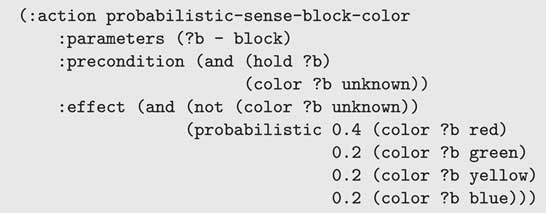
The action in Figure 8 assumes that there is no knowledge about the likelihood of the different sensing outcomes (e.g. because this knowledge is non-stationary). When this knowledge is available, it can be encoded with probabilistic effects using, for instance, PPDDL, the probabilistic version of PDDL (Younes and Littman, Reference Younes and Littman2004). Figure 9 shows a PPDDL action for sensing the color of a given block s.t. observing a red block is twice as probable. Planning with probabilistic actions becomes an optimization task where the planner aims at maximizing the probability of reaching the goals. Both non-deterministic and probabilistic actions can also encode non-deterministic state transitions, like in Fully Observable Non-Deterministic (FOND) or MDP planning (Mausam and Kolobov, Reference Mausam and Kolobov2012; Geffner and Bonet, Reference Geffner and Bonet2013).
probabilistic version of Planning Domain Definition Language action for sensing the color of a given block coded.

3.2 Representing initial and goal states
A set of states can be defined explicitly, enumerating each state in the set, or implicitly, defining the constraints that a state has to satisfy to belong to the set.
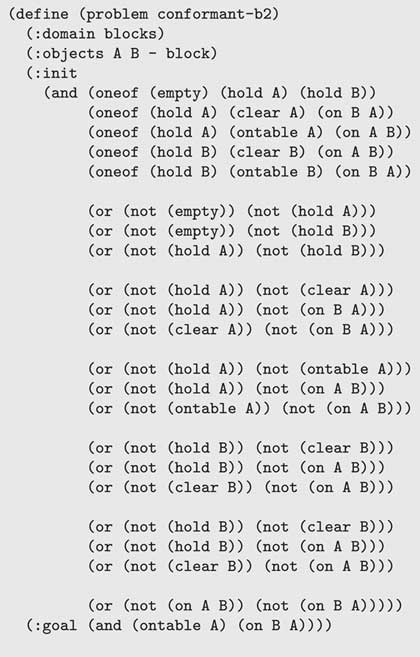
The set of instances in a generalized planning task can also be explicitly specified, enumerating the individual classical planning instances in the generalized planning task. An example of this is the set of three blocksworld instances, shown in Figure 1, plus their shared domain model with the action schemes for the unstack, stack, pick-up and put-down actions. Implicit representations of generalized planning tasks define two sets of constraints, one that defines the set of possible initial states, and a second one defining the set of goal states. An example of this is the conformant planning task shown in Figure 10 taken from IPC-2008.
Conformant planning task for a 2-block blocksworld. A single goal condition is defined for the different possible initial configurations of the two blocks.

Here we review different formalisms for representing a set of planning instances according to the language used for specifying these constraints:
∙ Propositional logic. In this case the sets of possible initial and goal states are represented exclusively using literals and the three basic logical connectives ( and, to indicate a conjunction of literals or, to indicate a disjunction of literals and not, to indicate negation). Examples of sets of planning instances represented with propositional logic are conformant, contingent or POMDPs planning tasks that define the different possible initial states of the task as a disjunction on the problem literals (goals are shared for all the possible initial states in the planning task) (Bonet et al., Reference Bonet, Palacios and Geffner2010).
∙ First-order logic. The benefit of first-order logic constraints is that they can contain quantified variables, include the transitive closure and represent unbounded sets of states. These features make first-order formulae achieve compact representations of sets of planning instances as well as to represent planning tasks of unbounded size (Srivastava et al., Reference Srivastava, Immerman and Zilberstein2011a). For a given finite set of objects, a first-order representation can be transformed straightforward into a propositional logic representation.
∙ Constraint programming. The previous representations restricted themselves to Boolean (two-valued) state variables. In this case sets of states are defined by a set of finite-domain variables X={x 1, … , x n } (where each variable x i , 1<i<n has an associated finite domain D(x i )) and a set of constrains C that determines when a state is part of the set.
Finite-domain variables are already de facto being used by classical planners: a standard preprocess to extract a many-valued representation from Boolean state variables. This preprocess can be quite expensive but it is completely unnecessary if states are represented with finite-domain variables (Rintanen, Reference Rintanen2015). In addition, constraint programming languages offer a great representation flexibility and off-the-shelf constraint satisfaction problem (CSP) solvers can be used in this case to solve the generalized planning tasks (Pralet et al., Reference Pralet, Verfaillie, Lematre and Infantes2010). This representation can be transformed into a first order representation with a given set of objects representing the domain of the variables.
∙ Three-valued logic. In this logic language there are three truth values 1 (true), 0 (false), or
$${1 \over 2}$$
(unknown). Srivastava et al. (Reference Srivastava, Immerman and Zilberstein2011a) use three-valued logic for state abstraction, to compactly represent unbounded sets of concrete states. Three-valued logic has also been useful to represent and solve conformant and contingent tasks (Petrick and Bacchus, Reference Petrick and Bacchus2004; Albore et al., Reference Albore, Palacios and Geffner2009; Palacios and Geffner, Reference Palacios and Geffner2009).

Apart from the sets of initial and goals states, further information can be used to specify a set of planning instances such as domain invariants (Srivastava et al., Reference Srivastava, Immerman and Zilberstein2011a), or even classified execution histories including positive and negative examples (Hu and Giacomo, Reference Hu and Giacomo2013), similar to what is done in Inductive Logic Programming (ILP) (Ross Quinlan, Reference Ross Quinlan1990).
4 Generalized plans
With respect to classical plans, generalized plans have two benefits, compactness and generality. In other words, generalized plans can be more succinct and be valid for solving multiple classical planning instances.
4.1 Representation
As mentioned in Section 2, generalized plans may have diverse forms, each with different expressiveness capacities and different execution mechanisms. The syntax and semantics of the formalism chosen for representing generalized plans defines the space of solutions that can be computed as well as the worst case computation complexity.
4.1.1 Control flow
Control-flow structures augment the flexibility of generalized plans with respect to classical plans:
∙ Branching: the execution of the plan branches according to the result of the evaluation of a given expression in the current state. Examples of planning solutions with branching structures are AND/OR tree-like contingent plans (Albore et al., Reference Albore, Palacios and Geffner2009) or K-fault tolerant plans (Domshlak, Reference Domshlak2013).
∙ Loops: the execution of a plan segment is repeated until a given condition holds in the current state. Examples of planning solutions with loops include the policy-like plans used for representing solutions to MDPs (Kolobov, Reference Kolobov2012), and FOND planning tasks (Muise et al., Reference Muise, Belle and McIlraith2014).
The size of a solution plan containing only branching constructs can be exponential in the number of possible state observations. Combining branching and loops is often helpful to compress generalized plans. In some solution representations, like DSPlanners (Winner and Veloso, Reference Winner and Veloso2003), branching and loops correspond to different control-flow constructs but often, they are implemented with the same construct (e.g. conditional transitions) to keep the solution space tractable. This is what happens in FSCs (Bonet et al., Reference Bonet, Palacios and Geffner2010), generalized policies (Martn and Geffner, Reference Martn and Geffner2004), or with the conditional gotos used in planning programs (Segovia-Aguas et al., Reference Segovia-Aguas, Jiménez and Jonsson2016a).
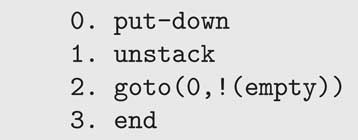
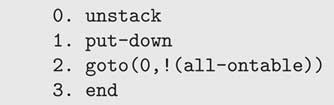
Figure 11 shows a generalized plan, in the form of a planning program, for unstacking a single tower of blocks no matter its height. The plan contains actions unstack and put-down (as defined in Figure 5) for unstacking the block at the top of the tower and putting it down on the table, respectively. The control flow instruction 2.goto (0, ! (empty)) jumps back to the first step, 0. put-down, when the robot hand is not empty. Note that such a compact and general plan is definable because the actual effects of put-down and unstack depend on the current state ( put-down and unstack have the conditional effects shown in Figure 5).
Example of a generalized plan for unstacking a single tower of blocks.

4.1.2 Variables
Unstacking multiple towers of blocks is more challenging than unstacking a single tower of blocks (there can be an arbitrary number of towers, each with different height). A general solution to this task cannot be compactly represented branching and looping over the ground values of the given state variables.
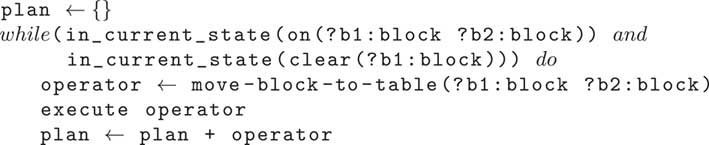
DSPlanners address this issue representing solutions with quantified variables (Winner and Veloso, Reference Winner and Veloso2003). Quantified variables makes it possible to identify objects with particular features and to apply selective actions to the identified objects. Figure 12 shows a generalized plan for unstacking multiple towers of blocks that uses two existential variables, ?b1 and ?b2. These variables capture the block to move next, linking the parameters of lifted predicates and actions. The generalized plan in Figure 12 has the form of a DSPlanner and its execution in a given planning instance requires unifying variables ?b1 and ?b2 with actual blocks in the current state of the planning task.
DSPlanner for unstacking multiple towers of blocks.

In the different formalisms for representing generalized plans, quantified variables appear as:
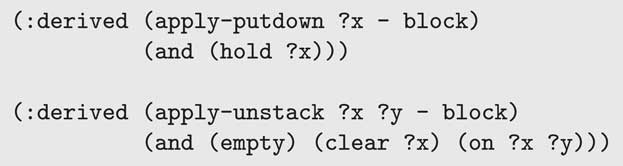
∙ Existential variables. An existential variable is a variable that asserts that a given property, or relation, holds for at least one possible variable value. Besides DSPlanners, existential variables also appear in choice actions (Srivastava et al., Reference Srivastava, Immerman and Zilberstein2011a), that is, actions instantiated during the execution of the plan and as a result of evaluating a FOL formula in the current state. Another example are generalized policies, whose rules contain variables to be unified with the current state (Khardon, Reference Khardon1999). PDDL can represent policies with derived predicates (Ivankovic and Haslum, Reference Ivankovic and Haslum2015), Figure 13 shows the PDDL derived predicates representing a two-rule policy for unstacking multiple towers of blocks (the encoding requires that these derived predicates are added as extra preconditions of the corresponding actions to make up the policy). More recently conjunctive queries, including existential variables, are used to address classification tasks that are modeled as generalized planning (Lotinac et al., Reference Lotinac, Segovia-Aguas, Jiménez and Jonsson2016).
∙ Universal variables. A universal variable asserts that a given property or relation holds for all the possible variable values. Figure 14 shows that the program in Figure 11, for unstacking a single tower of blocks, can be rewritten using the (all-ontable) derived predicate with universal variables defined in Figure 7.
Two-rule policy for unstacking towers of blocks represented with two Planning Domain Definition Language derived predicates.

Example of a generalized plan for unstacking a single tower of blocks using the (all-ontable) derived predicate.

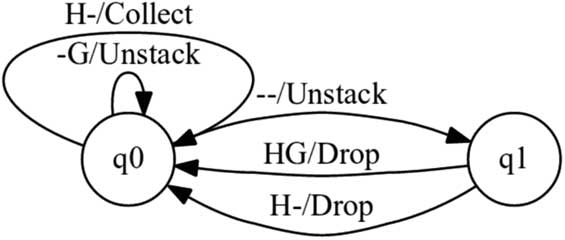
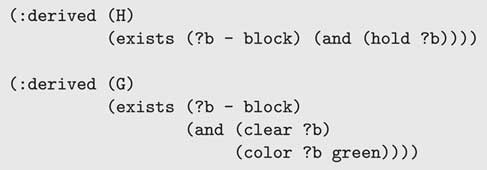
The use of derived predicates, that evaluate a given expression over quantified variables, applies also to other forms of generalized plans such as FSCs. Figure 15 shows a FSC for collecting a green block in a tower of blocks that achieve generalization because observations H and G are the result of evaluating an expression over quantified variables. In particular H holds when a block is being held and G when the top block is green. These two observations are defined using the derived predicates shown in Figure 16. The state queries depend on the joint variant HG with four possible values (true-true, true-false, false-true and false-false). Related to universal/existential variables are also the angelic/devilish concepts used in the literature to define planning hierarchies (Marthi et al., Reference Marthi, Russell and Wolfe2007).
Finite State Controllers for collecting a green block in a tower of blocks by observing whether a block is being held (H), and whether the top block is green (G).

Derived predicates with existential variables that capture when a block is being held (H), and when the top block is green (G).

4.1.3 Call stack
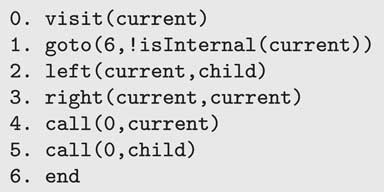
A call stack is another artifact borrowed from programming to make generalized plans more flexible (Fritz et al., Reference Fritz, Baier and McIlraith2008). Although one can explicitly encode a call stack using only basic control-flow and variables, more compact solutions are often derived with a call stack (e.g. tasks with recursive solutions (Segovia-Aguas et al., Reference Segovia-Aguas, Jiménez and Jonsson2016b)). Figure 17 shows a generalized plan for visiting all the nodes of a binary tree implementing a recursive Depth First Search with one procedural parameter. The instructions call(0, node) are recursive calls assigning argument node to the only parameter of the program and restarting the execution from its first line, 0. visit (current).
Example of a generalized plan π DFS (node) implementing a recursive Depth First Search (DFS) for traversing a binary tree of arbitrary size.

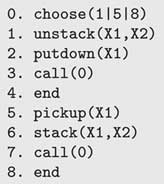
A given generalized plan can also be represented as a formal grammar with a call stack (Ramirez and Geffner, Reference Ramirez and Geffner2016; Segovia-Aguas et al., Reference Segovia-Aguas, Jiménez and Jonsson2017a). For instance, Figure 18 shows a grammar that encodes a generalized plan for blocksworld. The first instruction of this plan, 0. choose (1|5|8), is a choice instruction, that jumps to one of these three possible targets, line 1, line 5 or line 8 and hence, represents a rule selection. This action is non-deterministic since the rule selection is initially unknown and determined only during the execution of the program. Lines 1–4 encode the first grammar rule while lines 5–8 encode the second grammar rule. The third grammar rule parses the empty string and is encoded implicitly by line 8.
Grammar encoding a partially specified generalized plan for blocksworld.

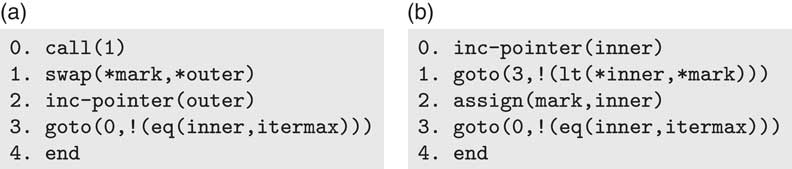
Furthermore, the benefits of using a call stack in generalized planning come from the reuse of existing generalized plans and the incremental building of hierarchical generalized plans (Segovia-Aguas et al., Reference Segovia-Aguas, Jiménez and Jonsson2016b). Figure 19 illustrates these benefits showing a two-module generalized plan for sorting lists of numbers that implements the selection sort algorithm and reuses Π1, a previously generated generalized plan for finding the minimum number in a list. Here Π0, left side, is the main program and its instruction call (1) invokes the execution of the auxiliary program Π1, right side, from its first line, 0. inc-pointer (inner).
Generalized plan with a procedure call for sorting list of numbers of arbitrary size and that corresponds to the selection sort algorithm. (a) II0: Main program that repeatedly selects the minimum value and swap contents. (b) II1: Auxiliary program that selects the minimum value from current position outer.

As a rule of thumb, a call stack allows the execution of a given generalized plan to jump to another generalized plan:
∙ Keeping different contexts. Each generalized plan can have different local state/variables.
∙ Sharing information. Passing information between the generalized plans as procedural parameters or using global state/variables.
4.2 Execution and validation
Generalized plans can branch, loop and have variables so executing a generalized plan on a particular classical planning instance requires specific machinery, different from the one traditionally used in classical planning:
∙ Branching. The execution of a generalized plan with different possible execution branches requires a mechanism for selecting the corresponding execution branch according to the current value of the state variables. The execution of several generalized plan that branch (like an HTN, an AND/OR tree-like plan or a policy) can be compiled into classical planning (Albore et al., Reference Albore, Palacios and Geffner2009; Alford et al., Reference Alford, Kuter and Nau2009; Ivankovic and Haslum, Reference Ivankovic and Haslum2015). As explained in Section 3, different possible execution outcomes according to different values of the state variables can be effectively modeled in classical planning via conditional effects (Bernhard, Reference Bernhard2000).
∙ Loops. Executing generalized plans that explicitly represent loops, like programs (or FSCs), requires to keep track of the current program line (or controller state). The execution of FSCs and programs can be compiled into classical planning by encoding the corresponding automata (its states and possible transitions) as extra state variables (Baier et al., Reference Baier, Fritz and McIlraith2007; Segovia-Aguas et al., Reference Segovia-Aguas, Jiménez and Jonsson2016a; Reference Segovia-Aguas, Jiménez and Jonsson2016b).
∙ Variables. If the generalized plan contains quantified variables, then plan execution requires unification mechanisms that assign possible values to these variables. Early planning systems implemented variable binding algorithms for matching control rules (Veloso et al., Reference Veloso, Carbonell, Perez, Borrajo, Fink and Blythe1995). Nowadays Fast-Downward evaluates derived predicates with quantified variables implementing the marking algorithm (Helmert, Reference Helmert2006). A different approach is to leverage external solvers, such as Answer Set Programming (Ivankovic and Haslum, Reference Ivankovic and Haslum2015) or CSP (Francès and Geffner, Reference Francès and Geffner2016) solvers, to ground quantified variables. The compilation approach has also been followed for binding existential variables in conjunctive queries (Lotinac et al., Reference Lotinac, Segovia-Aguas, Jiménez and Jonsson2016) and to evaluate FOL state queries with the transitive closure (Porco et al., Reference Porco, Machado and Bonet2011). Unfortunately most current off-the-shelf planners only effectively support simple conditions as conjunctions of propositional atoms and compiling away existentially quantified formulas have an exponential cost (Francès and Geffner, Reference Francès and Geffner2015).
The simplest desired property for the execution of a generalized plan on a given planning instance is termination, also referred in literature as the halting problem. In the worst case, the number of actions of a generalized plan execution has an upper bound given by the total number of possible states of the generalized plan. Infinite loops can then be detected counting the number of actions during plan execution and checking if this count exceeds the previous upper-bound (Bäckström et al., Reference Bäckström, Jonsson and Jonsson2014).
A second property for the execution of a generalized plan is guaranteeing that the plan solves a given instance. Testing this property is called validation, proving validation subsumes the proof of termination and is implicitly required as a part of plan generation. Plan validation in classical planning is linear, since either a validation proof or a failure proof is straightforward obtained by executing the plan starting from the initial state of the classical planning task. VAL (Howey et al., Reference Howey, Long and Fox2004), introduced in the third IPC, is the standard plan validation tool for classical planning.
The execution of a generalized plan (that can branch, loop and have variables) on a given planning instance can fail to solve that instance because:
1. The plan is unsound:
∙ The generalized plan does not satisfy the termination condition because it enters into an infinite loop.
∙ The action-to-apply-next (according to the generalized plan) cannot be applied. For instance, the preconditions of the recommended action do not hold in the current state.
∙ The execution of the plan ended but it did not achieve the goals of the planning task. Some forms of generalized plans include explicit termination actions (or states) so goal testing is only done when such actions are applied (or such states reached) (Srivastava et al., Reference Srivastava, Immerman, Zilberstein and Zhang2011b; Jiménez and Jonsson, Reference Jiménez and Jonsson2015). If the generalized plan lacks these termination actions (or states) goal achievement has to be tested after executing every plan step (Bonet et al., Reference Bonet, Palacios and Geffner2010).
2. The plan is incomplete. There is no action-to-apply-next for the current state (e.g. a policy with no applicable rule at the current state).
The execution of a generalized plan on a given classical planning task can be compiled into another classical planning task (Baier et al., Reference Baier, Fritz and McIlraith2007; Segovia-Aguas et al., Reference Segovia-Aguas, Jiménez and Jonsson2016a, Reference Segovia-Aguas, Jiménez and Jonsson2016b) and hence, an off-the-shelf classical planner can be used to effectively check the previous validation conditions. In that case, the validation of a generalized plan is as complex as the synthesis of a classical plan. When actions have non-deterministic effects plan validation becomes more complex since it requires proving that all the possible plan executions reach the goals (Cimatti et al., Reference Cimatti, Pistore, Roveri and Traverso2003). In such scenario model checking (Clarke et al., Reference Clarke, Grumberg and Peled1999) and non-deterministic planning are suitable approaches (Hoffmann, Reference Hoffmann2015).
Unlike classical plans, that are tied to a particular planning instance, generalized plans can also be executed on a set of different planning instances. The validation of a generalized plan on a generalized planning task requires executing the plan in all the instances comprised in the task and verifying that the plan solves them all. This means that the validation of a given generalized plan in a given instance should be polynomial in the size of the plan to be effective. The execution of a generalized plan in a set of planning instances can be implemented following two different approaches:
∙ Sequential, that is, executing the generalized plan at each instance separately one after the other. This is the approach followed for executing generalized plans using a classical planner that sequentially executes the plan in each of the individual planning instances comprised in a given generalized planning task (Segovia-Aguas et al., Reference Segovia-Aguas, Jiménez and Jonsson2016a).
∙ Parallel. The generalized plan is executed simultaneously in the set of instances of a generalized planning task (like in conformant, contingent or POMDP planning where the execution of an action progresses a set of states (Geffner and Bonet, Reference Geffner and Bonet2013)).
The implementation of the sequential approach is simpler but its utility is limited by the number of instances. The parallel approach allows to handle larger sets of instances (or instances with unbound number of objects) but it requires elaborated state progression techniques, such as belief tracking (Bonet and Geffner, Reference Bonet and Geffner2014) or the application of action updates on abstract states (Srivastava et al., Reference Srivastava, Immerman and Zilberstein2011a). Evaluating expressive goals, or derived fluents, becomes more complex in a parallel execution since it implies formulae evaluation over sets of states (Geffner and Bonet, Reference Geffner and Bonet2013). A third way to validate generalized plans is to show that some property holds before and after execution, like in program validation with Hoare triples (Schwinghammer et al., Reference Schwinghammer, Birkedal, Reus and Yang2009).
4.3 Evaluation
Given a set of planning instances, different generalized plans can be consistent with it, for example, the different generalized plans shown in Figures 11, 12 and 14 can unstack a tower of blocks of any height. It is then necessary to define methods that quantify the aptitude of a given generalized plan to articulate preferences among the possible solutions.
The aptitude of a generalized plan can be assessed with regard to different metrics:
∙ Coverage. The domain coverage of a generalized plan can be assessed as the ratio of the number of problem instances with size n that the generalized plan can solve, divided by the total number of solvable problem instances with this same size (Srivastava et al., Reference Srivastava, Immerman and Zilberstein2011a). In practice knowing these numbers implies solving large sets of planning tasks, so it is often intractable. Statistical Machine Learning (ML) techniques estimate the quality of a solution according to how well the solution performs on a representative sample of the domain instances, called test set (Mitchell, Reference Mitchell1997). In generalized planning one could also define a test set of instances and count how many are covered by a solution. If we view a classical planner as a particular form of a generalized plan, this is what is done at the sequential-optimal track of the IPC (Vallati et al., Reference Vallati, Chrpa, Grzes, McCluskey, Roberts and Sanner2015) where planners are awarded according to the amount of unseen instances they solve.
∙ Complexity. Because generalized plans are algorithm-like solutions their complexity can be theoretically assessed, for example, using asymptotic analysis that characterize how their running time and space requirements grow according to the size of the input tasks. In practice the complexity of a generalized plan can be quantified by the length of the sequence of actions produced by the execution of the plan on a given input instance. Then a generalized plan is optimal for a given instance when the length of this sequence is minimum for that instance. This is somehow related to what is done in the sequential-satisfying track of the IPC (Vallati et al., Reference Vallati, Chrpa, Grzes, McCluskey, Roberts and Sanner2015) where the final value of a planner is reported as the accumulated quality of the solutions in the instances of a testing set.
∙ Succinctness. The size of a given generalized plan can be assessed regarding to its number of program lines, controller states, policy rules or quantified variables. Similar metrics were already introduced in ILP systems to quantify the compactness and readability of solutions and to prefer models with the least number of rules and rules with the smallest size (Muggleton, Reference Muggleton1999). Note that in classical planning the execution complexity of a plan directly corresponds to its size.
5 Computing generalized plans
This section describes the two main approaches for the computation of generalized plans and reviews different plan reuse techniques to avoid computing generalized plans from scratch. The section ends reviewing particular implementations of different approaches for generalized planning.
5.1 Top-down/bottom-up generalized planning
The top-down approach for generalized planning searches for a solution that covers all the instances in the generalized planning task. On the other hand, the bottom-up approach computes a solution to a single instance (or to a subsets of the instances in the generalized planning task) and widens the coverage of the solution until covering all the instances in the generalized planning task. With respect to ML, the top-down approach relates to off-line ML algorithms that compute a model to cover, in a single iteration, the full set of input instances, for example, the induction of decision trees (Mitchell, Reference Mitchell1997). The bottom-up approach is related to the on-line versions of ML algorithms, that iterate to incrementally adapt the model as more input instances are presented to the learning algorithm (Utgoff, Reference Utgoff1989).
Top-down algorithms for generalized planning typically search for a solution in the space of possible generalized plans. The initial state of this search is the empty generalized plan and the search operators build a single step in the generalized plan (e.g. adding an instruction to a program, a new state or transition to a FSC, a new rule to a policy, etc.). The set of goal states of the search includes any state where the built generalized plan solves the given set of instances.
Examples of this approach are compilations of generalized planning into other forms of problem solving such as classical planning (Jiménez and Jonsson, Reference Jiménez and Jonsson2015), conformant planning (Bonet et al., Reference Bonet, Palacios and Geffner2010), CSP (Pralet et al., Reference Pralet, Verfaillie, Lematre and Infantes2010) or a Prolog program (Hu and Giacomo, Reference Hu and Giacomo2013). These compilations implement a search space as described above, and benefit from off-the-shelf solvers (with efficient search algorithms and heuristics) to complete the search for a generalized plan. The main limitation of the compilation approach is scalability. In practice, it is common to bound the size of the possible generalized plans (e.g. the maximum number of program lines, controller states, policy rules or quantified variables) with the aim of keeping the search tractable. This is similar to what is done in SATPLAN approaches that fix a maximum plan length (Rintanen, Reference Rintanen2012) and iteratively increments it until a solution is found.
Off-line algorithms for contingent (Albore et al., Reference Albore, Palacios and Geffner2009), conformant (Palacios and Geffner, Reference Palacios and Geffner2009) and POMDP planning (Geffner and Bonet, Reference Geffner and Bonet2013) can also be understood as top-down algorithms for generalized planning if we consider that the possible initial states represent different planning instances all sharing the same goals. In this case the search for a solution is not typically carried out in the space of possible generalized plans but in the space of reachable belief states (a belief state is a probability distribution over the states that are deemed possible). Here the scalability limitations come from the fact that the set of reachable belief states grows quickly (it is then key to exploit techniques for uncertainty reduction to keep the set of possible states tractable) and from the difficulty of defining effective heuristics that provide informative estimates with belief states.
Bottom-up generalized planning refers to an iterative and incremental approach where (1) a single planning instance (or a subset of the instances in the generalized planning task) is chosen, (2) a solution to it is computed, (3) generalized and finally (4), merged with the previously found and generalized solutions. This four-step process is repeated until all the instances in the generalized planning task are covered. The bottom-up approach is related to plan repair (Fox et al., Reference Fox, Gerevini, Long and Serina2006), case-based planning (CBP) (Borrajo et al., Reference Borrajo, Roubickova and Serina2015) and transfer learning (Pan and Yang, Reference Pan and Yang2010) because it also requires mechanisms to identify why a given solution does not cover a given instance (in this case validation mechanisms for generalized plans are suitable to find the cause of an assertion failure in a given plan (Winner and Veloso, Reference Winner and Veloso2003)) as well as mechanisms to adapt a given solution to a new scenario (this kind of adaptation mechanisms are also present when planning with imperfect control knowledge (Yoon et al., Reference Yoon, Fern and Givan2008)).
While top-down approaches can be implemented as compilations to other forms of problem solving, bottom-up approaches require specific techniques to lift and merge plans. On the other hand, bottom-up approaches provide anytime behavior and may be able to automatically build a small set of instances that achieve generalization (Srivastava et al., Reference Srivastava, Immerman, Zilberstein and Zhang2011b).
5.2 Reusing generalized plans
An alternative to the computation of generalized plans starting from scratch is to reuse existing solutions. Even when a certain generalized plan is unsound (in the sense that it fails to solve a given instance) or incomplete (it does not define the action to apply next for the given instance), it may contain useful knowledge. For example, the plan may be able to solve a sub-problem of the given generalized planning task, or similar instances (e.g. it is a solution but for objects of a different type), or solve new instances after tuning the conditions in the control-flow structures. In these cases adapting a previously existing generalized plan can pay off.
With this regard, bottom-up approaches for generalized planning are equipped with mechanisms to adapt a plan to unseen instances and incrementally increase its coverage (Srivastava et al., Reference Srivastava, Immerman, Zilberstein and Zhang2011b). On the other hand, top-down approaches can start with a partially specified solution instead of with the empty generalized plan. This has shown useful to narrow the search space and/or focus the search process making possible to address more challenging generalized planning tasks (Segovia-Aguas et al., Reference Segovia-Aguas, Jiménez and Jonsson2016a, Reference Segovia-Aguas, Jiménez and Jonsson2016b).
Next, we review different techniques for reusing previously found plans:
∙ Compilations. When the existing generalized plan has the form of a generalized policy it can be compiled into a set of PDDL derived predicates, one for each rule in the policy, that captures the different situations where the actions should be applied (Ivankovic and Haslum, Reference Ivankovic and Haslum2015). Figure 13 illustrated this approach showing an example of PDDL derived predicates representing a two-rule policy for unstacking towers of blocks. Existing generalized plans in the form of programs, FSCs or AND/OR graphs, can be encoded into a classical PDDL planning task by computing the cross product between the corresponding automata and the original planning task (Baier et al., Reference Baier, Fritz and McIlraith2007; Ramirez and Geffner, Reference Ramirez and Geffner2016; Segovia-Aguas et al., Reference Segovia-Aguas, Jiménez and Jonsson2016a). In this case, new extra state variables are added to the original planning task to represent the states and transitions of the automata corresponding to the program, FSC or AND/OR graph.
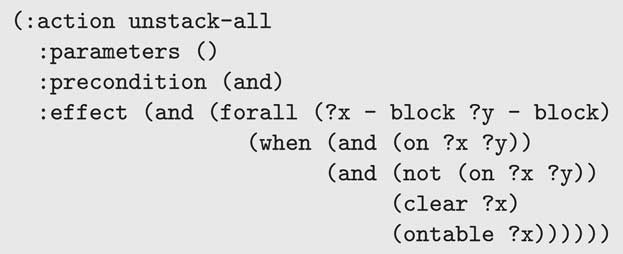
∙ Planning actions. Actions in classical planning do not only represent primitive actions but can also represent a generalized plan themselves. Figure 20 shows a classical planning action that corresponds to a generalized plan for unstacking any block in a blocksworld, that is, the first step in a general solution for solving any blocksworld instance.
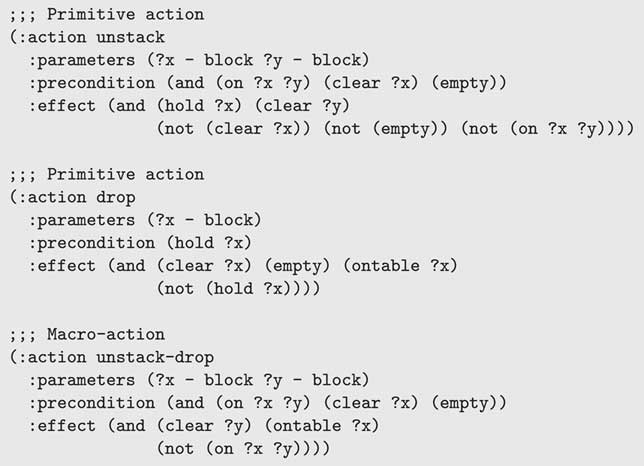
The compilation of existing solutions into new planning actions is well-studied for the particular case of macro-actions. A macro-action can be viewed as a parameterized generalized plan, without control flow, that can be reused in a straightforward way to enrich a domain theory (macro-actions have the form of standard classical planning actions). Figure 21 shows the classical planning actions unstack and drop from the blocksworld domain, for unstacking a block X from another block Y and for putting a block X onto the table, as well as the macro-action unstack-drop resulting from assembling them. The assembly of these two actions can, for example, be computed following the early planning algorithm of the triangle-table (Fikes et al., Reference Fikes, Hart and Nilsson1972).
A limitation of macro-actions is that their structure is too rigid so many generalized plans cannot be encoded as macro-actions. For instance, the generalized plan introduced in Section 1 for solving any blocksworld instance, cannot be encoded as a macro-action. Further research is necessary to automatically compile arbitrary generalized plans into planning actions, that can be directly included in a domain theory, without adding extra state variables. Recent work on planning with simulators opens the door to more effective approaches for reusing existing procedural solutions as black-box actions (Frances et al., Reference Frances, Ramrez, Lipovetzky and Geffner2017).
∙ Domain-specific heuristics. Incorrect and/or incomplete generalized plans have also been used to improve the performance of a classical planner working as domain-specific heuristics (Yoon et al., Reference Yoon, Fern and Givan2008; Rosa et al., Reference Rosa, Jiménez, Fuentetaja and Borrajo2011). This approach is specially useful at planning tasks where domain independent heuristics have flaws, for example, due to strong goal interactions.
Action for unstacking all the blocks in a blocksworld task. The action is encoded in Planning Domain Definition Language (PDDL) using universally quantified variables and conditional effects.

Two primitive actions from the blocksworld described in Planning Domain Definition Language (PDDL) and the macro-action resulting from assembling them.

5.3 Implementations
Now we review particular approaches for generalized planning. We analyze how they represent the tasks to solve, the representation of the generalized plans and the algorithms for computing them.
5.3.1 Computing macro-actions
Macro-actions are one of the first suggestions to compute general knowledge valid for solving different planning tasks (Fikes et al., Reference Fikes, Hart and Nilsson1972). There are diverse approaches in the literature for computing macro-actions (Botea et al., Reference Botea, Enzenberger, Müller and Schaeffer2005; Coles and Smith, Reference Coles and Smith2007; Jonsson, Reference Jonsson2009; Lukás, Reference Lukás2010) but the most common approach is to: (1) solve a training set of classical planning instances that share the same domain theory with an off-the-shelf classical planner and (2), identify, in the solution plans, sub-sequences of actions that are frequently used together.
The strength of macro-actions is that they have the form of standard classical planning actions so they can be added straightforward to the domain theory without requiring extra state variables. This makes macro-actions a practical and robust approach for reusing general planning knowledge: On the one hand, either planning with macro-actions or the execution and validation of plans that contain macro-actions do not require specific algorithms. On the other hand, adding incomplete or incorrect macro-actions will not prevent a planner to find a solution to a solvable task because the planner can always build a solution using the original actions.
The main limitation of macro-actions for defining general planning strategies is its sequential execution flow, that is too rigid. A solution involving macros may not be applicable to other problems, even when macro-actions are parameterized.
5.3.2 Computing generalized policies
A generalized policy is a set of rules that defines a mapping of state and goals, into the preferred action to execute next. Like macro-actions, generalized policies also allow parameters and can be induced from a set of solutions to classical planning instances that share the same domain theory (Martn and Geffner, Reference Martn and Geffner2004; Yoon et al., Reference Yoon, Fern and Givan2008; Rosa et al., Reference Rosa, Jiménez, Fuentetaja and Borrajo2011). Generalized policies are, however, more flexible than macro-actions since they can define execution flows with branching and loops.
Computing a good generalized policy is complex and, nowadays, the success of this approach is still limited to a reduced number of benchmarks. On the one hand, correct and complete generalized policies are not computable for many domains using the given representation for the states, actions and goals. In the past, the limitations of the given representation language has been addressed by hand-coding high-level state features that increase the expressiveness of the given representation (Khardon, Reference Khardon1999) or changing the representation language to reason better about classes of objects (Martn and Geffner, Reference Martn and Geffner2004; Fern et al., Reference Fern, Yoon and Givan2006; Yoon et al., Reference Yoon, Fern and Givan2008). On the other hand, the algorithms for computing generalized policies traditionally consider planning and generalization as two separated phases. This separation produces noisy examples difficult to be generalized due to the high number of symmetries and transpositions that typically appear in solution plans.
If a correct generalized policy is available, it can be added to a domain theory using derived predicates that capture the states where an action should be applied (Ivankovic and Haslum, Reference Ivankovic and Haslum2015), as shown in Figure 13. If the policy is incomplete or incorrect, adding it to the domain theory can turn solvable planning instances into unsolvable (adding the policy means adding new constraints to the original planning task). A more robust approach to reuse imperfect policies is to consider them as domain-specific heuristics that guide the search for a solution plan. Exploiting policies in such way requires the modification of the planner (Yoon et al., Reference Yoon, Fern and Givan2008; Rosa et al., Reference Rosa, Jiménez, Fuentetaja and Borrajo2011).
5.3.3 Computing Finite State Controllers
FSCs generalize policies with a finite amount of memory (Bonet and Geffner, Reference Bonet and Geffner2015). A FSC with a single state represents a policy, that is, a memory-less controller. The additional controller states of FSCs provide them with memory that allows different actions to be taken given the same observation. The FSC formalism can also be extended with a call stack to represent hierarchical and recursive solutions (Segovia-Aguas et al., Reference Segovia-Aguas, Jiménez and Jonsson2016b).
The existing algorithms for computing FSCs for generalized planning follow a top-down approach that interleaves programming the FSC with validating it and hence, they tightly integrate planning and generalization. To keep the computation of FSCs tractable, they limit the space of possible solutions bounding the maximum size of the FSC. In addition, they impose that the instances to solve share, not only the domain theory (actions and predicates schemes) but the set of fluents (Segovia-Aguas et al., Reference Segovia-Aguas, Jiménez and Jonsson2016a) or a subset of observable fluents (Bonet et al., Reference Bonet, Palacios and Geffner2010).
The computation of FSCs for generalized planning includes works that compile the generalized planning task into another forms of problem solving so they benefit from the last advances on off-the-shelf solvers (e.g. classical planning (Segovia-Aguas et al., Reference Segovia-Aguas, Jiménez and Jonsson2016a), conformant planning (Bonet et al., Reference Bonet, Palacios and Geffner2010), CSP (Pralet et al., Reference Pralet, Verfaillie, Lematre and Infantes2010) or a Prolog program (Hu and Giacomo, Reference Hu and Giacomo2013)). This last case requires a behavior specification of the FSC consisting on classified execution histories that (1) accept all legal execution histories leading to a goal-satisfying state, and (2) reject those that contain repeated configurations (indicating an infinite loop) and that cannot be extended (indicating a dead end) (Hu and Giacomo, Reference Hu and Giacomo2013).
5.3.4 Computing programs
Programs increase the readability of FSCs separating the control-flow structures from the primitive actions. Like FSCs, programs can also be computed following a top-down approach, for example, exploiting compilations that program and validate the program on instances with the same state and action space (Segovia-Aguas et al., Reference Segovia-Aguas, Jiménez and Jonsson2016a). Since these top-down approaches search in the space of solutions, it is helpful to limit the set of different control-flow instructions. For instance, using only conditional gotos that can both implement branching and loops (Jiménez and Jonsson, Reference Jiménez and Jonsson2015).
One of the first attempts to represent generalizes plans as programs are DSPlanners (Winner and Veloso, Reference Winner and Veloso2003; Winner and Veloso, Reference Winner and Veloso2007). A DSPlanner is a domain-specific program that can contain if-then-else and while constructs. These constructs branch and loop the execution control flow of the program according to FOL queries on the current state and/or the goals of the planning task.
The algorithm to compute DSPlanners is called Distill and implements a bottom-up approach on a set of classical planning instances that share the same domain theory. Given an instance, Distill computes a partially ordered plan for that instance and integrates it into an existing DSPlanner as follows. First, Distill lifts the partially ordered plan choosing a parameterization that matches the existing DSPlanner. If no such parameterization exists, Distill randomly assigns variable names to the objects in the plan. Then Distill attempts to identify if statements and unrolled loop iterations in the solution to replace them by the corresponding control-flow structure.
The work on generalized planning by Srivastava et al. introduces a powerful and compact structure to programs, called choice actions, that combines existential variables and control flow (Srivastava et al., Reference Srivastava, Immerman and Zilberstein2011a, Reference Srivastava, Immerman, Zilberstein and Zhang2011b). Input instances in this work are expressed as an abstract FOL representation with the transitive closure. This formalism allows to represent planning tasks with an unbounded number of objects and to guarantee the generalization of solutions for such tasks.
The generalized planning algorithm by Srivastava et al. implements also a bottom-up strategy. The algorithm starts with an empty generalized plan, and incrementally increases its coverage by identifying an instance that it cannot solve, invoking a classical planner to solve that instance, generalizing the obtained solution and merging it back into the generalized plan. The process is repeated until producing a generalized plan that covers the entire desired class of instances (or when a predefined limit of the computation resources is reached).
Both programs and FSCs can be compiled into a planning domain theory (Baier et al., Reference Baier, Fritz and McIlraith2007; Segovia-Aguas et al., Reference Segovia-Aguas, Jiménez and Jonsson2016a, Reference Segovia-Aguas, Jiménez and Jonsson2016b). Like happens with policies, this compilation is safe (is not turning solvable planning instances into unsolvable) when the given program (or FSC) is correct.
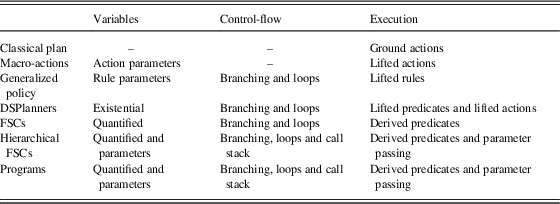
Table 1 is a summary of the reviewed approaches for generalized planning. The table indicates whether a given solution representation allows the use of variables, the kind of control-flow and whether the execution of the solution requires particular machinery.
Summary of the diverse approaches for generalized planning according to the solution representations

FSC=Finite State Controllers.
6 Related work
Here we review other forms of planning and problem solving that are related to the generalized planning approaches reviewed in the paper.
6.1 Planning under partial observability: conformant, contingent and POMDP planning
Conformant planning computes sequences of actions whose execution is consistent with a set of different initial states (Palacios and Geffner, Reference Palacios and Geffner2009). The difference to the classical planning model is the uncertainty in the initial state, which is described by means of clauses. A conformant plan is a sequence of actions that solves all the classical planning tasks given by the set of possible initial states that satisfy these clauses. The execution of same sequence of actions can produce different outcomes for different initial states because actions have conditional effects. The main approaches for conformant planning are:
∙ Uncertainty reduction. Compiling the conformant planning into classical planning to compute:
1. A plan prefix that removes any relevant uncertainty. In other words, only a single state (or at least a single partial state for the subset of state variables that are relevant for achieving the goals) is possible after the prefix application (Palacios and Geffner, Reference Palacios and Geffner2009).
2. A plan postfix that transforms the state (or partial state), where the relevant uncertainty is removed, into a state that achieves the goals of the conformant planning task.
∙ Belief propagation. Searching in the space of belief states where: the root belief state represents the set of possible initial states and the goals are the belief states s.t., all the possible states in the belief state satisfy the goal condition of the planning task (Cimatti et al., Reference Cimatti, Roveri and Bertoli2004; Hoffmann and Brafman, Reference Hoffmann and Brafman2006). While the previous approach leverages the classical planning machinery, this approach requires (1) mechanisms for the compact representation and update of beliefs states and (2), effective heuristics to guide the search in the space of belief states.
Contingent planning extends the conformant planning model with a sensing model. This sensing model is a function that maps state-action pairs (the true state of the system and the last action done) into a non-empty set of observations (Albore et al., Reference Albore, Palacios and Geffner2009; Albore et al., Reference Albore, Ramrez and Geffner2011). Observations provide only partial information about the true state of the system because the same observation may be possible in different states. A contingent plan must satisfy that:
∙ Its execution reaches a goal belief state (all the states in the belief satisfy the goal condition of the planning task) in a finite number of steps.
∙ The conditions for branching and looping refer to the observations (or the subset of state variables that are observable).
Like generalized plans, contingent plans can have different forms such as policies, AND/OR graphs, FSCs or programs (Bonet et al., Reference Bonet, Palacios and Geffner2010).
POMDP planning extends the contingent planning model allowing to encode uncertainty through probability distributions, rather than with sets of possible initial states and with sets of possible observations (Geffner and Bonet, Reference Geffner and Bonet2013). With this regard, the Bayes’ rule is used to update belief states after an action application or after an observation of the current state. The aim of a POMDPs solution is to maximize the expected cost to the goals, so POMDP planning becomes an optimization task. An optimal conformant/contingent/POMDP plan is the one that minimizes the cost of achieving the goals in the worst case.
Generalized planning can be seen as a particular example of contingent/POMDP planning: (1) the initial states and goals of the different instances comprised in a generalized planning task can be encoded as the different possible initial states of a POMDP task and (2) our definition of generalized planning assumed deterministic actions and full observability (the conditions for branching and looping can refer to the value of any state variable).
6.2 Planning with control knowledge
Since the beginning of research in planning, control knowledge has shown effective to improve the scalability of planners (Bacchus and Kabanza., Reference Bacchus and Kabanza.2000; Nau et al., Reference Nau, Au, Ilghami, Kuter, Murdock, Wu and Yaman2003). This was evidenced at IPC-2002 where planners exploiting DCK performed orders of magnitude faster than state-of-the-art planners (Long and Fox, Reference Long and Fox2003).
Algorithm-like representations of DCK (Baier et al., Reference Baier, Fritz and McIlraith2007) bear strong resemblances with generalized plans. Indeed both DCK and generalized plans represent general strategies that are valid for solving different planning instances. Despite the distinction between them is thin, one can claim that a generalized plan is a fully specified solution, that does not require a planner to be applied in a particular instance. On the other hand, DCK corresponds to partially specified solutions (contain non-deterministic constructs and missing/open segments to be determined by a planner at the time of the plan generation). Therefore DCK requires a planner to produce a fully specified solution to a given classical planning instance.
A different approach to define DCK is with a database of solved instances. In fact an alternative view of a generalized plan is as a compact library of plans. CBP is the approach to AP that aims saving computational effort by reusing previously found solutions (Borrajo et al., Reference Borrajo, Roubickova and Serina2015). A CBP system implements retrieval mechanisms that identify instances similar to the one to solve as well as adaptation mechanisms that repair flaws in a retrieved solution to make it applicable to another instance. Retrieval and adaptation mechanisms of CBP are relevant to bottom-up algorithms for generalized planning since they identify when a given generalized plan does not cover an instance and adapt the plan to cover it (Winner and Veloso, Reference Winner and Veloso2003; Srivastava et al., Reference Srivastava, Immerman and Zilberstein2011a). The development of such mechanisms for large case libraries following a domain-independent approach is still a challenge.
Another formalism for representing and exploiting DCK is hierarchical planning. Like classical planning, hierarchical planning deals with deterministic and fully observable planning tasks but uses a different task representation. While in classical planning actions are characterized in terms of their pre and postconditions, and their choice and ordering is computed automatically by a planner, hierarchical planning specifies a sketch of the solution with extra information about (1) which subgoal to pursue (Shivashankar et al., Reference Shivashankar, Kuter, Nau and Alford2012), and/or (2) which actions can be applied for achieving a given subgoal (Nau et al., Reference Nau, Au, Ilghami, Kuter, Murdock, Wu and Yaman2003).
In hierarchical planning the separation between the representation of the task to be solved and the strategy for solving it is not as clear as in classical planning. A hierarchical planning task can be understood as a partially specified generalized plan (or a domain-specific planner) where the missing parts of the plan are determined during its execution, by running a hierarchical planner. While a classical planner aims to compute a sequence of applicable actions that transforms a given initial state into a goal state, the hierarchical planner computes a sequence of applicable actions that: (1) transforms a given initial state into a goal state and (2), this transformation is compliant with the given hierarchy.
6.3 GOLOG
The Golog family of action languages has proven to be a useful mean for the high-level control of autonomous agents (Levesque et al., Reference Levesque, Reiter, Lespérance, Lin and Scherl1997). Apart from conditionals, loops and recursive procedures, an interesting feature of Golog programs is that they can contain non-deterministic parts. A Golog program does not need to represent a fully specified solution, but a sketch of it, where the non-deterministic parts are gaps to be filled by the system. This feature provides the Golog programmer with the flexibility to chose the right balance between:
∙ Determine predefined behavior, which normally implies larger programs.
∙ Leave certain parts to be solved by the system by means of search, which normally implies larger computation times.
The basic Golog interpreter uses the PROLOG back-tracking mechanism to resolve the search. This mechanism basically amounts to do a blind search so, when addressing planning tasks, it soon becomes unfeasible for all but the smallest instance sizes. IndiGolog (Sardina et al., Reference Sardina, Giacomo, Lespérance and Levesque2004) extends Golog to contain a number of built-in planning mechanisms. Furthermore, the semantics compatibility between Golog and PDDL (Röger et al., Reference Röger, Helmert and Nebel2008) can be exploited and a PDDL planner can be embedded (Claßen et al., Reference Claßen, Engelmann, Lakemeyer and Röger2008) to address the sub-problems that are combinatorial in nature.
6.4 Program synthesis
Program synthesis is the task of automatically generating a program that satisfies a given high-level specification. Many ideas from this research field are relevant to generalized planning but they are not immediately applicable since generalized planning follows a domain-independent approach and handles its own specific representation for states, actions and goals. Here we review two of the most successful approaches for program synthesis:
∙ Programming by Example (PbE), computes a set of programs consistent with a given set of input-output examples. Input-output examples are intuitive for non-programmers to create programs moreover, this type of specification makes program synthesis more tractable than reasoning with abstract program states. PbE techniques have already been deployed in the real world and are part of the Flash Fill feature of Excel in Office 2013 that generates programs for string transformation (Gulwani, Reference Gulwani2011). In this case the set of synthesized programs are represented succinctly in a restricted Domain-Specific Language using a data-structure called version space algebras (Mitchell, Reference Mitchell1982). The programs are computed with a domain-specific search that implements a divide and conquer approach.
∙ In Programming by Sketching (PbS) programmers provide a partially specified program, that is, a program that expresses the high-level structure of an implementation but that leaves low level details undefined to be determined by the synthesizer (Solar-Lezama et al., Reference Solar-Lezama, Tancau, Bodik, Seshia and Saraswat2006). This form of program synthesis relies on a programming language called SKETCH, for sketching partial programs. PbS implements a counterexample-driven iteration over a synthesize-validate loop built from two communicating SAT solvers, the inductive synthesizer and the validator, to automatically generate test inputs and ensure that the program satisfy them. Despite, in the worst case, program synthesis is harder than NP-complete, this counterexample-driven search terminates on many real problems after solving only a few SAT instances (Lake et al., Reference Lake, Salakhutdinov and Tenenbaum2015).
7 Conclusions
Generalized plans are able to solve planning tasks beyond the scope of classical planning: they can address planning tasks that comprise multiple instances or with an unbound number of objects, as well as planning tasks with partial observability and non-deterministic actions (Bonet et al., Reference Bonet, Palacios and Geffner2010; Hu and Levesque, Reference Hu and Levesque2011; Srivastava et al., Reference Srivastava, Immerman, Zilberstein and Zhang2011b; Hu and Giacomo, Reference Hu and Giacomo2013). Generalized planning is then a promising paradigm for problem solving but further research is needed to effectively address arbitrary planning tasks.
∙ Representation of generalized planning tasks. Implicit representations allow to handle large sets of planning instances. However, these representations require specific mechanisms for state progression, as well as for testing goals and action preconditions, that are different from the ones traditionally implemented in off-the-shelf planners.
Apart from the representation formalism, the given set of instances in a generalized planning task affects to the performance of the different approaches for computing a plan that generalizes. Sometimes small sets of representative instances can be built using corner cases. Corner cases push state variables to their minimum or maximum value so the plan behavior, is only considered on those specific states as opposed to consider all the possible input instances. For the general case, it is complex to automatically identify a small number of representative instances so often, the selection of representative instances in a generalized planning task, is still done by hand.
A first step towards automatically determining the instances to compute a solution that generalizes is characterizing the conditions under which a policy generalizes to other problems (Bonet and Geffner, Reference Bonet and Geffner2015). This approach opens the door to the development of methods for automatically generating the simplest set of instances that is required to compute a solution that generalizes.
∙ Computation of generalized plans. Current algorithms for generalized planning are only able to address relatively small tasks. Further research on specific heuristics for generalized planning, the automatic identification of relevant state variables (e.g. finding the subset of state variables that could appear in the conditions of the loops and branches) or the automatic serialization of goals, can help to increase the scalability of generalized planners.
Domain-specific decompositions allow also to address more challenging generalized planning tasks (Segovia-Aguas et al., Reference Segovia-Aguas, Jiménez and Jonsson2016a). Unfortunately these decompositions are currently done by hand and it is still an open issue how to automatically compute them from the representation of the generalized planning task. With this regard, planning landmarks can be an interesting research direction (Hoffmann et al., Reference Hoffmann, Porteous and Sebastia2004). An alternative work-line to improve the scalability of generalized planners is to explore the transformation of a given planning task into a smaller one that (1) is solvable by the same generalized plan and (2) has a more tractable search space (Bonet and Geffner, Reference Bonet and Geffner2015).
With regard to the reuse of generalized plans, key issues are the evaluation of the suitability of a given generalized plan for a given planning instance (like similarity metrics from CBP), and the reuse of incomplete or incorrect generalized plans. In this case, reusing existing generalized plans as domain-specific heuristics or preferences, is a safer approach that forcing to follow the generalized plans at every moment.
∙ Representation of generalized plans. Generalized plans that include variables and control-flow require more sophisticated execution mechanisms than a plan that just comprises a sequence of ground actions but, they may be able to represent more tasks. The same claim applies for partially specified solutions (whose execution is more complex because it requires a planner) with respect to fully specified solutions. Given a generalized planning task, identifying the kind of solution that is more suitable for solving it, is also an open issue.
The computation of a generalized plan is constrained by the given instances in the generalized planning task but also by the given representation for coding the states, actions and goals. The automatic derivation of alternative representations that allow more effective computation of generalized plans is a promising research direction with multiple links to previous research on AI such as ILP predicate invention (Craven and Slattery, Reference Craven and Slattery2001) or feature generation in ML.
Last but not least, generalized plans are generative models that can address tasks beyond planning. For instance, given a generalized plan and an execution trace, the parsing task can be defined as the task of determining whether that execution trace could be generated with the given generalized plan. This approach is useful for object classification (Lotinac et al., Reference Lotinac, Segovia-Aguas, Jiménez and Jonsson2016) but also for goal recognition (Ramírez and Geffner, Reference Ramírez and Geffner2010) and task classification (Segovia-Aguas et al., Reference Segovia-Aguas, Jiménez and Jonsson2017b). Furthermore, solutions to these tasks can be implemented with techniques very similar to the ones used for the computation of generalized plans. With this same regard, there are previous works using PbE techniques to synthesize a parser from input/output examples (Leung et al., Reference Leung, Sarracino and Lerner2015). This task have been addressed with classical planning for small context-free grammars (Segovia-Aguas et al., Reference Segovia-Aguas, Jiménez and Jonsson2017a), however, further research has to be done for building more challenging parsers.
Acknowledgment
This work is partially supported by grant TIN-2015-67959 and the Maria de Maeztu Units of Excellence Programme MDM-2015-0502, MEC, Spain. S. J. is supported by the Ramon y Cajal program, RYC-2015-18009, funded by the Spanish government.