Contemporaries and historians have often blamed the errors and tragedies of US policy during the Cold War—from military brinkmanship to imprudent intervention to alliance with rapacious autocrats and brutal rebels to an inflated defense budget—on the “Cold War consensus.” By this account, after around 1948, alternatives to militarized global containment could not get a hearing. This entrenched policy consensus allegedly dragged the United States into a disastrous war in Vietnam and unraveled amidst the trauma of that war.Footnote 1 However, the narrative of national security that we call the Cold War consensus has not been studied rigorously. More systematic data reveal the standard history of this important case to be wrong. Based on a content analysis of newspaper editorials, I show that the Cold War narrative was narrower than conventional accounts suggest, that it did not become dominant until the early 1950s—long after such oft-cited episodes as the Czech coup of winter 1948—and that its dominant position began to erode in the early 1960s—well before the 1968 Tet Offensive, which marked the American public's decisive turn against the Vietnam War.
But rethinking what the Cold War narrative was and when it consolidated and collapsed poses a substantial theoretical puzzle as well. A well-established, intuitive theory attributes major change in ideas and discourses—across many domains, including national security—to substantial, unexpected, and unwelcome policy failures; policy success, in contrast, impedes change, since prevailing ideas and discourses then seem to make adequate sense of reality.Footnote 2 That theory fits nicely with the contention that the Cold War consensus persisted until the Vietnam War and then collapsed amidst that harrowing conflict. It fits less comfortably, however, with my data, which show that the Cold War narrative fell from its dominant perch long before Americans rejected the Vietnam War and that it surprisingly achieved its dominance during the bloody Korean stalemate.
To make sense of this pattern, I develop an alternative theory rooted in the dynamics of public narrative and the domestic politics of the battlefield. I start from the constructivist premise that events do not speak for themselves, that their purported lessons are the product of interpretation by political actors, and that the critical junctures in which narratives are reconfigured are not productively theorized as responses to exogenous shock.Footnote 3 From that more deeply political foundation, I argue that failure and success have effects quite the opposite from existing theory's expectations: the politics of protracted military failure impede change in the dominant national security narrative in whose terms leaders legitimated the mission, whereas victory creates the opportunity for departure from that narrative. Dominant national security narratives, such as the Cold War consensus, depict the protagonists and the setting of security competition, defining the range of sustainable policy options: only those policies that can be effectively legitimated can be pursued. Their dominance endures as long as leading political and cultural elites continue to reproduce them, and erodes when elites publicly challenge key tenets. However, early in an uncertain military campaign, battlefield setbacks give both doves (war opponents) and hawks (war supporters) in the opposition incentives to criticize the war's conduct while reaffirming the underlying narrative. Opposition doves pull their rhetorical punches to avoid bearing the political costs of wartime criticism, whereas opposition hawks are moved by the prospect of gain, but the effect is the same. In contrast, victory creates an opening for its “owners” to advance an alternative: riding a political high, they can argue that, as a result of their wise policies, the world has changed, that a different narrative is now more apposite. In short, when it comes to public narratives of national security, the conventional wisdom has it backward.
This theory's expectations and mechanisms are consistent with the quantitative content analysis of newspaper editorials as well as with qualitative evidence from the Cold War. The disheartening Korean War facilitated the Cold War narrative's rise to dominance, whereas the triumph of the Cuban Missile Crisis made possible that narrative's breakdown before the upheaval of Vietnam. The Korean War's high costs might have undermined the Cold War globalism in whose name the United States had gone to war. However, leading Republicans, who had resisted the axiom that the world was so tightly interconnected that global security was indivisible, now insisted that the war had resulted from the fact that the Truman administration's battle against communism had not been global enough. They thus helped consolidate the global Cold War they had long feared would yield an imperial presidency and an imposing national-security state. The Cuban Missile Crisis was seen at the time as a one-sided victory for the United States and so, according to conventional theory, should have bolstered the dominant Cold War narrative. Republican hawks accordingly took the crisis and its resolution as proof of that narrative's core propositions. However, the missile crisis also opened space for John F. Kennedy, who had long hewed in public to the Cold War narrative despite the more nuanced views he expressed in private, to deviate publicly from that narrative and to lay the narrative foundation for détente.
This revisionist account of the Cold War narrative is intrinsically important, for it speaks to enduring questions—from the origins of America's national-security state to the conditions of possibility for détente to the sources of US intervention in Vietnam. But the Cold War narrative is also a prominent case. Hardly questioned narratives often structure nations' debates over security and foreign policy. We know them by shorthand expressions that encapsulate their portraits of the protagonists, scene, and action of a global drama: the Nazi obsession with “living space,” the Gaullist vision of French renewal, the communist faith in capitalist aggression, the Iranian Revolutionary regime's Great and Little Satans, the Israeli discourse of “no partner for peace,” and most recently the US “War on Terror.” These constitute what May called the “axiomatic” dimension of foreign policy: the “broad formulation that fixes priorities and provides standards by which the appropriate choices among alternatives may be made.”Footnote 4 However, scholars have devoted most of their attention to what May called the “calculated”: the level of effort expended, the scope of targets, the means employed. Even Legro, in his work on states’ ideas about international society, focuses on collective “causal beliefs” about the “effective means for achieving interests” in international politics.Footnote 5 The narrative underpinnings of policy debate have received far less attention, yet are arguably more important.
Rethinking the Cold War Consensus
The conventional view is that a dominant Cold War narrative took shape in the late 1940s. Lasting around two decades, it unraveled during the Vietnam War and failed to reemerge even as détente flickered in the mid-1970s. Scholars and contemporary observers alike identified Vietnam as “the acid that dissolved the postwar foreign policy consensus.”Footnote 6 Others, however, believe there to have been no substantial change throughout the post-1945 period.Footnote 7 Such opposed stances persist because we lack systematic evidence regarding what the consensus was, when it consolidated, and when it collapsed. Yet a shared public narrative is necessarily observable. The evidence I have gathered suggests that there was an authoritative Cold War narrative that defined the boundaries of legitimate politics in the United States, but that its content and dynamics were quite different from the usual account.
The Cold War consensus was a public discursive code that American policymaking elites felt compelled to adhere to in their public pronouncements, regardless of their private qualms. This is what Gelb meant when he blamed the consensus for driving the United States into the Vietnam fiasco; he knew many Washington insiders had severe misgivings about key pillars of the consensus and its application to Southeast Asia, but he also saw few who were willing to give public voice to their private dissent.Footnote 8 Despite persistent doubts at the highest levels of government that global communism was “a highly coordinated, conspiratorial, malevolent force” and that local communists were mere ciphers doing Moscow's biddingFootnote 9 —to the point that Gaddis has claimed that no US official ever really “believed in the existence of an international communist monolith”Footnote 10 —rare was the policy-maker who openly challenged this representation of global communism before the early 1960s. They could not say otherwise if they wished to be taken seriously, or so they thought.
Such public discursive codes normally take a narrative form,Footnote 11 for stories are the vehicles through which human beings define their reality and link thought to action—through which they formulate and articulate identity (who self and other are) and interest (what self and other want).Footnote 12 Public narratives are ubiquitous because meaning-making is essential to the human condition and because legitimation is the life blood of politics.Footnote 13 Only some narratives, however, become dominant, an accepted “common sense” about the world,Footnote 14 and thus set the boundaries of what actors can legitimately articulate in public, what they can collectively (though not individually) imagine, and what is politically possible. As the terrain on which political battle takes place, dominant public narratives do not fully smother contestation but channel it. They privilege a range of policies and impede the legitimation of others, and fundamental change in national security policy—in its basic orientation, as opposed to the effort expended or the means employedFootnote 15 —hinges on change in the dominant narrative. More than private belief, public adherence sustains dominant narratives: even those who disagree with their premises typically abstain from publicly challenging them, for fear of being ignored or castigated. Participants in political life—elected politicians but also bureaucrats, public intellectuals, and journalists—must operate within those narrative boundaries if they wish to retain legitimacy and respectability among broad audiences. Those who operate outside those limits consign themselves to irrelevance and even to punishment by relevant audiences—voters and colleagues for politicians, senior officials for bureaucrats, and advertisers, readers, and power-brokers for publishers.Footnote 16
As a dominant narrative, the Cold War consensus limited what policy options could be legitimately articulated. As Gelb and Betts observe, when it held sway, “debates revolved around how to do things better and whether they could be done, not whether they were worth doing.”Footnote 17 However, it did not sustain only a single policy approach. There was throughout the Cold War “a workable dissensus … over how communism could best be combated”—via military measures or via trade, aid, and development.Footnote 18 Debate swirled even at the consensus's alleged apex in the 1950s over the advisability of negotiating with the Soviet Union, the wisdom of military intervention, and the value of spending more on defense and foreign aid.Footnote 19 One cannot, therefore, apprehend this dominant narrative by examining congressional voting patterns on defense expenditures and foreign assistance, binding alliances, and military interventions—that is, the policies associated with militarized, unselective containment.Footnote 20 One cannot cite debate over policy as evidence of the consensus passing.Footnote 21
Nor can one identify a dominant narrative by analyzing individuals’ beliefs revealed through opinion polls. This was the strategy of survey researchers in the late 1970s, who contrasted the deep divides they discovered among Americans with the putative consensus of the past.Footnote 22 They admitted that, because sampling procedures were flawed in the 1950s, they could not properly document that opinion had become more fractured. But the problems with this method run deeper. First, opinion polls are not neutral instruments for gauging the public's views. Pollsters operate within the bounds of the respectable, and they embed narrative presuppositions in their questions. They are better at detecting cleavages than establishing zones of consensus and identifying the limits of the legitimate.Footnote 23 Second, and even more important, the Cold War narrative's dominance was rooted less in what individuals truly believed than in the stances they thought they could legitimately defend in public.
Measuring the Cold War Narrative
Dominant public narratives constitute the boundaries of legitimate politics. As a result, one cannot ascertain whether a public narrative is dominant by looking to only a single source, such as official government pronouncements, since that narrative may not be shared and since other narratives may retain legitimate standing. Nor can one look to politicians or media that address only narrow constituencies, since broader audiences might ignore or dismiss their views. Finally, one should look to a body of elite discourse present over the entire period to make possible comparisons over time. These considerations suggest that one should observe the presence or absence of a dominant narrative in a corpus of elite discourse that is relatively consistent and drawn from multiple sources. These sources should be within the pale but occupy distant, and ideally extreme, positions on the spectrum.
To track the Cold War narrative, I undertook a longitudinal content analysis of editorials on foreign affairs between the end of World War II (1945) and the dissolution of the USSR (1991). They were drawn from two leading newspapers that inhabited opposed poles on the ideological spectrum, especially with respect to foreign affairs: the consistently internationalist and liberal New York Times and the reliably nationalist and conservative Chicago Tribune. Although the length, style, and daily number of editorials varied between the two newspapers and over time, both ran editorials throughout the span on what they saw as the major issues of the day, including foreign affairs. The database contains nearly 9,100 editorials on foreign affairs, an annual average of 87.4 from the Tribune (range: 42 to 142) and an annual average of 101.8 from the Times (range: 33 to 188). Overall, 46.2 percent of the editorials come from the Tribune and 53.8 percent from the Times. I look to these editorials as reflections of a potentially dominant narrative and the changes it underwent, not as influential sources of narrative change. Major newspapers’ editorial stances appear to follow national politicians in their ideological camp and have little impact on the median member of Congress.Footnote 24
Based on existing catalogs of the Cold War consensus’ axioms, I constructed a fourteen-point questionnaire on the editorial's central concern, its representations of communist powers and superpower competition, its portrait of US allies, its stance on the domino theory, and its position on US leadership.Footnote 25 Human coders completed the questionnaire for each editorial in the database, with double-blind coding to establish intercoder reliability.Footnote 26 Because of the interpretive demands, intercoder reliability rates are lower than ideal but nevertheless quite strong.Footnote 27 When an element's scores across the two newspapers are statistically indistinguishable (p > .05), or when statistically significant differences are substantively negligible, I identify it as a zone of narrative agreement and thus as part of the dominant narrative. To my knowledge, this is the first time anyone has disaggregated the Cold War narrative into its possible components and traced their prominence in public elite discourse. This method makes it possible to establish whether there was a dominant Cold War narrative in the United States, what it consisted of, when it consolidated, and when it collapsed.Footnote 28
The study's validity depends on three assumptions. First, the questionnaire represents the Cold War narrative's farthest possible reach. To design it, I drew from a wide range of secondary sources, and the resulting list of questionnaire items is inclusive and extensive. I am unfamiliar with any elements commonly viewed as part of the Cold War consensus that do not appear on the questionnaire.
Second, we cannot reasonably speak of a dominant national security narrative if either of these two newspapers regularly departed from it. The New York Times and the Chicago Tribune are two of only three newspapers nationwide that ranked in the top ten in circulation in every decade over the span.Footnote 29 Both were widely seen as “opinion leaders.” The Times was, for much of the period under study, tightly tied to the national establishment, had reporting resources that dwarfed its competitors, and was the only newspaper that elites felt compelled to read.Footnote 30 Although the Tribune was not in the Times’s league, it was a highly regarded regional paper with a national profile.Footnote 31 Both operated within the bounds of legitimate discourse, and were acutely sensitive to how their reading publics and, crucially, advertisers responded to their editorial stances.Footnote 32 The two newspapers were also unusually ideologically consistent, especially on foreign affairs.Footnote 33 One cannot classify a narrative as dominant if either the nation's paper of record or the heartland's spokesperson deviated from it.
Third, these newspapers represent the boundaries of legitimate American views of the global scene.Footnote 34 It is conceivable that there were respectable papers whose foreign affairs editorials endorsed key propositions later or diverged from them earlier or never joined the consensus. I cannot discount this possibility fully without surveying a broader range of news outlets and undertaking a similar content analysis. However, coding other newspapers would be prohibitively expensive, and it is not obvious what other newspapers one should consult, for alternatives lacked long-standing national status and/or ideological consistency.Footnote 35
Content Analysis Findings
The content analysis yields several novel empirical claims regarding the dynamics of the Cold War narrative. First, the dominant narrative, or consensus, of the 1950s was not nearly as broad as conventional accounts suggest. Second, this narrow narrative achieved dominance later than the conventional wisdom claims—not in the late 1940s, but into the 1950s. Third, its dominance began to erode in the early 1960s—before the United States committed substantial forces to the defense of South Vietnam and long before mass opinion turned against the war.
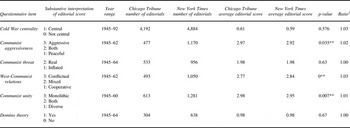
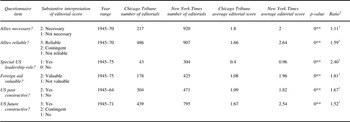
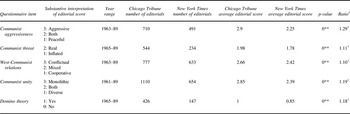
First, there was a dominant Cold War narrative, or consensus, in the 1950s, but it was narrow. The two newspapers’ editorials largely moved in lockstep regarding the centrality of superpower competition for global politics; on this issue, the gap between them was small and stable.Footnote 36 As Table 1 indicates, they agreed that the communist world was monolithic (see the row labeled “Communist unity”), that leading communist powers were expansionist and aggressive (Communist aggressiveness), that the threat was real (Communist threat), that relations between the two blocs were generally conflictual (West-Communist relations), and that the domino theory held (Domino theory). Between 1945 and the early 1960s, the differences between the two papers’ editorial stances on these five matters were either statistically insignificant (p > .05) or, when they were statistically significant, substantively negligible (3 percent or less, per the “Ratio” column). However, that is as far as the consensus went. As Table 2 shows, throughout the 1950s and early 1960s, the two papers’ editorials diverged over the reliability of allies (see the row labeled “Allies reliable?”), over whether the United States had special responsibilities as leader of the free world (Special US leadership role?), over the value of foreign assistance (Foreign aid valuable?), and even over whether the United States had in the past acted (US past constructive?), or would in the future act (US future constructive?), as a force for good in world affairs. The Times had much greater faith than the Tribune in US allies, in the utility of foreign aid, and in the need for and virtues of US leadership in world affairs. These differences were statistically significant (p < .01) and substantively large (on average, 68 percent).
The Cold War consensus: Representations of the communist Other

Notes: 1. Ratio is of higher to lower average editorial score. **Statistically significant: p < .05. †Substantively significant: > 10 percent.
Limits of the Cold War consensus

Notes: 1. Ratio is of higher to lower average editorial score. **Statistically significant: p < .05. †Substantively significant: > 10 percent.
Second, the usual periodization of even the narrow Cold War consensus is problematic: the consensus did not consolidate until well into the Korean War.Footnote 37 This is strikingly reflected in the paltry amount of editorial coverage the Tribune devoted, relative to the Times, to narrating the Cold War—to representing the free world's adversaries and the nature of the global conflict. Between 1948 and 1955, 48.3 percent of foreign affairs editorials in the Times identified the character of the leading communist powers, compared with just 28.7 percent in the Tribune; over that span, 25.1 percent of foreign affairs editorials in the Times referred to the perils of states going communist, compared with just 13.6 percent in the Tribune. Between 1948 and 1952, 44.6 percent of foreign affairs editorials in the Times presented a view of Western–Soviet bloc relations, whereas only 23.7 percent in the Tribune did. By the mid-1950s, the editorial coverage gap between the two papers had narrowed: the Tribune had joined the consensus.
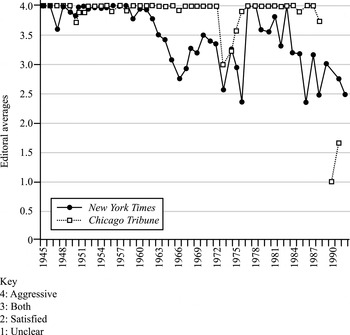
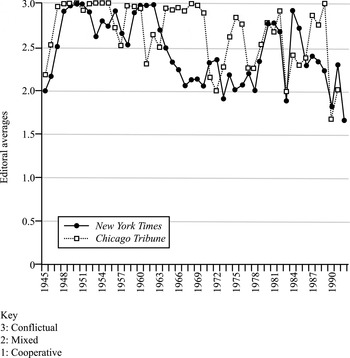
Third, the two papers’ articulated views did eventually diverge: as Table 3 indicates, from the early- to mid-1960s through the end of the Cold War, statistically significant gaps (p < .01) arose between the two newspapers on every question that had previously constituted the dominant narrative. The Tribune hewed to the traditional Cold War narrative, hardly diverging from its 1950s stance, whereas the Times deviated substantially. Those differences were substantively significant as well, averaging above 17 percent (per the “Ratio” column). But they emerged before leading figures in Congress, and before the American people, opposed the Vietnam War, and even before the Americanization of the war in 1965. Figures 1 and 2, displaying the papers’ editorial averages for communist powers’ aggressiveness and West-Communist relations, show this clearly. As the Vietnam War dragged on, there was even less agreement on representations of the Communist other, but the trend predates the war.Footnote 38
Aggressiveness of Communist powers

West-Communist relations

Erosion of the Cold War consensus

Notes: 1. Ratio is of higher to lower average editorial score. **Statistically significant: p < .05. †Substantively significant: > 10 percent.
Differences between the liberal internationalists at the Times and their conservative counterparts at the Tribune were real and growing by the early 1960s, but the former did not adopt editorial stances diametrically opposed to the erstwhile consensus. It did not represent the Soviet Union as a status quo power: between 1963 and 1975, its editorials averaged 3.21 on the scale—somewhat closer to expansionist/aggressive (4) than to satisfied/peaceful (2). It did not cast Western-Communist relations as generally cooperative, but at best as involving a mix of cooperation and conflict: even in 1966–70, a period of sustained optimism, its editorials averaged 2.12 on this question—close to a mixed-motive game (2) but slightly inclined toward zero-sum competition (3). It did not even decisively rebuff the domino theory, the preeminent legitimating logic of the Vietnam War: between 1965 and 1975, its editorials more often endorsed than rejected the claim that the United States should be concerned with other states “going communist,” averaging 1.60 (with 1.50 representing substantive indifference). These gaps were not trivial, but, comparing Tables 2 and 3, the differences between the two newspapers in the 1950s were four times larger than in this new zone of dissensus.
Contending Explanations
The content analysis challenges the conventional historical narrative and periodization of the Cold War consensus. It is also theoretically puzzling: standard models of change in the basic ideas informing national security do not accord with its findings. One well-known theory attributes change to large-scale policy failure. By this account, psychological, institutional, and social mechanisms mutually reinforce stasis with respect to national security, as in other domains.Footnote 39 Only during “critical junctures” can agents make meaningful choices that set a new course.Footnote 40 To explain how such moments of structural slack arise, scholars commonly invoke an exogenous shock that punctures stable equilibria and drives change in institutions and paradigms.Footnote 41 In the national security arena, this normally takes the form of substantial battlefield defeat. The most sophisticated account is Legro's, arguing that a necessary condition for the breakdown of dominant conceptions of how states should relate to international society is unexpected large-scale failure; success, even when unanticipated, yields no impetus for change.Footnote 42 This theory cannot make sense of a Cold War narrative that coalesced in the early 1950s, amidst a frustrating war in Korea, and that collapsed a decade later, when there was no unsettling shock.
Second, national security narratives might straightforwardly reflect global realities, as structural realists would argue.Footnote 43 Perhaps the Cold War narrative became dominant because it mirrored the bipolar structure of international politics, aggressive Soviet behavior, and a tightly controlled Soviet orbit, and perhaps it lost its grip on US national security debate because it was out of step with developments such as the Sino-Soviet split and Soviet moderation. The dominant Cold War narrative, however, came together only around Joseph Stalin's death, and it was strongest afterward—when, under Nikita Khrushchev, the Soviet bloc was becoming more diverse and Soviet policy growing more tolerant of difference. Moreover, contemporary realists such as George Kennan and Walter Lipmann, who were presumably most attuned to the realities of global politics, took issue early on with the Cold War narrative's view of global communism as monolithic and of superpower competition as a zero-sum game.Footnote 44 Finally, according to this realist theory, a new narrative should have become dominant in the 1960s that reflected crucial changes in global politics, notably a divided communist world following the eruption of Sino-Soviet conflict and shared superpower interests following the resolution of the Cuban Missile Crisis—but none did.
Third, perhaps national security narratives shift course along with presidential administration. When new presidents come into office, they often bring a different vision of global politics, conception of the national interest, and foreign policy priorities, a different group of advisers on whom they are reliant, and a different set of major contributors to whom they are (somewhat) beholden, especially when the new president comes from another political party.Footnote 45 Leaving aside the partisan presidential account's overall merits, it does not fit the Cold War narrative's dynamics. The key periods of change do not correspond to changes of presidential administration or party control of the White House. Those have been too frequent, and some key changes have occurred during times of partisan presidential stability.
The puzzle of the Cold War narrative's rise and fall is all the greater when one considers the events surrounding the nodal periods of change. They coincided with the two signal events of the first half of the Cold War: the Korean War, which was the first large-scale US military engagement of the bipolar era, which settled into a bloody stalemate, and which Americans experienced as deeply disappointing and chastening; and the Cuban Missile Crisis, which was the closest the two superpowers came to direct military confrontation and whose resolution Americans across the political spectrum saw as an unprecedented success. The consensus consolidated amidst (perceived) military failure, and began to erode after (perceived) victory in a major episode of coercive diplomacy. This outcome is theoretically surprising, but it is not a coincidence. The Cold War narrative rose to dominance not despite but because of the poor US performance in Korea, and its dominance slipped not despite, but because of, the seemingly one-sided US triumph over the USSR in Cuba.
Public Narrative and the Politics of the Battlefield
Both realist and historical institutionalist accounts of change are typically insufficiently sensitive to politics. Because realists implicitly adopt rationalist models of belief updating, whereas institutionalists believe all institutions and discourses are sticky, or tend to endure, they differ over how much discrepant evidence is required before learning occurs. However, both typically treat events as exogenous and as proving policies and ideas right or wrong. This article begins from the constructivist premise that although events—from natural disaster to economic recession to military conflict—are unquestionably real, their social import is not determined by any of their objective features. Whether an event is seen as a shocking crisis or manageable problem is endogenous to political contestation. As Hay writes, “crises are constituted in and through narrative.”Footnote 46
If dominant narratives coalesced and collapsed in response to objective shocks, it would make sense to conceptualize collective learning as an epiphany—per the institutionalist literature. The prevailing image of substantial failure, including battlefield defeat, as a moment of intellectual awakening is apt when defeat is overwhelming and wars are extremely short. But the collective perception of even major defeats normally comes together only at the end of a protracted process in which actors seek to make sense of accumulating setbacks. Few military contests have ended as decisively as World War II did for Germany and Japan, and even substantial battlefield defeats have permitted interpretations, such as the “stab in the back,” that legitimated rather than rejected the past. Although it is true that short wars are more common than even scholars generally realize,Footnote 47 most wars provide ample opportunity while combat is raging for debate over their lessons. Diverse approaches figure crises as times of national unity beyond politics,Footnote 48 but protracted conflicts are rife with disputes over the military's stumbles, which, the logic of path dependence suggests, condition the scope and direction of subsequent change. Both the emergence and breakdown of dominant narratives are deeply political processes.
Even when victory and defeat are clear,Footnote 49 accounting for these outcomes and assessing their implications are normally matters of intense public debate—not just in retrospect, but in the moment. As battlefield travails come to light, domestic political contestation centers on how to explain them. Is the army being outgunned or outsmarted? Does it lack fighting spirit, or did the nation's leaders dispatch it to an unwinnable war? Does the problem lie in tactics or strategy, or with the war's fundamental rationale and thus with the national security narrative in whose terms leaders had legitimated the war? Political elites are not equally empowered in these public contests. Government spokespeople enjoy substantial starting advantages in the exercise of “interpretive leadership,”Footnote 50 and because they own the military campaign, victory redounds to their benefit. Military setbacks, however, erode public trust, diffuse authority, and empower the opposition, and thus opposition leaders’ rhetorical deployments are most crucial in this context.
Opposition elites’ rhetorical choices have profound narrative implications. Because dominant narratives require continual reproduction, and because they always contain contradictory strands that make possible the remaking of common sense, these elites can, broadly speaking, explain the nation's battlefield travails either by reproducing the security narrative in whose terms the campaign had been legitimated or by charting a new narrative path. Both permit criticism of the government, but when opposition elites opt for the former, they reinforce the dominant narrative, and when they opt for a new path, they help undermine it. They are of course not the only producers of culture, authorized to remake the boundaries of the legitimate, and indeed activists and intellectuals are often the progenitors of alternative narratives. But those alternatives remain sidelined until political elites take them up. As the literature on securitization has emphasized, not everyone “can ‘do’ or ‘speak’ security successfully.”Footnote 51 Public debates rarely take place on level playing fields, especially in the national security domain—where publics mostly look to official sources, and especially the executive branch, for the production of meaning.Footnote 52
Whether elites publicly give voice to other narratives of national security depends on whether the alternatives are compatible with their established political identity and whether they see it as politically profitable. Although opposition elites’ rhetorical choices are thus to some extent contingent, they are partly the product of a predictable political environment. Early in a faltering war whose ultimate outcome is uncertain, all contestants, stylized here as doves and hawks, as opponents and supporters of military action and hard-line policies, have incentives to ground their criticisms in the legitimating national security narrative and thereby to preserve or consolidate its dominance. The politics of failure inhibit the opposition from jumping through a more ambitious rhetorical window and pursuing change in the narrative in whose terms the military operation had been publicly justified. As a result, national security narratives survive even substantial failures.
This conclusion derives from a view of political action as both cultural and strategic.Footnote 53 Doves and hawks operate within a common social environment with shared cultural toolkits they draw on to make public sense of events. But they are also strategic actors seeking to further their political fortunes via their public accounts of the conflict's course. To put strategizing political elites at the center of the dynamics of a national security narrative is not to reduce dominant narratives to elite strategizing alone. Whether elites can advance specific security narratives depends on more enduring structures of national identity discourse, in which those narratives must be grounded. At any given nodal point, the range of legitimate rhetorical moves is limited, due in part also to past elite rhetorical deployments.Footnote 54 Although neither national identity discourse, nor rhetorical consistency, nor strategic incentives render political action entirely predictable, this article rests on the wager that, in the context of a failing military venture, both those pressures and the dangers of bucking them are fairly clear and intense. I thus expect the following contingent generalizations often to hold, but there remains an irreducible element of choice, of agency.Footnote 55
Consider first political opponents who oppose the war. Doves confront a difficult choice: to seize the opportunity that military struggles provide to assail the underlying narrative, or to offer a more modest attack on the war that reaffirms that narrative. For instance, the surprising persistence and effectiveness of the Sunni insurgency in Iraq created an opening for Democratic doves to take on the George W. Bush administration. They could have exploited US struggles in Iraq to confront the Terror narrative the Iraq invasion had been bound into. But they also could have criticized the Iraq War from safe narrative terrain—as a distraction from the “real” War on Terror, against al Qaeda and the Taliban in Afghanistan and Pakistan. When leading Democrats opted for the second course, they disappointed many supporters, but their choice was not surprising in light of the fog of war and the politics of military failure.
When evidence of military difficulties has begun to accumulate but before the perception of irrevocable failure has crystallized, doves are reluctant to launch a thorough critique of the war's underlying narrative. Criticism in wartime is always dangerous, but the deeper it strikes, the more vulnerable critics are to charges that they are emboldening the enemy, demoralizing the troops, and prolonging the fight. This is especially true early in a war, when its outcome is still seen as uncertain and when vocal criticism arguably can affect whether the war ends in victory or defeat, not just the inevitable conclusion's terms and costs. Should the war's course reverse, critics’ judgment will be severely questioned, and should the nation's forces continue to flounder, critics may be held responsible, not lauded for their prescience. Given the stakes, it is far safer for doves to criticize the war's conduct, insist that the strategy's application alone is flawed, or propose withdrawal because of excessive cost or insufficient likelihood of victory. As a result, even as the war's costs mount, doves typically express themselves within the terms of the dominant narrative. Politics does not stop at war's edge, at least not for long, but wartime politics is normally waged within narrative bounds.
These political dynamics, narrowing the scope of criticism in a campaign's early stages, have long-term consequences. Once there is widespread agreement of defeat—that is, beyond the tipping point of failure—doves might find it appealing in principle to recast the narrative basis of national security, but that option is no longer available. Their past utterances, which reproduced and reinforced the dominant narrative, have established the conventions the public expects members of the “responsible opposition”—in both government and civil society—to adhere to. Those who move beyond those boundaries of legitimate critique, to embrace an alternative narrative of national security, are predictably assailed as reckless radicals. Were doves to know in prospect what they know in retrospect, they might couple their wartime criticism to a revision of the nation's security narrative. But the politics of an uncertain and failing war cast narrative alternatives to the margins in war's early stages—where they remain. This mechanism of lock-in is at work not only when the political opposition's leadership is stable, but even when military defeat shakes up the established order and brings new personalities into politics who are not personally shackled by a wartime rhetorical past. Wishing to avoid the radical label, politicians and pundits alike are confined to the dominant narrative. Even Barack Obama, who more than any other top Democrat made opposition to the Iraq War the centerpiece of his political persona, remained in thrall to the Terror narrative as a senator and presidential candidate. He joined other leading Democrats in criticizing the Iraq War as having obstructed the War on Terror properly conceived.Footnote 56
Now consider political opponents who support the war. Hawks face a seeming dilemma. On the one hand, they do not wish to undermine public support for the war, which may already be flagging: were they to challenge the war's legitimating logic, the public might lose faith entirely. On the other hand, they wish to exploit battlefield setbacks for political gain: supporting the policies and echoing the arguments of the wartime leadership will not position them as a credible political alternative. To sidestep the dilemma they can accuse the government of not having been sufficiently faithful to its articulated worldview and suggest that greater fidelity would have led to better battlefield outcomes, or even made the war and its attendant sacrifices unnecessary. Criticizing the war's conduct and presenting themselves as true believers, hawks seek to renew the mass public's commitment, redouble the military's efforts, and offer the public a distinctive political stance. Opposition hawks thus make political headway, albeit at the cost of principle if their hawkish preferences are rooted in a different narrative of national security from that of the wartime government. In contrast to opposition doves, who seek to evade the perils of criticism, hawks are lured by the prospect of gain. However, the effect is the same: to shore up the underlying narrative of national security. In fact, the politics of military failure can work to consolidate narrative dominance, when hawks are enticed to sign on to a narrative they had previously refused to endorse.
Although the politics of military failure stifle change, success on the battlefield and in significant episodes of coercive diplomacy opens space for departures from the dominant narrative. This is counterintuitive from the perspective of actors’ motives.Footnote 57 But motive is only half the story, and triumph alters the opportunity structure facing those in both government and civil society who wish to narrate the world differently but previously felt politically constrained. Success boosts the interpretive authority of both government spokespeople and their civil society allies, loosening those constraints and permitting them to advance their preferred alternative. It creates an opening for its owners to argue that the rules of the global game have changed because the policy they advocated or implemented was so successful. Success does not end narrative dominance, but it makes its breakdown possible—depending on whether doves or hawks occupy positions of authority: doves can reveal their true colors, while hawks are free to continue toeing the narrative line. Success is not, however, conducive to the consolidation of a new dominant narrative because it creates space for alternative futures without delegitimizing the past. It has not only many fathers, but many lessons: it can also be interpreted as proving the wisdom of the status quo from which deviation is dangerous. The erstwhile dominant narrative retains its legitimacy, and so, even when doves seize the opportunity that success provides, the result is at most the erosion of narrative dominance.
This theoretical framework helps make sense of the peculiar dynamics of the Cold War narrative. The protracted war in Korea—frustrating to Americans fresh after World War II, sure of their rectitude and power, and confident that their wealth and know-how guaranteed swift victory—might have led to the rejection of globalist underpinnings, but the Republican Party leadership composed of hawkish conservatives behaved in line with theoretical expectations. Worried about undercutting the war effort yet eager to strike political gains, they abandoned their preferred narrative that denied the world's tight interconnectedness. In assailing the Truman administration for having left East Asia to communist predation—that is, for pursuing a containment policy that was insufficiently global—they deprived a nonglobalist alternative of its leading voices and helped consolidate the Cold War consensus. A decade later, the Cuban Missile Crisis allowed the liberals who took credit for that triumph to articulate a different vision of the Soviet Union, global communism, and the possibilities of détente. During the Cold War, superpower crisis is what passed for the battlefield, and the administration's victory created an opening, which Kennedy eagerly seized. The Cuban Missile Crisis made possible the demise of the Cold War narrative's decade-long dominance.
Consolidation: The Korean War and the Nationalist Alternative
The dominant Cold War narrative took shape through the marginalization of alternative narratives propounded by accommodationists and conservative nationalists. Accommodationists, such as former Vice President Henry Wallace, shared with Cold Warriors internationalist premises—the indivisible nature of global security, the need for allies, the imperative of US leadership, the potential for constructive US engagement—but they differed in their representation of the adversary, their understanding of local conflicts, and the nature of superpower relations. Conservative nationalists could not be outdone when it came to anticommunism, but they accepted neither global interconnectedness nor a special US role in global affairs. Accommodationists fell silent after the outbreak of war in Korea, which seemed to confirm a Moscow-driven communist agenda of aggression.Footnote 58
The Korean War, however, need not have been fatal to the conservative nationalist narrative of national security. The North Korean invasion seemed to confirm their anticommunism, but it did not inherently undercut their skepticism of a global Cold War. In fact, the public's frustration with the costly stalemate could have bolstered their challenge to Cold War premises, as Secretary of State Dean Acheson feared.Footnote 59 In human terms, the war was overall nearly as costly for the United States as the subsequent war in Vietnam—on an annualized basis, even more so.Footnote 60 The Korean War became deeply unpopular after Chinese forces crossed the Yalu River and a bloody deadlock set in,Footnote 61 and Republican politicians repeatedly sought to exploit the public's frustration for political gain.Footnote 62 So desperate were Americans to bring the boys home that the war hero and presidential candidate Dwight Eisenhower's vague promise, “I shall go to Korea,” won them over in 1952.Footnote 63 Even as the war's memory faded, Americans continued to see it as a waste of blood and treasure: the most popular reason to support Republican candidates in 1956 was that the party had extricated the country from Korea.Footnote 64 There is thus good reason to think that the war's course could, if not should, have led to the rejection of its legitimating Cold War logic and redounded to the conservative nationalist alternative's benefit.
Yet the opposite occurred. By war's end, globalist premises ruled US foreign affairs debate: the Cold War consensus had consolidated, the nationalist narrative cast to the periphery. Conservative nationalists, however, who then dominated the congressional Republican leadership, had only themselves to blame. As military setbacks in Korea accumulated, they did not invoke them as evidence of the folly of a militarized, US-led global crusade against communism—which would have accorded with their narrative of global politics and with their domestic priorities. Rather, consistent with my theoretical expectations for opposition hawks amidst a faltering military campaign, they exploited military misfortune for political gain by trying to outdo the Cold Warriors in their enthusiasm for a global Cold War. Taking the Truman administration to task for waging its global crusade inconsistently and ineptly, they shunted aside the nationalist alternative they held dear.
At first, conservatives rallied ’round the flag: every Republican senator—even as orthodox a nationalist and as harsh a critic of Truman as Senate Minority Leader Kenneth Wherry of Nebraska—supported the administration.Footnote 65 But they held true to their vision even as they rallied. Senator Robert Taft of Ohio, the unquestioned party leader and the nation's most prominent conservative politician, challenged the legitimating globalist logic: the independence of Korea, he declared, was not a vital US national security interest, and the choice to draw the line there against communist aggression was arbitrary.Footnote 66 The Chicago Tribune spoke for many conservatives in objecting to the president's apparent belief that “it is the duty of the United States to oppose the spread of Russian communism anywhere, at any time.”Footnote 67 There was clearly no consensus on the nature of the post–war world in winter 1950–51, when Republican elder statesman and former president Herbert Hoover initiated the so-called Great Debate over permanently stationing US forces in Europe. Calling on Americans “to preserve for the world this Western hemisphere Gibraltar of Western Civilization,” Hoover challenged the liberal internationalist claim that the fabric of global politics was so tightly interwoven that security was indivisible. The communists, he reasoned, “can no more reach Washington in force than we can reach Moscow.” Even in a world in which Soviet-led communism was on the march, the United States could thrive “indefinitely” and could, regrettably, concede areas to communist domination.Footnote 68
Yet the Great Debate marked the last roar of conservative nationalism, which would soon be strangled by the politics of Korea. In contrast to Hoover, whose political time had passed, younger leading conservatives readily sacrificed their nationalism on the altar of political expediency. Eager to score gains against an administration already on the ropes, Taft privately strategized just a month into the war that “the only way we can beat the Democrats is to go after them for their mistakes. … There is no alternative except to support the war, but certainly we can point out that it has resulted from a bungling of the Democratic administration.”Footnote 69 Conservative Republicans, hawks in the political opposition, followed Taft's playbook for more than two years. They not only cast Korea as the latest debacle, following the loss of China and of the US atomic monopoly, but they invoked the domino theory to explain it: by selling out the nationalists in Formosa (Taiwan), Truman had invited aggression in Korea and perhaps soon in Indochina.Footnote 70 Even Harold Stassen, the normally moderate former governor of Minnesota and a serious presidential contender, could not restrain himself: the war, he advised in November 1950, resulted from “five years of coddling Chinese Communists, five years of undermining General MacArthur, five years of snubbing friendly freedom-loving Asiatics, and five years of appeasing the arch-Communist, Mao-Tse-Tung.”Footnote 71 In short, the Democrats had not been sufficiently faithful to the logic of the Cold War. This was hardly a new line of attack for Republicans, who spat out “Yalta” as if the word itself were evidence of Democratic perfidy, but the Korean War gave it renewed impetus and, crucially, a new Asian twist.
Unlike the party's “China bloc,” the orthodox Republican Right of Taft, Wherry, and Speaker of the House Joseph Martin had previously shown as little interest in committing US resources to East Asia as to Europe.Footnote 72 After North Korea's invasion, however, they discovered a long-lost love of Asia, and they enthusiastically backed General Douglas MacArthur, who called for escalating the war to China and whom Truman cashiered in April 1951. MacArthur was an orthodox if extreme Cold Warrior, whose commitment to Asia followed from the logic of the global Cold War: if containment was necessary in Europe to prevent Soviet aggression, and US military forces needed to be beefed up there, aggressive containment was equally warranted in Asia, especially when capable Nationalist Chinese were eager to join in. The deep interconnectedness of global politics, he warned Martin in a letter that became public, required the United States to beat back communism in Asia: “If we lose the war to Communism in Asia, the fall of Europe is inevitable. Win it, and Europe most probably will avoid war and yet preserve freedom.” His view of the Cold War was unselective: “I believe we should defend every place from Communism. I believe we can. I believe we are able to,” he testified to Congress.Footnote 73
MacArthur's stance was attractive to opposition hawks for obvious reasons: it scored political points without harming the war effort.Footnote 74 Conservative Republicans, however, could not follow MacArthur and preserve their opposition to the global Cold War. After all, for MacArthur, the chief problem with the administration's policy was that it was not global enough. Moreover, only by reproducing the logic of the global Cold War could hawks make their criticisms stick; if global security were divisible and if the battle against Communism were correspondingly selective, the administration's lack of resolve in East Asia may not have been very consequential. Thus in May 1951 Taft echoed MacArthur in declaring that his quarrel was “with those who wished to go all out in Europe, even beyond our capacity, and at the same time refuse to apply our general program and strategy to the Far East.” The administration's half-hearted commitment to the Cold War, Senator William Jenner of Indiana charged in fall 1951, had produced a “treadmill war.”Footnote 75 Had they been true to their principles, members of the Republican Right should have pressed to scale back US efforts in Asia, but instead they endorsed the expansion of what they had previously condemned as an illogical and unaffordable policy. As the long-time pacifist A.J. Muste observed ironically, “For isolationists, these Americans do certainly get around.”Footnote 76 In a July 1951 private letter, Taft admitted that his endorsement of an aggressive global Cold War was political in design: MacArthur may not be completely right when it comes to foreign policy, he wrote, but “we cannot possibly win the next election unless we point out the utter failure and incapacity of the present Administration to conduct foreign policy and cite the loss of China and the Korean war as typical examples of their very dangerous control.”Footnote 77
Once the Republican old guard had so publicly endorsed the global Cold War, the conservative nationalist narrative of national security not only lost its most prominent spokesmen, but descended into the realm of the irrelevant and irresponsible. Downplaying the threat posed by global communism and portraying global security as divisible—pillars of the nationalist alternative narrative—were clear signs that one was not serious and respectable. Thus by 1953 few conservatives elected to national office still publicly voiced reservations to Cold War globalism. Shortly after entering office, Eisenhower noted in his diary with pleasant surprise that, when it came to foreign policy, he and Taft never disagreed “academically or theoretically”—on principles—only on questions of application to and implementation in specific cases.Footnote 78 Even Hoover had by the middle of 1954 given up the fight against the global Cold War: “Our dangers from the Communist source of gigantic evil are unending,” he insisted.Footnote 79 If conservatives needed any reminder of the boundaries of legitimation in the early 1950s, they just had to look at the remaining old progressives, who generally railed against the global Cold War and found themselves ignored, dismissed as “hick provincials” and renegade isolationists.Footnote 80
Conservative intellectuals were also coming to terms with the new reality. In the mid-1950s, the National Review led the intellectual effort to fuse Burkean conservatism and antistatist individualism under the banner of anticommunism. The prominent libertarian Murray Rothbard ruefully recalled that, by the mid-1950s, “old libertarian and isolationist compatriots who should have known better … [and] who used to scoff at the ‘Russian threat’ and had declared The Enemy to be Washington, D.C. now began to mutter about the ‘international Communist conspiracy.’”Footnote 81 The globalism that nationalist hawks embraced in the midst of the Korean War had real costs, for it proved “a devil's bargain” that undermined their vision of the state.Footnote 82 Unable to deny the government the resources it needed to wage the global struggle, conservatives gave their blessing to the national-security state. The Old Right's maneuvering in the shadow of the Korean War paved the way for the rise of the globalist, interventionist New Right of Barry Goldwater and Ronald Reagan.
The Old Right never did shake the isolationist label, however. So pilloried, they were a useful foil to Cold Warriors in both parties. Taft's ill-deserved reputation as a doctrinaire conservative would serve him well though in the wake of the Vietnam War. Critics of the US intervention in that Asian conflict would proclaim the much-maligned Taft a “sober, wise, and realistic voice” who had warned of the dangers of the Cold War.Footnote 83 It is more than a little ironic that the Cold War consensus is perhaps Taft's most significant historical legacy.
Collapse: Cuba and the End of the Cold War Consensus
This Cold War narrative's dominance, however, lasted only about a decade. Beginning in 1963, while the Chicago Tribune remained faithful to that narrative, the New York Times’ assessment of communist aggressiveness declined substantially; its judgment of Western-Communist relations moved much closer to a mixed-motive game; and it more often thought the communist threat exaggerated. It was not defeat in Vietnam but triumph in Cuba that allowed liberal internationalists to drift from the Cold War narrative. However, as expected, conservative Cold Warriors continued to toe the old Cold War line, and they charged liberals with naively confusing a tactical flash in the pan with enduring strategic change.
Liberal activists and intellectuals had for years been poking holes in the Cold War narrative.Footnote 84 Behind closed doors, some officials, including Kennedy himself, questioned key elements, especially the zero-sum nature of superpower competition. In a background interview in 1959, Kennedy noted that what impeded the two powers from achieving a more stable modus vivendi was less Soviet ideology or ambition than preconceptions and miscommunication: “You have two people … who are both of goodwill, but neither of whom can communicate because of a language difference.”Footnote 85 In his March 1962 draft Basic National Security Policy, Walt Rostow, the head of Policy Planning, observed that “it may become increasingly possible to make [the Soviets] feel that we share a common interest in the exercise of restraint”; their communist system did not guarantee war and did not preclude “constructive participation.”Footnote 86 This view at times influenced Kennedy's decision making: during the Bay of Pigs operation, he refused to authorize air cover for the exiles because he feared provoking Soviet action against Berlin, which struck Eisenhower and Richard Nixon as a naïve reading of the sources of Soviet aggression.Footnote 87
However, these stirrings on the margins and in private rarely penetrated mainstream public discourse before the Cuban Missile Crisis. The major exception was the Sino-Soviet split, whose importance experts and policy-makers publicly recognized by the early 1960s, and they perceived centrifugal forces—“polycentrism” was the inelegant term—elsewhere in the communist world.Footnote 88 In general, however, the Times’s editorials on foreign affairs remained faithful to Cold War axioms, and the Kennedy administration's public rhetoric continued to hew to Cold War orthodoxy. The gap between the president's private musings, which displayed a “mentality extraordinarily free from preconceived prejudices,” and his public rhetoric startled former Ambassador to the USSR Chip Bohlen.Footnote 89 Pressure from the Right, reinforced by the administration's own Cold War rhetoric, kept Kennedy from closing that gap: Khrushchev “would like to prevent a nuclear war but is under severe pressure from his hard-line crowd … I've got similar problems,” he told Norman Cousins, editor of the Saturday Review.Footnote 90
What permitted liberal internationalists to begin deviating from the dominant Cold War narrative around 1963? Not large-scale failure, but success—specifically what seemed to be an unambiguous US triumph in an episode of coercive diplomacy that was the closest to date the two superpowers had come to blows: the Cuban Missile Crisis. Although we now know that the resolution of the crisis was a negotiated outcome in which the United States accommodated Soviet and Cuban concerns, the administration successfully went to great lengths to keep secret its agreement to remove the Jupiter missiles from Turkey.Footnote 91 Perhaps afraid that, under pressure, the Soviets might reveal the Jupiter deal, Kennedy and other officials refrained from publicly gloating, and they asked for the press's cooperation. However, the prevailing view at the time across the political spectrum was that Kennedy had scored a great victory, and journalists had difficulty exercising restraint. As Rovere wrote in The New Yorker at the time, it was “perhaps the greatest personal diplomatic victory of any President in our history.”Footnote 92
According to the Times, “reason prevailed” in October 1962—not because the United States suddenly saw the light, but because the Soviet Union finally came around to the long-standing American view of the nuclear balance of terror. Kennedy had “made clear time and again” that violence was not a rational tool of policy in a nuclear-armed world, and it was “encouraging” that Khrushchev now agreed. The two sides had not stepped back equally from the brink: Khrushchev had suffered a “humiliating defeat” in Cuba that he would never live down, while Kennedy deserved “the chief credit … [for] the fateful decision to confront Soviet Russia head-on” and for his prudent display of “American military might and firmness of purpose.”Footnote 93 His resolve had brought about not merely tactical adjustment on the Soviets’ part, but “a turning point in the cold war” heralding an era of “great détente.” Under the shadow of mutual assured destruction whose implications, thanks to liberal Cold Warriors, both superpowers now grasped, liberal internationalists at the Times looked forward to the possibility of ending the Cold War. A year later, they affirmed that strategic change was a fact, not “mere wishful thinking.”Footnote 94 Thus, when negotiations stalled in 1963–64 and the Soviets adopted a hard line, the Times interpreted this not as evidence of Soviet duplicity (as they had in the past) but as “ritualistic” posturing to appease Peking. Once a skeptic of negotiations, the Times had become an unequivocal advocate: “as long as the Russians are willing to talk, the possibilities of agreement exist, and we must continue to explore them.”Footnote 95
Afterward, the Kennedy administration also felt free to articulate publicly and more consistently a vision for transcending the Cold War, which it linked expressly to the crisis.Footnote 96 In mid-December the president told the public in a nationally televised interview that Khrushchev had finally “showed his awareness of the nuclear age[,] … of the dangers of the United States and the Soviet Union clashing over an area of vital importance.”Footnote 97 In an address at American University in June 1963, Kennedy forthrightly challenged the Cold War narrative, calling on Americans to reexamine their most basic attitudes “toward the possibilities of peace, toward the Soviet Union, toward the course of the cold war and toward freedom and peace here at home.” Mirroring concerns he had long expressed privately, Kennedy shared his fear of nuclear holocaust arising less from Soviet aspirations to world domination than from a security dilemma: “a vicious and dangerous cycle in which suspicion on one side breeds suspicion on the other.” The danger of nuclear war derived from “a distorted and desperate view of the other side,” from the “trap … [of] see[ing] conflict as inevitable, accommodation as impossible, and communication as nothing more than an exchange of threats.” Only after the Cuban Missile Crisis could Kennedy preach publicly what he had preached privately—that the superpowers shared “a mutually deep interest in a just and genuine peace and in halting the arms race” and that this interest trumped both ideological commitments and legitimate conflicts of interest.Footnote 98
Victory in the Cuban Missile Crisis freed liberals from the strictures of the Cold War narrative. It opened political space for them to narrate the world in public the way many had behind closed doors. For the American University address, speechwriter Theodore Sorensen drew on draft language that had been deleted from earlier major addresses, at the inauguration and at the United Nations in 1961, for being in those days too great a departure. As Beschloss notes, “there was not a sentence in this speech with which [Kennedy] would have privately disagreed in 1960. The change was not in Kennedy but in what he perceived to be his political environment.”Footnote 99 That vision did not become more sustainable simply because the crisis woke Americans up to the dangers of a nuclear-armed world. Although it amplified Americans’ fears of nuclear holocaust, Cold Warriors had previously grasped that mutual assured destruction gave the superpowers a common interest in avoiding direct confrontation. This premise underlay the Eisenhower administration's embrace of “massive retaliation,” which presumed that the Soviets would heed American threats, if only in extremis. That the Soviets backed away from the brink in Cuba was consistent with Cold War expectations and did not necessarily mean that they were open to genuine dialogue and a permanent settlement. That inference would have been reasonable if the Soviet Union had substantially changed its behavior after the crisis. But the USSR took few concrete steps in the months after October 1962 to alter that view.Footnote 100
However, the Cuban Missile Crisis equally lent itself to another interpretation: that it revealed the wisdom of staying the course. For conservative Cold Warriors at the Tribune, the outcome of the missile crisis was a great success, a “Red backdown,” and they even had complimentary things to say about the president's “unexpected show of … firmness.”Footnote 101 But the fact that the missile crisis had occurred at all simply confirmed how implacable the Soviet Union was and how dangerous it would be to negotiate with such a deceitful foe: it reinforced the dominant Cold War narrative. The crisis, conservatives argued, demonstrated the imprudence of deviating from the path of strength.Footnote 102 Before long, many, including Nixon and Republican Party Chairman George H.W. Bush, were taking the administration to task for allowing the Soviets to maintain a troop presence on the island.Footnote 103 Whereas liberal internationalists around the globe greeted the crisis’s end with hope, the retired Eisenhower, hardly a rabid Cold Warrior, warned against such optimism, citing a history of communist trickery and insisting that “the conflict of ideas, ideologies which defines what we have called the cold war, will continue.” Months later, the Tribune labeled the Nuclear Test Ban Treaty a “delusion” and a “snare.”Footnote 104 Senate Minority Leader Everett Dirksen agreed that the president's aspirations for a test ban treaty constituted a “renunciation of the policy of strength,” which had proved its worth in Cuba.Footnote 105
Consistent with theoretical expectations, even as the triumph of the Cuban Missile Crisis made possible the dissolution of the Cold War consensus, it did not yield a new one. Conflicting interpretations regarding US adversaries, superpower relations, and the magnitude of the threat were equally sustainable in its wake. The battles over Vietnam at home took place on a narrative terrain that had already begun to fracture.
Conclusion
This article has a dual agenda. On the one hand, it offers a reinterpretation of an important historical case. It shows that the narrative of national security that historians refer to as the Cold War consensus became dominant later, and lost its dominant standing earlier, than conventional accounts suggest. On the other hand, it also rethinks theoretically why and how major institutional and ideational change takes place. The Cold War consensus should have been an easy case for two common theories: that dominant narratives reflect global realities, and that only large exogenous shocks undo dominant narratives. My data on the Cold War narrative, however, confound realist and institutionalist expectations. To make sense of the Cold War consensus, I advance a more deeply political theoretical account. When it comes to public narratives in the national security domain, failure and success have surprising effects: military setbacks discourage elites from challenging the dominant narrative, whereas victory loosens the opportunity structure and permits deviations from that narrative. This theory accords more closely both with the quantitative content analysis and with qualitative evidence from the Korean War and the Cuban Missile Crisis.
This article's novel account of the Cold War consensus has implications for at least three enduring puzzles of US policy during the Cold War. First, for US state development, from one vantage point, it is surprising that the Cold War did not produce a garrison state. However, from another perspective, the puzzle is why the Cold War brought about a broad and deep national-security state and military-industrial complex despite antistatist traditions in the United States. The Old Right's abandonment during the Korean War of the nationalist narrative opposing Cold War globalism provides part of the answer. Second, regarding the changed character of superpower conflict, a more rule-governed superpower relationship emerged after the Cuban Missile Crisis, but it did not derive directly from mutual heightened awareness of the dangers of nuclear armageddon. It hinged, in the United States, on the demise of the earlier Cold War narrative's dominance. That too is a legacy of the Cuban Missile Crisis. Third, concerning the Vietnam War, scholars now know that large-scale US military intervention in Southeast Asia was not a direct result of Cold War groupthink. Had a new consensus taken shape in the wake of the Cuban Missile Crisis along the lines Kennedy envisioned, the charge of having “lost” Vietnam would have had little resonance, and President Lyndon Johnson might have avoided escalating US involvement in a war he thought unwinnable. But that indictment continued to resonate in the mid-1960s, with tragic consequences. This article explains why no new consensus consolidated in the wake of the triumph of the Cuban Missile Crisis.
Whether my counterintuitive theoretical argument travels beyond the Cold War and beyond the United States remains to be seen. It is true that, unlike other nations, the United States, by virtue of its geographical position and the absence of peer competitors in its hemisphere, normally has been located far from the battlefield and somewhat shielded from the costs of war. But distance has not led Americans to look on the nation's faraway wars with equanimity, and these wars, even when limited in scope, have resonated powerfully in American politics.Footnote 106 The political stakes of war are at least as great when the battle rages nearby, and wars on one's own territory can still be protracted, end indecisively, and be subject to multiple interpretations. Despite the unusual US geopolitical position, there is little reason to think that its experiences with respect to national security narratives are unusual. There was of course something distinctive about the Cold War superpower rivalry, conducted under conditions of bipolarity and in the shadow of nuclear armageddon. However, those factors should, if anything, have rendered national security narratives more responsive to presumptive global realities and less subject to the logic of narrative politics. The ways in which the Cold War was an outlier make it an especially hard case, which should give greater credence to the theoretical claims.
Although space constraints preclude much consideration of the argument's cross-national applicability, it is common for political oppositions to criticize military operations from the safe terrain of the dominant narrative. Everywhere the natives proved ungrateful for the graces of liberal empire. But their continual resistance, and the imperial forces’ regular setbacks, typically led to questions about methods and means, rarely to fundamental challenges to the imperial enterprise and its civilizing mission. The initial stages of the Yom Kippur War of October 1973 were so disastrous that it came to be known in Israel as the mehdal—the failure—despite the subsequent operational triumphs. However, the oft-heard charges of complacency, arrogance, and poor judgment directed at the political and military leadership and the intense demand for political accountability resulted in no fundamental rethinking of Israel's strategic environment, strengthened the right and the rhetoric of siege, and left the dominant narrative largely intact. France's floundering in Indochina and Algeria in the 1950s led to constitutional change, but opposition leader and then President Charles de Gaulle's calls for the restoration of French grandeur were rhetorically conservative, framed as an adjustment of means, not ends. Even Mikhail Gorbachev, who as a junior Politburo member in 1979 bore little responsibility for the invasion of Afghanistan and who as premier shared his Politburo colleagues’ pessimism that the Soviet Union could stabilize that country, was reluctant to break with his nation's dominant Cold War narrative: he long hesitated to withdraw Soviet forces from Afghanistan because he expressly feared it would harm the Soviet Union in the continuing superpower competition for Third World allegiances. I leave it to others to explore these and other cases and to identify scope conditions beyond those mentioned earlier: the extent and rapidity of military defeat.
The same dynamics were also at work in American politics in the decade after 9/11. The administration of President George W. Bush sold the Iraq War by binding it tightly into the War on Terror. One might have expected the Terror narrative to have met its end in the sands of Iraq, just like the US military's travails in Vietnam supposedly shattered the Cold War consensus. One might have expected the administration's Democratic opponents to jump at the chance to articulate a different narrative of national security. I have argued in this article, however, that although wartime setbacks shift narrative authority to the opposition, opposition doves are hesitant to break with the war's underlying rationale. This is precisely what leading Democrats did.
In line with this article's theory, setbacks on the Iraqi battlefield undercut the authority of the Bush administration, and more generally the Republicans, with respect to national security.Footnote 107 However, even as US forces in Iraq faced an increasingly sophisticated and effective insurgency and even as the insurgency morphed into a sectarian civil war, leading Democrats left the underlying Terror narrative untouched. Even as they stridently criticized a war they had once supported, leading Democrats did not launch a frontal assault on the War on Terror. Instead, they cast the Iraq War as a betrayal of the War on Terror properly conceived, in Afghanistan and Pakistan. They might have seized the opening the Iraq War provided to argue that terrorism was a concern, but no longer preeminent; that counterterrorism should not take pride of place above all other foreign policy initiatives; that a war against terror and violent extremism was misguided; and that 9/11 did not mark a fundamental change in global politics. But few Democratic leaders did. As a result, the Terror narrative maintained its dominant position for much of the decade—even though another mass-casualty attack on US soil did not take place, even though both US overseas adventures and its domestic counterterror campaign had proved extremely costly, and even though the public had soured on the wars in Iraq and Afghanistan. The wartime politics of failure curbed the degree to which Democrats confronted the Terror narrative.Footnote 108 Their rhetorical choices amidst a failing war whose outcome remained uncertain were understandable, but they thereby missed an opportunity to alter the narrative terrain of US national security. If Democrats complain that the War on Terror lasted too long, and in ways is still with us, they partly have themselves to blame.
Supplementary Material
Supplementary material for this article is available at http://dx.doi.org/10.1017/S0020818315000181.