Introduction
The Anisian Stage (Middle Triassic) is a critical period that witnessed biotic recovery or radiation after the most devastating mass extinction of life on Earth (Chen and Benton, Reference Chen and Benton2012). Similar to other clades, brachiopods rebounded during the Anisian worldwide (Chen et al., Reference Chen, Kaiho and George2005). However, their proliferation in the Anisian is rather uneven in terms of biogeographic and environmental distributions. For example, the Anisian brachiopods from South China reached a new biodiversity peak after a long depletion during the Early Triassic (Rong and Shen, Reference Rong and Shen2002; Chen et al., Reference Chen, Kaiho and George2005; Shen et al., Reference Shen, Zhang, Li, Mu and Xie2006), but most taxa (>95% of species) come from a single locality, the Qingyan section of Guizhou Province, southwestern China (J. Chen et al., Reference Chen, Tong, Liao and Chen2010). The remaining parts of South China have yielded few brachiopods, but other biota are abundant and diverse during the biotic recovery period (Chen and Benton, Reference Chen and Benton2012).
More recently, we have found abundant brachiopods that could be assignable to the spiriferinides from Middle Triassic successions in the Shaiwa area, southern Guizhou Province, southwestern China (~80 km southwest of the Qingyan section; see Fig. 1). In brachiopod evolutionary history, the Spiriferinida replaced the Spiriferida to become the predominant spiriferinides in the aftermath of the Permian-Triassic mass extinction (Chen et al., Reference Chen, Kaiho and George2005; Shen et al., Reference Shen, Zhang, Li, Mu and Xie2006). Of these, the superfamily Spiriferinoidea Davidson, Reference Davidson1884 is one of the major spiriferinid groups that proliferated in Middle Triassic. However, the globally sporadic fossil record prevents us from better understanding the evolution and classification of this spiriferinide group. This paper aims to describe a new brachiopod collection from the Anisian Stage of southwestern China and to discuss the assignment of a new genus to subfamily and family levels. In order to assign the new genus to a certain subfamily correctly, the classification of Spiriferinoidea was tested using a parsimony (also maximum parsimony; Fitch, Reference Fitch1971) analysis, which reconstructs evolutionary trees in phylogenetic analysis (Fitch, Reference Fitch1971; Sober, Reference Sober1983; Jaynes, Reference Jaynes2003). A new classification scheme for the Spiriferinoidea is also proposed based on this analysis. This paper also discusses the community paleoecology of the new brachiopod as well as the environmental implications in a broad context by integrating paleoecology and facies analysis.
Geographic map of Guizhou Province, southwestern China showing the location of the studied Shaiwa section.

Geological and stratigraphic settings
The Shaiwa section (25.60°N, 106.14°E) is located 2 km southwest of the Shaiwa Village of the Sidazhai Town, Ziyun County, southern Guizhou Province, southwestern China (Fig. 1), where the Permian–Middle Triassic succession is well exposed. The upper Permian rocks are assigned to the Lopingian Shaiwa Group and consist of deep-sea facies, clastic turbidite succession interbedded with several carbonate beds. The Shaiwa area therefore was situated in a deep-sea setting during the late Permian (Chen et al., Reference Chen, Shi, Yang, Gao, Tong and Peng2006). Such a deepwater setting seems to have been inherited throughout the Early–Middle Triassic times, although several short, shallowing periods are recorded in this area (Wang, Reference Wang1986; Wang, Reference Wang1999; Zhao, Reference Zhao1993; Yang, Reference Yang1996, Reference Yang1998; Liu and Tong, Reference Liu and Tong2001). The Lower Triassic rocks comprise the Luolou and Ziyun formations, whereas the Middle Triassic rocks consist of the Xinyuan Formation, 80–340 m in thickness (Dong, Reference Dong1997).
The lower Luolou Formation (Fig. 2, Beds 1–9) is characterized by yellowish green, thin-bedded, silty calcareous mudstones, commonly with laminations formed by deposition from suspension and deepwater fossil assemblages, which are generally indicative of basinal facies succession (Yang, Reference Yang1998; see also Fig. 2.1, 2.2, 2.7). The upper Luolou Formation (Fig. 2, Beds 11–28) is dominated by gray, medium- to thin-bedded sandy limestones interbedded with silty limestones, with characteristic Bouma turbidite sequences, indicating a distal slope setting (Wang, Reference Wang1986; Yang, Reference Yang1998; see also Fig. 2.1, 2.3, 2.8, 2.9). The overlying Ziyun Formation (Fig. 2, Beds 29–42) is dominated by gray calcirudites intercalated with gray micritic limestone and yellowish green, silty calcareous mudstone, commonly with normal graded bedding, hummocky cross stratification, and limestone breccia (rip-up intraclasts). These structures are typical of offshore tempestites, indicating the proximal slope near a storm wave base (Wang, Reference Wang1986; Fig. 2.1, 2.4, 2.10). The overlying beds of the Xinyuan Formation (Fig. 2, Beds 52–53) comprise yellowish green, thin-bedded silty mudstones interbedded with calcareous mudstones and yield Bouma turbidite sequences, indicating a distal slope or deep sea setting (Wang, Reference Wang1999; Xia and Zhang, Reference Xia and Zhang2000; Fig. 2.1, 2.6, 2.14).
Lithology, sedimentary features, and sedimentary models of the Early and Middle Triassic successions exposed at the Shaiwa section. (1) Columnar section and sedimentary structures. (2–6) Reconstruction of sedimentary models of Beds 1–9, 11–28, 29–42, 43–51, and 52–53, respectively. (7) Lamination (formed by deposition from suspension). (8) Td and Te intervals of Bouma’s turbidite sequence. (9) Tb and Te intervals of Bouma’s turbidite sequence. (10) Breccia (white outlines). (11) Small scale cross-beddings. (12) Wave-shaped scour surface. (13) Small scale cross stratification. (14) Tb and Te intervals of Bouma’s turbidite sequence. Note: Ta, Tb, Tc, Td, and Te are, respectively, parts a, b, c, d, and e of Bouma’s classic turbidite sequences (see Bouma, Reference Bouma1962). Ta is typical of massive, normal graded bedding. Tb is typical of plane parallel laminations. Tc is typical of rippled, wavy, or contorted laminations. Td is typical of upper parallel laminations. Te is typical of laminations formed by deposition of suspension.
The overlying beds of the lower Xinyuan Formation (Fig. 2, Beds 43–51) consist chiefly of yellowish green, thin-bedded calcareous mudstones interbedded with several siltstone layers. Calcareous mudstones contain suspension laminations and siltstone beds yield small-scale, wavy cross-beddings and small scour surfaces (Fig. 2.1, 2.5, 2.11–2.13). We infer that the Xinyuan Formation likely indicates a relatively deep, calm, offshore basin/slope with storm activity and relatively shallow, storm-induced sedimentary structures during falls in sea level (Fig. 2.5).
The new material was collected from the lower Xinyuan Formation (Fig. 2.1), where brachiopods are found in association with the ammonoid Leiophyllites confucii (Diener, Reference Diener1895) and the bivalve Posidonia wengensis (Wissmann in Wissmann and Münster, Reference Wissmann and Münster1841). Of these, Leiophyllites is commonly present in the early Anisian strata of the Guizhou and Guangxi areas, South China (Chen and Stiller, Reference Chen and Stiller2007; Stiller and Bucher, Reference Stiller and Bucher2008). This genus is also typical of the Anisian ammonoid assemblage in Thailand (Chonglakmani and Grant-Mackie, Reference Chonglakmani and Grant-Mackie1993). Posidonia is also extremely abundant in the Middle Triassic successions of South China (Tong, Reference Tong1997; Komatsu et al., Reference Komatsu, Akasaki, Chen, Cao and Stiller2004). The new material described below is early Anisian in age (Fig. 2.1).
Systematic palaeontology
The classification of the order Spiriferinida follows that given by Carter and Johnson (in Williams et al., Reference Williams, Brunton and Carlson2006) except that a new classification for the superfamily Spiriferinoidea is proposed in this paper. All the described specimens are housed at the Micropalaeontology Laboratory, Faculty of Earth Sciences, China University of Geosciences (Wuhan), China, with prefix SW for specimens from the Shaiwa section.
Order Spiriferinida Ivanova, Reference Ivanova1972
Suborder Spiriferinidina Ivanova, Reference Ivanova1972
Superfamily Spiriferinoidea Davidson, Reference Davidson1884
Family Mentzeliidae Dagys, Reference Dagys1974
Subfamily Mentzeliinae Dagys, Reference Dagys1974
Genus Liaous He and Chen new genus
Type species
Liaous shaiwensis He and Chen n. sp. from the lowest Middle Triassic of Shaiwa, Ziyun, southern Guizhou, southwestern China.
Diagnosis
Small, ovate spiriferinid, with apsacline ventral interarea, weak plicae, and finely spinose micro-ornament. Ventral interior with anteriorly convergent dental flanges apically fused to a short, triangular median septum. Dorsal interior with a cardinalia occupying one-half to one-third of hinge width; inner socket ridges pronounced.
Etymology
Named after Professor Zhuoting Liao, in honor of his great contribution to the study of the Permian brachiopods of China.
Occurrence
Lower Xinyuan Formation of Anisian age, Shaiwa section, Sidazhai Town, Ziyun County, southern Guizhou, southwestern China.
Remarks
The new genus is characterized by small size, spinose micro-ornaments, and a high median septum apically fused with dental flanges, which were termed ‘very short plates’ by Dagys (Reference Dagys1974). These features justify the assignment of the new genus to the subfamily Mentzeliinae.
Parsimony analysis shows that the new genus Liaous is most allied to both Mentzelia and Paramentzelia (Fig. 3). These three genera are assignable to the Mentzeliinae (see below). Of these, Mentzelia is most closely allied to Liaous He and Chen n. gen. because they both have a moderately high ventral interarea, short spinose micro-ornamentation, a high median septum apically fused with dental flanges in the ventral interior and a ctenophoridium-type cardinal process (Fig. 4). However, Mentzelia differs clearly from the new genus in having a significantly larger body size (>15 cm width), smooth lateral slopes (without any plicae on each lateral slope), and in lacking a sulcus and fold (evenly and slightly convex in midwidth) (Fig. 4). The new genus resembles Paramentzelia in having a broadly ovate outline, a high median septum, a pair of dental flanges, and spinose or papillose micro-ornamentation. However, Paramentzelia is distinguished from the new genus in having a larger size (>20 cm width), smooth lateral slopes (without any plicae on each lateral slope), the lack of a sulcus and fold (evenly and slightly convex in midwidth), and a blade-like cardinal process (Fig. 4). Madoia Sun and Ye, Reference Sun and Ye1982 is also allied to the new genus in having a weak sulcus and fold; a high, ventral, median septum; a pair of dental flanges; and a ctenophoridium-type cardinal process, but differs clearly from the latter in having a larger size and smooth lateral slopes, and in lacking micro-ornamentation (Fig. 4).
Phylogenetic tree of the superfamily Spiriferinoidea obtained by the parsimony analysis. Note the 50% majority-rule consensus of 121 trees (tree length = 21, consistency index = 0.50, retention index = 0.73) derived from a posteriori reweighting using rescaled consistency index. The numbers labeled at the branches are 50% majority rule values (percentages). Character data of all genera are derived from Table 2. Groups A (blue), B (green), and C (red) represent Sinucostidae, Spiriferinidae, and Mentzeliidae, respectively, in the classification proposed in this paper. Nine subgroups include D (representing Sinucostinae), E (Jiangdaspiriferinae), F (Qinghaispiriferininae n. subfam.), G (Spiriferininae), H (Triadispirinae n. subfam.), I (Tethyspirinae), J (Mentzeliinae), K (Madoinae n. subfam.), and L (Paralaballinae). Groups M and N represent the Sinucostidae and Spiriferinidae of Carter in Williams et al. (Reference Williams, Brunton and Carlson2006).
Comparison of Liaous He and Chen n. gen. and related genera. Note: size refers to shell width; value R in the ventral interarea column refers to the ratio of interarea height to the length of ventral valve, the terms “low,” “moderately high,” and “fairly high,” respectively, meaning R < 0.2, 0.2 ≦ R ≦ 0.5, and R > 0.5. Data on size, interarea height, and length of the ventral valve from the approximate measurements of the type species of each genus are based on our specimens (for Liaous He and Chen n. gen.) or on the figures published in the Treatise on Invertebrate Paleontology (Williams et al., Reference Williams, Brunton and Carlson2006; for other genera).
Paralaballa Sun, Reference Sun1981 also shares the same family with the new genus, but differs from the latter in having a quite high ventral interarea, a lack of micro-ornamentation, and a pair of dental adminicula (Fig. 4). Both Jehlanaria Havlicek in Havlicek and Vanek, Reference Havlicek and Vanek1998 and Cyrtina (Hystricocyrtina) Havlicek in Havlicek and Vanek, Reference Havlicek and Vanek1998 can be easily confused with the new genus through its small size, weak plicae, and finely spinose micro-ornaments, but the former two genera have a higher ventral interarea and a spondylium. The new genus cannot be confused with Spondylospiriferina Dagys, Reference Dagys1972 because the latter has smooth lateral slopes, a lack of micro-ornamentation, and a pair of dental adminicula (Fig. 4). The combination of quite large size, smooth lateral slopes, a lack of micro-ornamentation, and a pair of dental adminicula (Fig. 4) also distinguishes Tethyspira Siblík, Reference Siblík1991 from the new genus, although they belong to the same family (Fig. 3).
Liaous shaiwensis He and Chen new species
Liaous shaiwensis He and Chen n. gen. n. sp. from the lower Xinyuan Formation of early Anisian age at the Shaiwa section, Ziyun, southern Guizhou. (1) External mold of an incomplete ventral valve, illustrating quincunxially arranged spine bases, SW-1-001. (2) External mold of an incomplete ventral valve, illustrating irregularly arranged concentric lamellae, SW-3-002. (3) Ventral valve, outer layer of shell removed, SW-10. (4, 5) Internal molds of two complete ventral valves; (4) SW-5-001; ms=median septum; (5) paratype, SW-8-003. (6–12) Internal molds of five nearly complete ventral valves; (6) SW-7-001; (7) SW-11-004; (8) posterior view of (7); del =delthyrium, te = teeth; (9) SW-12-003; (10) posterior view of (9); (11) SW-16-001; (12) posterior view, SW-17-001.
Liaous shaiwensis He and Chen n. gen. n. sp. and ammonoids from the lower Xinyuan Formation of the Shaiwa section, Ziyun, southern Guizhou. (1, 2) External molds of two complete dorsal valves; (1) paratype, illustrating two orders of quincunxially arranged spine bases, SW-18-001; (2) SW-15-001. (3, 4) External molds of two incomplete dorsal valves; (3) SW-14-001; (4) SW-4-001. (5) Holotype, an internal mold of a complete dorsal valve, SW-2-001; ad = adductor scar, mr = median ridge. (6, 7) Internal molds of two incomplete dorsal valves; (6) SW-19-001; (7) SW-20-001. (8, 9) Ammonoid Leiophyllites confucii (Diener, Reference Diener1895); (8) SW-3-03; (9) SW-3-02.
Holotype
SW-2-001, a complete dorsal internal mold, from the lower Xinyuan Formation of early Anisian age at the Shaiwa section of the Ziyun county, southern Guizhou Province, southwestern China.
Paratypes
SW-18-001, a complete dorsal external mold; SW-8-003, a complete ventral internal mold; from the lower Xinyuan Formation of early Anisian age at the Shaiwa section of the Ziyun county, southern Guizhou Province, southwestern China.
Diagnosis
Shell surface with tiny, quincunxially arranged spines extending posteriorly; prominent, irregularly arranged concentric lamellae; and two plicae (one plica in juveniles) on each lateral slope.
Occurrence
Lower Xinyuan Formation of early Anisian age, Shaiwa section, Sidazhai Town, Ziyun County, southern Guizhou, southwestern China.
Description
Shell small, 4.63–5.13 mm wide, 4.61–4.66 mm long (N=27 complete specimens); hinge line shorter than greatest width, which is located slightly anterior to midlength; broadly ovate in outline; ventral valve strongly convex and dorsal valve weakly convex in profile.
Ventral beak slightly incurved; obtuse-angled triangular interarea moderately developed, incurved; delthyrium developed; median sulcus weak; flanks gently inclined. External surface with prominent, irregularly arranged concentric lamellae; spine bases quincunxially arranged; two orders of spine bases present, with larger ones arranged along crest of plications (Fig. 5.1), with spacing of larger spine bases ~7 per mm; smaller ones arranged between plications, with spacing of smaller spine bases ~8 per mm; spines extending posteriorly based on orientation of external molds of spine bases (Fig. 5.1).
Dorsal valve with obtusely rounded cardinal extremities, with cardinal angle 120–130°; lateral and anterior margins well rounded, with maximum width located slightly anterior to midlength; median fold low, round. Shell surface ornamented with irregularly arranged concentric lamellae, with two orders of spine bases, larger ones arranged along crest of plications and smaller ones arranged between plications, with spacing of larger spine bases 5 per mm and of smaller spine bases 9 per mm (Fig. 6.1, 6.3, 6.4).
Ventral interior with short, high, thin median septum (Figs. 5.4, 5.5, 7.1, ms) extending anteriorly up to one-third to one-fourth of shell length, becoming higher toward middle of septum and triangular in outline; dental flanges (df) anteriorly converging, fused apically to median septum (ms) (Fig. 7.1, 7.2).
Reconstruction of interiors of Liaous shaiwensis He and Chen n. gen. n. sp. (1) Ventral interior (cast). (2) Reconstruction of ventral interior, based on (1); df = dental flanges, drm = delthyrium, mss = median septum, te = teeth. (3) Dorsal interior; ct = ctenophoridium-like structure on cardinal process. (4) Reconstruction of dorsal interior based on Figures 6.5 and 7.3; ad = adductor scar, cp = cardinal process, ct = ctenophoridium-like structure on cardinal process. is = inner socket ridge, mr = median ridge, os = outer socket ridge, sk = socket. (5) Reconstructed lateral view.
Dorsal interior with cardinalia occupying one-half to one-third of hinge width (Fig. 6.5, 6.6); cardinalia consisting of ctenophoridium-type (ct) cardinal process (cp) (Fig. 7.3, 7.4), deep sockets (sk), prominent internal socket ridges (is); pair of adductor scars (ad) large, crescentic, separated by weak median ridge (mr) (Fig. 7.4).
Etymology
Named after the Shaiwa section where the described specimens were collected.
Other material
Registered specimens: SW-1-001, SW-3-002, SW-4-001, SW-5-001, SW-7-001, SW-10, SW-11-004, SW-12-003, SW-14-001, SW-15-001, SW-16-001, SW-17-001, SW-19-001, SW-20-001.
Classification of the Spiriferinoidea Davidson, Reference Davidson1884
Of all approaches of phylogenetic analysis, parsimony is probably the most intuitive (Jaynes, Reference Jaynes2003) and requires the smallest number of character changes to suggest the most likely correct phylogenetic inference (Sober, Reference Sober1983; Jaynes, Reference Jaynes2003). The detailed analytical procedure follows that introduced by Jaynes (Reference Jaynes2003).
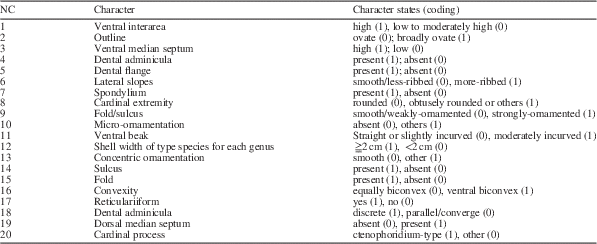
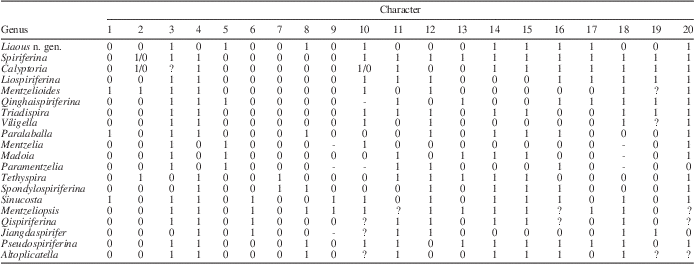
A total of 20 characters are coded for all genera assigned to the superfamily Spiriferinoidea. All characters were equally weighted in the quantitative analysis (Table 1). All 20 characters occurring in each genus were valued based on the features (see Table 1 for details of values), and then tabulated in the data matrix (Table 2). Except for the ingroup taxa that are targeted for parsimony analysis, two outgroup taxa from phylogenetically different groups were included in this analysis. Of these three superfamilies of the Spiriferinidina, the Syringothyridoidea Frederiks, Reference Frederiks1926 includes all genera that have a transverse spiriferiform outline and well-ribbed lateral slopes, and lack ventral median septum, and are readily different from the new genus described above. In contrast, the Pennospiriferinoidea Dagys, Reference Dagys1972 includes some genera broadly allied to the new genus. Both Pseudospiriferina Yang and Xu, Reference Yang and Xu1966 and Altoplicatella Xu and Liu, Reference Xu and Liu1983 of this superfamily were selected as the outgroup taxa involved in the parsimony analysis. Although the new genus shares some similar characteristics to some elements of the Laballinae Dagys, Reference Dagys1962 belonging to the Sucssioidea Waagen, Reference Waagen1883 (i.e., Laballa Moisseev in Dagys, Reference Dagys1962) in the ornamentation, no genera of the Laballinae were selected as ingroup taxa because this subfamily has a quite high interarea and subpyramidal outline, and thus is readily different from the new genus (Carter in Williams et al., Reference Williams, Brunton and Carlson2006).
Character descriptions of the genera of the superfamily Spiriferinoidea. NC = number code for characters in Table 2.
Character dataset of all ingroup genera of the superfamily Spiriferinoidea (including the new genus) and both outgroup genera, Pseudospiriferina and Altoplicatella. The list of genera includes all genera of the superfamily Spiriferinoidea (Carter in Williams et al., Reference Williams, Brunton and Carlson2006). Character number is equal to the NC (number for each character) in Table 1. The feature or its measurement for each character in Liaous He and Chen n. gen. are based on the specimens described in this paper; those of other genera are based on the figures in the Treatise on Invertebrate Paleontology (Williams et al., Reference Williams, Brunton and Carlson2006). ? = unknown; - = the character cannot be used to describe the genus, because the genus does not have the character, for example, Mentzelia has no dental adminicula (character 18), so it is meaningless to describe whether the dental adminicula of Mentzelia is discrete or parallel, thus character 18 of Mentzella is coded -; 1/0= 1 or 0.
The ingroup taxa include the new genus Liaous and all genera assigned to the Spiriferinoidea Davidson, Reference Davidson1884 by Carter in Williams et al. (Reference Williams, Brunton and Carlson2006), namely, Spiriferina d’Orbigny, Reference Orbigny1847, Calyptoria Cooper, Reference Cooper1989, Liospiriferina Rousselle, Reference Rousselle1977, Mentzelioides Dagys, Reference Dagys1974, Qinghaispiriferina Sun and Ye, Reference Sun and Ye1982, Triadispira Dagys, Reference Dagys1961, Viligella Dagys, Reference Dagys1965, Paralaballa Sun, Reference Sun1981, Mentzelia Quenstedt, Reference Quenstedt1871 in 1868–1871, Madoia Sun and Ye, Reference Sun and Ye1982, Paramentzelia Xu, Reference Xu1978, Tethyspira Siblík, Reference Siblík1991, Spondylospiriferina Dagys, Reference Dagys1972, Sinucosta Dagys, Reference Dagys1963, Mentzeliopsis Trechmann, Reference Trechmann1918, Qispiriferina Xu and Liu, Reference Xu and Liu1983, Jiangdaspirifer Chen, Rao, Zou, and Pan, Reference Chen, Rao, Zou and Pan1986 (Table 2). The parsimony analysis was performed using PAUP 4.0b10w (Swofford, Reference Swofford2002). The data from the matrix (Table 2) was analyzed using the heuristic search option, implementing random stepwise addition with 1000 replicates. One hundred and twenty-one parsimonious trees were yielded after a posteriori reweighting with rescaled consistency index. The 50% majority-rule consensus of these trees is shown (Fig. 3).
The parsimony tree shows that all ingroup genera can be categorized into three major groups and nine subgroups. These three major groups (Fig. 3, Groups A–C) are equivalent to three families of the Spiriferinoidea, whereas these nine subgroups could represent subfamilies (Fig. 3, Subgroups D–L). Of these, Mentzeliopsis, Sinucosta, and Qispiriferina belong to the same subgroup (Fig. 3, Subgroup D), as suggested by Carter in Williams et al. (Reference Williams, Brunton and Carlson2006) who assigned these genera to the subfamily Sinucostinae Xu and Liu, Reference Xu and Liu1983. Jiangdaspirifer was regarded as the single representative of the Jiangdaspiriferinae Carter in Carter et al., Reference Carter, Johnson, Gourvennec and Hou1994 (Carter in Williams et al., Reference Williams, Brunton and Carlson2006). This genus, however, is categorized into the same subgroup as both Viligella and Mentzelioides (Fig. 3, Subgroup E), and thus should share the same subfamily as the latter. The latter two genera were previously assigned to the Spiriferininae Davidson, Reference Davidson1884 by Carter (in Williams et al., Reference Williams, Brunton and Carlson2006). However, the parsimony tree shows that Spiriferina, the type genus of the subfamily Spiriferininae, is distinct from Viligella and Mentzelioides (Fig. 3). Both Mentzelioides and Viligella are therefore excluded from Spiriferininae. The previous subfamily, Jiangdaspiriferinae Carter in Carter et al., Reference Carter, Johnson, Gourvennec and Hou1994, is emended to accommodate these three genera (Jiangdaspiriferinae was regarded as monotypic in the Treatise on Invertebrate Paleontology, see Williams et al., Reference Williams, Brunton and Carlson2006, p. 1937). Similarly, both Qinghaispiriferina and Liospiriferina, referred previously to the Spiriferininae (Carter in Williams et al., Reference Williams, Brunton and Carlson2006), possess a very high affinity with one another, and thus form a subgroup (Fig. 3, Subgroup F), which could represent an independent subfamily from the Spiriferininae. Therefore, the Qinghaispiriferininae new subfamily is proposed herein to accommodate these two genera. Both Calyptoria and Spiriferina form an independent subgroup (Fig. 3, Subgroup G) on the parsimony diagram and thus represent one subfamily, which is referred to as the Spiriferininae, as suggested by Carter in Williams et al. (Reference Williams, Brunton and Carlson2006). The Spiriferininae therefore is restricted to both Spiriferina and Calyptoria. The last genus, Triadispira, assigned previously to the Spiriferininae, represents an independent subgroup (Fig. 3, Subgroup H), and thus could represent a new subfamily, which is here termed Triadispirinae new subfamily. Both the Tethyspirinae Carter in Carter et al., Reference Carter, Johnson, Gourvennec and Hou1994 and Paralaballinae Carter in Carter et al., Reference Carter, Johnson, Gourvennec and Hou1994 are well demonstrated by two independent subgroups in the parsimony tree, as suggested by Carter in Williams et al. (Reference Williams, Brunton and Carlson2006) (Fig. 3, Subgroups I and L, respectively). Of these, the Tethyspirinae includes Spondylospiriferina and Tethyspira, whereas the latter subfamily is represented by Paralaballa (Carter in Williams et al., Reference Williams, Brunton and Carlson2006). The remaining genera of the spiriferinoides were assigned to the Mentzeliinae Dagys, Reference Dagys1974 by Carter in Williams et al. (Reference Williams, Brunton and Carlson2006). However, Madoia represents a subgroup (Fig. 3, Subgroup K), whereas both Paramentzelia and Mentzelia, together with the new genus, represent another subgroup (Fig. 3, Subgroup J). The present Mentzeliinae Dagys, Reference Dagys1974 (Carter in Williams et al., Reference Williams, Brunton and Carlson2006) therefore should be separated into two subfamilies. The Mentzeliinae is confined to Paramentzelia, Mentzelia, and Liaous He and Chen n. gen., whereas the Madoinae new subfamily is here proposed to tentatively include the single Madoia herein.
Clearly, the Sinucostinae represents one major group (Fig. 3, Group A), forming an independent family, the Sinucostidae Xu and Liu, Reference Xu and Liu1983, as suggested by Carter in Williams et al. (Reference Williams, Brunton and Carlson2006). In contrast, the Jiangdaspiriferinae Carter in Carter et al., Reference Carter, Johnson, Gourvennec and Hou1994, assigned previously to the Sinucostidae by Carter in Williams et al. (Reference Williams, Brunton and Carlson2006) shares high affinity with the Qinghaispiriferininae n. subfam., the Spiriferininae, and the Triadispirinae n. subfam., all of which form a single group (Fig. 3, Group B), and thus represent another family, equivalent to the Spiriferinidae Davidson, Reference Davidson1884.
The remaining four subfamilies—Tethyspirinae Carter in Carter et al., Reference Carter, Johnson, Gourvennec and Hou1994, Mentzeliinae Dagys, Reference Dagys1974, Madoinae He and Chen n. subfam., and Paralaballinae Carter in Carter et al., Reference Carter, Johnson, Gourvennec and Hou1994—form the third major group (Fig. 3, Group C), which could represent an independent family, namely the Mentzeliidae Dagys, Reference Dagys1974 (Fig. 3).
The new, parsimony-tree-based classification categorizes the Spiriferinoidea into three families (Fig. 3, Groups A, B, C), which is different from the classification of Carter (in Williams et al., Reference Williams, Brunton and Carlson2006). The latter recognized two families: the Sinucostidae (Fig. 3, Group M) and Spiriferinidae (Fig. 3, Group N) within the superfamily Spiriferinoidea. The former family included the Sinucostinae and Jiangdaspiriferinae, whereas the Spiriferinidae contained other subfamilies (Carter in Williams et al., Reference Williams, Brunton and Carlson2006). The newly proposed classification also differs clearly from that of Dagys (Reference Dagys1996), which subdivided the Spiriferinoidea into three families, namely, Spiriferinidae, Paralaballidae, and Dentospiriferinidae Carter in Carter et al., Reference Carter, Johnson, Gourvennec and Hou1994. Herein, we propose a new classification scheme for the Spiriferinoidea Davidson, Reference Davidson1884 as follows:
Order Spiriferinida Ivanova, Reference Ivanova1972
Suborder Spiriferinidina Ivanova, Reference Ivanova1972
Superfamily Spiriferinoidea Davidson, Reference Davidson1884
Family Spiriferinidae Davidson, Reference Davidson1884
Emended diagnosis
Lateral slopes mostly smooth, but occasionally ribbed; dental adminicula discrete.
Subfamilies included
Jiangdaspiriferinae Carter in Carter et al., Reference Carter, Johnson, Gourvennec and Hou1994, Qinghaispiriferininae n. subfam., Spiriferininae Davidson, Reference Davidson1884, and Triadispirinae n. subfam.
Subfamily Jiangdaspiriferinae Carter in Carter et al, Reference Carter, Johnson, Gourvennec and Hou1994
Emended diagnosis
Lateral slopes smooth; sulcus and fold weakly developed.
Genera included
Jiangdaspiriferina Chen et al., Reference Chen, Rao, Zou and Pan1986, Viligella Dagys, Reference Dagys1965, and Mentzelioides Dagys, Reference Dagys1974.
Subfamily Qinghaispiriferininae He and Chen new subfamily
Type genus
Qinghaispiriferina Sun and Ye, Reference Sun and Ye1982.
Diagnosis
Lateral slopes smooth to weakly ribbed; sulcus and fold weakly developed, smooth; ventral median septum high, cardinal process ctenophoridium-type.
Other genus included
Liospiriferina Rousselle, Reference Rousselle1977.
Subfamily Spiriferininae Davidson, Reference Davidson1884
Emended diagnosis
Lateral slopes smooth to weakly ribbed; sulcus and fold prominent, smooth; dental adminicula variously developed; cardinal process ctenophoridium-type.
Genera included
Spiriferina d’Orbigny, Reference Orbigny1847 and Calyptoria Cooper, Reference Cooper1989.
Subfamily Triadispirinae He and Chen new subfamily
Type and only genus
Triadispira Dagys, Reference Dagys1961.
Diagnosis
Ventral interarea low; lateral slopes smooth; sulcus and fold prominent, smooth; dorsal median septum high; cardinal process ctenophoridium-type.
Family Mentzeliidae Dagys, Reference Dagys1974
Emended diagnosis
Cardinal extremities round to obtusely round; lateral slopes smooth to weakly ribbed; ventral median septum high; dental adminicula usually absent, but subparallel to convergent when occurring; cardinal process mostly ctenophoridium-type.
Discussion
To include their new genus Madoia Sun and Ye, Reference Sun and Ye1982, Sun and Ye (Reference Sun and Ye1982) broadened the concept of the Mentzeliinae. Sun and Ye (Reference Sun and Ye1982) also proposed the new family Mentzeliidae and superfamily Mentzelacea (=Mentzelioidea) by upgrading the emended Mentzeliinae. However, following the Principle of Coordination (ICZN, 1999, Art. 36.1), the authorships of both the Mentzeliidae and Mentzelioidea should be reserved to Dagys (Reference Dagys1974) because the subfamily Mentzeliinae Dagys, Reference Dagys1974 was proposed earlier. Furthermore, Madoia should be excluded from the Mentzeliinae (see below). Accordingly, the concept of the Mentzeliidae described by Sun and Ye (Reference Sun and Ye1982) is emended herein.
Subfamilies included
Tethyspirinae Carter in Carter et al., Reference Carter, Johnson, Gourvennec and Hou1994, Mentzeliinae Dagys, Reference Dagys1974, Madoinae He and Chen n. subfam., and Paralaballinae Carter in Carter et al., Reference Carter, Johnson, Gourvennec and Hou1994.
Subfamily Tethyspirinae Carter in Carter et al., Reference Carter, Johnson, Gourvennec and Hou1994
Emended diagnosis
Ventral interarea low; lateral slopes smooth; sulcus and fold smooth; dental adminicula converging to form a spondylium; ventral median septum variously developed.
Genera included
Spondylospiriferina Dagys, Reference Dagys1972 and Tethyspira Siblik, 1991.
Subfamily Mentzeliinae Dagys, Reference Dagys1974
Emended diagnosis
Ventral interarea low to moderately high; lateral slopes smooth or less ribbed; sulcus absent or weakly developed; micro-ornament pronounced; ventral median septum high; dental flanges present.
Genera included
Paramentzelia Xu, Reference Xu1978, Mentzelia Quenstedt, Reference Quenstedt1871 in 1868–1871 and Liaous He and Chen n. gen.
Subfamily Madoinae He and Chen new subfamily
Type and only genus
Madoia Sun and Ye, Reference Sun and Ye1982.
Diagnosis
Lateral slopes smooth; fold and sulcus weakly developed; micro-ornament absent; dental flanges present; ventral median septum long; cardinal process ctenophoridium-type.
Discussion
Although sharing many characters with the genera of the Mentzeliinae, Madoia differs clearly from the latter in having a weakly developed fold and sulcus and lacking micro-ornamentation. In particular, the latter feature is important in the classification of the spiriferinids (Carter et al., Reference Carter, Johnson, Gourvennec and Hou1994). Accordingly, we propose a new subfamily, Madoinae He and Chen n. subfam. to accommodate Madoia based on the consistency index on the parsimony tree (Fig. 3).
Subfamily Paralaballinae Carter in Carter et al., Reference Carter, Johnson, Gourvennec and Hou1994
Diagnosis
Cyrtiniform; fold and sulcus weakly developed; micro-ornament absent; dental adminicula thin, short, subparallel.
Only genus included
Paralaballa Sun, Reference Sun1981.
Family Sinucostidae Xu and Liu, Reference Xu and Liu1983
Emended diagnosis
Lateral slopes ribbed; dental adminicula discrete, subparallel.
Only subfamily included
Sinucostinae Xu and Liu, Reference Xu and Liu1983.
Subfamily Sinucostinae Xu and Liu, Reference Xu and Liu1983
Diagnosis
Dorsal median septum absent.
Genera included
Mentzeliopsis Trechman, 1918, Sinucosta Xu and Liu, Reference Xu and Liu1983, and Qispiriferina Xu and Liu, Reference Xu and Liu1983.
Community paleoecology and paleoenvironmental implications
Posidonia wengensis-Liaous shaiwensis (P-L) paleocommunity
Liaous shaiwensis He and Chen n. gen. n. sp. was found in association with the extremely abundant bivalve Posidonia wengensis (Wissmann in Wissmann and Münster, Reference Wissmann and Münster1841) and a few ammonoids, Leiophyllites confucii (Diener, Reference Diener1895). They form a paleocommunity with a low diversity and high dominance (Table 3). Posidonia wengensis possesses the most abundant individuals (98.92%) and Liaous shaiwensis He and Chen n. gen. n. sp. ranks second in the number of individuals (0.92%; Table 3). The predominant element P. wengensis has a left valve/right valve ratio of 0.96, close to 1. It is also true for Liaous shaiwensis He and Chen n. gen. n. sp. that has a ventral/dorsal ratio approaching 1, although its individual frequency is considerably smaller. Although the P-L paleocommunity comprises chiefly disarticulated valves, the taphonomic state of nearly equal numbers of left and right or dorsal and ventral valves suggests very limited or no transportation (Chen and Shi, Reference Chen and Shi1999; Z.-Q. Chen et al., Reference Chen, Tong, Liao and Chen2010). Moreover, all valves are randomly arranged on the bedding surface without particular orientation (Fig. 8). These taphonomic features also indicate that the P-L paleocommunity was preserved in situ and that current transportation had little effect (Chen and Shi, Reference Chen and Shi1999; Z.-Q. Chen et al., Reference Chen, Tong, Liao and Chen2010). This taphonomic interpretation is also consistent with facies analysis of the community substrate.
Shell concentration of the P-L paleocommunity on rocks; rock slab collected from Level 48 in Figure 2.
Individual abundance and community structural proxies of the P-L paleocommunity. Taxa (S) = 4; total individuals = 1854.

The P-L paleocommunity is characterized by a relatively low Shannon index of 0.06518, high dominance index of 0.9786, and low equitability index of 0.04702 (Table 3; the maximum number of left vs. right valves or dorsal vs. ventral valves was used, and one complete specimen with both valves articulated was used, when counting the number of individuals for each taxon), indicating low diversity and high dominance. The latter is also indicated by the highly dense arrangement of Posidonia wengensis shells, with 165–180 individuals per 5 cm2 (Fig. 8). These characteristics are typical of the shelly communities dominated by r-strategists, an expected life strategy in pioneering communities in the immediate aftermath of the Permian-Triassic mass extinction events in South China (Chen et al., Reference Chen, Shi and Kaiho2002, Reference Chen, Tong, Kaiho and Kawahata2007; J. Chen et al., Reference Chen, Tong, Liao and Chen2010). Thus, the P-L paleocommunity has a very similar community structure to those from the Early Triassic (Schubert and Bottjer, Reference Schubert and Bottjer1995; Hallam and Wignall, Reference Hallam and Wignall1997; Bottjer et al., Reference Bottjer, Clapham, Fraiser and Powers2008; J. Chen et al., Reference Chen, Tong, Liao and Chen2010).
Substrate setting
The P-L paleocommunity is preserved in the lower part of the Xinyuan Formation (Fig. 2.1, Bed 48), which is characterized by yellowish green, thin-bedded, calcareous mudstones interbedded with several layers of siltstones yielding small-scale cross-beddings and small scour surfaces (Fig. 2.1, 2.11–2.13). The P-L paleocommunity occurs in calcareous mudstones, suggesting a soft substrate. Mudstone yielding fine horizontal bedding generally indicates a low-energy, calm setting that could be either a relatively deep offshore basin/slope or a rather shallow, restricted lagoon. However, the presence of brachiopods and ammonoids inhabiting a normal marine environment and small scale, wavy cross-bedding indicates that the calcareous mudstone was not deposited in a lagoon. In particular, the latter sedimentary structure is comparable with these small-scale, hummocky cross-beddings from the Lower Triassic Yinkeng Formation in South China, indicative of an offshore slope/basin setting (Chen et al., Reference Chen, Tong, Kaiho and Kawahata2007). Accordingly, the substrate of the P-L paleocommunity was a relatively deep, low-energy environment with an influence of episodic storms (Fig. 2.5).
Paleoenvironmental implications
As stated above, r-strategist-dominated communities are very common in the aftermath of the Permian-Triassic mass extinction and comprise mostly opportunists that could inhabit highly stressed or poorly oxygenated environments (Schubert and Bottjer, Reference Schubert and Bottjer1995; Hallam and Wignall, Reference Hallam and Wignall1997; Bottjer et al., Reference Bottjer, Clapham, Fraiser and Powers2008; J. Chen et al., Reference Chen, Tong, Liao and Chen2010; Chen and Benton, Reference Chen and Benton2012). This unusual community structure is reinforced by their extremely small body sizes (Fig. 8) and thin shells, which increased surface area to volume ratio, similar to the Changhsingian deepwater brachiopod fauna in this aspect (He et al., Reference He, Shi, Zhang, Yang, Zhang, Wu, Niu and Zhang2014). The small-element-dominated communities usually inhabit the relatively deep, poorly oxygenated settings (Alexander, Reference Alexander1977; Oschmann, Reference Oschmann1994; Levin, Reference Levin2003; Payne et al., Reference Payne, Boyer, Brown, Finnegan, Kowalewski, Krause, Lyons, McClain, McShea, Novack-Gottshall, Smith, Stempien and Wang2009, Reference Payne, McClain, Boyer, Brown, Finnegan, Kowalewski, Krause, Lyons, McShea, Novack-Gottshall, Smith, Spaeth, Stempien and Wang2011; He et al., Reference He, Shi, Zhang, Yang, Zhang, Wu, Niu and Zhang2014) because they have a higher surface area to volume ratio and therefore enhanced oxygen and nutrient uptake to optimize respiration and metabolism of the organism (He et al., Reference He, Shi, Zhang, Yang, Zhang, Wu, Niu and Zhang2014). Middle–late Anisian marine ecosystems were restored following the Permian–Triassic ecologic crisis (Chen and Benton, Reference Chen and Benton2012). Instead, the coeval Qingyan fauna from the Anisian Qingyan Formation of Guizhou Province possesses high diversity and low dominance, characteristics of a paleocommunity dominated by K-strategists (J. Chen et al., Reference Chen, Tong, Liao and Chen2010). Accordingly, the unusual community structure of the P-L paleocommunity likely resulted from the poorly oxygenated setting due to great water depth rather than to the post-extinction deleterious environment, as in the Changhsingian deepwater brachiopods (He et al., Reference He, Shi, Zhang, Yang, Zhang, Wu, Niu and Zhang2014).
Moreover, small Posidonia fauna has been widely accepted to be pseudoplanktonic or epibenthic in lifestyle and to live in a deepwater basinal facies (Zhao, Reference Zhao1993; Yang, Reference Yang1996; Komatsu et al., Reference Komatsu, Akasaki, Chen, Cao and Stiller2004), and it could also spread to the niches above the storm wave base during the Middle Triassic (Komatsu et al., Reference Komatsu, Akasaki, Chen, Cao and Stiller2004). Similar to the Changhsingian ambocoeliid brachiopods (He et al., Reference He, Shi, Zhang, Yang, Teng and Wu2012), Liaous has a well-developed delthyrium and densely spinose micro-ornamentation. Such a morphological feature suggests the brachiopod fauna could have adopted an epiphytic lifestyle, ascending above the sediment-water interface (Harper and Moran, Reference Harper and Moran1997). The pedicle might have served as a device to attach the brachiopod on algae or other floating objects in the sea in order to keep the brachiopod above the soup-like substrate (see Harper and Moran, Reference Harper and Moran1997, fig. 3.2). The pedicle attachment might have also been further enhanced by body surface structures such as fine, dense, hair-like spines, which would have supported suspension of the brachiopod body in water by attaching to algae or other floating objects. This hypothesis is reinforced by the morphological features of small body size and thin shell, which could have decreased body weight and increased buoyancy. In addition, the Mentzeliidae brachiopods (including Liaous), as in all other spiralia-bearing spiriferinid brachiopods, possess a moderately complex lophophore (Carter and Johnson in Williams et al., Reference Williams, Brunton and Carlson2006), which usually serves the function of enhancing the efficiency of filter feeding or respiration of these brachiopods (Fürsich and Hurst, Reference Fürsich and Hurst1974; Thayer, Reference Thayer1986; Afanasjeva, Reference Afanasjeva2009). Thus, it is plausible that these brachiopods lived in a setting with low oxygen or limited trophic resources, but high abundance of Posidonia does not suggest low trophic resources in their habitats.
All lines of evidence documented above, together with the evidence from the sedimentary attributes, namely the yellowish green, thin-bedded calcareous mudstones, with fine laminations, indicate that the P-L paleocommunity could have inhabited a relatively deep, low-energy, dysaerobic environment that was influenced by episodic storms. The organisms dwelled on algae or other objects.
Acknowledgments
We are grateful to two anonymous reviewers for their critical comments and constructive suggestions, which have improved the quality of paper. We also sincerely thank G. Shi for the valuable discussion and improving on the manuscript. This study was supported by NSFC (Grant Nos. 41372030, 40872008, 41272023, 41472087), the 111 Program of China (grant number B08030) and the Ministry of Education of China (NCET-10-0712).