The voter turnout rate signals the legitimacy of the democratic process.Footnote 1 This suggests that countries can ‘legislate legitimacy’ by implementing compulsory voting, which has a robust and positive relationship with participation in elections.Footnote 2 Such a strategy, however, could fail if coercion and punishment produce or enhance negative orientations towards democracy.
Research from several fields highlights the attitudinal and behavioral consequences of coercion and punishment. Both mechanisms induce desired behaviors, but they also have undesirable second-order effects, including weakened beliefs about the legitimacy of the coercer and its authorities. Taking such consequences into account, I theorize that the relationship between one’s orientation towards democracy and his or her judgments about democratic legitimacy is conditioned by compulsory voting. Governmental coercion to vote – and associated punishments for nonvoting – will exacerbate the tendency of individuals who hold negative orientations towards democracy to question the legitimacy of the democratic system, its institutions and its authorities. Empirically, this suggests that such negatively oriented individuals, who I term ‘anti-democrats’, will be especially dissatisfied with democracyFootnote 3 where voting is compulsory.
To test my expectations, I initially gather survey data from the AmericasBarometer, which covers a set of countries in which compulsory voting is widely employed. I demonstrate that the relationship between anti-democratic attitudes and dissatisfaction intensifies where voting is compulsory; anti-democrats are especially dissatisfied with democracy where their participation is forced. I find further support for my expectations with surveys of Latin American publics from the Latinobarometer, with a broader cross-national set of surveys from the Comparative Study of Electoral Systems, and with a natural experiment that makes use of the fact that a group of Latin American countries with compulsory voting does not force participation among senior citizens of a certain age. I discuss the implications of my findings in the conclusion.
COMPULSORY VOTING AS A PRECIPITATOR OF SATISFACTION WITH DEMOCRACY
While attitudes towards democracy are classically considered to precede the decision to vote,Footnote 4 many contend that political participation can itself structure the formation of democratic attitudes. Specifically, participation can invoke positive attitudes towards democracy by bringing about self-actualization and gratificationFootnote 5 and a deeper engagement with the democratic system.Footnote 6
Empirical support for the argument that democratic participation precedes pro-democracy orientations abounds,Footnote 7 and participation can enhance attitudes towards democracy even when it is externally induced.Footnote 8 In debates over the introduction of compulsory voting, supporters routinely advise that forced participation can enhance the perceived legitimacy of the democratic process.Footnote 9 These arguments suggest that publics in countries that mandate turnout will express a higher level of satisfaction with democracy, as demonstrated by Birch.Footnote 10 This pattern should be most apparent where abstention is likely to be sanctioned and penalties for abstention are strong, as the effect of compulsory rules on turnout tends to be greatest where they are harsh and enforced.Footnote 11 And, all else being equal, this pattern should manifest independently of realized turnout, as compulsion inflates baseline participation rates.Footnote 12 Following from this, I advance a preliminary hypothesis:
Hypothesis 1: Individuals are less likely to be dissatisfied with democracy in countries with compulsory voting, especially where it is routinely enforced and the penalties for abstention are substantial.
COERCION AND PUNISHMENT, COMPULSORY VOTING AND DISSATISFACTION WITH DEMOCRACY
Individuals prefer to feel that their actions are a result of their own accord;Footnote 13 when one is coerced into a behavior, intrinsic motivation to engage in that behavior declines.Footnote 14 External coercion is associated with less cognitive engagement with one’s environment, a decreased interest in one’s assigned tasks, and a decreased belief in the legitimacy of the coercer and its authorities.Footnote 15
SidmanFootnote 16 explains that the attitudinal and behavioral effects of acting against one’s will are most pronounced among those who are negatively oriented towards the coercer. This suggests that, if the coercion present in compulsory systems sours beliefs about the legitimacy of the democratic system, this effect should be most pronounced among those who are negatively predisposed towards democracy and thereby likely to prefer abstention. Further, coercion will be most strongly felt where penalties for abstention are routinely enforced, as one will more likely feel obliged to act when he or she suspects that abstention will garner a penalty.
Depending on the nature of the compulsory rule, abstainers may also receive a penalty for non-participation. Penalties, like coercion, will intensify the consequences of negative orientations towards the democratic system, especially when the punishments are strong and thereby likely to meaningfully afflict the abstainer. In addition, as with coercion, the emotional effects of punishment are most pronounced when individuals have negative orientations towards the punisher or society in general.Footnote 17
With regard to democratic governance, such orientations are reflected by individuals’ attitudes about the principles of democracy. Many individuals support some such principles while rejecting others.Footnote 18 I refer to attitudes that run counter to democratic principles as anti-democratic, and I expect that individuals with anti-democratic attitudes are less likely to believe in the legitimacy of the democratic system, and therefore to express satisfaction with democracy. Of course, as extant research establishes that anti-democratic attitudes relate negatively to democratic satisfaction,Footnote 19 this expectation is not especially novel.
Yet the coercion and punishment present under compulsory voting will exacerbate the consequences of negative orientations towards the democratic system, which will strengthen the link between anti-democratic attitudes and dissatisfaction with democracy. Those with anti-democratic attitudes will further question the legitimacy of democratic authorities, institutions and processes where their participation in the system is mandatory, intensifying gaps in satisfaction between anti-democrats and those who are more positively oriented towards democracy. As discussed above, these patterns should be most prominent where voting is not just legally required, but where significant penalties for abstention are likely to be applied. A straightforward, observable implication results from this reasoning:
Hypothesis 2: Where voting is compulsory, anti-democrats will be particularly dissatisfied with democracy, especially where compulsory voting laws are routinely enforced and penalties for abstention are substantial.
DATA AND MEASUREMENT
My primary source of data is the AmericasBarometer,Footnote 20 which asks several questions about attitudes towards democracy consistently across its waves. Further, many of the countries it surveys mandate voter turnout. The countries included in the analyses are listed in Section 1 of the Appendix. While Canada and the United States are included in the AmericasBarometer surveys, I exclude both from the sample due to their unique status as wealthy, deeply entrenched democracies. Substantive results are not sensitive to this decision, and results are further unchanged when I limit the sample to Latin American countries. In Sections 6 and 7 of the Appendix, I test my expectations with additional data from the Latinobarometer and the Comparative Study of Electoral Systems, respectively.
Measuring Anti-Democratic Attitudes
The above discussion identifies anti-democratic individuals as those who hold attitudes that run counter to democratic principles. To measure such attitudes, I use four AmericasBarometer survey questions.Footnote 21 The first employs a seven-point scale to gauge the extent to which respondents agree with the idea that democracy is the best form of government. I code the measure so that higher values indicate less agreement, and I call the resulting variable Rejection of Democracy as the Best System of Government.
Secondly, as argued by Almond and Verba,Footnote 22 non-democratically oriented citizens prefer revolutionary to gradual changes in leadership. As a gauge of such orientations, I employ a question asking respondents to indicate whether they would approve of a group that advocated a violent overthrow of democracy using a ten-point scale. I code the answers so that higher values indicate more approval, and I call the resulting variable Approval of a Violent Overthrow.
Thirdly, non-democratically oriented citizens are relatively likely to express a preference for authoritarian government over representative democracy. To gauge such preferences, I use a survey instrument that asks respondents to choose from a list of statements about democracy. In doing so, some respondents indicated that an authoritarian government could, under certain circumstances, be preferable to a democratic one. These individuals are coded 1, and others are coded 0. I call this variable Belief that Authoritarian Government can be Better than Democracy.
Finally, individuals who are unsupportive of representative democracy may value decisive leadership over popular election.Footnote 23 To gauge such orientations, I use an instrument that asks respondents to choose from competing statements about democracy. In doing so, some respondents expressed a belief that their county needs a strong leader, and that having such a leader is more important than having an electoral democracy. These individuals are coded 1, and others are coded 0. I call the resulting variable Belief that the Country Needs an Autocrat.
Since the AmericasBarometer did not ask each of the questions that I use to gauge anti-democratic attitudes in all waves, the number of individuals and country-year surveys in the sample varies across models. There are twenty-two countries in the sample, which are identified in Section 1 of the Appendix, and each country is represented in each model.
Dissatisfaction with Democracy as an Indicator of Democratic Legitimacy
(Dis)satisfaction with democracy represents a broad overall belief about the legitimacy of the democratic process, its institutions and its authorities.Footnote 24 I gauge dissatisfaction with the following question: ‘In general, would you say you are very satisfied, satisfied, unsatisfied, or very unsatisfied with the way democracy works in [country]?’ (1=very satisfied, 2 =satisfied, 3 = unsatisfied, 4 = very unsatisfied). In line with previous research,Footnote 25 explorations detailed in Section 8 of the Appendix demonstrate that (dis)satisfaction with democracy is empirically distinct from other attitudes towards democracy.
Measuring Compulsory Voting
Following Fornos, Power and Garand,Footnote 26 and in line with my expectation that the character of enforcement and sanctions should shape the effects of compulsory rules, I employ a four-category variable to classify countries according to both the existence of a compulsory rule and the degree to which sanctions are enforced – which itself is strongly related to the severity of punishments for abstention.Footnote 27 The four categories are:
VV: Countries with purely voluntary voting.
CV1: Countries that statutorily mandate voting but do not employ sanctions for abstention.
CV2: Countries that have legal sanctions for abstention but do not generally enforce them in practice.
CV3: Countries that mandate turnout and enforce sanctions in practice.Footnote 28
Information on compulsory voting laws is from Payne, Zovatto and DíazFootnote 29 and the Institute for Democracy and Electoral Assistance.Footnote 30 Section 1 of the Appendix provides information on compulsory voting rules in the countries in the sample.
Control Variables
To help identify the causal effect of compulsory voting, at the individual level, I control for Age and College education, and at the survey level, I control for Economic Development, Democratic Development, Corruption, Presidentialism and whether a country had a Majoritarian electoral system. All variables are summarized in Section 1 of the Appendix. Further details of the control variables, and the rationale for their inclusion, are provided in Section 3 of Appendix.
METHODS AND RESULTS
Owing to the tiered structure of the data and the four-category, ordinal dependent variable, I estimate multilevel ordered logit models. Further details of my modeling approach are provided in Section 4 of Appendix.
I first test the expectation of Hypothesis 1: that dissatisfaction with democracy will be lower where voting is compulsory, especially where rules are routinely enforced and stiffly penalized. I exclude fully voluntary systems as the baseline category and include dummy variables for the other three compulsory voting categories.
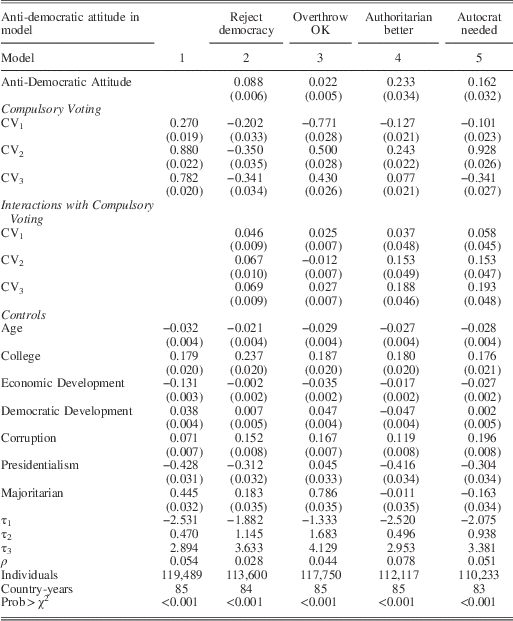
As shown in Model 1 of Table 1, there is no empirical support for Hypothesis 1.Footnote 31 In fact, contrary to the prediction of Hypothesis 1, dissatisfaction tends to be higher where individuals are subject to compulsory voting, especially where the rules have ‘teeth’. As I argue above, the absence of a positive link between compulsory voting and satisfaction with democracy may come about because certain individuals – those who I term anti-democrats – become especially dissatisfied with democracy where their participation is forced. That is, the lack of an overall positive relationship between compulsory voting and dissatisfaction with democracy may be a result of the pattern suggested by Hypothesis 2.
Dissatisfaction with Democracy, Anti-Democratic Attitudes and Compulsory Voting

Note: Dependent variable is dissatisfaction with democracy. Results are from multilevel ordered logistic regressions. Standard errors in parentheses.
To test Hypothesis 2, again excluding fully voluntary systems as the baseline category, I interact each anti-democratic attitude variable with dummy variables for the three included categories. Results are shown in Models 2–5 of Table 1. If compulsory voting most forcefully intensifies the relationship between anti-democratic attitudes and the propensity to be dissatisfied where compulsory rules are strongest, the coefficients on interactions that include higher levels of compulsory voting should be progressively larger. This pattern is observed in three of the four models: those in which the interacted variable is attitudes towards democracy as the best form of government, the belief that authoritarian government can be better than democracy and the belief that the country needs an autocrat. While this pattern does not manifest where the anti-democratic attitude under consideration is approval of a violent overthrow of government, compulsion continues to matter most where the rules are strictest.
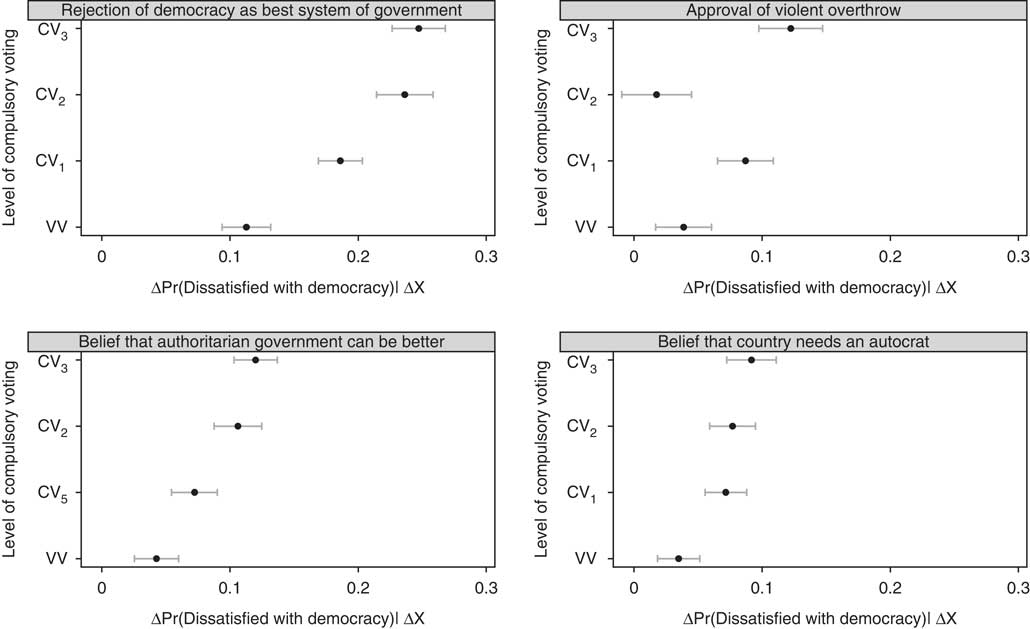
In Figure 1 Footnote 32 I plot the effect of each anti-democratic attitude on the probabilityFootnote 33 of being unsatisfied or very unsatisfied with democracy across each category of the compulsory voting scale. The patterns in the figures reflect those of Models 2–5. For example, the upper-left panel of Figure 1 depicts the change in the probability of being unsatisfied or very unsatisfied with democracy associated with a change in one’s rejection of democracy as the best form of government from its minimum value (1) to its maximum value (7), conditional on the voting rule. In fully voluntary voting systems, the associated effect is relatively weak, at 11 percentage points. In countries that mandate voting but do not employ sanctions for abstention (category CV1), the effect is 19 percentage points. And in countries that have legal sanctions for abstention but do not generally enforce them in practice (category CV2), and in countries that mandate turnout and enforce sanctions in practice (category CV3), the predicted effects are 24 and 25 percentage points, respectively.
The effect of anti-democratic attitudes on dissatisfaction with democracy according to the level of compulsory voting Note: Each circle represents the effect of a change in the range of the relevant independent variable on the probability of being unsatisfied or very unsatisfied with democracy, as estimated via multilevel logit regressions. Horizontal brackets represent 95 per cent confidence intervals. In Section 11 of the Appendix, I plot the predicted probability of being unsatisfied or very unsatisfied with democracy over the range of each relevant independent variable.

A NATURAL EXPERIMENT USING AGE THRESHOLDS IN COMPULSORY SYSTEMS
The cross-national analyses indicate that the link between dissatisfaction with democracy and anti-democratic attitudes intensifies where voting is compulsory. As with any observational design, the possibility that these relationships are spurious cannot be fully ruled out, even after controlling for several potential confounders. Further, while compulsory voting has been adopted for a variety of reasons,Footnote 34 one cannot know for sure that anti-democratic individuals were not relatively dissatisfied with democracy in countries with compulsory voting before such rules were adopted. By comparing separate groups of individuals quasi-randomly assigned to compulsory and voluntary voting conditions, an experimental approach can help substantiate the causal role of compulsory voting.
Five Latin American countries do not enforce their compulsory rules for senior citizens: in Argentina, Bolivia, Brazil and Peru, voting is not compulsory for individuals over seventy years of age, and in Ecuador the cut-off age is sixty-five. Not only do these age cut-offs affect turnout,Footnote 35 they set up a natural experiment, as individuals slightly above and slightly below the thresholds should not, on average, systematically differ, aside from variations in their legal requirement to vote (and slight differences in age).Footnote 36 Though I have no theoretical reason to believe that dissatisfaction with democracy should correlate with age, my theory does predict that, for anti-democrats, dissatisfaction will drop once individuals are no longer subject to compulsory rules. That is, I expect a sharp drop in predicted dissatisfaction just above the compulsory voting cut-off age, but only among anti-democrats. According to my theory, there is no reason to expect such a drop among those with pro-democratic orientations.
I estimate relationships between democratic attitudes and dissatisfaction across individuals subject to and free from compulsory rules using a sharp regression discontinuity (RD) design. Sharp RD models estimate a function on either side of a binary treatment thought to be precisely determined by the value of a predictor (here, the age cut-off), and subsequently estimate the difference between the two functions at this value.Footnote 37 Any discontinuity in the expected value of the outcome at the cut-off is interpreted as a causal effect of the treatment.
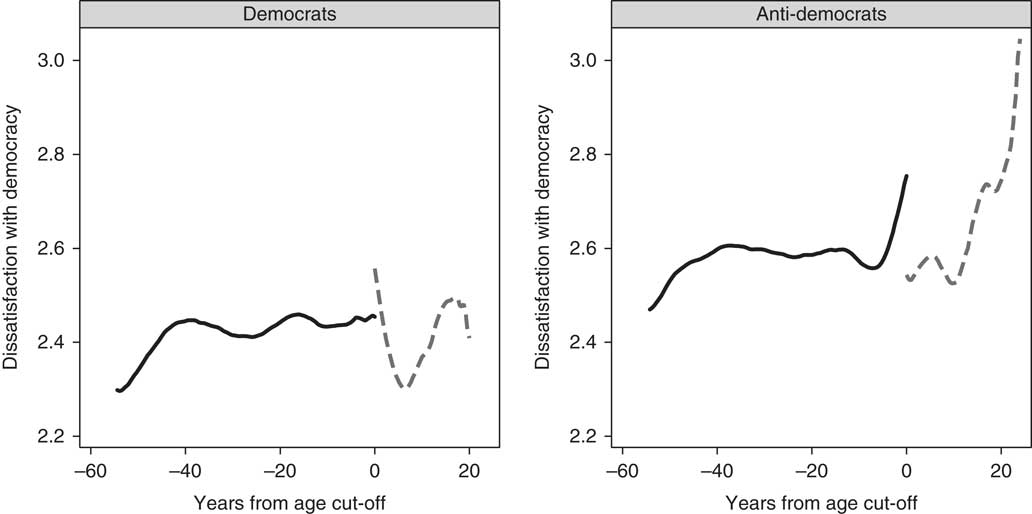
Figure 2 illustrates the results of the RD models. From both panels it is clear that dissatisfaction increases as one enters adulthood, after which it levels off until advanced ages. For democrats, there is a small increase in dissatisfaction once voting is no longer compulsory (as shown in the left-hand panel), though its estimated size, 0.10, is smaller than its associated standard error of 0.17. Alternatively, in line with the expectation of Hypothesis 2, for anti-democrats, dissatisfaction drops sharply after mandatory voting is no longer enforced (as shown in the right-hand panel). This effect is estimated to be −0.21, or 7 per cent of the range of the dissatisfaction variable, and is quite a bit larger in magnitude than its associated standard error of 0.13.
Age, dissatisfaction with democracy, and democratic attitudes above and below compulsory voting age thresholds Note: Plots contain smoothed local polynomial regressions estimated on both sides of the cut-offs. To identify anti-democrats and democrats, I estimated a polychoric factor analysis of the four anti-democratic attitudes variables, in which the first factor accounted for roughly 83 per cent of the common variance. I take anti-democrats to be those with factor scores above the 75th percentile of the variable and democrats to be those with factor scores below the 25th percentile.
The RD models provide further evidence that anti-democrats are especially dissatisfied with democracy when subject to mandatory voting; forced voting heightens the tendency of those with negative orientations towards the democratic system to question the legitimacy of the democratic process, its institutions and its authorities. Further details of the RD analyses, and tests probing the extent to which the data meet RD’s identifying assumptions, are provided in Section 13 of the Appendix.
CONCLUSION
Robson,Footnote 38 while mulling the prospect of compulsory voting, worried that it could be regarded ‘as an act of petty tyranny’ and ‘cause widespread irritation’ among the politically apathetic. The results of this article provide empirical support for this concern, showing that ‘anti-democrats’ are especially likely to question the legitimacy of the democratic system where their voting is forced. Thus increased turnout in a compulsory system can obscure the attitudinal divide that it accompanies.Footnote 39 Further, where anti-democrats make up a sizeable portion of the population, compulsory voting can lead to a decrease in the overall level of satisfaction with democracy.Footnote 40
The normative implications of this article’s findings are provocative: compulsory voting harms satisfaction among those who are most likely to challenge the system, whether tacitly or via protest, revolt or revolution. This implies that, in extreme scenarios, compulsory voting can hasten transitions away from democracy. A kneejerk reaction to this is a prescription to abolish compulsory voting where it is used, or to caution against it where it is being considered, particularly in countries in which political disaffection is widespread.
Still, many actions in democracies are mandatory, including jury duty, paying taxes and primary education. Few would argue that democratic countries would be better off if they abolished such obligations. Likewise, it is not yet clear that the benefits of compulsory voting – such as higher turnout and increased equality of both political participation and economic outcomesFootnote 41 – are offset by the dissatisfaction it can foment. In established democracies, at least, it is unlikely that such negativity will mature into revolutionary challenges. Further, by increasing rates of participation among those who are negatively oriented towards the democratic system, as well as amplifying dissatisfaction with the way democracy works among these same individuals, compulsory voting could enhance deliberation over a country’s democratic institutions and, in turn, spur useful political reforms.