Introduction
The term everyday action impairment (EAI) denotes difficulties performing everyday tasks involving common objects, multiple steps, and a practical end-goal (e.g., meal preparation; Schwartz & Buxbaum, Reference Schwartz and Buxbaum1997). EAI is associated with grave consequences across dementia syndromes (Knopman, Berg, & Thomas, Reference Knopman, Berg and Thomas1999; Noale, Maggi, & Minicuci, Reference Noale, Maggi and Minicuci2003), including Parkinson's disease dementia (PDD; McKeith et al., Reference McKeith, Dickson, Lowe, Emre, O'Brien and Feldman2005). Although neuropsychological research on EAI is accumulating (Marcotte & Grant, Reference Marcotte and Grant2009), there are still many gaps in the literature. For example, EAI is rarely characterized in light of a neuropsychological model, and most studies offer only cursory descriptions of functional deficits without detailed performance analysis. Very few dementia studies have focused on syndromes besides Alzheimer's disease (AD) and fewer still have compared EAI across syndromes. To address these gaps, this study evaluated EAI in individuals with PDD against individuals with Parkinson's disease-no dementia (PD) or AD using detailed error analysis of performance-based tasks informed by a neuropsychological model (Giovannetti, Bettcher, Brennan, Libon, et al., Reference Giovannetti, Bettcher, Brennan, Libon, Kessler and Duey2008).
Little is known about EAI associated with PDD/PD. Self- and caregiver-reports reveal that even mild cognitive deficits in PD interfere with complex everyday activities (Cahn et al., Reference Cahn, Sullivan, Shear, Pfefferbaum, Heit and Silverberg1998; Rosenthal et al., Reference Rosenthal, Brennan, Xie, Hurtig, Milber, Weintraub and Siderowf2010). Shulman et al. (Reference Shulman, Pretzer-Aboff, Anderson, Stevenson, Vaughan, Gruber-Baldini and Weiner2006) showed that PD participants underestimated their functional difficulties by comparing self-report and performance-based measures of everyday functioning. Detailed performance analysis on a computer-simulated cooking activity with a dual task component demonstrated rigid attention in PD participants, as they performed well on cooking at the expense of the secondary task (Bialystok, Craik, & Stefurak, Reference Bialystok, Craik and Stefurak2008). In PDD, deficits in sustained and focused attention are strongly associated with caregiver report of functioning, even after controlling for motor symptoms (Bronnick et al., Reference Bronnick, Ehrt, Emre, DeDeyn, Wesnes, Tekin and Aarsland2006). Cumulatively, these studies show an association between cognitive deficits and functional difficulties in PD/PDD and highlight the importance of detailed performance-based assessments.
Most investigators agree that overall level of EAI is moderately associated with overall level of cognitive impairment (Marcotte & Grant, Reference Marcotte and Grant2009). Therefore, we expected that PDD participants would show greater overall EAI than PD participants but comparable overall EAI as AD participants of equal dementia severity. By contrast, there is little consensus in the literature concerning the link between specific neuropsychological deficits and specific patterns of everyday action errors. Our group has developed a neuropsychological model of EAI that emphasizes the role of episodic memory, task knowledge, and executive control processes; the model was based on results from performance-based assessments and traditional neuropsychological measures with between-group comparisons and data reduction analyses (Giovannetti, Bettcher, Brennan, Libon, et al., Reference Giovannetti, Bettcher, Brennan, Libon, Burke, Duey and Wambach2008; Giovannetti, Schmidt, Sestito, Libon, & Gallo, Reference Giovannetti, Schmidt, Sestito, Libon and Gallo2006; Giovannetti, Schwartz, & Buxbaum, Reference Giovannetti, Schwartz and Buxbaum2007; Kessler, Giovannetti, & MacMulen, Reference Kessler, Giovannetti and MacMulen2007). On this model (hereafter Omission-Commission Model), deficits in episodic memory and/or task knowledge (i.e., script knowledge; Cosentino, Chute, Libon, Moore, & Grossman, Reference Cosentino, Chute, Libon, Moore and Grossman2006; Schank & Abelson, Reference Schank and Abelson1977) render individuals incapable of recalling or accessing task goals and lead to the omission of large portions of everyday tasks (i.e., omission errors). More specifically, the type of episodic memory deficit associated with omissions is at the level of encoding or retention, characteristic of the anterograde amnesia commonly observed in AD. By contrast, executive control deficits, specifically poor working memory and mental control, lead to inaccurate performance of task steps (i.e., commission errors) because of disorganization and distractibility, but they do not necessarily preclude task accomplishment. Alternate models suggest that EAI is homogeneous across even diverse patients and best explained by overall level of global cognitive impairment (Bouwens et al., Reference Bouwens, van Heugten, Aalten, Wolfs, Baarends, van Menxel and Verhey2008; Giovannetti, Libon, Buxbaum, & Schwartz, Reference Giovannetti, Libon, Buxbaum and Schwartz2002; Schwartz, Segal, Veramonti, Ferraro, & Buxbaum, Reference Schwartz, Segal, Veramonti, Ferraro and Buxbaum2002; Schwartz, et al., Reference Schwartz, Montgomery, Buxbaum, Lee, Carew, Coslett and Mayer1998, Reference Schwartz, Buxbaum, Montgomery, Fitzpatrick-DeSalme, Hart, Ferraro and Coslett1999) or that diverse neuropsychological deficits lead to similar functional deficits because of the complexity of everyday tasks (Buxbaum, Schwartz, & Montgomery, Reference Buxbaum, Schwartz and Montgomery1998; Hartmann, Goldenberg, Daumuller, & Hermsdorfer, Reference Hartmann, Goldenberg, Daumuller and Hermsdorfer2005). These alternate accounts predict comparable patterns of EAI across groups of comparable dementia severity.
EAI in PDD was evaluated using the Omission-Commission Model framework. We hypothesized that the neurocognitive deficits that differentiate PDD, PD and AD participants would lead to differential patterns of everyday action impairment. We predicted that individuals with PDD, known to exhibit greater executive control deficits than individuals with AD (Calderon et al., Reference Calderon, Perry, Erzinclioglu, Berrios, Dening and Hodges2001; Kraybill et al., Reference Kraybill, Larson, Tsuang, Teri, McCormick, Bowen and Cherrier2005; Lambon Ralph et al., Reference Lambon Ralph, Powell, Howard, Whitworth, Garrard and Hodges2001; Libon, et al., Reference Libon, Bogdanoff, Leopold, Hurka, Bonavita and Ball2001; Walker, Allen, Shergill, & Katona, Reference Walker, Allen, Shergill and Katona1998), would show a higher rate of commission than omission errors. By contrast, individuals with AD would demonstrate a higher rate of omissions than commissions, considering relatively greater impairment in episodic memory and task knowledge. Because individuals with PD demonstrate relatively circumscribed deficits in executive control, we predicted that they would show a pattern of errors similar to participants with PDD, committing more commissions than omissions. We also used correlation and regression analyses to evaluate relations between specific action errors and specific neuropsychological processes. Based on the Omission-Commission Model, we hypothesized that omissions would be most strongly associated with measures of episodic memory, whereas commissions would be most strongly associated with measures of executive control.
Methods
A prospective between-group design was used to compare everyday functioning across individuals with PDD, PD, or AD on performance-based assessments and caregiver reports.
Participants
Participants were recruited from university-affiliated specialty clinics in Philadelphia following comprehensive diagnostic evaluations. One participant could not complete the study because of illness requiring hospitalization. The remaining participants included 39 individuals with mild-moderate PD (Hughes, Daniel, Kilford, & Lees, Reference Hughes, Daniel, Kilford and Lees1992) 19 of whom also met criteria for dementia (PDD; Task Force on DSM-IV, 2000), and 20 individuals with mild-moderate AD (McKhann et al., Reference McKhann, Drachman, Folstein, Katzman, Price and Stadlan1984). One participant met clinical criteria for dementia with Lewy Bodies (DLB; McKeith et al., Reference McKeith, Dickson, Lowe, Emre, O'Brien and Feldman2005) and was included in the PDD group; his performance fell within the PDD range on all variables. PDD/PD participants were receiving dopaminergic therapy and were tested in the “on” state; AD participants were taking acetylcholinesterase inhibitors.
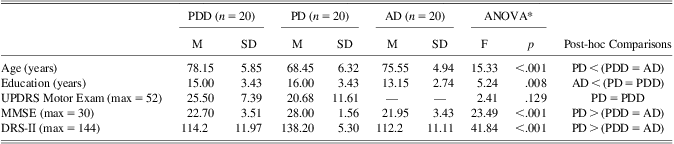
As shown in Table 1, the PDD and AD groups were significantly older and demonstrated greater overall cognitive impairment than the PD group on the Mini Mental-Status Exam (MMSE) and Dementia Rating Scale-2 (DRS-2). The PDD and AD groups did not significantly differ in age or dementia severity, but the AD group had significantly lower education than the PDD and PD groups. The mean Unified Parkinson's Disease Rating Scale (UPDRS)-Motor Exam score was higher for the PDD participants (suggesting greater impairment), but the difference was not statistically significant; the UPDRS was not administered to AD participants.
Means, Standard Deviations, and Statistical Comparisons for Demographic Variables between PDD, PD, and AD Groups
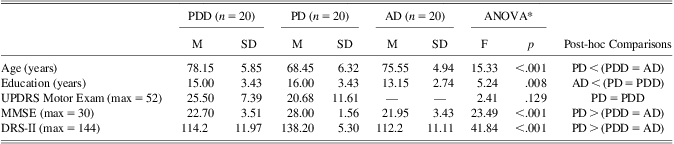
*df = 2, 57; UPDRS = Unified Parkinson's Disease Rating Scale Total Score; MMSE = Mini Mental-Status Examination Total Score; DRS-II = Dementia Rating Scale, Second Edition Total Score.
Procedures
The Temple University Institutional Review Board (IRB) and the IRB of each outpatient clinic approved this study. All participants provided informed consent, were tested in their homes using a standardized testing table, and were compensated $70.
Neuropsychological protocol
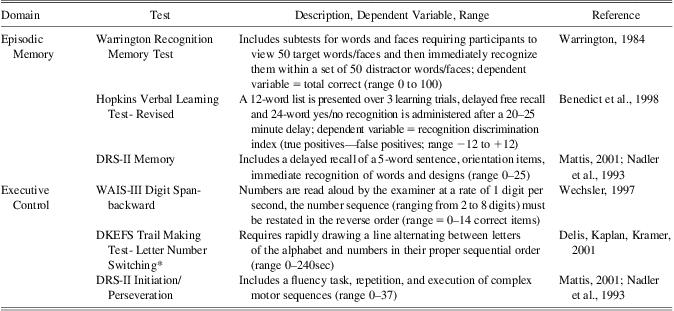
Tests of executive control, episodic memory, and global cognitive functioning were administered (see Table 2). Test selection was based on the Omission-Commission Model and past findings showing significant relations with performance-based measures of action (Buxbaum, Schwartz, & Carew, Reference Buxbaum, Schwartz and Carew1997; Giovannetti, Libon, Buxbaum, & Schwartz, Reference Giovannetti, Libon, Buxbaum and Schwartz2002; Giovannetti, Bettcher, Brennan, Libon, Kessler, et al., Reference Giovannetti, Bettcher, Brennan, Libon, Kessler and Duey2008; Kessler et al., Reference Kessler, Giovannetti and MacMulen2007; Nadler, Richardson, Malloy, Marran, & Hosteller Brinson, Reference Nadler, Richardson, Malloy, Marran and Hosteller Brinson1993; Schwartz, et al., Reference Schwartz, Montgomery, Buxbaum, Lee, Carew, Coslett and Mayer1998, Reference Schwartz, Buxbaum, Montgomery, Fitzpatrick-DeSalme, Hart, Ferraro and Coslett1999, Reference Schwartz, Segal, Veramonti, Ferraro and Buxbaum2002) and/or differences between AD and PD/PDD participants (Benedict, Schretlen, Groninger, & Brandt, Reference Benedict, Schretlen, Groninger and Brandt1998; Delis, Kaplan, & Kramer, Reference Delis, Kaplan and Kramer2001; Mattis, Reference Mattis2001; Warrington, Reference Warrington1984). Neuropsychological variables were combined into composite scores (Episodic Memory, Executive Control) to reduce analyses. Raw test scores were converted to Z-scores based on the mean and standard deviation of the entire sample (n = 60); the average Episodic Memory and Executive Control Z-score was computed to form each composite. Correlation analyses confirmed that the scores comprising each composite were significantly and strongly correlated with each other (Episodic Memory r > .63; p < .001 for all; Executive Control r > .36; p < .006 for all).
Neuropsychological Protocol
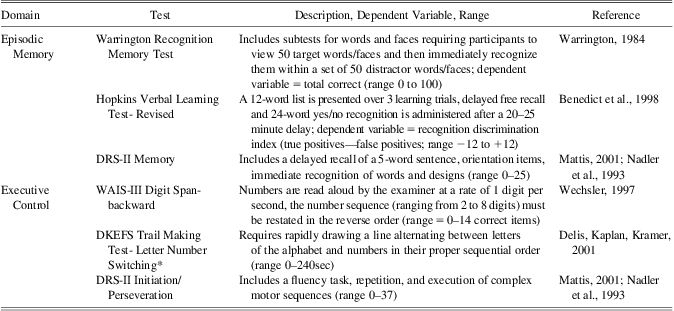
DRS-II = Dementia Rating Scale, Second Edition; WAIS-III = Wechsler Adult Intelligence Scale, Third Edition; DKEFS = Delis Kaplan Executive Function System.
*We were concerned that scores on this test might be influenced by the motor symptoms associated with PD/PDD. However, the strong correlations with other untimed and non-motor Mental Control measures suggested that this score was not capturing only low-level motor dysfunction in this sample.
Caregiver ratings
Caregivers rated participants’ functioning in the home using a modified version of the Instrumental Activities of Daily Living and Physical Self-Maintenance scales developed by Lawton and Brody (Reference Lawton and Brody1969). On this version, caregivers provide ratings for 15 tasks using a three-point scale: (1) independent; (2) requires assistance; (3) entirely dependent. Higher total scores (max = 45) indicate greater dependence. Only caregivers who had at least weekly contact with the participant were included; three participants (1 PD, 2AD) did not have available caregivers.
Performance-based Assessments
Two performance-based measures of everyday action were administered and videotaped for scoring.
Direct Assessment of Functional Status (DAFS; Loewenstein, et al., Reference Loewenstein, Amigo, Duara, Gutteman, Hurwitz, Berkowitz and Eisdorfer1989)
The DAFS is a sensitive performance-based measure of higher order functional abilities among older adults. It has been extensively researched and has excellent psychometric properties (Farias, Harrell, Neumann, & Houtz, Reference Farias, Harrell, Neumann and Houtz2003; Loewenstein, et al., Reference Loewenstein, Rubert, Berkowitz-Zimmer, Guterman, Morgan and Hayden1992, Reference Loewenstein, Duara, Rubert, Arguelles, Lapinski and Eisdorfer1995). Six of the original 14 DAFS tasks were included in this study, because they were appropriately difficult for our sample and they fit our definition of everyday action (i.e., multiple steps, require object use/selection, etc.): Eating; Telephone Skills; Preparing a Letter for Mailing; Counting Currency; Writing a Check; Balancing a Checkbook. Points (max = 36) were awarded for steps that were completed accurately according to guidelines set forth by Loewenstein et al. (1989); higher scores indicate better performance. Participants were not penalized for clumsiness or poor dexterity. Normative data indicate that healthy older adults are at or near ceiling on these tasks, earning an average of 99% of the 36 points (Loewenstein et al., Reference Loewenstein, Amigo, Duara, Gutteman, Hurwitz, Berkowitz and Eisdorfer1989).
Naturalistic Action Test (NAT; Schwartz, Buxbaum, Ferraro, Veramonti, & Segal, Reference Schwartz, Buxbaum, Ferraro, Veramonti and Segal2003)
The NAT evaluates cognitive difficulties in everyday tasks and has been validated with participants undergoing inpatient rehabilitation for head injury (Schwartz et al., Reference Schwartz, Montgomery, Buxbaum, Lee, Carew, Coslett and Mayer1998, Reference Schwartz, Segal, Veramonti, Ferraro and Buxbaum2002, Reference Schwartz, Buxbaum, Ferraro, Veramonti and Segal2003) or stroke (Buxbaum et al., Reference Buxbaum, Schwartz and Montgomery1998; Schwartz et al., Reference Schwartz, Buxbaum, Montgomery, Fitzpatrick-DeSalme, Hart, Ferraro and Coslett1999) and individuals with dementia (Giovannetti, Bettcher, Brennan, Libon, Burke, et al., 2002; Giovannetti et al., Reference Giovannetti, Schmidt, Sestito, Libon and Gallo2006; Giovannetti, Bettcher, Brennan, Libon, Burke, et al., Reference Giovannetti, Bettcher, Brennan, Libon, Burke, Duey and Wambach2008; Giovannetti, Bettcher, Brennan, Libon, Kessler, et al., Reference Giovannetti, Bettcher, Brennan, Libon, Kessler and Duey2008; Giovannetti, Libon, & Hart, Reference Giovannetti, Libon and Hart2002). NAT scores are not influenced by education, gender, or hemiparesis (Buxbaum et al., 1998; Giovannetti, Libon, Buxbaum, & Schwartz, Reference Giovannetti, Libon, Buxbaum and Schwartz2002; Schwartz, et al., Reference Schwartz, Montgomery, Buxbaum, Lee, Carew, Coslett and Mayer1998, Reference Schwartz, Buxbaum, Montgomery, Fitzpatrick-DeSalme, Hart, Ferraro and Coslett1999, Reference Schwartz, Segal, Veramonti, Ferraro and Buxbaum2002, Reference Schwartz, Buxbaum, Ferraro, Veramonti and Segal2003; Sestito, Schmidt, Gallo, Giovannetti, & Libon, Reference Sestito, Schmidt, Gallo, Giovannetti and Libon2005). Among dementia patients, NAT scores significantly correlate with functioning in the home (Giovannetti, Libon, Buxbaum, & Schwartz, Reference Giovannetti, Libon, Buxbaum and Schwartz2002; Giovannetti, Bettcher, Brennan, Libon, Kessler, et al., Reference Giovannetti, Bettcher, Brennan, Libon, Kessler and Duey2008).
The NAT includes three tasks: (1) prepare toast with butter and jelly and coffee with cream and sugar; (2) wrap a gift while distractor objects are included on the tabletop; and (3) pack a lunchbox with a sandwich, snack, and a drink and pack a schoolbag with supplies for school with several crucial objects stored out of view in a drawer containing additional, potentially distracting objects. The global “NAT Score” reflects overall level of performance/impairment and combines the proportion of task steps accomplished with the sum of a subset of key errors that have been shown to occur frequently in neurologically impaired patients. Each task is assigned a score ranging from 0 (Accomplishment Score<50% & 0 or more key errors) to 6 (Accomplishment Score = 100% &<2 key errors); task scores are then summed (i.e., NAT Score range = 0–18). NAT Scores below 14 suggest impairment among older adults (Sestito et al., Reference Sestito, Schmidt, Gallo, Giovannetti and Libon2005).
Detailed Analyses of Performance-Based Assessments
All DAFS and NAT tasks, except the DAFS Eating tasks, were further coded as described below. Eating items were not further analyzed because all participants performed these items perfectly.
Time to completion
The time taken to complete the DAFS and NAT tasks was recorded in seconds. Timing began at the point at which the examiner completed the instructions and terminated at the point when the participant stated he/she was finished or performed the final task step.
Comprehensive Error Score (CES)
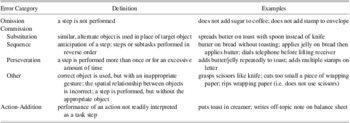
The total number and type of errors made on the DAFS and NAT were recorded based on the error scoring procedures described in Table 3 and detailed in prior publications (Buxbaum, Schwartz, Coslett, & Carew, Reference Buxbaum, Schwartz, Coslett and Carew1995; Buxbaum et al., Reference Buxbaum, Schwartz and Carew1997; Giovannetti, Libon, Buxbaum, & Schwartz, Reference Giovannetti, Libon, Buxbaum and Schwartz2002; Giovannetti, Bettcher, Brennan, Libon, Burke, et al., Reference Giovannetti, Bettcher, Brennan, Libon, Burke, Duey and Wambach2008; Giovannetti, Bettcher, Brennan, Libon, Kessler, et al., Reference Giovannetti, Bettcher, Brennan, Libon, Kessler and Duey2008; Schwartz et al., Reference Schwartz, Montgomery, Buxbaum, Lee, Carew, Coslett and Mayer1998, Reference Schwartz, Buxbaum, Montgomery, Fitzpatrick-DeSalme, Hart, Ferraro and Coslett1999, Reference Schwartz, Buxbaum, Ferraro, Veramonti and Segal2003). Physical assistance was provided without making eye contact or conversation when the intended action was clearly indicated. Assistance was offered only for steps that required motor dexterity or strength (e.g., opening jars, stabilizing the wrapping paper roll while the participant cut the paper). This type of assistance was offered so that the CES would not reflect gross motor difficulties (e.g., tremor, weakness).
Comprehensive Error Score Error Categories

Error type distributions
Prior studies have shown that NAT omission and commission error types (see Table 3) reflect dissociable constructs and that diverse patient populations differ on the distribution of errors from each category (Giovannetti, Schwartz, & Buxbaum, Reference Giovannetti, Schwartz and Buxbaum2007; Giovannetti, Bettcher, Brennan, Libon, Kessler, et al., Reference Giovannetti, Bettcher, Brennan, Libon, Kessler and Duey2008; Kessler et al., Reference Kessler, Giovannetti and MacMulen2007). In some studies, action addition errors have been associated with both commission and omission errors (Giovannetti, Bettcher, Brennan, Libon, Kessler, et al., Reference Giovannetti, Bettcher, Brennan, Libon, Kessler and Duey2008); in other studies action additions have been conceptualized as a type of commission error (Buxbaum et al., 1998; Giovannetti, Libon, Buxbaum, & Schwartz, Reference Giovannetti, Libon, Buxbaum and Schwartz2002; Schwartz et al., Reference Schwartz, Montgomery, Buxbaum, Lee, Carew, Coslett and Mayer1998, Reference Schwartz, Buxbaum, Montgomery, Fitzpatrick-DeSalme, Hart, Ferraro and Coslett1999).
To assess the pattern/distribution of errors, the proportion of errors from each error category was calculated from the total number of errors: Proportion Omission = Total Omissions/Total CES; Proportion Commission = Total Commissions/Total CES; Proportion Addition = Total Additions/Total CES. Proportion scores were calculated using CES from both the NAT and DAFS to include errors from a wide range of tasks and to reduce the number of statistical comparisons. Total error scores were used in correlation/regression analyses.
Inter-rater reliability
High inter-rater reliability has been reported for detailed analyses of the NAT (Buxbaum et al., Reference Buxbaum, Schwartz and Montgomery1998; Schwartz et al., Reference Schwartz, Montgomery, Buxbaum, Lee, Carew, Coslett and Mayer1998, Reference Schwartz, Buxbaum, Montgomery, Fitzpatrick-DeSalme, Hart, Ferraro and Coslett1999, Reference Schwartz, Buxbaum, Ferraro, Veramonti and Segal2003). However, because these detailed scoring procedures have not been used to evaluate DAFS performance, inter-rater reliability was evaluated for all DAFS detailed scores. Fifteen participants (25% of the sample) were randomly selected and coded separately by two coders (G.S. & F.R.). Discrepancies were noted for reliability analyses but then reconciled for final analyses. Discrepancies were reconciled following videotape review and discussion with a third coder (T.G.).
Statistical Analyses
Analyses of covariance (ANCOVA), controlling for age and education, were used to examine the effect of Group (PDD, PD, AD) on neuropsychological tests, caregiver reports, and performance-based variables. One-way ANCOVAs were used for post hoc comparisons between the groups when omnibus ANCOVAs were significant. Age was included as a covariate for post hoc comparisons including the PD group and education was included as a covariate in all post hoc comparisons including the AD group. Effect sizes for between-group differences were estimated using Cohen's d [.2 = small; .5 = medium; .8 = large (Cohen, Reference Cohen1988)]. Relations between total error scores and neuropsychological variables were assessed using bivariate correlations and hierarchical linear regressions.
Results
Neuropsychological Characterization of the Groups
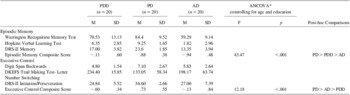
As shown in Table 4, there was a significant effect of Group for both Composite Scores.Footnote 1Post hoc comparisons showed the PDD and AD groups exhibited greater impairment than the PD (p < .001; d > .86 for all comparisons). The PDD group demonstrated greater executive control deficits than the AD group (p = .051; d = 1.23), whereas the AD group demonstrated greater episodic memory impairment than the PDD group (p < .001; d = 1.94 ).
Means, Standard Deviations, and Between-Group Statistical Comparisons for Neuropsychological Variables

DRS-II = Dementia Rating Scale, Second Edition; DKEFS = Delis Kaplan Executive Function System *df = 4, 55.
Caregiver Ratings
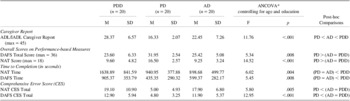
As expected, there was a significant effect of Group on the caregiver ratings (Table 5). Post hoc analyses showed caregivers of the non-demented PD group reported lower scores (greater independence) as compared to caregivers of the dementia participants (p < .002; d > 1.31 for all comparisons). Comparisons between the dementia groups showed AD participants were more independent than PDD participants (p = .022; d = .86).
Means, Standard Deviations, and Between-Group Comparisons for Measures of Everyday Action

ADL = activities of daily living; IADL = intrumental activites of daily living; DAFS = Direct Assessment of Functional Status; NAT = Naturalistic Action Test; *df = 4, 55 except for ADL/IADL ANCOVA df = 4, 52.
Performance-Based Assessments: Global Scores
There was a significant effect of Group on the NAT Score and DAFS Global Score (Table 5). Post hoc analyses showed no significant difference between the PDD and AD groups (NAT Score p = .76; d = .09; DAFS p = .25; d = .31). Both dementia groups (PDD, AD) performed worse than the PD group (p < .001; d > 1.7 for all comparisons). Note that even PD participants exhibited relatively lower scores as compared to published data from healthy older adults on the DAFS (Lowenstein et al., 1998) and NAT (Giovannetti, Bettcher, Brennan, Libon, Burke, et al., Reference Giovannetti, Bettcher, Brennan, Libon, Burke, Duey and Wambach2008).
Performance-Based Assessments: Detailed Analyses
Inter-rater reliability
Raters showed strong agreement for identifying DAFS actions as correct versus incorrect (90% agreement; Cohen's kappa = .78) and identifying a DAFS error as a commission versus an omission (86% agreement; Cohen's kappa = .76). The raters also were reliable in recording the time for completion for each DAFS task (r = .99; n = 15; p < .001).
Time to completion
There was a significant effect of Group on Time to Completion (Table 5). The PDD group had significantly longer times than both the PD and AD groups on the NAT (p < .001; d > 1.30 for both) and the DAFS (p < .017; d > .96 for both). There was no significant difference between the AD and PD groups (NAT p = .84; d = .09; DAFS p = .36; d = .57). The effect size for the PD vs. AD comparison of DAFS Time was medium, suggesting that this difference might have reached statistical significance with greater power.
Total comprehensive error score
There was a significant effect of Group on the CES for both the NAT and the DAFS (Table 5). As expected, the dementia groups (PDD, AD) made significantly more errors than the PD group (NAT p < .001; d > 1.78 for both; DAFS p <.001; d > 1.64 for both). The PDD and AD groups did not differ (p > .51; d<.17 for both).
Error patterns
Consistent with prior studies of dementia participants (Giovannetti, Libon, Buxbaum, & Schwartz, Reference Giovannetti, Libon, Buxbaum and Schwartz2002; Giovannetti, Bettcher, Brennan, Libon, Kessler, et al., Reference Giovannetti, Bettcher, Brennan, Libon, Kessler and Duey2008), sequence and substitution errors were the most frequent commissions. Relatively few action addition errors were made (i.e., <10% of all errors). Therefore, we examined relations among action addition errors and the other error categories to determine whether additions could be combined with commissions as in prior studies. In fact, action additions correlated significantly with commissions (r = .50; p < .001) but not omissions (r = .21; p = .112). Therefore, we chose to analyze a single commission error category to reduce the number of statistical comparisons while increasing power in the analyses, which was desirable given our sample size.
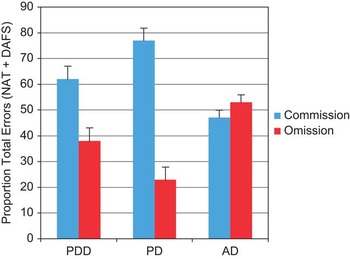
The distributions of Proportion Omissions and Proportion Commissions across the groups are shown in Figure 1. ANCOVA showed a significant effect of Group on Proportion Omission [F(4,55) = 12.05; p < .001]. As predicted, post hoc comparisons showed that the PDD group did not significantly differ from the PD group (p = .118; d = .68), although the effect size for this difference was medium. The AD group demonstrated the highest Proportion Omission of the entire sample, as they differed significantly from both the PDD (p = .028; d = .86) and PD (p = .017; d = 1.74) groups. Between-group analyses of the Proportion Commission were not performed, because after combining commission and addition errors, this score was the reciprocal of Proportion Omission.Footnote 2 Within-participant analyses showed error proportions patterned differently across the groups. As predicted, PDD and PD participants showed a similar error pattern, with a significantly higher Proportion Commission than Proportion Omission (PDD p < .024; d = 1.09; PD p < .001; d = 2.51). Participants with AD showed no significant difference between their Proportion Omission and Proportion Commission scores (p = .313; d = .46).
Mean Proportion Omission and Proportion Commission across the PDD, PD, and AD groups. Error bars reflect + 1 SEM.

Relations Among Neuropsychological Variables and Everyday Action Errors
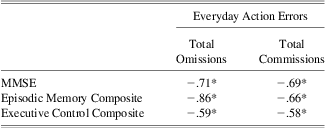
Total omissions and commissions correlated negatively and significantly with all neuropsychological variables, indicating that greater neuropsychological impairment was associated with more errors (see Table 6).
Single Order Correlations (r values) for NAT Error Scores x Neuropsychological Test Variables (n = 60)
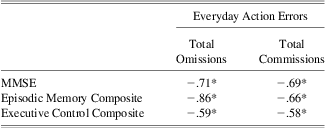
*p < .001
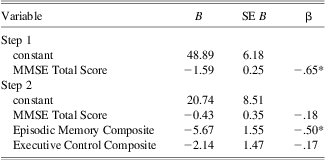
Hierarchical multiple regression was used to examine whether relations between neuropsychological tests and action errors might be best explained by overall level of cognitive impairment or a combination of neuropsychological measures. Two regression analyses were performed with MMSEFootnote 3 (i.e., overall impairment) in the first block and Episodic Memory and Executive Control composite scores in the second block. In the first regression, omissions was the dependent variable; the best model accounted for 57% of the variance [F(2,52) = 23.34; p < .01] with the Memory Composite emerging as the only significant predictor variable. As shown in Table 7, the change in the amount of variance explained by only the MMSE following inclusion of the Memory Composite Score was statistically significant.
Summary of Hierarchical Regression Analysis for Variables Predicting Omissions (N = 60)
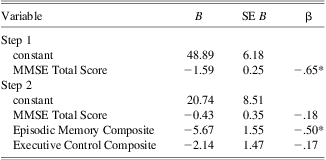
R 2 = .42 for Step 1 (p < .01); R 2 change = .15 for Step 2 (p < .01); *p < .05
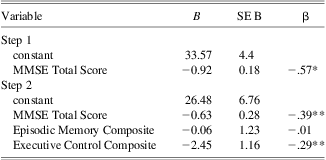
Total commissions was the dependent variable in the second regression (Table 8). The best model accounted for 38% of the variance [F(2,52) = 10.68; p < .01] with MMSE and the Executive Control Composite emerging as the only significant predictor variables. The change in the amount of variance explained by only the MMSE following inclusion of the composite scores did not reach statistical significance.Footnote 4
Summary of Hierarchical Regression Analysis for Variables Prediction Commissions (N = 60)
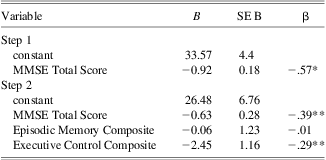
R 2 = .33 for Step 1 (p < .01); R 2 change = .06 for Step 2 (p = .11); *p < .01; **p < .05
Discussion
This novel study characterized EAI in PDD in contrast to PD and AD and in reference to a neuropsychological model. Although PDD participants exhibited a greater degree of EAI than PD participants, both groups exhibited a similar pattern of action errors that was qualitatively different from that of AD participants. The PDD/PD error pattern was characterized by relatively higher rates of commissions, an error type associated with reduced executive control. The AD error pattern was characterized by relatively higher rates of omissions, which have been associated with episodic memory failures (Giovannetti et al., Reference Giovannetti, Schmidt, Sestito, Libon and Gallo2006; Giovannetti, Bettcher, Brennan, Libon, Kessler, et al., Reference Giovannetti, Bettcher, Brennan, Libon, Kessler and Duey2008).
Between-group differences on performance-based tests of everyday action, as well as the results of the regression analyses, generally supported the Omission-Commission Model. This model posits that individuals with different neuropsychological impairments exhibit different patterns of EAI. Specifically, executive control deficits create difficulties in performing everyday tasks in an organized and efficient manner leading to mis-sequenced steps and inaccurate object/tool selection (i.e., commissions). This component of the model is generally consistent with accounts that emphasize the role of executive functions in efficient, goal-directed action (Buxbaum et al., Reference Buxbaum, Schwartz and Carew1997; Duncan, Reference Duncan1986; Fuster, Reference Fuster1989; Luria, Reference Luria1966; Norman & Shallice, Reference Norman and Shallice1980; Sirigu et al., Reference Sirigu, Zalla, Pillon, Grafman, Agid and Dubois1995). Another important component of the Omission-Commission Model proposes a unique role of episodic memory failures and degraded task knowledge on EAI, suggesting failure to recall or access task goals leads to the premature termination of the task and exclusion of major task components (i.e., omissions). The Omission-Commission Model contrasts with previous work emphasizing the role of global level of cognitive impairment on everyday action error patterns (Bouwens, et al., Reference Bouwens, van Heugten, Aalten, Wolfs, Baarends, van Menxel and Verhey2008; Giovannetti, Libon, Buxbaum, & Schwartz, Reference Giovannetti, Libon, Buxbaum and Schwartz2002; Schwartz et al., Reference Schwartz, Montgomery, Buxbaum, Lee, Carew, Coslett and Mayer1998, Reference Schwartz, Buxbaum, Montgomery, Fitzpatrick-DeSalme, Hart, Ferraro and Coslett1999) or suggesting that diverse neuropsychological deficits lead to similar everyday action errors (Buxbaum et al., Reference Buxbaum, Schwartz and Montgomery1998; Hartmann et al., Reference Hartmann, Goldenberg, Daumuller and Hermsdorfer2005). However, the model is consistent with several new reports showing differences in functional abilities across patients/populations with different dementia subtypes (Gure, Kabeto, Plassman, Piette, & Langa, Reference Gure, Kabeto, Plassman, Piette and Langa2010) or different forms of mild cognitive impairment (Bangen et al., Reference Bangen, Jak, Schiehser, Delano-Wood, Tuminello, Han and Bondi2010).
To be clear, general dementia severity remains important for understanding EAI, as global level of cognitive impairment was highly associated with the degree of functional impairment—the dementia groups (PDD, AD) exhibited significantly lower caregiver ratings and poorer global scores on performance-based functional tasks than the PD group. However, global cognitive impairment provides little information regarding the pattern of everyday action errors across the groups. Also, even after accounting for general dementia severity, neuropsychological measures of episodic memory and executive control explained additional variance in omission and commission scores, respectfully. In fact, episodic memory explained significantly more variance in Omissions than general dementia severity.
One important component of the Omission-Commission Model that was not evaluated in this study is the influence of task knowledge on everyday action error patterns. The link between degraded task knowledge and omission errors remains speculative (Bier & Macoir, Reference Bier and Macoir2011; Seter et al., Reference Seter, Giovannetti, Britnell, Brennan, Rosenthal, Grossman and Siderowf2010). Past studies have shown that AD patients exhibit impaired task knowledge when assessed independently from task execution (Cosentino et al., Reference Cosentino, Chute, Libon, Moore and Grossman2006; Grafman et al., Reference Grafman, Thompson, Weingarther, Martinez, Lawlor and Sunderland1991), but reports differ in terms of whether these knowledge deficits affect everyday action performance (Buxbaum et al., Reference Buxbaum, Schwartz and Carew1997). To our knowledge everyday task knowledge has not been empirically investigated in PDD, but investigators have reported relatively preserved task knowledge in PD (Zalla et al., Reference Zalla, Sirigu, Pillon, Dubois, Agid and Grafman2000) and in participants with executive control deficits following frontal lobe injury (Sirigu et al., Reference Sirigu, Zalla, Pillon, Grafman, Agid and Dubois1996). We speculate that degraded task knowledge associated with AD contributed to their omission error pattern and relatively preserved task knowledge in PD/PDD reduced the PD/PDD omission rate; however, further research is essential to fully appreciate the relation between task knowledge and EAI. Our laboratory is developing measures of task knowledge and refining intervention strategies to improve task knowledge (Bettcher et al., Reference Bettcher, Giovannetti, Libon, Eppig, Wambach and Klobusicky2011), but there is currently little consensus on the optimal method for evaluating this form of semantic knowledge.
In the present study, action addition errors occurred relatively infrequently and were strongly correlated with commissions but not omissions. Thus, to simplify our statistical analyses in the face of a small sample, we combined commissions and additions into a single commission error category. Prior studies have not conclusively shown action additions to dissociate from either omissions or commissions and the neuropsychological correlates for additions remain unknown (Giovannetti, Bettcher, Brennan, Libon, Kessler, et al., Reference Giovannetti, Bettcher, Brennan, Libon, Kessler and Duey2008). The current results suggest that action additions are more strongly associated with the executive control deficits that are linked to commissions, such as increased distractibility and off-task behaviors. Further research, possibly using experimental paradigms that offer a greater opportunity for additions or clinical populations with high rates of addition errors (e.g., schizophrenia; Kessler et al., Reference Kessler, Giovannetti and MacMulen2007) is necessary before drawing firm conclusions regarding the nature of this error type.
PDD caregivers reported participants to be less independent in daily activities than AD caregivers, even though the groups showed a comparable level of dementia severity and comparable overall impairment on performance-based global measures. There are numerous possible explanations for this finding. It is possible that caregiver ratings are influenced by different forms of EAI, with high rates of commissions and/or long task completion times leading to reports of greater dependence. When these performance-based variables were included individually as covariates in the analysis comparing PDD versus AD participants on caregiver ratings, only the Time to Completion variable made the difference non-significant (p = .32), suggesting that slowed performance times may differentially influence caregiver reports. We acknowledge, however, that other participant factors that were not measured also could have influenced the caregiver ratings, including affect, initiation, motivation, and so on. We also considered that caregiver reports reflect caregivers’ perceptions of performance in the home, which may be influenced by caregiver mood and distress (Zanetti, Geroldi, Frisoni, Bianchetti, & Trabucchi, Reference Zanetti, Geroldi, Frisoni, Bianchetti and Trabucchi1999). Unfortunately, we did not collect information on caregiver characteristics and are unable to offer a deep understanding of the difference in caregiver reports across the AD and PDD groups. However, this finding underscores the fact that caregiver reports and performance-based measures yield unique information and should be used jointly for the comprehensive assessment of EAI.
Along this line, it is important to note that our performance-based measures of everyday action focused on the cognitive contributions of everyday functioning, whereas caregiver ratings were not limited to the cognitive aspects of functional abilities. Performance-based scoring criteria purposefully focused on cognitive difficulties and did not include ratings for physical limitations or motor deficits (Schwartz et al., Reference Schwartz, Segal, Veramonti, Ferraro and Buxbaum2002, Reference Schwartz, Buxbaum, Ferraro, Veramonti and Segal2003). After controlling for global cognitive functioning (MMSE), relations between the UPDRS Motor Exam Score and performance-based measures of overall functioning were weak and nonsignificant (n = 40Footnote 5; r < .19 for all).
Our findings lay the groundwork for future studies designed to explore whether differential everyday error patterns have meaningful implications for intervention. The Omission-Commission Model suggests that omissions may be prevented by interventions that promote recall and access of task goals (Bettcher et al., Reference Bettcher, Giovannetti, Libon, Eppig, Wambach and Klobusicky2011; Bickerton, Humphreys, & Riddoch, Reference Bickerton, Humphreys and Riddoch2006; Brennan, Giovannetti, Libon, Bettcher, & Duey, Reference Brennan, Giovannetti, Libon, Bettcher and Duey2009; Bozeat, Patterson, & Hodges, Reference Bozeat, Patterson and Hodges2004; Sartori, Miozzo, & Job, Reference Sartori, Miozzo and Job1994). Interventions designed to improve task organization by imposing greater environmental structure (Giovannetti, Libon, et al., Reference Giovannetti, Libon, Brennan, Bettcher, Sestito and Kessler2007; Gitlin, Corcoran, Winter, Boyce, & Hauk, Reference Gitlin, Corcoran, Winter, Boyce and Hauk2001) or by promoting task monitoring (Levine et al., Reference Levine, Robertson, Clare, Carter, Hong, Wilson and Stuss2000, Reference Levine, Stuss, Winocur, Binns, Fahy, Mandic and Robertson2007; Manly, Hawkins, Evans, Woldt, & Robertson, Reference Manly, Hawkins, Evans, Woldt and Robertson2002; Robertson, Reference Robertson1996) may be most beneficial for EAI characterized by high rates of commissions, particularly among dementia participants whose commissions are largely comprised of sequence and substitution errors. However, the clinical implications of the Omission-Commission Model have not been empirically tested. There is relatively little work showing benefit from one functional intervention strategy over another in any patient population, despite that the notion of matching deficits to treatment approach makes theoretical sense and has been proven to be the most prudent intervention strategy for other complex disorders, including amnesia and aphasia (Riddoch & Humphreys, Reference Riddoch and Humphreys1994; Sohlberg & Mateer, Reference Sohlberg and Mateer2001; Wilson, Reference Wilson1999).
We acknowledge several limitations of our study and highlight several strengths. First, our sample size was relatively small, decreasing our power to detect small but potentially meaningful differences between our groups. Replication with larger samples is essential; future work also might focus on the functional deficits associated with PD as well as potential functional differences between PDD and DLB. Second, a more comprehensive evaluation of participants (e.g., UPDRS Motor Exam data on AD participants) and caregivers (e.g., mood, burden, etc.) would have allowed us to address several questions that were generated by our results on caregiver ratings. Third, our caregiver report measure, although widely used in the literature, provided information on only the global level of dependence on a set of tasks. In future research, we will incorporate newer caregiver measures that provide more detailed information on everyday functioning (Farias et al., Reference Farias, Mungas, Reed, Cahn-Weiner, Jagust, Baynes and DeCarli2008; Hobson, Edwards, & Meara, Reference Hobson, Edwards and Meara2001). Neuropsychological tests were selected on the basis of the Omission-Commission Model and prior research; measures of other constructs, including other executive processes (e.g., planning, concept formation) and other measures of the same constructs should be considered in future research. With respect to strengths, this study used a comprehensive evaluation of everyday action, including caregiver reports as well as detailed, performance-based methods. Comparisons were made across groups that differed in terms of their clinical diagnosis/neuropsychological profile, which allowed for more nuanced conclusions regarding everyday action impairment in PDD.
In conclusion, this study revealed that EAI in PDD differed quantitatively from action impairment in PD and qualitatively from EAI in AD. This supports the basic notion that clinical populations with different neuropsychological profiles show different patterns of EAI. Moreover, the nature of the error patterns across the groups supported the Omission-Commission Model, which posits a link between executive control deficits and commissions and between episodic memory deficits (and degraded task knowledge) and omissions. These results underscore the importance of detailed performance-based assessment of functioning in the clinic and specify targets for future interventions.
Acknowledgments
This study was funded by a grant from the Michael J. Fox Foundation to Tania Giovannetti and a Morris K. Udall Parkinson's Disease Research Center of Excellence grant from NINDS (NS-053488). A portion of this study was presented at the 2009 North American meeting of the International Neuropsychological Society; however, this manuscript has never been published either electronically or in print. The authors are grateful to Christy Favinger and Emily Rosenthal for their assistance in testing research participants. The authors have no conflicts of interest concerning this research.