Introduction
At its Annual Conference in Liverpool, in September 2008, the Academia Europaea celebrated the 20th anniversary of its foundation. Sir Arnold Burgen, First President, former Editor of European Review, and one of the very few of the ‘founding’ generation present at the meeting, bade farewell. The presentation evoked considerable interest, especially among members who had little or no previous information on the original rationale for Academia Europaea. Sir Arnold's presentation was subsequently published in European Review, so the actual chronology of events has now been well recorded.1
But what of the original ethos? The latter half of the 20th century witnessed a burgeoning of Europe-wide initiatives to promote scientific collaboration and inter-cultural dialogue. Given developments within the European Science Foundation (ESF), European Free Trade Alliance (EFTA), European Academy of Arts, Sciences and Humanities (EASSH) and other inter-academy alliances, whence any need for an institution like Academia Europaea? These were some of the questions raised by younger members at the Liverpool meeting.
I therefore submitted a proposal to Council, under its ‘New Initiatives’ rubric, for a pilot project involving video-recorded interviews with members of the original founding generation, inviting each to explain the motivations and contexts for this venture. DVD copies of these recordings could then be made available via the AE website so that all members, and particularly Section Chairs, could use them as catalysts for discussions and plans for continued pursuit of the AE mission. Feedback from such discussions, including specific questions could then be raised with the interviewees with invitations for direct responses or for written autobiographical essays, eventually to form the basis for a specific volume of papers to be prepared before the Silver Jubilee (2013).2
A small sum was allocated in late Autumn 2008 and interviews were undertaken in Spring 2009 with David Spearman (Dublin), Sir Arnold Burgen (Cambridge), and Lord Flowers (London). In the course of these interviews, the impression grew that somehow the life journeys and career contexts of these ‘founders’ might have a lot to do with the motivation for international and interdisciplinary collaboration. All subsequent interviews therefore endeavoured to glean more about the founders themselves and their career journeys. In April 2009 there was the opportunity to interview Professor David Magnusson, one of Academia Europaea's first Vice-Presidents, and on the same occasion to interview both Professor Stig Strömholm (Uppsala), later President, and also Dr Dan Brändström, former CEO of the Riksbankens Jubileumsfond, generous donor of financial support for Academia Europaea. Requests sent to other living members of the first Council received some negative responses, but among those who responded positively, there was a reluctance to being interviewed on camera. Others responded generously in postal and email communication. Eugen Seibold (Germany) wished simply to submit an essay on his recollections, later providing some details on his career experiences. Dr Ruurd van Lieshout kindly adapted his responses to an interview format and supplied very important details on his experiences and perspectives.
All these materials were submitted to AE Headquarters and both video and text materials were posted on www.acadeuro.org. There was little or no response. Informal feedback meanwhile suggested that AE members might prefer hard copy print material to web-based information. Substantively, too, the project had broadened its scope with a focus on the founders themselves as well as on the founding visions. Rather than wait for the Silver Jubilee, it therefore seemed wise to get these papers into print in 2011. I am extremely grateful to Professor Theo D'Haen, current Editor of European Review for the opportunity to publish these accounts.
Founder members have much in common by way of life experience – common denominators that may have bolstered their motivations to foster intellectual collaboration on a Europe-wide basis. All lived through wartime, depression and uncertain conditions. The Scandinavians faired reasonably well, but the continental Europeans experienced difficult economic and political circumstances. Van Lieshout was deported to Germany during the early 1940s and witnessed the ‘elimination’ of thousands Jewish friends; Eugen Seibold was wounded three times in the service of the Germany Army. Sir Arnold Burgen and Lord Brian Flowers had their studies radically changed during wartime. The lived experience of European disunity may surely have led to a desire for European unity after the war. All of the founders had travelled, voluntarily or otherwise, and experienced life in very different cultural and linguistic settings. This no doubt enabled them to appreciate various disciplinary perspectives, the importance of the social context in the development of science, and cultural variations in rapports between scientific research and public policy.
There were common denominators of scientific orientation too. Many of the founders were experts in ‘hard’ sciences: physics (Curien, Flowers, van Lieshout, Sinclair) pharmacology (Burgen), geology (Seibold), mathematics (Spearman, Tits) yet they warmly welcomed the prospect of a wider body of scholarship for Academia Europaea. Scholars from the human sciences were invited as participants in the First Council; Magnusson (psychologist) served as First Vice-President. It is also remarkable that articles published in European Review over the years, have been primarily by human scientists. And the foci of annual meetings have been largely on general issues addressed in a broadly cross-disciplinary manner.
Of the various points raised regarding the founding visions in the following accounts, a few were re-iterated by most respondents. The overall idea of a European Academy of scholars, aired over a few years through formal and informal encounters, however it was to be entitled, seemed certainly to be worthwhile.3 ‘Science’ was to be understood in the Continental European sense of Wissenschaften – all scholarly fields, rather than in the restricted British sense of natural/physical sciences. Membership should be comprised of individuals, nominated by members, and elected on the basis of scholarly merit and ‘European’ outlook by ‘subject committees’. There should be no ‘quotas’ by discipline, institution or country. A concerted effort should be made to engage scholars from a broad range of fields and from all ten European countries originally listed in the Council of Europe. No discipline or country should be dominant. In order to attract younger scholars who might otherwise prefer to remain associated with associations within their own special fields, provision should be made for both in-depth specialized enquiry on the one hand, and for general conferences with cross-disciplinary appeal on the other. Finally, in all interactions between the Academia and the public, scholarly opinions should be strictly non-partisan, objective and based on comparative research at a Europe-wide scale.
There were points of disagreement also. On the relationship between scientific research and problem-solving, there were substantial differences of opinion. Some hold that academic research should be for objectively-conducted ‘pure science’. Others see no objection to ‘applied science’. Surprisingly, there was not much discussion on issues of vernacular language – the Anglicization of discourse apparently acceptable to all those initially involved. Questions of money remained somewhat muted, but all felt that no subscription fees should be demanded, at least at the outset. And, as David Spearman pointed out, this remains an issue.
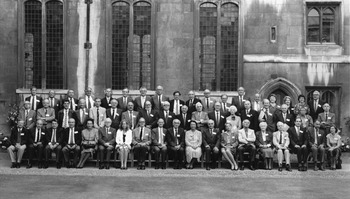
Some of the participants in the Cambridge meeting of Academia Europaea September 1988. (Those still alive 2009 in bold.)
Back Row: Canovas, Sylos−Labini, Gross, Jolowicz, Shackleton, Mueller, Baltes, Hers, Crutzen, Staab, Munk−Olsen, Pecker, Andreau, Attyah, De la Torre, Mrs Murray, Ms Salje−Rossi
Middle Row: Atkinson, Eschenmoser, Flavell, Cos, Fenstad, Dik, Hondros, Erben, Theocaris, De Wied, Amelinckx, Slaus, Gowing, Enquist, Handley, Mossbauer, Hohn, Petersen
Front Row: Le Pichon, von Wettstein, Birnstiel, Morelli, Mrs Morelli, Magnusson, Grodal, Flowers, van Lieshout, Burgen, Kornhauser, Curien, Chanin, Cappelletti, Douglas, Hägerstrand, Woods, Milner, McLaren

Many individuals contributed toward the launching of this European venture. All would agree, however, that without the decisive leadership of Sir Arnold Burgen, and the generous support of the British Research Councils, this venture would never have succeeded. Thanks to these efforts, 52 of the initial members met in Cambridge on 5 September 1988 – the ‘Foundation Meeting’ of Academia Europaea.
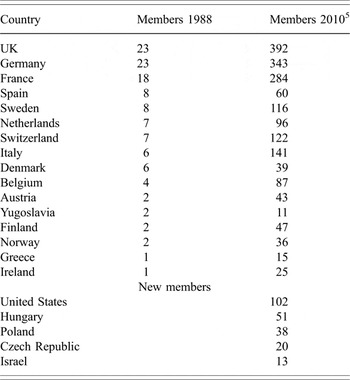
Academia Europaea: membership by country 1988 and 2010

Cambridge 1988: Foundation of Academia Europaea
Now as the Silver Jubilee Year approaches, one could raise the question of how well these founding ideals have been fulfilled.
The initial membership targets have certainly not been met. One of the proposals made at the 29 May 1987 meeting, as Seibold reported, was that there should be 5000 members in ‘a few years’. Today, the full membership totals 2295, including 91 who do not wish any further communication with AE. There have been strengths and limitations, too, in AE's commitment to individual membership. Each new member is free to identify his or her specific fields of expertise. Many, especially in the bio-physical sciences, identify with sub-disciplinary specialties. In all there are 565 ‘subject’ fields identified in the official membership list. This no doubt reflects the growing levels of specialization within 20th century science, thus also reflecting the problem of fragmentation in overall analytical effort. Given AE's commitment to ‘encouraging interdisciplinary and international research in all areas of learning’, perhaps some consideration should be given to establishing a broad check-list of specialties for new members to use. Questions also arise regarding the overall distribution of members across the continent. Of the initial 100 nominated by a small group appointed in 1987,Reference Burgen4 most came from a small number of countries, and the same countries continue to dominate.
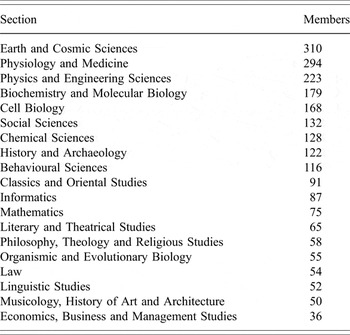
Academia Europaea: membership by section

The distribution of membership across various sections appears more equitable, but still those fields of ‘Founder’ expertise do appear to be dominant. Much has no doubt depended on leadership and precedent, but certainly an overall balance of sciences and humanities seems to have survived.
But the enduring general goals of Academia Europaea were all there, implicitly or explicitly, in the visions of the founders:
• to promote a wider appreciation of the value of European scholarship and research;
• to make recommendations to national governments and international agencies concerning matters affecting science, scholarship and academic life in Europe;
• to encourage interdisciplinary and international research in all areas of learning, particularly in relation to European issues;
• to identify topics of trans-European importance to science and scholarship and propose appropriate action to ensure that these issues are adequately studied.
Perhaps when the Silver Jubilee comes around in 2013, further reflection on progress toward these goals could again become catalysts for inter-disciplinary and inter-national dialogue.
Anne Buttimer is Emeritus Professor of Geography at University College Dublin. Graduate of the National University of Ireland, she received her PhD at the University of Washington (Seattle) in 1965 and since then has held research and teaching positions in Belgium, Canada, France, Scotland, Sweden, and USA. She is author of several books and articles on subjects ranging from social space and urban planning to the history of ideas and environmental policy. Some of her work has been published in translation into Dutch, French, German, Japanese, Latvian, Polish, Portuguese, Russian, Spanish, Swedish, and Russian. She received the Association of American Geographers’ Honours Award (1986), the Ellen Churchill Semple Award (1990), the Murchison Medal from the Royal Geographical Society (1997), and the Millennium Medal of the Royal Scottish Geographical Society 2001. She was elected member of Academia Europaea (1993), and Chair of its Social Sciences Section in 2010. She served as President of the International Geographical Union (2000–2004), and was awarded Honorary Doctorates from University of Joensuu, Finland (1999) and University of Tartu (Estonia) 2004. In 2009 she was awarded the Vega Gold Medal from the King of Sweden.