

The past few decades have bore witness to a profound change in societal attitudes toward self-identified gay, lesbian, and bisexual individuals. This change has been reflected in the official North American statistics, as more individuals have been inclined to declare their sexual orientation. For instance, Statistics Canada (2008) has reported that the number of publically self-identified gay and lesbian Canadians has increased from 13 to 20% between the years 2003 and 2008. In the same study, 1.3% of Canadians aged 18 to 59 self-identified as gay and 0.7% self-identified as lesbian. Similarly, researchers studying a sample of over 20,000 high school students from grade 7 to grade 12 (M age = 15.8 years) from 80 communities across the United States found that 14.4% of women self-identified as either lesbian or bisexual and 5.6% of men self-identified as gay or bisexual (Savin-Williams & Ream, Reference Savin-Williams and Ream2007). Moreover, there has been a recent surge in research statistics produced regarding the number of same-sex dyads. For example, the US Census altered the available marital status categories to include an ‘unmarried partner’ category, thus making it possible to obtain a more accurate estimation of the number of co-habiting same-sex couples (Peplau & Fingerhut, Reference Peplau and Fingerhut2007). According to a 2000 American Census, there were approximately 600,000 same-sex couples living together in the United States, with roughly equal numbers of men and women (Gates, Reference Gates2006). In 2005, this number increased by more than 30%, reaching nearly 777,000 (Gates, Reference Gates2006). In 2011, a similar nationwide Canadian Census reported 87,120 persons living in common-law same-sex relationships, and 21,015 same-sex married couples (Statistics Canada, 2011).
This significant increase reflected in the official statistics of same-sex unions has sparked a growing interest among many scientific disciplines to investigate the sexualities and experiences of individuals who identify themselves as gay, lesbian, and bisexual. Unfortunately, most measures used in research and therapeutic contexts have historically been normed on heterosexual persons only, and their applicability with non-heterosexual individuals has yet to be ascertained. In order to further advance the knowledge and investigation of self-identified gay, lesbian, and bisexual individuals involved in same-sex couple relationships, the professional community must have access to reliable and valid measures, which effectively evaluate the numerous facets and dimensions of such dyads. The current study aims to contribute to this feat by validating one such measure — the Caregiving Questionnaire (CQ) — with a sample of individuals involved in same-sex couple relationships and who identify themselves as gay, lesbian, and bisexual. The CQ is structured according to an attachment-theoretical perspective, and remains a widely used tool in couple relationship research and clinical practice alike (Mikulincer & Shaver, Reference Mikulincer, Shaver, Mikulincer and Shaver2007) since its development by Kunce and Shaver (Reference Kunce, Shaver, Perlman and Bartholomew1994).
Overview of Attachment Theory
Attachment theory, initially developed by Bowlby (Reference Bowlby1969, 1982), describes the emotional bond created between infants and their primary caregivers, as well as the stress deriving from the separation of the two. More specifically, Bowlby theorised that human behaviours are organised according to innate behavioural systems, which have been designed to increase people's capacity for survival against threatening conditions or environments. Such innate behavioural systems consist of the attachment system, the caregiving system, and the sexual mating system. The attachment system ensures an individual's proximity to a caring and supportive other referred to as the attachment figure. The caregiving system guarantees that the caregiver responds to the care-seeker's needs signals (e.g., an infant's cries, a romantic partner's stress outbursts). Finally, the sexual mating system functions as a motivator for sexual intercourse with an opposite-sex partner in order to ensure the survival of our species (see Mikulincer, Reference Mikulincer, Mikulincer and Goodman2006 for a review; Shaver & Hazan, Reference Shaver and Hazan1988). These interrelated systems develop throughout one's lifespan, allowing an individual to both seek and give protection to those with whom attachment bonds are shared. When experiencing adversity, fear, or illness, the attachment system will be most strongly activated, and according to this theory of attachment, it is during these times that individuals will seek protection from their caregiver(s). The caregiver therefore serves as a safe haven that provides protection and relief from threatening circumstances, and also functions as a secure base from which individuals may explore their environments and pursue their goals.
In the late 1980s, it was proposed that the aforementioned attachment processes governing infant-caregiver attachment relationships should also influence individuals’ thoughts and emotions regarding close others in adulthood (Hazan & Shaver, Reference Hazan and Shaver1987). Based on this postulation, attachment theory was extended to adolescent and adult romantic love (Hazan & Shaver, Reference Hazan and Shaver1987; Shaver, Hazan & Bradshaw, Reference Shaver and Hazan1988). Hazan and Shaver (Reference Hazan and Shaver1987) postulated that individuals may be grouped into three categories of attachment corresponding to those developed for measures of attachment in childhood (secure, avoidant, and anxious-ambivalent). Bartholomew and Horowitz (Reference Bartholomew and Horowitz1991) later introduced a four-category typology of adult attachment, which consists of secure and anxious-preoccupied attachment patterns, as well as two avoidant patterns: fearful and dismissing. These two major contributions to adult attachment theory inspired the development of a number of measures used to investigate various dimensions of romantic attachment (see Crowell, Fraley, & Shaver, Reference Crowell, Fraley, Shaver, Cassidy and Shaver2008, for a review). However, the availability of a vast array of assessment instruments resulted in confusion among researchers and clinicians regarding which measures are most efficacious and appropriate for use (Brennan, Clark, & Shaver, Reference Brennan, Clark, Shaver, Simpson and Rholes1998). In an attempt to resolve this newfound problem, Brennan and colleagues produced a self-report questionnaire of romantic attachment, entitled the ‘Experiences in Close Relationships’ (ECR), which incorporated most of the non-redundant items found in the existing literature. Their factor analysis yielded a bifactorial structure of romantic attachment, composed of the anxiety over abandonment and avoidance of intimacy dimensions. Anxiety over abandonment involves a negative model of the self in relation to the world. Consequently, highly anxious individuals tend to seek reassurance of their partners’ love, as they fear separation and abandonment. Alternately, avoidance of intimacy involves a negative model of others in the external world, with highly avoidant individuals being more prone to resist closeness and doubt their partners’ availability in times of need.
Using this attachment-theoretical framework, there has been a growing effort on behalf of researchers to investigate the romantic caregiving system more thoroughly. Empirical evidence has demonstrated that the provision of responsive care to a romantic partner is likely to have important long-term implications for the care-seeker, including higher levels of self-esteem, greater perceived competency, reduced stress, as well as a greater willingness to pursue personal goals (Collins, Guichard, Ford, & Feeney, Reference Collins, Guichard, Ford, Feeney, Mikulincer and Goodman2006; B.C. Feeney, Reference Feeney2004). The emotional wellbeing of the caregiver can also be enhanced by feelings of competency generated from responding to another person's needs (Mikulincer, Reference Mikulincer, Mikulincer and Goodman2006). Furthermore, caregiving has long been substantiated as a highly important contributor to the functioning of adult romantic relationships. For example, many studies have demonstrated that effective romantic caregiving is related to increases in both partners’ marital satisfaction (J.A. Feeney, Reference Feeney1996; Kane et al., Reference Kane, Jaremka, Guichard, Ford, Collins and Feeney2007; Kotler, Reference Kotler1985), general relationship functioning (Carnelley, Pietromonaco, & Jaffe, Reference Carnelley, Pietromonaco and Jaffe1996; Feeney & Collins, Reference Feeney and Collins2001), marital adjustment (Lafontaine & Bélanger, Reference Lafontaine and Bélanger2003), and conflict management (Lafontaine, Bélanger, & Gagnon, Reference Lafontaine, Bélanger and Gagnon2009).
In order to further explore the influence that caregiving may have on romantic relationships, several conceptualisations and measures of romantic caregiving have been developed throughout the past 10 years (Collins et al., Reference Collins, Guichard, Ford, Feeney, Mikulincer and Goodman2006; Davila & Kashy, Reference Davila and Kashy2009). For instance, some theorists choose to conceptualise caregiving as a general construct, combining both the safe haven and secure base processes (e.g., Crowell et al., Reference Crowell, Treboux, Gao, Fyffe, Pan and Waters2002; Waters & Waters, Reference Waters and Waters2006), while others prefer to investigate the safe haven and secure base constructs independently in order to investigate their unique functions and processes (e.g., Collins et al., Reference Collins, Guichard, Ford, Feeney, Mikulincer and Goodman2006; Feeney & Collins, Reference Feeney and Collins2003). The safe haven construct itself has been the focus of much examination (e.g., Carnelley et al., Reference Carnelley, Pietromonaco and Jaffe1996; Collins & Feeney, Reference Collins and Feeney2000; Kunce & Shaver, Reference Kunce, Shaver, Perlman and Bartholomew1994). Through such investigation of the safe haven and secure base constructs, several measurement tools have been developed. For example, experimental procedures have been created in order to evaluate one's responsiveness and availability by manipulating the romantic partner's level of need for support (e.g., Feeney & Collins, Reference Feeney and Collins2001). A few observational scoring systems have also been created with the intention of rating various dimensions of romantic caregiving, such as the ability to appropriately recognise and interpret a partner's cues of distress (e.g., Collins & Feeney, Reference Collins and Feeney2000; Crowell et al., Reference Crowell, Treboux, Gao, Fyffe, Pan and Waters2002; Simpson, Winterheld, Rholes, & Orina, Reference Simpson, Winterheld, Rholes and Orina2007). Finally, numerous self-report questionnaires have been produced to evaluate components of romantic caregiving, such as dyadic empathy and couple support (e.g., Brassard, Houde, & Lussier, Reference Brassard, Houde and Lussier2011; Long, Reference Long1990; Péloquin & Lafontaine, Reference Péloquin and Lafontaine2010). However, despite the development of such self-report measures, the CQ remains the only validated and psychometrically sound self-report questionnaire of romantic caregiving (Kunce & Shaver, Reference Kunce, Shaver, Perlman and Bartholomew1994). As such, its role in couple relationship research and therapy is critical, and proper validation of this tool with same-sex couples may hold much value for professionals aiming to expand existing knowledge and insights regarding the experiences of individuals involved in such romantic dyads.
The Caregiving Questionnaire
The CQ is a 32-item questionnaire that systematically describes the role of individual differences in the romantic caregiving system. Based on parental–infant caregiving relationships, Kunce and Shaver (Reference Kunce, Shaver, Perlman and Bartholomew1994) identified seven initial dimensions of caregiving: Sensitivity vs. Insensitivity, Acceptance vs. Rejection, being Cooperative vs. Uncooperative, being Accessible vs. Inaccessible, Physical Contact, Affective Expression, and Compulsive Caregiving. These different constructs were then forced into a four-factor solution comprising the following subscales: Sensitivity vs. Insensitivity (the ability to recognise and interpret the partner's need); Proximity vs. Distance (willingness to provide care needed); Cooperation vs. Control (support for the partner's attempts to solve problems); and Compulsive Caregiving (the tendency to intrude and become too involved in the partner's problems). The original alpha reliability coefficients reported by Kunce and Shaver for each subscale were .83, .83, .87, and .80, respectively. The scores obtained remained stable after a 1-month retest period and significant correlations were drawn with the partner's rating of one's caregiving (Kunce & Shaver, Reference Kunce, Shaver, Perlman and Bartholomew1994).
Furthermore, significant associations were found by Kunce and Shaver (Reference Kunce, Shaver, Perlman and Bartholomew1994) between caregiving patterns and romantic attachment as measured by Hazan and Shaver's (Reference Hazan and Shaver1987) three-category typology of adult romantic attachment and Bartholomew's four-category typology of adult attachment patterns (Bartholomew & Horowitz, Reference Bartholomew and Horowitz1991). More specifically, they found that participants reporting secure attachment patterns tended to score high on provisions of proximity, sensitivity, cooperation, and low on compulsive caregiving. Preoccupied participants were found to score high on providing proximity and compulsive caregiving, while low on sensitivity and cooperation. Dismissing individuals were found to be lowest on compulsive caregiving and on proximity, and also low on sensitivity. Fearful individuals scored low on provisions of proximity and sensitivity, and also displayed patterns of highly compulsive caregiving. Finally, the multidimensional structure of the CQ has been observed with various samples of heterosexual couples, including student dating couples (e.g., Feeney & Collins, Reference Feeney and Collins2003), married couples (e.g., J.A. Feeney, Reference Feeney1996; Feeney & Hohaus, Reference Feeney and Hohaus2001), and married couples with children (Millings & Walsh, Reference Millings and Walsh2009). Nonetheless, it appears that no study to date has employed the CQ to explore romantic caregiving amongst self-identified gay, lesbian, and bisexual persons in same-sex relationships. It is therefore undetermined whether its use with such population is psychometrically sound and should be warranted.
Over the years, other self-report questionnaires have demonstrated similar psychometric properties with samples of individuals who identify themselves as gay, lesbian, and bisexual, as found with heterosexual individuals. For example, the Interpersonal Reactivity Index for Couples (IRIC; Péloquin & Lafontaine, Reference Péloquin and Lafontaine2010), a measure of dyadic empathy, was recently validated for use with individuals in same-sex relationships, as well as with individuals in heterosexual relationships, with no psychometric differences found between these two groups. Moreover, although attachment theory and the sexual mating system have been denounced as heterosexist by some (e.g., Riggs, Reference Riggs, Nathanson and Tuley2008), the theoretical applicability of romantic attachment and romantic caregiving with self-identified gay, lesbian, and bisexual persons involved in same-sex couple relationships has been demonstrated by others (Mohr, Reference Mohr, Cassidy and Shaver2008; Peplau & Spalding, Reference Peplau, Spalding, Garnets and Kimmel2003). This was further supported by the validation and use of several measures of attachment with samples of individuals involved in same-sex romantic relationships. Specifically speaking, the factor structure and internal consistency of the Experiences in Close Relationships questionnaire (ECR; Brennan et al., Reference Brennan, Clark, Shaver, Simpson and Rholes1998) was investigated with a sample of gay and lesbian individuals, allowing this well-established measure of attachment patterns to be validated with self-identified gay, lesbian, and bisexual individuals involved in same-sex couple relationships (Matte, Lemieux, & Lafontaine, Reference Matte, Lemieux and Lafontaine2009). Also, the psychometric properties of two self-report measures of adult attachment, entitled the Adult Attachment Scale (Collins & Read, Reference Collins and Read1990) and the Relationship Scales Questionnaire (Griffin & Bartholomew, Reference Griffin, Bartholomew, Bartholomew and Perlman1994), were tested with a sample of both same-sex and heterosexual couples, with no evidence found of moderation attributed to differences in the sexual orientations of participants (Kurdek, Reference Kurdek2002). Although similar results may be expected with the CQ, a thorough examination is necessary to ascertain the suitability of its use with a population of individuals who identify themselves as gay, lesbian, and bisexual.
Objectives and Hypotheses
The primary objective of the present study was to examine the psychometric properties of the CQ when employed with a sample of individuals who identify themselves as gay, lesbian, and bisexual currently involved in same-sex couple relationships. As a baseline measure, we sought to determine whether the CQ would reveal the same seven-dimension structure when measuring same-sex romantic relationships as the seven-dimension structure reported by Kunce and Shaver (Reference Kunce, Shaver, Perlman and Bartholomew1994) during their development of the scale with heterosexual couples. Because factor analysis generally tends to overestimate the number of factors underlying questionnaires (Bryant & Yarnold, Reference Bryant, Yarnold, Grimm and Yarnold1995), the preliminary results will specifically be forced to four factors. This also follows Kunce and Shaver's initial steps to obtain the most parsimonious factor structure, and is the most accurate way to replicate their final factorial structure, which is composed of the questionnaire's final subscales. Based on the extracted factor structure, the internal consistency of the CQ's subscales will be assessed. Lastly, the concurrent and divergent validities of the questionnaire will be examined.
Factorial structure
When using factor extraction, it is hypothesised that the structure of the CQ will consist of the aforementioned seven initial dimensions reported by Kunce and Shaver (Reference Kunce, Shaver, Perlman and Bartholomew1994). It is also hypothesised that a forced four-factor solution using results collected from gay, lesbian, and bisexual individuals will separate the items into the originally modified four subscales: Proximity vs. Distance (eight items), Sensitivity vs. Insensitivity (eight items), Cooperation vs. Control (eight items) and Compulsive Caregiving (eight items).
Internal consistency
The forced four-factor solution's final subscales have demonstrated acceptable reliability, with alpha coefficients ranging from .80 to .87 (Kunce & Shaver, Reference Kunce, Shaver, Perlman and Bartholomew1994). Henceforth, internal consistency coefficients when measured with a sample of individuals who identify themselves as gay, lesbian, and bisexual in same-sex couple relationships are expected to demonstrate acceptable reliability falling within the same range.
Convergent and divergent validities
As previously discussed, Kunce and Shaver (Reference Kunce, Shaver, Perlman and Bartholomew1994) initially observed various links between the CQ scales and romantic attachment using Hazan and Shaver's three-category measure (Reference Hazan and Shaver1987) and Bartholomew's four category measure of adult attachment patterns (Bartholomew & Horowitz, Reference Bartholomew and Horowitz1991). In the present study, the ECR questionnaire (Brennan et al., Reference Brennan, Clark, Shaver, Simpson and Rholes1998) was used to establish convergent validity. This questionnaire measures romantic attachment on a continuum from romantic attachment security to insecurity, and is comprised of two dimensions: Anxiety over Abandonment and Avoidance of Intimacy. As such, convergent validity is predicted based on these two dimensions in parallel to the four CQ subscales. In examining the relationship between attachment insecurity and the CQ's four subscales, certain associations are expected to replicate Kunce and Shaver's previous findings. More specifically, individuals who report high scores of anxiety over abandonment are expected to demonstrate low sensitivity (Sensitivity vs. Insensitivity) and cooperation (Cooperation vs. Control), in contrast to high amounts of proximity (Proximity vs. Distance) and Compulsive Caregiving. Alternately, individuals reporting high avoidance are hypothesised to reflect low scores on all four dimensions measured by the CQ (i.e., low levels of sensitivity, cooperation, proximity and compulsive caregiving). Moreover, because of the original conceptualisation of caregiving as a universal system (Bowlby, Reference Bowlby1969, 1982), a number of sociodemographic variables will be used to establish divergent validity. Specifically, no association is expected between each subscale and the participants’ age, relationship duration, and gross annual revenue.
Method
Participants
A total sample of 143 individuals (N = 143; 114 females) participated in this study. Within this sample, 81.8% of participants self-identified as gay or lesbian, and 17.5% self-identified as bisexual (24 females; 2 males). A controversy exists within the social sciences with regard to collapsing individuals who identify themselves as bisexual into generic categories (see Carr, Reference Carr2007 for a review). Nonetheless, considering that the purpose of the present study was to validate the CQ among individuals involved in same-sex couple relationships, their inclusion in the sample was deemed appropriate inasmuch as they responded to the selection criteria. These criteria consisted of being involved in a same-sex romantic relationship at the time of participation (minimum duration of one year), being at least 18 years of age, and having a good knowledge of English. Participants ranged in age from 18 to 65 years, with a mean age of 29.93 years (SD = 9.77). The mean length of their romantic relationships was 5.05 years (SD = 5.40). Ninety-three per cent (93%) of participants were Caucasian, and 90.2% had resided in Canada throughout their entire lives. Twenty-five participants (25) reported French as their first language, and 114 were English-speaking. Twenty-two per cent (22%) had been awarded a high school diploma or less, and 76.2% completed a college or a university program. Annual revenue of participants ranged from 0 to 135,000 Canadian dollars (M = 34,393; SD = 29,547).
Procedure
Eligible individuals were invited to participate in the study through recruitment efforts distributed in the Ottawa region at community organisations and events. Recruitment posters and pamphlets were also strategically displayed on an East-Ontarian university campus. Additionally, an email describing the purpose of the study was sent to numerous associations serving the gay, lesbian, and bisexual community, and was subsequently forwarded to their members. Individuals qualifying for participation in the study were sent an email containing a link to the secure online survey. Paper copies of the questionnaire package were also available to participants if so desired. The questionnaire package consisted of the questionnaires outlined above, in addition to and a letter of consent. This letter included an outline of the study, a statement of its purpose, as well as an assurance of confidentiality. Once the questionnaire package was completed by participants, it was returned in a postage-paid envelope or submitted online. Participants’ identification numbers were then entered in a draw to win a gift certificate to a local music store.
Measures
Demographic information
A demographics questionnaire was included in the questionnaire package and included questions regarding personal information, such as the participant's gender, age, and level of education, as well as questions pertaining to romantic relationships.
The Caregiving Questionnaire (CQ; Kunce & Shaver, Reference Kunce, Shaver, Perlman and Bartholomew1994) is a 32-item self-report measure of caregiving, which comprises four scales: Proximity vs. Distance (e.g., ‘When my partner seems to want or need a hug, I'm glad to provide it’), Sensitivity vs. Insensitivity (e.g., ‘I am very attentive to my partner's nonverbal signals for help and support’), Cooperation vs. Control (e.g., ‘I tend to be too domineering when trying to help my partner’), and Compulsive Caregiving (e.g., ‘I tend to get overinvolved in my partner's problems and difficulties’). Each dimension consists of eight items rated according to Likert-type response format, with responses ranging from 1 = not at all like me, to 6 = very much like me. In order to avoid response bias, each scale comprises four positively worded (e.g., ‘I am always supportive of my partner's own efforts to solve his/her problems’) and four negatively worded (e.g., ‘I don't like it when my partner is needy and clings to me’) items. The negatively worded items were recoded and, to facilitate inter-study comparison of results, means were calculated based on each respective subscale's items, in order to produce a total score for each dimension (score range: 1–7). Higher scores reflect increased levels of proximity, sensitivity, cooperation, and a decreased level of compulsive caregiving.
The Experiences in Close Relationships Questionnaire (ECR; Brennan et al., Reference Brennan, Clark, Shaver, Simpson and Rholes1998), a 36-item measure of romantic attachment, and comprises two dimensions: Anxiety over Abandonment (e.g., ‘I need a lot of reassurance that I am loved by my partner’) and Avoidance of Intimacy (e.g., ‘I try to avoid getting too close to my partner’). Each scale consist of 18 items rated according to a Likert-type response format, with responses ranging from 1 = strongly disagree, to 7 = strongly agree. Mean scores were calculated and used as indexes of anxiety over abandonment and avoidance of intimacy. Again, scores ranged between 1 and 7, with higher scores denoting increased anxiety over abandonment and avoidance of intimacy. The ECR's two-factor structure was found to display the best psychometric properties in a comparison of other measures of adult attachment (Fraley, Brennan, & Waller, Reference Fraley, Brennan and Waller2000). The ECR has also recently been validated with a sample of gay and lesbian individuals (Matte et al., Reference Matte, Lemieux and Lafontaine2009).
Results
Preliminary Analyses
Prior to the main analyses, collected data were screened for the presence of missing values and multivariate outliers. In order to avoid the use of multiple imputation, a final sample of 143 individuals who had completed the entire questionnaire package was conserved. Due to attrition, it was noted that 153 of the 296 participants who had started filling out the questionnaire package had dropped out of the study (response rate 48%). No significant outliers were found.
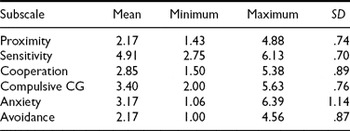
A multivariate General Linear Model (GLM) was conducted in order to assess whether or not participants who self-identify as bisexual and are involved in same-sex relationships differed on the sociodemographic variables as well as all other variables of interest. In order to proceed with the examination of bisexuality's individual effects on the variables in question, the omnibus test was verified for significance at the p < .15 level (Tabachnick & Fidell, Reference Tabachnick and Fidell2007). The omnibus test for this GLM was non-significant at p = .211, thus, it was not justified to examine individual effects, and it was concluded that bisexuals did not differ on the variables tested in this study. Average mean scores were calculated for each measure's respective subscales and are presented in Table 1 along with their respective ranges and standard deviations.
Averages of Mean Scores, Ranges, and Standard Deviations of the Respective CQ and ECR Subscales

Factor Structure
Given the sample size (N = 143), exploratory factor analysis (EFA) was considered appropriate for use, as 10 participants per item or parameter are typically required in order to conduct Confirmatory Factor Analysis (CFA) with sufficient statistical power (Bryant & Yarnold, Reference Bryant, Yarnold, Grimm and Yarnold1995). The Kaiser-Meyer-Olkin measure of sampling adequacy was .82; suggesting excellent sampling adequacy (Bryant & Yarnold, Reference Bryant, Yarnold, Grimm and Yarnold1995). Bartlett's test of sphericity was also significant at the p = .000 level, further reinforcing EFA as an appropriate analysis, given our sample size. Varimax rotation was used as the final method of rotation, based on the absence of intercorrelation between factors. This assumption was tested beforehand using a direct oblimin rotation, which produces a factor correlation matrix (Bryant & Yarnold, Reference Bryant, Yarnold, Grimm and Yarnold1995). A seven-factor solution was retained in parallel to the original CQ, and each item loaded correctly on its respective dimension. All factor loadings were found to be superior to the acceptable value of .30 (Bryant & Yarnold, Reference Bryant, Yarnold, Grimm and Yarnold1995). Factor 1 explained 25.88% of the variance, factor 2 explained 13.38%, factor 3 explained 7.64%, factor 4 explained 6.98%, factor 5 explained 5.33%, factor 6 explained 3.95%, and factor 7 explained 3.28%, for a total of 66.5% of the variance explained by the model prior to rotation. Because this EFA was performed solely to assess whether items would be grouped into seven factors as per Kunce and Shaver's (Reference Kunce, Shaver, Perlman and Bartholomew1994) initial factor analysis (which they did, both statistically and conceptually), detailed results for factor loadings will not be presented.
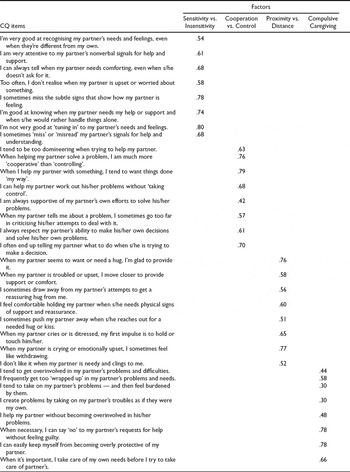
Consecutively, the second EFA forced to four factors (performed with principal axis factoring and varimax rotation) yielded results identical to those found by Kunce and Shaver in 1994. Factor 1 explained 25.88% of the variance, factor 2 explained 13.38%, factor 3 explained 7.64% and factor 4 explained 6.98%, for a cumulative total of 53.9% of explained variance. Factor loadings ranged from .54 to .80 on the first 8-item factor (Sensitivity vs. Insensitivity), from .42 to .79 on the second 8-item factor (Cooperation vs. Control), from .51 to .77 on the third 8-item factor (Proximity vs. Distance), and lastly, from .30 to .78 on the fourth 8-item factor (Compulsive Caregiving). Detailed results are presented in Table 2.
CQ Factor Structure Fixed at Four Factors After Varimax Rotation Found With 143 Individuals Involved in Same-Sex Relationships.

Reliability
Based on the final extracted factor structure, scores for subscales were calculated and used to establish internal consistency. After reverse scoring of negatively worded items, alpha coefficients were of .72 for the Sensitivity vs. Insensitivity subscale, of .88 for the Cooperation vs. Control subscale, of .84 for the Proximity vs. Distance subscale, and of .70 for the Compulsive Caregiving subscale.
Convergent and Divergent Validity
The CQ scales were generally found to be correlated as expected with the ECR. More specifically, no significant relationships were found between Avoidance of Intimacy and Proximity vs. Distance, r(143) = .19, ns; nor with Compulsive Caregiving, r(143) = .09, ns. A significantly large relationship was found between Avoidance of Intimacy and Sensitivity vs. Insensitivity, r(143) = .42, p < .01, and a significantly large inverse relationship was also found with Cooperation vs. Control, r(143) = −.42 p < .01. In regards to Anxiety over Abandonment, no significant relationship was found with Sensitivity vs. Insensitivity, r(143) = −.09, ns. However, a moderate relationship was observed with Proximity vs. Distance, r(143) = .27, p < .01, as well as a large relationship with Compulsive Caregiving, r(143) = .40, p < .01. Lastly, a moderate inverse relationship was found with Cooperation vs. Control, r(143) = −.27, p < .01. Magnitudes of effect sizes between .2 and .3 were considered moderate, and effect sizes above .4 were considered large (Tabachnick & Fidell, Reference Tabachnick and Fidell2007).
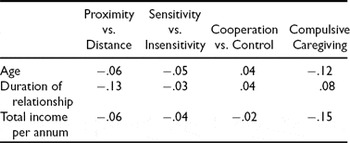
Sociodemographic variables were used in order to establish divergent validity. No significant relationships were found between the four CQ subscales and the sociodemographic variables that were theorised to be conceptually distinct from the caregiving response, namely, participants’ age, relationship duration, and total income (see Table 3).
Correlations Used to Assess Divergent Validity Between CQ and Conceptually Distinct Sociodemographic Variables.

Discussion
The present study consisted of an examination of the CQ's factor structure when used with a sample of self-identified gay, lesbian, and bisexual individuals involved in same-sex relationships. This was accomplished by replicating the initial methodology employed by the questionnaire's authors Kunce and Shaver (Reference Kunce, Shaver, Perlman and Bartholomew1994). Furthermore, the CQ's convergent validity with the ECR questionnaire, and its divergent validity with certain sociodemographic variables were tested. Results indicated that the CQ is a valid measure of caregiving with the present sample, therefore confirming its use with English-speaking individuals involved in same-sex couple relationships.
First, exploratory factor analysis of the items of the CQ revealed results identical to Kunce and Shaver's Reference Kunce, Shaver, Perlman and Bartholomew(1994) initial seven dimensions. The preliminary results were then forced into a more parsimonious four-factor structure, namely Proximity vs. Distance, Sensitivity vs. Insensitivity, Cooperation vs. Control, and Compulsive Caregiving. Factor loading for each dimension were similar to Kunce and Shaver's initial results, thus supporting the construct validity of the questionnaire.
The internal consistency of the CQ's four subscales was also found to be adequate. However, paralleling Kunce and Shaver's (Reference Kunce, Shaver, Perlman and Bartholomew1994) initial reliability coefficients, the Cronbach's alpha for the Compulsive Caregiving scale was found to be lower (α = .70; original α = .73) than that of the other three dimensions. In her research, J.A. Feeney (Reference Feeney1996) also discovered the scale's lower alpha, and subsequently deleted one item (item 9) from the Compulsive Caregiving scale in order to increase its reliability to .80. Nonetheless, because the reliability coefficients with this sample are satisfactory, no item modification was necessary.
The four subscales of the CQ demonstrated preliminary evidence of divergent and convergent validities. Specifically, in similar fashion to Péloquin and Lafontaine (Reference Péloquin and Lafontaine2010) and as expected theoretically (Bowlby, Reference Bowlby1969, 1982), divergent validity was found with the sociodemographic variables, thus indicating that caregiving is not moderated by one's age, annual income, or relationship duration. Partial convergent validity was found with the ECR's two dimensions of attachment: Anxiety over Abandonment and Avoidance of Intimacy. Individuals who scored higher on the anxiety subscale of the ECR indicated increased proximity and compulsive caregiving, in addition to low cooperation. These results are consistent with the tenets of attachment theory, as anxious individuals are expected to consistently seek others’ approval and may be too preoccupied by their own need for reassurance of their partner's affection to provide effective care (J.A. Feeney, Reference Feeney1996). As such, anxious individuals are more likely to compulsively and often inadequately provide care to others, while being dissatisfied with the care they receive. According to attachment theory, such individuals hyperactivate their attachment and caregiving systems by providing care in a self-sacrificing and intrusive way (for reviews, see Cassidy, Reference Cassidy2000; and Shaver & Hazan, Reference Shaver and Hazan1988). Unexpectedly, however, no correlation was found in the present study between anxiety over abandonment and the Sensitivity subscale of the CQ. These results, which differ from Kunce and Shaver's (Reference Kunce, Shaver, Perlman and Bartholomew1994), seem to indicate that attachment anxiety is not related to either higher or lower sensitivity to a partner's signals of need. Such inconsistency may be explained by differences tools used to measure of romantic attachment (Experiences in Close Relationships vs. Relationship Questionnaire), in sample sizes (143 vs. 393 participants), or in the type of relationships investigated (same-sex couples vs. heterosexual couples) between the present study and that of Kunce and Shaver's, respectively. Another possible reason for this discrepancy may relate to the high proportion of female participants in the current sample (79.2% vs. approximately 65% in Kunce and Shaver's study), as women are traditionally raised to be more nurturing and sensitive to their loved ones’ needs. This latter explanation is consistent with previous research, which yielded a significant negative correlation between anxiety over abandonment and sensitivity to a partner's need for men while it did not for women (Millings & Walsh, Reference Millings and Walsh2009). Additionally, it can be noted that women's expressions of psychological distress also tend to be more apparent and unequivocal than men's do (e.g., Umberson, Chen, House, Hopkins, & Slaten, Reference Umberson, Chen, House, Hopkins and Slaten1996). Therefore, in a romantic relationship where both partners are women, it is likely that a partner in distress may be more adept at expressing her needs and having her partner perceive them accurately, than within in heterosexual or gay male couple relationships. Future studies investigating the actor-partner effects of caregiving within same-sex couples could help verify these postulations.
Individuals who scored higher on the avoidant scale indicated, as predicted, lower levels of cooperative caregiving. However, in contrast to findings reported by Kunce and Shaver (Reference Kunce, Shaver, Perlman and Bartholomew1994), high avoidance of intimacy was found to be positively related to sensitivity to a partner's cues of distress. Moreover, no correlations were found between avoidance of intimacy and the Proximity vs. Distance and the Compulsive Caregiving subscales of the CQ. In other words, our results suggest that avoidant individuals involved in same-sex couples may adequately perceive their partner's need signals. Moreover, such individuals may respond to such needs in a controlling manner, which may result in their partner feeling inadequate and needy (e.g., Collins et al., Reference Collins, Guichard, Ford, Feeney, Mikulincer and Goodman2006). Our results also show that individuals with high avoidance of intimacy are not uniformly bound to be poor caregivers. In fact, some may be willing to provide care to their partners but have difficulty when attempting to be cooperative. Although unexpected, these findings seem in line with attachment theory, which contends that avoidant attachment patterns result from an individual's constant rejection by their primary caregiver(s). Thus, avoidant individuals learn to not trust others as they are unresponsive in times of need and are therefore expected to demonstrate less willingness to give and receive care (Shaver & Hazan, Reference Shaver, Hazan, Bradshaw, Sternberg and Barnes1988). Avoidant individuals deactivate both their attachment and caregiving systems by inhibiting their own need for support and dismissing others’ signals of distress (see Mikulincer, Reference Mikulincer, Mikulincer and Goodman2006). Yet this deactivation does not necessarily necessitate a breakdown in attachment and caregiving systems. Some individuals demonstrating high avoidance of intimacy may still possess the sufficient skills and motivation to provide support to their loved ones when needed. Notwithstanding the inconsistencies with Kunce and Shaver's original findings, the current results present certain similarities with prior empirical research. In a behavioural study, for instance, Collins and Feeney (Reference Collins and Feeney2000) did not find any relation between attachment avoidance and caregiving. Similarly, although Kunce and Shaver found that avoidance of intimacy was very strongly associated with low compulsive caregiving, their results were not reproduced in Millings and Walsh's later study (Reference Millings and Walsh2009) that yielded no such correlation. Further research, which should be inclusive of same-sex couples, seems therefore necessary in order to clarify these discrepancies in the literature.
Limitations and Future Research
Although this study provides promising findings, a number of methodological limitations must be addressed. First, despite numerous and diverse recruitment efforts, the final sample comprised mostly of women who self-identified as Caucasian, were well educated, and were recruited from the same community in the Ottawa region in Canada. It is therefore uncertain whether the conclusions drawn from this study could be generalised to a larger population of individuals involved in same-sex relationships. Furthermore, extrapolation to self-identified gay and bisexual men should be undertaken with extreme caution. Thus, additional research is necessary in order to further examine the CQ's multifactorial structure with samples including an equal number of male and female participants from different socioeconomic and cultural backgrounds. Evidence for the scale's external validity or correlations with real behaviour would also be desirable. Second, the modest size of our sample constitutes another limitation to this study. According to Bryant and Yarnold (Reference Bryant, Yarnold, Grimm and Yarnold1995), the minimum number of participants should ideally be at least five times the number of indicators observed. However, our sample size remains satisfactory when considering the small size of the target population and the concluding results obtained. Lastly, as our sample combined men and women, it is possible that gender differences might have biased our findings. As a result, future studies should seek to replicate these findings with a larger sample and through multi-group analysis comparing men and women separately.
Conclusion
Many studies have indicated that same-sex couples are more similar than different from heterosexual couples (e.g., Kurdek, Reference Kurdek2004, Reference Kurdek2008; Ridge & Feeney, Reference Ridge and Feeney1998). However, it is crucial to be mindful of the dynamics and sociocultural stressors unique to such dyads. As stated by the American Psychological Association's Code of Conduct (APA, 2002), it is every psychologist's responsibility to use valid and reliable measures to assess a specific population in order to take these unique differences into account. The preliminary results presented in this study support the use of the CQ with self-identified gay, lesbian, and bisexual involved in same-sex couple relationships, and thus function to expand our understanding of such relationships by confirming that an existing measure is appropriate for use with this population. Given its widespread use as well as its newfound validation among individuals who identify themselves as gay, lesbian, and bisexual involved in same-sex couples, we conclude that the CQ may prove to be a valuable tool for future studies aimed at expanding the modest body of research exploring the functioning and dynamics of same-sex romantic relationships.