Introduction
In recent years, individuals eating habits are converging to a diet rich in highly processed foods with an excessive concentration of lipids and sugars, and poor in dietary fibre, and this condition is convincingly associated with increased risk of noncommunicable diseases (NCDs) especially cardiovascular diseases (CVDs) and type 2 diabetes (T2D) in young adults.Reference Melaku, Temesgen and Deribew 1 Regarding diabetes, the younger ages at which T2D is seen also translates into an increasing number of pregnant women being affected, leading to a higher frequency of gestational diabetes. Furthermore, poorly controlled diabetes at the time of conception or during early pregnancy is a risk factor for the development of congenital malformations, in particular, congenital heart defects.Reference Nolan, Damm and Prentki 2 , Reference Wilmot and Idris 3
Thus, it is already known that maternal hyperglycaemia, found more frequently in obese and diabetic mothers, leads to foetal hyperglycaemia, resulting in foetal hyperinsulinemia that can lead to an increase in great arteries intima-media layer thickness, such as carotid and aortic artery, and this has a great influence on risk factors for CVD and the development of atherosclerosis in adult life.Reference Dratva, Breton and Hodis 4 , Reference McCloskey, Vuillermin and Ponsonby 5 In the Sarikabadayi study,Reference Sarikabadayi, Aydemir and Kanmaz 6 it was seen that at the time of birth, children of diabetic women showed increased aortic intima-media layer thickness when compared to children of healthy women.
Besides the maternal diabetes influence, the risk of offspring developing NCDs during life may also be influenced by maternal dietary intake during pregnancy and lactation,Reference Mennitti, Oliveira and Morais 7 a phenomenon that is called metabolic programming. Therefore, the functional foods and/or bioactive compounds intake such as omega-3 fatty acid, during this period can reverse the effects of programming, preventing or reducing cardiovascular changes in the foetus and consequently in adult life.Reference Gregorio, Souza-Mello, Mandarim-de-Lacerda and Aguila 8
Flaxseed is one of the main vegetable sources of omega-3 fatty acid and hence has been observed an increase in consumption of its oil, being this, a substitute to the fish oil, since it has a more smooth palate and less residual taste. In its composition, flaxseed oil presents 57% of ALA (α-linolenic acid, n-3), 16% of LA (linoleic acid, n-6), 18% monounsaturated fat and 9% of saturated fat.Reference Correia-Santos, Vicente and Boaventura 9
However, few studies associate the effect of maternal consumption of a diet containing flaxseed oil and its implication in the offspring when exposed to a hyperglycaemic milieu. In previous results of our research group, it was seen that maternal intake of flaxseed during pregnancy and lactation led to a beneficial action against aortic remodelling in male offspring of diabetic dam rats at 100 days of life, since they presented a lower intima-media layer thickness and a higher percentage of elastin in the aorta artery when compared to the other groups.Reference Vicente, Correia-Santos, Chagas and Boaventura 10 , Reference Vicente, Correia-Santos and Suzuki 11 The scientific hypothesis of this study is that maternal use of flaxseed oil prevents the offspring of both genders of diabetic mothers of being affected by cardiovascular disorders, preventing changes in aortic artery histology in adult life.
Given the above, the present study was carried out to investigate whether the treatment with flaxseed oil during pregnancy and lactation to diabetic dam rats reverses or not the possible negative effects of maternal hyperglycaemia on adult offspring, according to offspring gender, at 180 days of age.
Materials and methods
Experimental design
This research project was approved by the Ethics Committees for the Use of Animals from the Center of Laboratory Animals at the Federal Fluminense University (UFF), Niterói, Brazil under n. 681/2015. All procedures followed the norms of the National Research Council (US) Institute for Laboratory Animal Research.
Eighteen Wistar rats from the Center of Laboratory Animals (NAL) colony from UFF, with approximately three months old, were kept in collective cages, with constant temperature (21±2 °C), controlled light–dark cycle (12/12 h), and water and food ad libitum.
Experimental diabetes induction
Experimental diabetes induction was accomplished through a diet of high-energy density in combination with streptozotocin (STZ). From the total amount of animals used, 12 female rats were fed with a high-fat diet (60% of the total energy intake), in an initial period of 3 weeks, and six were fed with a control diet; both were ad libitum. After 3 weeks on the high-fat diet, the rats were given an intraperitoneal injection of STZ (Sigma Chemicals, St Louis, MO, USA) in a low dose (35 mg kg−1) diluted in vehicle (0.01 mol L−1 sodium citrate solution, pH 4.5) in accordance with Correia-Santos et al.Reference Correia-Santos, Suzuki and Anjos 12 The rats which were fed under control diet received only the vehicle (0.01 mol L−1 sodium citrate solution, pH 4.5) via intraperitoneal injection. After this procedure, the rats continued to receive the diets for one more week.
Diabetes follow-up: mating, pregnancy and lactation
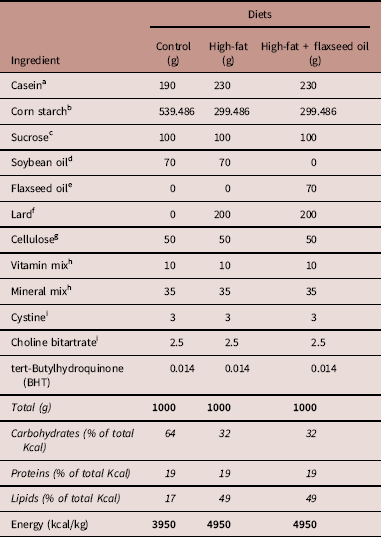
After the confirmation of diabetes (in which the serum concentration of glucose was above 300 mg/dL), the rats were sent to mating in the proportion of two female rats to each male, and were given either a high-fat diet or a control diet, both of which had 17% of protein (AIN-93G).Reference Reeves, Nielsen and Fahey 13 When pregnancy was confirmed by the vaginal plug method, the animals were caged individually and divided into three groups (n=6): the control group (CG) which received a control diet; the high-fat group (HG) which received a high-fat diet (49% of the total calories coming from lipids); and the flaxseed oil group (FOG) which received a high-fat diet with an addition of flaxseed oil, which replaced the soybean oil (49% of the total calories coming from lipids) (Table 1). The soybean oil presented 54% LA (n–6) and 8% of α-linolenic acid (n–3), showing n–6/n–3 as7:1 and the flaxseed oil presented approximately 16% of LA (n–6) and 57% of α-linolenic acid (n–3), showing n–6/n-3 as 1:3.
Nutritional Composition of Experimental Diets during pregnancy and Lactation

a Comércio e Indústria Farmos Ltda. (Rio de Janeiro, RJ, Brazil).
b Maizena da Unilever Bestfoods Brasil Ltda. (Mogi Guaçu, SP, Brazil).
c União (Rio de Janeiro, RJ, Brazil).
d Liza da Cargill Agricultura Ltda. (Mairinque, SP, Brazil).
e Giroil Agroindustria LTDA (Santo Ângelo, RS, Brazil).
f Sadia Comercial Ltda.
g Microcel da Blanver Ltda. (Cotia, SP, Brazil).
h PragSoluções Comércio e Serviços Ltda-ME (Jáu, SP, São Paulo).
i M. Cassab Comércio e Indústria Ltda. (São Paulo, SP, Brazil).
After the weaning, 21 days of life, six male and females pups of each group were separated and began being fed with a standard chow diet (Nuvital, Nuvilab, PR, Brazil) ad libitum until 180 days of age, when rats were euthanized. Body weight (BW) and food intake were recorded three times during the week.
Biochemical determinations
Blood collection and sample processing
At 180 days of age, the rats received a lethal dose of Thiopentax (sodium thiopental 1 g, Cristália Produtos Químicos Farmacêuticos Ltda, Brazil) at a 5% (0.15 ml/100 g of BW) by intraperitoneal injection. Blood was collected by cardiac puncture. The blood was put into tubes without anticoagulant, centrifuged (Sigma centrifuge) for 15 min at 3500 rpm to collect serum, which was stored in an −80°C freezer.
Blood lipids determination
Analysis of total cholesterol, triglyceride and high-density lipoprotein cholesterol (HDL-C) rates were executed using BIOCLIN kits (Indústria Quibasa – Química Básica Ltda/Belo Horizonte‐MG) in an automatic analyzer (Bioclin Systems 120–Chemistry Analyser) through the enzymatic colorimetric method.
Histomorphometric determinations
During euthanasia, the heart was removed together with the aorta, and then, the artery was separated by sectioning it along the aortic arch. The aorta was transversely sectioned and received transverse cuts always at the distal end of the sections. After this, the pieces of the aorta were fixed in buffered formalin at 10% (Millonig formalin) for a period of 24 h and processed with a standard technique of paraffin inclusion.
After the inclusion process, the paraffin blocks which contained aorta pieces were cut in a CUT 4050 microtome (Microtec®) in 5 µm sections and stained with Hematoxylin and Eosin for evaluation of aortic lumen area and the thickness of the aorta, and Weigert resorcin–fuchsin to evaluate the percentage of elastic fibre. The analyzes were performed using ImageJ® software (ImageJ 1.50i, Wayne Rasband, National Institutes of Health, Bethesda, MD) in order to evaluate the digital images processed by the cellSoens software (Olympus America Inc., Center Valley, PA) coupled with an Optronics digital video camera and BX51 Olympus microscope.
For area measurements, the images were captured and magnified 4×, for thickness analysis of 40× and for the measuring of elastic fibre percentage of 20×. All of the images were digitalized in tiff format.
Statistical analysis
The data were presented as a mean ± standard deviation. The results were tested regarding normality and homogeneity of variances, and differences between groups were analyzed using the following tests: unpaired t-test (to test data between genders), one-way analysis of analysis (ANOVA) and post hoc test of Tukey (to study the offspring groups). The statistical analyses were made using the GraphPadPrism (Prism version 5.03 for Windows; GraphPad Software, San Diego, CA) software at P<0.05 level of significance.
Results
Body mass and dietary intake
Male and female offspring of diabetic mothers presented lower body mass at weaning (21st day) when compared to control animals (P=0.003). At 180 days of age, the male offspring of the HG and FOG presented lower body mass when compared to the CG (−17.5% and −15.6%, respectively, P=0.018), which did not occur in the female offspring, where HG and FOG presented similar body mass to CG (P=0.067). When comparing body mass between genders at weaning, no difference was found (CG, P=0.078; HG, P=0.374 and FOG, P=0.395), however at 180 days of age, male offspring presented higher body mass when compared to female offspring (CG, P < 0.001; HG, P=0.004 and FOG, P=0.008) (Table 2).
Food intake, body mass at weaning and at 180 days of age

CG, control group; HG, high-fat group; FOG, flaxseed oil group.
The data were presented as mean±standard deviation. The significance in all tests was established based on the level of P<0.05.
The letter ‘a’ represents a statistical difference when compared to the control group. The symbol (*) represents statistical difference when compared to its opposite gender in the same group.
Concerning the daily feed intake, no difference was found between experimental groups, both in male and female offspring (P=0.084 and P=0.245, respectively). However, the gender comparison showed that the male offspring of the CG and FOG presented higher feed intake (+42.2% and 24.6%, respectively) when compared to female offspring of their respective group (P< 0.001 and P=0.015, respectively) (Table 2).
Blood lipids
No differences were found regarding total cholesterol and HDL-C among the groups in the male offspring (P = 0.976 and P=0.807, respectively). However, FOG and HG showed lower serum triglyceride when compared to CG (−48.4% and 44.1%, respectively, P=0.037). Regarding female offspring, no difference was found for total cholesterol (P=0.203), triglycerides (P=0.550) and HDL-C (P=0.812) between groups (Table 3).
Serum values of total cholesterol, triglycerides and HDL-C of the animals at the end of the experiment

CG, control group; HG, high-fat group; FOG, flaxseed oil group; HDL-C, high-density lipoprotein cholesterol.
The data were presented as mean±standard deviation. The significance in all tests was established based on the level of P < 0.05.
The letter ‘a’ represents a statistical difference when compared to the control group. The symbol (*) represents statistical difference when compared to its opposite gender in the same group.
When comparing genders, no difference was found for total cholesterol (CG, P=0.226; HG, P=0.131 and FOG, P=0.488) and HDL-C (CG, P=0.206; HG, P=0.895 and FOG, P=0.755). However, the CG and HG male offspring presented higher serum triglyceride when compared to female offspring of their same group (CG, +97.5%; P=0.003 and HG, +23.8%; P=0,002), the same did not occur when comparing FOG genders (P=0.706) (Table 3).
Aorta histomorphometry
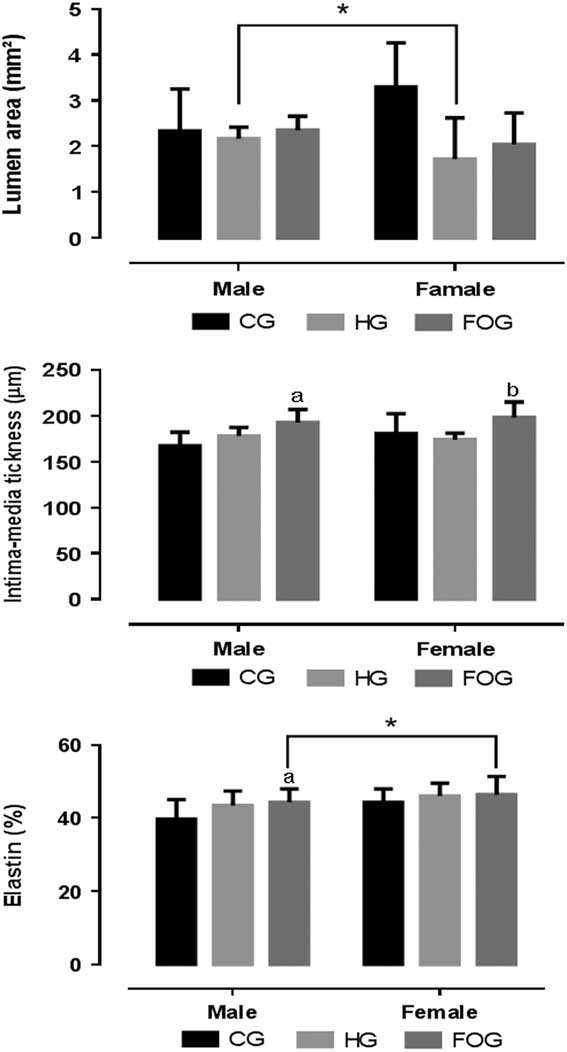
Morphometric analysis of the aorta showed that aortic lumen area was similar between offspring groups in both males (CG=2.334±0.92 mm2; HG=2.167±0.25 mm2; FOG=2.352±0.31 mm2; P=0.870) and females (CG=3.300±0.96 mm2; HG=1.723±0.90 mm2; FOG=2.042±0.69 mm2; P=0.289), and when comparing genders, HG males showed a larger lumen area when compared to the female of their respective group (+79.4%, P=0.030) (Figures 1 and 2).
Aorta histomorphometric parameters of experimental groups at 180 days. CG, Control Group; HG, High-fat Group; FOG, Flaxseed Oil Group. The data were presented as mean ± standard deviation. The significance in all tests was established based on the level of P<0.05. The letter “a” represents a statistical difference when compared to the control group; the letter “b” represents a statistical difference when compared to the high-fat group. The symbol (*) represents statistical difference when compared to its opposite gender in the same group.

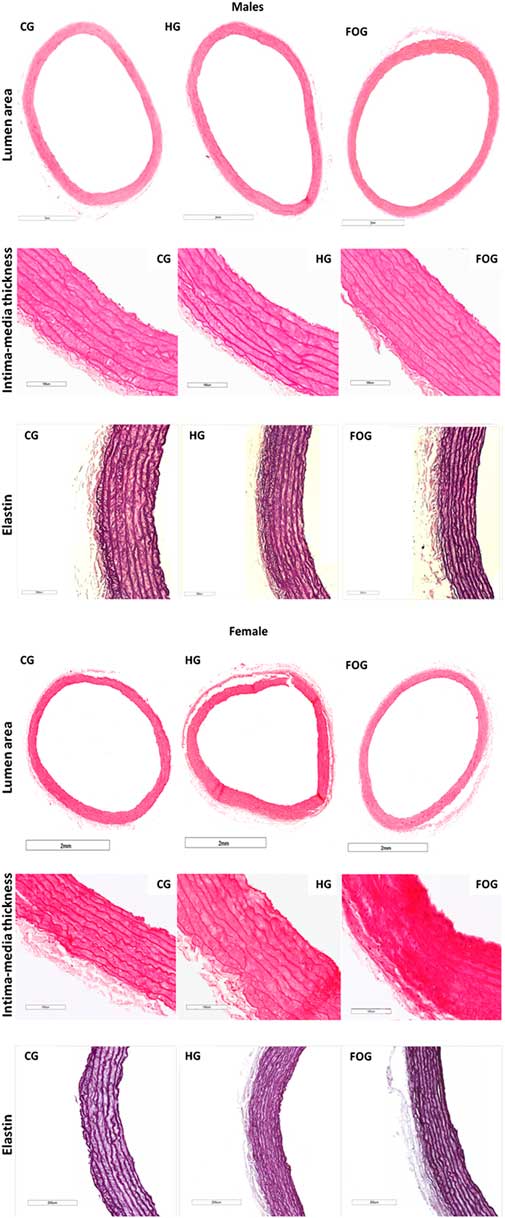
Photomicrographs of aorta histomorphometric analysis. CG, Control Group; HG, High-fat Group; FOG, Flaxseed Oil Group. Photomicrographs of lumen area of the aorta were captured with objectives 4× and stained with hematoxylin and eosin. Photomicrographs of intima media were captured with objectives 40× and stained with hematoxylin and eosin. Photomicrographs of elastic fiber were captured with objectives 20× and stained with Weigert resorcin–fuchsin.

The intima-media layer thickness was larger (+15%) in FOG than CG in male offspring (CG=167.5±14.68 µm; HG=178.1±9.29 µm; FOG=192.7±14.32 µm; P=0.004) and larger (+13.7%) in FOG when compared to HG in female offspring (CG=180.9±21.54 µm; HG=174.3±6.90 µm; FOG=198.2±17.00 µm; P=0.012), and there was no difference between genders (CG, P=0.189; HG, P=0.312 and FOG, P=0.453) (Figures 1 and 2).
Concerning elastic fibre in the aorta, male offspring of the FOG showed greater amount of elastin (+11.5%) than CG (CG=39.74±5.32%; HG=43.49±3.95%; FOG=44.34±2.44%; P=0.023), however, the same was not found in female offspring (CG=44.30±3.74%; HG=46.07±3.51%; FOG=46.43±5.01; P=0.434). Regarding gender, FOG female offspring showed greater amount of elastin than the male offspring of the same group (+4.8%, P=0.044) (Figures 1 and 2).
Discussion
In this study, we evaluated the effect of in utero exposure to maternal hyperglycaemia on aortic remodelling of male and female offspring in adult life. In both genders, we observed that severe maternal hyperglycaemia led to the low body mass of offspring at weaning. In children of diabetic women, low birth weight occurs in approximately two percent of births, due mainly to diabetic vasculopathy, which causes placental dysfunction, altering foetus nutrient supply, thus restricting foetal growth,Reference Gutaj and Wender-Ozegowska 14 , Reference Hay 15 and this may also occur in diabetic animals, resulting in the lowest body mass of the offspring of diabetic rats. The low birth weight can also be explained by the fact that during the pregnancy of the diabetic mothers, the foetus is confronted with severe intrauterine hyperglycaemia, which induces foetal islet hypertrophy and b-cell hyperactivity, a phenomenon that may result in early hyperinsulinaemia. This overstimulation of foetal b-cells limits their adaptation, so they become depleted of insulin granules and incapable of secreting insulin. B-Cell exhaustion results in foetal hypoinsulinaemia. Hypoinsulinaemia and a reduced number of insulin receptors in target cells lead to a reduction in the foetal glucose uptake. The growth of foetal protein mass is suppressed, and the foetal protein synthesis is consistently lowered, leading to a fetal microsomia. Postnatal development is retarded, and these offspring remain small in adulthood.Reference Correia-Santos, Vicente and Suzuki 16 This data endorse our results since at weaning the offspring of diabetic mothers had the lowest body mass when compared to the CG. Besides, the FOG results are in agreement with Guarda et al.,Reference Guarda, Lisboa and de Oliveira 17 once maternal intake of a high-fat diet containing flaxseed oil during lactation also led to the low body mass of male and female offspring at weaning when compared to the CG.
Catchup is a commonly event observed in cases of intrauterine growth restriction, which is characterized by accelerated growth after birth in order to compensate low birth weight.Reference Martin, Connelly, Bland and Reilly 18 Our results showed that female offspring of diabetic mothers (HG and FOG) were able to recover weight gained during the experiment, becoming similar to CG offspring, indicatory of a possible catch-up phenomenon. Nevertheless, the male offspring of diabetic mothers (HG and FOG) did not show this phenomenon, remaining with lower weight throughout life when compared to CG. According to Holemans et al.,Reference Holemans, Aerts and Van Assche 19 severe maternal hyperglycaemia leads to lower body mass at birth and hence, these lower weights last throughout life, supporting our data in the male offspring.
The imbalance in blood lipid levels may be a risk factor for cardiovascular diseases development, and the omega-3 fatty acid found in flaxseed has been associated with a decrease in total cholesterol and triglycerides.Reference Correia-Santos, Vicente and Boaventura 9 Flaxseed oil supplementation during pregnancy and lactation to the diabetic mothers in the present study led to lower triglyceride levels only in the male offspring when compared to CG. In Blondeau et al. study,Reference Blondeau, Joly and Perret 20 in utero exposure to hyperglycaemia in Sprague-Dawley rats did not alter total cholesterol, triglycerides and HDL-C serum levels in adult life. Guarda et al. Reference Guarda, de Moura and Carvalho 21 observed that the maternal intake of a diet high in flaxseed oil during lactation did not alter total cholesterol serum levels, although an increase in triglyceride was observed in male offspring. Nevertheless, there was no difference in female offspring at 180 days. Different from these studies, we observed that flaxseed oil during pregnancy and lactation showed a leaning to improve the serum triglyceride level of male rats in adult life and this is associated with the high content of omega-3 fatty acid present in this edible oil. Comparing genders, we observed that CG and HG males showed higher serum triglyceride levels than females (+49.4% and 19.2%, respectively).
Changes in great arteries structure may promote the development of cardiovascular diseases and adverse conditions in utero, such as hyperglycaemia during pregnancy, together with a high-fat diet contributes to the artery vessel remodelling in offspring, which can be defined as a thickening process of the vessel wall with consequent lumen diameter decrease.Reference Strait and Lakatta 22 In this study, the aortic lumen area was similar between the groups in both genders, besides that, male offspring showed a larger lumen area when compared to female offspring. Nevertheless, this result may be due to the fact that the male offspring are bigger than female offspring. Supporting our results, exposure to diabetes during pregnancy did not alter the lumen area diameter of male mesenteric aorta of rats at 90 and 540 days of life.Reference Vessières, Dib and Bourreau 23 Vicente et al. Reference Vicente, Correia-Santos and Suzuki 11 found no difference in the aortic lumen area in male offspring of diabetic rats that were fed with diets containing flaxseed oil at 100 days of life, however, a smaller aortic lumen area was found in female offspring of diabetic rats that intake diets with flaxseed oil during pregnancy and lactation.Reference Vicente, Correia-Santos, Suzuki, Chagas and Boaventura 24 Nogueira et al. Reference Nogueira, Kessuane and Lobo Ladd 25 observed that the intake of a high-fat diet containing flaxseed oil in adult low-density lipoprotein (LDL) receptor-deficient mice did not lead to differences in the aortic lumen area when compared to animals induced to diabetes.
Our analysis of the aorta intima-media layer thickness revealed that the offspring of mothers that consumed flaxseed oil showed larger thickness when compared to the CG in male offspring and to the HG in the female offspring. Some studies support these findings since they demonstrated that at the birth moment, children of diabetic women show larger aorta intima-media layer thickness when compared to children of healthy women.Reference Sarikabadayi, Aydemir and Kanmaz 6 , Reference Akcakus, Koklu and Baykan 26 Contrariwise, exposure to hyperglycaemia in utero did not alter the mesenteric aorta intima-media layer thickness of offspring at 90 days and 540 days in rats.Reference Vessières, Dib and Bourreau 23
As opposed to our findings, Vicente et al. Reference Vicente, Correia-Santos and Suzuki 11 , Reference Vicente, Correia-Santos, Suzuki, Chagas and Boaventura 24 found a smaller aortic intima-media layer thickness in male and female offspring of diabetic rats that consumed a diet with flaxseed oil during pregnancy and lactation at 100 days of life. In view of this, it is suggested that the flaxseed oil protective effect in this outcome does not remain throughout life, only for a short period, requiring its intake during adult life in order to guarantee the protector effect against aortic remodelling.
Alteration in elastin deposition in the arteries is another consequence of exposure to critical factors during the perinatal period, which leads to elasticity loss and consequently to the increase of arterial stiffness in adulthood.Reference Kornet, Lambregts, Hoeks and Reneman 27 , Reference Mitchell 28 In this study, it was observed that the FOG male offspring showed a higher amount of elastin in aorta when compared to CG, an effect not observed in the female offspring.
Studies have shown that the amount of elastic fibres in large arteries of diabetic rats is very scarce when compared to healthy rats, hence decreasing the arteries elasticity.Reference Fiordaliso, Cuccovillo and Bianchi 29 – Reference Searls, Smirnova and Vanhoose 31 Therefore, the maternal use of flaxseed oil preserved the elastic fibre deposition, providing a greater amount of elastin in the male offspring aorta, thus suggesting adequate aorta elasticity in the FOG offspring.
Experimental models of fetal programming with both genders exhibit differences in the pathophysiological response when exposed to an adverse fetal environment, but few studies have correlated this difference in response when the intrauterine insult is maternal hyperglycaemia. Our results demonstrate that metabolic programming by maternal diabetes shows different outcomes between genders, being male offspring more susceptible than female and this is due to the fact male offspring cannot adapt metabolically and physiologically to the adverse intrauterine environment, and thus ‘suffering’ the consequences of this exposure during its development. According to Bourghardt,Reference Bourghardt 32 estradiol presents beneficial actions to the endothelium by decreasing the expression of adhesion molecules and proinflammatory chemokines, decreases endothelial permeability and endothelial cell apoptosis. In addition, estradiol decreases the oxidation of LDL and the accumulation of lipids in macrophages, which could also contribute to the atheroprotection. In males, it is known that low levels of testosterone are associated with atherosclerosis, but the mechanisms like testosterone exert protection are not well defined, it is noted that it is capable of reducing proinflammatory cytokines and that the beneficial effect is mediated by the androgen receptor-independent pathway, involving the aromatization of testosterone into estradiol. Differences in hormones may be justified by our findings, so it becomes important to intervene during this stage of life in male offspring.
In conclusion, our study observed that maternal intake of a diet with flaxseed oil by diabetic mothers during pregnancy and lactation improves serum triglyceride levels only in adult male offspring. The effects of maternal hyperglycaemia on male and female offspring were not very severe and the use of flaxseed oil by mothers led offspring of both genders to increase in aorta intima-media layer thickness. Nevertheless, flaxseed oil preserves aorta elastic fibre deposition in male offspring.
Acknowledgments
None
Financial support
Research was supported by the Coordination for the Personnel Improvement of Higher Education (CAPES), the National Council for Scientific and Technological Development (CNPq, grant number 477763/2011-1) and Rio de Janeiro State Foundation for Scientific Research (FAPERJ, grant number E-26/100.001/2012).
Conflicts of interest
None