After the 1971 premiere of the revolutionary opera Sea of Blood (P'i pada), Kim Jong Il declared the dawn of a new operatic era defined by groundbreaking musical and dramatic techniques that captured the juche spirit.Footnote 1 ‘Juche ideology’ (‘self-reliance ideology’) has long been the leading slogan in North Korean nationalist politics, and while its specific definition is slippery and much-debated, Kim's invocation of the term broadly demonstrates that he considered Sea of Blood a proud and uniquely Korean accomplishment that correctly portrayed the young nation's artistic heritage. Both the 1969 film version and the 1971 opera version of Sea of Blood were some of Kim's earliest projects overseen at the Propaganda and Agitation Department (PAD) where he began after finishing university. The period featured many purges throughout government, cementing his father General Kim Il Sung's control and setting the stage for his own inheritance of his father's power. The younger Kim's main task at the PAD was a similar campaign in microcosm. It represented an effort to centralize artistic production and to use such art to build up the Kim Il Sung cult of personality, much like the contemporary Cultural Revolution in China did for Mao Tse-tung.
It would have been important for the young bureaucrat to make a splash, and make a splash he did: Sea of Blood was so exemplary that it established a new canon of works called the Five Great Revolutionary Operas (5 tae hyŏngmyŏng kagŭk). The opera's title became almost synonymous with the genre itself, often referred to as Sea of Blood-style (P'i pada sik) opera.Footnote 2 The original five remain the primary examples of revolutionary opera, but a handful of works labelled variously ‘opera’ or ‘revolutionary opera’ modelled after them continued premiering into the 1990s. The musical style established in Sea of Blood also appears in other important theatrical genres such as song-and-dance stories (ŭmak muyong iyagi) of the early 1980s and the later genre of national opera (minjok kagŭk), sometimes called ‘Sea of Blood-style national opera’ to distinguish it from national operas of the 1960s and earlier. Finally, Kim Jong Un seems to have revived the revolutionary opera genre in the last several years: two new revolutionary operas entitled The Revolution's Victory Is in Sight (Hyŏngmyŏng ŭi sŭngni ka poinda) and Three Days on Wŏlmi Island (Wŏlmido ŭi sam ilgan) premiered in 2016 and 2017, respectively. Sea of Blood was truly a milestone in North Korean operatic production that established performance practices apparent in the country's musical theatre all the way to the present day.
In his post-premiere speech to the Sea of Blood production team, Kim Jong Il celebrated the new opera's most innovative features. He was especially pleased that a new musical form called chŏlga (‘stanzaic song’) had supplanted the Western convention of recitative and aria. Such a formal innovation led Kim to proclaim that ‘the antiquated style of opera has been completely shattered’ in favour of a style that better captured the characteristics of the people (inminsŏng), the nation (minjoksŏng), and popular taste (t'ongsoksŏng).Footnote 3 In other words, Kim oversaw the establishment of an operatic style in Sea of Blood that intentionally existed outside and even contravened the conventions of Western opera, and this new style was meant to express his vision of an optimistic, vibrant, and socialist Korean nation. Musical form was crucial to the case Kim made for his new operatic style. This article therefore probes the form of chŏlga and its political signification, and particularly seeks to understand it from the perspective of Kim Jong Il as a positive and proactive choice that reflected his values for the young nation.
Kim's perspective is essential to understanding chŏlga as a form; its conventions are simply not given to sympathetic analysis by traditional Western criteria. A typical operatic chŏlga is composed of a four-line poem with standard twelve-syllable lines, and the music almost always follows a binary form structure. Chŏlga are also rather short, rarely more than a minute or two in length, and offer little in terms of melodic, harmonic, or rhythmic complexity. When a three-hour opera is built almost exclusively out of chŏlga, it can be easy to dismiss the music as formulaic at best. Even Keith Howard, a leading scholar of North Korean music, has joked that uninitiated audiences ‘probably wouldn't want to listen … for more than five minutes.’Footnote 4 Yet Kim insisted that chŏlga was an epoch-defining innovation that revolutionized opera. Something about its conventions made such a difference that Kim felt confident extolling the form to audiences of expert professional musicians. In order to understand his claims, then, it is important to put his words in the context of Korean musical politics throughout the twentieth century. In such a context, the formal characteristics of chŏlga bear witness to a contested past and present that Kim continually renegotiated as he carved out a place in the world for North Korean art.
The political significance of chŏlga and its formal characteristics have yet to be deeply explored in studies of North Korean revolutionary opera. Some scholars have briefly defined surface-level characteristics in Western terms. Howard, for instance, acknowledges the importance of chŏlga (which he translates as ‘couplets’), but only spends one paragraph of his book describing its defining characteristics. After stating that chŏlga are ‘structured in couplets or as stanzas containing several couplets’, he notes that they tend mainly towards ‘simple’ metres, contain two to four lines per stanza, and often follow binary or ternary form.Footnote 5 Yi Hyŏn-chu's survey of the songs in the 1972 opera The Flower Girl (Kkot p'anŭn ch’ŏnyŏ) lists similar characteristics, including a trend towards compound metre, major and minor modes with Western (sŏyang) harmonies, and sixteen- or twenty-four-bar song structures.Footnote 6 Such formal descriptions do offer some insight into the music of revolutionary opera, but do little to contextualize the style within other musical trends in Korea and do not fully explain the significance Kim Jong Il assigned to it.
Other scholars have attempted to describe musical characteristics of chŏlga in more depth, but often overlook its formal conventions in favour of other topics that privilege Western epistemologies. Youngmin Yu briefly mentions chŏlga as a requirement of revolutionary opera, for example, but emphasizes the Westernized orchestral accompaniment as the main proponent of a ‘modern’ sound.Footnote 7 Lisa Burnett remarks that most chŏlga follow binary or ternary forms and that such songs are generally strophic. But Burnett too glosses over specific unifying characteristics of the genre and instead turns to a lengthy discussion of topoi (a term she borrows from Wye Allanbrook's study of rhythm in Mozart's music) that separate subgenres.Footnote 8 Burnett claims that these topoi offer more ‘opportunities for creativity in song composition’,Footnote 9 betraying a romantic European aesthetic that values individual expression over convention. Alzo David-West makes European aesthetic criteria even more overt in his study of the libretto, considering Sea of Blood ‘a failure as a work of true art, as a form of cognition of life’.Footnote 10 In prizing originality and aesthetic cognitivism, however, scholars are more likely to dismiss the elements these North Korean cultural workers valued most: exemplars and convention. Kim Jong Il held chŏlga in high esteem and praised its pervasive use, yet musical scholars have only shown interest in nearly anything else. I instead presume Kim Jong Il's sincerity in his appraisal of chŏlga and use his speeches to ground my study, providing a deep contextual look at the political work chŏlga did for Kim's artistic revolution.
My focus on chŏlga and its standardized features dovetails with the work of other humanists who have invited scholars to reconsider the value of convention. In her book Conventional Wisdom: The Content of Musical Form, Susan McClary admonishes musicologists against overlooking convention, which she says we often interpret as meaningless, in contrast to so-called ‘purely musical’ devices that have ‘transcended signification’.Footnote 11 The present study, in line with McClary's exhortation, considers convention politically valuable and examines the far-reaching ramifications of an incredibly predictable form. Even this approach, however, is nothing new to scholars of socialist realism, the movement to which North Korean revolutionary opera belongs. Katerina Clark's landmark study of socialist realist literature, for instance, theorizes a ‘master plot’, a conventional dramatic arc that describes nearly every novel written from the 1930s onward in the Soviet Union.Footnote 12 Marina Frolova-Walker recounts a similar phenomenon in music: Soviet cantatas and operas exhibited a ‘near-complete obliteration of individual style – by the late 1940s, it seems as if the whole thousand-strong Union of Composers wrote with a single pen.’Footnote 13 Both Clark and Frolova-Walker suggest that conventionality is not only common but also desirable in socialist realist works. The search for originality or individuality, in other words, misses the point of socialist realism entirely, and North Korean revolutionary opera is no exception.
Carrying the banner of socialist realism, North Korean artists relied on exemplars in crafting new works, and the story of Sea of Blood has filled that role across various media.Footnote 14 Because Kim Il Sung allegedly authored the original play himself – part of an effort to gin up support for the anti-Japanese revolution in Manchuria in the 1930s – the story entered the canon of ‘immortal classics’ (‘pulhu ŭi kojŏnjŏk myŏngjak’) after which numerous pieces of media were modelled. The 1971 opera Sea of Blood followed Kim Il Sung's purported canonic example and also established a more focused canon in the Five Great Revolutionary Operas, all of which premiered between 1971 and 1973. Kim Jong Il specifically wished for operas to follow the lead of Sea of Blood, and many of his speeches outline exactly how artists should do so. This one opera's conventions therefore represent the conventions of revolutionary opera as a whole in North Korea. As such, this article focuses on musical characteristics in Sea of Blood and especially on the standard features of chŏlga, the genre's defining form. Only by foregrounding the formulas present in such an exemplar can one even begin to understand later productions in its mould.
This article argues that chŏlga and its conventions bear the imprint of cultural hybridity and postcolonial nationalism, including all the messy contradictions that accompany such phenomena. While the resulting sounds may suggest Western music, however, this article argues that ‘Westernness’ is to some degree a mirage that is better described as a polyphonic assemblage, a concept originally theorized by Anna Lowenhaupt Tsing. The assemblage includes elements of various countries’ styles in both the East and the West combined in a way unique to the form's Korean context. I locate the form's stylistic origins especially in the genres of yuhaengga (‘popular song’) promoted by the Japanese imperial music industry in the 1920s and 1930s. This genre is related to a number of later musical styles on either side of the demilitarized zone, including but not limited to taejung kayo (‘popular/mass song’), ppongttchak (‘oom-chuck’), and perhaps the best-known t’ŭrot’ŭ (‘trot’, short for ‘foxtrot’) that remains popular among working-class elders in South Korea.
Contextualizing chŏlga and revolutionary opera within the history of popular music and cultural hybridity on the Korean peninsula has a number of advantages. Not only does it tie together more cohesively the musical characteristics described by earlier scholars but it also explains the political and cultural weight attached to the form evident in Kim Jong Il's nationalist speeches on opera. This context also frames revolutionary opera as a recognizably Korean phenomenon tied to the nation's history as a victim of colonialism, occupation, and war. It demonstrates how a form such as chŏlga, despite and even because of its formulaic nature, came to represent for North Korea a modern, postcolonial nation with a unique culture of which its people wished to be proud. The form's conventions reveal North Korea's self-understanding and its place in the world amid a rapidly shifting political atmosphere and tie the country's cultural milieu to its shared history with South Korea. It brings to light genuine socio-political values that revolutionary opera was designed to convey, even as the regime leveraged such values to secure its own power. This contextualization therefore demonstrates that the style was an intentional, proactive choice determined by local contingencies in North Korea at the time.
This article begins by outlining my theory of chŏlga as a polyphonic assemblage of colonial musical genres. The first section analyses the genres that inspired chŏlga, the values they conveyed, and the opportunities they therefore afforded Kim Jong Il in spearheading the revolutionary opera project. The next section examines Kim Jong Il's rhetoric advocating chŏlga as his project was underway. Kim's version of the genre's history celebrated the innovative and proletarian conventions of chŏlga and furthermore contrasted them with the bourgeois and foreign characteristics of other performance traditions that had existed in colonial and pre-colonial Korea, illustrating the enduring impact of earlier musical production on the peninsula. Kim's association of musical convention with class and nationality provides the analytical framework for this article's final section that probes a pivotal scene from Act III of Sea of Blood in which a minor hero's music subsumes that of the opera's primary antagonist, the pro-Japanese village leader. My analysis shows that chŏlga conventions play a crucial role in the drama that allows North Korean culture to symbolically conquer that of enemies foreign and domestic. Chŏlga bestows upon the heroes a patriotic aura that grants them power over their adversaries. The form's conventions are central to Kim's operatic revolution, and Sea of Blood demonstrates their revolutionary power.
Chŏlga and polyphonic assemblage
Kim Jong Il's revolutionary opera project drew in its form and function from a number of sources from the Japanese colonial era that formally began with annexation in 1910 and ended with Japan's defeat in the Second World War. The musical form of chŏlga and its associated social values descended from the commercial genre of yuhaengga, also called taejung kayo, both of which translate to ‘popular song’. This genre emerged in the 1920s as a local adaptation of Japanese ryūkōka (the Japanese cognate of yuhaengga) and was key to the development of both Korea's radio broadcast infrastructure and its broader capitalist music market under Japanese rule. While yuhaengga produced the most recognizable musical characteristics of chŏlga, many of revolutionary opera's guiding ideological principles came furthermore from Kim Il Sung's early interactions with Christian ch'angga (‘singing songs’) during his youth in Manchuria. Ch'angga is a broad term that includes hymns, children's songs, and folk songs introduced by American and German missionaries during the colonial era, and Kim Il Sung apparently grew familiar with such music as a young organist at a Methodist church.Footnote 15 The combination of yuhaengga and ch'angga apparent in revolutionary opera reflects broad, global musical influences in North Korea, and yet this particular blend is unique to the local experience of colonial and postcolonial modernity in Korea and, more specifically, for the Kim family. I therefore argue that the hybrid musical style of Kim Jong Il's revolutionary opera project is a polyphonic assemblage as theorized by Anna Lowenhaupt Tsing.
Postcolonial scholars have studied such cultural hybridity in formerly colonized countries around the world. Homi Bhabha, for instance, describes hybridity that includes ‘elements that are neither the One … nor the Other … but something else besides, which contests the terms and territories of both’.Footnote 16 This ‘something else besides’ arises in a Third Space between the One and the Other through ‘negotiation of contradictory and antagonistic instances that open up hybrid sites and objectives of struggle’ (see Figure 1).Footnote 17 The concept of negotiation and antagonism is useful: as Michael Robinson notes, there was a notable tension between yuhaengga's role in the Japanese cultural assimilation project on the one hand, and the genre's genuine popularity among Korean listeners – and their market power – on the other.Footnote 18 Unlike Bhabha, however, Robinson and co-editor Gi-Wook Shin analyse this negotiation through a tripolar lens rather than a bipolar one (see Figure 2). Much like Bhabha, they include poles of the national (Bhabha's ‘One’) and the colonial (Bhabha's ‘Other’) but they add a third pole called ‘the modern’. Importantly, they also view these concepts as overlapping and mutually reinforcing rather than simply oppositional as many nationalists believe.Footnote 19 Yet unlike ‘colonial’ and ‘national’, ‘modern’ is a temporal rather than a geographic or demographic descriptor. The geographic and demographic sources of ‘the modern’ reveal even further axes of negotiation: not only Japanese but also European and American.
Bhabha's ‘Third Space’ model of cultural hybridity.

Shin and Robinson's model of colonial modernity in Korea.

Such an intricate network of influences can be described as a polyphonic assemblage, a theory which anthropologist Anna Lowenhaupt Tsing introduced in The Mushroom at the End of the World: On the Possibility of Life in Capitalist Ruins (see Figure 3). Tsing defines a polyphonic assemblage as a collection of living and non-living things that come into contact with one another in a given area (e.g., the Korean peninsula), and whose interaction or ‘polyphony’ produces the possibility of future events and changes all parties involved.Footnote 20 This is a small but meaningful adjustment to Bhabha's Third Space and to Shin and Robinson's tripolar model. Tsing's polyphonic assemblage makes room for infinite axes of negotiation that impact outcomes as postcolonial nations find their place in the modern world. Both earlier models hint at the existence of these other axes: Bhabha's ‘something else besides’ cannot exist in a different dimension than the One and the Other, nor is Shin and Robinson's ‘modern’ monolithic. Other forces and interactions including cultural exchange with other postcolonial nations, domestic political concerns, the limitations of media technology, and so on exerted pressure from other directions and shaped cultural production in the postcolonial era. Chŏlga was produced through negotiation with many forces living and non-living, domestic and foreign, friendly and adversarial. It is a particularly knotty case study in cultural hybridity attested to by eclectic musical characteristics with disputed histories.
The Korean Peninsula as a polyphonic assemblage.

One axis of negotiation in producing chŏlga was the colonial-era genre of yuhaengga. The yuhaengga style most relevant to this article arose in the late 1920s and early 1930s. Unlike earlier yuhaengga that mostly added Korean lyrics to foreign melodies, Korean composers had begun writing melodies in their own idiom, and Japanese broadcasting authorities under the Government-General of Korea had not yet imposed the restrictions that typified Second World War-era yuhaengga more associated with wartime mobilization efforts. Musicologist Young Mee Lee therefore considers the years around 1930 to be a sort of high-water mark in which yuhaengga exhibited characteristics that captured the Korean zeitgeist resulting from the relative compositional freedom they were granted. Among these features, she highlights triple metre and a preference for minor mode with the A–B–C–E–F pentatonic scale, though A–C–D–E–G also appears in minor melodies and C–D–E–G–A in the occasional major. She also notes that the songs tend to be driven more by melody than by harmony, and that the harmony as a result tends to change infrequently and sometimes not at all.Footnote 21 Min-Jung Son confirms the prominence of triple metre, noting that it was both a common metre for ballroom dances in the early twentieth century and for traditional music that nationalists could easily connect to pre-colonial musical production. She also remarks on the songs’ frequently sorrowful lyrics, arranged into standardized poetic stanzas with twelve-syllable lines divided into clauses of seven and five syllables.Footnote 22 Each of these features’ provenance is contested,Footnote 23 but taken together, they illuminate a clear stylistic pattern of poetry in combination with music that Korean audiences preferred as they interacted with the burgeoning music industry in the colonial era.
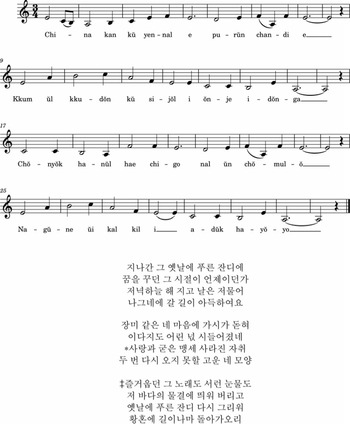
Out of the many examples Lee and Son discuss, perhaps the most revealing is ‘Three Friends’ (‘Se tongmu’) written for the 1928 film Three Beggars (Sam gŏrin) (see Example 1). The singer reflects with characteristic sorrow on a long-lost love. He sings wistfully of bygone days when he dreamed on the grass, presumably with his beloved who now scorns him like a withered rose. The text comprises two strophic verses (or three, depending on the performance) of four lines apiece. Each line is twelve to thirteen syllables long, and further divided into two clauses of around seven and five syllables apiece. This poetic structure lends itself easily to a rounded binary form without repeats: each pair of lines produces a musical period. The first two lines constitute the exposition; the third, the digression; and the fourth, the recapitulation. Finally, in line with Lee and Son's observations, the song largely follows the A–B–C–E–F pentatonic scale with minor mode accompaniment in triple metre (3/4). ‘Three Friends’ thus typifies the characteristics of early 1930s yuhaengga in both its poetic and its musical structures and embodies the growing hybrid musical identity of Koreans under Japanese occupation.
‘Three Friends’ (‘Se tongmu’). Music and lyrics by Kim Sŏ-chŏng. Translation my own.
China kan kŭ yennal e p'urŭn chandi e In years gone by, on the green grass –
Kkum ŭl kkudŏn kŭ sijŏl i ŏnje idon'ga Do you remember the time I once had dreams?
Chŏnyŏk hanŭl hae chigo nal ŭn chŏmurŏ The evening sun sets and the day grows dark;
Nagŭne e kal kil i adŭk hayŏyo This traveler has a long way to go.
Changmi gat’ŭn ne maŭm e kasi ka tothyŏ Your heart like a rose has thorns;
Idaji to ŏril nŏk si dŭro chyŏnne Your soul, young as it is, has withered;
*Sarang kwa kudŭn maengse sarajin chach'wi *Our love and our vows have vanished;
Tu bŏn tasi oji mot hal koun ne moyang I will never be able to see your beautiful figure again.
‡Chŭlgŏubdon kŭ norae to sŏrŏn nunmul to ‡That lovely song and those sad tears
Chŏ pada ŭi mulgyŏl e ttŭiwo pŏrigo Float away on the ocean's waves.
Yennal e p'urŭn chandi tasi kŭriwŏ I once again miss that old green grass –
Hwanghon e kil inama tora kaori Even though it is already dusk, I shall return there.
* Some performers replace these two lines with the last two lines of verse 1
‡ This verse is commonly included on lyric websites, but older recordings do not always include it

For many Koreans, this new style became a musical symbol of modernity through which they negotiated modern social mores. Certain elements of yuhaengga performance were notably Western, including diatonic harmonies performed by an ensemble similar to an American big band on a proscenium stage. Men typically wore suits (yangbok or ‘Western clothing’), while women – who only sang – generally wore traditional hanbok (‘Korean clothing’). This combination of foreign and native markers has led Min-Jung Son to argue that yuhaengga was ‘a cultural space in which Koreans re-articulated their traditional cultural identity while reflecting on modern values.’Footnote 24 Such ‘modern values’ were not without their detractors, however. For some, especially Korean elites and Japanese authorities, yuhaengga held negative moral implications due to its association with drinking, kisaeng (‘courtesans’), and the corrupting influence of profit.Footnote 25 Middle- and upper-class critics instead advocated for yesul kayo (‘art song’), the predecessor of modern kagok (‘song works’) based in Western high art genres such as opera and German lieder.Footnote 26 Yuhaengga thus gained enduring associations with the working class and with modernity that Kim Jong Il was able to exploit to produce a modern, socialist operatic style for the Korean nation.
Kim also took musical advice from his father, who was known for his strong views on music. The elder Kim was raised by Methodist parents and trained as a church organist in the 1920s. In such a context, he would have been familiar with Christian ch'angga, especially hymns brought to Korea by American and German missionaries.Footnote 27 His own dedication to the religion seems to have been tenuous at best, but Kim Il Sung learned the persuasive power of music as a unifying community activity from the Christian chapels, whose techniques he later appropriated in ‘democratic propaganda halls’ (‘minju sŏnjŏnsil’) to bring youth to the communist cause. He in fact argued that it was not faith in Jesus, but rather enjoyable social interactions around music that brought youth to Christianity. As a result, Kim required that democratic propaganda halls be equipped with literature and instruments encouraging the youth to play, sing, dance, and read together.Footnote 28 Adam Cathcart further recounts Kim Il Sung's awareness of the fine details of music theory, exemplified by one occasion when the leader purportedly explained to Kim Jong Il in the 1960s – just before the operatic revolution – that songs in E major were more likely than songs in D major to compel audiences to action.Footnote 29 The Great Leader's detail-oriented nature and focus on community singing likely led to Kim Jong Il's later search for amateur-friendly didactic songs such as chŏlga in revolutionary opera. Such music presented on stage would inspire audiences to sing chŏlga in social settings and thereby strengthen the operas’ ideological messages in their daily lives.
Chŏlga's polyphonic assemblage of yuhaengga’s style, its working-class appeal, and the practices of ch'angga would have produced an effective musical tradition through which the regime could foster communist ideology. Revolutionary opera further assimilates this style into the performance rituals of Western opera, granting an aura of high art to the people's music and, by the same token, a populist sheen to the perceived elite theatrical genre. In this way, the development of chŏlga was a globally oriented, but local phenomenon to North Korea that arose from the country's specific context in the early twentieth century. Koreans interacted with multiple forces from around the world to produce a unique and contingent musical style. The genre produced by these interactions does not bear the cultural purity many nationalists seek – one would be hard-pressed to find an art form that does – but neither is it ‘Western’ in the sense that many European and American listeners may mean when they hear characteristics such as regular metres and functional diatonic harmonies. Instead, it is a polyphonic assemblage of all of the preceding and more, creating a rich and multifaceted arena upon which Koreans continued to debate their national identity for decades to come.
Chŏlga and the benefits of hybridity
This dynamic, hybrid musical tradition provided fertile ground on which to nurture revolutionary opera in the 1970s. Since national division at the end of the Second World War, local governments and art troupes in North Korea worked to establish performance traditions appropriate for the new socialist state without much direct guidance from the national Worker's Party. Most attempts variously updated existing Korean musical theatre traditions or built on Western opera.Footnote 30 In the late 1960s, Kim Jong Il joined the PAD and spearheaded a new effort to centralize artistic production in North Korea. The first fruits of his project were revolutions in cinema and opera. The younger Kim gave a number of speeches throughout the process encouraging and instructing artists in creating proper art. His speeches on opera, for instance, discuss everything from the libretto, to music, to dance and even stage design, giving clear parameters for each element and explaining how they create a cohesive whole. In terms of song writing, Kim considered chŏlga an essential innovation representing a modern operatic style appropriate for the Korean masses: he acknowledged the form's hybridity and highlighted its arguably native elements while sweeping under the rug the more unsavoury elements from its colonial history. He also chose convenient scapegoats from Europe and South Korea against which he contrasted chŏlga to build his nationalist case. In so doing, Kim constructed a rhetorical framework around chŏlga that illuminates what he imagined as North Korea's place in the world and the nation he sought to build.
That revolutionary opera contributed to North Korea's nation-building is well established in scholarly research. Heonik Kwon and Byung-Ho Chung argue that revolutionary opera, and particularly Sea of Blood's allegorical reference to Kim Jong Il's mother, Kim Jong Suk, helped transform Kim Il Sung's ‘irreplaceable personified charisma’ into ‘hereditary charismatic authority’ that justified the ailing leader's hereditary transfer of power to his son.Footnote 31 Jae-Cheon Lim similarly argues that Kim Jong Il's time at the PAD heading projects such as the operatic and cinematic revolutions ‘adapted North Korean society so that it would support his family cult for decades to come’ through the creation of new myths and rituals.Footnote 32 Suk-Young Kim goes even further, asserting that the North Korean state through propaganda such as revolutionary opera fosters ‘reverse mimesis’: a reality designed to mimic an idealized world found in performance art that thus ‘fabricates the foundation of every sociocultural reality’.Footnote 33 Keith Howard adds music to this concept of daily-life-as-performance and says that ‘songs form much of the soundtrack to the theatre of daily life’.Footnote 34 Songs from revolutionary opera, and particularly those of the genre-defining Sea of Blood, create the sound-world in which North Koreans negotiate their relationships with the state and with each other. Kim Jong Il's advocacy of chŏlga thus represents not only a stylistic preference but also an entire cultural and political orientation: it was the sound of a new, revolutionary North Korea.
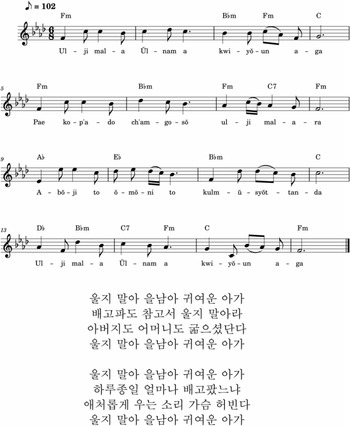
The new sound of chŏlga also bears more than a passing resemblance to 1930s yuhaengga. One representative example is the lullaby ‘Don't Cry, Ŭl-nam’ (‘Ulji mara Ŭl-nam a’) from Sea of Blood, a song Kim Jong Il singled out for praise in his speeches (see Example 2). Like the earlier example of ‘Three Friends’, ‘Don't Cry’ is strophic, with each verse composed of four twelve-syllable lines. Each line is similarly divided into two clauses, the first of seven syllables and the second, five. ‘Don't Cry’ sets these lines to a conventional binary form in a slow compound metre that maintains the waltz-like feeling of ‘Three Friends’. The song is furthermore in F minor, reminiscent of but not entirely congruent with the A minor pentatonic melody of ‘Three Friends’. The increased prominence of scale degrees 4 and 7 in the melody – absent in a typical Korean A–B–C–E–F minor pentatonic scale – suggests further assimilation of a diatonic vocabulary over the previous four decades. Broadly speaking, however, the melody still emphasizes the minor pentatonic scale, particularly by resting frequently on scale degree 5 and decorating it with an upper neighbour tone. The waltz-like compound metre and minor melody, in combination with the poetic structure, bear a clear family resemblance to 1930s yuhaengga, and in fact the styles are so similar that one could trade the lyrics of ‘Three Friends’ and ‘Don't Cry’ without much adjustment at all.
‘Don't Cry, Ŭl-nam’ (‘Ulji mara Ŭl-nam a’) from Sea of Blood, Act I, scene 1. Published in the Songbook of the Five Great Revolutionary Operas (5 Tae hyŏngmyŏng kagŭk noraejip), ed. Ch'oe Sŏk (Pyongyang: Munhak yesul ch'ulp’ansa, 2008). Translation my own.
Ulji mara Ŭl-nam a kwiyŏun aga Don't cry, Ŭl-nam, lovely baby
Paegop'ado ch'amgosŏ ulji marara Even though you're hungry, grin and bear it
Abŏji to ŏmoni to kulmŭshŏttanda Mother and Father have skipped meals, too
Ulji mara Ŭl-nam a kwiyŏun aga Don't cry, Ŭl-nam, lovely baby
Ulji mara Ŭl-nam a kwiyŏun aga Don't cry, Ŭl-nam, lovely baby
Harujongil ŏlma na paegop'annŭnya I can't imagine how hungry you were all day
Aech’ŏrobge unŭn sori kasŭm hŏbinda Your pitiful crying pierces my heart
Ulji mara Ŭl-nam a kwiyŏun aga Don't cry, Ŭl-nam, lovely baby

An analysis of the songs included in the Songbook of the Five Great Revolutionary Operas (5 tae hyŏngmyŏng kagŭk noraejip) reveals that ‘Don't Cry’ represents the norm for chŏlga. Out of forty-six songs, forty-three follow binary form, and those that do not were either pre-existing (e.g., the ‘Song of Struggle’ (‘Tobŏl ka’) that reportedly inspired Kim Il Sung's original play in the 1930s) or have a clear dramatic purpose (e.g., the chorus vocalizing to convey the characters’ awe of Mt Paektu, an important national landmark). A similarly high number (forty-one) follow the four-line stanza structure; fourteen of these songs append the stanzas with a two-line refrain. Most of these forty-one also break down each line into two clauses, the first of around seven or eight syllables and the second of around five syllables. Other musical characteristics show clear trends, though slightly less consistently than those previously mentioned: two-thirds (twenty-nine) employ triple or compound metre, and the rest employ duple metre. Interestingly, twenty-seven songs are in major mode in comparison to nineteen minor, suggesting further incorporation of diatonic norms, though melodies in both major and minor do frequently adhere, or at least allude, to their respective pentatonic scales. In this way, the key defining features of chŏlga representing nearly every song in Sea of Blood include a standardized four-line poetic structure set conventionally in a strophic binary form. These features, along with other melodic, modal, and rhythmic trends, demonstrate a clear inheritance from colonial-era yuhaengga and its attendant cultural hybridity.
Kim Jong Il seemed to consider such hybridity a natural and even valuable part of stylistic development in his 1974 text On the Art of Opera (Kagŭk yesul e taehayŏ). The book is the print version of a marathon speech he gave to creative workers on 4–6 September 1974 outlining the official criteria revolutionary operas should meet. He considered the opera project an especially important one in establishing the art culture of North Korea because of the genre's multidisciplinary nature. Every art form was represented in opera, making it ‘a criterion by which one can appraise a country's artistic level’.Footnote 35 Chŏlga was therefore the peak of song writing in his eyes, presenting the best music the young nation could produce in the hopes that other nations’ artists would evaluate it favourably.
In order to create the impression of such a zenith in music, Kim constructed a proud musical lineage culminating in the chŏlga form. A characteristic passage from On the Art of Opera extols the virtues of what Kim considered ongoing musical innovation by essentially turning such innovation into a national tradition. The passage is worth quoting at length:
National melodies (minjokjŏk sŏllyul) are not set in stone. As the era develops, worn-out clichés fade while beautiful, progressive elements are refined, making the treasure trove of national music more abundant. It is not just the new era's folk songs (minyo) that become treasures; even more so do quality songs composed by experts (chŏnmun'ga ka ch'angjakhan choŭn noraedŭl). Expertly written songs that last through the ages become like folk songs (minyohwa) on their own, and their melodies and pitches broaden the stock of intrinsically national melodies. Nowadays we do not only have folk songs (minyo) from the olden days, but also progressive songs (chinbojŏgin kayo) of the 1920s, revolutionary songs (hyŏngmyŏng kayo) composed and disseminated during the Anti-Japanese Revolutionary Struggle, and popular songs (taejung kayo) composed after liberation. These kinds of songs do not only have a clear connection to national melodies, but also appear to have overcome the limitations of folk melodies (minyo sŏllyul) of the past.Footnote 36
This passage presents cultural hybridity as a beneficial force in Korean musical history. Kim acknowledged the importance of folksong as a sort of musical baseline, but demonstrated some concern that it could become hackneyed if people treated it too rigidly. His focus here on ‘melodies and pitches’, given the history of music on the peninsula, could indicate more specifically that Kim welcomed features such as diatonicism and regular metres – elements introduced by the ‘progressive songs of the 1920s’ including yuhaengga and ch'angga, though Kim notably avoided mentioning any specific genre. In the hands of experts, namely those in Kim's audience tasked with musical composition, such features enriched and revitalized the folk tradition while maintaining a sort of intangible national spirit. Kim thus defined folksong as a practice characterized by active engagement and dialogue with tradition rather than a static repertoire that belonged to a long-lost ‘golden age’. Cultural hybridity ensured that music remained relevant to the lives of Koreans in every era.
Judging by Kim's terminology, each era's music was also defined first and foremost by its political spirit. The ‘progressive songs of the 1920s’ accompanied rapid modernization and industrialization, and they begat the patriotic tradition of anti-Japanese songs that North Korean media largely locates in the 1930s and 1940s in order to foreground Kim Il Sung's contribution to the communist cause. The revolutionary tradition in turn begat post-liberation ‘popular songs’ for which Kim Jong Il uses the term taejung kayo rather than yuhaengga. While both terms translate to ‘popular song’, they each convey different meanings of the popular. Yuhaengga (流行歌) refers to songs that are popular in the sense that they are famous, well known, widely distributed, or trendy. Taejung kayo (大衆歌謠) instead refers to songs that have broad, as opposed to elite, appeal. Kim's choice of taejung kayo could therefore have a number of implications. It could on the one hand be an attempt to avoid referencing the colonial origin of yuhaengga in Japanese ryūkōka, thus diminishing the Japanese footprint on the style despite its continued use. On the other hand, it could be a socialist reclamation of the style, as one could easily translate it to ‘mass song’, a well-known genre in other socialist states. The term de-emphasizes commodification in favour of a broader class-based appeal.Footnote 37
With such a political spirit in mind, it is especially telling that the only popular songs Kim found worthy of specific mention were the taejung kayo composed after liberation and under the socialist leadership of Kim Il Sung. The songs’ content – their support of the socialist cause – was a key element of their style. Such an idea grew out of Kim Jong Il's socialist realist aesthetic that sought to ‘package socialist content in national form’.Footnote 38 In context, however, Kim's definition of ‘national’ was expansive, including hybrid characteristics reflecting a vibrant, modern take on tradition. The political spirit of the era demanded appropriately modern music, and revolutionary opera through chŏlga continued the process into the 1970s.
That chŏlga grew out of taejung kayo in Kim's history therefore reflects both a nationalization and a popularization of opera. Kim contrasted revolutionary opera, for instance, with Western opera of earlier eras meant to serve bourgeois elites. Keith Howard mentions a text called The World Collection of Songs and Arias (Segye kagok sŏnjip) that informed much of the North Korean understanding of Western opera, featuring the music of many canonic operatic composers such as Verdi, Bizet, and Tchaikovsky.Footnote 39 Kim took issue with the freedom of both arias and recitatives in these composers’ operas: arias were too free for him and over-emphasized the technical skill of individual singers. He complained that such songs were ‘difficult to understand, awkward to the ear, and hard to sing, and because of that the people did not like them’.Footnote 40 Recitatives, by contrast, contributed to pattern of vague and artificial performance because they were ‘neither song nor speech’.Footnote 41 Kim considered such characteristics bourgeois and reactionary, entirely different from the clear, concise, and popular style of chŏlga that the Korean people would be inspired to sing on their own. This demonstrates the resilience of the 1930s class division between art song (yesul kayo) and popular song (yuhaengga) across time: the conventions of popular song in chŏlga signalled working-class affinity, while Western opera, which had its own conventions, signalled the politics of the elite. In advancing chŏlga, Kim expressed a desire to bring opera off of its pedestal and instead produce works tailored to what he imagined were the tastes of the Korean people.
The polyphonic assemblage of Kim's national music, of course, was negotiated across not only an intercontinental axis through Western opera but also a domestic axis running from north to south through traditional musical theatre. While Kim promoted his operatic revolution in North Korea, he was acutely aware of the brewing nationalist politics in South Korea concerning the preservation of traditional music performance genres such as p'ansori and ch'anggŭk. The epic story-singing tradition of p'ansori dates back centuries to the southern provinces of Korea. It is characterized by a hoarse singing style performers carefully hone over years, with one singer typically assuming all of the roles of the story, supported only by a drummer and with a fan as their sole prop. Ch'anggŭk is an operatic reinterpretation of p'ansori that developed during the Japanese colonial era, and such performances generally present the same epics from p'ansori, but fully staged with ensemble casts and traditional court orchestras.Footnote 42 Given the genres’ homegrown origins, one may assume that they would be desirable practices to advocate in nationalist politics such as North Korea's, and in fact musicians in North Korea did continue to perform them until around 1964.Footnote 43 Perhaps not coincidentally, the South Korean government also in 1964 designated p'ansori an Important Intangible Cultural Property (chungyo muhyŏng munhwajae) under the 1962 Cultural Property Protection Law (munhwajae poho-pŏp). Jan Creutzenberg argues that these South Korean legal moves catalysed the invented traditions of contemporary p'ansori performances, particularly unabridged recitals (wanch'ang), providing Koreans an ‘occasion for collectively staging community’.Footnote 44 Creutzenberg seems to suggest that this amounted to a sort of organic, decentralized nation-building exercise – not based in fiat (as revolutionary opera was in the north) but nonetheless one in which artists established their Koreanness through performance practice.
Given the regime's tendency to associate South Koreans with flunkeyism, dogmatism, and various other retrograde characteristics, South Korean musicians’ rallying around p'ansori was likely the death knell for the genre in the north. By the time Kim delivered On the Art of Opera ten years later, it provided an opportune foil against which to justify revolutionary opera. In fact, just before the preceding passage on folksong, Kim took a swipe at p'ansori in South Korea, saying:
As we speak, South Korean bourgeois reactionary theorists and artists are, under the pretext of preserving the national characteristics of art … promoting p'ansori, which amused feudal noblemen (ryangban), as the representative musical inheritance of our people. Even worse, some are tying their hair in topknots, wearing noblemen's hats (kat), dancing and singing hoarsely (sswaek sori) in flying silk robes, and considering it national art. This is shameful, profane behaviour that distorts our noble national art and makes our people look uncivilized.Footnote 45
Kim's chief concern appears to have been South Korea's impact on Korea's international reputation as a whole. P'ansori in Kim's eyes made Korea look like a dinosaur within a modernizing world, which brought shame on the country. Chŏlga, by contrast, represented democratic ideals, having come from the people, and it also represented engagement with international high art through its discerning incorporation of Western operatic techniques.
In this way, cultural hybridity was central to Kim's argument in favour of chŏlga. He acknowledged and even celebrated that it was not a pure, untouched art form from time immemorial. Such historic calcification would have gone counter to his professed democratic and socialist ideals, and South Korea's cultural preservation policies provided a useful scapegoat in that regard. Instead, Kim sought to promote innovation and engagement with the world in order to bolster Korea's international artistic reputation. In a sense, he only cautioned against throwing the baby out with the bathwater: artists were to write music with a Korean character (‘national in form’) and with modern sensibility (‘socialist in content’). Chŏlga struck this balance for him: he claimed, somewhat truthfully, that it was rooted in Korean aesthetic preferences that developed in folksong and that it also represented a modernization of those tastes. He simply left out the impetus of such modernization – the Japanese colonial music industry – in order to preserve his nationalist credentials. Embracing hybridity, in essence, gave him some cover to make a convincing case for chŏlga. He only needed to select which hybrid elements to acknowledge, and by highlighting those and identifying scapegoats, he could distract from the more controversial elements of the genre's history. Furthermore, in clearly delineating the conventions of different genres of the bourgeoisie and proletariat, he created a powerful semiotic system that composers deployed for dramatic effect.
Chŏlga and musical class struggle
Sea of Blood operationalizes the conventions of chŏlga to stage the contrast between bourgeois and proletarian music, reinforcing the revolutionary politics of its libretto. The strongest example of this phenomenon occurs in Act III, scene 2, in which the Korean traitor and chief antagonist Pyon (Pyŏn) engages in a battle of wits with a minor protagonist named Ung Pal (Ŭng-p'al). Until this scene, Pyon served as the village head (kujang), a leadership position appointed by Japanese colonial administrators that has become a villain archetype in North Korean media for its associations with collaboration and betrayal. Pyon enters the scene to announce his promotion to Captain of the Self-Defence Corps (chawidanjang), a reward for informing on his communist neighbours. He wishes to recruit the farm labourer and secret communist Ung Pal to the Self-Defence Corps in the hopes of acquiring a naïve henchman. Ung Pal in turn graciously accepts, seizing the opportunity to be a double-agent for the communist rebels. The two characters exchange superficial pleasantries while keeping their true intentions to themselves. The music, however, exposes each character's duplicity by aligning him with his class and thus demonstrating his true allegiance. Chŏlga plays a central role in the exchange by granting Ung Pal a symbolic victory in the struggle – a victory that foreshadows the communist coup that concludes the opera.
Pyon's music begins with a nineteen-syllable opening recitative, a striking change after a steady stream of chŏlga (see Example 3, bb. 1–2). This brief recitative is Pyon's musical calling card. In fact, it only occurs one other time in the opera, when Pyon stops the Mother on her way into town and sabotages her errand for the communists. The recitative's features contribute to an unstable listening experience reflecting the complicated and ambiguous musical structures Kim Jong Il denounced as reactionary. Recitative signals Pyon's reactionary beliefs and bourgeois status and self-consciously frames the moment as theatre. Its formal freedom exposes his free morals and duplicitous nature. The music's formal ambiguities also continue through the remainder of his verse. Bars 3–4, for instance, render the metre unrecognizable: bar 3 features a hemiola that prevents establishing a clear pulse, and bar 4 subsequently shifts to duple metre, making it all but impossible for listeners to orient themselves metrically. The text similarly avoids a steady metre, in contrast to the conventions of chŏlga. Such vague and unclear music goes against Kim Jong Il's musical edicts in On the Art of Opera, and thus represents a flaw to be corrected. Fortunately for the audience, Ung Pal is there to restore order.
Pyŏn's offer to Ŭng Pal from Sea of Blood, Act III, scene 2. Piano reduction and translation my own based on full score (Pyongyang: Munye ch'ulp’ansa, 1972).

Because of Ung Pal's desire to subtly deflect Pyon's scheme, his response begins with an imitation of Pyon's offer and transforms into a patriotic chŏlga setting of Arirang, the quintessential Korean folk song. The song's origins are unknown and its meaning unclear, but both North and South Korea invoke Arirang as a symbol of the entire nation. One can expect to hear it at almost any event focusing on reconciliation between the two Koreas, where the song is a sort of stand-in for their shared cultural history.Footnote 46 Throughout Sea of Blood, Ung Pal sings Arirang to himself both on- and offstage, which marks his character as the Korean everyman. When juxtaposed with Pyon's bourgeois music, Arirang signals Ung Pal's righteousness, strength, and moral clarity in a situation that requires him to dissemble. The song's ultimate victory over Pyon's music is therefore a victory not just for Ung Pal but also for the nation and for chŏlga.
Ung Pal's setting of Arirang also follows chŏlga convention and, in doing so, legitimizes chŏlga itself by aligning the relatively new form with a pre-colonial national precedent. The text is a single strophe of four ten-syllable lines; the first two lines divide themselves into clauses of six and four syllables, while the third and fourth lines contain two five-syllable clauses (see Figure 4). The melody also strictly follows the A♭ major pentatonic scale and maintains a steady compound metre while the accompaniment offers diatonic harmonies (see Example 3, bb. 27–30). Owing to its folk origins, the song does not precisely follow the conventions of functional tonality – the melody frequently cadences on scale degree 5 and the harmonies do not follow the typical tonic–predominant–tonic phrase structure – but in terms of thematic content, it can be described using binary terminology. Lines 1 and 2 constitute the exposition, line 3 the digression, and line 4 the recapitulation, mirroring the cadence from line 2 (bb. 28 and 30). Thus, Ung Pal's performance of Arirang follows chŏlga convention, and consequently reinforces Kim Jong Il's claim that chŏlga represents the Korean nation. It aligns the relatively new form with a prominent historic precedent and therefore leverages the folk song's patriotic associations towards chŏlga's legitimacy as a genre.
Arirang lyrics. Translation my own.
Arirang, arirang, arariyo Arirang, Arirang, arariyo [nonsense syllables]
Arirang kogae no nŏmo kanda I'm crossing the Arirang Pass
Ch’ŏngch’ŏn hanŭl en chanbyŏl to mank'o There are thousands of stars in the sky,
Yonae kasŭm en mŏngmul man ch'anne And my heart is filled with sorrow.

The real political work, however, happens in the transition between Pyon's verse and Ung Pal's full-throated performance of Arirang. Ung Pal takes Pyon's music and subtly counters it with more and more characteristics of chŏlga until all bourgeois traits have been supplanted by proletarian ones. In bar 16, he begins with a quick recitative accidentally addressing Pyon by his previous title in order to play up the drunken, simple persona he cultivated in earlier acts. After this address, Ung Pal praises his own luck while echoing Pyon's earlier music, particularly in the accompaniment. Despite clear engagement with the earlier musical material, however, his metre is much more stable: it remains in 12/8 with the exception of a single 6/8 bar at bar 20. The bass also keeps a much steadier downbeat in contrast to the earlier verse's frequent hemiolas. In bringing stability to the music, Ung Pal restores symbolic order to the scene and leaves an opening for Arirang to capture Pyon's Korean heart.
In fact, Ung Pal's performance of Arirang appears to have an almost supernatural effect on Pyon. Ung Pal subtly introduces elements from the song in his response to Pyon's offer, such as the melody in bars 17–18, which mimic the melody of lines 1 and 2 from Arirang (bb. 27–28). The reference grows more explicit in bars 23–24, which borrow both text and melody from lines 3 and 4 of Arirang (bb. 29–30). As Ung Pal sings lines from Arirang, Pyon's entire demeanour changes. He shifts from a suspicious interloper to a smiling, gleeful Korean who cannot help but dance to the music. Once Ung Pal has finished singing these lines, Pyon begins snooping around the stage again, always on the lookout for Korean rebels. By that point, however, Ung Pal has taken musical command of the scene and begins singing Arirang in full. Once he does, Pyon cannot resist, and Ung Pal deftly guides him offstage as the two sing Arirang together.Footnote 47 The music gives him the power to thwart Pyon's plans. Chŏlga, through this setting of Arirang, symbolically conquers bourgeois music with a new, patriotic form for all Koreans. Through singing chŏlga, Ung Pal stages a mini-revolution that holds the promise of a musical utopia for Korea.
Conclusion
When Kim Jong Il declared chŏlga a revolutionary form for the juche era, it was more than simply hot air from a prominent member of the Great Leader's family. In the context of Korean history, his pronouncement was rather sound: the form grew out of musical practices that were genuinely popular with broad swathes of the Korean populace, and particularly with the working class valorized in North Korea's communist politics. Given such working-class appeal, it is understandable for Kim to have asserted that chŏlga democratized and nationalized opera for North Korea. It replaced foreign, bourgeois traits such as aria and recitative with a musical style that in Kim's eyes better represented the Korean people. The form's apparent cultural hybridity stood for a modern, democratic, and socialist Korea, sentiments that sat well alongside the country's economic and political optimism in the early 1970s. This proletarian sound world was the backdrop of various nation-building projects over the next several decades. Only in understanding chŏlga on its own terms, rather than with Western artistic criteria such as originality and complexity, does one begin to see its profound impact on the cultural politics of North Korea and the immense work it did for Kim Jong Il's artistic revolution.
This historical understanding of chŏlga adds much-needed context to previous studies of revolutionary opera. Other scholars, especially Keith Howard and Lisa Burnett, have given incredibly detailed accounts of individual songs and the ways songs progress across individual operas. Howard deserves particular commendation for bringing to light a treasure trove of primary sources, including unparalleled access to interlocutors within North Korea itself. For both Howard and Burnett, however, the characteristics of chŏlga seem to behave as a sort of empty frame that is filled with meaning through text, individual compositional decisions, or the context in which it is performed. This article has instead framed chŏlga as an entire semiotic system developed in polyphony with various forces throughout Korean history. The form and its conventions situate individual songs within a sonic environment already laden with meaning and value. This environment's characteristics are manifestations of a broader juche culture in which the North Korean government monitored and scrutinized global cultural, political, and economic trends and adopted some foreign practices with especially conservative discretion. Chŏlga is essentially a microcosm of juche itself: a cultural practice of ‘doing things our way’ while acknowledging that the North Korean experience is inextricably tied to global forces and that some global practices may in fact benefit North Korea. In order to understand which practices they adopt, however, it is first necessary to understand their criteria for selection, and polyphonic assemblage theory helps to uncover such a value system.
Such an analytical realignment is necessary not only for studies of North Korean music in specific, but also for academic music studies as a whole. As musicology, ethnomusicology, and music theory grapple with the power Western epistemologies hold over our disciplines and as we seek to expand the musical repertoires we study beyond Western art music, chŏlga and polyphonic assemblage theory could offer one path forward. It is hard to ignore the similarities between the Western criteria by which chŏlga has thus far been assessed and Philip Ewell's recent discussions of the repertoire excluded from study by music theory's ‘white racial frame’.Footnote 48 White racialized criteria, particularly those of English-speaking, capitalist, and democratic countries, have led scholars to look for romanticized ideals of creativity, individuality, free expression, and alterity, all of which exclude a priori the music of North Korea from consideration on its own merits.
Furthermore, characteristics that listeners may consider ‘Western’ (i.e., white) in harmony, instrumentation, rhythm, performance ritual, and so on have a rich history on the peninsula that has made them Korean. This history is impossible to extricate from the history of yuhaengga, ch'angga, and, eventually, chŏlga in North Korea. These sounds arrived on the peninsula through multiple avenues, only some of which were Western. An industrial, Westernized-but-not-Western Japan produced many other conditions that led to the development of chŏlga form. Polyphonic assemblage theory helps expose the multifaceted ways Koreans localized and claimed the sounds for their own in ways that defy the criteria set by traditional Western analysis. It calls into question the very categories of Western and Eastern, as chŏlga could have only appeared in the circumstances particular to North Korea in the mid- to late twentieth century. It is a Korean genre, specific to its narrow context, created in polyphony with any number of other elements that happened to pass into the Korean assemblage.
Much like Ewell in music theory, Danielle Brown's recent ‘Open Letter on Racism in Music Studies’ took ethnomusicologists to task for undervaluing the expertise of black, indigenous, and people of colour (BIPOC) over their own cultures, noting especially the inherently colonial nature of white scholars presuming expertise over cultures to which they do not belong.Footnote 49 As a white American scholar, I cannot claim to have successfully overcome such an impulse, and I look forward to the productive discussions that may result from this article. With that said, I cannot help but note how many scholars in print and in casual conversation have ignored or even dismissed Kim Jong Il as an authority on revolutionary opera, despite his overseeing opera production at the PAD where he wrote prolifically on the topic. His text outlined clearly his musical values and goals, most of which directly correspond to onstage action. While his speeches did often overstate the operas’ accomplishments and alter or even fabricate Korean history towards nationalist ends (and were likely ghost-written), they at the same time inform us of Kim's vision of North Korea's future and its place in the world. Looked at with a critical eye, Kim's words illuminate much about North Korean music scene and should be taken seriously in that regard.
When taken seriously, Kim Jong Il's words demonstrate that an operatic style permeated by chŏlga was a positive, intentional choice. It was the sound of juche: a sound and a value system that continue to undergird North Korean society to this day. This new framework focusing on polyphonic assemblage takes the wants and needs of North Koreans seriously and may provide pathways for mutual understanding as North Korea charts its future in the twenty-first century.