In dairy cows only up to 20% of the milk is stored in the cisternal compartment of the udder and therefore immediately available for harvesting (Bruckmaier & Hilger, Reference Bruckmaier and Hilger2001). The major amount of milk is stored in the alveolar tissue and is only available for milk removal after it is shifted into the cisternal compartment through milk ejection in response to oxytocin (OT) release (Bruckmaier & Blum, Reference Bruckmaier and Blum1998). Milk ejection is triggered by tactile teat stimulation, which can be manual pre-stimulation or the liner movement of the teat cup (Bruckmaier & Blum, Reference Bruckmaier and Blum1996). During machine milking, the continuous application of vacuum to the teat requires the avoidance of transient milking on empty teats to prevent ‘climbing’ of the teat cup (movement upwards over the teat) shortly after the start of milking. Usually, a pre-stimulation is recommended to induce OT release and milk ejection before the start of milking to make sure that the alveolar milk is available before the cisternal fraction is removed (Weiss & Bruckmaier, Reference Weiss and Bruckmaier2005; Watters et al. Reference Watters, Bruckmaier, Crawford, Schuring, Schukken and Galton2015). Thus, an interruption of milk flow between the removal of cisternal milk and the occurrence of alveolar milk can be avoided. Instead of pre-stimulation, alternative milking settings can be considered to prevent climbing of the teat cup before the availability of alveolar milk. Such a system may reduce the claw vacuum during periods of low milk flow and simultaneously reduce the liner-open phase of the pulsation cycle as well as the pulsation rate. However, the stimulatory effect of the liner movement to induce milk ejection must be sufficient also in such reduced pulsation settings. We have therefore tested the hypothesis that a reduced vacuum level at the teat end, combined with longer liner-closed and shorter liner-open periods of the pulsation cycle (via shortened b-phase and prolonged d-phase) during low milk flow enables milking without pre-stimulation. We have investigated the OT release, milking characteristics, and post-milking teat condition with the reduced vacuum and pulsation settings in comparison to milking with or without pre-stimulation at full vacuum and normal pulsation at the start of milking. In addition, the reduced vacuum settings were applied during overmilking at the end of milking.
Materials and methods
Animals and milkings
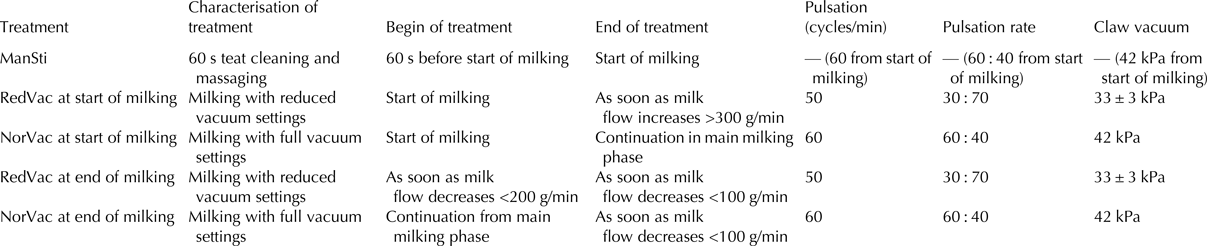
Seven Holstein dairy cows from the herd of the Institute for Livestock Sciences, Research Station Agroscope in Posieux (herd size 80 lactating cows, average milk production 8300 kg in 305 d) were used in the current study. In this study, animals were in their first (2), second (2), third (2) and fourth (1) lactation, and between 200 and 441 DIM. Cows were fed ad libitum with a partial mixed ration (grass- and corn-silage, hay, soy grist) and received concentrate according to the animal's individual production level provided by automatic feeders. Experimental milkings were performed in a tie stall with a portable bucket milker (DelPro MU450, DeLaval, Tumba, Sweden). The installation of the milking system on a height of 1·1 m represented a midline milking system and imitated the conditions as frequently installed in modern milking parlours. System vacuum was 42 kPa and the pulsation rate was 60 cycles/min with a 60 : 40 pulsation ratio during the main milking phase. Milkings were performed with a standard milking unit with a top flow claw (Cluster Harmony, weight: 1·6 kg, claw volume: 360 ml, DeLaval, Tumba, Sweden) and standard liners (liner 20M – LS, product number: 99900982, diameter of mouthpiece: 20 mm, touch point pressure difference: 12 kPa, DeLaval, Tumba, Sweden). The milking system included automatically switchable settings (according to the operating instructions) of reduced claw (33 kPa) and pulsation chamber vacuum (PCV; 39 ± 3 kPa), pulsation rate (50 cycles/min), and pulsation ratio (30 : 70), which were active during low milk flow at the start of milking (<300 g/min) and at the end of milking (as soon as milk flow dropped below 200 g/min). For certain treatments the automated changes of vacuum and the pulsation settings were manually switched off.
Experimental design
Two days before the start of the experiment cows were transferred to the experimental tie stall barn for adaptation to the milking conditions. One day before the start of the experiment, an indwelling catheter (Intranule, length 105 mm, 13 G, Vygon, Ecouen, France) was inserted into the right jugular vein. Experimental milkings were performed twice daily (04:30 am and 04:30 pm). Three different treatments at the start of milking were combined with two different treatments at the end of milking, resulting in six different treatment combinations. Manual pre-stimulation (ManSti) lasted, when applied, for 60 s and consisted of teat cleaning with a wet single-use-paper followed by teat and udder massage. In treatments without pre-stimulation, milking was either started with reduced vacuum and pulsation settings (RedVac) or with full vacuum and normal pulsation (NorVac). The treatments with either reduced or normal vacuum and pulsation settings (RedVac, NorVac) were again applied during a controlled overmilking phase at the end of milking, i.e. when milk flow decreased <200 g/min, and the cluster was removed at a milk flow of 100 g/min. Thus, the resulting six treatment combinations were two with ManSti with either RedVac or NorVac (ManSti/RedVac and ManSti/NorVac) and four treatments without ManSti: RedVac/RedVac, RedVac/NorVac, NorVac/RedVac and NorVac/NorVac (Table 1). The seven experimental cows were randomly enrolled to all treatment combinations in a crossover-design over 6 d. Every treatment combination was applied at two successive milkings on each cow (morning and evening milkings of the same day, respectively).
Overview of treatments at the start or at the end of milk removal

Vacuum patterns
To verify the applied vacuum and pulsation settings of the used milking system, vacuum recordings were performed during one evening milking. Both the pulsation chamber and claw vacuum were measured through pressure probes (pressure probe MPX5100DP, Freescale Halbleiter Deutschland GmbH, Munich, Germany) in both pulsation tubes and one short milk tube, respectively. The vacuum levels were recorded at 0·001 s intervals in a period of 5 s around the up switch from RedVac to NorVac during milking. This data was analysed using the LabView Software 8.6 (National Instruments, Kista, Sweden).
Blood sampling and oxytocin measurements
Blood samples (10 ml) were collected from the jugular catheter at −2, −1 (start of ManSti if applied), −0·5, 0 (immediately before cluster attachment in all treatments), 0·5, 1, 1·5, 2, 3, 4 and 5 min relative to the cluster attachment and the start of milking, and were placed into tubes containing 3 K-EDTA. Blood samples were put on wet ice until centrifugation at 2500 g for 20 min and the obtained plasma was stored at −20 °C until analysis. Plasma OT concentration was determined by radioimmunoassay after extraction with Sep-Pak® C18 cartridges (Waters, Dublin, Ireland) as described by Schams (Reference Schams1983).
Milk flow recording and evaluation of milking characteristics
Milk flow was recorded with a mobile recording unit (Lactocorder, WMB-AG, Balgach, Switzerland) and the milking characteristics resulting from the milk flow profiles were analysed with the LactoPro Software (Version 5.2.0 Beta 49 software, WMB-AG, Balgach, Switzerland). Evaluated milking characteristics were total milk yield (TMY), main milking time (MMT; time from cluster attachment until milk flow decreased <200 g/min at the end of milking), and peak flow rate (PFR; highest milk flow maintained for at least 22 s). Bimodality of milk flow was used to describe a partially separate removal of cisternal and alveolar milk. It was characterised as a transient milk flow decline of more than 200 g/min, which occurred in the period of 95 s after milk flow first increased above 500 g/min.
To define bimodality more precisely, the first peak of milk flow in bimodal curves, the time until the first peak of milk flow in bimodal curves, the milk flow at start of main milk flow and the time until start of main milk flow were evaluated manually according to milk flow and electrical conductivity (EC) curves provided by the Lactocorder. The occurrence of the alveolar milk ejection was characterised as the time point of milk flow increase concomitantly with an abrupt drop of EC in the harvested milk. This method is based on the fact that the first ejected alveolar milk has a low electrical conductivity (Bruckmaier et al. Reference Bruckmaier, Weiss, Wiedemann, Schmitz and Wendl2004).
Time points of up and down switches between RedVac and NorVac as well as an experimentally intended overmilking (OM; time from the milk flow decrease <200 g/min until cluster detachment at a milk flow of 100 g/min) were recorded with a stopwatch.
Teat ultrasound imaging
Longitudinal and transversal cross section images through the right front teat were performed by B-mode ultrasonography (Draminski 4Vet Ultrasound, Olsztyn, Poland). In order to avoid any stimulatory effect on the udder and wet teats, the pre-milking teat ultrasound imaging was performed one day before the experiment started (pre-milking) as described previously (Bruckmaier & Blum, Reference Bruckmaier and Blum1992; Weiss et al. Reference Weiss, Weinfurtner and Bruckmaier2004). Another teat ultrasound was performed 15 min after the end of each milking during the trial. The teat was dipped in a cup filled with warm water (37 °C) and a 5-MHz linear probe was applied from the outside of the cup using contact gel between cup wall and probe. Images were evaluated by measuring the teat wall thickness at 2 cm above the teat tip.
Statistical analysis
Results are presented as means ± sem. For statistical evaluation the MIXED procedure of SAS was used (SAS 9.4; SAS Institute Inc., Cary, NC). Milking characteristics resulting from treatment combinations were sorted after the applied treatments at the start (ManSti, RedVac, NorVac) or at the end (RedVac, NorVac) of milk removal. For milking characteristics the treatments were set as fixed effects and the animal as repeated subject. For the evaluation of OT profiles the model included treatment, experimental period (from −2 to 5 min after the start of milking) and the interaction between both as fixed effects and the animal as repeated subject. For the evaluation of teat wall thickness the model included treatment, experimental period (pre-milking and 15 min after the end of milking), and the interaction between both as fixed effects and the animal as repeated subject. Significant treatment effects were localised by Tukey's multiple comparison t-test (P < 0·05).
Results
Vacuum conditions
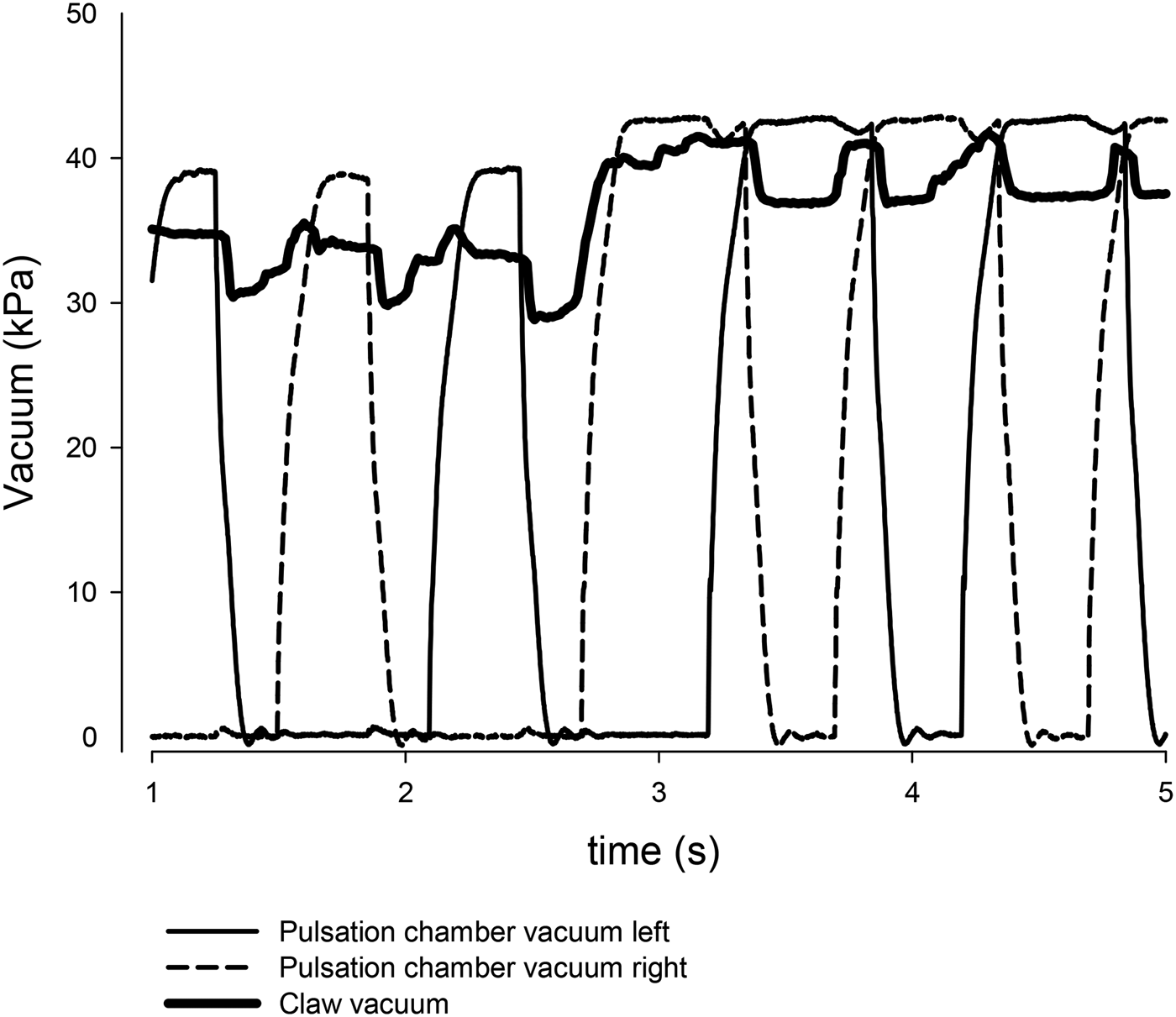
The vacuum settings shortly before, during and after the up-switch from RedVac to NorVac at a milk flow of 300 g/min were verified by simultaneous vacuum measurements in the pulsation tubes and in one short milk tube (Fig. 1). Pulsation chamber and claw vacuums were reduced during the RedVac period as planned (average claw vacuum under RedVac = 33 kPa; pulsation chamber vacuum PCV = 39 kPa). After the switch from RedVac to NorVac the PCV was 42 kPa and the claw vacuum immediately after the switch was 39 kPa. In both settings the claw vacuum followed vacuum fluctuations due to the actual milk flow. The measured pulsation ratio was 30 : 70 during the RedVac settings, and 60 : 40 during the NorVac settings. The pulsation rate during RedVac and NorVac was as expected (RedVac = 50 cycles/min; NorVac = 60 cycles/min, respectively).
Vacuum curves measured in two alternate acting short pulse tubes and one short milk tube with focus on the up-switch from reduced to full vacuum settings.

Oxytocin profiles
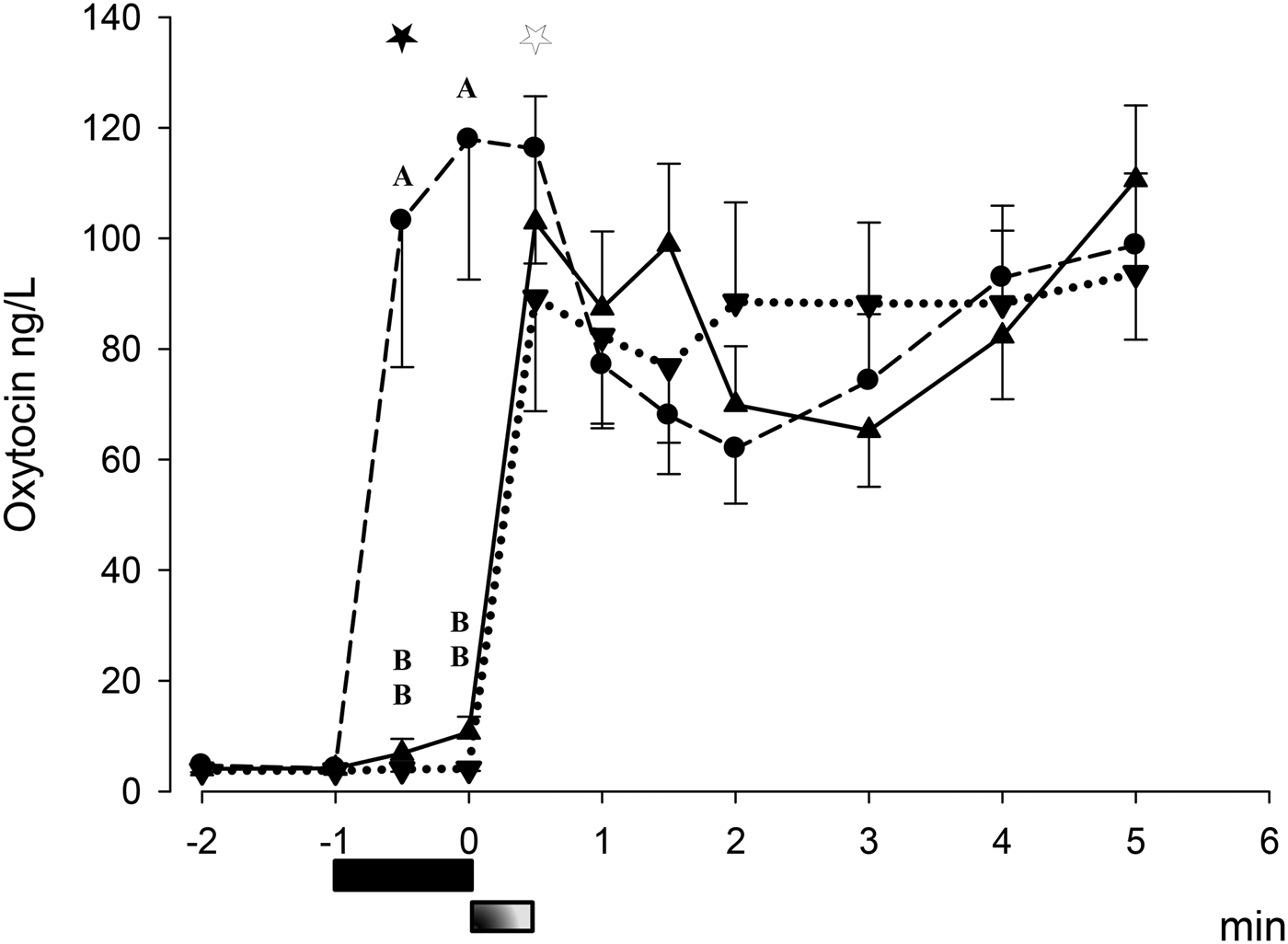
The pre-milking baseline OT concentrations were similarly low for all treatments (Figs. 2 & 3). Oxytocin increased within 0·5 min during manual pre-stimulation in treatment ManSti (P < 0·05) and remained elevated until 5 min after the start of milking. Oxytocin concentrations remained at a basal level in RedVac and NorVac at the start of milking. In those treatments OT concentrations were increased at 0·5 min after teat cup attachment and remained elevated throughout milking. No statistical differences between treatments (ManSti, RedVac, NorVac) were detected for OT concentrations from 0·5 to 5 min after the start of milking.
Oxytocin (OT) concentrations in plasma (means ± sem for n = 84 milkings) from −2 to 5 min relative to the start of milking.  ,
 : ManSti;
 ,
 : RedVac;
 : NorVac; 0 min: start of milking.
 , time point at which OT means caused by ManSti are significantly elevated from baseline (P < 0·05) until the end of milking;
 , time point at which OT means caused by RedVac or NorVac are significantly elevated from baseline (P < 0·05) until the end of milking. A, B = means without common superscription letters are not significantly different from each other.

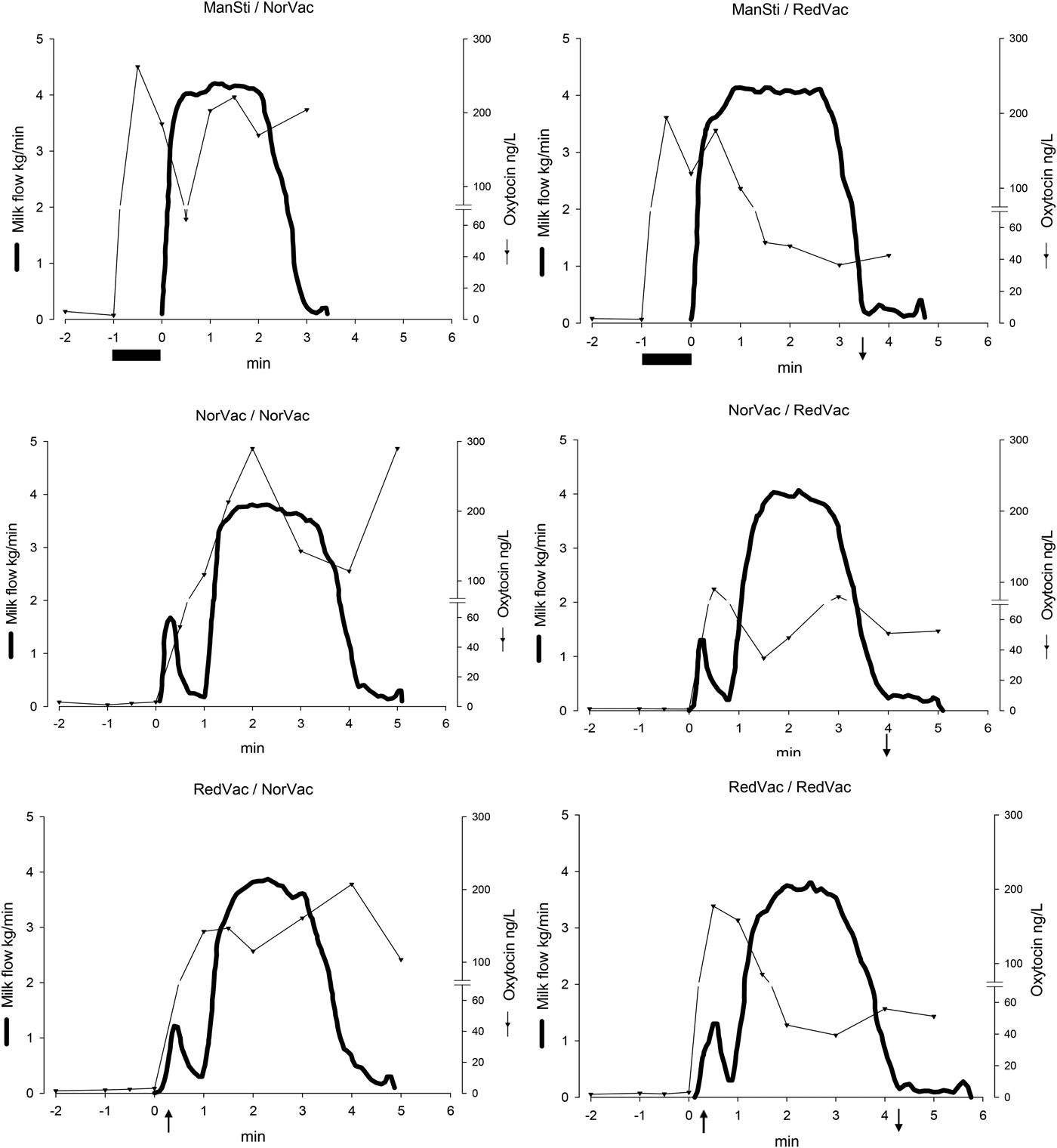
Representative milk flow curves and OT concentrations in one individual cow (1891) during six different treatment combinations. ManSti, manual pre-stimulation; RedVac, milking with reduced vacuum settings; NorVac, milking with full vacuum settings;  , ManSti; ↑, up-switch from RedVac to full vacuum settings; ↓, down-switch from full vacuum settings to RedVac.

Milking characteristics
Treatments: ManSti, RedVac, and NorVac at start of milking
Total milk yield did not differ between treatments (P > 0·05). In ManSti the MMT was shorter (P < 0·05) than in RedVac and NorVac, respectively, whereas these parameters did not significantly differ between RedVac and NorVac (Table 2). Adding the time of 1 min manual pre-stimulation to the MMT in ManSti leads to similar values in all three treatments. No significant differences between treatments were detected for PFR (P > 0·05).
Mean milking characteristics resulting from the three different treatments at start of milk removal (ManSti, RedVac, NorVac). In the assorting the end of milking is not considered

ManSti, manual pre-stimulation; RedVac, reduced vacuum settings at start of milk removal; NorVac, full vacuum settings at start of milk removal; TMY, total milk yield; MMT, main milking time; PFR, peak flow rate.
A,BMeans with different superscripts indicate significant differences between treatments (P < 0·05).
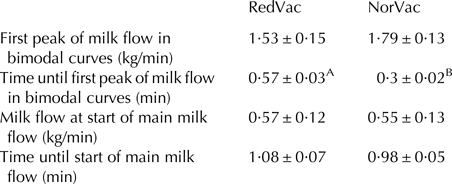
In ManSti bimodal milk flow curves occurred in 11%, whereas in RedVac and NorVac bimodal milk flow curves occurred quite similarly in 79 and 82% of all milkings, respectively. A shape description of bimodality courses is shown in Table 3. During the first peak of milk flow in the bimodal milk flow curves, milk in NorVac was harvested in a shorter time compared to RedVac (P < 0·05). The maximal milk flow during the first peak in bimodal milk flow curves, and the time until start of main milk flow (second milk flow increase) did not differ between RedVac and NorVac.
Shape of bimodal milk flow curves during start of milking with reduced (RedVac) or full (NorVac) vacuum load. Bimodality occurred in 79% during RedVac and in 82% during NorVac, respectively

A,BMeans with different superscripts indicate significant differences between treatments (P < 0·05).
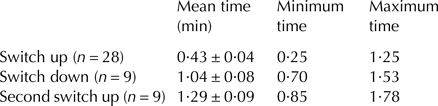
The first up switch from RedVac to NorVac took place within the first 0·5 min of milking (Table 4). In nine of the twenty-eight milkings in RedVac the milk flow during early milking dropped below 200 g/min shortly after switching up to full vacuum settings and the milking machine switched back down to RedVac, before a second switch up occurred at the start of main milk flow.
Switches from reduced vacuum settings (RedVac) up to full vacuum settings during the start of milking: 68% once/32% twice (n = 28)

No statistically significant interaction between the treatment differences at the start of milking and the end of milking was found. Consequently, we have compared the two different settings at the end of milking independently of the treatment at the start of milking. At the end of milking the RedVac and NorVac settings were identical until a milk flow of 200 g/min. The period after this level is considered as overmilking because the cluster is usually removed at the latest at 200 g/min. The OM until a milk flow of 100 g/min was significantly (P < 0·05) prolonged in RedVac as compared to NorVac (1·07 ± 0·10; 0·76 ± 0·06 min, respectively). This course of prolonged OM is also visible by the example milk flow curves of one individual cow representing all treatments (Fig. 3).
Teat ultrasound imaging
Pre-milking teat wall thickness was 7·26 ± 0·25 mm. In each treatment combination, teat wall thickness was increased at 15 min after milking (P < 0·05), whereas no significant differences for individual treatment combinations were observed (P > 0·05; ManSti/NorVac 8·25 ± 0·22 mm; ManSti/RedVac 8·27 ± 0·25 mm; NorVac/NorVac 8·26 ± 0·23 mm; NorVac/RedVac 8·16 ± 0·23 mm; RedVac/NorVac 8·16 ± 0·25 mm; RedVac/RedVac 8·25 ± 0·20 mm).
Discussion
Milking machine settings are a compromise to achieve a milk removal which is fast and complete. Because the vacuum acting on the teat end changes during milking, an ideal vacuum setting for the whole milking process hardly exists (Rasmussen & Madsen, Reference Rasmussen and Madsen2000). The claw vacuum which acts on the teat during milking is responsible for removal and transportation of milk, but also for the pressure of the liner on the teat during the liner-closed phase (Mein et al. Reference Mein, Williams and Thiel1987). In contrast to the PCV, which is not affected by milk flow, the claw vacuum is subject to milk flow dependent vacuum losses during the course of milking which can be more or less pronounced, depending of the technical characteristics of the milking system (Ambord & Bruckmaier, Reference Ambord and Bruckmaier2010; Besier & Bruckmaier, Reference Besier and Bruckmaier2016). A general increase of the system vacuum level would cause the impact of this full vacuum on the teat because vacuum drops do not occur in the absence of milk flow. This fact is of importance at the very beginning of milking and mainly towards the end of milking, when milk flow gradually ceases while the flow dependent vacuum drop disappears. It has been shown that high system vacuum increases the load on the teat tissue despite considerable milk-flow dependent vacuum drops (Besier & Bruckmaier, Reference Besier and Bruckmaier2016).
The magnitude of the OT release was quantitatively similar in the three different treatments concerning the start of milking (ManSti, RedVac, NorVac). However, the timing of the OT release occurred 1 min later in the treatments without pre-stimulation (RedVac, NorVac) as compared to a one minute manual pre-stimulation (ManSti). This observation confirms our previous findings that the normal pulsation cycle has a similar stimulatory effect as a manual stimulation (Bruckmaier & Blum, Reference Bruckmaier and Blum1996) shown by the bimodal milk flow curves observed in most of the milkings with RedVac and NorVac. The start of the second milk flow increase in bimodal curves has been demonstrated to represent the start of milk ejection (Bruckmaier & Blum, Reference Bruckmaier and Blum1996; Bruckmaier & Hilger, Reference Bruckmaier and Hilger2001). Most importantly, the similarity of the OT release in RedVac and NorVac confirms our hypothesis that the OT release stimulated by the cyclic liner movement is also similar if the teat-end vacuum is reduced, the liner-closed phase prolonged and the pulsation rate reduced. We expected this result because we have previously demonstrated that the teat stimulation and its effect on milk ejection is mainly a matter of timing, and it is much less affected by the intensity of stimulation (Weiss et al. Reference Weiss, Dzidic and Bruckmaier2003). Consequently, the stimulatory effect to induce OT release and milk ejection in the reduced vacuum settings appears to be fully adequate. Even though the OT concentrations between individual milkings and individual animals differ, the threshold of OT to induce a maximum milk ejection (Schams et al. Reference Schams, Mayer, Prokopp and Worstorff1984) was certainly surmounted in all treatments and all individual milkings in the present study.
At the start of milking, an insufficient cisternal refill during the liner-closed phase concomitantly with a lack of positive pressure in the teat before the alveolar milk ejection occurs increases the probability of teat cup climbing and liner slips caused by a reduced liner adhesion (Rasmussen & Madsen, Reference Rasmussen and Madsen2000). Consequently, the risk of tissue damage is increased under those milking conditions (Nyhan, Reference Nyhan1968; Thiel et al. Reference Thiel, Cousins, Westgarth and Neave1973). From this point of view it appears to be advantageous that the bimodality in treatment RedVac had a delayed peak as compared with NorVac, while the start of the second milk flow increase in bimodal curves did not differ between the treatments. This indicates a more gentle milk removal during this period of low availability of milk in RedVac. Those findings are in agreement with other studies where the milk flow rate was affected by the system vacuum and the pulsation ratio used during milking (Bade et al. Reference Bade, Reinemann, Zucali, Ruegg and Thompson2009; Besier & Bruckmaier, Reference Besier and Bruckmaier2016; Penry et al. Reference Penry, Leonardi, Upton, Thompson and Reinemann2016). However, the reduced claw vacuum and shortened liner-open phase in RedVac is supposed to prevent a pre-term climbing of the teat cup during low milk flow which would occur during the first peak of bimodal milk flow, i.e. before milk ejection. During this phase, any milk flow dependent vacuum drop is lacking which is systematically replaced by the reduced claw vacuum in RedVac (Besier & Bruckmaier, Reference Besier and Bruckmaier2016). In addition, a particularly high pressure of the liner on the teat in this treatment is avoided (Bade et al. Reference Bade, Reinemann, Zucali, Ruegg and Thompson2009), which hence may decrease the risk of hyperkeratosis (Zecconi et al. Reference Zecconi, Hamann, Bronzo and Ruffo1992). A prolonged liner-closed phase is supposed to provide better relieve of teat congestion (Upton et al. Reference Upton, Penry, Rasmussen, Thompson and Reinemann2016) and a slower milk removal, and therefore improves cisternal refill as long as milk ejection has not occurred, thereby also improving liner adhesion.
Not surprisingly, milk yields and peak flow rates did not differ between treatments. In ManSti the shorter MMT compared to RedVac and NorVac is expected because the pre-stimulation induced milk ejection already before cluster attachment. When the 60 s of pre-stimulation in ManSti are added to MMT, i.e. when milking time is calculated from the first tactile teat contact, the total milking time did not differ between treatments. This is in agreement with a number of earlier studies showing that delayed milk ejection does not necessarily result in a longer milking time (Bruckmaier & Blum, Reference Bruckmaier and Blum1996). Most importantly, this demonstrates that the reduced settings of vacuum and pulsation do not cause a prolonged milking time.
At the end of milking, reduced vacuum settings in RedVac were acting significantly longer on the teat until milk flow has decreased to 100 g/min, as compared to full vacuum settings in NorVac. This indicates again a gentle action of liner and vacuum in RedVac. Under routine milking conditions the cluster would be removed at 200 g/min or higher. The switch to the reduced vacuum and pulsation settings at the end of milking does therefore have mainly a protective effect on the teat tissue if the cluster should not be removed in time, i.e. if overmilking occurs. As compared to pre-milking, teat wall thickness based on ultrasound cross sections was increased in each treatment combination after milking. Despite the increased overmilking time at a milk flow <200 g/min in RedVac, teat wall thickness did not significantly differ compared to NorVac. This means that milking with RedVac does not impact the teat condition if the cluster is not removed at the latest at 200 g/min.
In conclusion, the RedVac settings have an adequate stimulatory effect on OT release and milk ejection at the start of milking and thus help to avoid negative effects before the availability of the alveolar milk fraction on the teat tissue and further milk removal. Thus, a negative effect on the teat tissue by a potential delay of cluster removal at the end of milking due to bad milking management is likely reduced if the RedVac settings are automatically switched on when milk flow drops below 200 g/min.
The expert laboratory assistance by Mrs Yolande Zbinden is gratefully acknowledged.