INTRODUCTION
Polyclads are marine, benthonic flatworms that generally live in rocky substrates. Most of them are free living, while some live in intimate association with other invertebrates (e.g. corals, hermit crabs, echinoderms and molluscs), forming commensal relationships (Newman & Cannon, Reference Newman and Cannon2003). Several species of commensal polyclads live in the mantle cavity of gastropods and polyplacoforan molluscs (Faubel et al., Reference Faubel, Sluys and Reid2007). A few species have been reported as associated with boring bivalves. One of these, Taenioplana teredini Hyman, Reference Hyman1944 (Acotylea, Euplanidae), was first described as living in the tubes of Teredo spp. on the coast of Hawaii (Hyman, Reference Hyman1944). Later, T. teredini was found in association with another Teredo species, Teredo furcifera Martens in Semon, 1894, as well as with other bivalves including Bankia fimbriatula Moll & Roch, 1931, and Lyrodus massa (Lamy, 1923) (Riser, Reference Riser1970, Reference Riser, Riser and Morse1974). Taenioplana teredini was recently reported to be associated with different invasive bivalves in several continents (Carlton, Reference Carlton, Rilov and Crooks2009; Carlton & Eldredge, Reference Carlton and Eldredge2009, and citations therein).
Polyclads of the south-east Pacific coast are poorly studied. From the 19th Century to the early 20th Century, twelve species from central and southern Chile were described, including five from the Juan Fernández archipelago (Schmarda, Reference Schmarda1859; Plehn, Reference Plehn1896; Ritter-Zahony, Reference Ritter-Zahony1907; Bock, Reference Bock1913, Reference Bock and Skottsberg1923). Marcus (Reference Marcus1954) described three new species from southern Chile and reported another four, two of them already mentioned from the Juan Fernández archipelago and Central Chile (Peru–Chilean province sensu Boschi, Reference Boschi2000). Faubel (Reference Faubel1983) and Baeza et al. (Reference Baeza, Veliz, Pardo, Lohrmann and Guisado1997) described two new polyclads from North Chile. Bulnes (Reference Bulnes, Häussermann and Försterra2009) recorded five polyclad species already known in Chile, but some of them were in fact misidentified (Brusa & Damborenea, Reference Brusa and Damborenea2011). More recently, during a study on the diversity of bivalve molluscs from southern Chile, we found an unidentified polyclad living in tubes bored in the wood of Nothophagus that fall into the sea when they die and sink to the bottom of the fjords, turning into the substrate for Bankia martensis (Stempell, 1899) (Teredinidae). This polyclad appeared morphologically similar to T. teredini, suggesting a very close relationship between the two taxa.
In the present study, we describe this unidentified polyclad as a new species belonging to a new genus. To clarify relationships of the new taxon within the family Euplanidae, we carry out a phylogenetic analysis based on morphological characters. In addition, we compare the new species with its putative close relative, T. teredini that we also discussed.
MATERIALS AND METHODS
Sixteen specimens of the new polyclad taxon were collected on 15 February 2010 at the Fiordo Cahuelmó (42°15′24.9″S72°24′10.9″W) in southern Chile between 50 and 95 m deep. The specimens were extracted manually from tubes bored in the wood by Bankia martensi (Bivalvia, Teredinidae). Collected specimens were deposited in the Helminthological Collection of the Museo de La Plata (MLP), Argentina; and in the Museo de Zoología of Universidad de Concepción (MZUC), Chile. For taxonomic identifications we used the Faubel (Reference Faubel1983, Reference Faubel1984) classification system of acotyleans.
For morphological analysis, collected specimens were fixed in 10% formalin, then washed and preserved in 70% ethanol. After body measurements were taken, the fixed specimens were photographed. The body regions containing the pharynx and the reproductive structures of four specimens were removed and embedded in paraplast for serial microtome sectioning. Samples were sectioned sagitally at 8 µm, stained using haematoxylin–eosin and Masson's trichrome and, finally, mounted in synthetic Canada balsam. Whole mounts were prepared by first dehydrating the fixed specimens of the new taxon through an ascending alcohol series, then clearing the specimens in xylene and, finally, mounting them in synthetic Canada balsam. In addition, one whole specimen was stained with acetic carmine and mounted in synthetic Canada balsam. Schematic reconstructions of the reproductive system were made, based on the sectioned specimens and whole mounts.
We studied the whole mounted holotype and sagittal sections of the paratype of Taenioplana teredini from collections of the National Museum of Natural History (USNM, USA). In addition, we sectioned and stained a paratype of T. teredini deposited at the Bishop Museum (BPBM, Hawaii).
For the phylogenetic analysis, we used 16 out of the 19 valid species of Euplanidae (superfamily Ilyplanoidea) (Faubel, Reference Faubel1983, Reference Faubel1984). Aprostatum longipenis, Euplanoida concolor and E. pardalis were excluded from analysis, because no complete information of these three species was available. In the absence of molecular and/or morphological phylogenetic analyses at the family level, six representative species of different families within Ilyplanoidea Faubel, Reference Faubel1984 were selected as outgroups (Anocellidae, Anocellidus profundus Quiroga, Bolaños & Litvaitis, Reference Quiroga, Bolaños and Litvaitis2006; Discoprosthididae, Discoprosthides patagoniensis Faubel, Reference Faubel1983; Ilyplanidae, Ilyella gigas (Schmarda, Reference Schmarda1859) of uncertain position according to Doignon et al. (Reference Doignon, Artois and Deheyn2003), Euilyoida malagasensis (Doignon, Artois & Deheyn, Reference Doignon, Artois and Deheyn2003) and Postenterogonia orbicularis (Schmarda, Reference Schmarda1859); and Mucroplanidae, Mucroplana caelata Sopott-Ehlers & Schmidt, Reference Sopott-Ehlers and Schmidt1975).
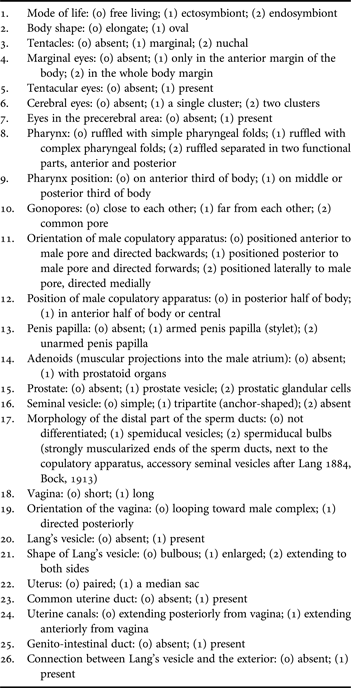
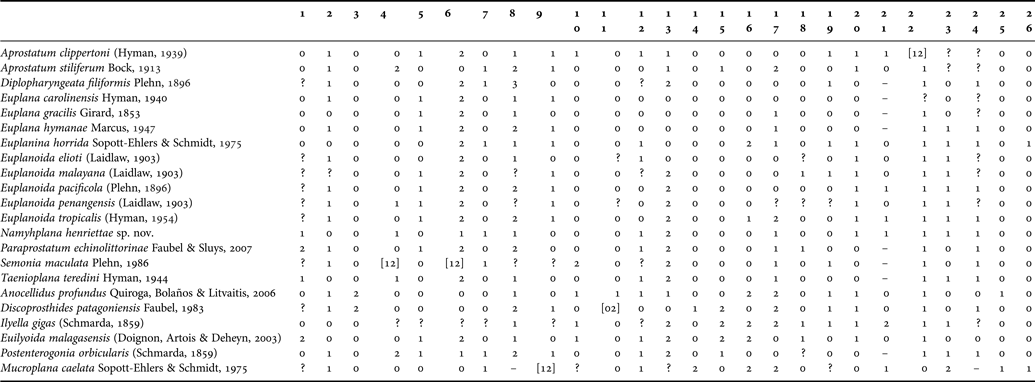
For all taxa considered we coded 26 morphological characters (Table 1). Information about character states of the new species and of T. teredini was obtained from the specimens studied here; that of the remaining species was obtained from the literature (Plehn, Reference Plehn1896; Laidlaw, Reference Laidlaw1903a, Reference Laidlawb; Bock, Reference Bock1913; Hyman, Reference Hyman1939, Reference Hyman1941, Reference Hyman1944, Reference Hyman1953, Reference Hyman1954, Reference Hyman1955; Marcus, Reference Marcus1947, Reference Marcus1954; Sopott-Ehlers & Schmidt, Reference Sopott-Ehlers and Schmidt1975; Faubel, Reference Faubel1983; Doignon et al., Reference Doignon, Artois and Deheyn2003; Quiroga et al., Reference Quiroga, Bolaños and Litvaitis2006; Faubel et al., Reference Faubel, Sluys and Reid2007; Holleman, Reference Holleman2007). Missing data were coded as ‘?’, inapplicable character states as ‘–’, and characters with multiple states in brackets (Table 2). Parsimony analysis was performed using the program TNT (Goloboff et al., Reference Goloboff, Farris and Nixon2008). All characters were treated as unordered and weighted equally. A heuristic search was performed by tree bisection–reconnection (TBR) branch swapping of 1000 series of random-addition sequence, saving 100 (most parsimonious) trees after each replicate. The option ‘collapse tree’ after search was selected. Bremer Support was calculated to assess branch support.
List of characters and respective character states.

Matrix of 22 taxa and 26 characters used in this analysis. Unknown states are represented by ‘?’, inapplicable characters by ‘–’ and characters with multiple states in brackets.
SYSTEMATICS
Order POLYCLADIDA Lang, 1881
Suborder ACOTYLEA Lang, 1884
Superfamily ILYPLANOIDEA Faubel, Reference Faubel1984
Family EUPLANIDAE Faubel, Reference Faubel1983
Namyhplana gen. nov.
DIAGNOSIS
Euplanidae with pharynx anterior to mid-body; eye spots cerebral, pre-cerebral and anterior marginal; male copulatory apparatus with unarmed penis papilla horizontally placed; female apparatus with Lang's vesicle.
TYPE SPECIES
Namyhplana henriettae sp. nov.
ETYMOLOGY
We dedicate the name of the genus to Libbie Henrietta Hyman (1888–1969) who contributed to the knowledge of the Platyhelminthes of South America at the beginning of the 20th Century. The first part of the name (Namyh) is an anagram of Hyman.
Namyhplana henriettae sp. nov.
(Figures 1–5)
ETYMOLOGY
We dedicate the name of the species to Libbie Henrietta Hyman (1888–1969).
TYPE MATERIAL
Holotype: sectioned specimen mounted on 16 slides (from tubes made in the wood by Bankia martensi, Fiordo Cahuelmó, Chile; coordinates: 42°15′22.4″S72°23′48.5″W; water depth: 50–95 m) (MLP 6682); coll. D. Zelaya, 15 February 2010.
Paratype: 15 specimens (from tubes made in the wood by Bankia martensi, Fiordo Cahuelmó, Chile; coordinates: 42°15′22.4″S72°23′48.5″W; water depth: 50–95 m); coll. D. Zelaya, 15 February 2010. Three of them are sectioned specimens mounted on a series of 56 slides (MLP 6683); two specimens are whole mounted (MLP 6683); and ten additional specimens are preserved in ethanol (MLP 6683, MZUC 40120).
COMPARATIVE MATERIAL EXAMINED
Taenioplana teredini Hyman, Reference Hyman1944. Holotype: whole-mounted specimen (USNM 20636): Oahu Island, Honolulu, Hawaii (coordinates: 21°30′N157°85′W); collected by C. Edmondson on 24 February 1944. Paratype: one specimen mounted on two slides (USNM 20637); two specimens, one sectioned and mounted on 16 slides (BPBM-F 115), and one preserved in ethanol (BPBM-F 117): Oahu Island, Honolulu, Hawaii (coordinates: 21°30′N157°85′W), collected by C. Edmondson on 24 February 1944.
DIAGNOSIS
Acotylea with a ribbon-like body. Body colour light brown, with two dorsal dark brown longitudinal bands. Few eyes, in the unpigmented anterior region. Tentacles absent. Pharynx with few folds. Gonopores independent, in the middle of the body. Seminal vesicle strongly muscularized connected to digitiform penis papilla oriented posteroanteriorly. Vagina curled. Lang's vesicle large, ventral to the intestine.
DESCRIPTION
Fixed specimens have a light brown dorsum with two dark brown, broad, dorsal longitudinal bands (Figure 1). At the brain level the central light band is broader. The ventral surface is beige. The body is ribbon-like with the anterior end slightly tapering and a blunt posterior end. Fixed adult specimens are 20–25 × 1.5 mm. Tentacles absent. The distance between the anterior margin of the body and the anterior end of the pharynx is 2.6 mm. The distance between the anterior margin of the body and the mouth is 3 mm. The pharynx is 1.1 mm long. The distance between the rear end of the pharynx and the female gonopore is 1.8 mm. The distance between gonopores is 1 mm (Figures 2 & 3).
Anterior end of Namyhplana henriettae: (A) fixed specimen under stereomicroscope; arrow heads show the marginal eyes; (B) whole-mounted diaphanized specimen in Canada balsam showing the cerebral and marginal eyes. Scale bars: A, 500 µm; B, 1000 µm.
Schematic representation of Namyhplana henriettae in dorsal view. Abbreviations: ce, cerebral eyes; me, marginal eyes; o, oviduct; ph, pharynx; ♀, female gonopore; ♂, male gonopore. Scale bar: 1000 µm.
Dorsal view of Namyhplana henriettae. Specimen stained with acetic carmine. Abbreviations: ce, cerebral eyes; me, marginal eyes; o, oviduct; ph, pharynx; pp, penis papilla; ♀, female gonopore; ♂, male gonopore. Scale bar: 1000 µm.
Few eyes occur on the anterior region of the body, some of which are dorsal to the brain in the unpigmented centrodorsal region, and others are located in the unpigmented pre-cerebral marginal region (Figures 1 & 4A). The musculature of the body wall consists of an outer longitudinal layer of one or two fibres in thickness, then a layer of circular muscles one fibre in thickness, and an inner longitudinal layer 4–5 fibres in thickness. The epidermis is ciliated, with the dorsal cilia longer than the ventral ones. The pharynx is located anteriorly to the medial region of the body and is folded, showing up to four folds (Figure 4B, C).
Anatomical features of Namyhplana henriettae: (A) sagittal section of the cerebral region; (B) whole-mounted preparation of the pharyngeal region and gonopores; (C) sagittal section of the pharyngeal region; (D–F) sagittal section of the region of the copulatory system. Abbreviations: b, brain; cep, ciliated epithelium; e, eyes; ev, external vagina; i, intestine; iv, internal vagina; lv, Lang's vesicle; lvc, Lang's vesicle canal; m, mouth; o, oviduct; ph, pharynx; pp, penis papilla; spv, spermiducal vesicle; sv, seminal vesicle; ♀, female gonopore; ♂, male gonopore. Scale bars: A, C–F, 500 µm; B, 1000 µm.
Separate gonopores are located in the middle third of the body (Figure 4B, D–F). Testes are located along the body, in dorsal position. A pair of well-developed spermiducal vesicles with thin muscularized walls, ventral in the anterior region, occupy the total height of the body, next to the copulatory apparatus (Figure 5). The spermiducal vesicles are charged with spermatozoids that flow independently into the seminal vesicle in front of the male gonopore (Figure 4D, E). The seminal vesicle is oval (400 × 200 µm) and strongly muscularized and contained spermatozoids in all studied specimens (Figure 4D, E). A very long and thin ejaculatory duct in horizontal position and dorsal to the male atrium connects the seminal vesicle to the penis papilla (Figure 4D, E). The penis papilla is digitiform, 1 × 0.1 mm, and is in horizontal position, with the distal end directed forward. The ejaculatory duct that runs along the penis papilla is sinuous. The male genital atrium is covered by a ciliate and glandular epithelium (Figure 4D, E).
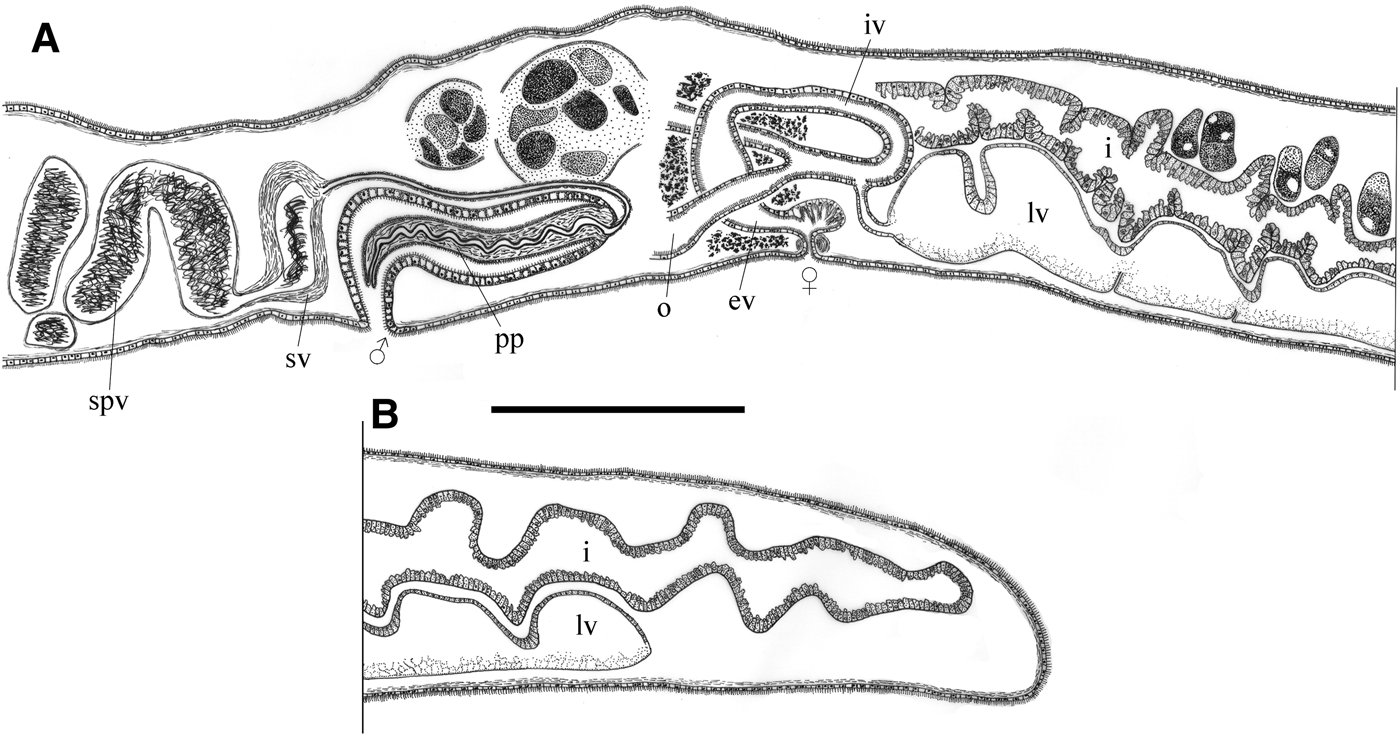
Schematic reconstruction of the copulatory system of Namyhplana henriettae. Anterior end on the left: (A) sagittal reconstruction of the entire copulatory system; (B) sagittal reconstruction of the posterior region of the body. Abbreviations: ev, external vagina; i, intestine; iv, internal vagina; lv, Lang's vesicle; o, oviduct; pp, penis papilla; spv, spermiducal vesicle; sv, seminal vesicle; ♀, female gonopore; ♂, male gonopore. Scale bar: 1000 µm.
The ovaries are dorsal and occupy a large part of the body. The dilated oviducts are full of oocytes (Figure 4B). They extend from the anterior region to beyond the level of the female gonopore, separately reaching the internal vagina that curves towards the dorsum, forms a curl, and continues into the median vagina surrounded by a large number of eosinophil glands (mucous sensu Faubel, Reference Faubel1983) (Figure 4D, F). The external vagina, positioned dorsoventrally, flows into the female gonopore, which presents an asymmetrical sphincter (Figure 4F). The external vagina is lined up with a high epithelium and shows a ‘pocket’-like expansion towards the posterior region. A short canal connects the internal vagina to a large Lang's vesicle, that extends posteriorly for a long distance, ventrally to the intestine. Ventral evaginations of the intestine are intimately in contact with Lang's vesicle (Figure 5).
Taenioplana teredini Hyman, Reference Hyman1944
(Figures 6–8)
MATERIAL EXAMINED
Holotype: USNM 20636. The specimen is from Oahu Island, Honolulu, Hawaii (21°30′N157°85′W); collected by C. Edmondson on 24 February 1944 and found in association with Teredo sp.
Paratypes: USNM 20637, BPBM- F 115, BPBM- F 117. All these specimens are from Oahu Island, Honolulu, Hawaii (21°30′N157°85′W); collected by C. Edmondson on 24 February 1944 and found in association with Teredo sp.
REMARKS
The study of these specimens allowed us to provide new details of some structures of Taenioplana teredini. The paratype sagittally sectioned in this study provided new details of some structures, especially of the female reproductive system, because the Bishop Museum paratype (BPBM-F 115) specimen is more mature (the eggs are mature, and such vaginal glands are well-developed) than Hyman's (USNM 20637).
The body wall is well-developed with long cilia on the dorsal and ventral epithelia. The ventral musculature has three layers: an external longitudinal, a middle circular, and an internal longitudinal layer. The dorsal musculature is thicker than the ventral one, has a longitudinal external layer and a circular internal layer from which dorso-ventral muscular fibres arise. An inner longitudinal layer in the dorsal musculature was not observed. Under the musculature of the dorsal region, a dark pigment forms stripes on different regions of the body, but mainly on the anterior region. This pigment is also observed externally in the holotype (Figure 6).
Holotype of Taenioplana teredini (USNM 20636). Anterior end on the left. Scale bar: 5 mm.
The brain is spherical and encapsulated in the anterior prepharyngeal region. The distribution of the eyes is the same that Hyman (Reference Hyman1944) described. All eyes have a pigmented cup. The epithelium in this region is low and the cells are almost flat and unpigmented. The pharynx is folded; many folds occupying a large part of the first third of the body.
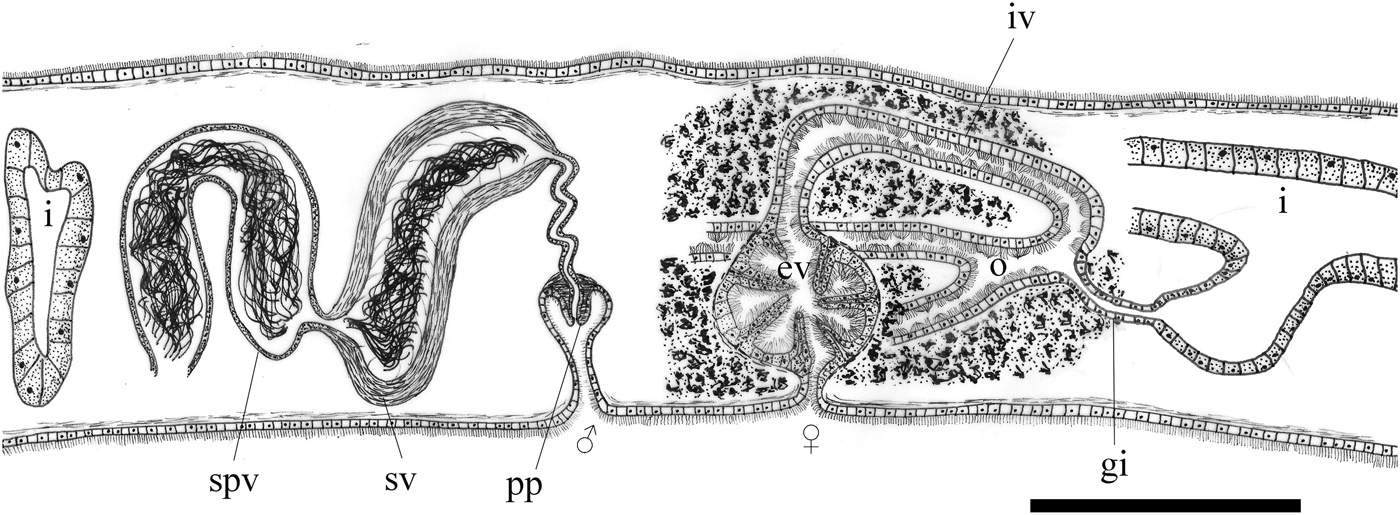
The morphology of the male genital system coincides with the original description (Hyman, Reference Hyman1944). The testes are dorsal. In the female genital system the ciliated oviducts extend from the anterior region to beyond the level of the female gonopore. They flow into a common oviduct. The ciliated internal vagina that curves towards the dorsum, forms a curl, and continues forward (Figures 7 & 8). The external vagina, oriented vertically, with high, folded, and ciliated wall, surrounded by numerous eosinophil glands, flows into the female gonopore without sphincter. A genito-intestinal duct originates in the curl of the internal vagina and goes backwards through a long section until it broadens, opening into an intestinal pocket. In the specimen studied here (BPBM-F 115), the genito-intestinal duct is longer than the one described by Hyman (Reference Hyman1944) as a short duct communicating with a ventral intestine pocket.
Copulatory region of Taenioplana teredini. Sagittal section of the paratype specimen (BPBM-F 115). Abbreviations: ev, external vagina; i, intestine; iv, internal vagina; o, oviduct; sv, seminal vesicle; spv, spermiducal vesicle; ♂, male gonopore. Scale bar: 250 µm.
Schematic reconstruction of the copulatory system of Taenioplana teredini. Abbreviations: ev, external vagina; gi, genito-intestinal duct; i, intestine; iv, internal vagina; sv, seminal vesicle; o, oviduct; pp, penis papilla; spv, spermiducal vesicle; ♀, female gonopore; ♂, male gonopore. Scale bar: 250 µm.
PHYLOGENY
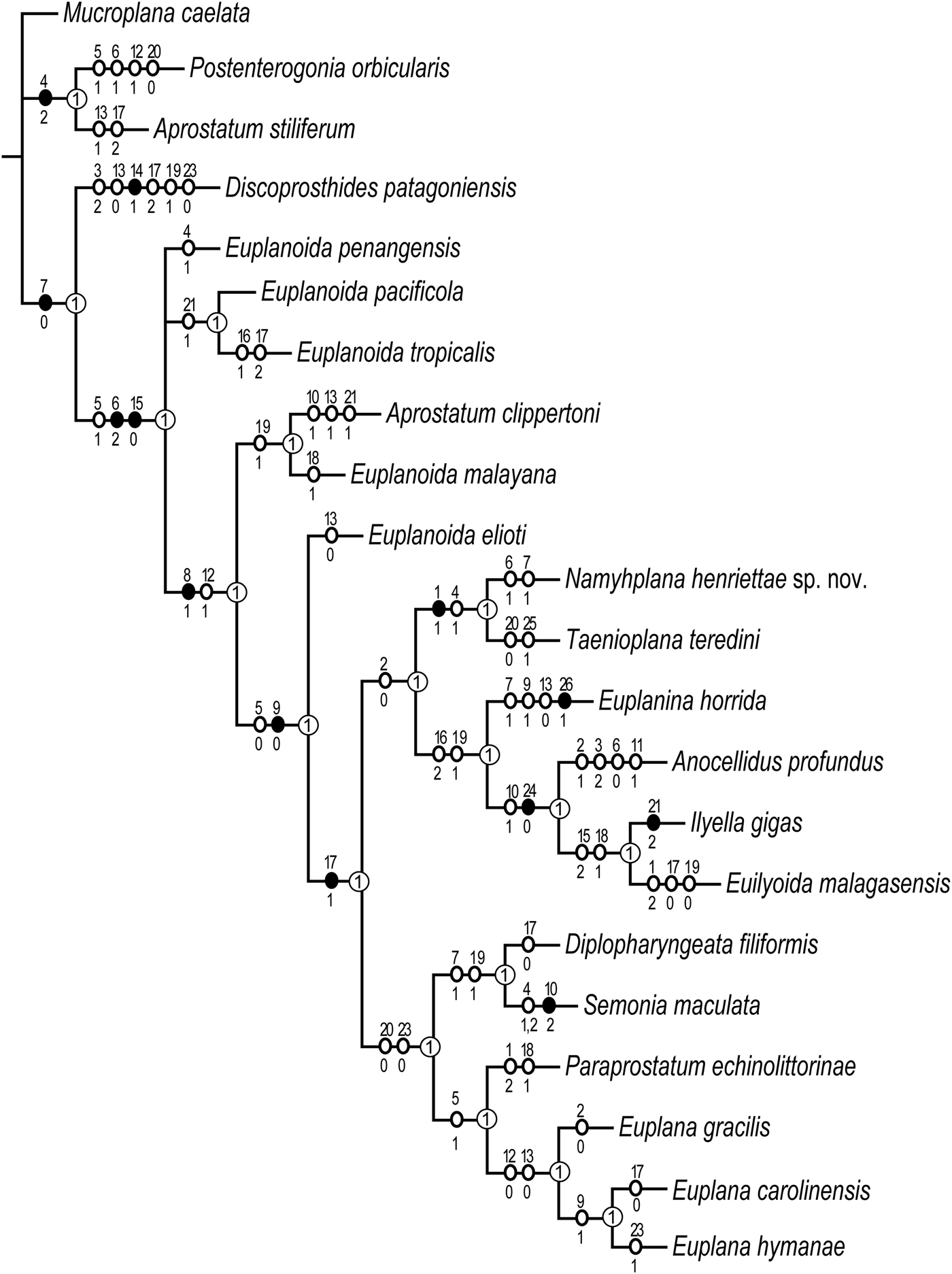
Parsimony analysis of the data matrix (Table 2) yielded one most parsimonious tree of length 88 (consistency index 0.41; retention index 0.53). Bremer support values are indicated on the nodes of the tree (Figure 9).
Most parsimonious tree inferred with phylogenetic analysis of the morphological dataset of Euplanidae species (length 88 steps, consistency index = 0.41; retention index = 0.53). Numbers indicate characters as listed in Table 1. Apomorphies are in black, and homoplasies in white. Bremer support values are indicated on nodes.
The phylogenetic analysis does not recover the family Euplanidae as a ‘natural’ group, since two Ilyplanidae species and Anocellis profundus (Anocellidae) are included in the Euplanidae ingroup. These species form a clade supported by the orientation of the uterine canals in relation to the position of the vagina (#24.0) and by a large distance between the genital pores (#10.1). Moreover, Aprostatum stiliferum is outside the family Euplanidae in the analysis because of the presence of a prostatic vesicle (#15.1 see data matrix), and peculiarities in the distribution pattern of eyes, especially the marginal ones (#4.2 and #6.0, see data matrix). The absence of prostatic structures (#15.0), the presence of cerebral eyes in two clusters (#6.2) and the presence of tentacular eyes (#5.1, homoplasic) support the other species of the family Euplanidae and three outgroup species.
Namyhplana henriettae sp. nov. is inferred as sister of Taenioplana teredini, sharing the mode of life (#1.1) and the particular disposition of the marginal eyes (#4.1). However, T. teredini lacks Lang's vesicle (#20.0), a character shared instead with other family members. Also, it possesses a genito-intestinal duct (#25.1), a character shared with one of the outgroup species, Mucroplana caelata.
The new species presents unarmed penis papilla, Lang's vesicle and pharynx in the anterior region of the body. Although these characters are shared with most of the species included in the genus Euplanoida Faubel, Reference Faubel1983, the new species is inferred as distantly related to Euplanoida. It remains unclear, whether Euplanoida is a monophyletic genus, since relationships among its species are unresolved in our analysis.
DISCUSSION
The study of polyclad flatworms living in tubes of the bivalve Bankia martensi from southern Chile allowed us to describe a new species of a new genus, Namyhplana henriettae. This species displays a unique combination of characters, mainly of the reproductive system, including the Lang's vesicle ventral to the intestine, absence of a genito-intestinal duct and presence of a large, unarmed penis papilla placed horizontally with the distal end directed forward. Despite this lost feature, the whole copulatory apparatus of N. henriettae is directed backwards, like in Taenisplana teredini. The absence of prostatic structures places N. henriettae in the family Euplanidae. To understand the relationships of the new species within this family we carried out phylogenetic analysis based on morphological data, the first analysis of this kind at the family level.
Results suggest that N. henriettae is sister to T. teredini. The two species are indeed highly similar based on the general (external and internal) morphology (Figure 9). Characteristics shared between the two species include the short band of eyes along the anterior margin, an anterior pharynx and the copulatory apparatus in the anterior half of the body. External morphological differences between the two species include the cerebral eyes, fewer in number in N. henriettae than T. teredini, and an unpigmented region in the epidermis at the level of the brain, where cerebral eyes are present, only in the new species. The most important internal morphological difference is the presence of Lang's vesicle in the new species, absent in Taenioplana. This is currently considered a diagnostic feature at the generic level (Faubel, Reference Faubel1983; Faubel et al., Reference Faubel, Sluys and Reid2007). Bock (Reference Bock1927) and Hyman (Reference Hyman1944) suggest a possible ‘homology’ among Lang's vesicle, the genito-intestinal duct and the vaginal duct. This hypothesis is supported by the residual products of the reproductive system, such as spermatozoids and yolk, found in Lang's vesicle of N. henriettae, and by the evaginations present in the intestine, touching Lang's vesicle.
Other differences between N. henriettae and its sister species, T. teredini, include the location of the pharynx, situated closer to the medial region of the body in the new species and smaller in size than in T. teredini. The penis papilla is large and placed horizontally with the distal end directed forward in N. henriettae, whereas it is small and placed dorso-ventrally in T. teredini. The ejaculatory extra-penial duct is straight in N. henriettae, whereas it is curled before entering the small penis papilla in T. teredini. The vagina of the new species is longer and more twisted than in T. teredini, and its distal portion has a posterior pocket with an epithelium of very long cilia, which is absent in T. teredini. The sphincter in the female gonopore of the new species is strong and more developed posteriorly, while it is absent in T. teredini.
When comparing the new species to other species within the family Euplanidae, N. henriettae shows similar characteristics to some species of Euplanoida (unarmed penis papilla and Lang's vesicle). In this context, the generic assignment of other Euplanoida species should be reviewed, since Euplanoida elioti lacks the unarmed penis papilla considered a diagnostic characteristic of the genus.
Several studies have contributed to increasing our understanding of the systematics of the family Euplanidae (Faubel, Reference Faubel1983, Reference Faubel1984; Prudhoe Reference Prudhoe1985; Doignon et al., Reference Doignon, Artois and Deheyn2003; Quiroga et al., Reference Quiroga, Bolaños and Litvaitis2006). Some of these authors (Doignon et al., Reference Doignon, Artois and Deheyn2003; Quiroga et al., Reference Quiroga, Bolaños and Litvaitis2006), and results from our phylogenetic analysis as well, do not support monophyly of the family and of its genera Aprostatum and Euplanoida. Comprehensive phylogenetic analyses using more detailed anatomical and molecular information are necessary to disentangle relationships of species currently ascribed to Euplanidae.
Namyhplana henriettae lives associated with the tubes that B. martensi makes in the wood of Nothofagus submerged in the fjords from southern Chile. This is similar to the habitat of T. teredini intimately associated with Teredo sp. in different parts of the world. The current wide distribution of T. teredini is probably due to the commercial transportation of the wood used by Teredo sp. between ports (Hoagland & Turner, Reference Hoagland and Turner1980; Carlton, Reference Carlton, Rilov and Crooks2009). Therefore, it is possible that the geographical distribution of N. henriettae will also expand in the future, and we advise monitoring of the possible introduction of this polyclad along with the transportation of the wood used by Bankia.
ACKNOWLEDGEMENTS
We thank Diego Zelaya (for the collection of the polyclads, the identification of Bankia martensi, and the information on the habitat where the specimens of Namyhplana henriettae were collected), the USNM and the Bishop Museum (for the loan of the type material of Taenioplana teredini) and the librarians of the Instituto Nacional de Desarrollo Pesquero (for the access to bibliographical material essential for this work).
FINANCIAL SUPPORT
This study was partially funded by Consejo Nacional de Investigaciones Científicas y Técnicas (CONICET) and Universidad Nacional de La Plata.