Introduction
Ghana, West Africa, has among the highest rates of forest destruction in the world (Hall and Swain, Reference Hall and Swain1981), mostly due to the clearing of forests for agriculture and from logging for timber. Only approximately 13% of original forest cover remains (Sayer et al., Reference Sayer, Harcourt and Collins1992; Poorter et al., Reference Poorter, Bongers, Kouamé and Hawthorne2004; although see Fairhead and Leach, Reference Fairhead, Leach and Verweij2002). This human transformation of what was originally an expansive and largely contiguous forested landscape has resulted in relatively small, isolated patches of remnant forest surrounded by anthropogenically derived farm bush savannah (Hall and Swain, Reference Hall and Swain1981).
Species populations in remnant forest patches are potentially isolated from other populations if individuals are unable or unwilling to disperse across the surrounding non-forest landscape matrix. Isolation of populations reduces effective population size and causes loss of genetic diversity due to genetic drift and inbreeding depression (Young et al., Reference Young, Boyle and Brown1996). Genetic diversity is essential for adaptive change, and its loss decreases evolutionary flexibility and can ultimately lead to species extinctions (Lande, Reference Lande1988; Primack, Reference Primack2004). Connectivity of patchy populations via dispersal of individuals and subsequent genetic exchange, or gene flow, serves to maintain genetic diversity and to counter factors that promote extinction of local populations. In Ghana, no substantial intact forest habitat exists outside gazetted reserves, but the shreds of riparian forests, overgrown cocoa groves and plantations, and numerous sacred forest groves scattered throughout the matrix may serve as dispersal stepping stones that help to connect spatially separated forest communities, particularly for species that experience farm bush savannah as relatively benign.
Determining which forest-associated species are resistant to the isolating effects of fragmentation due to dispersal among habitat patches is a formidable challenge. Mark-release-recapture studies are logistically prohibitive when fragments are separated by significant distance, and interpretation of dispersal estimates derived from genetic analyses is not straightforward (Bossart and Pashley-Prowell, Reference Bossart and Pashley-Prowell1998). Certainly though, lack of fidelity to the forest patch is a prerequisite for dispersal across landscapes. Species vary in their dependency on patch resources and their tolerance of habitat degradation and environmental conditions outside the forest. This variability is manifested as species-specific differences in willingness and ability to venture out of and away from a forest patch (Gascon et al., Reference Gascon, Lovejoy, Bierregaard, Malcolm, Stouffer, Vasconcelos, Laurance, Zimmerman, Tocher and Borges1999; Ricketts, Reference Ricketts2001; Horner-Devine et al., Reference Horner-Devine, Daily, Ehrlich and Boggs2003; Vandergast and Gillespie, Reference Vandergast and Gillespie2004). Species with stringent specificities to the particular environmental conditions of forests, even those that are relatively strong dispersers, will be less likely to occur in the surrounding non-forest matrix than species having more flexible tolerances (Klein, Reference Klein1989; Bender et al., Reference Bender, Contreas and Fahrig1998; Villard, Reference Villard1998; Kotze and Samways, Reference Kotze and Samways1999; Rosenblatt et al., Reference Rosenblatt, Heske, Nelson, Barber, Miller and MacAllister1999). Documentation of which forest species occur in the matrix thus gives a first approximation of those potentially dispersing across it.
Here, we quantify the community of fruit-feeding butterflies at the forest edge and in the farm bush savannah outside a forest reserve in Ghana. Out of the approximately 900 butterfly species known for Ghana, nearly 80% are centred on forest habitat and approximately one-third of these forest species are fruit feeders as adults (Larsen et al., Reference Larsen, Aduse-Poku, Boersma, Sáfián and Baker2007). The occurrence and distribution of fruit-feeding butterflies within forest fragments in Ghana have been investigated (Bossart et al., Reference Bossart, Opuni-Frimpong, Kuudaar, Nkrumah, Huber, Sinclair and Lampe2005, Reference Bossart, Opuni-Frimpong, Kuudaar and Nkrumah2006; Larsen et al. Reference Larsen, Aduse-Poku, Boersma, Sáfián and Baker2007; Bossart and Opuni-Frimpong, Reference Bossart and Opuni-Frimpong2009). However, virtually no systematic empirical data have been collected on which of these forest butterfly species are found in the non-forest matrix.
Materials and methods
Study location
The study was conducted at Bobiri Forest Reserve (hereafter, Bobiri forest), which is located in the moist semi-deciduous forest zone southeast of Kumasi, Ghana (6°41′N, 1°21′W). Bobiri forest is a managed reserve that covers approximately 5000 ha. Bobiri forest is also approximately 16 km distant from the next closest forest fragment, the 8 ha Bonwire sacred grove, and approximately 40 km distant from the next substantial expanse of forest, the 1200 ha Owabi Wildlife Sanctuary. Logging in Bobiri forest is regulated by the Ghana Forestry Commission and is prohibited within the area designated as the Bobiri Butterfly Sanctuary, an ecotourism site located within the southwestern portion of the forest.
Trap samples
We used standard fruit-baited traps to survey the fruit-feeding butterflies occurring in the savannah matrix bounding the southwest perimeter of Bobiri forest, which includes the Bobiri Butterfly Sanctuary. Five 50 m forest edge to savannah transects were established along an approximately 2 km section of forest. Transects were set by walking perpendicular from the forest edge into the savannah matrix using a compass to set direction and a metre tape to determine distance. Traps were hung approximately 10 cm from the ground at the forest-savannah edge and at 12 and 50 m distant from the edge for a total of 15 traps (three per transect). The two matrix distances were incorporated to test whether species differed in the extent to which they would move into the matrix. Edge traps were hung on understory trees; matrix traps were hung on steel rebar rods bent at a 90° angle and driven into the soil. For ease of reference and discussion, trap locations will hereafter be referred to as Elbers-edge (E-edge), near matrix and far matrix habitats, respectively. Transects were established in areas having similar forest canopy cover and matrix habitat and separated from each other by at least 400 m. Sampling occurred between 13 June and 12 July 2007, and included 14 total sampling bouts. Each sampling bout consisted of baiting traps with a mixture of fermenting banana and palm wine and retrieving collections approximately 24 h later.
To increase the interpretive context of the current study, these data were compared with forest trap data collected by Bossart from the same area of Bobiri forest between 2005 and 2006. In this earlier study, paired traps were hung approximately 15 cm above the forest floor at the forest edge (hereafter Bossart-edge (B-edge)) and 80 m from the edge in the forest interior (hereafter Bossart-forest (B-forest)). Trap pairs were established at two locations separated by nearly 2 km for a total of four traps and were sampled approximately every 3 weeks for a total of 14 sampling bouts. Comprehensive analysis and discussion of the fruit-feeding butterfly community within Bobiri forest have been published elsewhere (Bossart et al., Reference Bossart, Opuni-Frimpong, Kuudaar, Nkrumah, Huber, Sinclair and Lampe2005, Reference Bossart, Opuni-Frimpong, Kuudaar and Nkrumah2006; Bossart and Opuni-Frimpong, Reference Bossart and Opuni-Frimpong2009).
Collected specimens were identified using Larsen (Reference Larsen2005). The vast majority of Ghana's butterflies can easily be identified based on wing colour patterns and wing morphology. The few difficult specimens were identified with assistance from Dr John Rawlins, Associate Curator, Section of Invertebrate Zoology, Carnegie Museum of Natural History, USA.
Data analysis
Community diversity of each habitat, i.e. edge, forest, and near and far matrix, was analysed utilizing both univariate (rarefied species accumulation curves and Simpson's index of diversity) and multivariate (non-metric multidimensional scaling ordination (NMDS)) methods. Rarefaction curves and 95% confidence intervals were constructed to standardize sample size across habitats being compared and were generated using EcoSim 7.00 (Gotelli and Entsminger, Reference Gotelli and Entsminger2003). Simpson's index, which gives the most robust measure of overall community heterogeneity (Magurran, Reference Magurran2003), was computed using EstimateS 7.5 (Colwell, Reference Colwell2005). Trap data for each habitat were pooled across sampling bouts prior to analysis.
NMDS, which is considered the best ordination analysis for multivariate data (McCune and Grace, Reference McCune and Grace2002), reduces lists of species and their abundances into a single measure of dissimilarity between all pairs of samples. An iterative procedure then optimizes the arrangement of samples in multidimensional space such that rank order among sample dissimilarity is preserved in the rank order of spatial distances. The NMDS analysis was conducted using CAP 3.11 (Pisces Conservation Ltd, 2005). Raw data were square root transformed prior to calculation of the initial Bray–Curtis dissimilarity matrix. The program was run for 200 iterations using a randomly calculated initial starting point.
To quantify the relative fidelity of forest species to forest habitat, we calculated the percentage occurrence of each species in each habitat. We restricted the analysis to those species represented by at least five individuals in order to have confidence in percentages obtained (Appendix 1). Habitat occurrence data were then compared with Larsen et al.'s (Reference Larsen, Aduse-Poku, Boersma, Sáfián and Baker2007) independently determined habitat association categories, which were compiled over a decade of collecting in preparation for the book, The Butterflies of West Africa (Larsen, 2005). Species are characterized as wet forest (WEF), moist forest (MEF), dry forest (DRF), all forests (ALF), Guinea savannah (GUI), Sudan savannah (SUD) or ubiquitous (UBQ) species, based on their distribution and abundance in these habitats. We predicted that the forest species with the lowest fidelity to Bobiri's moist forest habitat and therefore most likely to occur in the savannah matrix would be those associated with dry forests or all forest types, given their presumed higher tolerance of drier, more open environments. We conversely expected those species with the highest fidelity to moist forest habitat and least likely to occur in the matrix would be those known to be centred on moist or wet forest subtypes.
Results
Community diversity analysis
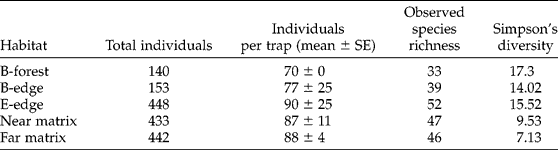
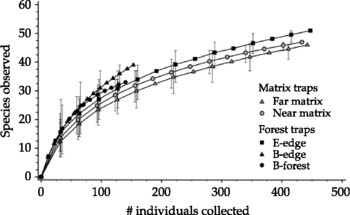
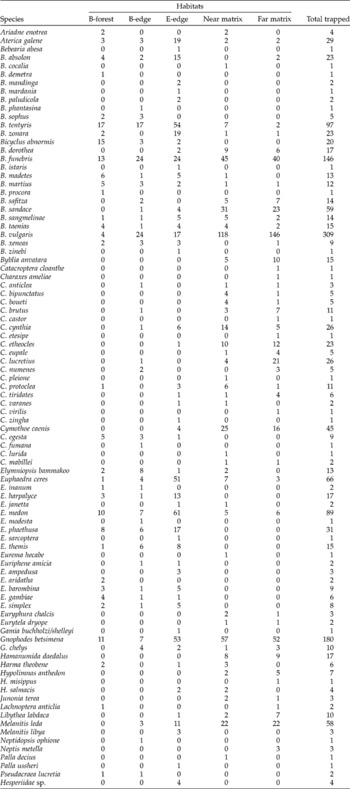
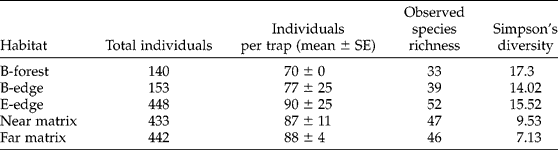
A total of 1616 individuals was collected from the 19 traps, representing 90 species (Appendix 1). The number of species trapped from each habitat area ranged from a low of 33 at B-forest to a high of 52 at E-edge (Table 1). However, species accumulation curves were still rising in all cases, indicating that species saturation had not been reached and more species would have been collected had sampling continued (Fig. 1). Only the B-forest sample showed a rate of accumulation that seemed to be slowing. Rarefied species richness, which controls for sample size differences, was comparable across habitats at nearly all sub-sample sizes. The total 40 species collected from B-edge, however, exceeded the rarefied estimates and their 95% confidence intervals for the other four habitats. Also, significantly more species were collected from E-edge at the largest sub-sample size relative to the number collected from either of the matrix habitat sites (Fig. 1). Simpson's index of diversity, which integrates both the number of species and their relative abundances, was lower by 40% or more for samples collected from the matrix traps relative to those collected from edge or forest traps (Table 1).
Summary trap collection data
Individual-based rarefied species accumulation curves for fruit-feeding butterflies in four surveyed habitats.

Ordination analysis
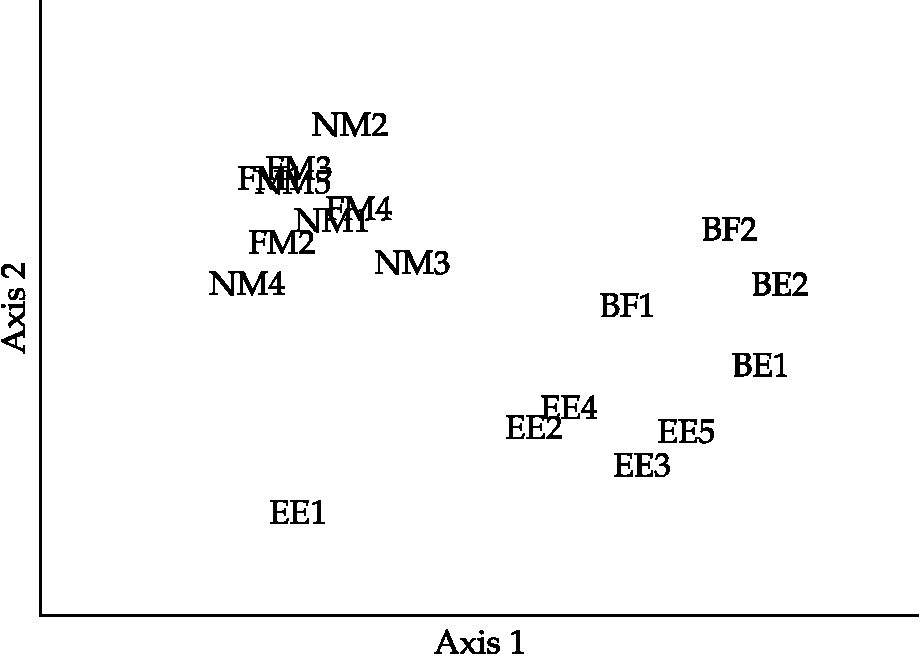
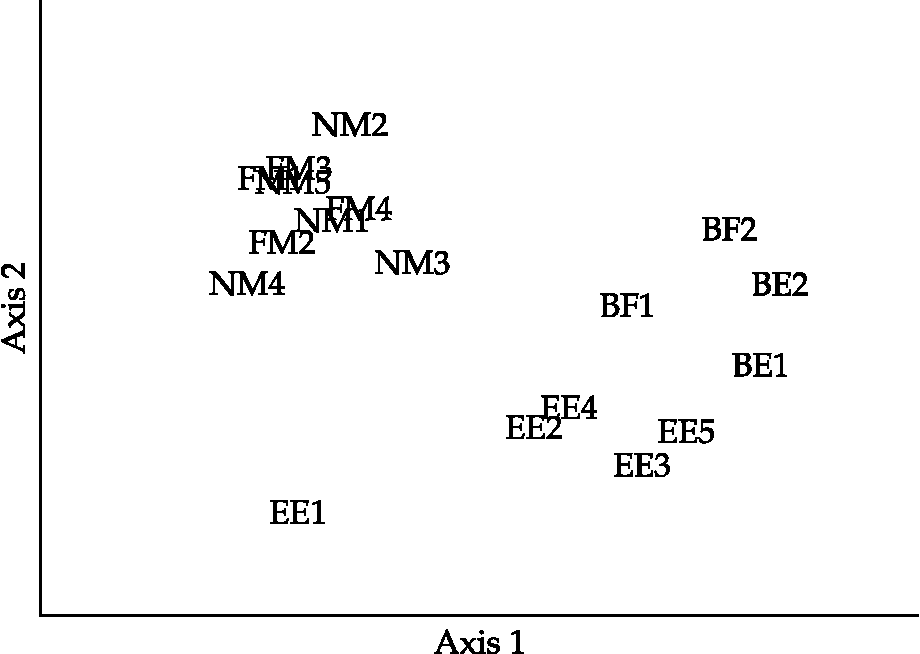
The NMDS analysis produced two distinct groups (Fig. 2). The first group consisted of all the matrix trap collections, regardless of whether traps were 12 or 50 m distant from the forest edge. The second group consisted of all the forest trap collections, regardless of whether traps were located on the forest edge or in the forest interior. Trap EE1 clustered with neither of the groups (Fig. 2). Separation of this trap community from the rest is undoubtedly due to the low number of butterflies collected (n = 24) relative to that collected from all other traps (85 ± 6.5, mean ± SE).
Non-metric multidimensional scaling ordination of trap collections of fruit-feeding butterflies. Trap collections that are closer together are more similar to each other and vice versa. Points indicate trap locations coded by habitat (first and second positions: BE, Bossart-edge; BF, Bossart-forest; EE, Elbers-edge; NM, near matrix; FM, far matrix;) and trap number (third position: BE and BF have only two traps each, all others have five).
Habitat occurrence
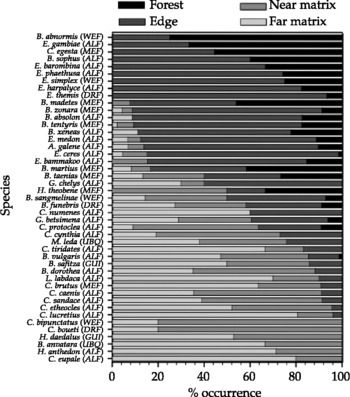
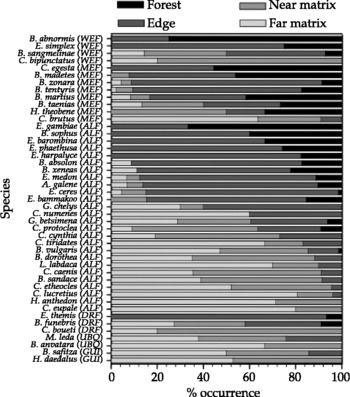
Out of the 90 total butterfly species collected, 45 were represented by at least five individuals and could be quantified for relative habitat occurrences (Fig. 3). Out of these 45 species, 15 were trapped in a single broad habitat type; nine were trapped only in the forest (edge and interior combined) and six were trapped only in the matrix (far and near combined). Two-thirds of the species (30 out of 45) occurred in both matrix and forest habitats, although 78% were predominately trapped ( ≥ 80% occurrence) in one or the other of these habitats.
Percentage occurrence of 45 fruit-feeding butterfly species in four habitat types. Species are ordered with respect to their increasing occurrence in the matrix (near and far combined). Species trapped only in forest are additionally ordered with respect to their increasing occurrence in edge habitat; similarly, species trapped only in matrix are additionally ordered with respect to their increasing occurrence in far matrix. See Appendix 1 for full names of genera.

Only 2 out of the 45 species are GUI specialists (Bicyclus safitza Westwood and Hamanumida daedalus Fabricius (Nymphalidae)), and two others are considered UBQ (Melanitis leda Linnaeus and Byblia anvatara Aurivillius (Nymphalidae) Larsen et al. Reference Larsen, Aduse-Poku, Boersma, Sáfián and Baker2007). The remaining 41 are forest-associated species. Out of these, 63% (26 out of 41) are forest generalists and found in all forest subtypes. The other 37% are forest habitat specialists; 7% (3 out of 41) are predominately associated with dry forests and 29% (12 out of 41) are centred on wet or moist forests. No SUD species were collected, which was expected since this habitat is found only in the far north of the country, well outside the forest zone where the study was conducted.
There was no linkage between the habitat occurrences of species, i.e. where they were trapped, and their predetermined habitat associations (Fig. 4). Strong association would be apparent as an overall progressive decrease in dark to light shading moving from top to bottom on the graph, indicating a decreasing occurrence in forest habitat traps by species that have an increasingly loose association with wetter forests. However, out of the 41 forest species trapped, WEF or MEF species accounted for only a slightly higher percentage of those collected predominately in forest habitat versus those commonly trapped in the matrix (37 vs. 23%), and this difference was not statistically significant (χ2 = 0.97; P = 0.32). Additionally, the 26 forest generalists that were trapped spanned the spectrum of relative habitat occurrences, from those trapped only in the forest to those trapped only in the matrix. DRF species were expected to have high tolerance of the drier conditions outside the forest, but the very common DRF species, Euphaedra themis Hübner (Nymphalidae), was never trapped in the matrix.
Correspondence between the habitat associations of 45 fruit-feeding butterfly species and their percentage occurrence in four habitat types. Species are ordered with respect to their increasingly loose association with wetter forests and following the relationship predicted a priori for their presumed fidelity to moist forest habitat: WEF, wet forest species; MEF, moist forest species; ALF, species found in all forest subtypes; DRF, dry forest species; UBQ, ubiquitous species; and GUI, guinea savannah species. Habitat associations follow Larsen et al. (Reference Larsen, Aduse-Poku, Boersma, Sáfián and Baker2007). Within each habitat association category, species found only in forest are additionally ordered with respect to their increasing occurrence in edge habitat; similarly, species found only in matrix are additionally ordered with respect to their increasing occurrence in far matrix. See Appendix 1 for full names of genera.

Discussion
Fruit-feeding butterfly communities trapped in forest habitats were distinct from those trapped in the surrounding farm bush savannah. Since rarefied species richness was broadly similar across habitats, these differences mostly reflect differences in species composition within communities and relative abundances of shared species. Studies of beetles (Spector and Ayzama, Reference Spector and Ayzama2003), spiders (Vandergast and Gillespie, Reference Vandergast and Gillespie2004) and mammals (Bentley et al., Reference Bentley, Catterall and Smith2000) have also reported differences in diversity between forest and matrix communities. Kotze and Samways (Reference Kotze and Samways1999) found that Afromontane forests harboured communities of carabids and ants that were distinct from those of the surrounding grassland matrix, but also determined that edge communities of ants shared greater similarity with grassland communities than with forest communities. In our case, edge communities of butterflies were most similar to those deeper in the forest versus those outside the forest, but only a few genuine savannah-dwelling species are attracted to fruit-baited traps (indeed, we only collected 2 of 82 possible), and our trap captures were almost entirely forest species. Consequently, differences we observed between matrix and forest communities mostly reflect which forest-dwelling species were willing to leave the forest versus those that were not. Had we not focused only on the fruit feeders, relative distinctions among communities trapped in the matrix, edge or forest may have differed from those observed here. Edge and matrix collections, for example, might have been more closely aligned. Horner-Devine et al. (Reference Horner-Devine, Daily, Ehrlich and Boggs2003), however, found very similar patterns between fruit feeders and non-fruit feeders. That there were additionally no differences among trap communities within each of these broader habitat types, e.g. trap communities at 12 m were not different from those at 50 m, implies that (1) butterflies leaving the forest are just as likely to move 50 m into the matrix as 12 m, and (2) edge habitat is generally perceived as forest by fruit-feeding butterflies at the distances investigated here.
Ten species showed very high fidelity to forest habitat ( < 20% occurrence in the matrix) and only another nine showed strict fidelity, i.e. were never found in the matrix. This is good news from a conservation perspective. Given that movement out of the forest is a necessary first step for dispersal across the matrix, the fact that more than half of the forest-associated butterflies collected were commonly trapped in the matrix suggests that many of these have at least the potential to be resistant to forest fragmentation and land use change. A matrix that is a mixed mosaic of land cover and land use types can have significant conservation value to the extent it presents a relatively benign environment, promotes connection among populations in separate habitat patches and supplements or provides needed resources (Gascon et al., Reference Gascon, Lovejoy, Bierregaard, Malcolm, Stouffer, Vasconcelos, Laurance, Zimmerman, Tocher and Borges1999; Ricketts et al., Reference Ricketts, Daily, Ehrlich and Fay2001; Daily et al., Reference Daily, Ceballos, Pacheco, Suzán and Sánchez-Azofeifa2003; Dennis et al., Reference Dennis, Shreeve and van Dyck2003; Horner-Devine et al., Reference Horner-Devine, Daily, Ehrlich and Boggs2003; Marín et al., Reference Marín, León-Cortés and Stefanescu2008; Perfecto and Vandermeer, Reference Perfecto and Vandermeer2008). Which, if any, of the species we trapped in the matrix had literally moved out of Bobiri forest as opposed to dispersing from elsewhere within the matrix is unknown. However, only that subset of species that consists of strong dispersers or that does not have an obligate association with forest resources would ultimately be expected to successfully disperse away from a forest fragment, whether it is Bobiri forest or another. Physically, the Charaxes Ochsenheimer (Nymphalidae) are the most likely candidates capable of movement between fragments because they are large, robust-bodied and strong fliers. Bossart et al. (Reference Bossart, Opuni-Frimpong, Kuudaar and Nkrumah2006) often trapped these large butterflies in small, isolated, sacred forest groves even though these communities were overall much smaller and less diverse than those in forest reserves. Possibly, viable populations of these large butterflies reside and persist in these small patches. Alternatively, individuals may be dispersing across the landscape mosaic and passing through or recolonizing these forest remnants. Interestingly, not a single Charaxes was captured in the edge or forest traps during the current study. Their prevalence in these matrix traps combined with their presence in forest canopy traps (J.L. Bossart, unpublished data) suggests that this group exhibits positive phototaxis and preferentially fly into the canopy upon reaching the boundary of large intact forests.
Nearly one-quarter of Ghana's forest butterfly species are habitat generalists found in all forest subtypes, but the other 75% tend to be specialists of either wet, moist or dry forest habitat (Larsen et al., Reference Larsen, Aduse-Poku, Boersma, Sáfián and Baker2007). Although overlap of species among these ecological zones occurs, this overlap is largely in one direction. Species specialized on dry forest habitat are not uncommonly found in wetter forests in areas that are somewhat degraded or more open, but species associated with increasingly wet forests are much less rarely, if ever, found in dry forests. In light of this general pattern of habitat affinities, we expected that species centred on wet and moist forests would mostly be absent from the matrix and, conversely, that most ALF or DRF species would commonly be trapped in the matrix. Farm bush savannah intuitively seems more comparable to the environment of dry forests than to that of moist or wet forests. Generalists also by definition have a wider tolerance range and would presumably experience the landscape outside the forest as a less formidable challenge and may even rely in part on resources in the matrix. In fact, generalists are often considered less susceptible to extinction in human-dominated environments specifically because of their broader tolerances (Rabinowitz, Reference Rabinowitz and Synge1981) and correlated broader distributions. However, contrary to our prediction, only 3 out of the 12 species associated with wetter forests were not trapped in the matrix; 5 out of the 12 were commonly trapped in the matrix. Perhaps more surprising, nearly half of the species that exhibited strong or complete fidelity to the forest were forest habitat generalists, and in one case, a dry forest specialist. The specific factors that account for the relaxed fidelity of forest species to forest habitat are unknown, but could include the lack of a behavioural aversion to heat, light, or decreased humidity or enhanced access to adult or larval resources located outside the forest (Dennis et al., Reference Dennis, Shreeve and van Dyck2003; Fermon et al., Reference Fermon, Waltert and Mühlenber2003). Additionally, at this point, we do not know how relative habitat fidelities are modified by seasonality or manifest in different taxonomic groups. Our matrix sampling occurred only during the wet season. In theory, species' fidelities could change temporally if patterns of resource distribution and availability between forest and matrix change across wet and dry seasons. Similarly, we focused only on the fruit-feeding butterflies. The percentages of species with stringent versus relaxed fidelity to forest habitats in lineages with markedly different resource requirements, e.g. ant-associated lycaenids, could differ from those we observed. Regardless of the factors responsible and how these pan out seasonally and across taxonomic groups, responses will undoubtedly be species specific and modified by the relative hostility of the surrounding landscape. The current study represents an important but only a first step towards determining which forest-associated butterflies are resistant to forest fragmentation.
Conclusions
Our traps collected 45 fruit-feeding butterflies that could be quantified with respect to their habitat occurrence. Because the vast majority of these were forest-associated species, differences between forest and matrix communities identified which species were more versus less tightly linked to forest habitat. Slightly more than half of the forest species trapped were commonly collected in the matrix and therefore potentially able to move across the landscape. An unexpected result was the lack of any link between the known habitat affinities of species and their relative occurrence in forest versus matrix habitat. Species of wetter forests were no less likely to be trapped in the matrix than forest generalists or DRF species; conversely, some of the species most tightly linked to the forest were forest generalists or DRF species.
Acknowledgements
We wish to acknowledge the staff of the Bobiri Butterfly Sanctuary for their help and for making our stay an enjoyable and delightful experience. John Rawlins and his staff at Carnegie Museum of Natural History assisted with identification of difficult specimens. This research was supported by grants to J.L.B. from the National Science Foundation.
Total specimens collected in traps in each habitat