

1. INTRODUCTION
In a previous paper,Footnote 1 we presented two writings by Ibn ʿIrāq in which this author discusses, comments on and proves Proposition III.5 of Menelaus' Spherics.Footnote 2 Indeed, the Arabic mathematicians since the beginning of the 10th century were not satisfied by the proof that Menelaus gave of that proposition. In fact, Menelaus rather gave a sketch of the proof, and several of the Arabic mathematicians worked out on the details of the proof. We noted in the same paper the role of Ibn ʿIrāq and of his contemporaries (in particular, Abū al-Wafāʾ al-Būzjānī, al-Khujandī and Kushyār ibn Labbān) in the renewal of the field of spherical geometry which was accompanied by the withdrawal of the notion of the chord of the double of an arc and the introduction of the notion of sine. We also recalled that Ibn ʿIrāq was the first to prove the law of sines and to introduce the concept of polar triangle and that he took advantage of these new concepts in the proof he gave of Proposition III.5. Moreover, it seems that it is for the sake of that proposition that he invented the notion of polar triangle. We also noted the use of a spherical cross ratio, a composition of four ratios of sines of distances and the use of its invariance under (what is called today) projectivities, in one of the propositions that Ibn ʿIrāq established in the course of his proof of Proposition III.5.
Several successors of Ibn ʿIrāq took over his work. In this paper we present the commentaries of two of them on the same proposition, namely, Naṣīr al-Dīn al-Ṭūsī and Ibn Abī Jarrāda, the former consolidating some details in the proof, and the latter including the result in a historical perspective.
Naṣīr al-Dīn al-Ṭūsī (1201–1274) had access to several versions of Menelaus' Spherics that were edited by his predecessors, including al-Māhānī, al-Harawī and Ibn ʿIrāq. In the preface to his edition of the Spherics, al-Ṭūsī writes:
I wanted to write books of an intermediate type, I mean books that may stand in the teaching curriculum at an intermediate place between Euclid's Elements and Ptolemy's Almagest. And as I came over the book of Menelaus on the spherics, I found several copies of it with problems that were not solved and including several rectifications like those of al-Māhānī and of Abū al-Faḍl Aḥmad Ibn Abū Saʿd al-Harawī and others, some of them not complete and some of them not correct. I remained puzzled for several years while I was clearing up some of the problems of the book, until I found the rectification by the Emir Abū Naṣr Manṣūr ibn ʿAlī ibn ʿIrāq, may God have mercy on him, and what I expected became clear to me. I then wrote the book using all my possibilities [...].Footnote 3
Thus, for the proof of proposition III.5 and the other propositions leading to it, Naṣīr al-Dīn al-Ṭūsī followed the approach of Ibn ʿIrāq and the new tools of spherical geometry invented in the 10th century, quoting him frequently, borrowing from him lemmas and propositions.
The purpose of Ibn Abī Jarrāda is slightly different from that of al-Ṭūsī. Ibn Abī Jarrāda (13th century) also worked on an edition of Menelaus’ Spherics, but he wanted it to be very close to the original. Instead of using the sine function, like Ibn ʿIrāq and al-Ṭūsī did, he employed the notion of the chord of the double of an arc, which was originally used by Menelaus, but in compliance with the approach of Ibn ʿIrāq, for what concerns the plan of the proof. The approach of Ibn Abī Jarrāda is also the one of a historian, and for this reason his edition contains historical remarks. He also brought some improvements and generalizations to Menelaus' result which are not contained in the papers by his predecessors.
2. MATHEMATICAL COMMENTARY
2.1. The Text of Naṣīr al-Dīn al-Ṭūsī from his Edition of Menelaus' Spherics
In this treatise, Naṣīr al-Dīn al-Ṭūsī reports on two sketches of proofs of Menelaus' Proposition III.5 that he found in two different Arabic translations. Then, he presents the proofs of a few lemmas that are useful to complete the proof of this proposition. The first of these lemmas is the famous spherical Sine Rule. The proof he gives uses the Sector Figure Theorem, and it is in the spirit of the proof by Ibn ʿIrāq that we presented in the introduction of our previous paper. Al-Ṭūsī then indicates how one can use these results to complete the proof of Proposition III.5. He mentions attempts of proofs by al-Māhānī and by al-Harawī, which were both unsuccessful and which use solid Euclidean geometry (that is, they deal with intersections of planes with the sphere).
Menelaus' result and the sketch of the proof is presented by al-Ṭūsī as follows.
Proposition
(Menelaus, Book III, Proposition 5). — Consider two spherical triangles ABC and DEG with two right angles BAC and EDG and two equal angles ACB and DGE, each of them smaller than a right angle, and assume that each of the sides AC and DG is smaller than a quarter of a circle. Then, we have
 $$\displaystyle{{\sin\left( {{\rm AC} + {\rm CB}} \right)} \over {\sin\left( {{\rm BC} - {\rm AC}} \right)}} = \displaystyle{{\sin\left( {{\rm DG} + {\rm GE}} \right)} \over {\sin\left( {{\rm EG} - {\rm DG}} \right)}}.$$
One should note that since CA is smaller than a quarter of a circle, and CA is perpendicular to AB, then the arc CA is the shortest arc from C to the great circle AB, therefore CA < CB. Thus, the term BC – AC in the denominator is positive. Likewise, the term EG – DG is also positive.
Al-Ṭūsī gives two outlines of proofs that he found in the two different texts.
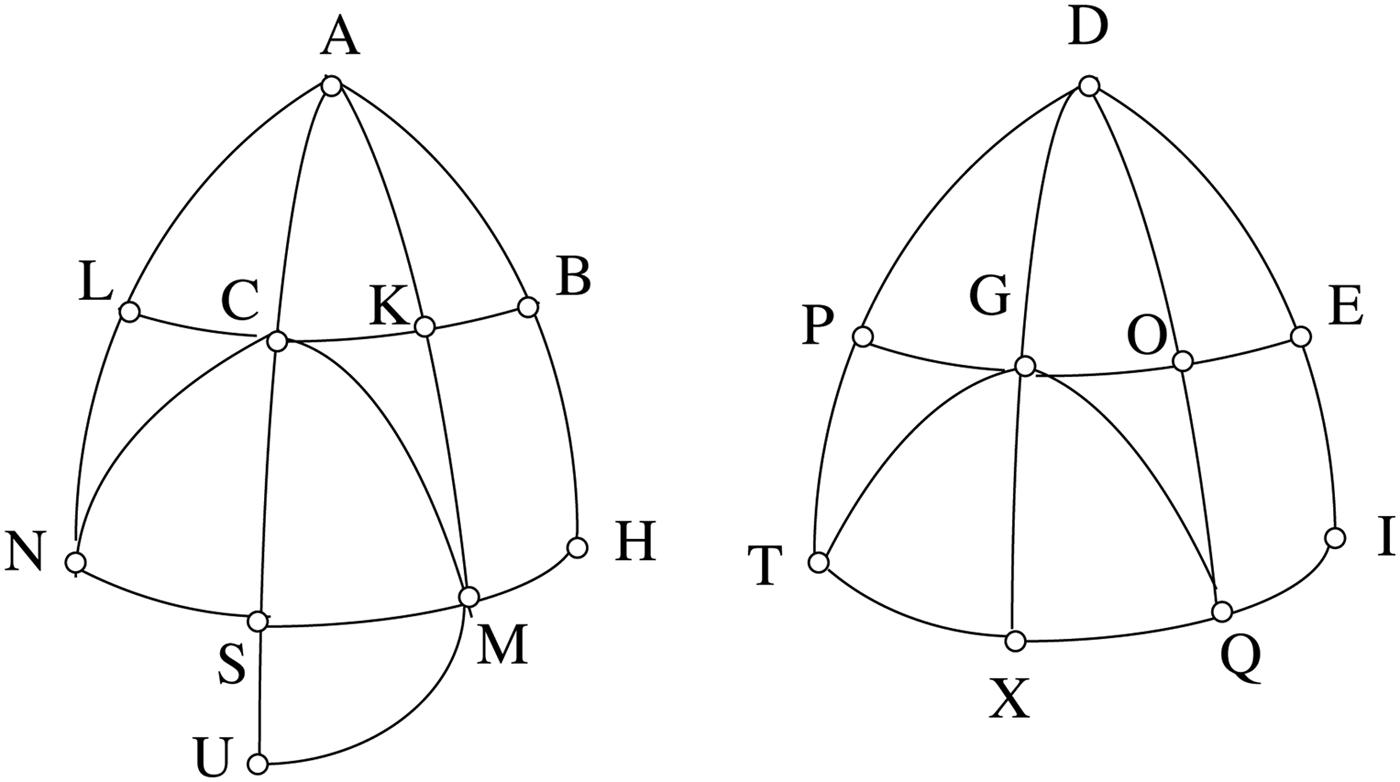
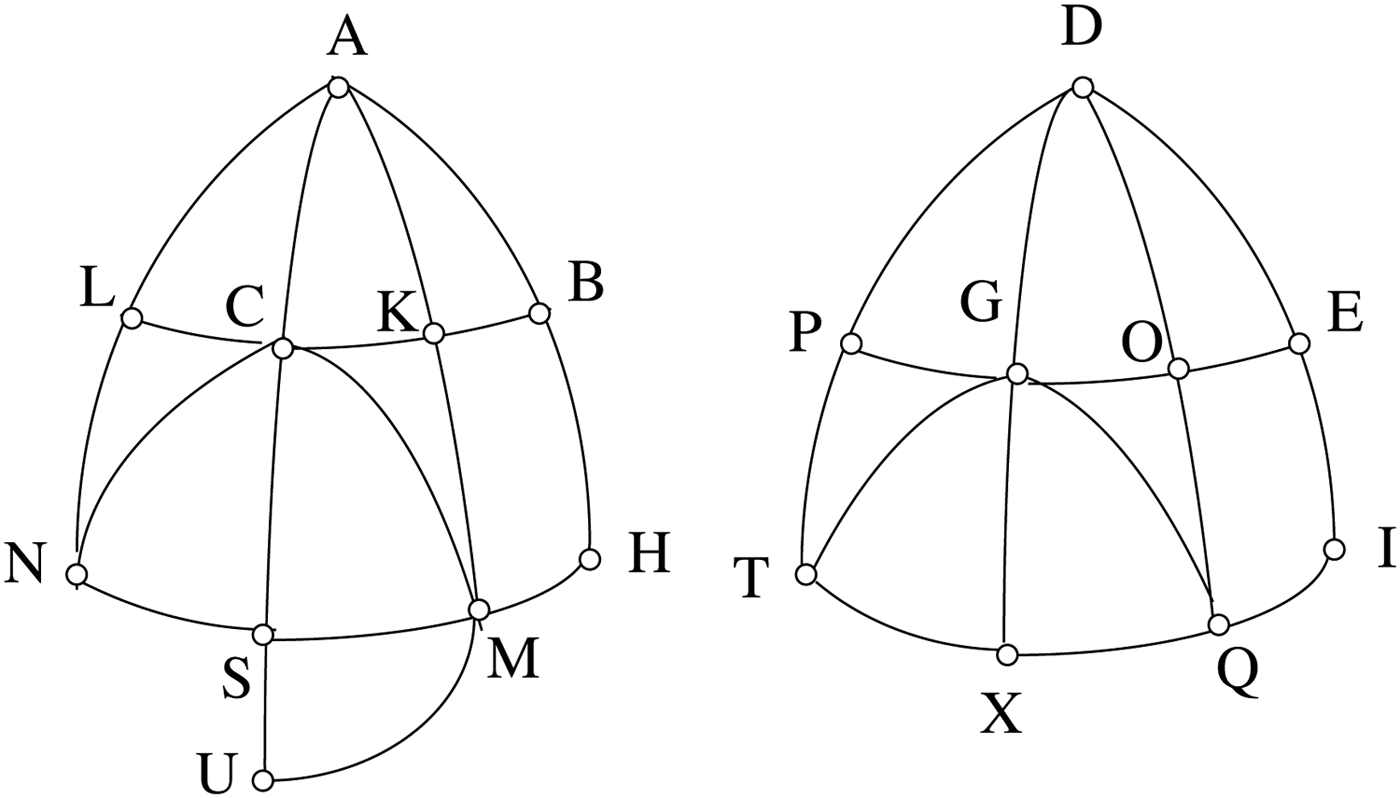
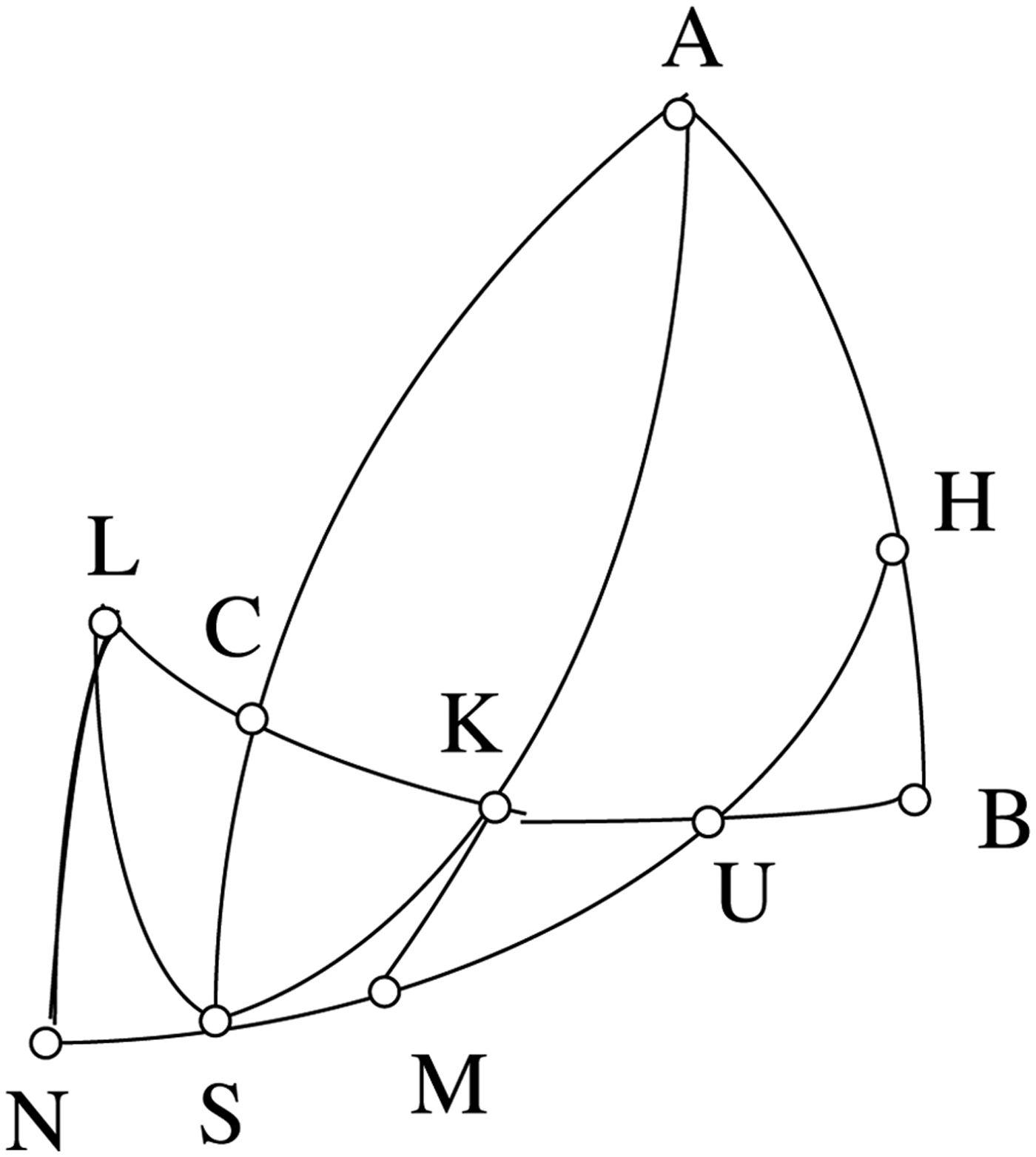
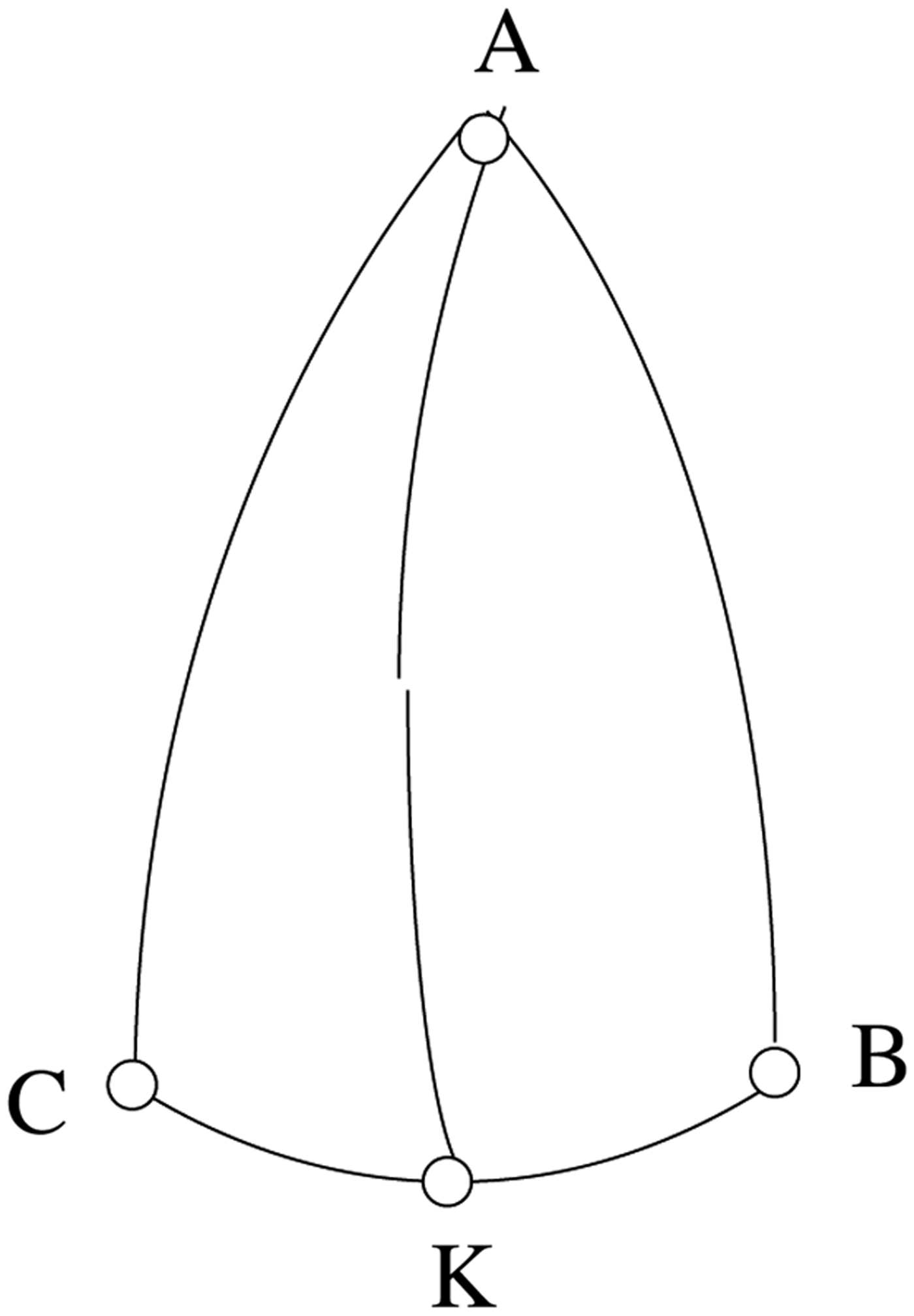
Proof 1. We refer to Figure 1. We produce the great circle arc BC and we make CL = CA = CK. We draw with C as a pole an arc of great circle and we extend the great circle arcs AB, AK, AC, AL until the points H, M, S, N on this arc. We also join CM and CN. The last two arcs divide in two halves the angles KCS and LCS.Footnote 4 We do the same construction in the triangle DEG. Since HAS and HSA are right angles, H is a pole of the great circle ACS and HS is a quarter of a circle. Likewise I is a pole to the great circle DGX and IX is a quarter of a circle.
Fig. 1.

Since the angles KCS and LCS add up to two right angles and since the angle MCN is half of this sum, then MCN is a right angle and the same holds for the angle QGT.
Since C is a pole of HN, then the angle CNM is also right, therefore M is a pole of CN. Also Q is a pole of GT. Then each of the great circle arcs HS, MN, IX, QT is a quarter of a circle, HM = SN and we have IQ = XT. Since the angles LCS and PGX are equal, then the halves of these angles are also equal, which implies that the arcs NS and TX are equal. Likewise, MS = QX and HM = IQ. From this we deduce:Footnote 5
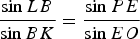 $${\sin LB \over \sin BK} = {\sin PE \over \sin EO}$$
which means that
 $$\displaystyle{{\sin\left({BC + CA} \right)} \over {\sin\left({BC - CA} \right)}} = \displaystyle{{\sin\left({EG + GD} \right)} \over {\sin\left({EG - GD} \right)}},$$
which had to be proved.
Proof 2. As before, we produce from the point A to the two great circle arcs BCL and HSN the arcs of great circle AH, AM, AS, AN. Then, using the fact that LC = CK, we have
 $$\displaystyle{{\sin LB} \over {\sin BK}} = \displaystyle{{\sin LB} \over {\sin LC}} \cdot \displaystyle{{\sin LC} \over {\sin CK}} \cdot \displaystyle{{\sin CK} \over {\sin KB}} = \displaystyle{{\sin LB} \over {\sin LC}} \cdot \displaystyle{{\sin CK} \over {\sin KB}}.$$
We obtain:Footnote 6
 $$\displaystyle{{\sin LB} \over {\sin BK}} = \displaystyle{{\sin NH} \over {\sin NS}} \cdot \displaystyle{{\sin MS} \over {\sin MH}}.$$
Likewise, in Figure 1 (right hand side), we have:
 $$\displaystyle{{\sin PE} \over {\sin EO}} = \displaystyle{{\sin IT} \over {\sin TX}} \cdot \displaystyle{{\sin QX} \over {\sin IQ}}.$$
We already saw that the arcs HM, MS, SN are equal to the arcs IQ, QX, XT respectively, therefore
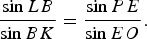 $$\displaystyle{{\sin LB} \over {\sin BK}} = \displaystyle{{\sin PE} \over {\sin EO}}.$$
This is what we wanted.
After these outlines, al-Ṭūsī proves the following that are needed in the proof.
Proposition 2.1
(Sine rule). — In a spherical triangle, the ratio of the sine of any side to the sine of another side is equal to the ratio of the sine of the angle that the first side intercepts to the sine of the angle that the second side intercepts.
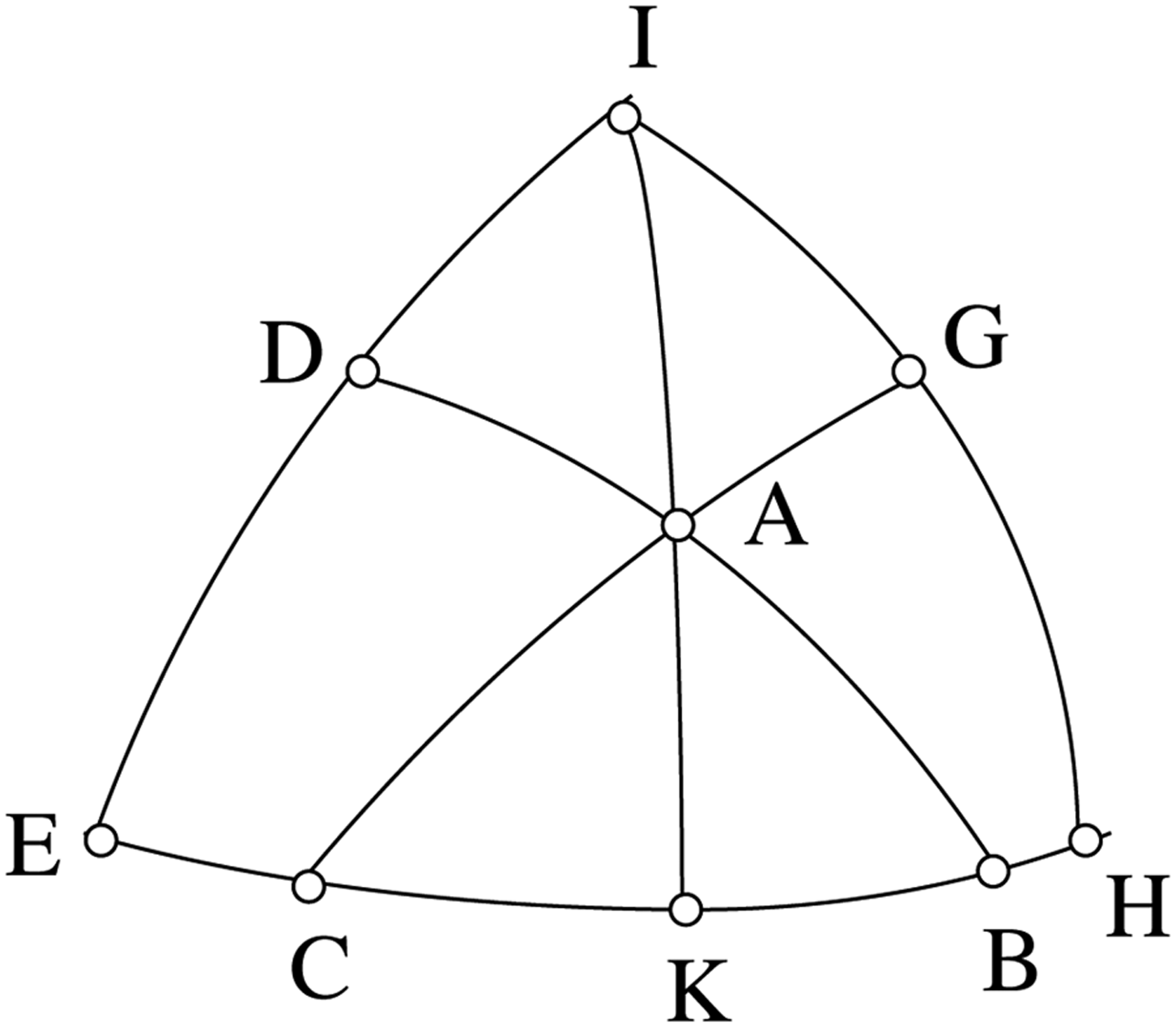
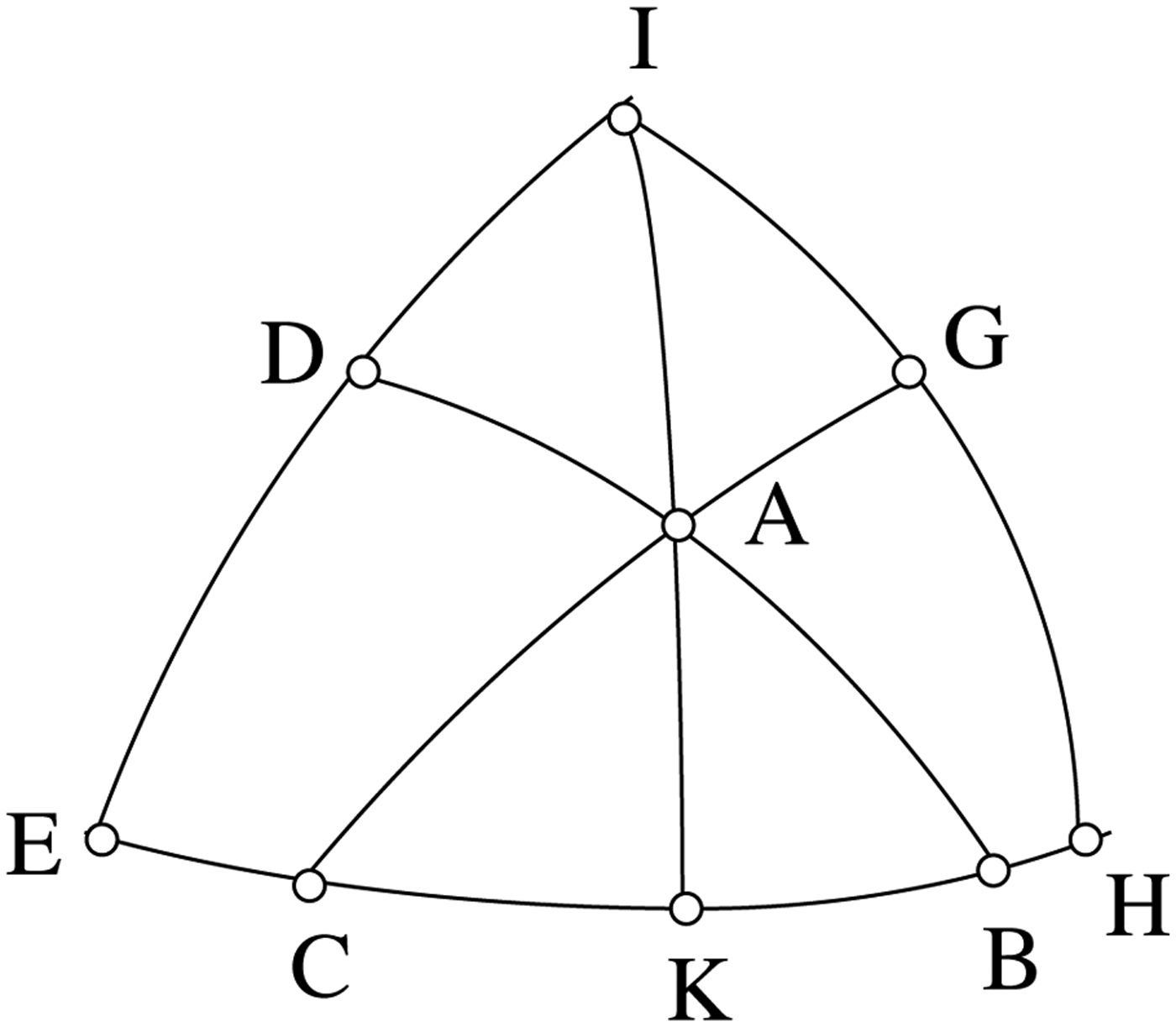
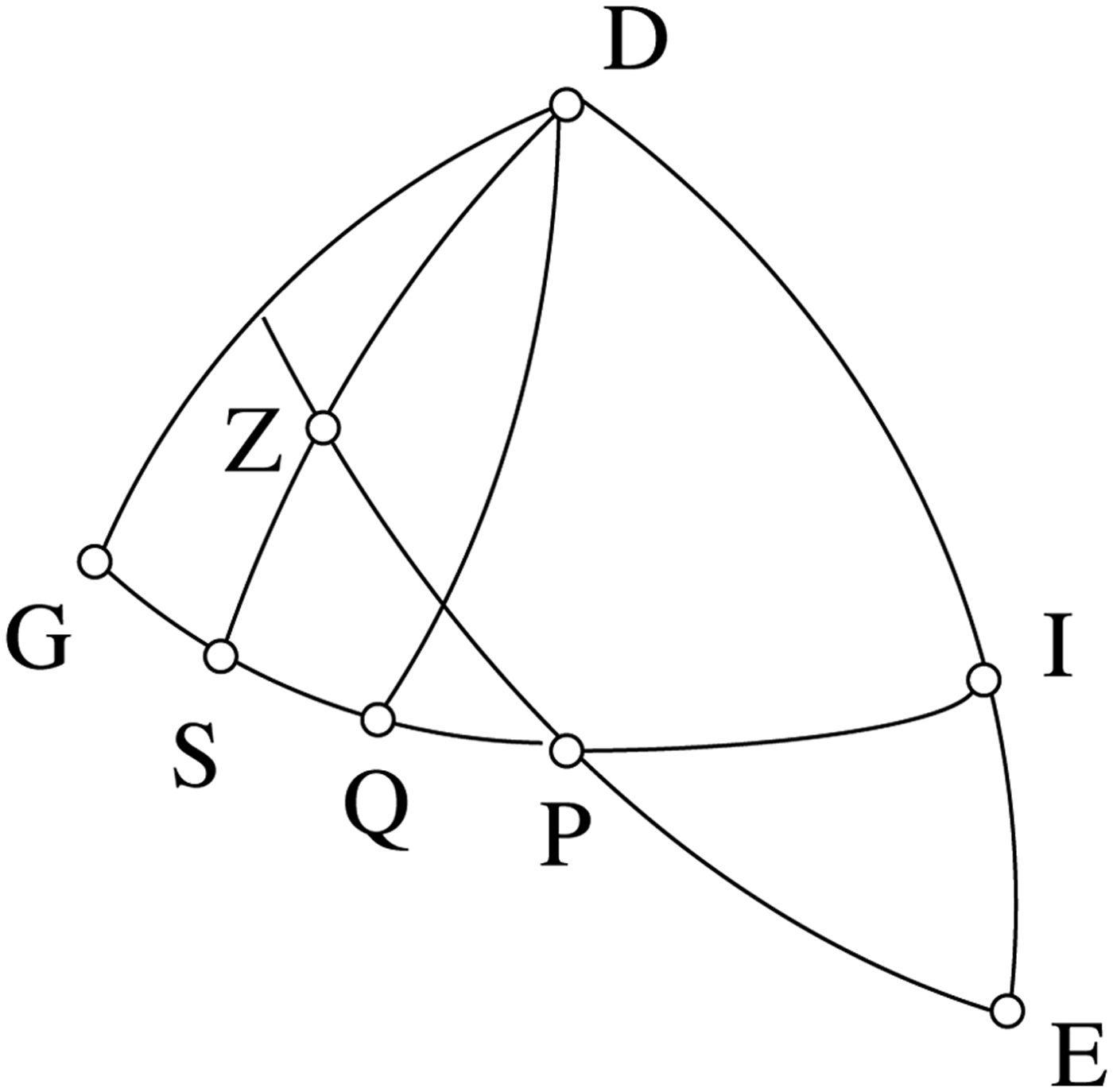
Proof. We consider a spherical triangle ABC and we produce BC in both directions until each of BE, CH is a quarter of a circle (Fig. 2).Footnote 7 (Recall that by hypothesis, BC is smaller than a quarter of a circle.) We draw on the poles B and C two arcs of great circles which intersect BA and CA respectively in D and G.
Fig. 2.
We now claim that
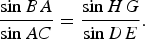 $$\displaystyle{{\sin BA} \over {\sin AC}} = \displaystyle{{\sin HG} \over {\sin DE}}.$$
To prove this claim, we produce ED and HG until they meet at I. The point I is then a pole of the arc ECBH. We join IA and we produce it until a point K on EH. Then IK is perpendicular to EH. We have, by Menelaus' Sector FigureFootnote 8 applied to the sector IHCA:
 $$\displaystyle{{\sin IK} \over {\sin KA}} = \displaystyle{{\sin IH} \over {\sin HG}} \cdot \displaystyle{{\sin GC} \over {\sin CA}}.$$
Since sin IK = sin IH = 1, we obtain
 $${{\sin HG} \cdot {\sin CA}} = {{\sin GC} \cdot {\sin AK}}.$$
Likewise in the sector IEBA, we have
 $$\displaystyle{{\sin IK} \over {\sin KA}} = \displaystyle{{\sin IE} \over {\sin ED}} \cdot \displaystyle{{\sin DB} \over {\sin BA}}.$$
Since IK = IE = 1, we obtain
 $${{\sin ED} \cdot {\sin BA}} = {{\sin DB} \cdot {\sin KA}}.$$
But GC = DB (by polarity each of them is equal to a quarter of a circle). Therefore
 $${{\sin GC} \cdot {\sin KA}} = {{\sin DB} \cdot {\sin KA}}.$$
Likewise,
 $${{\sin HG} \cdot {\sin CA}} = {{\sin DE} \cdot {\sin BA}}.$$
Thus
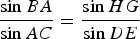 $$\displaystyle{{\sin BA} \over {\sin AC}} = \displaystyle{{\sin HG} \over {\sin DE}}$$
and this is what we wanted. From this follows the sine formula, since the value of the arc HG is equal to the value of the angle GCH (because C is a pole of GH) and the value of the arc ED is equal to the value of the angle EBD (because B is a pole of DE).
Al-Ṭūsī then states the following corollary of the Sine Rule:
Corollary 2.2.
If two angles in a spherical triangle are equal to two corresponding angles in another spherical triangle, the ratios of the sines of the respective sides of the third angle are equal in the two triangles.
Proposition 2.3.
With the notation of Menelaus' Proposition III.5 stated above (Fig. 1), we have
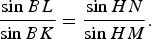
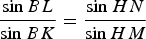
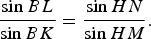 $$\displaystyle{{\sin BL} \over {\sin BK}} = \displaystyle{{\sin HN} \over {\sin HM}}.$$
(This equality is used in the proof of Proposition III.5 above.)
Proof. We use the Sine Rule (Proposition 2.1). We have
 $${\sin BL \over \sin AL} = {{\sin B}\hat{A} {L} \over {\sin A}\hat{B} {L}} ({\hbox{Sine Rule in the triangle}} ABL)$$
and
 $$\displaystyle{{\sin AL} \over {\sin CL}} = \displaystyle{{\sin A\hskip2pt\hat {\hskip-2ptC}L} \over {\sin C\hskip3pt\hat {\hskip-3ptA}L}} \ ({\hbox{Sine Rule in the triangle}} \, CAL).$$
Multiplying both sides of the last two equations, we get
 $$\displaystyle{{\sin BL} \over {\sin AL}}\; \cdot \; \; \displaystyle{{\sin AL} \over {\sin CL}} = \displaystyle{{\sin B\hskip3pt\hat {\hskip-3ptA}L} \over {\sin A\hskip2pt\hat {\hskip-2ptB}L}}\; \cdot \; \displaystyle{{\sin A\hskip3pt\hat {\hskip-3ptC}L} \over {\sin C\hskip3pt\hat {\hskip-3ptA}L}} = \displaystyle{{\sin B\hskip3pt\hat {\hskip-3ptA}L} \over {\sin C\hskip3pt\hat {\hskip-3ptA}L}}\; \cdot \; \displaystyle{{\sin A\hskip3pt\hat {\hskip-3ptC}L} \over {\sin A\hskip3pt\hat {\hskip-3ptB}L}}.$$
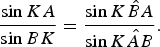
Likewise (by the Sine Rule in the triangles KAC and KBA),
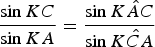 $$\displaystyle{{\sin KC} \over {\sin KA}} = \displaystyle{{\sin K\hskip3pt\hat {\hskip-3ptA}C} \over {\sin K\hskip3pt\hat {\hskip-3ptC}A}}$$
and
 $$\displaystyle{{\sin KA} \over {\sin BK}} = \displaystyle{{\sin K\hskip3pt\hat {\hskip-3ptB}A} \over {\sin K\hskip3pt\hat {\hskip-3ptA}B}}.$$
Multiplying both sides of the last two equations, we get
 $$\displaystyle{{\sin KC} \over {\sin KA}} \cdot \displaystyle{{\sin KA} \over {\sin KB}} = \displaystyle{{\sin K\hskip3pt\hat {\hskip-3ptA}C} \over {\sin K\hskip3pt\hat {\hskip-3ptC}A}} \cdot \displaystyle{{\sin K\hskip3pt\hat {\hskip-3ptB}A} \over {\sin K\hskip3pt\hat {\hskip-3ptA}B}} = \displaystyle{{\sin K\hskip3pt\hat {\hskip-3ptA}C} \over {\sin K\hskip3pt\hat {\hskip-3ptA}B}} \cdot \displaystyle{{\sin K\hskip3pt\hat {\hskip-3ptB}A} \over {\sin K\hskip3pt\hat {\hskip-3ptC}A}}.$$
Now we write
 $$\displaystyle{{\sin BL} \over {\sin BK}} = \displaystyle{{\sin BL} \over {\sin AL}} \cdot \displaystyle{{\sin AL} \over {\sin LC}} \cdot \displaystyle{{\sin CK} \over {\sin KA}} \cdot \displaystyle{{\sin KA} \over {\sin BK}}.$$
From the Sine Rule applied to each of the preceding ratios, we get:
 $$\displaystyle{{\sin BL} \over {\sin BK}} = \displaystyle{{\sin B\hskip3pt\hat {\hskip-3ptA}L} \over {\sin C\hskip3pt\hat {\hskip-3ptA}L}} \cdot \displaystyle{{\sin A\hskip3pt\hat {\hskip-3ptC}L} \over {\sin A\hskip3pt\hat {\hskip-3ptB}L}} \cdot \displaystyle{{\sin K\hskip3pt\hat {\hskip-3ptA}C} \over {\sin K\hskip3pt\hat {\hskip-3ptA}B}} \cdot \displaystyle{{\sin K\hskip3pt\hat {\hskip-3ptB}A} \over {\sin K\hskip3pt\hat {\hskip-3ptC}A}}.$$
Simplifying and using the fact that the two angles ACL and KCA are supplementary and therefore have the same sines, we get
 $$\displaystyle{{\sin BL} \over {\sin BK}} = \displaystyle{{\sin B\hskip3pt\hat {\hskip-3ptA}L} \over {\sin C\hskip3pt\hat {\hskip-3ptA}L}} \cdot \displaystyle{{\sin K\hskip3pt\hat {\hskip-3ptA}C} \over {\sin K\hskip3pt\hat {\hskip-3ptA}B}}$$
In the same way we obtain
 $$\displaystyle{{\sin HN} \over {\sin HM}} = \displaystyle{{\sin B\hskip3pt\hat {\hskip-3ptA}L} \over {\sin C\hskip3pt\hat {\hskip-3ptA}L}} \cdot \displaystyle{{\sin K\hskip3pt\hat {\hskip-3ptA}C} \over {\sin K\hskip3pt\hat {\hskip-3ptA}B}}$$
by equality of the angles that are involved. Therefore
 $$\displaystyle{{\sin BL} \over {\sin BK}} = \displaystyle{{\sin HN} \over {\sin HM}}.$$
Now al-Ṭūsī concludes as follows the proof of the Proposition of Menelaus.
Since (from Proposition 2.3)
 $$\displaystyle{{\sin BL} \over {\sin BK}} = \displaystyle{{\sin HN} \over {\sin HM}}$$
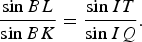
and since HN = IT and HM = IQ (as follows from the first proof of Proposition III.5), we get
 $$\displaystyle{{\sin BL} \over {\sin BK}} = \displaystyle{{\sin IT} \over {\sin IQ}}.$$
Then using
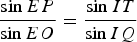 $$\displaystyle{{\sin EP} \over {\sin EO}} = \displaystyle{{\sin IT} \over {\sin IQ}}$$
(which follows again from Proposition 2.3), we obtain
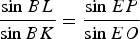 $$\displaystyle{{\sin BL} \over {\sin BK}} = \displaystyle{{\sin EP} \over {\sin EO}}$$
and this is what we wanted (see Equation 1).
2.2. Ibn Abī Jarrāda, on Menelaus' Spherics
In the treatise from which this text is extracted, Ibn Abī Jarrāda tries to restitute Menelaus' Spherics in its original form; this is why, unlike the authors of the others texts we presented, he does not use the notion of sine and he returns to the old language of chords of the double of an arc, but taking advantage of the discoveries made by his predecessors, and in particular Ibn ʿIrāq, which were a consequence of the invention of the sine rule. Ibn Abī Jarrāda starts by reviewing the history of the problem, recalling, like Naṣīr al-Dīn al-Ṭūsī did in his treatise, the efforts by al-Māhānī and al-Harawī on this topic.
Ibn Abī Jarrāda gives the following statement of Menelaus' Proposition III.5:
Consider two triangles ABC and DEG whose angles A and D are right, whose angles C and G are equal and acute, and such that each of the sides AC, DG is smaller than a quarter of a circle. Then,
 $$\displaystyle{{{\rm crd}\, 2\left({{\rm AC} + {\rm BC}} \right)} \over {{\rm crd}\, 2\left({{\rm BC} - {\rm AC}} \right)}} = \displaystyle{{{\rm crd}\, 2\left({{\rm DG} + {\rm EG}} \right)} \over {{\rm crd}\, 2\left({{\rm EG} - {\rm DG}} \right)}}.$$
The notation of the figure used in the proof is almost the same as the one in the text of al-Ṭūsī.
Ibn Abī Jarrāda then gives the following outline.
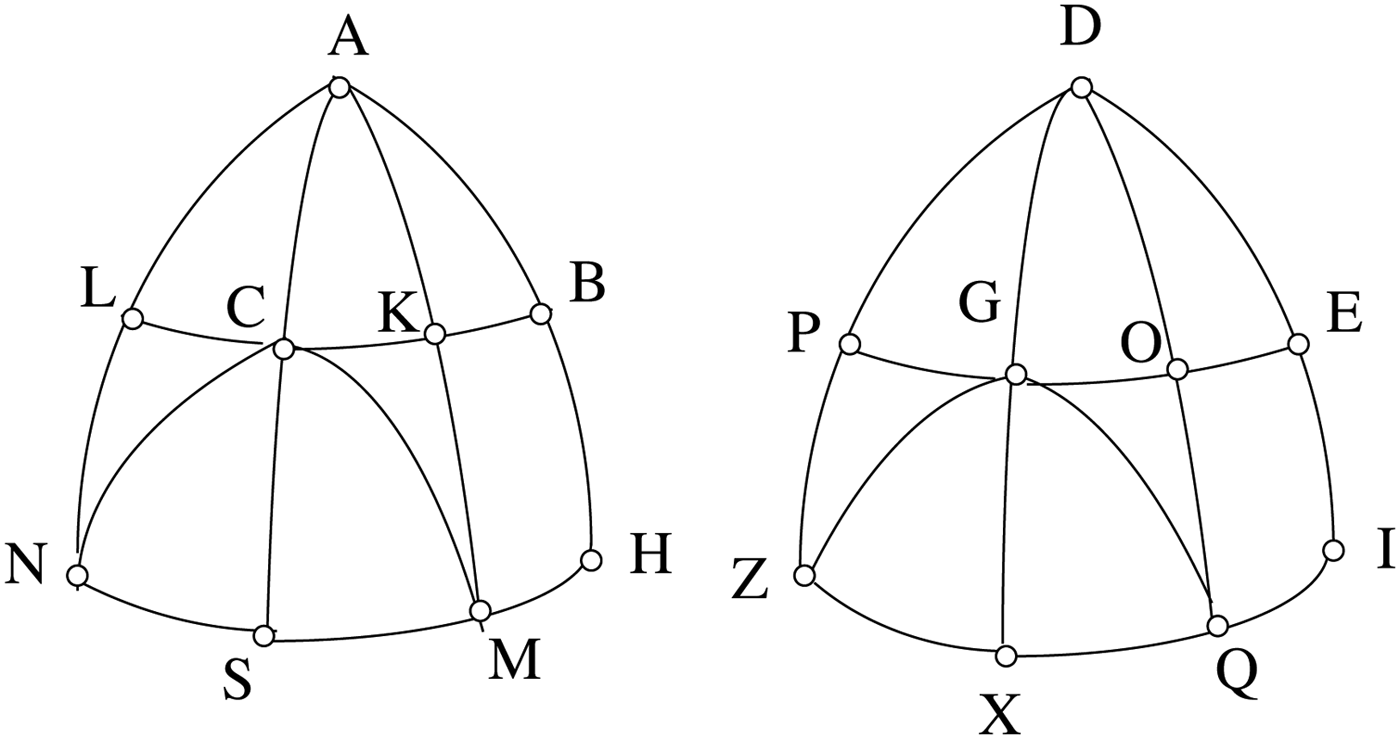
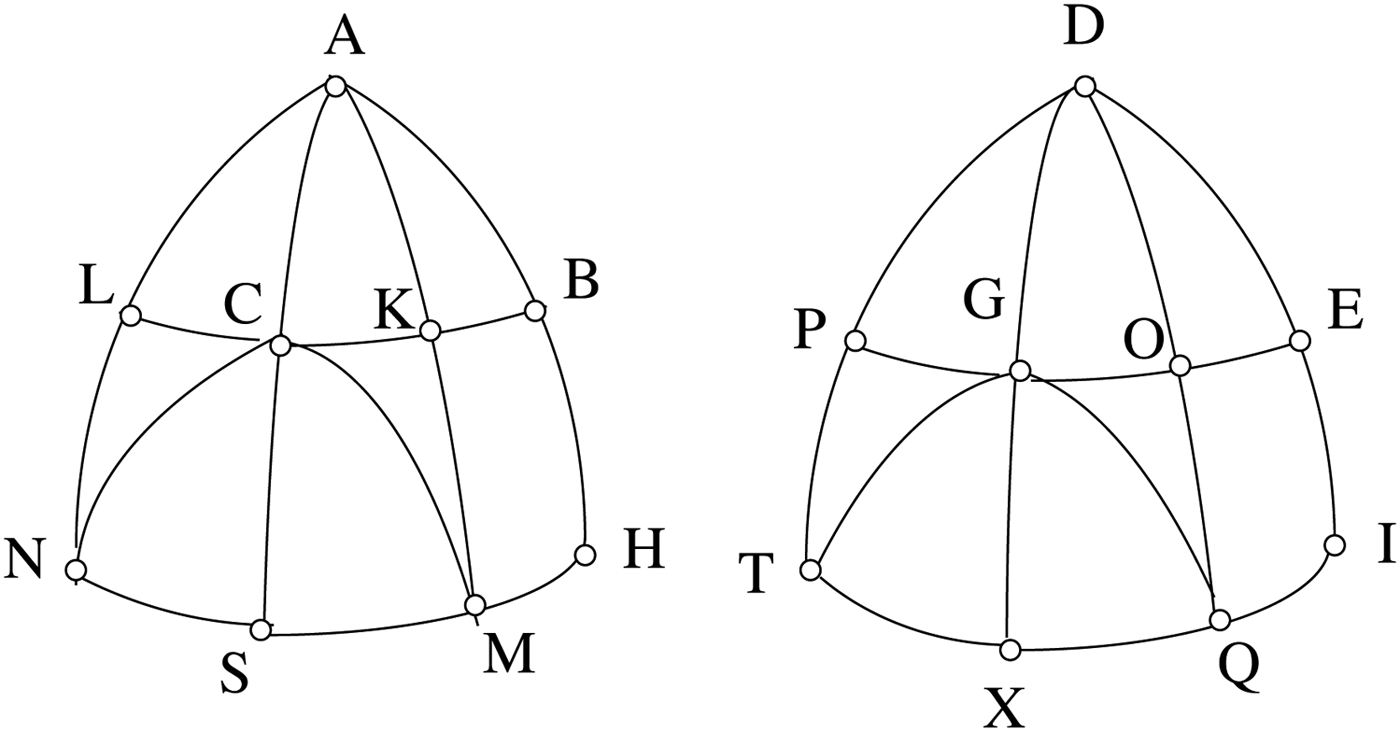
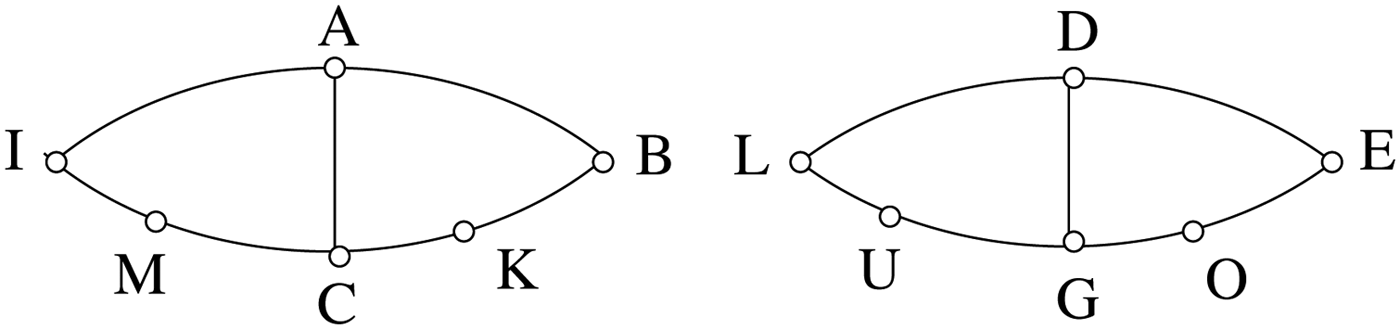
Outline of proof of Proposition III.5. The author reports on a construction in Menelaus' proof that is based on polarity theory, described in Fig. 3. He starts by recalling that BC is greater than AC and that EG is greater than DG.Footnote 9 Thus, we can take on BC a point K satisfying AK = BC and on EG a point O satisfying GO = DG. We then produce the great circle arc BC until L satisfying CL = KC and we produce the great circle arc OG until P satisfying GP = OG.
Fig. 3.
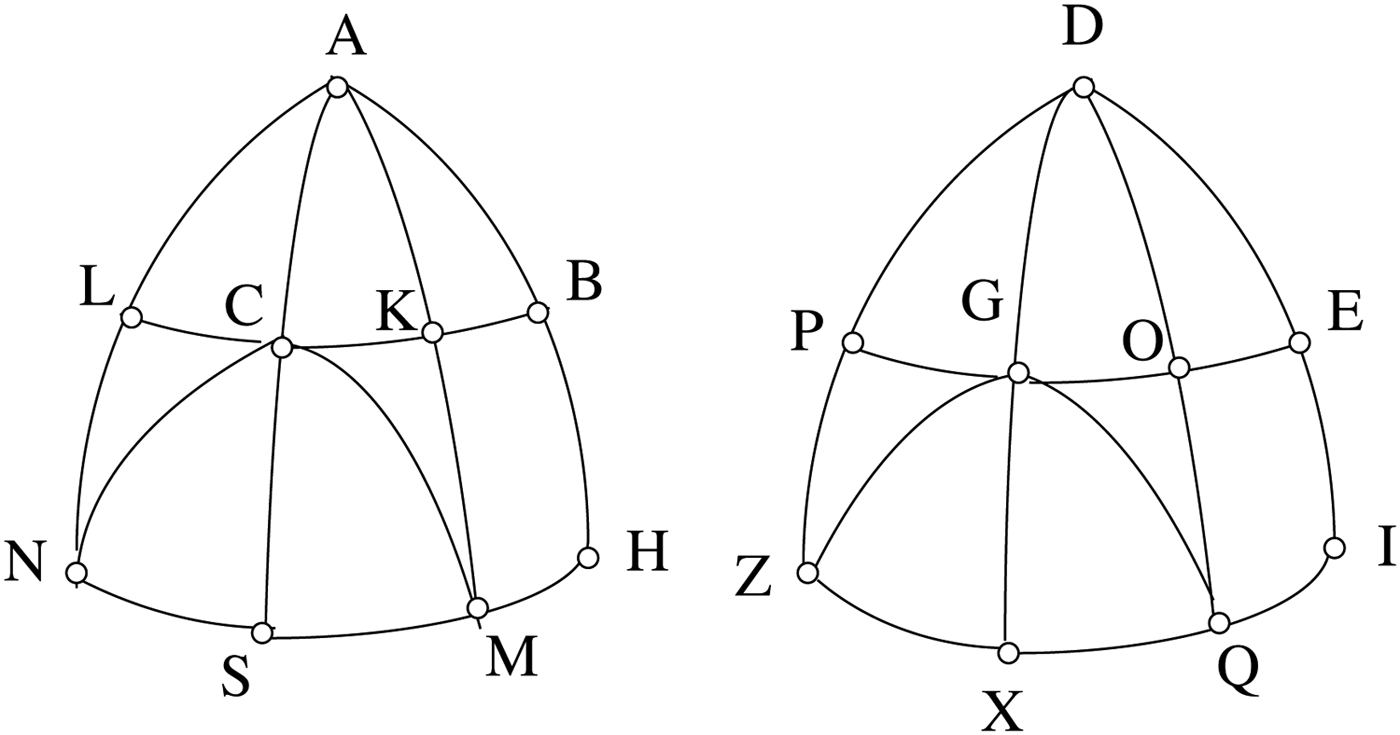
Taking C as a pole, we draw the great circle arc HMSN and taking G as a pole we draw the great circle arc IQXZ. Here, H is on the great circle arc AB, M is on the great circle arc AK, S is on the great circle arc AC and N is on the great circle arc AL. Likewise, I is on the great circle arc DE, Q is on the great circle arc DO, X is on the great circle arc DG and Z is on the great circle arc DP. We also connect by great circle arcs NC, MC, ZG and QG.
The author gives then the following outline of the proof of Proposition III.5 which is essentially the one that was given by Ibn ʿIrāq.Footnote 10
• MC divides the angle SCK into two halves;
• NC divides the angle LCS into two halves;
• QG divides the angle OGX into two halves;
• ZG divides the angle XGP into two halves;
•
 $M\hskip3pt\hat {\hskip-3ptC}N = Q\hskip3pt\hat {\hskip-3ptG}Z = A\hskip3pt\hat {\hskip-3ptS}H = S\hskip3pt\hat {\hskip-3ptA}H = D\hskip2pt\hat {\hskip-2ptX}I = X\hskip2pt\hat {\hskip-2ptD}E = 90$°.
• SM = XQ, MH = IQ, SN = XZ and HN = IZ;
•
$\displaystyle{{{\rm crd}\; 2NH} \over {{\rm crd}\; 2NS}} \cdot \displaystyle{{{\rm crd}\; 2SM} \over {{\rm crd}\; 2MH}} = \displaystyle{{{\rm crd}\; 2IZ} \over {{\rm crd}\; 2ZX}} \cdot \displaystyle{{{\rm crd}\; 2XQ} \over {{\rm crd}\; 2QI}}$.•
$\displaystyle{{{\rm crd}\; 2NH} \over {{\rm crd}\; 2NS}} \cdot \displaystyle{{{\rm crd}\; 2SM} \over {{\rm crd}\; 2MH}} = \displaystyle{{{\rm crd}\; 2LB} \over {{\rm crd}\; 2BK}} \cdot \displaystyle{{{\rm crd}\; 2KC} \over {{\rm crd}\; 2LC}}$.• Therefore:
$\displaystyle{{{\rm crd}\; 2LB} \over {{\rm crd}\; 2BK}} = \displaystyle{{{\rm crd}\; 2NH} \over {{\rm crd}\; 2NS}} \cdot \displaystyle{{{\rm crd}\; 2SM} \over {{\rm crd}\; 2MH}}$.• Likewise,
$\displaystyle{{{\rm crd}\; 2EP} \over {{\rm crd}\; 2EO}} = \displaystyle{{{\rm crd}\; 2IZ} \over {{\rm crd}\; 2ZX}} \cdot \displaystyle{{{\rm crd}\; 2XQ} \over {{\rm crd}\; 2QI}}$.• We conclude that
$\displaystyle{{{\rm crd}\; 2LB} \over {{\rm crd}\; 2BK}} = \displaystyle{{{\rm crd}\; 2EP} \over {{\rm crd}\; 2EO}}$.





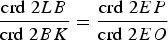
From the equalities, LB = AC + CB, BK = BC – AC, EP = DG + EG and OE = EG – DG, the result follows.
After that, Ibn Abī Jarrāda outlines the proofs of two propositions that are similar to the one of Menelaus, but in which the hypotheses are modified:
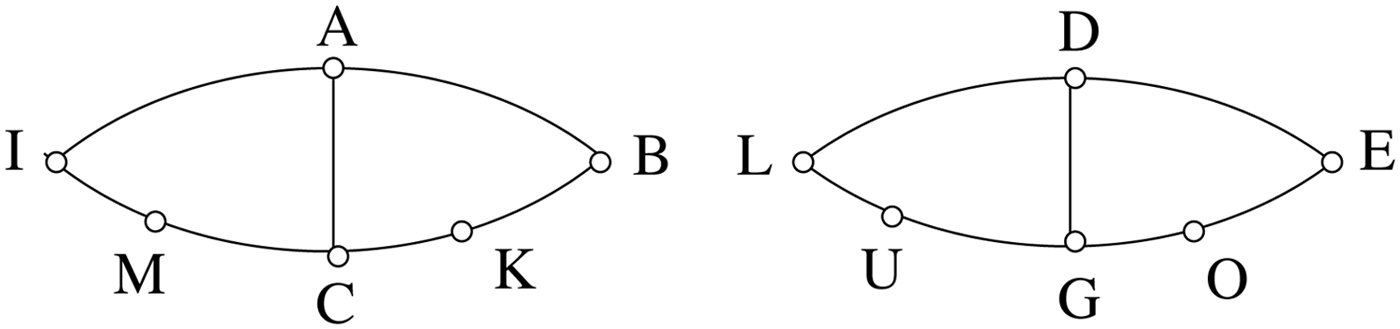
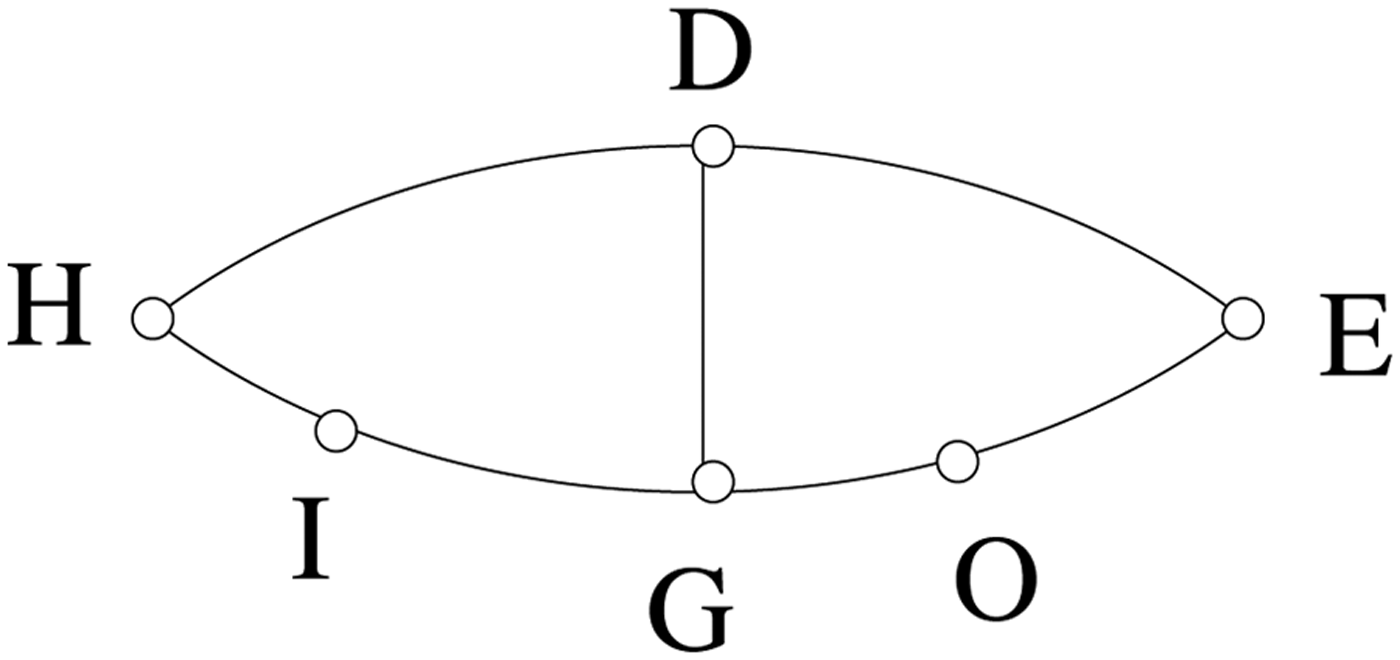
(1) Proposition III.5 in which the hypothesis that the two angles C and G are equal and acute is replaced by the hypothesis that these angles are equal and obtuse. The author gives an outline of a proof which is based on the following. In the triangle ABC (respectively DEG), we extend the great circle arcs AB and BC (respectively ED and EG) until they meet at the point I (respectively L) which is the polar opposite of B (respectively of E) on the sphere; see Fig. 4. Then, the triangles AIC and DLG satisfy the hypothesis of Menelaus' Proposition III.5 (the angles at A and D are right; the angles at I and B are equal and they are equal to the angles at E and L; the angles ACI and DGL are acute). The proofs of the new proposition is done by working on these triangles.
Fig. 4.
(2) Proposition III.5 where instead of taking equal and acute angles at C and G, he takes them supplementary: C acute and D obtuse, and their sum is equal to two right angles. In this case, one replaces the triangle DEG by the triangle DLG constructed as in the right hand side of Fig. 4, and one applies the proposition of Menelaus to the triangles ABC and DLG. In each case, the conclusion in Menelaus' Theorem is changed accordingly.
3. TRANSLATIONS
3.1. The Text of Naṣīr al-Dīn al-Ṭūsī from his Edition of Menelaus' SphericsFootnote 11
For any two triangles having two right angles and two equal angles, each of them smaller than a right angle and each of the two sides that subtend (wataray) the two remaining angles being smaller than a quarter <of a circle>, then the ratio of the sine of the sum of the two sides that contain the acute angle to the sine of their difference in one of the two triangles is equal to the ratio of the sine of the sum of the two sides that contain the acute angle to the sine of their difference in the other triangle.
Let ABC and DEG be the two triangles with BAC and EDG their right angles and ACB and DGE the two equal angles that are smaller than a right angle, and let each of the sides AC and DG be smaller than a quarter <of a circle>. We say: the ratio of the sine of the sum of AC and CB to the sine of their difference is equal to the ratio of the sine of the sum of DG and GE to the sine of their difference.
Proof: Let us produce BC and let us make CL equal to CA [K-48r]. We separate CK from CB, [A-213v] such that CK is also equal to them,Footnote 12 and we draw with C as a pole and at a distance equal to the side of a squareFootnote 13 an arc HN. We produce ABH, AKM, ACS and ALN and we join CM and CN. They divide in two halves the angles KCS and LCS. We do the same in the triangle DEG. Since the two angles HAS and HSA are right angles, H is a pole of the circle ACS and HS is a quarter. Likewise I [I-283r] is a pole of the circle DGX and IX is a quarter. Since the two angles KCS and LCS add up to two right angles and since the entire angle MCN is half of their sum, then it is right and the same holds for the angle QGT. Since C is a pole of HN, the angle CNM is also right, M is a pole of CN, and likewise Q is a pole of GT. Each of HS, MN, IX, QT is a quarter, HM and SN are equal and the same holds for IQ and XT. Since the two angles LCS and PGX – I mean the angles ACB and DGE – are equal, then [C-143] their halves – I mean the arcs NS, TX – are equal. Likewise, MS and QX are equal, and HM and IQ are equal.
He (Menelaus) said: According to what we presented, the ratio of the sine of LB to the sine of BK is equal to the ratio of the sine of PE to the sine of EO.
I say: This is what I found in the copy whose numbers are in black. As for the copy whose numbers are in red, then it is as follows:Footnote 14
Since we produced from the point A to the two arcs BCL and HSN the arcs AH, AM, AS, AN, then the ratio of the sine of the arc LB to the sine of the arc BK is compounded of the ratio of the sine of the arc LB to the sine of the arc LC and of the ratio of the sine of the arc LC to [B-60r] the sine of the arc CK and of the ratio of the sine of the arc CK to the sine of the arc KB. And this ratio is equal to the compounded ratio of the ratio of the sine of the arc LB to the sine of the arc LC and of the ratio of the sine of the arc CK to the sine of the arc KB. This is so because the sine of the arc LC is equal to the sine of the arc CK. And this ratio is equal to the compounded ratio of the ratio of the sine of the arc NH to the sine of the arc NS and of the ratio of the sine of the arc MS to the sine of the arc MH. Likewise, we showed that the ratio of the sine of the arc PE to the sine of the arc EO is compounded of the ratio of the sine of the arc IT to the sine of the arc TX and of the ratio of the sine of the arc QX to the sine of the arc IQ. But it was already proved that the arcs HM, MS, SN are equal to the arcs IQ, QX, XT. Therefore the ratio of the sine of the arc LB to the sine of the arc BK is equal to the ratio of the sine of the arc PE to the sine of the arc EO. This is what we wanted. This is what I found in these two copies.
To prove this, we first present a lemma.
Lemma. The ratio of the sine of any side of a triangle to the sine of another side is equal to the ratio of the sine of the angle that the first side intercepts to the sine of the angle that the other side intercepts.
Proof: Let ABC be a triangle. We produce BC in both directions until each of BE, CH is a quarter (Fig. 6). We draw on the poles B and C at a distance equal to a quarter two arcs ED and HG, and we produce BA and CA until D and G so that DE has the same magnitude as the angle B and GH is of the magnitude [A-214r] of the angle C. We say: the ratio of the sine of BA to the sine of AC is equal to the ratio of the sine of HG to the sine of DE. We produce ED and HG until they meet at I. Then I is a pole of the arc ECBH. We join IA and we produce it until K, then it falls on EH with right angles.
Fig. 5.
Fig. 6.
In the sector IHCA the ratio of the sine of IK to the sine of KA is compounded of the ratio of the sine of IH to the sine of HG and of the ratio of the sine of GC to the sine of CA, and if [K-48v] we make the two sines IK, IH [U-60v] altitudes of two solids which are equal, then the product of the sine of HG and the sine of CA is equal to the product of the sine of GC and the sine of AK. Likewise, in the sector IEBA the ratio of the sine of IK to the sine of KA is compounded of the ratio of the sine of IE to the sine of ED and of the ratio of the sine of DB to the sine of BA. If we make the two sines of IK and IE altitudes of two solids which are equal, then it remains that the product of the sine of ED and the sine of BA is equal to the product of the sine of DB and the sine of KA. But GC is equal to DB, therefore the product of the sine of GC and the sine of KA and the product of the sine of DB and the sine of KA are the same and thus the product of the sine of HG and the sine of CA is equal to the product of the sine of DE and the sine of BA. Thus the ratio of the sine of BA [I-283v] to the sine of AC is equal to the ratio of the sine of HG to the sine of ED, and this is what we wanted.
It is clear from this that if two angles in a triangle are equal to two angles in another triangle, each angle being equal to its homologue, then the sines of their chords are proportional, given that they are proportional to the sines of the intercepted angles and they are the same quantities in the two triangles. This assertion is one of the corollaries of the figure which exempts (al-shakl al-mughnī).
We repeat the two preceding figures and we say (Fig. 7): the ratio of the sine of BL to the sine of AL in the triangle BAL is equal to the ratio of the sine of the angle BAL to the sine of the angle ABL, and the ratio of the sine of AL to the sine of CL in the triangle CAL is equal to the ratio of the sine of the angle ACL to the sine of the angle CAL. Then the ratio compounded of the sine of BL to the sine of AL and of the sine of AL to the sine of CL is compounded of the ratio of the sine of the angle BAL to the sine of the angle ABL and of the ratio of the sine of the angle ACL to the sine of the angle CAL. Permuting the denominators, it becomes compounded of [B-60v] the ratio of the sine of the angle BAL to the sine of the angle CAL and of the ratio of the sine of the angle ACL to the sine of the angle ABL. Likewise, the ratio of the sine of KC to the sine of KA in the triangle KAC is equal to the ratio of the sine of the angle KAC to the sine of the angle KCA. The ratio of the sine of KA to the sine of BK in the triangle BAK is equal to the ratio of the sine of the angle KBA to the sine of the angle KAB. Then the compounded ratio of the ratio of the sine of KC to the sine of KA and of the ratio of the sine of KA to the sine of KB is compounded of the ratio of the sine of the angle KAC to the sine of the angle KCA and of the ratio of the sine of the angle KBA to the sine of the angle KAB. Permuting the denominators, it becomes compounded of the ratio of the sine of the angle KAC to the sine of the angle KAB and of the ratio of the sine of the angle KBA to the sine of the angle KCA. And the ratio of the sine of BL to the sine of BK is then compounded of the ratio of the sine of BL to the sine of AL and the ratio of the sine of AL to the sine of LC and the ratio of the sine of CK to the sine of KA and the ratio of the sine of KA to the sine of BK. The four together, compounded of four ratios, are equal to the ratio of the sine of the angle BAL to the sine of the angle CAL and the ratio of the sine of the angle ACL to the sine of the angle ABL and the ratio of the sine of the angle KAC to the sine of the angle [A-214v] KAB and the ratio of the sine of the angle KBA to the sine of the angle KCA. Since the numerator of the second is the denominator of the fourth and the denominator of the second is the numerator of the fourth, the second and the fourth are inversely proportional and they cancel, and it remains for us that the ratio of the sine of BL to the sine of BK is compounded of the ratio of the sine of the angle BAL to the sine of the angle CAL – the first – and of the ratio of the sine of the angle KAC to the sine of the angle KAB – the third.
Fig. 7.
The same method shows that the ratio of the sine of HN to the sine of HM is compounded of these same two ratios, [C-144] therefore the ratio of the sine of BL to the sine of BK is equal to the ratio of the sine of HN to the sine of HM. Given that each of HM, MS, SN is equal to its homologue in IQ, QX, XT, then the ratio of the sine of BL to the sine of BK is equal to the ratio of the sine of IT to the sine of IQ.
The same method shows that the ratio of the sine of EP to the sine of EO is equal to the ratio of the sine of IT to [K-49r] the sine of IQ. From this it follows necessarily that the ratio of the sine of BL to the sine of BK is equal to the ratio of the sine of EP to the sine of EO. This is what we wanted.
It is obvious from the preceding that the sines of HN and MS are the same since they form together a semicircle, and the two sines SN and HM are the same since the arcs are equal.
You should know that most of those who examined that book were puzzled by that proposition. Concerning al-Māhānī who tried to rectify that book, because of his perplexity he did not go past this point and did not complete the rectification of the book. And as for Abū al-Faḍl Aḥmad ibn Saʿd al-Harawī, [I-284r] he gave an incomplete proof and he mentioned there a lemma which is the following [...].Footnote 15
And myself I did not get the proof of that proposition until I benefited from the explanation of the prince Abū Naṣr ibn ʿIrāq, let God reward him for the scholars of science with the best of rewards.
3.2. Ibn Abī Jarrāda, Commentary on Proposition III.5 of Menelaus' SphericsFootnote 16
If two triangles have in common two right angles and two equal acute angles and if the two sides that subtend (wataray) the remaining angles are smaller than a quarter of a circle, then the ratio of the chord of the double of the sum of the sides of the acute angle in one of them to the chord of the double of their difference is equal to the ratio of the chord of the double of the sum of the sides of the acute angle in the other triangle to the chord of the double of their difference.
Let ABC and DEG be two triangles with angles A and D right and angles C and G equal and acute, and such that each of the sides AC, DG is smaller than a quarter of a circle. I say: The ratio of the chord of the double of the sum of AC and BC to the chord of the double of the difference between BC and AC is equal to the ratio of the chord of the double of the sum of DG and EG to the chord of the double of the difference between EG and DG.
We proved that BC is greater than AC and that EG is greater than DG, then we separate KC equal to AC and we separate OG equal to DG. We produce KC until L such that LC is equal to each of AC and KC and we produce OG until P such that GP is equal to each of DG and OG.
Let C be a pole of the great circle HMSN and G be a pole of the great circle IQXZ. We produce AB until H and AC until S and we join AKM, ALN, MC and CN. We produce DE until I, DG until X and we join DOQ and DPZ and we join QG and ZG. Since AC is equal to KC, each of them is smaller than a quarter of a circle and since we produced ACS and AKM and we joined MC, and MC is a quarter of a circle because it connects a pole of the circle SH to its circumference, then MC divides the angle SCK into two halves. Similarly, we show that NC divides the angle LCS into two halves, since NC is a quarter of a circle and each of AC and LC is smaller than a quarter of a circle. Likewise, we show that QG divides the angle OGX into two halves and ZG divides the angle XGP into two halves.
Since the angle ACK is equal to the angle DGO, then the angle KCS is equal to the angle OGX. And the angle LCS is equal to the angle XGP. For that reason, the angle SCM is equal to the angle XGQ and the angle SCN is equal to the angle XGZ. Therefore, the whole angle MCN is equal to the whole angle QGZ. But the angle MCN is half of the sum of the two angles KCS and LCS, which are right angles. Thus, the angle MCN is right. And the same holds for the angle QGZ. But the angle MNC is also right, therefore NM is a quarter of a circle. But the angle QGZ is also right, therefore ZQ is a quarter of a circle. But the angles ASH and SAH are right, therefore SH is a quarter of a circle. But the two angles DXI, XDI are right angles, therefore XI is a quarter of a circle.
Since the angle SCM is equal to the angle XGQ, and MCS, SCN, ZXG are all quarters of circles, then SM is equal to XQ. It remains that MH is equal to IQ, so SN is equal to XZ and HN is equal to IZ. Therefore the compounded ratio of the ratio of the chord of the double of NH to the chord of the double of NS and the ratio of the chord of the double of SM to the chord of the double of MH is equal to the compounded ratio of the ratio of the chord of the double of IZ to the chord of the double of ZX and the ratio of the chord of the double of XQ to the chord of the double of QI. But the compounded ratio of the ratio of the chord of the double of NH to the chord of the double of NS with the ratio of the chord of the double of SM to the chord of the double of MH is equal to the compounded ratio of the ratio of the chord of the double of LB to the chord of the double of BK and the ratio of the chord of the double of KC to the chord of the double of LC. But the chord of the double of KC is equal to the chord of the double of LC, then the ratio of the one to the other cancels in the composition and it remains that the ratio of the chord of the double of LB to the chord of the double of BK is equal to the compounded ratio of the ratio of the chord of the double of NH to the chord of the double of NS with the ratio of the chord of the double of SM to the chord of the double of MH.
In the same way, it is clear that the ratio of the chord of the double of EP to the chord of the double of EO is equal to the compounded ratio of the ratio of the chord of the double of IZ to the chord of the double of ZX with the ratio of the chord of the double of XQ to the chord of the double of QI. This is because the chord of the double of OG is equal to the chord of the double of GP, therefore the ratio of the one to the other cancels in the composition. Therefore the ratio of the chord of the double of LB to the chord of the double of BK is equal to the ratio of the chord of the double of EP to the chord of the double of EO. But LB is the sum of AC and BC, and BK [90r] is the difference between BC and AC, and EP is the sum of DG and EG, and OE is the difference between EG and DG. Therefore, the ratio of the chord of the double of the sum of AC and BC to the chord of the double of the difference between BC and AC is equal to the ratio of the chord of the double of the sum of DG and EG to the chord of the double of the difference between EG and DG. This is what we wanted to prove.
I said that this is the proposition that al-Māhānī was led to at the end and which was difficult for him to understand, and he gave up. Then al-Harawī proved this using a lemma and he made it planarFootnote 17 using intersections,Footnote 18 and this was not the method of Menelaus. Furthermore, he required in the statement that BC is greater than AC and that EG is greater than DG, and Menelaus did not make this requirement. This is clear in the proof; it seems that he could not obtain a proof of that, so he set it as a condition. And even with that, what al-Harawī said was not sufficient, it lacked a complement concerning straight lines. This becomes clear to anyone who ponders on the rectification of al-Harawī and meditates on it, and who is knowledgeable in geometry.
Then God helped me in understanding this proposition according to the intention of Menelaus and his method, and I give thanks to Him for his benefits.
I want you to know that this requirement is the same which is also necessary in the case where the angles ACB and DGE are equal and obtuse.Footnote 19
Proof: We repeat the figure and we construct all what we constructed before, and we let KC be smaller than a quarter and BC greater than a quarter (Fig. 9). Let UC be a quarter. Then the arc NH passes through U since C is its pole, and H is between B and A. Let PG be a quarter (Fig. 10).
Fig. 8.
Fig. 9.
Fig. 10.
Then IG passes through P and I is between E and D. We then follow the same proof mentioned by Menelaus, and then precisely what has to be proved will be proved, and this will be no more hidden to anyone who knows geometry.
Another method: We produce BA, BC until I and EG, ED until L (Fig. 11). From IC we separate MC equal to AC, and from LG we separate UG equal to DG. Then the two triangles AIC and DLG have right angles at A and D, and their angles ACI and DGL are acute and equal. After we invert, the ratio of the chord of the double of MI to the chord of the double of the sum of IC and AC – I mean KI – is equal to the ratio of the chord of the double of GL to the chord of <the double of the sum> of LG and GD – I mean LO; but BCI is a semicircle, and EGL is a semicircle. Therefore the chord of the double of MI is the chord of the double of MB,Footnote 20 and the chord of the double of IK is the chord of the double of BK, and the chord of the double of UL is the chord of the double of UE, and the chord of the double of LO is the chord of the double of EO. Thus the ratio of the chord of the double of MB – I mean the sum of AC and BC – to the chord of the double of BK is equal to the ratio of the chord of the double of UE – I mean the sum of DG and GE – to the chord of the double of EO. This is what we wanted to prove.
Fig. 11.
But if the angle C is acute and the angle DGE is obtuse and their sum is two right angles, then I say: the ratio of the chord of the double of the sum of AC and BC to the chord of the double of the difference between BC and AC – that is, BK – is equal to the ratio of the chord of the double of the difference between EG and OG – which is EO – to the chord of the double of the sum of DG and EG.
Proof: We produce EG and ED until they meet at H, and we separate GI equal to DG. The two triangles ABC and DGH have right angles at A and D, and the two angles ACB and DGH are equal and acute. Therefore each of AC and DG is smaller than a quarter of a circle. Thus, the ratio of the chord of the double of the sum of AC and BC to the chord of the double of BK is equal to the ratio of the chord of the double of the sum of DG and GH – I mean OH – to the chord of the double of IH. But, EGH is a semicircle, therefore the chord of the double of OH is the chord of the double of EO, and the chord of the double of IH is the chord of the double of EI. Thus, the ratio of the chord of the double of the sum of AC and BC to the chord of the double of BK is equal to the ratio of the chord of the double of EH to the chord of the double of EI – I mean the chord of the double of the sum of EG and DG. This is what we wanted to prove.
Fig. 12.
Fig. 13.
 <تحرير كتاب مانالاوس في الأشكال الكرية >
- ه من ﺟ -كل مثلثين كانت فيهما زاويتان قائمتان وزاويتان متساويتان كل واحدة منهما أصغر من قائمة، وكان كل واحد من وتري الزاويتين الباقيتين أصغر من ربع، فإن نسبة جيب مجموع الضلعين المحيطين بالزاوية الحادة إلى جيب الفضل بينهما في أحد المثلثين كنسبة جيب مجموع الضلعين المحيطين بالزاوية الحادة إلى جيب الفضل بينهما في المثلث الآخر.
فليكن المثلثان ا؟ب؟ﺟ د؟ه؟ز والقائمتان منهما زاويتي ب؟ا؟ﺟ ه؟د؟ز والزاويتان المتساويتان زاويتي ا؟ﺟ؟ب د؟ز؟ه، وكل منهما أصغر من قائمة، وكل واحد من ضلعي ا؟ﺟ د؟ز أصغر من ربع، فنقول: إن نسبة جيب مجموع ا؟ﺟ ﺟ؟ب إلى جيب الفضل بينهما كنسبة جيب مجموع د؟ز ز؟ه إلى جيب الفضل بينهما.
فلنخرج ب؟ﺟ ونجعل ﺟ؟ل مثل ﺟ؟ا، [ك-٤٨و] ونفصل من ﺟ؟ب [ا-٢١٣ظ] ﺟ؟ﻛ أيضًا مثلها ونرسم على قطب ﺟ وببعد ضلع المربع قوس ح؟ن، ونخرج ا؟ب؟ح ا؟ﻛ؟م ا؟ﺟ؟س ا؟ل؟ن ونخرج ﺟ؟م ﺟ؟ن، فهما ينصّفان زاويتي ﻛ؟ﺟ؟س ل؟ﺟ؟س. ونعمل مثل ذلك في مثلث د؟ه؟ز. فلأن زاويتي ح؟ا؟س ح؟س؟ا قائمتان، يكون ح قطبًا لدائرة ا؟ﺟ؟س وح؟س ربعًا. وأيضًا يكون ط [ط-٢٨٣و] قطبًا لدائرة د؟ز؟ش وط؟ش ربعًا. ولأن زاويتي ﻛ؟ﺟ؟س ل؟ﺟ؟س كقائمتين ومجموع زاوية م؟ﺟ؟ن نصفهما، فهي قائمة وكذلك زاوية ق؟ز؟ت. ولأن ﺟ قطب ح؟ن،  ﺟ؟ن؟م أيضًا قائمة ويكون م قطب ﺟ؟ن، وكذلك يكون ق قطب ز؟ت. فكل واحد من ح؟س م؟ن ط؟ش ق؟ت ربع وح؟م س؟ن متساويتان وكذلك ط؟ق ش؟ت. ولكون زاويتي ل؟ﺟ؟س ف؟ز؟ش – أعني زاويتي ا؟ﺟ؟ب د؟ز؟ه – متساويتين، تكون [ﺟ-١٤٣] أنصافهما – أعني قوسي ن؟س ت؟ش – متساويين، وكذلك م؟س ق؟ش متساويتان وح؟م ط؟ق متساويتان.
قال: فبحسب ما قدّمنا، تكون نسبة جيب ل؟ب إلى جيب ب؟ﻛ كنسبة جيب ف؟ه إلى جيب ه؟ع.
أقول: هكذا وجدت في النسخة التي أرقامها بالسواد، وأما في النسخة التي أرقامها بالحمرة فهكذا:
(ولأنه قد خرج من نقطة ا إلى قوسي ب؟ﺟ؟ل ح؟س؟ن قسي ا؟ح ا؟م ا؟س ا؟ن، تكون نسبة جيب قوس ل؟ب إلى جيب قوس ب؟ﻛ مؤلفة من نسبة جيب قوس ل؟ب إلى جيب قوس ل؟ﺟ ومن نسبة جيب قوس ل؟ﺟ إلى [ب-٦٠و] جيب قوس ﺟ؟ﻛ ومن نسبة جيب قوس ﺟ؟ﻛ إلى جيب قوس ﻛ؟ب، وهذه النسبة مثل النسبة المؤلفة من نسبة جيب قوس ل؟ب إلى جيب قوس ل؟ﺟ ومن نسبة جيب قوس ﺟ؟ﻛ إلى جيب قوس ﻛ؟ب؛ وذلك لأن جيب قوس ل؟ﺟ مساوٍ لجيب قوس ﺟ؟ﻛ. وهذه النسبة مثل النسبة المؤلفة من نسبة جيب قوس ن؟ح إلى جيب قوس ن؟س ومن نسبة جيب قوس م؟س إلى جيب قوس م؟ح، وكذلك أيضًا يتبين أن نسبة جيب قوس ف؟ه إلى جيب قوس ه؟ع مؤلفة من نسبة جيب قوس ط؟ت إلى جيب قوس ت؟ش ومن نسبة جيب قوس ق؟ش إلى جيب قوس ط؟ق. وقد تبين أن قسي ح؟م م؟س س؟ن مساوية لقسي ط؟ق ق؟ش ش؟ت؛ فتكون لذلك نسبة جيب قوس ل؟ب إلى جيب قوس ب؟ﻛ كنسبة جيب قوس ف؟ه إلى جيب قوس ه؟ع؛ وذلك ما أردناه). فهذا ما وجدته في هاتين النسختين.
ولنقدّم لبيان هذا البرهان مقدمة: هي أن نسبة جيب كل ضلع مثلث إلى جيب ضلع آخر منه كنسبة جيب الزاوية الموتّرة بالضلع الأول إلى جيب الزاوية الموتّرة بالضلع الآخر.
فليكن مثلث ا؟ب؟ﺟ؛ ونخرج ب؟ﺟ في الجهتين إلى أن يصير كل واحد من ب؟ه ﺟ؟ح ربعًا، ونرسم على قطبي ب ﺟ ببعد الربع قوسي ه؟د ح؟ز ونخرج ب؟ا ﺟ؟ا إلى د ز ليكون د؟ه مقدار زاوية ب وز؟ح مقدار [ا-٢١٤و] زاوية ﺟ؛ ونقول: نسبة جيب ب؟ا إلى جيب ا؟ﺟ كنسبة جيب ح؟ز إلى جيب د؟ه، ونخرج ه؟د ح؟ز إلى أن يلتقيا عند ط، فيكون ط قطبًا لقوس ه؟ﺟ؟ب؟ح، ونصل ط؟ا ونخرجه إلى ﻛ، فهو يقع على ه؟ح على زوايا قائمة.
وفي قطاع ط؟ح؟ﺟ؟ا نسبة جيب ط؟ﻛ إلى جيب ﻛ؟ا مؤلفة من نسبة جيب ط؟ح إلى جيب ح؟ز ومن نسبة جيب ز؟ﺟ إلى جيب ﺟ؟ا، وإذا [ك-٤٨ظ] جعلنا جيبـي ط؟ﻛ ط؟ح [ص-٦٠ظ] ارتفاعي المجسمين، وهما متساويان، صار سطح جيب ح؟ز في جيب ﺟ؟ا كسطح جيب ز؟ﺟ في جيب ا؟ﻛ. وأيضًا في قطاع ط؟ه؟ب؟ا نسبة جيب ط؟ﻛ إلى جيب ﻛ؟ا مؤلفة من نسبة جيب ط؟ه إلى جيب ه؟د ومن نسبة جيب د؟ب إلى جيب ب؟ا. وإذا جعلنا جيبـي ط؟ﻛ ط؟ه ارتفاعي المجسمين، وهما متساويان، بقي سطح جيب ه؟د في جيب ب؟ا كسطح جيب د؟ب في جيب ﻛ؟ا. ولكن ز؟ﺟ مساوٍ ﻟ د؟ب، فسطح جيب ز؟ﺟ في جيب ﻛ؟ا وسطح جيب د؟ب في جيب ﻛ؟ا شيء واحد، ولهذا صار سطح جيب ح؟ز في جيب ﺟ؟ا كسطح جيب د؟ه في جيب ب؟ا، فإذًا نسبة جيب ب؟ا [ط-٢٨٣ظ] إلى جيب ا؟ﺟ كنسبة جيب ح؟ز إلى جيب ه؟د؛ وذلك ما أردناه.
ويتبين من ذلك أنه إذا ساوت زاويتان من مثلث زاويتين من مثلث آخر، كل لنظيره، تناسبت جيوب أوتارهما لكونها على نسب جيوب الزوايا الموتّرة، وهي أقدار بأعيانها في المثلثين، وهذا الحكم من تفاريع الشكل المغني.
ثم نعيد الشكلين المتقدمين ونقول: نسبة جيب ب؟ل إلى جيب ا؟ل في مثلث ب؟ا؟ل كنسبة جيب زاوية ب؟ا؟ل إلى جيب زاوية ا؟ب؟ل، ونسبة جيب ا؟ل إلى جيب ﺟ؟ل في مثلث ﺟ؟ا؟ل كنسبة جيب زاوية ا؟ﺟ؟ل إلى جيب زاوية ﺟ؟ا؟ل. فالنسبة المؤلفة من جيب ب؟ل إلى جيب ا؟ل ومن جيب ا؟ل إلى جيب ﺟ؟ل مؤلفة من نسبة جيب زاوية ب؟ا؟ل إلى جيب زاوية ا؟ب؟ل ومن نسبة جيب زاوية ا؟ﺟ؟ل إلى جيب زاوية ﺟ؟ا؟ل وبتبادل التاليين تكون مؤلفة من [ب-٦٠ظ] نسبة جيب زاوية ب؟ا؟ل إلى جيب زاوية ﺟ؟ا؟ل ومن نسبة جيب زاوية ا؟ﺟ؟ل إلى جيب زاوية ا؟ب؟ل. وأيضًا نسبة جيب ﻛ؟ﺟ إلى جيب ﻛ؟ا في مثلث ﻛ؟ا؟ﺟ كنسبة جيب زاوية ﻛ؟ا؟ﺟ إلى جيب زاوية ﻛ؟ﺟ؟ا. ونسبة جيب ﻛ؟ا إلى جيب ب؟ﻛ في مثلث ب؟ا؟ﻛ كنسبة جيب زاوية ﻛ؟ب؟ا إلى جيب زاوية ﻛ؟ا؟ب. فالنسبة المؤلفة من نسبة جيب ﻛ؟ﺟ إلى جيب ﻛ؟ا ومن نسبة جيب ﻛ؟ا إلى جيب ﻛ؟ب مؤلفة من نسبة جيب زاوية ﻛ؟ا؟ﺟ إلى جيب زاوية ﻛ؟ﺟ؟ا ومن نسبة جيب زاوية ﻛ؟ب؟ا إلى جيب زاوية ﻛ؟ا؟ب. وبتبادل التاليين تكون مؤلفة من نسبة جيب زاوية ﻛ؟ا؟ﺟ إلى جيب زاوية ﻛ؟ا؟ب ومن نسبة جيب زاوية ﻛ؟ب؟ا إلى جيب زاوية ﻛ؟ﺟ؟ا؛ فنسبة جيب ب؟ل إلى جيب ب؟ﻛ المؤلفة من نسبة جيب ب؟ل إلى جيب ا؟ل و <نسبة> جيب ا؟ل إلى جيب ل؟ﺟ و <نسبة> جيب ﺟ؟ﻛ إلى جيب ﻛ؟ا و < نسبة> جيب ﻛ؟ا إلى جيب ب؟ﻛ الأربع مؤلفة من نسب أربع هي نسبة جيب زاوية ب؟ا؟ل إلى جيب زاوية ﺟ؟ا؟ل ونسبة جيب زاوية ا؟ﺟ؟ل إلى جيب زاوية ا؟ب؟ل ونسبة جيب زاوية ﻛ؟ا؟ﺟ إلى جيب زاوية [ا-٢١٤ظ]
و ه السياقة بعينها تبين أن نسبة جيب ح؟ن إلى جيب ح؟م مؤلفة من هاتين النسبتين بعينهما، [ﺟ-١٤٤] فإذًا نسبة جيب ب؟ل إلى جيب ب؟ﻛ كنسبة جيب ح؟ن إلى جيب ح؟م. ولكون كل واحد من ح؟م م؟س س؟ن مساويًا لنظيره من ط؟ق ق؟ش ش؟ت، تكون نسبة جيب ب؟ل إلى جيب ب؟ﻛ كنسبة جيب ط؟ت إلى جيب ط؟ق.
ثم تبين بهذه السياقة أن نسبة جيب ه؟ف إلى جيب ه؟ع كنسبة جيب ط؟ت إلى [ك-٤٩و] جيب ط؟ق. ويجب من ذلك ضرورة أن تكون نسبة جيب ب؟ل إلى جيب ب؟ﻛ كنسبة جيب ه؟ف إلى جيب ه؟ع؛ وذلك ما أردناه.
وظاهر مما مرّ أن جيبي ح؟ن م؟س واحد لكونهما معًا كنصف دائرة، وجيبـي س؟ن ح؟م واحد لتساويهما.
واعلم أن أكثر الناظرين في هذا الكتاب قد تحيّروا في هذا الشكل. أما الماهاني الذي حاول إصلاح الكتاب فلتحيّره فيه لم يتجاوز هذا الموضع ولم يتمّم إصلاح الكتاب. وأما أبو الفضل أحمد بن سعد الهروي، [ط-٢٨٤و] فأورد فيه برهانًا ناقصًا وذكر فيه مقدّمة هي هذه. [...]
وأنا ما وقفتُ على برهان هذا الشكل إلا بعد أن ظفرتُ بشرح الأمير أبي نصر بن عراق، جزاه الله عن طلبة العلم خير الجزاء.
ابن أبي جرادة
إذا كان مثلثان بينهما زاويتان قائمتان وزاويتان متساويتان حادتان، وكل من وتري الزاويتين الباقيتين أقل من ربع دائرة، فنسبة وتر ضعف مجموع ضلعي الحادة من أحدهما إلى وتر ضعف فضل أحدهما على الآخر كنسبة وتر ضعف مجموع ضلعي الحادة من الآخر إلى وتر ضعف فضل أحدهما على الآخر.
فليكن مثلثا ا؟ب؟ﺟ د؟ه؟ز زاويتا ا د منهما قائمتان، وزاويتا ﺟ ز متساويتان حادتان، وضلعا ا؟ﺟ د؟ز كل منهما أقل من ربع دائرة؛ فأقول: إن نسبة وتر ضعف مجموع ا؟ﺟ ب؟ﺟ إلى وتر ضعف فضل ب؟ﺟ على ا؟ﺟ كنسبة وتر ضعف مجموع د؟ز ه؟ز إلى وتر ضعف فضل ه؟ز على د؟ز.
برهان ذلك: أنا قد بينا أن ب؟ﺟ أعظم من ا؟ﺟ وه؟ز أعظم من د؟ز، فنفصل ﻛ؟ﺟ مثل ا؟ﺟ ونفصل ع؟ز مثل د؟ز ونخرج ﻛ؟ﺟ إلى ل حتى يكون ل؟ﺟ مثل كل واحد من ا؟ﺟ ﻛ؟ﺟ، ونخرج ع؟ز إلى ف حتى يكون ز؟ف مثل كل واحد من د؟ز ع؟ز.
وليكن ﺟ قطب دائرة ح؟م؟س؟ن العظمى، وز قطب دائرة ط؟ق؟ش؟ذ العظمى؛ ونخرج ا؟ب إلى ح وا؟ﺟ إلى س، ونصل ا؟ﻛ؟م ا؟ل؟ن م؟ﺟ ﺟ؟ن. ونخرج د؟ه إلى ط ود؟ز إلى ش، ونصل د؟ع؟ق د؟ف؟ذ ونصل ق؟ز ذ؟ز، فلأن ا؟ﺟ مثل ﻛ؟ﺟ، وكل منهما أقل من ربع دائرة، وقد أخرج ا؟ﺟ؟س ا؟ﻛ؟م ووصل م؟ﺟ، وم؟ﺟ ربع دائرة لأنه من قطب دائرة س؟ح إلى محيطها؛ وم؟ﺟ يقسم زاوية س؟ﺟ؟ﻛ نصفين. وكذلك يتبين أن ن؟ﺟ يقسم زاوية ل؟ﺟ؟س نصفين، لأن ن؟ﺟ ربع دائرة وكلَّ واحد من ا؟ﺟ ل؟ﺟ أقل من ربع دائرة. وكذلك يتبين أن ق؟ز يقسم زاوية ع؟ز؟ش نصفين وذ؟ز يقسم زاوية ش؟ز؟ف نصفين.
ﻛ؟ا؟ب ونسبة جيب زاوية ﻛ؟ب؟ا إلى جيب زاوية ﻛ؟ﺟ؟ا. ولكون مقدّم الثانية هو تالي الرابعة وتالي الثانية مقدم الرابعة، تكافأتا الثانية والرابعة وسقطتا وبقي معنا نسبة جيب ب؟ل إلى جيب ب؟ﻛ مؤلفة من نسبة جيب زاوية ب؟ا؟ل إلى جيب زاوية ﺟ؟ا؟ل الأولى ومن نسبة جيب زاوية ﻛ؟ا؟ﺟ إلى جيب زاوية ﻛ؟ا؟ب الثالثة.
ولأن زاوية ا؟ﺟ؟ﻛ كزاوية د؟ز؟ع، تكون زاوية ﻛ؟ﺟ؟س كزاوية ع؟ز؟ش، وزاوية ل؟ﺟ؟س كزاوية ش؟ز؟ف، ولأجل ذلك تكون زاوية س؟ﺟ؟م كزاوية ش؟ز؟ق وزاوية س؟ﺟ؟ن كزاوية ش؟ز؟ذ. فكل زاوية م؟ﺟ؟ن مثل كل زاوية ق؟ز؟ذ، وزاوية م؟ﺟ؟ن نصف مجموع زاويتي ﻛ؟ﺟ؟س ل؟ﺟ؟س اللتين هما كقائمتين. فزاوية م؟ﺟ؟ن قائمة، وكذلك زاوية ق؟ز؟ذ. وزاوية م؟ن؟ﺟ أيضًا قائمة، ﻓ ن؟م ربع دائرة. وزاوية ق؟ز؟ذ قائمة أيضًا، ﻓ ذ؟ق ربع دائرة. وزاويتا ا؟س؟ح س؟ا؟ح قائمتان، ﻓ س؟ح ربع دائرة، وزاويتا د؟ش؟ط ش؟د؟ط قائمتان، ﻓ ش؟ط ربع دائرة.
ولأن زاوية س؟ﺟ؟م كزاوية ش؟ز؟ق وم؟ﺟ؟س س؟ﺟ؟ن ذ؟ش؟ز كلها أرباع <دوائر> ، يكون س؟م مثل ش؟ق، فيبقى م؟ح مثل ط؟ق، ﻓ س؟ن مثل ش؟ذ، ويكون ح؟ن مثل ط؟ذ. فالنسبة المؤلفة من نسبة وتر ضعف ن؟ح إلى وتر ضعف ن؟س بنسبة وتر ضعف س؟م إلى وتر ضعف م؟ح كالنسبة المؤلفة من نسبة وتر ضعف ط؟ذ إلى وتر ضعف ذ؟ش بنسبة وتر ضعف ش؟ق إلى وتر ضعف ق؟ط. لكن النسبة المؤلفة من نسبة وتر ضعف ن؟ح إلى وتر ضعف ن؟س بنسبة وتر ضعف س؟م إلى وتر ضعف م؟ح كالنسبة المؤلفة من نسبة وتر ضعف ل؟ب إلى وتر ضعف ب؟ﻛ بنسبة وتر ضعف ﻛ؟ﺟ إلى وتر ضعف ل؟ﺟ. [ووتر ضعف ل؟ﺟ] ووتر ضعف ﻛ؟ﺟ كوتر ضعف ل؟ﺟ، فنسبة أحدهما إلى الآخر ساقطة من التأليف، فتبقى نسبة وتر ضعف ل؟ب إلى وتر ضعف ب؟ﻛ كالنسبة المؤلفة من نسبة وتر ضعف ن؟ح إلى وتر ضعف ن؟س بنسبة وتر ضعف س؟م إلى وتر ضعف م؟ح.
وبمثل ذلك يتبين أن نسبة وتر ضعف ه؟ف إلى وتر ضعف ه؟ع كالنسبة المؤلفة من نسبة وتر ضعف ط؟ذ إلى وتر ضعف ذ؟ش بنسبة وتر ضعف ش؟ق إلى وتر ضعف ق؟ط، لأن وتر ضعف ع؟ز كوتر ضعف ز؟ف، فنسبة أحدهما إلى الآخر ساقطة من التأليف. فلذلك نسبة وتر ضعف ل؟ب إلى وتر ضعف ب؟ﻛ كنسبة وتر ضعف ه؟ف إلى وتر ضعف ه؟ع، ول؟ب هو ا؟ﺟ ب؟ﺟ، وب؟ﻛ [٩٠و] هو فضل ب؟ﺟ على ا؟ﺟ، وه؟ف هو د؟ز ه؟ز، وع؟ه هو فضل ه؟ز على د؟ز. فنسبة وتر ضعف مجموع ا؟ﺟ ب؟ﺟ إلى وتر ضعف فضل ب؟ﺟ على ا؟ﺟ كنسبة وتر ضعف مجموع د؟ز ه؟ز إلى وتر ضعف فضل ه؟ز على د؟ز؛ وذلك ما أردنا أن نبين.
قلت في هذا الشكل هو الذي انتهى إليه الماهاني وتعذر عليه فهمه فوقف عنده. فقد بينه الهروي بمقدمة بسطها بالفصول المشتركة، وليس من طريقة منالاوس واشترط في الخبر أن يكون ب؟ﺟ أعظم من ا؟ﺟ وه؟ز أعظم من د؟ز؛ ولم يشترطه منالاوس، بل هو بين بالبرهان، فكأنه لم يتح له برهانه فاشترطه، ومع ذلك فلا تمّ بمجرد ما ذكره الهروي، بل يفتقر إلى تتمة أخرى بالخطوط المستقيمة، ومن وقف على إصلاح الهروي وكان له أحوال في الهندسة أفصح له تأمله.
وقد سير لي فهم هذا الشكل على وفق مراد منالاوس وطريقه، فلله الحمد على نعمه.
ثم اعلم أن هذا اللازم بعينه يلزم لو كانت زوايا ا؟ﺟ؟ب د؟ز؟ه متساويتين منفرجتين.
برهان ذلك: أن نعيد الصورة ونعمل فيها كل ما عملناه أولاً، فيكون ﻛ؟ﺟ أقل من ربع وب؟ﺟ أعظم من ربع. فليكن ص؟ﺟ ربعًا، فقوس ن؟ح يمرّ على ص لأن ﺟ قطبها، وتكون ح بين ب وا. وليكن ف؟ز ربعًا. ﻓ ط؟ز يمرّ على ف وتكون ط بين ه د. ثم نسلك في هذا ذلك البرهان الذي ذكره منالاوس بعينه، فيتبين هذا اللازم بعينه، ولا يخفى مثله على من عرف الهندسة.
وطريق آخر: وهو أن نخرج ب؟ا ب؟ﺟ إلى ط وه؟ز ه؟د إلى ل، ونفصل من ط؟ﺟ م؟ﺟ مثل ا؟ﺟ، ونفصل من ل؟ز ص؟ز مثل د؟ز. فمثلثا ا؟ط؟ﺟ د؟ل؟ز فيهما زاويتا ا د قائمتان وزاويتا ا؟ﺟ؟ط د؟ز؟ل حادتان متساويتان. فبعد العكس نسبة وتر ضعف م؟ط إلى وتر ضعف ط؟ﺟ ا؟ﺟ، أعني ﻛ؟ط، كنسبة وتر ضعف ز؟ل إلى وتر <ضعف> ل؟ز ز؟د، أعني ل؟ع؛ وب؟ﺟ؟ط نصف دائرة وه؟ز؟ل نصف دائرة، فوتر ضعف م؟ط هو وتر ضعف م؟ب ووتر ضعف ط؟ﻛ هو وتر ضعف ب؟ﻛ ووتر ضعف ص؟ل هو وتر ضعف ص؟ه ووتر ضعف ل؟ع هو وتر ضعف ه؟ع، فنسبة وتر ضعف م؟ب، أعني ا؟ﺟ ب؟ﺟ، إلى وتر ضعف ب؟ﻛ كنسبة وتر ضعف ص؟ه، أعني د؟ز ز؟ه، إلى وتر ضعف ه؟ع؛ وذلك ما أردنا أن نبين.
فأما إن كانت زاوية ﺟ حادة وزاوية د؟ز؟ه منفرجة ومجموعهما القائمتين، فأقول: إن نسبة وتر ضعف مجموع ا؟ﺟ ب؟ﺟ إلى وتر ضعف فضل ب؟ﺟ على ا؟ﺟ، وهو ب؟ﻛ، كنسبة وتر ضعف فضل ه؟ز <على ع؟ز> – وهو ه؟ع – إلى وتر ضعف مجموع د؟ز ه؟ز.
برهان ذلك: أن نخرج ه؟ز ه؟د حتى يلتقيا على ح، ونفصل ز؟ط مثل د؟ز. فمثلثا ا؟ب؟ﺟ د؟ز؟ح فيهما زاويتا ا د قائمتان وزاويتا ا؟ﺟ؟ب د؟ز؟ح متساويتان حادتان. فكل من ا؟ﺟ د؟ز أصغر من ربع دائرة، فنسبة وتر ضعف مجموع ا؟ﺟ ب؟ﺟ إلى وتر ضعف ب؟ﻛ كنسبة وتر ضعف مجموع د؟ز ز؟ح، أعني ع؟ح، إلى وتر ضعف ط؟ح، وه؟ز؟ح نصف دائرة، فوتر ضعف ع؟ح هو وتر ضعف ه؟ع، ووتر ضعف ط؟ح هو وتر ضعف ه؟ط، فنسبة وتر ضعف مجموع ا؟ﺟ ب؟ﺟ إلى وتر ضعف ب؟ﻛ مثل نسبة وتر ضعف ه؟ح إلى وتر ضعف ه؟ط، أعني وتر ضعف مجموع ه؟ز د؟ز؛ وذلك ما أردنا أن نبين.