


In the Imperial period, the familia Caesaris, a modern name for the enslaved men and women “owned” by the emperors, grew exponentially.Footnote 1 The group had its origins in the households of the emperors and their family members. Over time, it came to encompass legions of people – including many men, highly educated – who served the emperor by doing administrative work in Rome and far beyond. At all times, it included workers who performed menial, domestic labor in the imperial residences of Italy, including those that the emperors visited only periodically. Members of the familia Caesaris were more numerous than enslaved people associated with non-imperial elite households and, as a result, often had more specialized job-titles – though the tasks that they performed were similar, in the main. I focus here on those among them whose work related to the emperor’s performances as priest: aiding in sacrifice, providing musical accompaniment, and managing ritual implements. It was commonplace for enslaved members of Roman households to attend their masters in similar ways in rituals in the domestic sphere, but the size and scale of the familia Caesaris makes this group fruitful for exploring the value of labor, both because our evidence is rich and because these people were more likely to identify by job-title.
I center my inquiry around two types of evidence: depictions of priests and their attendants in Roman art from public and private contexts; and funerary inscriptions that document the lives of enslaved and freed people in the familia Caesaris, as celebrated by their family members after death. Bringing these categories of material into conversation allows us to reconstruct the value of religious labor from two perspectives – contrasting labor as it was construed by the emperor (and other elites) with what it meant to the people who performed it.Footnote 2 I argue that for the emperor, as a practitioner, enslaved assistants performed work that required extreme physical exertion or helped create a conducive atmosphere, freeing him to take on those acts of greatest ritual power, such as speaking prayers or giving offerings. These actions of assistants primarily had meaning relative to those that he undertook himself. But whether commemorated in a communal or family tomb, in their own eyes, these attendants saw themselves as individuals first, concerned about their own commemoration; they were ritual specialists in service of the emperor only second. In sum, to these workers, the expression of occupation served as a means to build and celebrate a place within rich and diverse social networks of their peers.
Elite perspectives: ritual labor in Roman art
Let us begin with the value of ritual labor as it may have been construed by the people for whom it was performed. As I argue below, ritual workers within the familia Caesaris labored both in private, domestic contexts and in public, state-sponsored ceremonies. Their labor thus benefited at certain times the members of the imperial household, and at other times the community at large. For this reason, looking at depictions of enslaved people in Roman sacrificial scenes from a range of contexts, including those from other Roman households, helps us establish elite expectations regarding their varied roles. Whether painted on a wall or sculpted on an altar, many elements of these scenes were formulaic and changed little over time. They collapsed aspects of a ritual event that transpired over hours, in practice, into a single scene that served to underscore the ritual, social, and political power of the priest. In such scenes, the priest is surrounded by implements and figures that remind the viewer of all stages of the ritual – animal sacrifice, pleasant music, fragrant incense, all of which supported the invocation of prayer.Footnote 3
In Roman religion, enslaved people were afforded fewer active ritual roles than were granted to people of freeborn status. They more often served as attendants than as agents, whether representing the broader community or family units.Footnote 4 This was true especially of rituals associated with the household, whether practiced in private or in public. Dan-el Padilla Peralta has pointed out, for example, that during the Compitalia, enslaved people were represented in offerings left at roadside shrines as objects, balls of wool, while free family members were represented as small dolls, taking human form.Footnote 5 When literary authors describe enslaved family members taking ritual actions, as in Cato’s well-known injunctions to the enslaved woman (vilica) who tends the farm, they are presented as doing so at the master’s behest – in his interest, in his stead – rather than for their own benefit or by their own initiative.Footnote 6 Depictions of enslaved people in ritual scenes in Roman art generally present them as generic figures or stock types, who assist a primary actor by killing animals or carrying ritual implements for others to use. Such figures are found both in contexts that served specific audiences of family members, which were generally produced to the specifications of heads of household, and in those on public view, often commissioned by the state or by elite men serving in public roles. Scenes from private contexts were generally painted, often associated with the site of ritual action; scenes from public contexts were marble sculptures, found sometimes on altars but as often on monuments that frame the emperor’s priestly role as one of his many virtues.
In shrine paintings from domestic contexts, ritual attendants are often clearly distinguished from high-status family members through a hierarchy of scale.Footnote 7 In the shrine painting from Pompeii’s “House of Cipius Pamphilus Felix” (House VII, 6, 38), for example, the two divine figures, the Lares, stand in the foreground and occupy the full frame of the register (Fig. 1). Behind are several human figures. The paterfamilias is the largest, and is designated as of elite, free status by his dress, posture, and action: he wears a white toga with broad stripe, typical ceremonial dress for elite men; a fold of the toga is worn over his head (capite velato), indicating solemnity; and he pours a libation on the altar in front of him. To either side, much smaller figures, all seemingly male, perform actions that aid in his endeavor. One leads a pig, and his dress, stripped to the waist, indicates that it is his job to ritually stun and kill it; another, larger figure plays a double flute; finally, the smallest figure carries a tray of food offerings and garlands. Thus, there was a role for all family members, free and enslaved, in ritual action. The hierarchy of scale clearly indicates the relative importance of the actors. The officiant, representing the family as a social and political unit, is positioned as the director of all other action. Embedded in this visual system is an elite system of valuation: physical labor, though necessary, was deputized to servants. Some of the work, especially killing and handling animals, was seen as dirty and dangerous.Footnote 8
Shrine painting, Pompeii, House VII,6,38, with scenes in two registers. The upper features the Lares, paterfamilias, and attendants. The lower register depicts snakes accepting food offerings. MANN inv. 8905. (Image: Simon Burchell, CC BY-SA 4.0 https://creativecommons.org/licenses/by-sa/4.0, via Wikimedia Commons.)

Fig. 1. Long description
Panel A: The upper register of the shrine painting shows two divine figures, the Lares, standing in the foreground and occupying the full frame. They are depicted with high status and are clearly distinguished from other figures through a hierarchy of scale. The paterfamilias and attendants are also present, with the attendants being smaller in scale. The scene is set against a backdrop with decorative elements. Panel B: The lower register of the shrine painting features snakes accepting food offerings. The snakes are depicted in a stylized manner, coiled and intertwined among plants. The altar, located between the two snakes, features a representation of a small figure.
Roman dwellings often had more than one shrine, ranging in size, scale, and opulence. Those shrines with richer decoration, such as marble paneling or faux-marble painting, were located in public parts of houses; others, often more modest, appeared in working spaces, like kitchens. These, too, reflect the valuation of labor – both religious and ordinary – performed for family benefit.Footnote 9 Some of these modest shrines also included decorative elements that referred to the role of enslaved family members in food preparation, which was, of course, a quotidian activity but of particular importance when it accompanied ritual events, where meat from sacrificial animals was consumed – a special treat, given the simple fare eaten day-to-day by most family members.
A shrine from the kitchen of a residence in Pompeii (V, 4, 3) provides a case in point. In the top register, incompletely preserved, were several figures, which appear to have included a paterfamilias and attendants (Fig. 2). As in the scene discussed above, there was a hierarchy of scale; the only complete figure, clearly the smallest overall, is an animal-killer who leads a pig to the altar. In the middle register, there is a scene of a snake. It is incomplete, but as is typical of imagery from shrines, the snake moves toward what must have been an altar; commonly, these snakes were shown in the act of consuming offerings left by families, often eggs. In the lowest register, there is a still-life of cooked food and the tools used to prepare it. The scene includes both foodstuffs (an eel threaded on a spit; a pig’s head; a brace of birds; cuts of meat that may represent offal) and cooking implements (a rack for grilling meats; a flaming brazier of the type that could be used to cook or warm food in dining areas). The provender depicted – all meat, some potentially from sacrificial victims – were delicacies, the kinds of foods not eaten daily.Footnote 10 Their inclusion here underscores that commensality was both critical to the efficacy of ritual performance and one of its key benefits for participants. People invoked the gods through offerings, including of foodstuffs. Divine beings, represented by the snakes, indicated their acceptance of those gifts through the act of consumption. Finally, the members of the household celebrated their ties with one another and with the gods by sharing special foods. These scenes presented ritual action in a way that drew on the real experiences of household members, enslaved and free alike. They were designed to spark memories of ritual action as vivid: accompanied by music, evocative smells (incense, food), and the spoken invocation of prayer.Footnote 11 The recent discovery of the domestic shrine from another house in Pompeii (IX, 10, 1), where the ritual act can be reconstructed from two distinct deposits of carbonized remains, affirms this view. There were traces of offerings given burnt, but also of some given fresh; further, many of the vegetal remains, like pine wood, would have been fragrant when burnt.Footnote 12 What we can take away from this brief survey of the material from private contexts is that enslaved labor was pervasive in ritual action – foundational to the experience of everyone involved. Yet, as I will also discuss below, this work within the home was not often valorized with a specific job-title. Rather, it was but a part of the many duties expected of enslaved people.
Fragmentary scene from a shrine painting, Pompeii, House V,4,3. The upper register depicts a ritual scene with figures at varying scales; one is identifiable as a victimarius (far left) and a togate figure as a paterfamilias (far right). The center register represents a snake. The bottom register depicts food and cooking implements. (Photo: NScav 1901, 258.)

We possess little evidence for what such ritual performances might have looked like within the emperor’s own domestic environment. Suetonius offers a couple of anecdotes that indicate that the emperor – like everyone else – performed rituals at home. Suetonius says that he himself once gave the emperor Hadrian a small statuette of Augustus, which Hadrian displayed and worshipped alongside his Lares in his private chambers. Suetonius also notes that an enslaved servant with the specific job of tending the family gods in the bedroom of Domitian witnessed his murder in that same space.Footnote 13 We are fortunate, however, to have rich evidence for the emperor’s roles as priest, when he oversaw veneration in public. There, too, enslaved labor underpinned his performance, and thus supported the expression of his social, political, and ritual power.
Let us consider just two of the many public reliefs that depict the emperor and his assistants in ritual. Typical of the genre, albeit later in date than the frescoes discussed above, is a well-known scene of Marcus Aurelius. It may have been one of several panels from a lost arch.Footnote 14 In this scene, the emperor is situated in front of a temple, probably the Temple of Jupiter Optimus Maximus, and several personifications that represent the audience, likely the Senate and the populus Romanus. To the right are men assisting with the ritual: one figure, seemingly younger than the others and with an androgenous hairstyle (though he is generally understood to be male), holds a box of incense; another attendant plays music; two, bare to the waist, stand near a bull about to be sacrificed, one of them ready to stun the animal with an axe and the other, dressed similarly, carrying a casket that probably holds a sacrificial knife or other implement (Fig. 3). These men are not presented as individuals. Instead, they are generic figures, whose actions (sacrifice, offering, and creating a conducive atmosphere though scent and sound) support the officiant; they are not themselves responsible for the most efficacious communication between the people and the gods as mediated by the priest in the form of spoken prayer. Laetitia La Follette has argued that still-lives of religious implements, a decorative motif frequently found on religious monuments, similarly stand in for important ritual moments – she notes that objects in still-lives are posed to suggest action, the box open, the knife point down, to emphasize actions surrounding the priest, including those that he did not himself perform.Footnote 15 In this case, the monument itself did not serve a ritual function, but instead celebrated the emperor in those capacities that embodied his formal roles – as a general, triumphator, and sacrificer.
Panel from a lost monument of Marcus Aurelius, Rome, 176–180 CE (Capitoline Museum inv. 807). (Image by User:MatthiasKabel – own work, CC BY-SA 3.0, https://commons.wikimedia.org/w/index.php?curid=6737712.)

A key point is that, though the emperor was in charge of the sacrifice in scenes such as these, he did not himself perform many of the central acts (killing the animal, making the offering, playing the music, burning the incense) or deal with the objects that typify those actions. Even the knife wielded by Roman priests was, in the Imperial period, something of a prop. As Richard Gordon notes, “to be sacrificant in this type of sacrifice is not to labour.”Footnote 16 Thus, in public reliefs, the emperor is surrounded by objects and people that serve as visual reminders of his ritual authority – the libation vessels, the altar, the scroll; the victimarius and his axe, the flute player and his instrument. These people are, in essence, tools of the emperor’s will. They are important as extensions of his agency, not because they possess their own agency. The emperor’s role was necessarily paramount: he was the figurehead, taking on the burden of perfect performance necessary for proper communication with the gods, and thus performing emotional labor for the community around him. The labor of presumably enslaved persons enabled the emperor, in other words, to appear impressive and to focus his attention, in a context where a wrong word or gesture could undermine ritual potency.
In contrast to the relief of Marcus Aurelius, the Ara Pacis took a different approach to the depiction of ritual – a useful counterpoint because it was a monument that itself served as a site of sacrifice. In the processional scenes on the outer face of the precinct walls, Augustus was marked as a priest, with his toga drawn up over his head. Also on the exterior face of the monument, Aeneas is shown imprecating the gods in the guise of a Roman priest, with a toga drawn over his head. He is assisted by one attendant carrying a platter of fruits and another leading a pig. A child stands to Aeneas’s side. Though this type of figure is often referred to by scholars as a camillus, “the boy attendant of a priest,” recent work has suggested that girls, too, could serve in similar ritual roles.Footnote 17 Ritual attendants also appear in the frieze that decorated the functional altar located inside the precinct. This frieze is small in scale and not well preserved, but even so, it is clear that it includes many ritual attendants. Some were certainly of elite status, like the Vestal virgins; many others assisted the priest. There are adults and children carrying ritual implements (jugs, boxes of incense) and men, in the typical dress of victim-handlers, who lead animals to sacrifice (Fig. 4). There is some debate, particularly in the case of those that represent children, about whether these figures and others like them in Roman historical reliefs are intended to represent people who were enslaved or those who were freed.Footnote 18 I argue, below, that we can reasonably assume that many “real” people who filled such roles were enslaved, though probably not all. Nevertheless, what is clear is that, in the case of the Ara Pacis, scenes that alluded to the process and emotion of ritual action were woven into the decoration of the monument at many levels, inviting the viewer to bring their own, firsthand memories of ritual – including the one at which the altar itself had been promised to the gods, in the form of a vow – into conversation with scenes that presented Roman religion as practiced in the distant past. The implication of the two depictions of ritual, read in concert, is that ancestral practices were similar to those rituals that the monument’s viewers had taken part in, witnessed, and possibly even directed.Footnote 19 And the labor of attendants was a necessity for an efficacious ritual, both in the distant past and in the present.
Ritual scene from the interior altar of the Ara Pacis, detail of victimarii, 13–9 BCE. (DAI-Rome Inv. 66.107, H. Koppermann.)

Thus, from the elite or “priestly” perspective, the ritual labor performed by attendants was invaluable in one sense, but also taken for granted, and – when the actors were of enslaved status – also uncompensated. This observation, however, leads us to deeper questions. What did this labor mean to those people who performed it? And how can we, as scholars today, work against the grain, to counter the bias of the evidence? We must confront the fact that we sometimes do not even know what to call the work performed by ritual attendants. In no scene in Roman art are these workers labeled; and we must, as always, take care when applying terminology found principally in Latin literary authors to material culture.Footnote 20 To take one example, many scholars call one of the young attendants on the Ara Pacis the camillus, as noted above.Footnote 21 Yet, there is no evidence that a word like this was ever used as a job-title or applied to any real person who performed such work, in public or private. Indeed, most of the literary attestations of the word are scholiastic, and thus anachronistic: neither elite Romans nor enslaved people would likely have chosen such a term to characterize themselves or their endeavors.Footnote 22 Instead, we need to turn to a different body of evidence, divorced from the place and practice of ritual (altars, shrines, temples) but relating deeply to the lived experience of enslaved and freed people.
Non-elite perspectives: ritual job-titles in the familia Caesaris
We are fortunate to possess inscriptions, commissioned by or for actual enslaved and freed people owned by the emperor, that mention ritual roles. I here offer a brief survey of the evidence for people who, like those attendants in visual depictions, tended ritual implements, aided in animal sacrifice, or played music to accompany ritual services.Footnote 23 On the one hand, that we possess such job-titles underscores the importance of these roles in ritual and thus complements the elite view. On the other, the contexts in which they appear – entirely funerary – reveal a system of valuation that prioritizes the individual as a member of a family or community. The inscriptions reveal the agency of these workers, reflecting self-constructed identities that, at times, contravene elite value systems, including those constructed in and by public monuments.
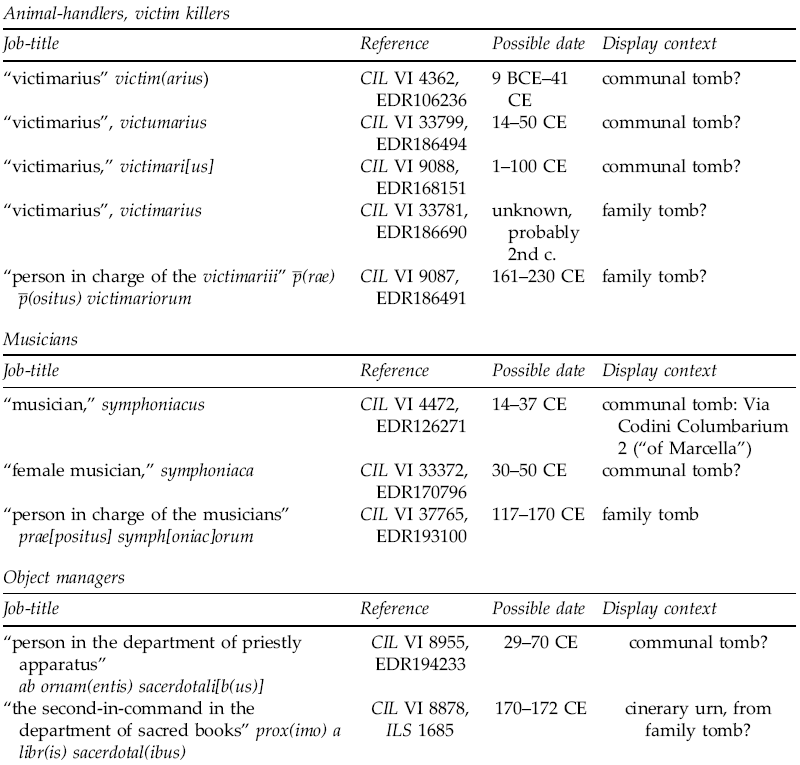
Which people in the emperor’s household, then, chose to self-identify with a ritual role and why? I have identified a small number of inscriptions that appear to relate to the kind of work discussed above: animal-handlers, musicians, and attendants who specialized in the care of sacred objects and ornaments (Table 1). Before we can consider the specific ritual functions of these laborers, however, it is important to consider the social factors that affected the information conveyed. Though the sample is too small for statistical analysis, it is notable that many of the inscriptions documenting victimarii and musicians appear to date to the early Imperial periodFootnote 24 – particularly interesting because that was the period when domestic job-titles were most often employed, in inscriptions, as markers of community and inclusion in elite households.Footnote 25 A great deal of the evidence for domestic occupations comes from communal tombs, which were built and run by groups of enslaved and freed people who pooled resources to provide spaces that housed the remains of many people, some of whom shared an affiliation (members of the same household) and some of whom did not. Rosters of household-based voluntary associations, though few are preserved, provide similar information. Both speak to the rich social world of the people documented in the inscriptions: the groups that maintained sites of collective burial engaged in a range of activities, including electing magistrates, collecting dues, performing religious observances, and feasting; household associations also held elections, made sacrifices, and sponsored feasts.Footnote 26 In these societies, information about job-title was not provided to document the precise nature of one’s work or to proclaim a relationship with the emperor – only a few, especially among such lower-status household members, interacted with him directly. Rather, the choice to include this information represented the priorities of the community, celebrating people who lived and worked together. And, as with any category of material, funerary inscriptions are subject to bias. Jobs that required some degree of education or which were deemed prestigious are better represented than those that were menial; men identify by job title more often than women. Generally speaking, too, lower-status jobs are more likely to be found in material from columbaria or other sites of collective burial, which were more prevalent in the 1st c. CE than later.
Funerary inscriptions of ritual workers in the familia Caesaris from Rome.Footnote 27

Table 1. Long description
A table listing job titles, references, possible dates, and display contexts of ritual workers in the familia Caesaris. The table is divided into three sections: Animal-handlers, victim killers; Musicians; and Object managers. Each section contains rows with columns for Job-title, Reference, Possible date, and Display Context. The Animal-handlers, victim killers section has six rows with job titles such as ʼvictimariusʼ and ʼperson in charge of the victimariiʼ. The Musicians section has three rows with job titles like ʼmusicianʼ and ʼfemale musicianʼ. The Object managers section has two rows with job titles such as ʼperson in the department of priestly apparatusʼ and ʼthe second-in-command in the department of sacred booksʼ. Each row lists the job title, reference citations, possible dates ranging from 9 BCE to 172 CE, and display contexts like communal tomb or family tomb.
This context helps explain the relative scarcity of ritual job-titles in the corpus. Such titles are rare, far less common than those titles used for people who performed other labor in the imperial household, where great numbers of people tended to objects (e.g., silver, gold, or cloth) and worked within specific spaces, both public and private (e.g., libraries or bedchambers). In her landmark study of the enslaved and freed people associated with the household of Livia, Susan Treggiari drew information from several different contexts to survey the range of labor performed for the empress’s benefit, which showed how large her household was, and also how specialized.Footnote 28 For example, Livia had three people who tended silverware (ab argento) and two in charge of personal items of adornment (ab ornamentis).Footnote 29 There were no ritual workers, though this might be explained by the fact that an empress had fewer public ritual roles than an emperor. In the records of the household association associated with the residence at Antium, too, a wide range of job-titles are attested. There are two aeditui or “people who tended shrines,” usually associated with specific temples or sites, but there are no workers with more specialized ritual roles such as those considered here.Footnote 30 All of this context underscores two points that are critical to understanding the evidence that we do possess: 1) many, or even most, people who performed ritual labor for the emperor did not identify by job-title, either because much of that work was deemed relatively generic or because it was understood as low-status; 2) as a corollary, many of the ritual workers we do possess documentation for, especially animal-killers (victimarii) and ensemble musicians (symphoniaci),Footnote 31 should be understood as performing work that was construed as specialist and prestigious. Although we do not have many individuals attested in the epigraphic record, then, those people that we can see were understood to have had important jobs. Over time, people in these roles were organized under supervisors, which also suggests that there were sufficient numbers of them to warrant some kind of an administrative structure.Footnote 32
There are four victimarii attested in the familia Caesaris (and one supervisor of victimarii) and two musicians (and one supervisor of musicians) (Table 1: animal-handlers; musicians). Both animal-killers and ensemble musicians performed work that, manifestly, required training. Victimarii needed to possess extraordinary physical strength, but also experience working with large, difficult animals who were required to behave in a specific and docile way in order for the ritual to function.Footnote 33 Likewise, musicians required instruction in their instruments and experience in playing in ensembles, though our evidence about what this entailed is not rich.Footnote 34 In both cases, this ritual work supported the role of the priest, who oversaw the rites and gave voice to the hopes and desires of the community through prayer. Both sound (of music) and silence (of animals) needed to be carefully controlled to achieve the desired outcome and to provide the appropriate setting in which the priest’s words could be most efficacious.Footnote 35 Despite its importance, however, the work of animal-handling and music-playing was subject to a decidedly elite bias, in which the outcome of the labor was valued but its practitioners deemed “less than.” Musicians (who may well have also played at other events central to elite expression, including games, theatrical performances, dinner parties, and so on) were viewed with the same suspicions as were actors and other performers.Footnote 36 Jack Lennon has argued that elites considered the work of those who slaughtered animals ignominious.Footnote 37 Yet as with other supposedly disreputable professions, it is clear that this work was inherently valuable to and valued by those who performed it.Footnote 38
Notably, we possess evidence that there were voluntary associations for people involved with both of these professions in Roman society, offering social opportunities in and beyond the performance of the work itself.Footnote 39 A collegium of victimarii can be dated to 129 CE, documented in an inscription that seems to have been a dedication displayed in a public context. Members of this group seem predominantly to have served public priests; probably many in the familia Caesaris similarly served the emperor when he, too, performed rites for community benefit.Footnote 40 The voluntary association of the symphoniaci is especially interesting, because the group is also associated with a communal tomb, the “Vigna Codini Columbarium 2.” This tomb was large, with sufficient niches to accommodate roughly 700 individuals; some of these were, indeed, musicians, including one man indicated as a member of the familia Caesaris.Footnote 41 Some niches in the tomb, furthermore, were decorated with depictions of musical instruments, which might refer to the profession of certain people interred there or might simply be appropriate to the funerary setting. On this basis, some scholars have argued that the voluntary association of the symphoniaci might have helped oversee some functions of the tomb – whether allotting the niches or organizing funerals for its own members, or taking on this role for the larger group of people interred within the structure.Footnote 42 One inscription from the tomb refers to the voluntary association by what may have been its title, “the collegium of the symphoniacii, who are ‘at one’s service’ at public sacred events,” and states that they were granted their right of assembly by the Senate.Footnote 43 We might cautiously imagine that members of the group assembled for professional reasons (to practice music, to serve priests, and so on) and for social reasons (to elect leaders for their voluntary association, to enjoy social events, and ultimately to participate in the funerals for other members). This example, linking professional identity with those sites where individual identity was celebrated by friends, colleagues, and family members, shows that although the performance of the ritual work was public, the value of that work to those who performed it was deeply personal. Together, these men and women saw to the universal Roman concern with commemoration, ensuring that the individuals would be remembered and celebrated.
There are also two people in the familia Caesaris who are described by job-titles that indicate that they managed ritual objects – specifically, sacred books and “priestly apparatus,” which might imply items like the priest’s sacrificial knife, the lituus (“priest’s staff”), or special garments worn for ritual events (Table 1: object managers). At first blush, their work is more typical of that of many of the menial laborers in the imperial household who tended to physical goods. Imperial repositories of clothes, jewelry, silver plate, and so on were vast and could also be converted into ready money in difficult times.Footnote 44 In my view, however, these workers were likely higher in status than typical object-tenders – not because they worked with materials that were ritual per se, but because they had greater access to the emperor’s person. One of them had the rank of a promixus, an administrator of low rank; he was probably well educated. That he was known to the emperor personally and possessed some degree of social capital within the household is clear from the nature of the text engraved upon his cinerary urn. He was a freedman, 42 years old, and died away from home at the frontier at Carnuntum, which may suggest that he had been accompanying the emperor at the time, Marcus Aurelius, in the field. His wife arranged to have his remains brought back to Rome, an act that required special permission because disinterring remains was deemed sacrilegious.Footnote 45 This poignant case underscores that the motivations behind funerary material were always personal – a desire to define the self by relationships, both familial and communal. Job-titles in these contexts reveal that all manner of work meant something to those who performed it. Often, that information was included in commemorations as a way of expressing the deceased’s place in the communities those individuals hoped would remember them after death. Although they performed in the service of the emperor, their primary audience was their peers.
Conclusion
Ritual labor performed by enslaved people or other servants was manifestly valuable to elites, especially men, in that it supported actions undertaken for the benefit of family and community, of which they were the figureheads. It was also taken for granted. Depictions of ritual acts in Roman art – whether the everyday invocation of the Lares, followed by a meal of special but not opulent foodstuffs, or a solemn state ceremony, followed by games and feasts – frame the scene around the officiant, whether the father of a family or the emperor of a people. Musicians and flute-players are present, as are other, nameless servants who carry trays of vegetal offerings, incense boxes, or other ritual implements. Their actions created a sensory ambiance without which the ritual could not have been efficacious nor the audience’s emotional experience satisfying. Some attendants – like the victimarius and symphoniacus – had titles that valorized their roles. But the others were no less important, and likely often were the same people who labored long after the ritual itself, preparing foods for peers that brought the community together in acts of commensality.
As scholars and students of Roman art and culture, it falls to us to find other ways to expose the value of this labor as it was performed and to attempt to see those who performed it as individuals with motivations beyond mere service. I have suggested that funerary evidence provides a useful complement to iconographical evidence, even if it leaves open certain long-standing questions. For example: what was the right Latin word to describe a young girl or boy who assisted a Roman priest? Funerary evidence reveals the ways that workers expressed complex social identities; describing themselves with job-titles was one way of asserting self-worth, but not the only way. Even in the imperial household, for which the evidence for the occupations of enslaved and freed people is abundant, people who served as ritual assistants rarely self-identified. We find testimonia only for those people who had the most specialized training, attended the emperor himself, or enjoyed relatively high rank – overseeing the work of others. One implication of this evidence is that, in the context of the Roman family, many kinds of labor that aided in ritual (carrying plates of offerings, cooking meals associated with ritual practice, etc.) were understood as so commonplace that they were not valorized with specific job-titles. Rather, this kind of work was part of generic domestic work undertaken in support of the family and the home. Yet funerary evidence, when we are lucky enough to have it, also reveals that specialized ritual work – which required collaboration with others or extensive training – opened economic and social opportunities for those who performed it. Some of these workers had access to communities outside the household, such as voluntary associations. In these settings, they expressed themselves as individuals first, able to build and maintain prestige through interactions with peers, whether running for office in an association, collecting or managing dues, celebrating events, or laying friends and family members to rest. They were ritual specialists in service of the emperor, but this was only secondary to their self-understanding and self-presentation.
Acknowledgments
I express my thanks to Matthew McCarty and Katie Rask, who organized such a stimulating session at the 2025 meetings of the Archaeological Institute of America, and to Greg Woolf and the anonymous reader for JRA, whose comments have enriched my thinking significantly. All translations are my own unless otherwise noted.



 Open access

