Introduction
In 2017 in the United States, 2.48 million hectares of vegetables and melons were grown (Anonymous 2018). California and Florida combined accounted for 64% of the value of total production (Anonymous 2018), with 69,150 ha of vegetables planted in Florida. Nearly 100% of the Florida production and a significant proportion of the vegetable production in all other states makes use of the plasticulture production system. Plasticulture vegetable production has been widely adopted, because the use of drip tape in conjunction with plastic mulches improves water and nutrient use efficiency, increases crop yields and quality, and helps reduce weed competition (Lamont Reference Lamont2005). The mulch prevents the germination or establishment of most broadleaf and grass weeds on the bed except where holes are punched in the mulch to allow transplant of vegetable crops.
It is widely acknowledged that weed competition with vegetables such as tomato in bare-ground production systems can significantly reduce crop quality and yield (Friesen Reference Friesen1979; Qasem Reference Qasem1992). Far less is known about the effects of weeds in transplant holes on vegetable crops in plasticulture production systems. Buckelew et al. (Reference Buckelew, Monks, Jennings, Hoyt and Walls2006) found that eastern black nightshade (Solanum ptycanthum Dunal) emerging in the planting hole reduced total tomato yield by approximately 35% when the nightshade was transplanted in the transplant hole 1 wk after transplanting (WATr) as opposed to 12 WATr. They concluded that the critical weed-free period to avoid >20% tomato yield loss for extra-large and jumbo grades was 28 to 50 d after transplant. Chaudhari et al. (Reference Chaudhari, Jennings, Monks, Jordan, Gunter, McGowen and Louws2016) reported that weeds that emerged at tomato transplant reduced marketable yield up to 65%. Additional research is needed, but it is safe to conclude that weed growth close to the crop in transplant holes will reduce crop yield and quality through direct competition for resources or by modifying the environment to favor or attract pests and pathogens.
In many regions of the United States, vegetable growers rely on fumigants to control weeds, soil-borne pests, and pathogens. Many registered fumigants control or suppress nutsedge species but tend to provide poor or inconsistent broadleaf and grass control (Boyd et al. Reference Boyd, Vallad, Wu, Noling and Guan2017). For this reason, PRE herbicides are frequently applied in conjunction with fumigants immediately before laying the plastic mulch. A variety of PRE herbicides have been evaluated and proven safe and effective (Boyd Reference Boyd2015, Gilreath and Santos Reference Gilreath and Santos2005). However, broadcast application of herbicides on a bed top that is covered with a plastic mulch is inefficient. Broadleaf and grass weeds can only emerge through transplant holes, which account for only a small proportion of the entire bed-top area. Broadleaf and grass herbicides under the mulch are unnecessary. Technology that facilitates application of herbicides only to the areas where the plastic is punctured would reduce herbicide inputs and minimize risk of crop damage.
The objective here is to describe a new technology developed at the University of Florida that accurately applies herbicide where transplant holes occur and to prove the efficacy and safety of this technology.
Materials and Methods
Equipment Description
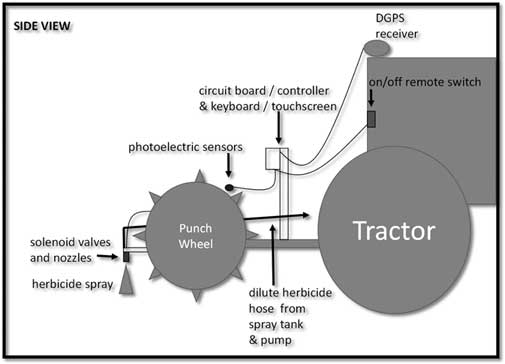
Herbicide application technology developed at the University of Florida enables the precise application of PRE herbicides to soil beneath holes punched in plastic mulch for transplanted crops. All of the spray and sensing components were added to standard hole-punch equipment used in many regions in Florida (Kennco Mfg., Ruskin, FL). The average size of the transplant hole created using this equipment is 32 cm2. The technology uses photoelectric sensors to detect the spikes located on the wheeled hole-punch (Figure 1). The time between spike detection and when the spike will puncture the plastic mulch is calculated using algorithms that incorporate the speed of travel, distance between spikes, diameter of the wheel, and additional calculated time delays. Solenoid valves open when the sprayer nozzle is directly over the hole in the plastic mulch. The timing of the opening and closing of the valve can be adjusted to increase or decrease the size of buffer (i.e., the length of sprayed area on both sides of the transplant hole). The herbicide for the prototype sprayer was mixed in aluminum spray cans and pressurized with CO2 at 0.24 MPa. Two 8002EVS nozzles (Teejet Technologies, Wheaton, IL) were centered directly over the single (tomato) or double (pepper) rows of holes in the plastic mulch.
Schematic of the precision applicator for PRE herbicides in plasticulture vegetable production.

General Methodology
Two experiments were conducted in 2015 and 2016 at the Gulf Coast Research and Education Center (27.45o N, 82.13o W) to evaluate the new precision application technology and compare it to the conventional banded applications that cover the entire top of the raised bed. All experiments were set up as randomized complete block designs with four blocks and were repeated. Soil type at the research center is a Myakka fine sand (sandy, siliceous hyperthermic Oxyaquic Alorthod) with a pH of 7.6 and 0.8% organic matter. Raised beds were formed with standard bed-shaping equipment (Kennco Mfg., Ruskin, FL), with 152 cm from bed center to bed center, bed height of 20 cm, and a bed-top width of 71 cm. The soil was fumigated with 336 kg ha−1 of 39% 1,3-dichloropropene plus 59.6% chloropicrin (Pic-Clor 60, Cardinal Professional Products, Hollister, CA) in all experiments. Fumigants were shank-injected with a standard fumigation rig equipped with three equally spaced shanks (Kennco Mfg., Ruskin, FL) set at a 20-cm depth. Double-drip tape with emitters every 30 cm and a flow rate of 0.83 L h−1 (Eurodrip USA, Madera, CA) was installed 2 cm below the soil surface of the bed, and the beds were covered with VIF plastic mulch (Berry Plastics Corp, Evansville, IN). All plots were irrigated and fertilized throughout the season as per industry standards.
Evaluation of Precision Application Technology
An experiment was set up at two sites as a two by two by three factorial with four randomized blocks to evaluate the effects of herbicide type, application volume, and buffer distance on crop tolerance, weed control, accuracy of precision technology, and the area sprayed. Each plot was 7.62 m of a single bed. Beds were shaped, fumigated, and covered with plastic mulch on February 1, 2016. Holes were punched in the plastic mulch and herbicides applied on March 31, 2016. The first factor was herbicide type, and napropamide and S-metolachlor were applied at 1,121 and 1,419 g ai ha−1, respectively. The second factor was application volumes of 233 or 466 L ha−1. The third factor was the buffer distance, which is the size of the additional treated area on either side of the transplant hole. We evaluated buffer distances of 10, 20, or 40 mm on each side of the hole. Two rows of peppers (cv. ‘TomKat’) with 38-cm spacing between plants were transplanted on March 31, 2016 within 1 h of herbicide application.
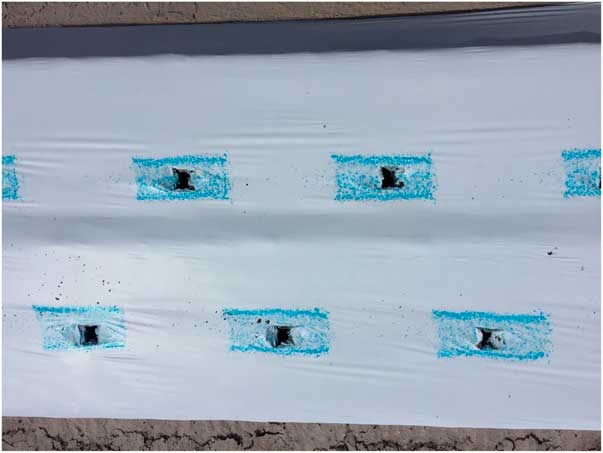
Data collection included pepper heights and crop injury ratings 2, 4, and 8 WATr. Pepper heights were obtained from 10 plants per plot. Crop injury ratings were based on a 0 to 100 scale where 0 represents no damage and 100 represents complete shoot death. Twenty plants per plot were harvested a single time, and the fruits were counted and weighed. Broadleaf and grass weeds emerging in the planting hole were counted at fruit harvest. A blue dye was added to the herbicide spray to make the spray area readily visible. The number of holes missed in each plot was counted immediately after spraying. Two photographs were taken directly above the bed immediately after spraying, with five holes in each photo (Figure 2). ImageJ software (NIH, Bethesda, MD) was used to estimate the area of the hole and the area covered by the herbicide around each hole. Excess coverage was calculated by subtracting the area of the hole from the total area covered by the herbicide around each hole. Herbicide use reduction was calculated to compare the estimated herbicide usage by the hole-punch applicator versus broadcast applications on the bed top. Use reduction was calculated by dividing the area covered by the herbicide when applied with the hole-punch applicator by the total bed-top area and multiplying by 100.
Area sprayed using the precision applicator on top of a plastic mulch–covered bed. Blue dye was added to the spray water to make the area visible where the herbicide was applied. The length of the area sprayed on each side of the hole (buffer distance) is adjustable.

Pepper and Tomato Tolerance of PRE Herbicides Applied with Precision Application Technology
Experiments were conducted in the fall of 2015 and spring of 2016 to evaluate the effects of herbicide type and application technique on tomato (cv. ‘Charger’) and pepper (cv. ‘Aristotle’ in year 1 and ‘TomKat’ in year 2) tolerance to PRE herbicides broadcast on the bed top immediately before laying the plastic mulch or applied to the transplant holes immediately before transplant. Separate experiments were conducted for each crop, and all experiments were set up as a two by three factorial with four randomized blocks. Each plot was 7.62 m of a single bed with a 1.5-m buffer between plots. For the pepper trials, beds were shaped, fumigated, herbicides broadcast-applied in the broadcast treatments, and beds covered with plastic mulch on July 24, 2015 for the fall trials and February 1, 2016 for the spring trials. For the tomato trials, beds were shaped, fumigated, herbicides broadcast-applied, and beds covered with plastic mulch on August 12, 2015 for the fall trials and February 1, 2016 for the spring trials. Holes were punched in the plastic mulch, herbicides applied in the precision treatments, and both crops were transplanted on October 15, 2015 in the fall trial and March 24, 2016 in the spring trial. The first factor was herbicide type and included a nontreated control, 1,121 g ha−1 napropamide, and 1,419 g ha−1 S-metolachlor. The second factor was application technique and included broadcast applications on the bed top made immediately before installing the plastic mulch and applications immediately before placement of vegetable transplants using the precision applicator previously described. All herbicides were applied in 187 L ha−1. Bed-top applications were applied with a backpack sprayer (Bellspray Inc., Opelousa, LA) equipped with a single 8002EVS nozzle (Teejet Technologies, Wheaton, IL) and applied with a pressure of 0.24 MPa.
Data collection included pepper or tomato heights and crop injury 2, 4, and 8 WATr. Heights were obtained from 10 plants per plot with both crops. Crop injury ratings were based on a 0 to 100 scale, where 0 represents no damage and 100 represents complete shoot death. Twenty pepper plants or five tomato plants per plot were harvested a single time, and the fruits were counted and weighed. Broadleaf and grass weeds emerging in the planting hole were counted at fruit harvest. A blue dye was added to the herbicide spray to make the spray area readily visible.
Data Analysis
Data were analyzed in SAS (version 9.2, SAS Institute Inc., Cary, NC) using the mixed procedure. Data were checked for normality and constant variance before analysis. Block and site were considered random factors in the model. Means were compared using the least squares means statement in SAS with the Tukey adjustment. Data collected on multiple dates such as nutsedge counts were analyzed using the repeated statement.
Results and Discussion
Evaluation of Precision Application Technology
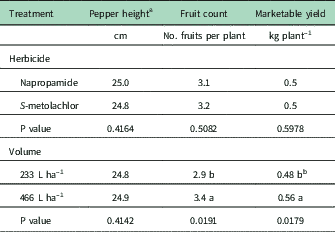
Weed density in the planting holes was unaffected by herbicide type (P = 0.8944), application volume (P = 0.8077), or buffer width (P = 0.2672). No crop injury was observed from any of the treatments. Napropamide or S-metolachlor applications with the precision applicator immediately before transplant had no effect on pepper height, the number of fruits per plant, or the total marketable yield (Table 1). The number of fruits per plant and the marketable yield were 14% to 15% higher when herbicides were applied in a larger water volume. The reason for this difference is unknown. Both herbicides are registered for use in bell pepper when applied immediately before laying the plastic mulch (Boyd and Dittmar Reference Boyd and Dittmar2015), which typically occurs 21 to 30 d before transplant. Previous research has shown that select PRE herbicides such as S-metolachlor can be safely applied 1 d prior to bell pepper transplant (Robinson et al. Reference Robinson, McNaughton and Soltani2008). However, some adjustments to the herbicide label may be required to account for the new use pattern.
The effect of herbicide and application volume when applied with a precision applicator that targets plant holes in plastic mulch on pepper height, fruit count, and total marketable yield.

a Pepper heights are the average of measurements taken 2, 4, and 8 wk after transplant.
b Means within columns and categories followed by different letters are significantly different at P <0.05 using Tukey adjusted means comparisons.
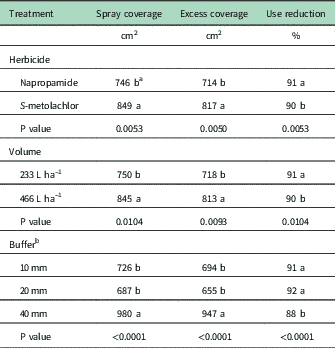
Herbicide type affected the spray pattern due to viscosity differences and as a result also affected spray coverage. Spray coverage and excess coverage were all significantly less where napropamide was applied (Table 2). Movement of the solenoid valves closer to the nozzles largely eliminated the gradual tapering off of the spray following valve shutoff and as a result have largely removed differences in coverage caused by different herbicides. Spray coverage was 11% higher at the highest application volume. Differences that occurred in spray coverage between application volumes were due to adjustment of the two volumes evaluated in this experiment by altering tractor speed. The travel distance between closing the valve and drainage of the herbicide lines between the nozzle and the solenoid was also greater at higher speeds. As expected, the buffer distance altered the area sprayed. Averaged across all herbicide types, application volumes, and buffer widths, the precision applicator reduced herbicide use by 88% to 92%. This represents significant savings in herbicide use.
The effect of herbicide, application volume, and buffer width on the total area sprayed around each hole in the plastic mulch (spray coverage), the area in excess of the hole (excess coverage), and the reduction in herbicide used compared to a broadcast application on the bed top (use reduction) when applied with a precision applicator that targets plant holes in plastic mulch.

a Means within columns and categories followed by different letters are significantly different at P <0.05 using Tukey adjusted means comparisons.
b The buffer is the length of treated area on both sides of the transplant hole.
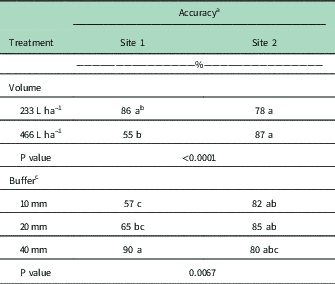
The number of holes accurately sprayed with the herbicide tended to increase from site 1 to site 2, as equipment adjustments were made between sites to improve accuracy (Table 3). Adjustments included movement of the solenoid valves closer to the nozzle bodies, modifications to the calculation that estimates distance between detection of spike and plastic puncture, as well as the addition of a leveling mechanism to ensure that the distance between the nozzles and the plastic remains the same over time. At site 1, accuracy improved with buffer width but not at site 2. The lack of difference in site 2 can be attributed to our overall improvement in accuracy. We are confident that additional equipment modifications, such as the use of GPS to estimate tractor speed rather than entering it manually, will improve accuracy to near 100%.
The effect of application volume and buffer width on the percentage of successful applications to individual plant holes using a precision applicator that targets plant holes in plastic mulch.

a Accuracy was calculated by dividing the number of transplant holes where herbicide was applied by the total number of holes within a plot and multiplying by 100.
b Means within volume and buffer categories with different letters are significantly different at P <0.05 using Tukey adjusted means comparisons.
c The buffer is the length of treated area on both sides of the transplant hole.
Pepper and Tomato Tolerance of PRE Herbicides Applied with Precision Application Technology
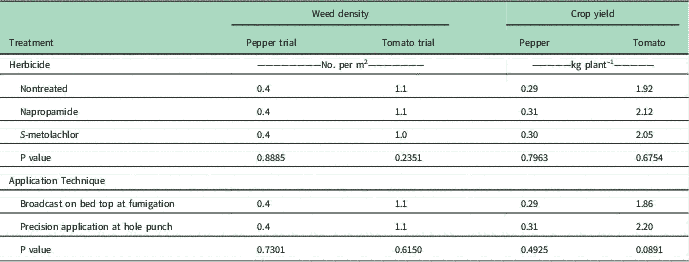
Application technique and herbicide type had no effect on weed density in either trial (Table 4). These results should be interpreted with caution, as weed densities were very low and none of the treatments differed from the nontreated control. This was expected; we had selected a site with low weed density, as the focus of the experiment was to confirm crop tolerance when herbicides are applied immediately before transplant with a precision herbicide applicator. No herbicide damage was observed on either crop, and there were no differences in shoot height or yield between herbicide types or application techniques (Table 4). We conclude that S-metolachlor and napropamide can be safely applied immediately before tomato or pepper transplant using precision application technology in conjunction with a standard hole punch.
Effect of herbicide type and application technique on weed density and crop yield averaged across sites at the Gulf Coast Research and Education Center in Balm, FL, in 2015 and 2016.

We have successfully developed a precision hole-punch applicator capable of applying PRE herbicides during the hole-punch operation. The equipment can be used to safely apply S-metolachlor and napropamide to plasticulture beds immediately before tomato and bell pepper transplant. This approach eliminates the application of herbicides beneath the intact plastic mulch where they are not needed. Adoption of this technology will significantly reduce the use of PRE herbicides in plasticulture vegetable production. Research is continuing to improve accuracy and evaluate the technology in other cropping scenarios.
Acknowledgments
The authors would like to acknowledge the technical assistance of Mike Sweat and Nicole Billera. This research was funded in part by a Specialty Crop Block Grant. No conflicts of interest have been declared.