Attracting people's attention to a particular referent is a common task of human communication. To reach the goal of reasonably clear referential communication, speakers tacitly or intentionally work on building mutually shared knowledge (i.e., common ground) with their addressees (Clark, Reference Clark1996; Clark & Carlson, Reference Clark, Carlson, Long and Baddeley1981). Speakers adjust the content and form of their referring expressions by heeding the communicative demands of the situation, especially the cognitive accessibility of the referent for their addressee (Ariel, Reference Ariel1988). Languages have evolved complex syntactic structures that permit speakers to uniquely identify referents even in the most challenging situations (e.g., Bybee & Hopper, Reference Bybee and Hopper2001). Relative clauses (e.g., the car you gave me) exemplify such structures, serving the function of augmenting nouns with additional information presumed important for identification.
Multiple studies have found that, in comparison to adults, children struggle to adapt referring expressions to the needs of their interlocutor, especially when doing so requires using complex referring expressions such as relative clauses. Relative clauses are constructions with high linguistic complexity on account of both their functional and their formal properties since they simultaneously involve semantic expansions of the simple noun phrase and syntactic embeddedness within another clause. Studies using naturalistic corpora have found that relative clauses do occur but not frequently in early productions of young children in languages such as German and English (Diessel & Tomasello, Reference Diessel and Tomasello2000). They are especially rare in Turkish (Slobin, Reference Slobin, Gleitman and Wanner1982).
Turkish is a language with morphosyntactic properties that have been argued to make the acquisition of relative clauses particularly arduous. However, there may be many other reasons in addition to morphosyntactic complexity that make use of relative clauses challenging for young children, including (a) lack of insight into the interlocutors’ need for information, (b) lack of exposure to relative clauses in child-directed speech, (c) lack of practice of using relative clauses in communicative situations where their use is particularly effective, and (d) infrequency of situations where precise characterization of referents is essential. Through using a motivating task and modeling the critical relative clause structure repeatedly, this study provides young learners of Turkish with some support on these factors and explores the limits on young children's ability to produce relative clauses for unique identification. Our objective is to find out the extent to which young children's ability to employ relative clause constructions productively is enhanced (a) when a strong motivation for nominal expansion is set up in a referent selection task, and (b) when effective use of relative clauses is modeled in a training task.
RELATIVE CLAUSES IN TURKISH
Turkish is a verb-final language, with subject and object relative clauses preceding the nouns they modify (Çağrı Reference Çağrı2009; Hankamer & Knecht, Reference Hankamer and Knecht1976; Underhill, Reference Underhill1972). Subject relative clauses are used when the modified noun is the subject of the relativized clause as in (1a), whereas in object relative clauses the modified element is a nonsubject as in (1b):
- (1)

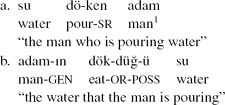
Previous accounts of the morphosyntax of relative clauses in Turkish (e.g., Çağrı, Reference Çağrı2009; Hankamer & Knecht, Reference Hankamer and Knecht1976; Kornfilt, Reference Kornfilt1984; Özsoy, Reference Özsoy, Johanson, Csató, Locke, Menz and Winterling1998; Underhill, Reference Underhill1972) treat subject relative clauses as morphosyntactically less complex and structurally less embedded than object relative clauses. There is also a substantial amount of evidence in the acquisition literature indicating that object relative clauses are relatively more challenging for preschool children to process and produce than are subject relative clauses (Ekmekçi, Reference Ekmekçi and Rona2001; Hermon, Kornfilt, & Öztürk, Reference Hermon, Kornfilt and Öztürk2010; Özge, Marinis, & Zeyrek Reference Ozeki and Shirai2010; Slobin, Reference Slobin, Slobin and Zimmer1986; Yumrutaş, Reference Yumrutaş2009).
Slobin (Reference Slobin, Gleitman and Wanner1982, Reference Slobin, Slobin and Zimmer1986) pioneered the study of the use and comprehension of relative clauses in Turkish, demonstrating that they are less frequent in adult conversations and child productions in Turkish (children aged between 2 and about 4.5 years) when compared to similar corpora of American English. Slobin (Reference Slobin, Slobin and Zimmer1986) also asked Turkish 4-year-olds to perform instructions such as in (2) with toy prompts.
- (2)

Although the children were given three animals to play with for these enactments, such sentences were often performed in total oversight of the relative clause part, implying the usage of a simple transitive, canonical word order strategy (subject–object–verb). Example (2), for instance, was typically acted out as the cow patting the zebra, in disregard of the embedded relative clause. This led Slobin (Reference Slobin, Slobin and Zimmer1986) to conclude that Turkish learners master relative clauses later than French, English, and Russian learners, that is, later than age 4;8, which was the oldest age in the sample. The property that was thought to hinder processing of relative clauses in Turkish was proposed as complexity of the morphosyntactic processes that led to a divergence in relativization constructions from the typical subject–object–verb word order in addition to the presence of nonfinite verbs. Considering several languages, Brandt (Reference Brandt and Kidd2011) argues that divergence of the relative clause word order from the typical word order preference of a given language is a major determinant of ease of processing and age of acquisition of relative clauses crosslinguistically (see also Hsiao & Gibson, Reference Hisao and Gibson2003, for Chinese). A complementary finding of Slobin (Reference Slobin, Slobin and Zimmer1986) that Turkish children were expressing equivalents of relative clauses through coordinated clauses (e.g., hani sarı kedi var ya . . . o-nu isti-yor-um, “you know there is the yellow cat . . . I want that”) was used as evidence that Turkish children have problems with the morphosyntactic forms of relative clauses until late in preschool years, but they express the pragmatic functions of relative clauses early on through alternative constructions.
In brief, many previous studies on Turkish relative clause acquisition showed late mastery, well after age 4, but they generally did not attempt to generate a strong motivation for relative clause usage. The context provided by the standard act-out task as used by Slobin (Reference Slobin, Gleitman and Wanner1982, Reference Slobin, Slobin and Zimmer1986) did not allow interpretation of relative clauses as noun modifiers that are responsible for disambiguation of referents already mentioned in prior discourse, and hence the task's appropriateness has been criticized by a number of different researchers (Córrea, Reference Córrea1995; Hamburger & Crain, Reference Hamburger, Crain and Kuczaj1982; Kidd, Reference Kidd2003). Two recent relative clause production studies with Turkish children (Hermon et al., Reference Hermon, Kornfilt and Öztürk2010; Özge et al., Reference Özge, Marinis, Zeyrek, Chandlee, Franich, Iserman and Keil2010) addressed this issue by introducing into their task two pictured referents of the same category with a contrasting feature or relation. What was required of the child was to answer “which” or “who” questions that attempted to elicit contrastive relative clauses that can uniquely describe the specified scenes.
In this study, rather than asking questions to be answered, we set up actual situations of referential indeterminacy in a sticker request task, where children should authentically care about appropriate identification of the target referent to be able to complete their own book in comparison to that of the experimenter. We examined, through using this task and providing children with model subject relative clauses in a training phase, whether we can motivate 3- and 4-year-olds to productively use the morphosyntactically easier type of relative clauses in Turkish, that is, subject relative clauses, in a pragmatically facilitative context of referent identification. Dasinger and Toupin (Reference Dasinger, Toupin, Berman and Slobin1994) found that identification of a referent was found to be the earliest and most frequently used function among the general discourse functions of relative clauses in picture book narratives gathered from child and adult speakers of five different languages (Berman & Slobin, Reference Berman and Slobin1994).
DEVELOPMENT OF REFERENTIAL IDENTIFICATION
Sociocognitive developmental research has long been investigating the extent to which and under what conditions preschool children consider common ground with interlocutors and provide enough information to their listeners for them to uniquely identify referents (e.g., Bahtiyar & Küntay, Reference Bahtiyar and Küntay2009; Matthews, Lieven, & Tomasello, Reference Matthews, Lieven and Tomasello2007; Nadig & Sedivy, Reference Nadig and Sedivy2002; Nilsen, Graham, & Smith, Reference Nilsen, Graham and Smith2008; O'Neill, Reference O'Neill1996; Piaget, Reference Piaget1930; Salomo, Lieven, & Tomasello, Reference Salomo, Lieven and Tomasello2010). Children as young as 2 years have been demonstrated to tailor their referential attempts in relation to the knowledge state of their listener (O'Neill, Reference O'Neill1996; O'Neill & Topolovec, Reference O'Neill and Topolovec2001). However, other studies have concluded that young children often display ineffective communicative attempts, at rates higher than older children or adults. The differences between younger and older participants are evident in numerous studies, independent of whether the explanation for this developmental gap lies in more exaggerated or less monitored egocentric conceptual thinking in children compared to adults (e.g., Epley, Morewedge, & Keysar, Reference Epley, Morewedge and Keysar2004; Piaget, Reference Piaget1930; Sodian, Reference Sodian1988), relatively more cognitive immaturity such as processing limitations under memory load (e.g., Bloom & German, Reference Bloom and German2000; Moses, Reference Moses1993; O'Neill, Reference O'Neill1996), or a special informational bias toward accepting self-available knowledge and ignoring others’ perspectives (e.g., Birch & Bloom, Reference Birch and Bloom2003; Mitchell, Robinson, Isaacs, & Nye, Reference Mitchell, Robinson, Isaacs and Nye1996).
In addition to plausibly not having adultlike conceptual or cognitive maturity, younger children naturally have not had as many opportunities of exposure to referentially effective communication and/or feedback as older children and adults. Thus, the effects of exposure to referentially adequate forms and experiences with clarification requests have also been an active area of research.
TRAINING OF REFERENTIAL CLARITY
There are several studies demonstrating the beneficial effects of training on children's referential communication skills as listeners and speakers. Some of these studies concluded that children can improve their referential skills by focusing on the contrastive attributes of the referent object when compared to the nonreferent objects (Asher & Wigfield, Reference Asher and Wigfield1981; Lefebvre-Pinard & Reid, Reference Lefebvre-Pinard and Reid1980). Other studies indicated that children improve their referential skills by experiencing communicative breakdown and repair (Robinson & Robinson, Reference Robinson and Robinson1985) and by being exposed to adult models showing how to describe the target referents (Whitehurst, Sonnenschein, & Ianfolla, Reference Whitehurst, Sonnenschein and Ianfolla1981). However, these studies were conducted with older children. For example, Asher and Wigfield (Reference Asher and Wigfield1981) involved third- and fourth-grade children (8–10 years old) and Robinson and Robinson (Reference Robinson and Robinson1985) involved 5-year-old children. At these ages, children should, at least in principle, have a reasonably sophisticated understanding (albeit not yet adultlike) of their interlocutors’ need for information.
Recently, Matthews, Lieven, and Tomasello (Reference Matthews, Lieven and Tomasello2007, Reference Matthews, Lieven and Tomasello2012) conducted a training study with very young children ranging in age from 2 to 4 years. They focused on how children benefit from receiving feedback upon communicative breakdown during a sticker identification task. The aim for the child in these studies was to request a specific sticker from an array of distracters. It was found that the children who were given specific feedback that models a target structure (e.g., “Do you want the daddy eating carrots or the daddy dancing?”) were more likely to use elaborate descriptions compared to the children who were given general feedback (“Which one do you want?”). Moreover, contra previous findings (Whitehurst et al., Reference Whitehurst, Sonnenschein and Ianfolla1981), children tended to use more elaborate descriptions when there were more competitors to the target sticker (i.e., when the array size was 4 in comparison to 2). It was concluded that children as young as 2 can learn to tailor their referring expressions and adjust their informativeness in relation to the specific referential context (e.g., number and type of distractors). That is, even the youngest children were not just learning to produce longer utterances that were incidentally more informative.
Training studies in language use are generally not abundant (Hale & Tager-Flusberg, Reference Hale and Tager-Flusberg2003), and there are only a few training studies that involve relative clauses, commonly not as a main concern. Roth (Reference Roth1984) found an improvement in relative clause knowledge of children aged 3 years, 6 months (3;6) to 4;6 following intervention in a toy manipulation task. A side analysis in the Matthews et al. (Reference Matthews, Lieven and Tomasello2007) study asked whether hearing model constructions led to increased usage of relative clauses by the children. Although reduced relative clauses such as the girl signing were provided more frequently as models for certain conditions, children did not use more relative clauses in these conditions than in other conditions, leading to the conclusion that “there is . . . no suggestion that hearing more models of relative clauses led to a greater use of this structure” (p. 1752). However, the types of grammatical constructions and relative clauses used were not the primary focus of the Matthews et al. (Reference Matthews, Lieven and Tomasello2007) study, and thus the amount of exposure to relative clauses was not directly manipulated. Kloo and Perner (Reference Kloo and Perner2003) used relative clause training as a control task in a study testing the transfer of training from executive function to false belief understanding and found evidence of increase in the rate of usage of relative clauses from pretest to posttest. The test items involved sentence completion in this study, such as here is a child who is sitting on a chair, and here is a child . . . , where the head noun is presented to the child in a presentational construction, which highly constrains the children's choice of construction. A study by Branigan, McLean, and Jones (Reference Branigan, McLean, Jones, Brugos, Clark-Cotton and Ha2005) found evidence of priming of noun phrase structures, including relative clauses, in 3- and 4-year-old English learners. When the children heard adjective–noun phrases such as a blue cat in the experimenter's description of colored pictures, they tended to describe their own picture also with adjective–noun phrases. When the modeled construction was a relative clause, such as a cat that is blue, the children opted to use noun–relative clause phrases in their descriptions.
PRESENT STUDY
Our aim was to examine the extent to which young Turkish-speaking children can be trained to increase their use of referential requests (a) with relative clauses in them and (b) that constitute uniquely identifying referring expressions. We assess changes in the nature of the referring expressions children choose to use from pretest to posttest following a similar training procedure as in Matthews et al. (Reference Matthews, Lieven and Tomasello2007), but testing the effects of different types of feedback constructions. As in Matthews et al. (Reference Matthews, Lieven and Tomasello2007), the children's task was to complete a picture book by adding stickers to it such that it would be identical to Experimenter 1's book. To obtain the required stickers, children needed to approach a second experimenter, E2, who had an array of stickers, one of which (unbeknownst to E2) was the target. The children requested 6 stickers in the pretest and 12 stickers in the posttest. In between the pretest and the posttest, the children were provided with one of three types of training. For all types of training, children identified 12 missing stickers under the supervision of E1, who immediately provided descriptions of the selected stickers. The descriptions differed as a function of training condition, as follows.
In the relative clause feedback condition, a relative clause that uniquely describes the selected sticker was used (e.g., pasta yiyen kızı seçtin, “you selected the girl eating cake”). In the demonstrative-noun phrase feedback condition, the distal demonstrative o, which is used for objects held by the addressee (Küntay & Özyürek, Reference Küntay and Özyürek2006), was combined with the appropriate noun for the character in the sticker (e.g., o kızı seçtin, “you selected that girl”). In the positive feedback condition, a general approval was provided endorsing the selection of the sticker (e.g., güzel seçtin, “you did a nice selection”). We anticipate that modeling with relative clauses will selectively facilitate young children's usage of relative clause constructions and enhance their tendency for using uniquely identifying constructions. Exposure to relative clauses with their unique identificational function will prime the type of construction and will also increase the sensitivity of the children to the needed informativeness of their referential expressions, increasing the rate of appropriate referential forms that do not necessarily involve relative clauses. However, exposure to feedback that highlights the child's selection (i.e., the demonstrative-noun phrase and the positive feedback conditions) may also lead to activation of contrastive thinking (Asher & Wigfield, Reference Asher and Wigfield1981) and enhance children's use of uniquely identifying constructions without leading to a concomitant increase in production of relative clauses.
The predicted effects are as follows: (a) the children in the relative clause feedback condition will use more relative clauses in the posttest compared to the pretest, and such an increased usage of relative clauses will not be as strong in the demonstrative-noun feedback and the positive feedback conditions; and (b) the children in the relative clause feedback condition will use more uniquely identifying referential forms in the posttest compared to the pretest, and such an increased usage of uniquely identifying referential forms will be observed to a lesser extent in the demonstrative-noun feedback and the positive feedback conditions. We will also determine whether these effects are similar for 3- and 4-year-olds.
METHOD
Participants
Ninety (N = 90) native learners of Turkish living in Istanbul were recruited from the Language and Communication Lab (Koç University) database and local preschools, and randomly assigned to one of the three conditions in each age group. An additional 32 children (23 boys, 9 girls; mean age = 33.31 months, age range = 31.12–40.29 months) were contacted but not included in the final sample because of complete lack of cooperation. Sixteen other children (7 boys, 9 girls; mean age = 39.51 months, age range = 31.46–54.0 months) were excluded from the analysis because they did not produce any words and merely used pointing throughout in both the pretest and the posttest phases. We could not include these children in any of our analyses about the effect of training because we were focusing on changes in the linguistic forms children use. In addition, the pointing behavior of most of these children appeared to be random.
Both of the parents of all the participants had attained at least a high school level of education. All children were living in monolingual households from birth onward. However, one 3-year-old child in the relative clause feedback condition was reported to have had some exposure to German in her household by her predominantly Turkish-speaking mother. Forty percent of 3-year-olds and 82% of 4-year-olds were attending nursery school for at least part of the day at the time of the testing.
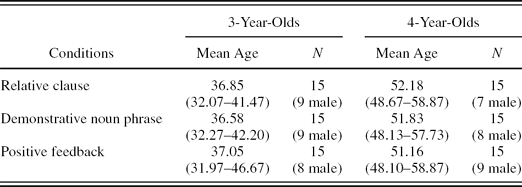
The mean and range of age and sex, and the number of the participants in each of the age groups and conditions are provided in Table 1.
Mean age (age range), gender, and number of participants in each age group and condition

E1 (the first author) was present in all of the experimental sessions. Two research assistants who were trained in the experimental procedure took turns as the confederate (E2) and helped E1 by responding to children's requests for missing stickers to be lowered from the board.
Materials
We used five picture books created by Matthews et al. (Reference Matthews, Lieven and Tomasello2007) about the adventures of a family (e.g., The Bumbles Go to the Zoo and The Bumbles Stay at Home), substituting a Turkish family name for the Bumbles, Mutlu (e.g., Mutlu Ailesi Hayvanat Bahçesine Gidiyor, “The Mutlus Go to the Zoo”). In each book, there are six different pictures showing different family members (e.g., father, mother, girl, boy) performing simple actions (e.g., eating and sleeping). Half of these pictures are about intransitive actions (e.g., the father dancing), while the rest are about transitive actions (e.g., the girl eating cake). In each picture, the subject performing the action is animate. However, the patients in the transitive scenes are animate (e.g., human or animal) in two out of the three items in the pretest and three out of the six items in the posttest; at other times for transitive scenes, the patients were inanimate.
Similar to the experimental procedure of the Matthews et al.'s study (Reference Matthews, Lieven and Tomasello2007), two versions of each of the five picture books were prepared (see Figure 1). The experimenter's version of the picture book included an extra picture on all the pages, which was a picture of a character engaged in some activity. The child's version was missing that extra picture.
Example pages of the experimenter's and the child's versions of the book titled Mutlu Ailesi Çiftlikte, “The Mutlu Family on Farmland.” [A color version of this figure can be viewed online at http://journals.cambridge.org/aps]
There was a child-sized table and two chairs where E1 and the child participant sat during the pretest, the training, and the posttest phases. This is where they went through and compared their books. A large box barrier placed on the table ensured that E2 at the opposite side of the room could not see the child's and E1's books.
A board was fixed on the wall behind E2 to display the array of stickers to the child. The sticker board was placed high on the wall in order to make identification by pointing inappropriate. For each missing picture, 13 nontarget stickers were placed on the wall along with the target sticker. Description of the target stickers in the five picture books are presented in Appendix A. A circle-shaped piece of cardboard was placed on the floor near the board so that the children could be asked to stand on it before asking for a sticker from E2. Standing at this location rendered pointing relatively ineffective for sticker identification.
Procedure
The testing took place at the university laboratory or in a quiet place in the preschools set up similarly to the lab. The three training conditions were implemented at about equal levels in the lab and in the preschools. E1 and the child sat on the chairs on one side of the child-sized table in one corner of the room. Before the beginning of the experiment, a snap game was played with the child as warm-up in order to make sure that the child understood the qualifier aynısı, “the same.” E1 placed six pairs of identical cards on the table in an arbitrary configuration. Then E1 selected one of the cards and asked the child which among the remainder was the same as the card she had picked, using the following instructions: Masanın üzerindeki kartların içinden seçtiğim kartın aynısını gösterir misin? “Can you point at the card which is the same as the one I picked?” Once the child matched all six pairs of cards, E1 terminated the game.
Introduction and pretest
After the snap game, E1 showed the two versions of the Mutlu Ailesi Hayvanat Bahçesine Gidiyor, “The Mutlus Go to the Zoo,” picture book (i.e., the experimenter's version and the child's version) to the child and said that one of the picture books belonged to E1 and the other belonged to the child. E1 then asked the child if he/she could name all the characters in the picture book to make sure that the child could produce the words for the characters, which most the participants were able to do. A few children referred to the woman/mother as the girl and the man/father as the boy initially. In this case, the experimenter provided the correct labels and made sure that these children supplied the correct labels when asked again. It was further explained that E1's book had been completed that morning but that some of the pictures in the child's book were missing. E1 informed the child that the child could make his/her book the same as E1's book by asking for the relevant stickers from E2. Then the child was informed about the large box barrier that prevented E2 from seeing the picture books in front of E1 and the child. In order to make sure that the children grasped that E2 did not get to see the books on the table, they were told to go to the other side of the table and check whether E2 could see their books on the table. Having established E2's inaccess to the books and having identified which sticker was missing on the first page, the child was encouraged to go from where he/she was sitting (with the books next to E1) toward E2, where the board with the stickers was hung up on the wall. The child was told to stand on the circle in front of the sticker board. In addition, E2 encouraged the child to come and ask for the sticker s/he needed.
If the child could uniquely identify the character or simply name the character, E2 gave the right sticker to the child. However, if the child only pointed to the sticker or simply said bu/şu/o, “that one,” E2 handed over to the child the incorrect sticker that had the same character as the target but engaged in a different action. If the child did not accept the incorrect sticker, E2 selected the right sticker and gave it to the child. If the child accepted the nontarget sticker and returned to the table, E1 told the child that the sticker he brought was the wrong one, pointing out the right sticker in her book. Occasionally, the child would request a wrong sticker. In this case, E2 gave the wrong sticker to the child and E1 told the child that this was the wrong one when compared to her own version and asked her to go back to E2 and request the right sticker. Once the child completed requesting the six stickers and finished the picture book, the pretest was terminated.
Training session
Children were exposed to a training session with E1 immediately after the pretest. In the training session, children completed two different picture books, namely, Mutlu Ailesi Parti Yapıyor, “The Mutlus Have a Party,” and Mutlu Ailesi Tatile Çıkıyor, “The Mutlus Go on Holiday,” with six pictures in each (i.e., 12 feedback trials in total).
At the beginning of each training session, the child and E1 sat side by side at the table so that the child could compare his version of the book to E1's and detect the missing stickers. E1 explained to the child that the task was to select the right stickers, making his book the same as E1's book, and then to explain to E1 which sticker was selected. For each page turned and hence for each new missing sticker, E1 placed a new sheet of paper with a selection of 14 stickers on it between the child and herself on the table. Among the stickers on the sheet, there was 1 sticker matching the target sticker, 1 sticker that matched the character but not the action performed, and 1 sticker that matched the action but not the character who was performing it.
In the relative clause feedback condition, after the child selected the right sticker (e.g., the girl eating cake) from among the nontarget stickers (e.g., the mum eating cake, the girl singing) on the table, E1 asked the child “Which sticker did you select?” Once the child verbally described the sticker, E1 informed the child that the sticker was correct by saying Evet, pasta yiyen kızı seçtin; bu çıkartma bizim sayfalarımızı aynı yapacak, “Yes, you selected the girl eating cake; this sticker makes our pages the same.”
In cases where the child occasionally refused to describe the character on the sticker, E1 did not insist for a verbalization and went on to provide the feedback. In each trial, E1 repeated the feedback construction twice; the first time after the child selected the right sticker (and talked about it) and the second time during the placement of the right sticker onto the page. Occasionally, the children selected the wrong sticker. In this case, E1 pointed out to the children that only the correct sticker could make their books similar and provided feedback as described above.
In the other two conditions, the procedure was exactly the same except for the content of the feedback constructions. In the demonstrative-noun phrase condition, E1 said: Evet, o kızı seçtin; bu çıkartma bizim sayfalarımızı aynı yapacak, “Yes, you chose that girl; this sticker makes our pages the same.” In the positive feedback condition, E1 said: Evet, çok güzel seçtin. Bu çıkartma bizim sayfalarımızı aynı yapacak, “Yes, you made a good choice. This sticker makes our pages the same.”
Posttest
The procedure in the posttest was the same as in the pretest, with the child moving over from the table to where E2 stood by the board with the stickers on it and requesting the missing sticker to complete their page as in E1's version. However, in this phase, children completed two picture books (as opposed to one in the pretest), namely, Mutlu Ailesi Çiftlikte, “The Mutlus Go to the Farm,” and Mutlu Ailesi Evde, “The Mutlus Stay at Home,” with 12 trials in total. Once the child was through requesting the 12 stickers from E2, the posttest was terminated.
Transcription and coding
The sessions were videotaped in their entirety. The verbal responses were transcribed by the first author and retranscribed by the third author. The pointing gestures were separately screened by the first author and by another native speaker of Turkish. The transcribed referential utterances were later coded by the first author in terms of (a) whether they contained relative clauses, and (b) whether they could uniquely identify the specific sticker. The utterance had to include a verb and a subject relativizer in order to be coded as a relative clause; it had to mention the discriminatory features of the specific referent in order to count as uniquely identifying. The codes were later confirmed by the third author, who watched the entirety of all the videotapes. Occasional corrections to the codes were provided after agreement between the first and the third author was reached. Not all relative clause constructions were appropriate for the purpose of unique identification, and not all uniquely identifying utterances were in the form of relative clauses. Although many (about 61%) of the relative clause constructions provided unique identification, the remainder did not. An example of a relative clause that does not achieve unique identification is şunu, maymuna yem vereni, “that one, the one feeding the monkey,” where the construction does not provide the modified head noun such that the specific referent can be singled out. Among uniquely identifying constructions, 52% included relative clauses. An example of a declarative sentence that provides unique identification with no relativization is babayı eşek—köpek kovalıyor, “a donkey—a dog is chasing the dad.”
RESULTS
The referential devices in the form of a relative clause or constituting uniquely identifying utterances for the specific stickers were tagged separately for the pretest and the posttest. The percentage of use for each child was calculated by dividing the number of referential expressions in the form of a relative clause or uniquely identifying form in each group by the total number of referential opportunities for each phase (i.e., total number of trials, which is 6 in the pretest and 12 in the posttest). There were some missing responses for some trials, where the children did not produce any codable requests for a sticker. The percentages were calculated by including the missing responses and the responses that included merely nonverbal pointing in the total. Thus, the denominator for each child was always 6 for the pretest and 12 for the posttest.
The presentation of the results is organized as follows. The descriptive statistics for each of the dependent measures (number of relative clauses and number of uniquely identifying expressions) are reported, followed by the results of mixed-effects logistic regression models run for each of the dependent measures. We tested whether the children who were trained with relative clauses increased their usage of relative clauses and uniquely identificational descriptions from the pretest to the posttest more than the children who were exposed to more general referential expressions such as demonstrative noun phrases or positive feedback statements.
Descriptive statistics
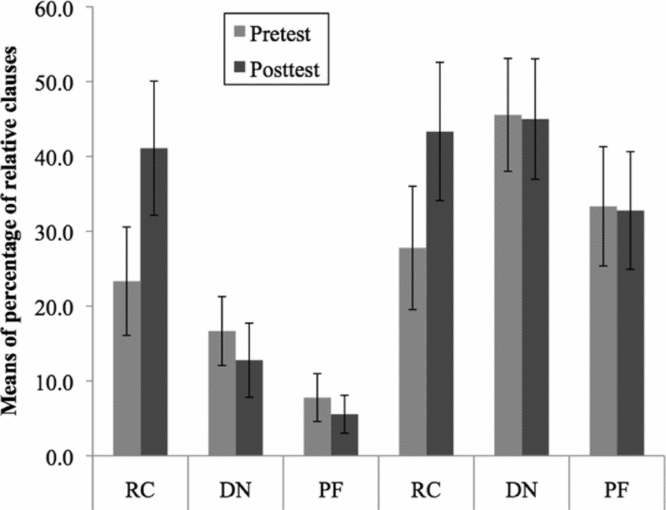
Figure 2 presents the percentages of relative clauses used by 3- and 4-year-olds in the pretest and the posttest phases. The pretest and the posttest scores were correlated for both age groups, with a higher correlation coefficient for the younger age group (Pearson r = .78 for 3-year-olds, .53 for 4-year-olds, and .67 for the total, ps < 0.01). The production of a relatively high proportion of referential forms that include relative clauses in the pretest phase was associated with a high proportion of referential expressions with relative clauses in the posttest.
The means of the percentage of trials where relative clauses were produced as a function of time (pretest or posttest), condition, and age. Standard errors are represented by error bars.
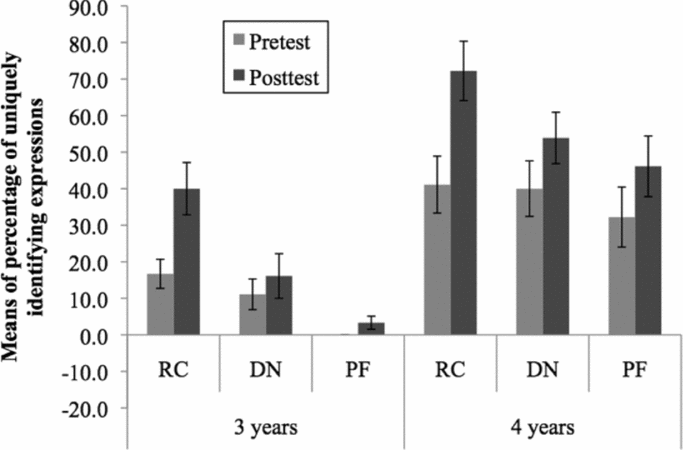
Figure 3 presents the percentages of uniquely identifying expressions used by 3- and 4-year-olds in the pretest and the posttest phases. The pretest and the posttest scores were correlated for both age groups, with a higher correlation coefficient for the younger age group (Pearson r = .79 for 3-year-olds, .51 for 4-year-olds, and .70 for the total, ps < 0.01). The production of a relatively high proportion of referential forms that include uniquely identificational utterances in the pretest phase was associated with a high proportion of referential expressions with unique identification functions in the posttest.
The means of the percentage of trials where uniquely identifying expressions were produced as a function of time (pretest or posttest), condition, and age. Standard errors are represented by error bars.
A comparison of pretest and posttest rates suggests that relative clauses increase in the relative clause condition for both 3- and 4-year-olds; in the demonstrative noun phrase and the positive feedback conditions, the proportions of utterances with relative clauses remain virtually the same before and after the exposure to feedback. Uniquely identifying constructions, however, show some increase for all the conditions, although the increase is more salient in the relative clause condition.
Mixed-effects logistic regression model
To determine how Age Group, Training Condition, and Time affected the rate of relative clause usage, we ran mixed-effects logistic regression models, which fit the data using Laplace approximation (Baayen, Reference Baayen2008; Jaeger, Reference Jaeger2008; see also Arnon, Reference Arnon2010; Matthews et al., Reference Matthews, Lieven and Tomasello2012). Mixed-effects logistic regression includes all the properties of logistic regression, analyzing how predictors (fixed effects) account for the probability of belonging to one of the categorical levels of an outcome variable. A mixed-effects model additionally takes into account random effects, such as speakers and items used in a study, which may have effects on the outcome variable. In other words, a mixed-effects model adjusts for differences in the outcome variable due to random factors in reporting the effects of the fixed factors (Baayen, Reference Baayen2008).
We had three fixed factors: Age Group (3-year-olds and 4-year-olds), Condition (relative clause vs. demonstrative noun phrase vs. positive feedback), and Time (pretest vs. posttest). The outcome variable was whether the participant described the requested sticker with a relative clause construction (1) or not (0). The random factor Child was added to all the models reported to adjust for individual differences (N = 90). When the random factor Item was added, to control for item effects, the effects of any of the fixed factors or their interactions did not change for either of the outcome variables; thus, we report just the results with child as a random factor. Descriptive statistics for each item separately are provided in Appendix B.
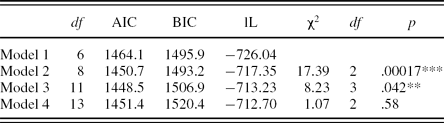
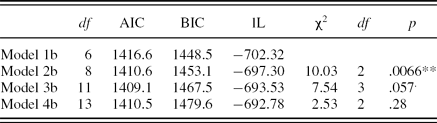
As summarized in Table 2, we ran a mixed-effect logistic regression model, Model 1, with all three fixed factors (and one random factor, Child). Then, we ran another mixed model, Model 2, which included all three fixed factors and an interaction between Condition and Time. When these two models were compared by a likelihood ratio test, Model 2 significantly improved the fit of the model to the data, χ 2 (2) = 17.39, p < .001. An additional mixed model, Model 3, included all the two-way interactions between all three factors of Condition, Time, and Age Group. When Model 3 was compared to Model 2, Model 3 significantly improved the fit of the model to the data, χ 2 (3) = 8.23, p < .042. Model 4, which included all the two-way and the three-way interactions between the fixed factors in addition to the random factor, did not improve the fit. For the best fitting Model 3, the estimated intercepts for the children varied with a standard deviation of 1.57.
The mixed-effect logistic regression models for predicting the usage of relative clause constructions
Note: AIC, Akaike information criterion; BIC, Bayesian information criterion.
**p < .01. ***p < .001.
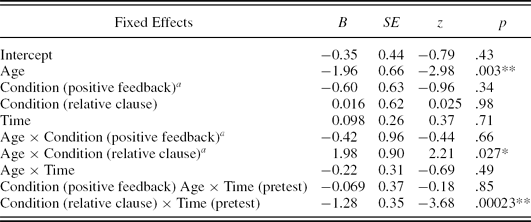
The mixed logistic regression results corroborated the descriptive statistics reported earlier. Table 3 reports the coefficients and other parameters of Model 3, which provided the best fit to the data. In this model, the only main effect was Age, with 4-year-olds providing more relative clauses overall than 3-year-olds (B = −1.96, SE = 0.66, z = −2.98, p < .001). The significant interaction between Condition (relative clauses) and Time (B = −1.28, SE = 0.35, z = −3.68, p < .001) indicates that the change of rate of usage of relative clauses from the pretest to the posttest was significantly greater in the relative clause training condition compared to the demonstrative noun phrase condition. The rate of change of the relative clause construction from pretest to posttest in the positive feedback condition was not significantly different from the demonstrative noun phrase condition. The significant interaction between age and condition (relative clause; B = 1.98, SE = 0.90, z = 2.21, p < .027) suggests that the rate of relative clause usage does not differ between 3-year-olds and 4-year-olds in the relative clause condition whereas 4-year-olds in the demonstrative noun condition use more relative clauses than 3-year-olds.
Fixed effects and their parameters in Model 3
Note: C = 0.747, Dxy = 0.494.
aThe demonstrative condition and the posttest time were chosen as the baseline.
*p < .05. **p < .01.
Because we were interested in whether the relative clause condition was unique in being more effective in facilitation of relative clauses, we fitted to the data three simpler follow-up models for each condition separately with only age and time as fixed effects. We confirmed that there was an effect of time in the relative clause condition only (B = −1.02, SE = 0.33, z = −3.05, p < .002), and no effect of time in the general feedback and the demonstrative noun phrase conditions. Although age did not significantly affect the rate of relative clause usage in the relative clause condition, 3-year-olds produced fewer relative clauses than did 4-year-olds, both in the positive feedback (B = −2.49, SE = 0.73, z = −3.39, p < .001) and the demonstrative noun phrase conditions (B = −1.96, SE = 0.63, z = −3.13, p < .002).
We ran another set of mixed logistic regression models considering the number of trials with uniquely identifying referential forms as our dependent measure, and again with Age Group, Training Condition, and Time as fixed factors and Child as a random factor. We ran Model 1b, with all three random factors (and one fixed factor). Then, we ran another mixed model, Model 2b, which included all three random factors and an interaction between Condition and Time. When these two models were compared by a likelihood ratio test, Model 2b significantly improved the fit of the model to the data over Model 1b. An additional mixed model, Model 3b, included all the two-way interactions between all three factors of Condition, Time, and Age. When Model 3b was compared to Model 2b, Model 3b had a borderline improvement to the fit of the model to the data. Model 4b, which included all the two-way and the three-way interactions between the fixed factors in addition to the random factor, did not improve the fit over Model 3b. Table 4 summarizes the results of the mixed logistic regression analyses predicting the rate of usage of uniquely identificational referential forms. Table 5 provides the parameters of the fixed effects in Model 3b. For the best fitting Model 3b, the estimated intercepts for the children varied with a standard deviation of 1.51.
The mixed-effect logistic regression models for predicting the uniquely identificational referential forms
Note: AIC, Akaike information criterion; BIC, Bayesian information criterion.
**p < .01.
Fixed effects and their parameters in Model 3b
Note: C = 0.892, Dxy = 0.783.
aThe demonstrative condition and the posttest time were chosen as the baseline.
**p < .01. ***p < .001.
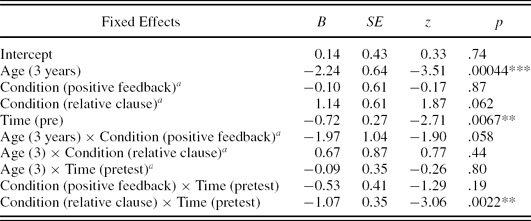
As summarized in Table 5, there was a Condition (Relative) × Time interaction such that there was a significantly greater increase in the use of appropriately identifying forms in the relative clause condition compared to the demonstrative noun condition. There was also an Age × Condition (Positive) interaction that merely reflects the fact that 3-year-olds produced fewer identifying forms in the positive feedback condition compared to the demonstrative condition. In addition to these interactions, there were main effects of time, age, and condition.
To check whether the use of uniquely identificational forms increased significantly with time for all the conditions, we fitted to the data three simpler models run for each condition separately, with age and time as fixed effects. The increase of unique identificational forms from the pretest to the posttest was significant for the relative clause condition (B = −1.88, SE = 0.33, z = −5.74, p < .001), the demonstrative noun phrase condition (B = −0.71, SE = 0.29, z = −2.46, p < .014), and the positive feedback condition (B = −1.20, SE = 0.34, z = −3.53, p < .001). Thus, merely by taking part in the task, children tended to improve in their ability to provide identifying forms. The relative clause training was just more effective in facilitating this change.
When we compared the distribution of relative clauses in the transitive action stickers to the intransitive action stickers, we found more relative clauses were used for intransitive items, both for the pretest items, χ2 (1, N = 957) = 9.85, p < .002, and for the posttest items, χ2 (1, N = 538) = 14.75, p < .001. The distribution of uniquely identifying referential forms was not significantly different for transitive and intransitive items, neither in the pretest nor in the posttest phases.
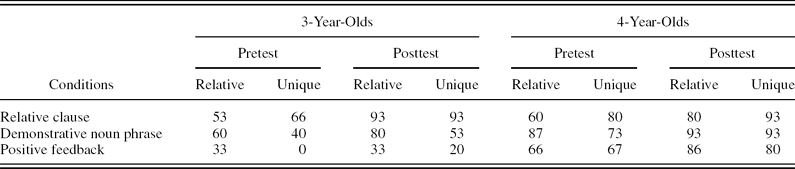
Finally, it is interesting to consider how many children were able to produce at least one relative clause or one uniquely identifying form at each time step. Table 6 shows the number (and percentage) of children who produced at least one relative clause or one uniquely identifying form during their pretest and posttest trials across conditions and ages. Going through the experimental procedure in all the conditions increased the numbers of children who are referentially clear, although it is clear that many 4-year-olds and a few 3-year-olds were able to produce a uniquely identifying form or a relative clause form even at the pretest.
The percentage of children who produced at least one relative clause and one uniquely identifying form during the pretest and the posttest trials across conditions and ages
DISCUSSION
We investigated the extent to which young Turkish learners increase their usage of referential forms that include relative clauses and uniquely identifying referring expressions as a result of three different types of training. In all three conditions, the children's actions of choosing the matching sticker to that of the experimenter were ratified 12 times, albeit in different ways. In the relative clause condition, a relative clause construction was provided, precisely and distinguishingly describing the right sticker that the child just picked up (i.e., havuç yiyen babayı seçtin, “you selected the dad eating carrot”). In the demonstrative noun phrase condition, the relevant noun preceded by the distal demonstrative o “that” was provided right after the child selected the right sticker (i.e., o çocuğu seçtin, “you selected that boy”). In the positive feedback condition, the child's selection was approved by a general approving comment about the choice (i.e., güzel seçtin, “you made a good choice”), providing no linguistic content about the referent.
The results confirm the first prediction and demonstrate that both 3-year-olds and 4-year-olds increased their usage of relative clause constructions for describing the sticker they needed when they were exposed to relative clauses in the training but not in the demonstrative noun phrase and positive feedback conditions. The adult modeling of relative clauses in the training session increased the tendency of children to use a construction type that they just heard from the adult experimenter, generalizing the pattern to similar constructions with different lexical items. Although 4-year-olds used higher rates of relative clauses in the pretest than did 3-year-olds, and those rates were positively associated with the posttest rates in both ages, both age groups showed a significant rate of increase in the relative clause constructions they generated when they were modeled with the relative clause construction. It is crucial to note that the books and therefore the pictured activities to be described during the posttest were different from the scenes used during the training and the pretest, with the requisite constructions calling for different verbs and nouns. Thus, any relative clause constructions produced by the children were not verbatim imitations of the E1's words in the training phase; they reflected, rather, productive use of the relative clause construction for another adult, E2.
These results support the previous training effects of Matthews et al. (Reference Matthews, Lieven and Tomasello2007), demonstrating that children's referring strategies could be improved by exposing them to adult models that demonstrate how target referents can be unambiguously talked about. However, we also partially corroborate Slobin's (Reference Slobin, Slobin and Zimmer1986) finding that Turkish relative clauses demand developmental time to be learned, because even in a task that specifically calls for relative clause usage, 4-year-olds produced relative clauses more readily than did 3-year-olds, and the 4-year-olds were far from ceiling even after training. In addition, we did not always observe perfectly produced and fully fleshed out relative clauses. Especially 3-year-olds experienced difficulties when articulating relative clauses. Headless relative clauses (such as in saying köpeği yıkayan, “dog-ACC wash-SR, the one washing the dog,” for the target sticker where the mother washes the dog) and inversion of the order of the actor and the undergoer (such as in saying şu çocuk binen traktör, “that child ride-SR tractor, that child . . . the one riding the tractor,” for the target sticker in which the boy drives the tractor) were common (Sarılar & Küntay, Reference Sarılar, Küntay, Taylan and Rona2011). Hermon et al. (Reference Hermon, Kornfilt and Öztürk2010) also report for Turkish learners (mean age = 4;8) similar head choice errors and reversals of the agent and patient in a picture-based elicited production task prompting relative clause usage. Such errors are not unique to Turkish. Brandt, Kidd, Lieven, and Tomasello (Reference Brandt, Kidd, Lieven and Tomasello2009) found that 3-year-old German learners often choose the incorrect noun phrase referent, not the head noun, in a referential choice task involving relative clause comprehension (for similar reversal errors, see Arnon, Reference Arnon, Brugos, Clark-Cotton and Ha2005, and Friedmann & Novorogrodsky, Reference Friedmann and Novogrodsky2004, for Hebrew, and Fragman, Reference Fragman, Hughes, Greenhill and Hughes1997, for French). It appears that these young children are still at the beginning of mastery of the relative clause construction as Slobin (Reference Slobin, Slobin and Zimmer1986) suggested, and their productions are often error prone. Nonetheless, the children's productions of relative clauses often appropriately included bits and pieces of the morphosyntactic machinery of the construction (Hermon et al., Reference Hermon, Kornfilt and Öztürk2010). As Diessel and Tomasello (Reference Diessel and Tomasello2005) argue for complex constructions, specifically for relative clauses, acquisition starts early, to be elicited in certain contexts and developing in a piecemeal fashion. Future work should be directed to determine where and why children (and adults) encounter problems in the online production of the morphosyntactic elements of relative clauses. As a starter, Sarılar (Reference Sarılar2010) found that the children in the current study were more likely to produce disfluency indicators such as restarts when they employed relative clause forms and uniquely identifying referential forms (e.g., ablayı, abla resim çiziyor, “the girl, the girl is drawing”) in requesting a sticker.
Turning to our second prediction, although the rate of relative clauses was only boosted in the relative clause condition, all three training conditions led to some increase in rate of uniquely identifying constructions from the pretest to the posttest for both 3-year-olds and 4-year-olds. Providing general approving comments about the child's selection as in the positive feedback condition or through a deictically grounded acknowledgment of the generic category of the character as in the demonstrative noun phrase condition seems to encourage young children toward usage of uniquely identifying descriptions. These descriptions often involved simple sentences conveying the unique contents of the sticker (e.g., baba havuç toplamış, “the dad has picked up carrots”) or two conjoined nouns without a verb (e.g., zürafa ve kız, “the giraffe and the girl”). Especially for 4-year-olds, the nonrelative clause training conditions seemed to facilitate the mention of the contrastive properties of the selected sticker in relation to the competitor. However, the training impact of the relative clause condition was stronger than in the other two conditions, in which feedback did not specify the discriminatory features of the selected sticker. This highlights how providing an example of an appropriate linguistic tool in a given communicative setting promotes development.
The effects we observe are highly reminiscent of structural priming (Bock, Reference Bock1986; see Pickering & Ferreira, Reference Pickering and Ferreira2008, for a review and Rowland, Chang, Ambridge, Pine & Lieven, Reference Rowland, Chang, Ambridge, Pine and Lieven2012, for a recent review of the developmental literature), a phenomenon that was first documented in the adult psycholinguistics literature. Structural priming is described as “unintentional and pragmatically motivated tendency to repeat the general syntactic pattern of an utterance” (Bock & Griffin, Reference Bock and Griffin2000, p.177). In addition, scene description and sentence imitation tasks show that children as young as 3 years can be primed to produce certain types of constructions (Shimpi, Gámez, Huttenlocher, & Vasilyeva, Reference Shimpi, Gámez, Huttellocher and Vasilyeva2007; Thothathiri & Snedeker, Reference Thothathiri and Snedeker2008).
Error-based implicit learning seems especially relevant here as a mechanism of structural priming (Chang, Dell, & Bock, Reference Chang, Dell and Bock2006; Kidd, Reference Kidd2012a) to explain the improvement that the children show in their production of relative clauses in our study. The tendency to choose a relative clause to ask for the specific sticker increases in the posttest, in particular as a result of prior exposure to relative clause constructions as an alternative to the construction that the children spontaneously produce. This tendency is also evidence of relatively “longer term persistence” (Kidd, Reference Kidd2012a) because the repeated presentation of the construction was used only during the training phase and had been terminated during the posttest phase, where we actually assessed the use of relative clause usage.
Although strengthening of structural knowledge might have taken place in our relative clause condition, it is not obvious whether it is the structural aspects of the relative clause construction or bringing its function of referential disambiguation to the foreground that led to the increased rate of both relative clauses and uniquely identificational forms. The form and the function of a construction are not really dissociable according to cognitive or constructivist approaches to grammar (e.g., Goldberg, Reference Goldberg2003; Langacker, Reference Langacker2008). If children are found to be using constructions appropriately and productively, this might mean they have grasped the needed pairings of the form with its typical discourse functions. As Kidd (Reference Kidd2012a) argues in explaining the effective structural priming of 4- to 6-year-olds’ use of passive constructions, an implicit learning mechanism might have served to lead to a stronger mapping between the relative clause construction and its referent identificational function. One way to test this might be to check whether children would restrict their use of relative clauses only to contexts where they were required (rather than being primed across the board). There is evidence from studies in English that children given referential communication training are able to learn to use structures selectively when they are required and are not primed in a “blind” manner (Matthews et al., Reference Matthews, Lieven and Tomasello2012).
In the same way that Gamez, Shimpi, Waterfall, and Huttenlocher's (Reference Gamez, Shimpi, Waterfall and Huttenlocher2009) observed less than perfect priming with a rare passive form in Spanish (the fue-passive form), the Turkish learners in our study were often using relative clauses with missing parts or resorting to other (often simpler) uniquely identifying constructions when modeled with relative clauses. Thus, rather than assuming that it was only structural priming that was facilitating the increased use of the construction by the children, the finding that the discourse-pragmatic function of unique identification was also fostered suggests that we can speculate about a “pragmatic priming” that was also in effect. In a recent methodological guide of using priming procedures with children, Vasilyeva, Waterfall, and Gomez (Reference Vasilyeva, Waterfall, Gomez and Hoff2012) point out a key question for future research is to determine how syntactic and nonsyntactic information interact to determine sentence reproduction.
However the nature of the priming was, what we find here is in line with a large body of literature showing a relationship between children's language and child-directed input. Production of grammatical forms and complex linguistic constructions by children in their spontaneous discourse often demonstrates repetition and partial or full imitation of previously heard utterances (Bloom, Rispoli, Gartner & Hafitz, Reference Bloom, Rispoli, Gartner and Hafitz1989; Clancy, Reference Clancy, Guo, Lieven, Budwig, Ervin-Tripp, Nakamura and Özçalışkan2009; Ervin-Tripp & Miller, Reference Ervin-Tripp, Miller, Bellugi and Brown1964; Keenan, Reference Keenan, Ervin-Tripp and Kernan1977; Köymen & Kyratzis, Reference Köymen and Kyratzis2009). Branigan et al. (Reference Branigan, McLean, Jones, Brugos, Clark-Cotton and Ha2005) found that children are especially susceptible to priming of relative clauses (more than adults in Cleland & Pickering Reference Cleland and Pickering2003) just because their initial syntactic representations are weaker. It is possible that just because relative clauses are not encountered frequently in everyday child-directed and child talk, an inverse preference effect takes hold. The inverse preference effect, where structures that are encountered relatively less often exhibit greater structural priming than more frequent structures, is a phenomenon already demonstrated for adults (Hartsuiker & Westenberg, Reference Hartsuiker and Westenberg2000).
We do not know whether the increase in the rate of usage of relative clause constructions and appropriately identifying constructions after being trained reflect facilitation of the learning of these constructions or a strengthened ease of access of these structures that the children are already familiar with (see Kidd, Reference Kidd and Kidd2011). The existence of an association between the pretest and the posttest scores suggests that the latter is definitely the case. However, there were also some children who did not use any relative clauses or uniquely identifying forms during the pretest but did so in the posttest; thus, it is possible some of the children were actually increasing their grasp of the form and/or the function of relative clauses. Of course, there is no way to precisely and task-independently determine the participants’ initial mastery of relative clauses in terms of structural or pragmatic knowledge. For children who did not produce relative clauses in the pretest, one could not be sure whether they totally lacked the pragmatic or structural means or the alternative ways of requesting the sticker were just more accessible. Still, the effect of the training of this relatively complex and relatively infrequent construction is impressive, given how rare it is for young children to use relative clauses in their spontaneous conversations in Turkish. That more than 40% of the requests were rendered in relative clauses in the relative clause condition both for 3- and 4-year-olds indicates that the training facilitated use of relative clauses over the level we would expect for the age. Although we cannot empirically distinguish between the effect of training as initial learning or strengthening of the usability of this construction in this study, from a theoretical point of view, structural priming might not be that separable from initial acquisition. As Chang et al. (Reference Chang, Dell and Bock2006) convincingly argue, “structural priming is a form of error-based learning, with the same learning mechanism responsible both for syntax acquisition and for priming” (p. 246).
As noted in the introductory section, most previous research with the acquisition of relative clauses have examined verb initial languages such as English, German (Brandt et al., Reference Brandt, Kidd, Lieven and Tomasello2009; Diessel & Tomasello, Reference Diessel and Tomasello2000; Kidd, Brandt, Lieven, & Tomasello, Reference Kidd, Brandt, Lieven and Tomasello2007), or Hebrew (Arnon, Reference Arnon2010; but see Ozeki & Shirai, Reference Ozeki and Shirai2010, for acquisition of relative clauses in Japanese, a verb final language). As Kidd (Reference Kidd and Kidd2011) points out, “The acquisition and processing of relative clause structures should be studied with a keen awareness of the broader properties of the input language that might help or hinder the acquisition of individual relative clause types” (p. 7). This study demonstrates that modeling this difficult construction in a well-motivated communicative setting dramatically improves the use of this challenging structure. In future work, we need to determine how individual differences in nonverbal competencies in addition to preexisting linguistic knowledge affect children's propensity to be primed and openness to benefit from different types of training (Kidd, Reference Kidd2012b).
As a caveat, these findings only relate to subject extracted relative clauses, although a lot of current theoretical debate centers on both subject and object relative clauses. Hermon et al. (Reference Hermon, Kornfilt and Öztürk2010) and Özge et al. (Reference Ozeki and Shirai2010) demonstrate late mastery in production of object relative clauses in Turkish while the appropriate performance involving subject relative clauses appears earlier. The current study includes a younger age group (3-year-olds with mean age of about 36 months) than in both of these studies, thus we do not know how children younger than the youngest participants of the Hermon et al. and Özge et al. studies would have fared in their tasks. However, future studies should train children on both subject extracted and object extracted relative clauses, since object relative clauses are structurally more complex and pose additional challenges to those of subject relative clauses.
It is clear that what we demonstrate here is priming that arises from comprehension of E1's talk, affecting children's own production for E2, that is, comprehension to production transfer (Pickering & Ferreira, Reference Pickering and Ferreira2008). The constructional pattern and the function of unique identification is gleaned from one dialogue with an adult with the child being on the receiving end and transferred to another dialogue with a different adult with the child now being on the speaker end. Although studies that aim at facilitating children's vocabulary competence exist, research about how syntactic (Vasilyeva, Huttenlocher, & Waterfall, Reference Vasilyeva, Huttenlocher and Waterfall2006) and pragmatic knowledge can be facilitated during early years is sparse. We show here it is possible to integrate training of a certain complex construction type, reflecting both syntactic and pragmatic competence in young children, into children's daily lives in an ecologically feasible way through relevant interactive dialogues. In this regard, this work has implications for preschool programs targeting children's syntactic–pragmatic proficiency.
APPENDIX A
Target stickers in the five picture books
APPENDIX B
Item analysis