The syndrome of 22q11.2 microdeletion is the most common involving microdeletion in the global population, with an incidence of around 1 per 4000,Reference Scambler1 usually found as new deletions. Although the spectrum of the ensuring clinical phenotype is extensive, and includes cleft palate, hypocalcaemia, thymic or immune deficiencies, developmental delay, difficulties in feeding, ocular abnormalities, and psychiatric illness,Reference Hay2 congenital cardiac disease is the most frequently observed clinical manifestation, occurring in three-quarters of patients.Reference McDonald-Mcginn, Kirschner and Goldmuntz3
In a recent study, such children were shown to be at high risk for mortality and morbidity.Reference Kyburz, Bauersfild and Schinzel4 The prognoses are rather different for those with congenitally malformed hearts in the absence of this kind of genetic abnormalities.Reference Weismann and Gelb5 Accurate pre-operative or prenatal genetic diagnosis, therefore, should prove helpful in health care and for genetic counseling of the patients and their families.
The currently available method for detection of the aberrations is fluorescence in situ hybridization, but this method is labour intensive and quite expensive, and may be unreliable in detecting some atypical deletions.Reference Jalali, Vorstman and Errami6 Recent research has indicated that multiplex ligation-dependent probe amplification is a more cost-effective and accurate diagnostic tool,Reference Fernández, Lapunzina and Arjona7 and also identifies cases not detected by standard fluorescence in situ hybridization.Reference Jalali, Vorstman and Errami6 In our study, therefore, we used a new multiplex ligation-dependent probe amplification probe set to detect the deletions and duplications of 22q11.2 in patients scheduled for congenital cardiac surgery, as well as in fetuses with congenital cardiac malformations diagnosed prenatally by echocardiography.
Materials and methods
Patients
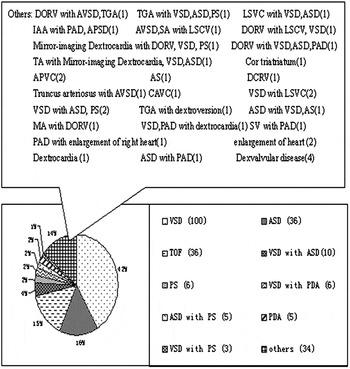
From November, 2006, through April, 2008, we enrolled patients for study from Nanjing Drum Tower Hospital, the Affiliated Hospital of Nanjing University Medical School, and Nanjing Children’s Hospital, a member hospital of Nanjing Drum Tower Hosptial Group. Appropriate approval was obtained for this study from the Committee for Ethical Clinical Research of both hospitals. Detailed data regarding the cardiac malformations was achieved primarily by echocardiography. Having obtained consent for genetic examination, we systematically collected 227 samples of peripheral blood from the patients scheduled for the cardiac surgery. Of these samples, 108 samples were from males and 119 from females, with 9 patients being neonates, 145 aged under 14 years, 5 aged 14 to 18 years, and 68 were adults, aged from 18 to 63 years. In the other 14 fetal cases with congenitally malformed hearts, we obtained samples of umbilical cord blood. Amongst all 241 cases, we found 100 cases of ventricular septal defect, 36 cases of atrial septal defect, 36 cases of tetralogy of Fallot; 10 cases of atrial septal defect combined with ventricular septal defect, 6 cases of pulmonary arterial stenosis, 3 cases of ventricular septal defect combined with pulmonary arterial stenosis, 5 cases of atrial septal defect combined with pulmonary arterial stenosis, 5 cases of patency of the arterial duct, 6 cases of ventricular septal defect combined with patency of the arterial duct, and 34 instances of other types of defect (see Fig. 1)
The spectrum of phenotypes of cardiac anomalies in our patients with congenitally malformed hearts. Abbreviations: DORV: double outlet right ventricle; AVSD: atrioventricular septal defect; TGA: concordant atrioventricular and discordant ventriculo-arterial connections; LSCV: left superior caval vein; VSD: ventricular septal defect; ASD: atrial septal defect; IAA: interruption of aortic arch; SA: single atrium; TA: tricuspid atresia; APVC: anomalously pulmonary venous connection; AS: aortic stenosis; DCRV: double chambered right ventricle; SV: functionally single ventricle; MA: mitral atresia; PAD: patency of arterial duct; TOF: tetralogy of Fallot.

Cases with 22q11.2 deletion
In order to have a preview of the multiplex ligation-dependent probe amplification probe set, we used 4 cases previously diagnosed by short tandem repeat analysis and fluorescence in situ hybridization. They included one case of no deletion, two cases with a typical 3 Megabase deletion, and one case with 1.5 Megabase deletion.Reference Yi, Xu and Mo8
Cell culture and karyotyping
Karyotypic analysis was performed on all patients, including the fetuses. We cultured the lymphocytes from peripheral blood or fetal umbilical cord blood. The traditional G-banding analyses, at about 400 bands level were completed.
DNA extraction
DNA was extracted from nucleolated cells of the blood following the standard phenolchloroform DNA extraction method.Reference Hu, Zheng, Xu, Wang and Cui9 The DNA samples were diluted using Tris-EDTA (Ethylenediamine Tetraacetic Acid) buffer. All samples were quantified by ultraviolet Spectrophotometer (Eppendorf).
Multiplex ligation-dependent probe amplification analysis
The SALSA MLPA kit P250 DiGeorge (Lot 0907) (MRC-Holland, Amsterdam) was used in this study to detect the variation of copy number in 22q11.2 region. This kit contains thirty probes on 22q11.2, including fourteen probes for commonly deleted DiGeorge region, five probes in Cat Eye Syndrome Region, eleven probes from LCR22-D to LCR22-G. The remaining 18 probes are located on 22q13, two probes, chromosome 10, 8, 4, 9 and 17 as controls. The experiments were performed following the instructions of the manufacturer, instructions and all runs included a normal control DNA for calibrating. The polymerase chain reaction products were loaded on an ABI 3130 Genetic Analyzer (Applied Biosystems) for collection of data. For sizing and peak area obtaining, GeneMapper software v3.7 was applied. The texts of data were exported and transferred to Coffalyser v7 (MRC-Holland) for analysis.
Results
Karyotypc analysis
We identified 4 aneuploidies, 3 instances of trisomy 21, and a mosaic trisomy 8 [47,XY,+8/46,XY(1:2)]. No other obvious structural abnormalities were found on the metaphase spreads.
Multiplex ligation-dependent probe amplification
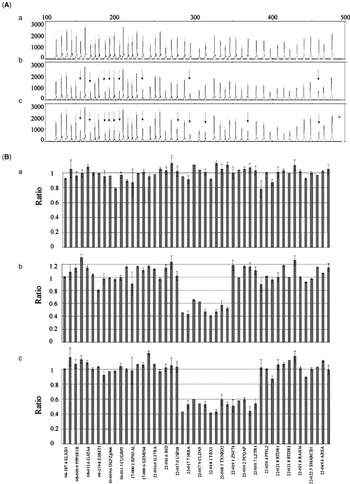
In the 4 samples already having definite genetic diagnoses, we confirmed the findings by multiplex ligation-dependent probe amplification. In 2 cases with typical “3 Megabase” deletion previously detected by short tandem repeat and fluorescence in situ hybridization, we found a homozygous value less than 0.7 from CLTCL1 to LZTR1 (LCR22-A to LCR22-D), about 2.0–2.5 Megabase deletions. The case with a 1.5 Megabase deletion gave a hemizygous result for the region from CLTCL1 to DGCR8, about 0.9–1.5 Megabase in size. The normal case showed ratios ranging from 0.78 to 1.13 (see Fig. 2).
Panel A shows multiplex ligation-dependent probe amplification electropherograms of three samples: two patients and a control, previously diagnosed by fluorescence in situ hybridization and short tandem repeat polymerase chain reaction. Amplified probes were detected as fluorescent signals, the area of each peak were calculated by Coffalyser v7 software. A-a: control sample. b: sample with a 1.5 megabases deletion region of 22q11.2. c: sample with a 3 megabases deletion region of 22q11.2. The arrows point out the decreased signal intensity of the peaks, compared with the control sample. Panel B shows the ratio charts of the samples above. X-axis was marked by the names of ratio bars discontinuously. The Y-axis indicates the ratio. a, b, c are corresponding to the a, b, c of A respectively.

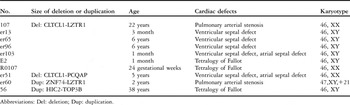
In the 241 cases, 7 cases were hemizygous from CLTCL1 to LZTR1. In 1 case, we found a different deletion region, from CLTCL1 to PCQAP, equal to LCR22-A to LCR22-C, about 1.6–1.9 Megabase in size. In these 8 cases, the cardiac phenotypes included 3 instances of ventricular septal defect, 2 of tetralogy of Fallot, 2 of combined atrial and ventricular septal defects, and 1 case of pulmonary arterial stenosis. We also found duplications in 2 cases. One spanned from ZNF74 to LZTR1 (LCT22-B to LCR22-D). This case also was a patient with trisomy 21, whose cardiac defect was pulmonary arterial stenosis. The other duplication spanned from HIC2 to TOP3B (LCR22-D to LCR22-E), and the patient exhibited tetralogy of Fallot (Table 1). Other probes on the referred chromosomes, such as chromosomes 4, 8, 9, 10, 17, did not reveal obvious changes in the number of copies.
The detailed information of the 10 patients with copy number aberrations within 22q11.2.

Abbreviations: Del: deletion; Dup: duplication.
Discussion
Though introduced only 5 years ago, multiplex ligation-dependent probe amplification has already proven an effective method for the detection of fragment deletions or duplications.Reference Janssen, Hartmann, Scholz, Jauch and Zschocke10 When studying 22q11.2 deletion, the SALSA MLPA kit P023B DiGeroge Syndrome/VCFS is more commonly used.Reference Fernández, Lapunzina and Arjona7, Reference Stachon, Baskin and Smith11 Recently, a high density multiplex ligation-dependent probe amplification probe set has specially been designed for detailed investigation on the deletion and duplication in 22q11.Reference Jalali, Vorstman and Errami6 The set used in our study also was of high density in the 22q11.2 region. There were 21 probes located in the same gene, but with different sequences than the corresponding probes used previously.Reference Jalali, Vorstman and Errami6 Specifically, 2 probes within LCR22-A, and 1 within LCR22-B, are different, but in the same location. The probes we used to cover the LCR22-E zone were also greater than those used previously.Reference Jalali, Vorstman and Errami6
Compared with our previous experience in detecting 22q11.2 deletion by short tandem repeat polymerase chain reaction,Reference Yi, Xu and Mo8 fluorescence in situ hybridization and real-time polymerase chain reaction,Reference Zhang, Xu and Yi12 we found that use of multiplex ligation-dependent probe amplification offers numerous advantages. The procedure is as rapid and convenient as short tandem repeat polymerase chain reaction and real-time polymerase chain reaction, and the results can be achieved in 2 days. It is more practical than short tandem repeat polymerase chain reaction, since the absence of parental specimens is not a barrier for analysis. The probes on 22q11.2 are much denser than used in real-time polymerase chain reaction. As a result, multiplex ligation-dependent probe amplification can give more reproducible results, more detailed information about the size of the deletion or duplication, and can even detect atypical deletions. Fluorescence in situ hybridization is considered as a standard diagnostic method, but the commercial probes, being located at the proximal end of the typically deleted region, fail to detect some atypical deletions.
We detected 10 cases of micro-deletion and micro-duplication of 22q11.2 using the set. Of the 8 cases with 22q11 deletion, 7 are hemizygous from CLTCL1 to LZTR1. They had the same deletion region as the previously confirmed 3 megabase deletion sample. As we calculated the detailed base pairs throughout this region using our multiplex approach, we found the deletion to be about 2 megabases, and at most 2.5 megabases. This was unexpected. Previous investigatorsReference Fernández, Lapunzina and Arjona7 identified the size of the region from HIRA to LZTR1 as 3 megabases using the SALSA MLPA kit P023B DiGeroge Syndrome/VCFS, which is a sparse probe set in 22q11.2. OthersReference Stachon, Baskin and Smith11 identified a specified deletion region for all patients, albeit a little shorter. They described a “common 3 megabase hemizygous deletion”. Since in these early periods, the only way to identify the break point of micro-deletion was fluorescence in situ hybridization, a more cursory probe, the initial definition of the commonly deleted region at 3 megabases should be considered approximate. Our study, and the other recent investigation,Reference Jalali, Vorstman and Errami6 have shown the deleted region to be less than 2.5 megabases, rather than 3 megabases.
We detected deletions or duplication in almost one-twentieth of our patients. This is higher than the rate previously detected in non-selected patients with congenital cardiac disease.Reference Botto, May and Fernhoff13 In our patients, we encountered ventricular septal defect, the lesion in combination with a defect in the oval fossa, tetralogy of Fallot, and pulmonary arterial stenosis. This spectrum is much different from that seen previously.Reference Botto, May and Fernhoff13 Our patients, however, reflect those already selected as requiring cardiac surgery, hence the propensity of septal defects. The more usually reported lesions in the setting of 22q.11 deletion, such as interruption of the aortic arch, or common arterial trunk, were rare in our series. The differences noted, therefore, probably reflect the bias introduced by the populations studied.
We also detected one uncommon region for deletion, and 2 cases of duplication. The deleted region was from CLTCL1 to PCQAP, while the duplicated regions mapped ZNF74 to LZTR1 and HIC2 to TOP3B respectively. Although not reported previously, the break points are close to the boundaries of known deletions or duplications. It is not unexpected, therefore, to find such variations. As HIC2 to TOP3B is downstream to the critical region of 1.5 deleted megabases, those seeking candidate genes for congenital cardiac disease should not focus exclusively on the 1.5 megabase region.
According to our study, the genetic anomalies are detected at a rate of about one in 20. These genetic abnormalities can cause more malformations and functional disabilities than congenital cardiac disease presenting in isolation. Investigation of these genetic problems prior to surgery may, therefore, prove helpful in improving the diagnosis and prognostication. Genetic information will be necessary for planning care, as well as choosing suitable strategies for management.Reference Weismann and Gelb5 Owing to the techniques for detection of micro-deletions being available for only a few years, the 22q11.2 deletion syndrome is not well known to many of those working in clinical practice. For example, in our study, the structural anomalies in one patient were recognized only after she was diagnosed by multiplex ligation-dependent probe amplification as having 22q11.2 deletion. This patient, aged 22 years, has an abnormally long face and unusually small ears. An absence of posterior nasal septum was detected by electronic nasoscope, and the left side of the face and the nasal pinna were larger than the right side. The patient also possesses a high arched palate, and she reports that one of her 2 brothers was born with cleft palate. These phenotypes were not noted in our first evaluation, which strongly suggests that patients with congenitally malformed hearts should undergo genetic screening during pre-operative investigations. In addition, prenatal genetic molecular diagnosis in those with recognized cardiac defects could also provide additional information, which might assist parents in choosing either to continue or terminate the pregnancy.
Acknowledgements
Supported by Jiangsu Province’s Outstanding Medical Academic Leader program; Supported by Jiangsu Province’s Key Laboratory; Supported by Jiangsu Province’s Social Development program; Supported by Jiangsu Key Laboratory for Molecular and Medical Biotechnology.