I. INTRODUCTION
The development and application of high and new technology is often inseparable from discovery of new materials, and most of the new materials research and development starts with synthesis and characterization. Polynary compounds compared with binary compounds have additional constituent elements and potentially a diversity of structure. These compounds may exhibit excellent properties for developing new function materials. As far as we know, previous studies of the RE–Al–Cu–Ni quaternary system have reported several quaternary compounds: AlCeCu2Ni2 (Sinha and Wallace, Reference Sinha and Wallace1984), AlCuLaNi3 (Burnasheva et al., Reference Burnasheva, Petrova, Semenenko, Zhang and Bobev1984), and AlCu0.2 LaNi3.8 (Li et al., Reference Li, Wang, Chen, Luo, Chen and Yang2009). These compounds have a hexagonal structure, space group P 6/mmm (No. 191) with the CaCu5 (Haucke, Reference Haucke1940) structure type. So far, we have not found any powder diffraction patterns of quaternary compounds of RE–Al–Co–Ni quaternary system included in the Inorganic Crystal Structure Database (ICSD Database, 2015.01). Therefore, in this paper, we present high-quality experimental powder X-ray diffraction (XRD) data for AlCeCo2Ni2.
II. EXPERIMENTAL
A. Synthesis
Polycrystalline specimen of AlCeCo2Ni2 was prepared by arc melting using a non-consumable tungsten electrode and a water-cooled copper tray under argon atmosphere. Aluminum (purity of 99.9%), cobalt (purity of 99.9%), cerium (purity of 99.99%), and nickel (purity of 99.9%) were used as the starting materials. Titanium was used as an oxygen getter during the melting process. The sample was remelted several times in order to ensure complete fusion and homogeneity. Weight losses were <1 wt%. After melting, the sample was enclosed in an evacuated quartz tube and annealed at 1053 K for 720 h, then cooled down at a rate of 12 K h−1 to room temperature. Before X-ray measurements, the sample was ground in an agate mortar and pestle to particle sizes of no larger than 30 μm.
B. Data collection
The powder XRD patterns of AlCeCo2Ni2 compound were collected at room temperature on a Rigaku Smart Lab 2006 powder diffractometer using CuKα radiation and a diffracted-beam graphite monochromator. The diffractometer was operated at 40 kV and 150 mA, the 2θ scan range was from 10° to 100° with a step size of 0.02° and a count time of 3 s per step. The X-ray goniometer optics were 300 mm goniometer radius, receiving slit of 0.3 mm, ½ deg. incident and diffracted beam anti scatter slits, incident and diffracted beam solar slits, and a scintillation counter detector, the stabilities of both the X-ray source and the specimen were checked by recording again the diffraction lines at low angles. Two sets of XRD data were collected: one with SRM 640a Si added as an internal standard to correct for possible systematical errors in the observed peak positions and the other pure sample do not add anything. All the XRD data samples used a flattened surface when data were collected. In order to reduce the preferred orientation for the intensity data, the samples were ground to particle sizes of no larger than 30 µm, and do not exert external force as far as possible. The XRD pattern recorded from the specimen added with Si internal standard was used for indexing and for determining space-group and unit-cell information, while the XRD pattern without Si internal standard was used for determining diffraction intensities. The 2θ obs values of the peaks were determined by the Savitzky–Golay second derivative using JADE 6.0 (Materials Data Inc., 2002) XRD Pattern Processing software of Materials Data, Inc. after smoothing the patterns, fitting and removing the background, and stripping the CuKα 2 peaks. Values of unit-cell parameters were then obtained by the least-squares method using JADE 6.0.
III. RESULTS
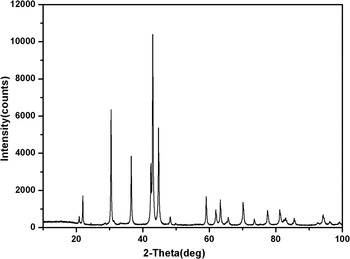
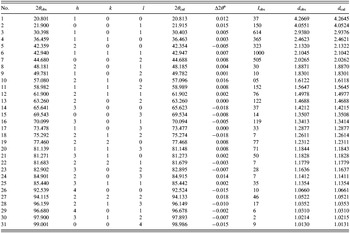
The experimental XRD pattern of compound AlCeCo2Ni2 is shown in Figure 1. All lines were successfully indexed using the Jade6.0 program in the hexagonal system. By comparing powder XRD data with those of AlCeCu2Ni2 (Sinha and Wallace, Reference Sinha and Wallace1984) and AlCuLaNi3 (Burnasheva et al., Reference Burnasheva, Petrova, Semenenko, Zhang and Bobev1984), it was found that AlCeCo2Ni2, AlCeCu2Ni2, and AlCuLaNi3 have the same structure type P 6/mmm (No.191). Using the corrected diffraction data of AlCeCo2Ni2, the accurate unit-cell parameters were obtained with a = 4.9242(2) Å, c = 4.0524(1) Å, V = 85.1 Å3, Z = 1, and ρ x = 7.85 g cm−3, which is very close to the experimental density (about 7.55 g cm−3). The figure of merit for indexing F N (Smith and Snyder, Reference Smith and Snyder1979) is F 30 = 130.2 (0.010, 30) and the value of RIR (RIR = 0.71) was obtained from the value of the ratio of the strongest line in the pattern to the strongest line of corundum in a 50–50 wt.% mixture of the two compounds. The observed and the calculated X-ray powder diffraction data for AlCeCo2Ni2 are listed in Table I.
The powder XRD pattern of AlCeCo2Ni2.

Powder diffraction data for AlCeCo2Ni2 (CuKα 1, with λ = 1.540 60 Å).

a Δ2θ = 2θ obs–2θ cal.
SUPPLEMENTARY MATERIAL
The supplementary material for this article can be found at http://dx.doi.org/10.1017/S0885715616000300.
ACKNOWLEDGEMENTS
This work was supported by the Scientific Foundation of Guangxi High Education (Grant No. KY2015YB279) and Science and Technology Research Foundation of Guangxi (Grant No. 14122005-12).