I am to set before you the advantages of organization. The benefits of organization are so numerous and so diversified, and in some instances so obscure that to discuss all of them would require considerable time …[particularly] the existence of the National Metal Trades Association and kindred organizations of employers, originated in the militant attitude assumed by aggressive labor leaders towards the individual employer.
—Andrew J. Allen, Secretary of the Indianapolis Branch of the National Metal Trades Association (NMTA), addressed to the Ninth Annual Convention of the National Metal Trades Association, in Boston, MassachusettsFootnote 1
The Open Shop has made Detroit a great industrial center,
Detroit needs the Open Shop if she is to continue to advance…
What can Mr. Average Citizen do to promote the welfare of Detroit and incidentally, of his fellows, his family, and himself?
The answer is a simple one:
Property owners specify the Open Shop and employ only local contractors who are fighting for progress.
Purchasers of goods buy only from Open Shop producers.
If you need printing, seen an Open Shop printer.
Manufacturers buy patterns and castings from open pattern shops and foundries.
Think Open Shop!
Talk Open Shop!
Yes, and vote for those who support the Open Shop. Footnote 2
Andrew J. Allen's address to the member firms at the annual convention of one of the most prominent American employer organizations, the source of the first epigraph, exhorted the National Metal Trades Association's (NMTA's) member firms to commit more resources to the organization. It was a plea for firms to devote more resources to enforce the principles of an organizational movement to unite firms against the demands of U.S. unions. This effort is an example of an attempt to expand local-level firm coordination in response to the “militant attitude” of workers. The second epigraph, showing the type of organization that Allen praised, is from an advertisement posted by the Employers’ Association of Detroit in 1926 and displays the rhetoric and strategies of local-level employer associations.
This effort of organizational leaders raises theoretical and historical questions about what circumstances drive employer organizations to form in response to workers’ demands. Why did some localities in the United States experience such organizations while others did not? Despite recent work in comparative politics that seeks to explain variation in the formation of encompassing employer associations by using evidence from the United States, and the long-standing attention of labor and business historians to the relationship between U.S. institutional labor repression and weakness of the labor movement, few studies examine the determinants and variation of another source of labor repression in the early twentieth century in the United States, that of local-level repressive employer associations. Previous historical research explores the impact of select local- or national-level employer associations in the United States, but it does not explain their emergence at the local level. Further, the increasing attention of the subfield of comparative political economy on the historical origins of industrial institutions has generally ignored early repressive employer associations; this literature largely theorizes that early employer associations were collaborative and primarily engaged in collective bargaining with workers.Footnote 3 The absence of studies on the diffusion of local-level employer associations, particularly those espousing the open-shop anti-union movement, is surprising, given that such associations have been linked to the decline in union membership and major setbacks experienced by the labor movement in the interwar period. Such associations, when they could form, were generally effective in disseminating anti-union propaganda and engaging in local repression of workers.Footnote 4 Studying the development of these local-level employer associations in the United States can broaden our understanding of the causes of labor-repressing institutions in the early twentieth century, as well as provide an opportunity to test competing theories of the collective action of firms. Collective employer repression inhibited organized labor in the United States, but it remains an undertheorized outcome in the comparative political economy literature and a relatively neglected phenomenon in the historical and sociology literature on U.S. labor repression.
In this article I present and test different families of hypotheses of collective employer repression during the interwar period, using new data on local variation in employer associations that supported the anti-union open-shop movement at the county level. The data allow for consideration of many hypotheses derived from both theoretical and historical literatures that have not been systematically tested. I consider hypotheses that predict the baseline impact of structural factors that affect collective action, redistributive threats from organized labor, and political opportunities for collective action. The data provide evidence from the important anti-labor open-shop movement in the United States during the early 1920s. This movement was one of industrial firms engaging in collective repressive strategies against unions before the Great Depression, with local and regional employer organizations that espoused an ideology and policies that restricted union presence at the plant level and undermined the nationalization of the labor movement. The data measure participation in this movement at the U.S. county level during the interwar period, capturing subnational variation in such coordination. I also consider a large set of variables that can function as proxies for the historical factors that should be relevant for locality-level variation in employer associations, including measures of the different types of labor union locals that formed in the late nineteenth and early twentieth centuries and county-level measures on the legacy of previous labor organization, labor conflict, and pre-WWI employer associations.
I find that firms’ adoption of repressive employer organizations against workers arose in response to higher levels of threats posed by labor and that more recent threats as opposed to legacies of labor organization are more relevant. Additionally, the credibility of workers to win strikes, as indicated by previous strike success, also affects the collective action of firms. The evidence points to the relative importance of more proximate threats by organized labor, as opposed to just the historical organizing capacity of workers. But, the general structural features of a locality that condition incentives for collective action appear to be less important, and many do not positively correlate in expected directions with the adoption of collective employer repression.
These findings provide more systematic evidence regarding the instruments of firm and state repression of workers in the early twentieth century and also contribute to the limited literature on the causes of repressive strategies of earlier employer associations. Besides contributing to our understanding of the emergence of different kinds of employer coordination, the article also shows how these critical, interwar local-level organizations that inhibited labor—the level at which much repression actually occurred—were a response to previous union organizing. The results help arbitrate among the many competing theories of firm associations during a period of greater antilabor sentiment and shed new light on the origins and politics of the open-shop movement of the interwar period.
The article proceeds as follows. The first section reviews the related existing literature and extant questions and discusses the particular relevance of the open-shop movement. The second section explores the history of the open-shop movement in the United States. The third section presents the hypotheses and operationalization of specific variables. The fourth section describes the data and empirical tests. The fifth section presents the results. The sixth section contains the conclusion and discusses implications.
EMPLOYER ASSOCIATIONS AND LABOR REPRESSION IN THE UNITED STATES
The subject of general U.S. labor repression in the early twentieth century and interwar period has received ample scholarly attention in the fields of sociology and labor history, and a few signature studies document the roles of specific employer associations in the inhibition of the labor movement. The bulk of existing research in the social sciences and history on the role of such associations chronicles the activities of several prominent national or sector-level associations and their role regarding connections to the political establishment (such as political parties). The few studies in political science that examine historical U.S. employer associations do so with the goal of explaining why the United States in the early twentieth century did not develop more corporatist or more encompassing employer institutions compared to continental Europe. These studies focus on the influence of the lobbying association of the National Association of Manufacturers (NAM) and its connection with the Republican Party and argue that the U.S. two-party system and geographical sectional divisions explain the NAM's inability to become a more encompassing national association.Footnote 5 Such accounts contribute to a larger comparative politics debate regarding the origins of national-level firm institutions of coordination, and whether electoral systems (majoritarian versus proportional) play a role in spurring peak institutions.Footnote 6
The findings about the NAM are complemented by several rich case studies in U.S. labor and business history by historians and sociologists on the roles that sector-level associations played in repressing organized labor movements. This broader conception of employer coordination documents how these employer associations undermined unionism. Although such associations varied in recruiting and enforcement procedures, they generally functioned with member firms contributing to a collective fund and abiding by organizational rules in return for assistance during industrial conflict. Such services helped firms prevent or undermine union activity, preserving the employer's claimed “right to manage.”Footnote 7 Firms in these repressive employer organizations coordinated to prevent or minimize union influence within individual firms and plants and agreements that would challenge firms’ flexibility in setting wages.Footnote 8 As discussed in the subsequent section, other organizational instruments included the use of strikebreakers and substitute labor during labor industrial disputes, the use of blacklists to alert firms to employees’ previous affiliations with unions or political organizations, and lobbying the state for use of coercive personnel to enforce lockouts or repress workers.
This recent scholarship in U.S. labor and business history documents how employer associations in select localities undermined local-level unions. Important works discuss the development of the National Metal Trades Association (NMTA) in select regions, including meticulous accounts of the founding of the Metal Manufacturers’ Association of Philadelphia (MMA) in Philadelphia and its successful battles against the International Molders’ Union (IMU),Footnote 9 and the rise of the National Erectors’ Association (NEA) and its conflict with the International Association of Bridge, Structural, Ornamental, and Reinforcing Iron Workers (IABSIW).Footnote 10 These accounts detail how open-shop or related movements formed and responded to industrial conflict and demands by workers.Footnote 11 Voss specifically describes the relevance of local-level employer associations regarding the formation of the Knights of Labor (KL) in New Jersey and concludes that the KL in New Jersey foundered in the late 1800s due to employer opposition and the choice of the government not to intervene on the KL's behalf.Footnote 12 This is one of the few quantitative studies that isolates the impact of employer organizations on union organization, with a focus on the KL in New Jersey. Overall, this recent historical work on these associations documents their negative impact on local-level union success and mobilization.Footnote 13
The descriptive studies on the negative impact of employer associations on organized labor movements are connected to the voluminous historical literature on the different repressive political institutions that contributed to a weaker U.S. labor movement, in comparison with other Western European democracies.Footnote 14 These research agendas describe the connection between state institutions and reduced labor mobilization, such as the roles of the U.S. executive branch, state-level political institutions, the judicial system (particularly its support of antitrust enforcement against unions and enforcement of anti-injunction legislation), congressional legislation, and the use of coercive apparatus (soldiers or police) to put down strikes.Footnote 15 Other scholarship discusses the roles of major individual firms in repressing workers and how economic and political actors could act in tandem to repress workers.Footnote 16
Thus, while the recent attention in political science to the political origins of major business associations neglects the repressive dimension to such associations, the historiography of select major U.S. employer associations that documents repressive strategies focuses less systematically on their theoretical origins and, importantly, their advent at the local level. Many of the above studies that discuss national-level lobbying do not address the roles of local-, sector-, and regional-level employer associations. This historiography neglects other antilabor movements or collective employer repression as a strategy.
Absent from both of these discussions are research and evidence about the overall variation in the emergence of such relevant local associations, which would address why some areas experienced repressive employer associations while others did not. This is unfortunate, as repression against workers actually took place largely at the local level, but we lack evidence and testing of explanations regarding where this type of repression emerged against workers. There has been relatively little theorizing and evidence in the fields of comparative political economy and American political development regarding variation in the adoption of coordinated repression. Although a handful of detailed qualitative studies of individual associations note their large negative impact on workers, we do not have systematic evidence about their local-level variation. We thus know little about where and why local-level collective repression emerged as a firm strategy.Footnote 17 Assessing which factors correlate with the rise of such associations within the United States can contribute to understanding broader cross-national and historical trends in the rise of repressive employer coordination.
Beyond the comparative politics scholarship, this omission of the study of local-level coordinated repression is unfortunate for several reasons related to the study of American political and labor development. First, as noted above, the actual pushback against and repression of labor unions largely first occurred at the local level. When associations of firms organized, their starting point was at the level of cities or counties, and it is in these initial environments where decentralized organizations first inhibited labor organizations. As Bernstein extensively chronicles in his account of the U.S. labor movement in the interwar period, the American labor movement faced difficult economic times, minimal wage increases, and organizing setbacks in the immediate post-WWI era and during and throughout the 1920s.Footnote 18 He and other historians document the negative impact of such associations on union organizing and density during this period.Footnote 19 Thus understanding their emergence, given that that was the locus of repression, is key to understanding how labor movements were inhibited after WWI.
Further, understanding the diffusion of local-level employer associations against unions deepens the extant literature on how decentralized political institutions inhibited national organizing capacities of workers. While much previous literature on federalist institutions focuses on how the decentralized institutions such as state legislatures and governors affected national-level labor organization, the resurgence of the open-shop anti-union movement during the interwar period is indicative of how the decentralized nature of the U.S. political system facilitated such industrial coordination against workers. Whereas previous literature dwells on national-level efforts at coordination, and other literature shows how both state-level institutions and the U.S. federalist system prevented effective labor organization, few studies examine the role of local-level institutions and organizations that initially mattered most.Footnote 20 Thus better understanding the politics and origins of interwar antilabor coordination, via the open-shop movement, is instructive about how local-level interest group agendas can emerge and become effective in highly decentralized political environments, where industrial activity and worker organization in geographically dense localities is most relevant for firms.Footnote 21 In a large, federalist, and decentralized system like the United States with much local-level autonomy of firms, there was much variation in the capacity of firms to organize against workers, and a natural task is to account for such variation. This local-level variation in firm strategies with respect to workers ultimately contributed to difficulties in forming coherent, antilabor associations that persisted, and other regional, sector, and national-level anti-union employer associations also used rhetoric and techniques that partially drew on some of the successful local-level firm efforts at coordination. While other research notes the connection between local urban political institutions and worker movements,Footnote 22 this literature has also not focused on the origins of important firm-initiated organizations.
Finally, understanding variation in the development of local-level employer associations in the United States is relevant for the larger issue of the conditions under which firms can collectively act, a classic issue in the development of corporatist institutions. But this outcome is rarely examined at the local level, nor was the original theoretical discussion of collective action (of firms or other elite actors) focused on the issue of labor repression.Footnote 23 Understanding such patterns can help test competing theories of which factors should facilitate this type of collective action among firms and thus contribute to the study of collective action among different types of actors.
Explaining variation in local-level repression requires data to document where it occurred and information on what the correlates of such local-level repression were. To more rigorously test some of the implicit theories in these historical accounts regarding development of employer associations, as well as standard theories of collective action that should apply to firms, I use new data from a time period in the United States where such employer repression was organized in response to labor attempts to improve worker conditions and institutions during the early interwar period.Footnote 24
THE UNITED STATES AND THE INTERWAR OPEN-SHOP MOVEMENT
The U.S. interwar period is an instructive one in which to examine the development of repressive employer coordination, as much variation exists in the emergence of such coordination across different industrial sectors as well as localities. This is most relevant when considering the emergence of local-level associations of firms that supported the open-shop anti-union movement, as such coordination of firms to check and roll back union activity proliferated after WWI. The movement itself in the interwar period reveals much about the dynamics of local-level antilabor organization, because it consisted of firms joining local-level employer associations to undermine craft and industrial unionism and to develop and spread anti-union messages. Such associations sought to prevent union infringement on firms’ supposed right to set wages, working conditions, and control of training. It was the intention of employers to dismantle wage-compression agreements set up during the war and to restore the prewar status quo of U.S. industrial institutions, which was more hostile to labor. The movement sought to revive anti-union labor sentiment in the general public.
The re-emergence of local-level antilabor coordination was a result of the failure of national bargains after WWI and the waning capacity of wartime labor institutions. After the end of the war, major firms and prominent employer associations discussed the ending of government-imposed wage agreements that had been implemented during the war.Footnote 25 Their preferences regarding policies and industrial institutions appeared in trade publications and at President Woodrow Wilson's National Industrial Conference in September 1919. A government objective of the conference was to derive an agreement about postwar industrial institutions that would resolve labor disputes that had emerged since the end of the war. The conference included representatives from employer organizations such as Magnus Alexander, the head of the National Industrial Conference Board (NICB); James A. Emery of the NAM; J. W. O'Leary of the NMTA; and representatives from large corporations.Footnote 26 The labor delegation included the leadership of the American Federation of Labor (AFL), including Samuel Gompers, as well as leaders of major railroad unions.
Union leaders at the conference preferred to continue the framework that had been established by the National War Labor Board, which had given workers the right to bargain collectively. But as Hurvitz notes, the business delegates’ preferences were “diametrically opposed” to those of unions,Footnote 27 and employer representatives advocated returning to prewar labor outcomes and dismantling collective bargaining. To accede to union demands, as one industrial representative put it, would be “nothing short of a national calamity, for it would set up a dominating power side by side with the National Government which would have an influence and a force … [that] no private organization should possess.”Footnote 28 Alexander, the head of the NICB, advocated at this conference the principle of the open shop, indicative of the general employer belief at the conference that unionism imposed unfair restrictions on firms’ managerial authority.Footnote 29 Employer intransigence caused the conference to end without any resolution, and largely anti-union and repressive preferences of key employer associations were attained, preventing continuation of wartime wage agreements and labor regulations. The open-shop movement that emerged in the wake of the collapsed national conference challenged organized labor and union efforts to maintain and extend such wage agreements. From the employers’ perspective, the perception was that firms, after the period of war-induced government intervention private intervention, needed to “win back” managerial authority over workers. William H. Barr, the President of the National Founders’ Association, succinctly stated the goal of liquidating wartime wages.Footnote 30
After the failure of these industrial conferences, and in the context of the massive strike waves of 1919 (where an estimated one in five workers at some point went on strike),Footnote 31 firms in some localities began forming open-shop associations (OSAs) to roll back unions. The resulting movement was characterized by the diffusion of employer associations across counties that supported open-shop or anti-unionization principles for member firms. These associations generally formed in the metal-manufacturing and finished-goods industries, among other sectors. The phrase “open shop” refers to an objective of the owners of a firm to have the choice and “right” to hire and fire workers regardless of their union affiliation. The term also refers to the firm owner's perceived right to manage worker training without interference from apprenticeship demands from workers, and to pay wages and benefits as the owner saw fit. The movement had an ideological component and use of patriotic rhetoric that used the language of firms’ rights to oppose collective bargaining; local and sector member associations’ publications provided information to member firms on the status of legislation and union demands in other states and localities.Footnote 32
Firms involved in the movement and regional and local offices produced an array of publications and propaganda to promote its policy goals to reduce the political and economic influence of workers. The NMTA published The Open Shop, with articles from prominent industrialists on threats posed to firms by unionism and pro-labor legislation, and the NAM published in 1921 a guide to the open shop for distribution in public schools and libraries.Footnote 33 Other publications such as the Iron Trades Review and Metal Trades Bulletin discussed the progress of legislation at the state and federal level that was framed as detrimental to firms. They also included information on industrial trends and economic data. This diffusion in local associational activity coincided with increased activity from national-level employer associations that used aggressive and sometimes violent means to defeat unionism, such as in the steel-making and steel-erection industries. The goals of these local and state organizations characterized what has been called “undoubtedly the most militant and widespread offensive ever undertaken by the American employing class—a class which has probably shown greater vigor and fighting spirit than in any other country.”Footnote 34 The end of sustained government support for unionism after the war provided an opportunity for firms to strike back.Footnote 35
Local and regional collective repressive associations sought to achieve anti-union goals through several instruments. They imposed rules prohibiting employers from hiring union or formerly union-affiliated workers, coordinated blacklists that prevented workers with any union history from being hired, imported strikebreakers, and tried to consign member firms to participate in lockouts to enforce their aggressive anti-union stance. An instrument of such associations was the multi-employer sympathy lockout in response to strikes. Employers in a city would agree to lock out union-affiliated workers in the event of a strike, in order to force unions to use as much of their strike-support funds as possible. This strategy countered the union strategy of engaging in whipsaw strikes against individual firms and forcing them to concede individually. Sustained employer coordination at the local level, with the weapon of the lockout, undercut such union activities. Beyond these instruments that directly targeted union workers and treasuries, local- and state-level employer associations lobbied state governments for legislation against unions, such as outlawing pickets and allowing the use of court injunctions against strikes.Footnote 36 Open-shop associations could also use techniques of worker discrimination such as firing or blacklisting workers who were part of unions, use injunctions against strikes, and hire detective agencies for industrial espionage or supply such spies themselves.Footnote 37
One of the first documented city-level associations formed in Seattle; historians note that this was likely due to the ending of the general strike that had just occurred and a reaction to the previous city-wide strike in Seattle in 1919.Footnote 38 The OSA formed in 1919 by the Waterfront Employers’ Association, which then allied with other business associations and firms, and formed the Associated Industries of Seattle.Footnote 39 Firms in industries such as manufacturing and retail merchants in other cities formed both industry-specific and more general anti-union OSAs. Associations formed in Beaumont (the retail merchants association declared an open-shop policy in April 1919), San Antonio, Toledo, Louisville, Miami, San Diego, Indianapolis (with the influential Associated Employers of Indianapolis), and St. Paul.Footnote 40 As an example of the orientation of such local-level associations, the Industrial Association of San Francisco, established in November 1921, was primarily directed against unions in the construction industry and had large-business employers in building, manufacturing, retailing, and banking. The association maintained a non-union supply of workersFootnote 41 and was also against the closed shop in building trades.Footnote 42 Associations were often established by specific industries, though they sometimes adopted city titles for their movements. By 1922, more than 200 U.S. counties had employer organizations.Footnote 43 These OSAs generally functioned as described here, with member firms paying dues and agreeing to comply with institutional rules such as participating in a lockout and in exchange receiving information and industrial-relations services. They received assistance in times of strikes and supporting funds to compensate for lost productivity during lockouts. Some OSAs also published local trade journals and circulated information on labor conditions and wages of firms. They distributed information about ongoing and potential labor organizations and could provide strike assistance when a member firm asked for it.Footnote 44 The few historical descriptions of the local-level associations describe the movement as a reaction to the end of the 1919 strike.Footnote 45 The available evidence indicates that the open-shop movement was initially composed of firms responding to local-level labor organization, although the backdrop was the threat posed by the 1919 strike wave, the failure of national-level negotiations, and the desire to recapture gains that were lost during the war.
Studying the variations in the formation of OSAs provides an opportunity to test hypotheses about the causes of these variations in repressive employer coordination. I use data on the locality-level presence of OSAs to measure instances of repressive employer coordination, as the existence of a local OSA is the best available proxy for firms’ repressive coordination against workers, because it is a discrete unit of a collective repressive employer organization. Despite the influence of the open-shop movement on U.S. industrial relations and its brand of ideological anti-unionism, little scholarship has systematically examined its diffusion. As noted here, rich descriptions of specific associations’ activities during this time period do exist, but there has been little use of systematic data to explain why OSAs emerged in some counties and not others.Footnote 46
THEORETICAL PERSPECTIVES AND HYPOTHESES
What theoretical factors can explain variation in the local county-level presence of OSAs? What might account for why some firms in localities were able to do so, while others were not? Given the scarcity of empirical studies of the development of the open-shop movement in the United States and the absence of studies regarding variation in repressive employer coordination more generally, I draw on theoretical literatures that have been applied to business collective action and inferences based on claims made by some of the local-level associations, and from those sources, I outline a basic set of hypotheses. I consider variables that should affect the probability of adoption of an OSA at the local level.Footnote 47
The descriptive evidence of initial local employer associations suggests the need to distinguish among locality-level variables that affect the probability of organizing. I draw on these accounts and the wider literature on collective action and relevant social movements (though the latter has been more sparingly applied to firms).Footnote 48 I test different families of arguments that have been posited or that follow from the cases discussed above; the goal is not to definitively arbitrate among them, but rather to see which variables that function as proxies for these perspectives seem to have more explanatory weight. These include the existence of a legacy of previous coordination, structural factors that would prevent or facilitate firm collective action, the overall threat from workers posed to firms, and the political context that would facilitate firm-level action.Footnote 49 These families of hypotheses are not exhaustive, of course, but they cover many possible competing explanations for why employer associations were formed at the locality level.Footnote 50 Within each theoretical perspective, we can decompose the category into more precise explanations, discussed in the next section.
Previous Firm Organizational Presence
Sensibly, previous organizational experience from before World War I should affect the probability of association presence in the interwar period. It could be because this organizational legacy indicates that firms in the locality have previously surmounted collective action problems, previous institutional apparatus might exist, or firms in the locality have recollection of previous successful associations, even if such associations did not persist between their initial founding and the open-shop movement after WWI. Literature on organizations in other contexts details the importance of historical legacies and continuity in explaining later variation.Footnote 51
Structural Factors Inhibiting Collective Action
I now turn to explain separate variables that constitute structural factors that should affect collective action among firms. These structural factors can affect individual-level firm decisions to join an association, as well as the eventual internal organization of an association.
Number of Firms
A straightforward insight from collective action theory is that the incentive to collectively act is decreasing in the number of firms; this observation specifically about employer associations is also emphasized in Schmitter and Streeck.Footnote 52 The number of firms in an area should be negatively related with the adoption of repressive employer organizations. Consistent with classic theories of collective action that emphasize incentives to free-ride on public goods provided by associations, an increased number of firms should reduce the probability of successful collective action among firms.
Local-Level Industrial Heterogeneity
Another important structural feature of a locality that should affect incentives of firms to collectively act is the overall economic differences among sectors and firms. Collective action should be more difficult if firms have different industrial compositions, such as if production functions across firms are different and if firms face differential labor and product markets.Footnote 53 A related concern about locality-level heterogeneity is differences in net benefits from collective action: The more varied these net benefits from cooperation are dispersed across individual-level members, the less incentive some member firms would have to contribute to join an association. As Derber documents, the fact that many initial employer associations were formed at the industrial sector level indicates baseline support for the intuitive claim that some level of firm homogeneity is a precondition for initial collective action.Footnote 54
Industrial Output and Working Population
Another structural feature that should matter is the amount of industrial output. The basic logic is that the more industrial activity, holding constant other structural features, the more profitability that such organizations could conceivably bring. Areas with higher manufacturing output should be more likely to have employer organizations (because higher industrial output would be a proxy for sufficient resources for firms to form organizations) or have an interest in maintaining high output through an employer organization. This hypothesis is consistent with previous descriptions of local-, regional-, and national-level employer organizations. Following the same logic about industrial output, I also expect areas with larger working populations to be more likely to have repressive employer organizations.
Incentives to Organize Against Threats
I now turn to the hypotheses regarding the role of threats from organized workers that would incentivize the formation of repressive employer associations. While the structural variables already discussed here dealt with incentives to overcome collective action problems, this perspective focuses on factors that would affect collective repression as a strategy. As the descriptive evidence in the preceding section about employer organizations’ preferences suggests (evidenced by their publications, discussion at annual meetings, and their positions taken at Wilson's Industrial Conference), the main reason documented as to why associations formed was in response to the threats posed by unions. While the threats posed by workers sensibly should matter, this concept can be disaggregated and measured in different ways, each of which poses a distinct mechanism for why labor threats would affect the probability of firms organizing in response. Different measurements of this threat can test different aspects of this concept and illustrate why labor threats mattered for associational formation. Variation in these threats include the amount of organizational capacity of workers, the legacy of organizational capacity, and the ability to inflict costs on firms via strikes. These labor threats are obviously not exhaustive nor necessarily mutually exclusive, but they allow for decomposition of broad types of threats posed by workers to firms. I turn to the theoretical relevance and more specific characterizations of each in turn.
Proximate Amount of Threats and Legacy of Union Organization
The first conceptualization of overall threat to firms is a variable that captures the proximate amount of threats posed by workers. At the local level, repressive employer organizations should be more likely to form in response to higher overall threats to firms posed by worker unionization. I characterize this by the number of union locals at the locality level. The presence of more union locals across different sectors indicates a greater capacity for workers to organize, and thus a higher potential exists for those unions to attain their demands from firms. Further, union locals that have organized more recently should be more likely to lead to employer associations in response.
Related to the proximate number of union locals, firms might also be responsive to the organizational legacy of unions, which might indicate latent worker organizational capacities. The legacy of worker organization is evidenced by the historical presence of KL locals, which attained peak membership in the 1880s. One can also measure the legacy of worker organization by examining the number of KL locals during its peak period of activity. This captures the original organizing capacity of labor in a given locality.
Ability to Inflict Costs
Beyond just the simple number of union locals and historical legacies of labor organization, though, union threats themselves may differ based on the ability to inflict costs on firms. The more that unions are able to demonstrate that they can win industrial conflicts against firms or attain demands regarding workers, the more likely it is that firms will be incentivized to form repressive associations in response.Footnote 55 A reasonable indicator of the capacity of organized labor to attain its demands is the history of labor conflict in the region. The previous presence of strikes by workers would indicate the capacity of inflicting losses on firms, independent of the amount of union presence. Further, if there has been conflict, previous success of those strikes should affect incentives of firms to organize. If workers have been historically capable of winning strikes, this should increase the probability of firms organizing in response to workers. Other conflict variables that capture this threat related to conflict are the number of previous strikes and number of workers involved in strikes in the locality. Finally, besides industrial conflict history, an indicator of the ability for unions to inflict costs is that of stronger ties to the AFL central office. Unions affiliated with the AFL, such as those with more voting weight, should also be considered as more of a threat, because those unions would be more influential in national-level office.
Political Context and Electoral Threats
I now turn to hypotheses discussing the role of political context and how the political orientation of the locality could affect the formation of employer associations through several distinct channels. Given the attention in the comparative political economy literature to party systems and incentives of firms to respond to either left-wing-oriented parties or to multiple political parties, I test these models in the context of the U.S. two-party system. The most direct one is that greater Democratic Party orientation of a locality may indicate more support for state intervention that would negatively affect the interests of firms and thus increase the chance of employer associations forming. Evidence from sector- and local-level associations indicates that such associations were more supportive of the Republican Party than the Democratic Party due to the latter's closer relationship with organized labor, and many employer associations were hostile toward policy positions of the Democratic Party platform and the Socialist Party.Footnote 56 As discussed earlier, given that the open-shop movement in the early interwar period was partially reinvigorated by the intransigence of major employer associations at the industrial conference of 1919, it is not surprising that local-level associations would be concerned with intervention at the state government and federal level.Footnote 57 This account also follows from the “power resources” tradition in comparative politics, which broadly argues that social policy and labor institution outcomes are a function of the degree of left-wing power, as captured by support for labor-supporting political parties.Footnote 58 Consistent with the literature on the politicization of organized labor movements, firms should be responsive to political conditions in making decisions about forming repressive organizations.
Building on these intuitions, one hypothesis is that repressive employer organizations should be more likely to form to respond to left-wing electoral support, as firms would be concerned that local support for left-wing politicians would make pro-union policies more likely. This could be because of the concern that the local population will support unions through favoring legislation (such as laws that prohibit the use of injunctions to prevent strikes or that exempt unions from antitrust regulation) or through coercive intervention in labor disputes that would favor workers. Under this hypothesis, employers coordinate to form repressive organizations in response to the activities of the state, as opposed to just those of unions.
Of course, the Democratic Party in the United states during this time was not nearly as institutionally connected with workers as were the Socialist Parties in European states, indicating that Democratic political support is not necessarily a threat to firms. I use the term left-wing only in a relative sense of being more likely to be more supportive of organized labor relative to the Republican Party. As Greene and others discuss, the national-level platform of the Democratic Party after 1908 contained more pro-labor provisions.Footnote 59 In reality, of course, many congressional districts supportive of the Democratic Party were also hostile towards organized labor, particularly in the South. Thus an addendum in the U.S. context to the “threat from the left” hypothesis is that repressive employer organizations were more likely to form in areas of more extreme left-wing ideology, such areas where the Socialist Party contested national elections.Footnote 60 Another expectation is that the closeness of the election should matter; if preferences of the electorate and the political opportunity structure matter at the local level, then the likelihood of one party winning versus another should influence firm decisions. Elections that are closer should increase the risk to firms of the Democratic Party gaining more support, and thus closer elections should induce more employer association activity.
DATA SOURCES, VARIABLES, AND ESTIMATION
I test these competing families of hypotheses with new data on U.S. county-level variation in repressive employer organizations from the interwar period. In this section I describe the sources of data and procedures used to code the variables to test the above hypotheses.
Measuring the Dependent Variable: County-Level Repressive Employer Coordination
To measure the dependent variable of the existence of repressive employer coordination, I use results from a 1920 questionnaire distributed to firms and associations administered in 1920 by the Associated Employers of Indiana (AEI). The AEI supplemented the questionnaire with attempts to find out which cities in the United States had active OSAs. The existence of an OSA in a county is a straightforward indicator of a collective repressive coordination, as it constitutes a successful attempt on the part of to institutionalize their operations against organized labor. The adoption of an OSA in a county indicates that firms in a given locality had the capacity to create a formal association.Footnote 61 I use the AEI survey data to generate a list of U.S. counties that contained an OSA.Footnote 62 The dependent variable of interest for all county-level analyses is binary: 1 indicates the county-level presence of at least one OSA, and 0 indicates that no OSA was present in the survey data. These new data permit us to test a variety of hypotheses more directly and systematically than before and allow for consideration of other factors that previously theories posited, but did not test at the local level.
Independent Variables
Lagged Organizational Presence
To measure whether any previous employer organizations affected interwar open-shop mobilization at the local level, I use data from the most comprehensive available secondary account by Bonnett in his book History of Employers’ Associations in the United States. These data describe the largest known number of local-level employer associations in U.S. cities and counties between the 1870 and 1900.Footnote 63 I code each mention of an employer association that was formed to deal with labor issues and matched the locality Bonnett discusses to the proper county. The binary variable Prev emp org (previous employer organization) is an indication of whether the county had at least one employer association, deemed significant enough to merit mention in the media sources Bonnett combed. Bonnett's book does not continue to systematically discuss associations beyond 1900. While there is no doubt measurement error (it may underestimate the amount of local-level employer coordination), the Prev emp org variable is the best available indicator of the legacy of employer coordination at the county level.
Structural Variables
To measure variables that capture structural factors that facilitate collective action, I use county-level economic data from the 1920 U.S. Census. These lagged variables include the natural log of the number of workers (Ln workforce), amount of manufacturing output (Ln output), and number of firms (Ln firms).Footnote 64 To generate a measure of industrial concentration, I use data from the U.S. International Public Use Microdata Series (IPUMS) database to construct indices of concentration, using the amount of employment by industry (Ind conc). The measure for concentration is the standard inverse of the sum of squares of employment in each of 154 industrial categories. This variable is rescaled 0-1, with higher values indicating more overall industrial concentration (that is, employment is more concentrated in fewer industries, and thus higher concentration should be linked to greater probability of OSA adoption).Footnote 65
Threat Posed by Unions
Legacy of Labor Activism
To code the legacy of labor activism, I first use data provided on the previous presence of the KL locals in the county between 1879 and 1889.Footnote 66 This gives some indication of the historical activism of workers in the area, even though the KL significantly declined in membership and influence before the twentieth century. I use a binary indicator of whether the county had any KL presence by coding the presence of at least one local office between 1879 and 1889. This variable is KL presence. I also represent the overall legacy of labor activism with the sum of all independent KL locals that existed in the county in this time period. This variable is KL locals total.
To code the more proximate threat of organized labor before the interwar period, I use data that quantify the amount of more recent union presence at the county level. These data indicate whether a U.S. county had a union local for twenty-three separate industries or craft professions for three different time periods between 1890 and 1915: 1890–1895, 1895–1910, and 1910–1914. These detailed data on the presence of union locals by county are available for 595 cities in seventeen states.Footnote 67 The data are structured such that, for each industry or craft in each discrete time period before 1914, there is an indicator of the number of different union locals represented by that industry in the county.
Measures of Coding Aggregate Union Threat
These data on the presence of different union locals in a county allow for two intuitive ways of coding the degree of union threat or presence. The first way makes use of the fact that in some U.S. counties, there were multiple union locals representing different industries. One measure of union threat is simply the sum of all union locals (each local indexed l) across all industries i in a given county j, for any of the three time periods (indexed t) for which the data were coded. For example, there was an average of seven union locals during this time period, with a large standard deviation of nearly 10. This measure of union threat allows us to estimate the marginal impact of one more union local (in any industry) in a county on the probability of OSA adoption.Footnote 68 Few counties had more than two locals for the same industry. This variable measuring total union local presence is called Union locals (which functions as a proxy for the cumulative threat of number of separate union locals).
An alternative measure of union threat is the sum of all unique industries represented by a union (indexed i) in a county j for the entire time period. This sum is the total number of different industries represented by union locals in a county. To construct this alternative measure of union threat to firms at the county level, I first code a binary variable for each county that indicates whether county j was home to a union local in industry i at all for the time period 1890–1914. A 0 indicates that for the given county-industry-time interval in question, no union local was present; a 1 indicates that at least one union local in that industry in that county was present. Each county thus has a binary indicator if that industry is at all represented by a union local in the county. I then sum for each county j each of these binary indicators; this sum is the alternative measure of union threat. For example, if a county had union presence in 10 different industries in that period, its summed union threat would be 10.Footnote 69 This variable indicating the cumulative threat of number of separate industries represented by union locals is called Union ind. The maximum number of industries in the data set is 23; the mean number at the county is 4.6 separate industries. Higher values of this variable indicate that throughout the time period 1890–1914, the county had a higher number of different union-represented industries.
This alternative measure of union threat allows us to estimate the marginal impact of one additional industry represented by a union local in a county on the probability of OSA adoption. It allows assessment of whether having more industries represented by at least one local union increases the probability of collective employer repression. We would expect that the estimated marginal impact of an additional industry in a county would be greater than that of just one more local; the statistical tests described in the next section allow us to test these competing measures.Footnote 70 These two competing measures distinguish between the marginal effects of an additional industry being represented by a union and the impact of an additional local, regardless of industry.
Credibility of Threat: Strike Data
To measure the credibility of union threats via strikes, I use detailed data on the incidence of strikes at the county level, from a set of reports by the Commissioner of Labor in 1887 and 1894.Footnote 71 This data set gives details on the incidence of strikes for U.S. cities and counties and relevant details including the number of strikers involved and whether the strike was successful. For this time period, I code at the county level a binary indicator for whether the county had any strikes (Any strike), the total number of separate strike incidents that workers organized in the county (Strikes), the natural log of total number of strikers involved across all strikes (Ln Strikers), and, finally, the percentage of strikes that ended in success for workers (Succ strikes). Each of these variables allows us to assess which, if any, matter for the credibility of union threats against firms.
Decomposing the Threat Posed by Unions
To capture distinct period changes in union threat and to test the more specific hypotheses that firms may have been more responsive to the aggregate union threat in 1910–1914 (the period right before WWI) and responsive to different types of locals, I decompose the union threat variable into two categories. The first variable is the sum of the number of union locals and industries in the period 1890–1910 only (90-10 unions). The second variable is the sum of union locals and industries in the period 1910–1914 only (1910-14 unions). Thus we can distinguish the impacts of an additional union local or union industry in the pre-1910 period versus the 1910–1914 period. I also distinguish among union locals that might pose higher threats based on their stronger affiliation with the AFL, as measured by greater voting weight with in the AFL central office. I code stronger unions as having greater than 2 percent of votes and code all others with 2 percent or less as weaker; the maximum among the available union data is 8 percent.Footnote 72 These variables are labeled Strong unions and Weak unions, respectively.
Political Variables
To measure the threat from a left-wing electorate, I use county-level Democratic presidential vote share from the 1920 election (Dpres vote). This is a proxy for political support for the left and the potential threat from the left to firms. To measure the more extreme electoral left-wing threat, I also use the Socialist presidential vote share from the same election (Spres vote). I also code the difference between the Democratic and Republican presidential vote shares, rescaled 0-1 such that higher values indicate a closer election (Vote margin).
Estimation Procedure
Because the dependent is binary (whether the county was noted to have an OSA), to test the competing hypotheses about the development of repressive employer coordination, I estimate a standard logit regression model over the cross section of U.S. counties.Footnote 73 The unit of analysis is at the U.S. county level, with 3,082 counties.
RESULTS
Descriptive Statistics and Simple Differences Across Counties
Before presenting the results of different estimations, I summarize descriptive statistics that provide a sense of which families of hypotheses matter more for the development of local-level employer repression. Appendix 1 gives the full set of descriptive statistics. In 1921, 217 counties had at least one OSA (7 percent of all counties). The cities and counties that had such associations were not only limited to the largest metropolitan areas, but they were also prominent in many medium to large industrialized cities throughout the Midwest and South. In 1920 the counties that had at least one OSA contained more than 40 percent of the U.S. population and nearly 50 percent of the total number of firms.
How are counties that had an OSA different from those without? I first present simple difference of means tests (as baseline tests) of which categories of variables are more relevant.
Regarding the legacy of previous associations, 6 percent of counties had at least one employer association in 1870–1900. Among those counties in the interwar period that had an OSA, 44 percent had a previous organizational presence, whereas only 4 percent of counties that did not have any OSAs after WWI had a previous organizational presence (p < .001). Regarding the class of variables that capture the structural conditions that might affect collective action, simple difference of means tests between the means of variables related to structural conditions of the OSA and non-OSA counties reveal that at first glance, counties with OSAs had significantly more workers, firms, lower industrial concentration, and slightly more manufacturing output, as compared to counties without OSA presence. This is unsurprising, given the fact that many of these counties contained the most industrialized cities.
Turning to simple relationships with various measures of previous labor organization, among OSA counties, 89 percent had at least one previously active KL assembly, whereas only 49 percent of counties without an OSA did; similarly, OSA counties relative to other counties had many more local assemblies (an average of 20 compared to 2, p <.001).Footnote 74 If we consider the specific craft union locals in the later period, 1890–1914, in the data set only one U.S. county had an OSA that also had no union local presence in any industry (that is, where the value on the union threat variable is 0). In other words, the set of counties that experienced an OSA constitutes almost an entire subset of cities with at least some union presence in the previous period, 1870–1900. Regarding simple difference of means between OSA and non-OSA counties and the threat posed by different measures of union organization, overall, the initial test confirms that a higher proportion of OSA counties experienced higher labor threats than non-OSA counties. OSA counties also had a mean of more than 20 different union locals between 1890 and 1914, while non-OSA counties had an average of 5 (p < .001), for the counties where such union data are not missing. If we examine the measure of labor threat that is the sum of number of distinct industries, OSA counties also had a mean of approximately 12 different industries represented by union locals between 1890 and 1914, while non-OSA counties had an average of 3 (p < .001). Thus the initial evidence indicates that previous union presence is an important factor that distinguishes OSA from non-OSA counties.
These differences between the two set of counties are also visible when we look at the variables that capture the capacity of unions to inflict harm on firms, given that across the strike-conflict-oriented variables, OSA counties were distinct from other counties. They were more likely to have experienced a strike (0.83 vs. 0.19), experienced more strikes (54 vs. 2), and had correspondingly more strikes resolved in favor of unions as a proportion of all strikes (0.35 vs. 0.08). In all cases, these differences of means are statistically significant at p < .001.Footnote 75
Finally, in terms of descriptive difference of means tests, regarding differences in Democratic presidential vote share, OSA counties had a 10 percent less electoral support for the Democratic candidate than did non-OSA counties (0.36 vs. 0.46, p < .001); however, OSA counties were more likely to have some form of Socialist Party contestation (0.63 vs. 0.83, p < .001) and more likely to have closer elections (0.67 vs. 0.61 on the rescaled closeness scale). In the estimations in the next section, I examine if these differences are robust to standard demographic controls.
Results by Category of Variables
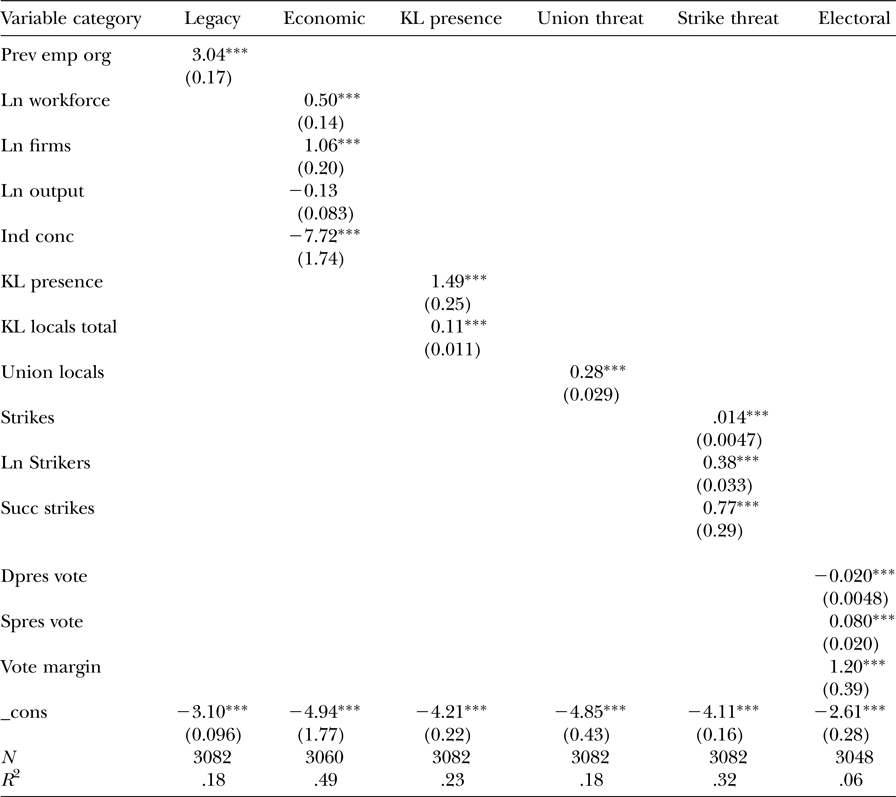
I now present estimations where we separately consider the different categories of independent variables based on the theoretical propositions discussed earlier, before turning to complete multivariate estimations. I estimate simple logistic regression models where the outcome is whether a county had an association declare for the open shop.Footnote 76 This allows us to assess within each family of hypotheses whether some variables are precisely estimated. Table 1 presents the results. Each column regresses the outcome on a separate category of covariates. Overall, many of the theoretical propositions independently are verified, with a few interesting exceptions. Column 1 considers just the impact of the previous presence of an employer association (based on the available data from Bonnett). The precisely estimated coefficient indicates that not considering other covariates, lagged associational presence is correlated with OSA presence.
Explaining OSA Emergence by Separate Categories of Hypotheses

Notes. Standard errors are in parentheses. * p < 0.10, ** p < 0.05, *** p < 0.01.
Column 2 considers the class of variables that should affect structural incentives for collective action, including the total population, amount of manufacturing output, number of firms, and occupational fractionalization. This column indicates that, unsurprisingly, firms with a larger working population were more likely to have had an employer association. However, interestingly, the number of firms is not negatively correlated with formation of an association, and industrial concentration is negatively correlated with associational formation. One reason why this could be the case is that industrial concentration is negatively correlated with manufacturing output; it is in richer, more manufacturing-oriented counties where OSAs were likely to emerge, and in such counties, there were simply more industries (reducing the overall amount of employment concentration). Another possibility is that the concentration variable cannot capture decisions of individual large firms to bear costs of forming associations; measurement error could also be an issue.Footnote 77
Columns 3 and 4 of Table 1 consider the class of variables related to the threat posed by organized labor, as measured by capacity of union organization. Column 3 considers just the legacy of worker organization, principally through previous presence of KL locals, and column 4 considers the role of more proximate labor threats, as indicated by the number different union locals in the period before the interwar period. In both categories of variables, we observe both the legacy of union organization as well more proximate success as being positively correlated with the probability of an employer organization counter-response. The marginal effect of a union local from a more proximate time period after 1890 (a non-KL union) is more than twice that of an additional KL local.
Column 5 of Table 1 considers the credibility of threats posed by workers with variables related to previous strikes. All such strike variables are positively correlated with the presence of an association, with the highest magnitude being that of the fraction of strikes that were successful on the part of unions. Column 6 considers the specific role of political opportunity variables. The simple relationship does not reveal much support for the theorized role of electoral support for the Democratic Party, but Socialist presidential vote share as well as closeness of the election both are positively correlated with OSA presence. This indicates initial support for multiple theories by which political opportunity and concerns about the electorate preferences might matter. Overall, the evidence from Table 1 indicates that each cluster of variables is correlated with OSA presence, though the category of structural variables that should affect collective action and previous labor conflict (indicating credibility of previous threats against firms) both have the greatest explanatory weight.
Multivariate Results
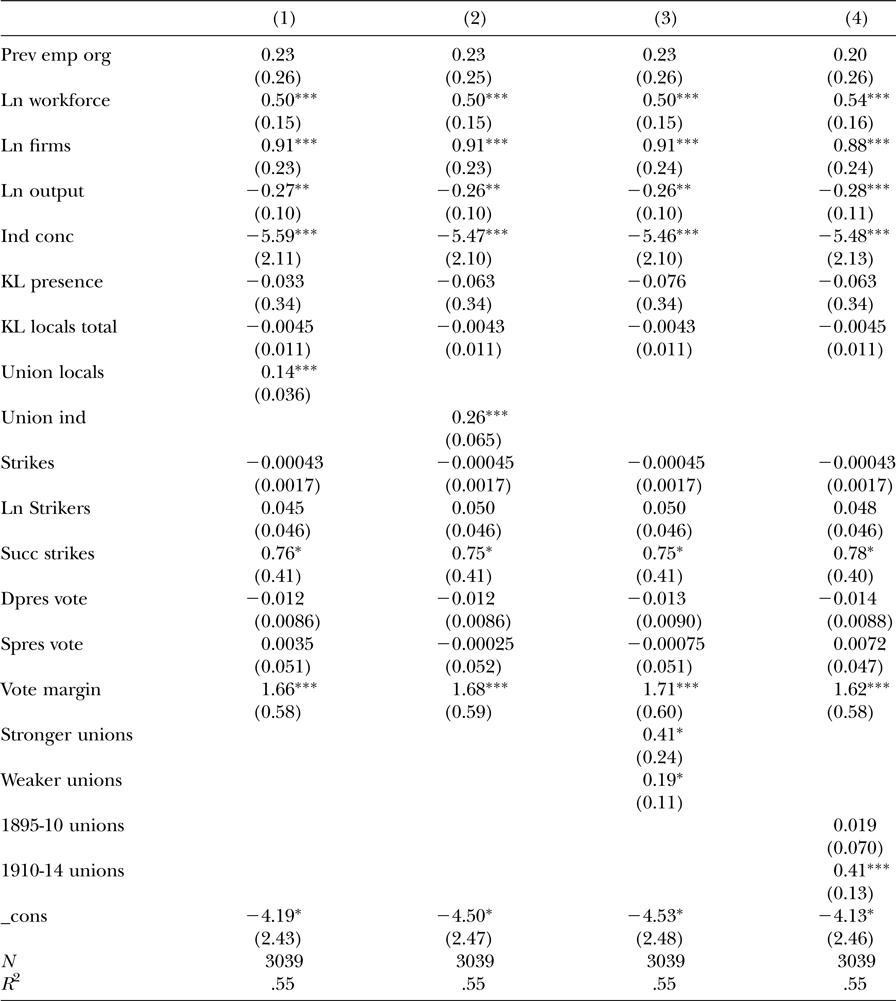
I now consider these competing families of variables in tandem, by estimating a multivariate model that includes all the sets of variables displayed in Table 1. Column 1 of Table 2 presents these results. The column shows that when we consider the different families variables in a single model, many coefficients become less precisely estimated, and only several structural and union-oriented variables remain statistically and substantively significant at conventional levels. For example, lagged employer organizational presence no longer matters; nor does the previous presence of labor organization as indicated by KL presence.
Explaining Emergence of OSAs

Notes. Standard errors are in parentheses. * p < 0.10, ** p < 0.05, *** p < 0.01.
The structural variables that should facilitate collective action remain significant, although as with Table 1, the number of firms is actually positive (perhaps because that is likely to be correlated with economic activity); contra the straightforward collective action hypothesis, industrial concentration remains negatively correlated with the likelihood of collective action. The indicator of number of workers remains positively correlated with employer organization presence, showing that one measure of economic productivity is linked with incentives to organize; overall, we do not observe convincing evidence for the standard structural factors that would facilitate collective action, other than one proxy for county-level industrial activity.
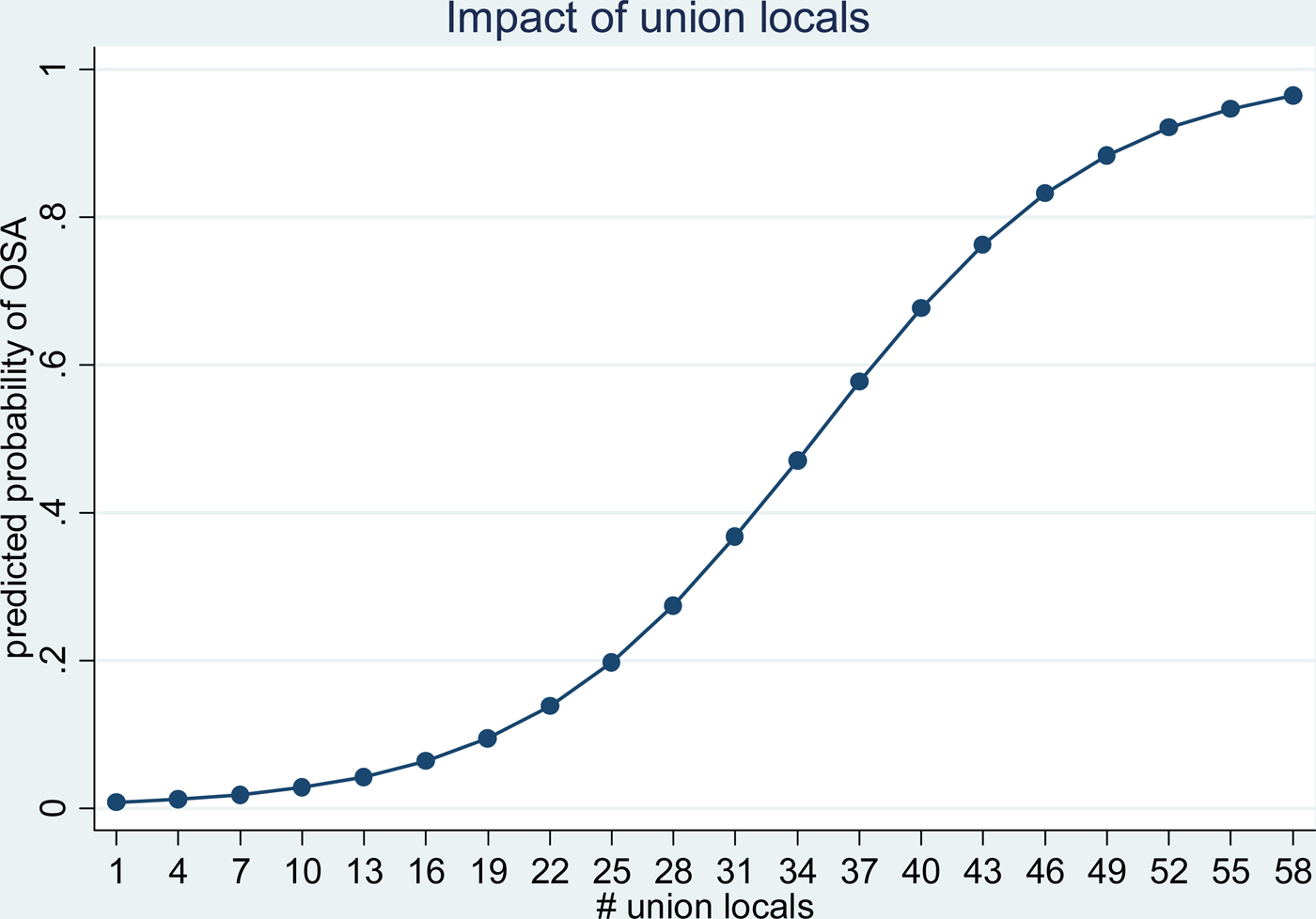
Turning to the other variables that remain robust in the multivariate estimation to alternative explanations, column 1 also shows the enduring relevance of the overall threat posed by unions, as the number of locals as an indicator of overall organizing capacity remains relevant. This indicates the value in separating the competing reasons why the threat from organized labor would induce collective action. The impact of additional union local variables (Union loc) remains positive, and the estimated marginal impact of an additional union local across all industries is on average 1 percentage point; however, at certain thresholds the impact of an additional local is considerably greater, as seen in Figure 1.Footnote 78 The figure shows the predicted probability of OSA presence, based on the model in column 1, holding all other variables at their means, and shows a steadily increasing impact of additional union locals. A county with no union presence had almost no chance of having an OSA, whereas counties with high numbers of locals were nearly guaranteed to have an OSA. Column 2 shows a larger marginal impact of an additional union local in a new industry (Union ind); although there is, of course, a smaller range of data (as there were fewer industries than locals by definition), moving from five to fifteen union industries (holding all other variables at their means) substantially increases the probability of OSA adoption from about 0.02 to .20. The robustness and magnitude of these effects are notable, given the battery of other explanations at the county level considered.
Marginal Impact of Union Locals on OSA Adoption.

Beyond the impact of union presence, however, columns 1 and 2 show that the most relevant conflict-oriented variable—which is an indicator for the credibility of unions to attain their demands—is previous success of industrial conflicts. The more successful unions have been in previous decades, the higher likelihood of employer coordination as a response.Footnote 79 The other indicators of conflicts—such as the mere presence of a conflict, or number of strikes and strikers—matter little, once other indicators of the locality are controlled for.
Finally, turning to variables capturing political opportunity and the preferences of the electorate, we observe that the Democratic presidential vote share variable has a negative sign, but is now imprecisely estimated (as is the Socialist vote share variable); the electoral closeness variable remains positively signed and precisely estimated, indicating that elections where the margins are closer are correlated with higher likelihood of OSA adoption. This is suggestive evidence, corroborating some discussion of the Republican platform above, that firm associations may react to the political opportunities provided, and the possibility of Democratic electoral preferences being attained can contribute to incentives to coordinate. Overall, the evidence points to the importance of union threat, but also previous strike success. If we compare the marginal effects of each variable, however, the number of post-1890 union locals still matters most in explaining OSA emergence.
Whereas columns 1 and 2 establish the importance of the amount of threats posed by union locals and industries, columns 3 and 4 present more nuanced considerations of the impact of the union threat variable. These latter two columns present the same logistic estimations as before, but consider different components of the union local variable. Column 3 tests the credibility of threat hypothesis by examining the separate impact of unions representing industries with greater voting weight in the AFL, versus unions that represent industries with much lower voting weight within the AFL. This tests the hypothesis that unions in industries with more capacity to inflict costs should be more likely to affect OSA formation. Column 3 shows that union industries with higher voting weight are highly correlated with OSA option, whereas the coefficient indicating the presence of union locals with lower voting weight has a much smaller magnitude. Moving from zero to five additional industries with greater voting weight increases the probability of OSA adoption from nearly zero to above .20. This result supports the intuition that unions with greater weight could have a greater ability to win strikes or wrest concessions from firms.Footnote 80 An alternative but not mutually exclusive interpretation is that such industries are a more reliable indicator of overall organizational capacity of workers, and that is why firms are more likely to respond.Footnote 81
Column 4 considers an alternative decomposition of the union threat variable, which is the separate impact of the sum of union locals from 1890 to 1910 versus the sum of union locals between 1910 and 1914. The column shows that the latter matters more than the former, as the latter coefficient is statistically significant at conventional levels and substantively large, whereas it is neither for the previous period. The estimated marginal effect for the more recent period of moving from the minimum to maximum number of locals is twice that of the effect of an additional union local in the previous period, and the latter coefficient is also imprecisely estimated and near zero. Moving from zero to just five union locals in the more recent time period increases the probability of OSA adoption from near zero to 0.1.Footnote 82 Column 4 indicates that differences among counties in the amount of union threat in the five years before WWI are more correlated with risk of OSA adoption than such differences before 1910.
Table 2 overall indicates that once that once the temporal aspect of union organization is disaggregated, the marginal impact of union threats is more driven by recent unions and unions in industries with slightly greater voting weight in the AFL. This interpretation also comports with the evidence from column 1, that once more recent union organization is accounted for, the “legacy” of previous organization in the form of KL locals dissipates. However, these different disaggregated effects are relatively smaller compared to the overall impact of having more union locals, regardless of time period and industry. Further, as Table 2 also shows, although there is still a lingering impact of the success of previous strikes, the magnitude of this variable is much smaller. The overall results indicate that more recent union threats, as opposed to legacies of threats, are more correlated with employer association formation.Footnote 83
Regarding the variables that function as proxies for political opportunity, the results from Table 2 also indicate that electoral concerns at the county level are not robust controlling for other variables; across all models, the absolute vote share variables are not precisely estimated. One possible reason for this null outcome is that as noted above, the Democratic Party, while perceived to be pro-labor, was far less extreme in its demands than counterpart Socialist Parties in other states. However, the coefficient on the closeness of the election remains precisely estimated, although its substantive impact is quite small. Overall, in terms of relative explanatory weight, firms were more responsive to direct threats posed by recent union organization than other competing political opportunity variables.Footnote 84
The results indicate that union presence in the late nineteenth and early twentieth century is strongly correlated with firms’ adoption of collective repressive strategies during the immediate interwar period, and more recent union organizations (as opposed to legacies of organizations), as well as labor organizations that have slightly stronger ties to the central AFL office, were more likely to induce the formation of repressive employer associations. Previous labor conflict successes and electoral closeness also are relevant, but less so. The results help isolate individual factors that explain why repressive employer coordination was adopted in some counties and not in others, and confirm the theory and previous historical evidence that repressive firm strategies were primarily designed as defensive organizations against union penetration of plants; importantly such factors are robust to many of the alternative families of hypotheses.Footnote 85
CONCLUSIONS AND IMPLICATIONS
Despite the few detailed histories of influential American national and local-level employer associations, and the recent attention in comparative politics to U.S. evidence to support theories of the development of certain systems of employer coordination, there is a surprising dearth of systematic analysis of such organizations at the local level. Such analysis of the open-shop movement is particularly useful because as these histories discuss, these organizations were an important instrument in inhibiting U.S. labor mobilization throughout the first half of the twentieth century. If we want to understand the origins of U.S. coordinated employer repression, then it is critical to examine it at the local level, because that is where the relevant activity took place. Only then can we have confirmation of some theories that explain their existence and, with that, more precise testing of competing families of hypotheses that explain firms’ collective action. With respect to the comparative political economy literature on the development of industrial institutions, many of these studies do not address the importance of repressive employer organizations; the historiographies of the select associations discussed focus less on testing theories of their emergence. This article addresses these issues with new data on a key example of adoption of repressive institutions at the local level during a crucial time period—the post-WWI dismantling of wartime wage institutions. I demonstrate that such repressive coordination, in the form of the adoption of OSAs, can be best explained as a response to the threats posed by recent unions, even accounting for a host of competing theories. This hypothesis is corroborated by unique data on local-level participation in repressive employer organizations from the U.S. interwar period.
The findings indicate that measures of proximate union threat and the credibility of previous successes in conflicts are more important for explaining repressive employer coordination than are standard economic or election-oriented covariates. Moreover, there is strong evidence that more recent union threats—in the years before WWI—matter for explaining repressive employer associations; there is suggestive evidence that more recent union locals that posed a greater threat were also more likely to induce repressive employer associations. The threat is not just about the presence of a particular union industry, as previous historiographies richly show, but also about the additional threat that union organizing can pose to firms.Footnote 86 As discussed earlier, the concrete focus on OSA adoption likely underestimates the true degree of employer associations, given that there may be employer associations that existed that were not contacted in the national associations’ survey. Further, there were very likely to be repressive employer associations that did not engage with the open-shop movement or that used other instruments of repression.
The fact that such coordination mattered in response to workers adds to our existing research that has effectively documented how such coordination was detrimental to unions. This study presents the first survey and analysis of the formation of repressive local-level firm coordination. While other historical research claims that local OSAs arose in response to conflicts involving unions or workers, this had not been systematically shown, nor had the threat or conflict posed by workers been disaggregated as precisely here. The findings here demonstrate that even employer associations during the interwar period were quite responsive to the threats posed by organized labor at the local level, and that more recently formed union locals posed great risks to firms.
This study is also a contribution to the broader literature on union mobilization in the interwar period, and the analysis critically shows how employer repression is not just a cause of union mobilization but a consequence of it as well. The empirical approach here allows us to point to a strong connection between union mobilization and subsequent organized employer coordination as a response, and identifies the consequences of a key historical point where the failure of national-level bargaining and corresponding mass labor unrest in 1919 facilitated local-level responses on the part of employers to coordinate in response to workers. This key moment and data shed new light on the diffusion of the open-shop movement, as well as the way that union and employer conflict fit into American political development in the interwar period, and present new evidence on the local origins of interest group agendas. One of the lessons from the evidence is how firms differentially responded to union threats that had mobilized before the war, taking into account the limitations of purely demographic or economic factors in explaining local firm response.
The theory and results here raise additional research questions relevant for the fields of American political development and comparative political economy. On the empirical front, this article has focused on the cross-sectional variation of repressive employer coordination. Although this study brings more attention to the potential role of legacy organizations than before and uses the early interwar period as a testing ground, a knotty causal empirical question involves the precise relationship between threats posed by unions and repressive associations. As Voss has shown for New Jersey for an earlier time period, local-level employer associations in New Jersey helped undermine the ultimate success of labor unions there.Footnote 87 By contrast, in many of the specific historiographies of local and regional-level associations, we observe the collective mobilizations of firms in a sector or area in response to the worker organizations and demands. The empirical design here has tried to use the lagged historical aggregate sums of unions to explain interwar adoption of open-shop movements (going back to the late 1800s), but it is possible that in some cases, those measures of union threats from the late nineteenth century are affected by even earlier attempts at employer organizations. However, the results presented are broadly consistent with some of the theories suggested by the specific historical accounts.
The measures of the threat posed to firms by workers are intuitively calculated here, but a first extension of the findings would be to gather more precise, systematic data on the differing demands of workers in different union locals. Such data might also shed light on the limited robustness of standard structural factors at the locality level; what might matter more are precise indices of concentration and other variables that affect incentives for collective action within specific industries inside particular localities.
A second empirical extension would be to obtain data that would allow us to disentangle different mechanisms that explain why more union local or industrial presence leads to employer responses in the form of OSAs, beyond the new set of conflict indicators presented here. One intuitive mechanism for the threat theory is that the greater presence of locals or industries is an indicator to firms that workers are more likely to make demands on firms. Another non-mutually exclusive mechanism is that a greater presence of any local or industry increases the probability of that particular local or industry to make demands or engage in industrial conflict. More specific data, which would be difficult to obtain at the locality level, could code individual reasons for formations of OSAs to distinguish between these mechanisms.
A third empirical extension of the findings here would be to examine the ways in which the different repressive institutions and strategies—state governments, individual firms, employer associations, and the courts—complemented or substituted for one another. Many of these OSAs had preferences for antilabor political leadership or supported the actions of the judiciary. Firms also could choose to coordinate as opposed to pursue repression individually. It could be that when the threat posed by workers reaches a certain threshold, it becomes easier to pool resources to form associations as opposed to doing so individually. The relationship among individual firms, separate associations, and political institutions at the local level remains underexplored. A natural research agenda is to look at how localities varied in types of cooperation between these associations and public institutions.
On balance, however, the findings here should stimulate additional research into variation in the local-level dynamics of repressive employer coordination in a more systematic fashion. One interpretation of the findings here is that the success of the initial repressive coordination at the local level helps explain why the United States never developed long-lasting cooperative institutions that Wilson envisioned at his conference. The precise causal story though that links early collective repression to contemporary outcomes is an area of fruitful research.
Appendix 1. DESCRIPTIVE STATISTICS