In early 2014, an outbreak of Ebola virus was identified in several West African countries, including Sierra Leone, Liberia, and Guinea. 1 The virus has a case fatality rate of approximately 50% to 70%, which caused governments around the world to focus on containing the Ebola outbreak and limiting disease transmission. 2 Within the United States, this concern was heightened by 4 Ebola cases diagnosed in fall 2014.
As the US response to Ebola materialized, law played a critical role.Reference Hodge, Penn and Ransom 3 Federal laws, including the Pandemic and All-Hazards Preparedness Act, provided an infrastructure for federal, state, and local responses. The US Centers for Disease Control and Prevention (CDC) issued nonbinding guidance for movement restrictions and monitoring for those potentially exposed to Ebola. 4 At the state level, governors took actions, such as declaring a public health emergency, to ensure that state officials had isolation or quarantine authority relative to Ebola. 5 Local health departments developed policies and protocols to facilitate Ebola-related efforts.Reference Bevington, Kan and Schemm 6
Legal responses to Ebola among the 50 US state governments varied, with some taking no specific action and some creating policies through their legislative, executive, or judicial branches. 7 These state responses offer insight into the types of legal responses that arise during an outbreak of a highly lethal infectious disease and may assist in preparing for subsequent infectious disease emergencies. States’ legislative responses to Ebola are especially noteworthy, as enacted laws represent legally binding changes to a state’s statutory code, and resolutions provide insight into issues legislators sought to highlight.
This article presents the systematic identification and analysis of state-level legislative responses to Ebola from April 2014 through June 2015. We examine bills and resolutions, including those that were introduced but failed. Additionally, we consider the objectives of each bill or resolution and lessons learned for future legal responses to infectious disease outbreaks.
Methods
We used standard public health law research methods to identify state-level bills or resolutions that referred to the Ebola outbreak of 2014-2015.Reference Wagenaar and Burris 8 These methods involved the systematic identification and analysis of primary legal sources (eg, bills) by use of standardized search terms and processes. The LexisNexis State Capital legal database (LexisNexis, Colorado Springs, CO) was searched to identify bills and resolutions in all 50 US states and Washington, DC, from April 2014 through June 2015. We selected this date range because the CDC sent its first Ebola response team to West Africa on March 31, 2014. The CDC removed its active monitoring requirements for travelers to the US from Liberia on June 17, 2015.
We developed standardized search terms, which were initially created by using the study team’s a priori knowledge and consultations with emergency preparedness and public health law experts. Through an iterative process that included review of preliminary findings, search terms were finalized. The final search terms, which used Boolean terms, were Ebola! OR hemorr! OR “world health organization” OR “Africa” OR “health emergency” OR “pressure /s room” OR filter OR “infectious disease” OR preparedness OR incubat! OR expos! OR quarantine OR isolation OR travel OR “personal protective equipment” OR PPE. Each identified bill or resolution was screened by a study team member to determine whether it met our inclusion criterion (ie, text explicitly containing the term “Ebola” or “viral hemorrhagic fever”). The full text of each relevant bill or resolution was downloaded and reviewed. Duplicates were removed. For companion bills or multiple versions of the same bill, we retained the version for which the most recent legislative action was taken. Bills summarizing gubernatorial executive orders were excluded, because executive orders derive from a different policy mechanism than legislation. When it was unclear whether a bill or resolution met our inclusion criterion, two study team members reviewed it and reached a decision by consensus. To validate identified bills and resolutions, we compared them with information available on state legislatures’ websites. Through this process, we located one additional bill.
We created an electronic data abstraction form in Qualtrics (Qualtrics, Provo, UT). For each bill or resolution, we abstracted information including the state, bill/resolution number, date of bill/resolution introduction, bill/resolution sponsor’s political party, date of last legislative action, and bill/resolution’s primary goal. The data abstraction form also contained an open text section for additional information.
Whenever possible, information was summarized by using descriptive statistics. Abstracted information from the open text section was analyzed to identify patterns and themes within the previously determined categories in our data abstraction form. To do this, the forms were annotated, compared, and reviewed by study team members. Summary tables were created in Microsoft Word. IRB protocol approval was not needed because this research did not involve human participants.
Results
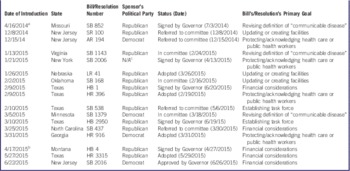
Our search processes returned 273 bills and resolutions (Supplemental Table 1 in the online data supplement); 17 met our inclusion criterion. These 17 bills and resolutions were introduced in 11 states from April 2014 through June 2015 (Table 1). Six bills were enacted and 4 resolutions were adopted. The goals of the bills and resolutions are described below.
Bills and Resolutions Mentioning Ebola or Viral Hemorrhagic Fever by State and Date

a Bill was originally introduced on February 10, 2014, but was revised to contain language relevant to Ebola on April 16, 2014.
b Bill was originally introduced on January 1, 2015, but was revised to contain language relevant to Ebola on April 17, 2015.
c In New York State, budget bills do not have a sponsor.
Protecting or Acknowledging Public Health and Health Care Workers
New York legislators enacted a law that created labor protections for health care providers who volunteer to travel overseas for Ebola-related work (New York SB 2006 [2015]). The law states that health care providers may request a leave of absence—without adverse consequences—if the request is tied to voluntary Ebola work overseas. Employers must permit the leave unless it would cause them undue hardship. The Georgia and Texas legislatures adopted resolutions commending their state health department commissioners for coordinating Ebola responses in the United States (Georgia HR 916 [2015]; Texas HR 396 [2015]). New Jersey legislators introduced, but failed to adopt, a resolution praising health care providers who traveled to West Africa to treat Ebola patients (New Jersey AR 194 [2015]).
Revising the Definition of “Communicable Disease”
Missouri legislators enacted a law that revised the definition of “communicable disease” to include “viral hemorrhagic fevers” such as Ebola in the state’s public safety law (Missouri SB 852 [2014]). Bills proposing revised definitions were also introduced in Minnesota and Virginia, but neither was enacted. The Minnesota bill sought to revise the definition of “communicable disease” in its isolation and quarantine law to include viral hemorrhagic fevers (Minnesota SB 1379 [2015]). The Virginia bill would have allowed the governor to quarantine those entering the state from a country experiencing a communicable disease threat, such as Ebola, if a CDC travel warning were in place (Virginia SB 1143 [2015]).
Financial Considerations
For fiscal year 2015, Montana’s successful appropriations bill allocated funds to activities for public health emergency preparedness for Ebola, and to epidemiology and laboratory capacity for infectious diseases, including Ebola (Montana HB 4 [2015]). New Jersey legislators successfully allocated funds to Ebola hospital preparedness and public health emergency preparedness for Ebola (New Jersey SB 2016 [2015]). Finally, Texas legislators successfully allocated funds to the prevention and treatment of infectious diseases, including Ebola (Texas HB 1 [2015]). The Texas legislature adopted a resolution altering formatting requirements for this appropriations bill (Texas HR 3315 [2015]). In North Carolina, a bill was introduced to appropriate funds for the Carolinas Poison Center, which houses an Ebola help line (North Carolina SB 437 [2015]). This bill stalled in committee.
Establishing a Task Force
Texas legislators introduced 2 similar bills to establish a task force charged with developing assessments and recommendations for the state’s responses to infectious disease outbreaks, with explicit consideration of Ebola. The first bill stalled in committee (Texas SB 538 [2015]), but the second bill was signed into law (Texas HB 2950 [2015]). That law indicates that the task force was created, in part, due to the September 2014 diagnosis of an Ebola case in Dallas.
Updating or Creating Facilities
Nebraska’s legislature adopted a resolution to encourage the establishment of an in-state training center for highly infectious diseases like Ebola (Nebraska LR 41 [2015]). New Jersey legislators introduced, but failed to adopt, a resolution that concerned using former military facilities for Ebola-related quarantine and isolation (New Jersey SR 100 [2015]). Oklahoma legislators introduced a bill that would have required all in-state hospitals to provide written verification that their negative pressure rooms were equipped with a specific type of air filter used when treating Ebola patients (Oklahoma SB 168 [2015]). That bill stalled in committee.
Discussion and Implications for Public Health Practice
From April 2014 through June 2015, 17 bills or resolutions that explicitly referred to Ebola or viral hemorrhagic fever were introduced in 11 states. While 6 bills became law and 4 resolutions were adopted, much can also be learned from the bills and resolutions that were introduced but did not move forward. They reveal issues on legislators’ agendas relative to Ebola and offer insight into concerns that may arise among policy-makers during future infectious disease outbreaks.
Protecting or Acknowledging Public Health and Health Care Workers
New York’s legislature passed a law adding protections for health care providers who volunteered to assist in Ebola-related work in West Africa (New York SB 2006 [2015]). This type of law is in line with arguments put forth by bioethicists regarding employer support of Ebola work by employees who are health care providers.Reference Mello, Merritt and Halpern 9 By codifying the leave of absence provisions, New York created a foundation for health care provider protections during future infectious disease outbreaks.
In contrast, New Jersey’s legislature failed to adopt a resolution about the importance of appreciating health care workers who treated Ebola patients in West Africa (New Jersey AR 194 [2015]). Although it failed, this resolution highlights a contentious issue that arose when a medical aid worker returned to New York—a state with which New Jersey shares a border—and was diagnosed with Ebola after traveling throughout New York City. The public alternated between praising such aid workers and fearing the spread of Ebola in the United States.Reference Brown 10 Future outbreaks of uncommon, and highly lethal, infectious diseases are likely to elicit similarly divisive reactions, suggesting the importance of incorporating risk communication into planning and response efforts.
Revising the Definition of “Communicable Disease”
One state expanded the definition of “communicable disease” to explicitly include viral hemorrhagic fevers like Ebola (Missouri SB 852 [2014]) and 2 other states considered similar bills (Minnesota SB 1379 [2015]; Virginia SB 1143 [2015]). This raises 2 issues: (1) some states may want to explicitly list viral hemorrhagic fevers in their laws to ensure that preparedness and planning activities account for emergencies like the recent Ebola outbreak; and (2) other states may have laws that are narrowly written, meaning they must be revised to guarantee that they cover outbreaks of unusual or rarely observed diseases like Ebola. Ideally, state emergency preparedness laws should include expansive definitions of phrases like “communicable disease,” thus mitigating the need to revise these laws for new infectious disease threats.
Implementation Considerations
The final 3 categories of bills and resolutions that we identified—those touching on financial considerations, establishing a task force, and updating or creating facilities—all raise important implementation considerations. In contrast to the bills that changed states’ laws regarding the protection of health care workers or the definition of a “communicable disease,” the impact of bills and resolutions involving appropriations, task forces, and hypothetical facilities heavily depends on their implementation. In other words, appropriated funds must be spent, a task force must make recommendations, and a facility must be constructed before their utility can be assessed. To truly understand the public health practice implications of these types of bills and resolutions, they must be revisited after their respective provisions have been implemented.
Limitations
This study had several limitations. First, despite our comprehensive search methodology, relevant bills may have been excluded if they were not captured by our search terms. For example, funds allocated in appropriations bills may ultimately support Ebola preparedness efforts even if the bills themselves do not indicate this. In addition, we excluded bills that mentioned isolation or quarantine but did not include the terms “Ebola” or “viral hemorrhagic fever.” Second, our search concluded in June 2015; some states may have subsequently introduced bills related to their Ebola response. Finally, our data did not allow us to definitively determine why some bills became law and others did not. This is an important and promising area for future research given the likely need for legislative responses to future infectious disease threats.
Conclusion
With the emergence of several Ebola cases in the United States in 2014, state governments engaged in various policy approaches. Approximately 20% of the states introduced bills or resolutions that explicitly mentioned Ebola or viral hemorrhagic fever. The successful and failed bills and resolutions provide insight into the range of ways that legislators sought to address Ebola. Given the likelihood of future outbreaks involving Ebola or similar infectious diseases, policy-makers and emergency planners would benefit from incorporating lessons learned from states’ Ebola policy responses into their ongoing preparedness activities.
Supplementary Material
To view supplementary material for this article, please visit http://dx.doi.org/10.1017/dmp.2016.96