INTRODUCTION
There are three entrances by which the fish fauna of the Mediterranean is enriched by some new taxa: the Suez Canal for species from the Red Sea; the Strait of Gibraltar for Atlantic species; and the Bosporus–Dardanelles for Pontic fish (Dulčić & Pallaoro, Reference Dulčić and Pallaoro2002).
The Diodontidae family is widely distributed in tropical and temperate marine areas of the Atlantic Ocean and Indo-Pacific region (Leis, Reference Leis2006). It is represented by three exotic species in the Mediterranean: Diodon hystrix (Linnaeus, 1758), first mentioned in 1963 (Torchio, Reference Torchio1963); Cyclichthys spilostylus (Leis & Randall, 1982) quoted in 1993 (Golani, Reference Golani1993); and Chilomycterus reticulatus (Linnaeus, 1758) cited in 2009 (Follesa et al., Reference Follesa, Mulas, Porcu and Cau2009). Whereas Diodon hystrix and Chilomycterus reticulatus came through the Strait of Gibraltar, Cyclichthys spilostylus came through the Suez Canal (Golani et al., Reference Golani, Orsi Relini, Massutí, Quignard and Briand2002). Chilomycterus spinosus mauretanicus (Le Danois, 1954) can be added to the list of exotic species of this family in the Mediterranean Basin.
MATERIALS AND METHODS
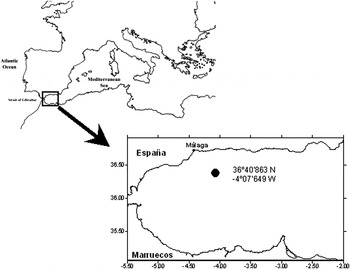
The specimen was captured by a trawl boat at 3 nautical miles offshore (latitude: 36°40′863N and longitude: 4°07′649 W; WGS 84 Datum) and at 68 m depth (Figure 1) on 4 December 2008.
Location of the first record of Chilomycterus spinosus mauretanicus in the Mediterranean Sea (Alboran Sea).

RESULTS
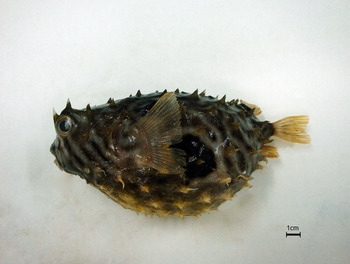
Description of the captured specimen (Figure 2)
It presents a rounded body covered with thorns with three roots and soft extensions on the ventral side. The upper jaw forms a single plaque with just one tooth. It is dark brown on the dorsal part, with a symmetrical speckle. On the ventral part the speckled brown becomes more intense clarifying to an orange hue. On the sides, it presents lines with a tendency towards the ventral part of the body, where they disappear. It features 5 ocelli: one at the base of the dorsal fin and 2 eyespots behind each pectoral fin (one dorsal and one in lateral position). It has 5 fins: one dorsal, two pectoral, another anal and the one truncated caudal. The ventral fin is absent. The pectoral fins present all the bifurcated rays, which does not occur in the caudal fin. All these features correspond to Chilomycterus spinosus mauritanicus described by Leis (Reference Leis, Fischer, Bianchi and Scott1981).
Photograph of Chilomycterus spinosus mauretanicus, specimen captured by a trawl boat at 68 m depth

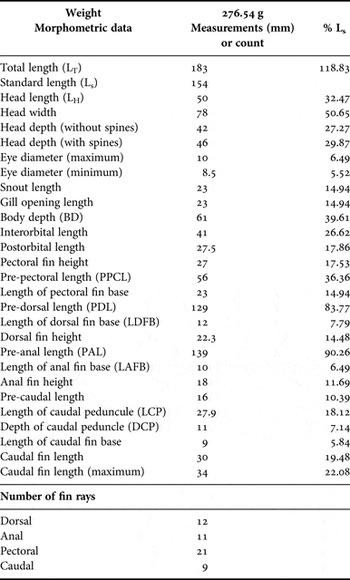
The morphometric and meristic specimen data were measured (Table 1), before freezing it for conservation.
Morphometric and meristic data from the captured specimen.

DISCUSSION
The number of exotic species that reach the Mediterranean increases year after year. 986 exotic species have been currently identified in the Mediterranean Sea including all the phyla, of which 126 are fish (Zenetos et al., Reference Zenetos, Gofas, Morri, Rosso, Violanti, García Raso, Çinar, Almogi-Labin, Ates, Azzurro, Ballesteros, Bianchi, Bilecenoglu, Gambi, Giandrande, Gravili, Hyams-Kaphzan, Karachle, Katsanevakis, Lipej, Mastrotorato, Mineur, Panucci-Papadopoulou, Ramos Esplá, Salas, San Martín, Sfriso, Streftaris and Verlaque2012).
Chilomycterus spinosus mauretanicus is a demersal tropical species. Its natural distribution is in the eastern region of the Atlantic, from Angola to the Canary Islands and perhaps Portugal (Leis, Reference Leis2006). It is located at a depth of 100 m on sand and mud, feeding on sessile benthic invertebrates (Halpern & Floeter, Reference Halpern and Floeter2008). They reach a maximum length of 25 cm (Leis, Reference Leis, Fischer, Bianchi and Scott1981; Halpern & Floeter, Reference Halpern and Floeter2008).
The number of records of warm water species outside their normal range has grown a lot in the Mediterranean in recent years possibly due to the warming of the water (Francour et al., Reference Francour, Boudouresque, Harmelin, Harmelin-Vivien and Quignard1994). According to Ben Rais Lasram & Mouillot (Reference Ben Rais Lasram and Mouillot2009), this warming can lead to tropical Atlantic species to change their distribution area northward along the African coast as far as the latitude of the Strait of Gibraltar.
The abovementioned data, combined with the natural distribution of Chilomycterus mauretanicus spinosus and the fact that it was captured alive, makes us think that the gateway to the Mediterranean was in fact the Strait of Gibraltar, either by natural means aided by the continued inflow of water from the Atlantic or via ballast water coming as egg or larvae (Orsi Relini, Reference Orsi Relini2002; Follesa et al., Reference Follesa, Mulas, Porcu and Cau2009).
ACKNOWLEDGEMENTS
Special thanks to the crew of the trawler ‘Paco Basilio’ for their cooperation, information and delivery of the specimen and to Domingo Lloris and Luis Gil de Sola for their continuous support. This work was supported by the Consejería de Agricultura y Pesca, Junta de Andalucía.